Make the
Shift Happen
with
T R T W
Lesson Plan:
Make the Shift with TRTW!
Purpose: The Academic need
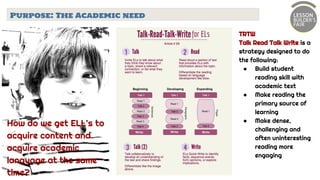
TRTW
Talk Read Talk Write is a
strategy designed to do
the following:
● Build student
reading skill with
academic text
● Make reading the
primary source of
learning
● Make dense,
challenging and
often uninteresting
reading more
engaging
How do we get ELL’s to
acquire content and
acquire academic
language at the same
time?
Anticipatory Set: Getting the Learners Prepped
Talk #1 (Anticipatory Set/Engage)
{1-5 min.}
* bellringer
* disagree/agree form
* big question
* would you rather questions
* visual (multimedia) - Classhook,
Google Arts & Culture
* quote/excerpt
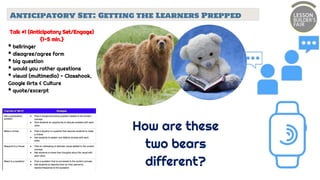
How are these
two bears
different?
Input: Students need information and facts
Read (Instructional
Input/Modeling/Explore) {1-15 min.}
* mini lesson
* lecture
* shared/independent reading (When
working with ELL & Special Education
students, you may want to do the
reading as a class.)
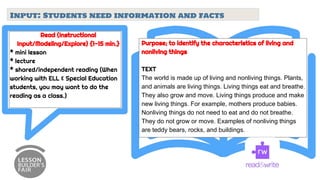
Purpose; to identify the characteristics of living and
nonliving things
TEXT
The world is made up of living and nonliving things. Plants,
and animals are living things. Living things eat and breathe.
They also grow and move. Living things produce and make
new living things. For example, mothers produce babies.
Nonliving things do not need to eat and do not breathe.
They do not grow or move. Examples of nonliving things
are teddy bears, rocks, and buildings.
Guided Practice: Teflon/no-stick work for the kids
Talk #2 (Guided
Practice/Explain/Elaborate)
{1-10 min.}
* class discussion
* open ended questions
* group
work/discussion/meet & greet
* Socratic seminar/Fish Bowl
* role play
* interactive game
* sentence stems
Talk #2
TEXT
1. How are living things and nonliving things
different?
2. sort these pictures into living and non-living
things. (Teacher provides 4 to 6 pictures to each
talking group.)
Independent Practice: Time to work/create
Write (Independent Practice/Evaluate)
{1-15 min.}
* assessment
* written paragraph
* reflection journal
* essay/short answer/quick writes
* project (multimedia) - Adobe Spark,
sketchnote, Blabberize
* sentence stems
* exit ticket
Write
TEXT
Is a butterfly a living or nonliving thing?
Give two reasons for how you know.
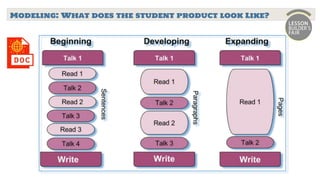
Modeling: What does the student product look Like?
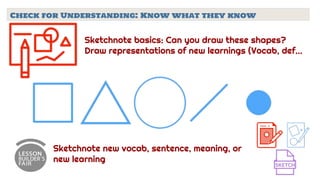
Check for Understanding: Know what they know
Sketchnote new vocab, sentence, meaning, or
new learning
Sketchnote basics: Can you draw these shapes?
Draw representations of new learnings (Vocab, def...
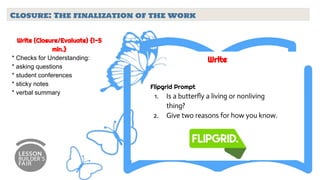
Closure: The finalization of the work
Write (Closure/Evaluate) {1-5
min.}
* Checks for Understanding:
* asking questions
* student conferences
* sticky notes
* verbal summary
Write
Flipgrid Prompt
1. Is a butterfly a living or nonliving
thing?
2. Give two reasons for how you know.
Get the Preso at
bit.ly/boldtrtw
AFTERPARTY
30 minutes unstructured follow up
and custom builds on your concept!

Make the Shift Happen with TRTW! #CUEBOLD

  • 1.
  • 3.
    Lesson Plan: Make theShift with TRTW!
  • 4.
    Purpose: The Academicneed TRTW Talk Read Talk Write is a strategy designed to do the following: ● Build student reading skill with academic text ● Make reading the primary source of learning ● Make dense, challenging and often uninteresting reading more engaging How do we get ELL’s to acquire content and acquire academic language at the same time?
  • 5.
    Anticipatory Set: Gettingthe Learners Prepped Talk #1 (Anticipatory Set/Engage) {1-5 min.} * bellringer * disagree/agree form * big question * would you rather questions * visual (multimedia) - Classhook, Google Arts & Culture * quote/excerpt How are these two bears different?
  • 6.
    Input: Students needinformation and facts Read (Instructional Input/Modeling/Explore) {1-15 min.} * mini lesson * lecture * shared/independent reading (When working with ELL & Special Education students, you may want to do the reading as a class.) Purpose; to identify the characteristics of living and nonliving things TEXT The world is made up of living and nonliving things. Plants, and animals are living things. Living things eat and breathe. They also grow and move. Living things produce and make new living things. For example, mothers produce babies. Nonliving things do not need to eat and do not breathe. They do not grow or move. Examples of nonliving things are teddy bears, rocks, and buildings.
  • 7.
    Guided Practice: Teflon/no-stickwork for the kids Talk #2 (Guided Practice/Explain/Elaborate) {1-10 min.} * class discussion * open ended questions * group work/discussion/meet & greet * Socratic seminar/Fish Bowl * role play * interactive game * sentence stems Talk #2 TEXT 1. How are living things and nonliving things different? 2. sort these pictures into living and non-living things. (Teacher provides 4 to 6 pictures to each talking group.)
  • 8.
    Independent Practice: Timeto work/create Write (Independent Practice/Evaluate) {1-15 min.} * assessment * written paragraph * reflection journal * essay/short answer/quick writes * project (multimedia) - Adobe Spark, sketchnote, Blabberize * sentence stems * exit ticket Write TEXT Is a butterfly a living or nonliving thing? Give two reasons for how you know.
  • 9.
    Modeling: What doesthe student product look Like?
  • 10.
    Check for Understanding:Know what they know Sketchnote new vocab, sentence, meaning, or new learning Sketchnote basics: Can you draw these shapes? Draw representations of new learnings (Vocab, def...
  • 11.
    Closure: The finalizationof the work Write (Closure/Evaluate) {1-5 min.} * Checks for Understanding: * asking questions * student conferences * sticky notes * verbal summary Write Flipgrid Prompt 1. Is a butterfly a living or nonliving thing? 2. Give two reasons for how you know.
  • 12.
    Get the Presoat bit.ly/boldtrtw
  • 13.
    AFTERPARTY 30 minutes unstructuredfollow up and custom builds on your concept!