Martin Ricardo Cisneros @TheTechProfe
Sketchnoting
Martin Ricardo Cisneros @TheTechProfe
Get the Preso at
bit.ly/sketchmtv
What?
4
Martin Ricardo Cisneros @TheTechProfe
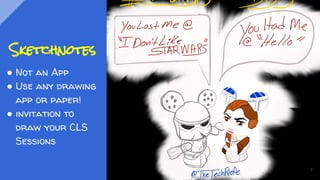
Sketchnotes
● Not an App
● Use any drawing
app or paper!
● invitation to
draw your CLS
Sessions
7
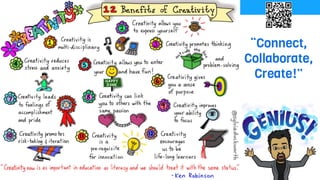
“Connect,
Collaborate,
Create!”
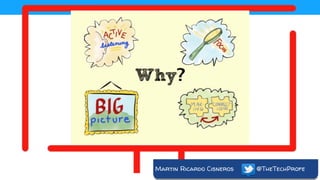
Why?
9
Martin Ricardo Cisneros @TheTechProfe
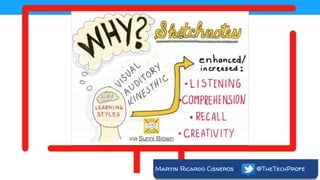
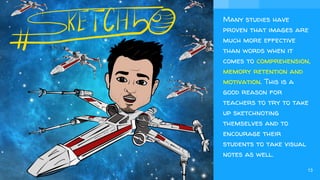
Many studies have
proven that images are
much more effective
than words when it
comes to comprehension,
memory retention and
motivation. This is a
good reason for
teachers to try to take
up sketchnoting
themselves and to
encourage their
students to take visual
notes as well.
13
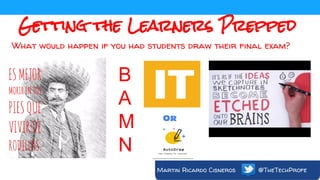
Getting the Learners Prepped
What would happen if you had students draw their final exam?
B
A
M
N
Or
Martin Ricardo Cisneros @TheTechProfe
Uses?
15
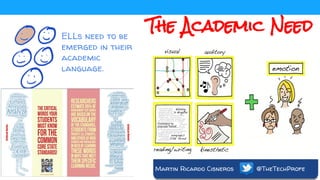
The Academic NeedELLs need to be
emerged in their
academic
language.
Martin Ricardo Cisneros @TheTechProfe
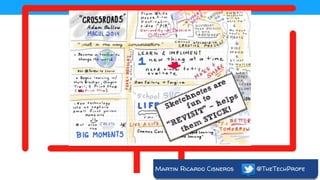
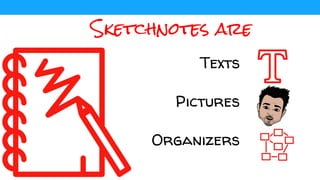
Sketchnotes are
Texts
Pictures
Organizers
How?
23
Martin Ricardo Cisneros @TheTechProfe
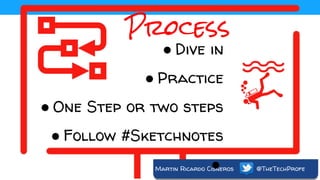
Process
● Dive in
● Practice
● One Step or two steps
● Follow #Sketchnotes
●
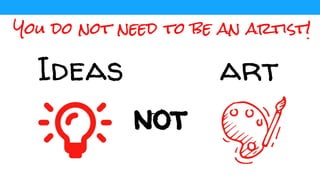
You do not need to be an artist!
Ideas art
not
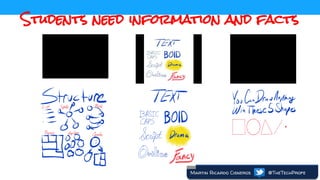
Students need information and facts
Martin Ricardo Cisneros @TheTechProfe
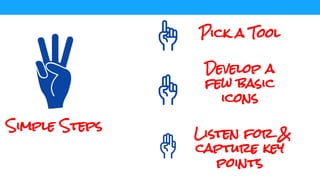
Simple Steps
Pick a Tool
Develop a
few basic
icons
Listen for &
capture key
points
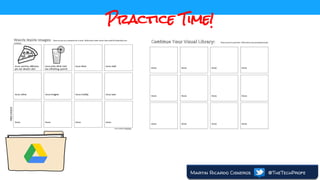
Practice Time!
Martin Ricardo Cisneros @TheTechProfe
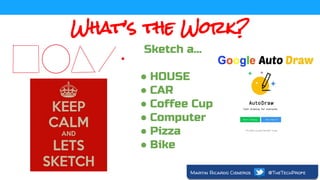
What’s the Work?
Sketch a…
● HOUSE
● CAR
● Coffee Cup
● Computer
● Pizza
● Bike
Martin Ricardo Cisneros @TheTechProfe
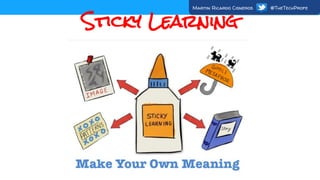
Sticky Learning
Martin Ricardo Cisneros @TheTechProfe
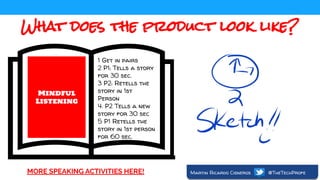
What does the product look like?
Mindful
Listening
1 Get in pairs
2 P1: Tells a story
for 30 sec.
3 P2: Retells the
story in 1st
Person
4. P2 Tells a new
story for 30 sec
5 P1 Retells the
story in 1st person
for 60 sec.
MORE SPEAKING ACTIVITIES HERE! Martin Ricardo Cisneros @TheTechProfe
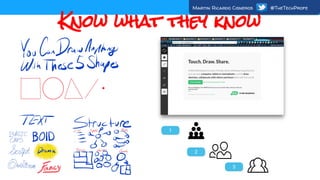
Know what they know
1
2
3
Martin Ricardo Cisneros @TheTechProfe
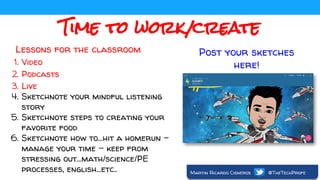
Time to work/create
Lessons for the classroom
1. Video
2. Podcasts
3. Live
4. Sketchnote your mindful listening
story
5. Sketchnote steps to creating your
favorite food
6. Sketchnote how to...hit a homerun -
manage your time - keep from
stressing out...math/science/PE
processes, english...etc..
Post your sketches
here!
Martin Ricardo Cisneros @TheTechProfe
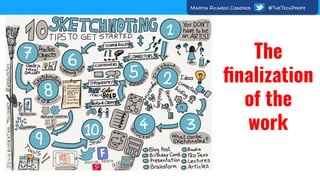
The
finalization
of the
work
Martin Ricardo Cisneros @TheTechProfe
One more
thing!
36
Tools
37
Resources
38
Martin Ricardo Cisneros @TheTechProfe
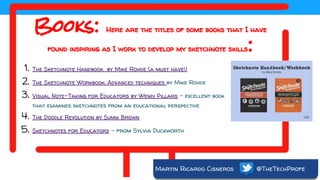
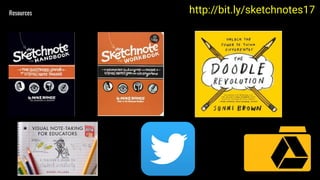
Books: Here are the titles of some books that I have
found inspiring as I work to develop my sketchnote skills:
1. The Sketchnote Handbook by Mike Rohde (a must have!)
2. The Sketchnote Workbook: Advanced techniques by Mike Rohde
3. Visual Note-Taking for Educators by Wendi Pillars - excellent book
that examines sketchnotes from an educational perspective
4. The Doodle Revolution by Sunni Brown
5. Sketchnotes for Educators - from Sylvia Duckworth
Martin Ricardo Cisneros @TheTechProfe
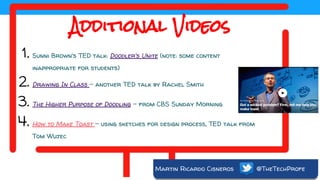
Additional Videos
1. Sunni Brown's TED talk: Doodler's Unite (note: some content
inappropriate for students)
2. Drawing In Class - another TED talk by Rachel Smith
3. The Higher Purpose of Doodling - from CBS Sunday Morning
4. How to Make Toast - using sketches for design process, TED talk from
Tom Wujec
Martin Ricardo Cisneros @TheTechProfe
Stylus Recommendations:
1. Inexpensive Stylus - for student use
2. Apple Pencil - a must have for drawing on an iPad Pro!
Currently the stylus that I am using!
3. Apple Pencil Cozy - keeps the top of your Apple Pencil
attached!
4. Pencil - syncs with Paper53 and Procreate apps, pressure
sensitive, works without sync in any app, easy flow!
5. Lynktec Apex Fine Point Stylus - A good fine point stylus for
writing. See my review here.
6. Sensu Brush - amazing brush that works on the iPad!
7. Sensu Solo Brush - another less expensive option (I have not
tried it)
8. Adonit Jot Pro Stylus - for fine lines, writing
Martin Ricardo Cisneros @TheTechProfe
Research/Articles Related to Sketchnotes:
1. The Pen is Mightier than the Keyboard (study abstract)
2. The Lowdown on Longhand: How Writing by Hand Benefits the Brain
(article)
3. Taking Notes: Is the Pen Still Mightier than the Keyboard (article)
4. What Does Doodling Do? (study abstract)
5. The Drawing Effect: Evidence for Reliable and Robust Memory
Effects in Free Recall (study abstract)
6. The Benefits of Doodling and Sketchnotes in the Classroom (article)
7. Making Learning Visible: Doodling Helps Memories Stick (article)
8. 6 Ways Doodling Can Make You Smarter, Happier, and More
Productive (article)
9. "Picting", not Writing, is the Literacy of Today's Youth (article)
Martin Ricardo Cisneros @TheTechProfe
Educators Who Sketchnote: follow these educators on Twitter for inspiration
1. @Braddo - Brad Ovenell-Carter
2. @rockourworld - Carol Anne McGuire
3. @sylviaduckworth - Sylvia Duckworth
4. @langwitches - Silvia Tolisano
5. @rebezuniga - Rebeca Zuñiga
6. @Sharron_Drummond - Sharon Drummond
7. @MrsKemper - Mary Kemper
8. @jmattmiller - Matt Miller
9. @itsallaboutart - Nicki Hambelton
10. @ProfVigeant - Margot Vigeant
11. @lancslassrach - Rachel Smith
12. @TannyMcG - Tanny McGregor, great ideas to use sketchnotes with literacy
13. Also, follow the hashtags #skecthnote50 #sketchnotes #sketchnote #edusketch
#SketchCUE
Martin Ricardo Cisneros @TheTechProfe
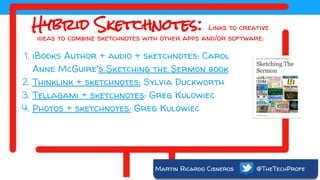
Hybrid Sketchnotes: lLinks to creative
ideas to combine sketchnotes with other apps and/or software:
1. iBooks Author + audio + sketchnotes: Carol
Anne McGuire's Sketching the Sermon book
2. Thinklink + sketchnotes: Sylvia Duckworth
3. Tellagami + sketchnotes: Greg Kulowiec
4. Photos + sketchnotes: Greg Kulowiec
Martin Ricardo Cisneros @TheTechProfe
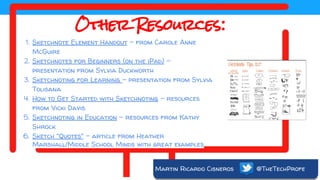
Other Resources:
1. Sketchnote Element Handout - from Carole Anne
McGuire
2. Sketchnotes for Beginners (on the iPad) -
presentation from Sylvia Duckworth
3. Sketchnoting for Learning - presentation from Sylvia
Tolisana
4. How to Get Started with Sketchnoting - resources
from Vicki Davis
5. Sketchnoting in Education - resources from Kathy
Shrock
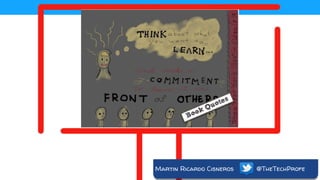
6. Sketch "Quotes" - article from Heather
Marshall/Middle School Minds with great examples
Get the Preso at
bit.ly/sketchmtv
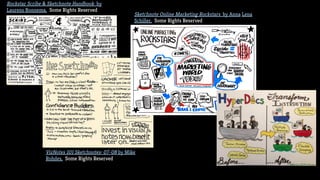
VizNotes 101 Sketchnotes: 07-08 by Mike
Rohdes, Some Rights Reserved
Rockstar Scribe & Sketchnote Handbook by
Laurens Bonnema, Some Rights Reserved
Sketchnote Online Marketing Rockstars by Anna Lena
Schiller, Some Rights Reserved
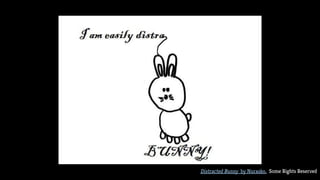
Distracted Bunny by Nurasko, Some Rights Reserved
Pop Quiz!
By Dominique Feldwick-Davis, CC0 Public Domain
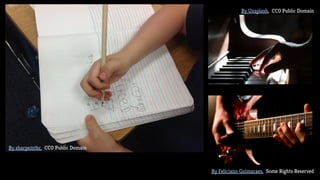
By sharpemtbr, CC0 Public Domain
By Unsplash, CC0 Public Domain
By Feliciano Guimaraes, Some Rights Reserved
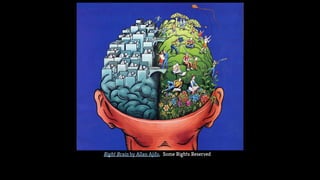
Right Brain by Allan Ajifo, Some Rights Reserved
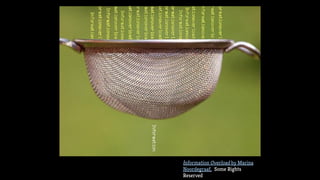
Information Overload by Marina
Noordegraaf, Some Rights
Reserved
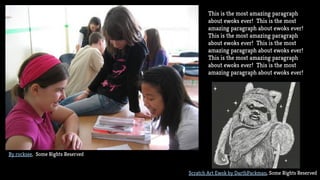
By rocksee, Some Rights Reserved
This is the most amazing paragraph
about ewoks ever! This is the most
amazing paragraph about ewoks ever!
This is the most amazing paragraph
about ewoks ever! This is the most
amazing paragraph about ewoks ever!
This is the most amazing paragraph
about ewoks ever! This is the most
amazing paragraph about ewoks ever!
Scratch Art Ewok by DarthPackman, Some Rights Reserved
By TBIT, CC0 Public Domain
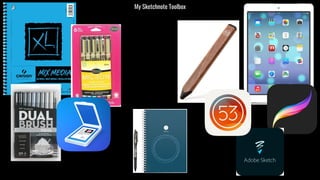
My Sketchnote Toolbox
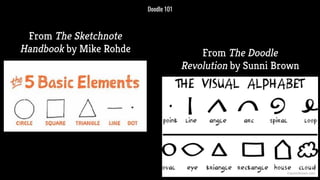
Doodle 101
From The Sketchnote
Handbook by Mike Rohde From The Doodle
Revolution by Sunni Brown
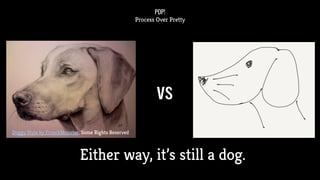
POP!
Process Over Pretty
Doggy Style by FroschMonster, Some Rights Reserved
vs
Either way, it’s still a dog.
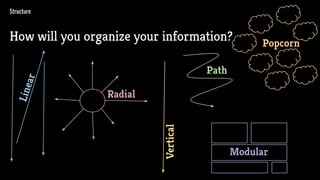
Structure
How will you organize your information?
Linear
Radial
Vertical
Path
Modular
Popcorn
Hierarchy
WATCHMEN: Metro newspaper as The News Frontiersman [front page] by Annie Ok, Some Rights Reserved
Size
Color
Font
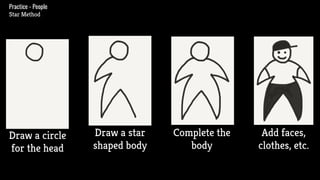
Practice - People
Star Method
Draw a circle
for the head
Draw a star
shaped body
Complete the
body
Add faces,
clothes, etc.
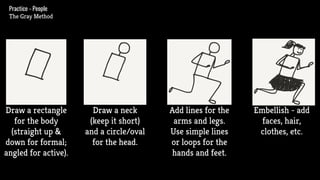
Practice - People
The Gray Method
Draw a rectangle
for the body
(straight up &
down for formal;
angled for active).
Draw a neck
(keep it short)
and a circle/oval
for the head.
Add lines for the
arms and legs.
Use simple lines
or loops for the
hands and feet.
Embellish - add
faces, hair,
clothes, etc.
Practice - Faces
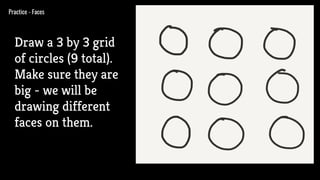
Draw a 3 by 3 grid
of circles (9 total).
Make sure they are
big - we will be
drawing different
faces on them.
Practice - Faces
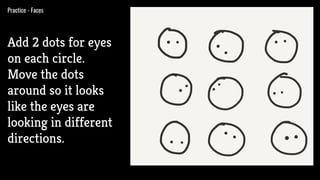
Add 2 dots for eyes
on each circle.
Move the dots
around so it looks
like the eyes are
looking in different
directions.
Practice - Faces
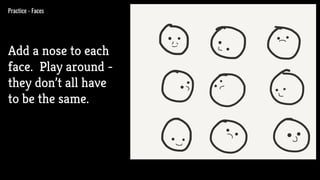
Add a nose to each
face. Play around -
they don’t all have
to be the same.
Practice - Faces
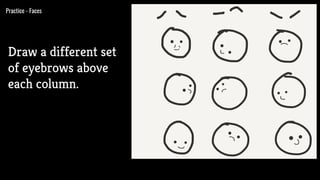
Draw a different set
of eyebrows above
each column.
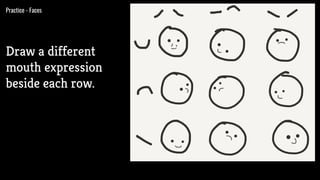
Practice - Faces
Draw a different
mouth expression
beside each row.
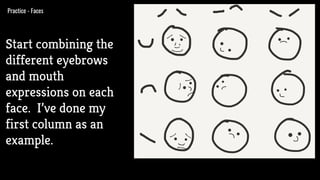
Practice - Faces
Start combining the
different eyebrows
and mouth
expressions on each
face. I’ve done my
first column as an
example.
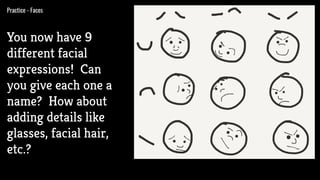
Practice - Faces
You now have 9
different facial
expressions! Can
you give each one a
name? How about
adding details like
glasses, facial hair,
etc.?
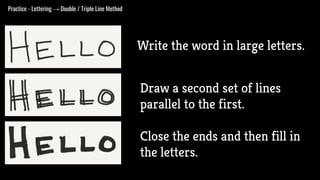
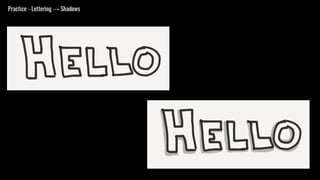
Practice - Lettering → Double / Triple Line Method

Write the word in large letters.
Draw a second set of lines
parallel to the first.
Close the ends and then fill in
the letters.
Practice - Lettering → Shadows
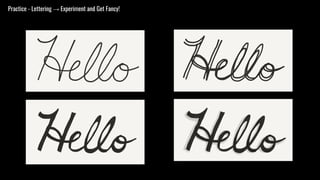
Practice - Lettering → Experiment and Get Fancy!
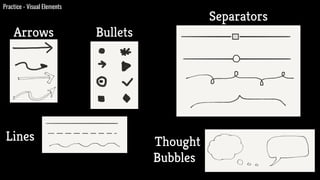
Practice - Visual Elements
Arrows Bullets
Lines
Separators
Thought
Bubbles
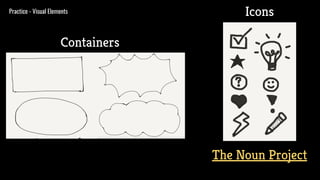
Practice - Visual Elements
Containers
Icons
The Noun Project
How can you KEEP practicing?
Book study
Ted Talks
Podcasts
Would you rather…?
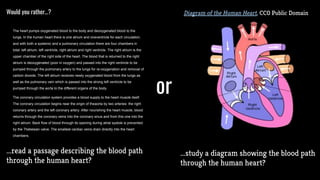
The heart pumps oxygenated blood to the body and deoxygenated blood to the
lungs. In the human heart there is one atrium and oneventricle for each circulation,
and with both a systemic and a pulmonary circulation there are four chambers in
total: left atrium, left ventricle, right atrium and right ventricle. The right atrium is the
upper chamber of the right side of the heart. The blood that is returned to the right
atrium is deoxygenated (poor in oxygen) and passed into the right ventricle to be
pumped through the pulmonary artery to the lungs for re-oxygenation and removal of
carbon dioxide. The left atrium receives newly oxygenated blood from the lungs as
well as the pulmonary vein which is passed into the strong left ventricle to be
pumped through the aorta to the different organs of the body.
The coronary circulation system provides a blood supply to the heart muscle itself.
The coronary circulation begins near the origin of theaorta by two arteries: the right
coronary artery and the left coronary artery. After nourishing the heart muscle, blood
returns through the coronary veins into the coronary sinus and from this one into the
right atrium. Back flow of blood through its opening during atrial systole is prevented
by the Thebesian valve. The smallest cardiac veins drain directly into the heart
chambers.
Diagram of the Human Heart, CC0 Public Domain
...read a passage describing the blood path
through the human heart?
...study a diagram showing the blood path
through the human heart?
or
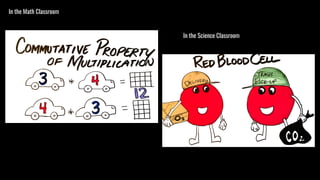
In the Math Classroom
In the Science Classroom
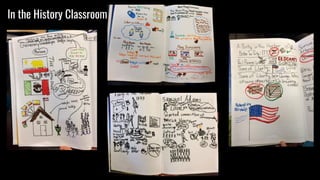
In the History Classroom
In the Classroom
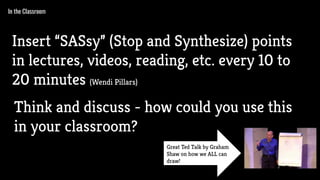
Insert “SASsy” (Stop and Synthesize) points
in lectures, videos, reading, etc. every 10 to
20 minutes (Wendi Pillars)
Think and discuss - how could you use this
in your classroom?
Great Ted Talk by Graham
Shaw on how we ALL can
draw!
Resources http://bit.ly/sketchnotes17
Let’s Practice!
“7 Things That Happen
When Students Own Their
Learning” from the
Creative Classroom
Podcast featuring John
Spencer
Thank you for joining me today!
Get the Preso at
bit.ly/sketchmtv

Sketchnoting: Making Thinking Visible!

  • 1.
    Martin Ricardo Cisneros@TheTechProfe Sketchnoting
  • 3.
    Martin Ricardo Cisneros@TheTechProfe Get the Preso at bit.ly/sketchmtv
  • 4.
  • 5.
  • 6.
  • 7.
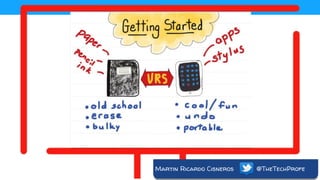
    Sketchnotes ● Not anApp ● Use any drawing app or paper! ● invitation to draw your CLS Sessions 7
  • 8.
  • 9.
  • 10.
  • 11.
  • 12.
  • 13.
    Many studies have proventhat images are much more effective than words when it comes to comprehension, memory retention and motivation. This is a good reason for teachers to try to take up sketchnoting themselves and to encourage their students to take visual notes as well. 13
  • 14.
    Getting the LearnersPrepped What would happen if you had students draw their final exam? B A M N Or Martin Ricardo Cisneros @TheTechProfe
  • 15.
  • 16.
    The Academic NeedELLsneed to be emerged in their academic language. Martin Ricardo Cisneros @TheTechProfe
  • 17.
  • 18.
  • 19.
  • 20.
  • 21.
  • 22.
  • 23.
  • 24.
  • 25.
    Martin Ricardo Cisneros@TheTechProfe Process ● Dive in ● Practice ● One Step or two steps ● Follow #Sketchnotes ●
  • 26.
    You do notneed to be an artist! Ideas art not
  • 27.
    Students need informationand facts Martin Ricardo Cisneros @TheTechProfe
  • 28.
    Simple Steps Pick aTool Develop a few basic icons Listen for & capture key points
  • 29.
    Practice Time! Martin RicardoCisneros @TheTechProfe
  • 30.
    What’s the Work? Sketcha… ● HOUSE ● CAR ● Coffee Cup ● Computer ● Pizza ● Bike Martin Ricardo Cisneros @TheTechProfe
  • 31.
    Sticky Learning Martin RicardoCisneros @TheTechProfe
  • 32.
    What does theproduct look like? Mindful Listening 1 Get in pairs 2 P1: Tells a story for 30 sec. 3 P2: Retells the story in 1st Person 4. P2 Tells a new story for 30 sec 5 P1 Retells the story in 1st person for 60 sec. MORE SPEAKING ACTIVITIES HERE! Martin Ricardo Cisneros @TheTechProfe
  • 33.
    Know what theyknow 1 2 3 Martin Ricardo Cisneros @TheTechProfe
  • 34.
    Time to work/create Lessonsfor the classroom 1. Video 2. Podcasts 3. Live 4. Sketchnote your mindful listening story 5. Sketchnote steps to creating your favorite food 6. Sketchnote how to...hit a homerun - manage your time - keep from stressing out...math/science/PE processes, english...etc.. Post your sketches here! Martin Ricardo Cisneros @TheTechProfe
  • 35.
  • 36.
  • 37.
  • 38.
  • 39.
    Martin Ricardo Cisneros@TheTechProfe Books: Here are the titles of some books that I have found inspiring as I work to develop my sketchnote skills: 1. The Sketchnote Handbook by Mike Rohde (a must have!) 2. The Sketchnote Workbook: Advanced techniques by Mike Rohde 3. Visual Note-Taking for Educators by Wendi Pillars - excellent book that examines sketchnotes from an educational perspective 4. The Doodle Revolution by Sunni Brown 5. Sketchnotes for Educators - from Sylvia Duckworth
  • 40.
    Martin Ricardo Cisneros@TheTechProfe Additional Videos 1. Sunni Brown's TED talk: Doodler's Unite (note: some content inappropriate for students) 2. Drawing In Class - another TED talk by Rachel Smith 3. The Higher Purpose of Doodling - from CBS Sunday Morning 4. How to Make Toast - using sketches for design process, TED talk from Tom Wujec
  • 41.
    Martin Ricardo Cisneros@TheTechProfe Stylus Recommendations: 1. Inexpensive Stylus - for student use 2. Apple Pencil - a must have for drawing on an iPad Pro! Currently the stylus that I am using! 3. Apple Pencil Cozy - keeps the top of your Apple Pencil attached! 4. Pencil - syncs with Paper53 and Procreate apps, pressure sensitive, works without sync in any app, easy flow! 5. Lynktec Apex Fine Point Stylus - A good fine point stylus for writing. See my review here. 6. Sensu Brush - amazing brush that works on the iPad! 7. Sensu Solo Brush - another less expensive option (I have not tried it) 8. Adonit Jot Pro Stylus - for fine lines, writing
  • 42.
    Martin Ricardo Cisneros@TheTechProfe Research/Articles Related to Sketchnotes: 1. The Pen is Mightier than the Keyboard (study abstract) 2. The Lowdown on Longhand: How Writing by Hand Benefits the Brain (article) 3. Taking Notes: Is the Pen Still Mightier than the Keyboard (article) 4. What Does Doodling Do? (study abstract) 5. The Drawing Effect: Evidence for Reliable and Robust Memory Effects in Free Recall (study abstract) 6. The Benefits of Doodling and Sketchnotes in the Classroom (article) 7. Making Learning Visible: Doodling Helps Memories Stick (article) 8. 6 Ways Doodling Can Make You Smarter, Happier, and More Productive (article) 9. "Picting", not Writing, is the Literacy of Today's Youth (article)
  • 43.
    Martin Ricardo Cisneros@TheTechProfe Educators Who Sketchnote: follow these educators on Twitter for inspiration 1. @Braddo - Brad Ovenell-Carter 2. @rockourworld - Carol Anne McGuire 3. @sylviaduckworth - Sylvia Duckworth 4. @langwitches - Silvia Tolisano 5. @rebezuniga - Rebeca Zuñiga 6. @Sharron_Drummond - Sharon Drummond 7. @MrsKemper - Mary Kemper 8. @jmattmiller - Matt Miller 9. @itsallaboutart - Nicki Hambelton 10. @ProfVigeant - Margot Vigeant 11. @lancslassrach - Rachel Smith 12. @TannyMcG - Tanny McGregor, great ideas to use sketchnotes with literacy 13. Also, follow the hashtags #skecthnote50 #sketchnotes #sketchnote #edusketch #SketchCUE
  • 44.
    Martin Ricardo Cisneros@TheTechProfe Hybrid Sketchnotes: lLinks to creative ideas to combine sketchnotes with other apps and/or software: 1. iBooks Author + audio + sketchnotes: Carol Anne McGuire's Sketching the Sermon book 2. Thinklink + sketchnotes: Sylvia Duckworth 3. Tellagami + sketchnotes: Greg Kulowiec 4. Photos + sketchnotes: Greg Kulowiec
  • 45.
    Martin Ricardo Cisneros@TheTechProfe Other Resources: 1. Sketchnote Element Handout - from Carole Anne McGuire 2. Sketchnotes for Beginners (on the iPad) - presentation from Sylvia Duckworth 3. Sketchnoting for Learning - presentation from Sylvia Tolisana 4. How to Get Started with Sketchnoting - resources from Vicki Davis 5. Sketchnoting in Education - resources from Kathy Shrock 6. Sketch "Quotes" - article from Heather Marshall/Middle School Minds with great examples
  • 46.
    Get the Presoat bit.ly/sketchmtv
  • 47.
    VizNotes 101 Sketchnotes:07-08 by Mike Rohdes, Some Rights Reserved Rockstar Scribe & Sketchnote Handbook by Laurens Bonnema, Some Rights Reserved Sketchnote Online Marketing Rockstars by Anna Lena Schiller, Some Rights Reserved
  • 48.
    Distracted Bunny byNurasko, Some Rights Reserved
  • 49.
  • 50.
  • 51.
    By sharpemtbr, CC0Public Domain By Unsplash, CC0 Public Domain By Feliciano Guimaraes, Some Rights Reserved
  • 52.
    Right Brain byAllan Ajifo, Some Rights Reserved
  • 53.
    Information Overload byMarina Noordegraaf, Some Rights Reserved
  • 54.
    By rocksee, SomeRights Reserved This is the most amazing paragraph about ewoks ever! This is the most amazing paragraph about ewoks ever! This is the most amazing paragraph about ewoks ever! This is the most amazing paragraph about ewoks ever! This is the most amazing paragraph about ewoks ever! This is the most amazing paragraph about ewoks ever! Scratch Art Ewok by DarthPackman, Some Rights Reserved
  • 55.
    By TBIT, CC0Public Domain
  • 57.
  • 58.
    Doodle 101 From TheSketchnote Handbook by Mike Rohde From The Doodle Revolution by Sunni Brown
  • 59.
    POP! Process Over Pretty DoggyStyle by FroschMonster, Some Rights Reserved vs Either way, it’s still a dog.
  • 60.
    Structure How will youorganize your information? Linear Radial Vertical Path Modular Popcorn
  • 61.
    Hierarchy WATCHMEN: Metro newspaperas The News Frontiersman [front page] by Annie Ok, Some Rights Reserved Size Color Font
  • 62.
    Practice - People StarMethod Draw a circle for the head Draw a star shaped body Complete the body Add faces, clothes, etc.
  • 63.
    Practice - People TheGray Method Draw a rectangle for the body (straight up & down for formal; angled for active). Draw a neck (keep it short) and a circle/oval for the head. Add lines for the arms and legs. Use simple lines or loops for the hands and feet. Embellish - add faces, hair, clothes, etc.
  • 64.
    Practice - Faces Drawa 3 by 3 grid of circles (9 total). Make sure they are big - we will be drawing different faces on them.
  • 65.
    Practice - Faces Add2 dots for eyes on each circle. Move the dots around so it looks like the eyes are looking in different directions.
  • 66.
    Practice - Faces Adda nose to each face. Play around - they don’t all have to be the same.
  • 67.
    Practice - Faces Drawa different set of eyebrows above each column.
  • 68.
    Practice - Faces Drawa different mouth expression beside each row.
  • 69.
    Practice - Faces Startcombining the different eyebrows and mouth expressions on each face. I’ve done my first column as an example.
  • 70.
    Practice - Faces Younow have 9 different facial expressions! Can you give each one a name? How about adding details like glasses, facial hair, etc.?
  • 71.
    Practice - Lettering→ Double / Triple Line Method Write the word in large letters. Draw a second set of lines parallel to the first. Close the ends and then fill in the letters.
  • 72.
  • 73.
    Practice - Lettering→ Experiment and Get Fancy!
  • 74.
    Practice - VisualElements Arrows Bullets Lines Separators Thought Bubbles
  • 75.
    Practice - VisualElements Containers Icons The Noun Project
  • 76.
    How can youKEEP practicing? Book study Ted Talks Podcasts
  • 77.
    Would you rather…? Theheart pumps oxygenated blood to the body and deoxygenated blood to the lungs. In the human heart there is one atrium and oneventricle for each circulation, and with both a systemic and a pulmonary circulation there are four chambers in total: left atrium, left ventricle, right atrium and right ventricle. The right atrium is the upper chamber of the right side of the heart. The blood that is returned to the right atrium is deoxygenated (poor in oxygen) and passed into the right ventricle to be pumped through the pulmonary artery to the lungs for re-oxygenation and removal of carbon dioxide. The left atrium receives newly oxygenated blood from the lungs as well as the pulmonary vein which is passed into the strong left ventricle to be pumped through the aorta to the different organs of the body. The coronary circulation system provides a blood supply to the heart muscle itself. The coronary circulation begins near the origin of theaorta by two arteries: the right coronary artery and the left coronary artery. After nourishing the heart muscle, blood returns through the coronary veins into the coronary sinus and from this one into the right atrium. Back flow of blood through its opening during atrial systole is prevented by the Thebesian valve. The smallest cardiac veins drain directly into the heart chambers. Diagram of the Human Heart, CC0 Public Domain ...read a passage describing the blood path through the human heart? ...study a diagram showing the blood path through the human heart? or
  • 78.
    In the MathClassroom In the Science Classroom
  • 79.
    In the HistoryClassroom
  • 80.
    In the Classroom Insert“SASsy” (Stop and Synthesize) points in lectures, videos, reading, etc. every 10 to 20 minutes (Wendi Pillars) Think and discuss - how could you use this in your classroom? Great Ted Talk by Graham Shaw on how we ALL can draw!
  • 81.
  • 82.
    Let’s Practice! “7 ThingsThat Happen When Students Own Their Learning” from the Creative Classroom Podcast featuring John Spencer
  • 83.
    Thank you forjoining me today!
  • 84.
    Get the Presoat bit.ly/sketchmtv