MAINTAINING CLASSROOM
RECORDS
Presented To
Mam Hina
Munir
RECORDS
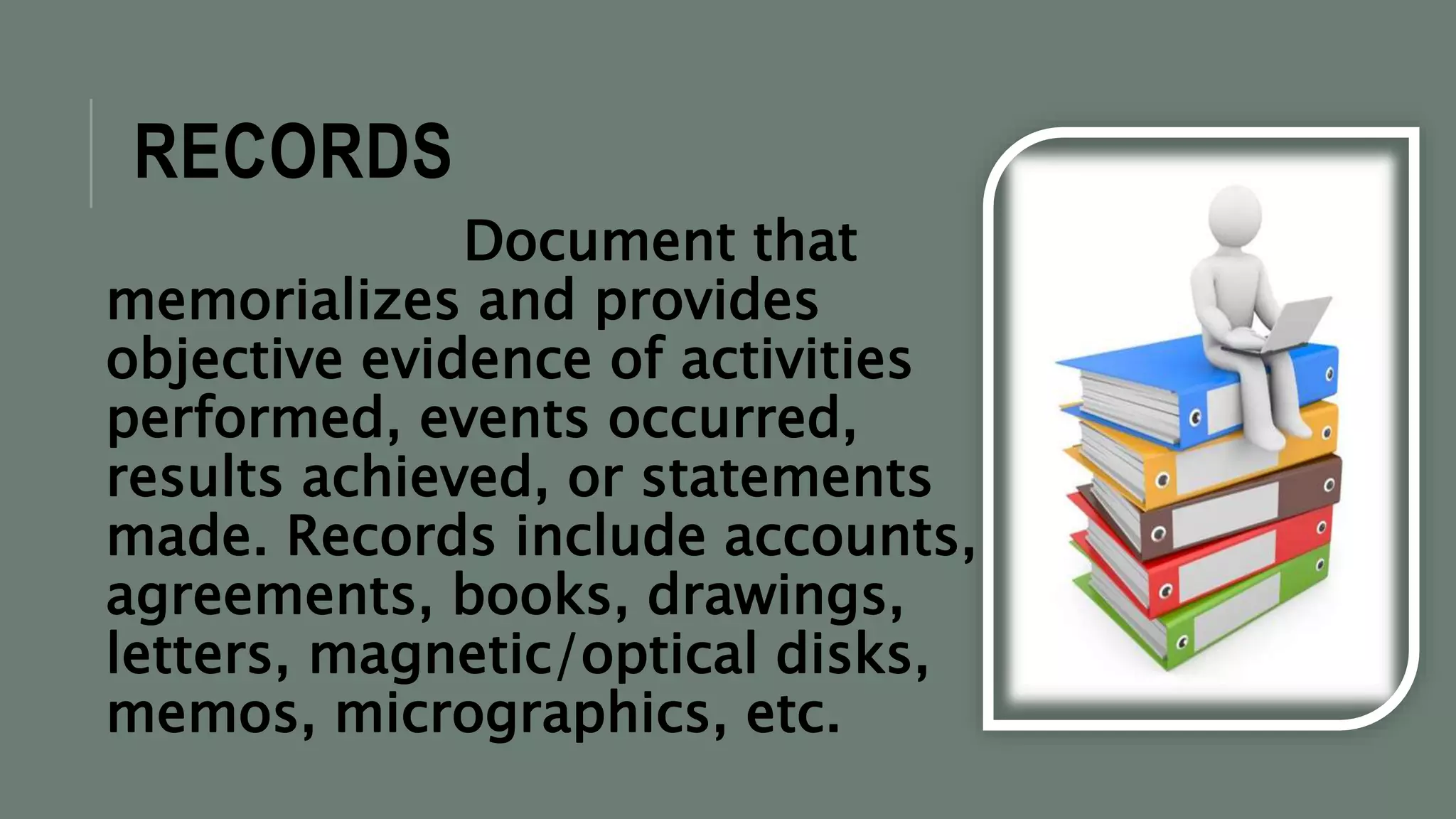
Document that
memorializes and provides
objective evidence of activities
performed, events occurred,
results achieved, or statements
made. Records include accounts,
agreements, books, drawings,
letters, magnetic/optical disks,
memos, micrographics, etc.
RECORDS KEEPING
SYSTEM
Record-keeping refers to keeping, filing, categorizing and
maintaining information.
There are two types of records.
 Manual record keeping systems:
Manual record keeping systems consist of paper based
journals for each financial year.
Electronic record keeping systems:
An Electronic Document and Records Management System
(EDRM) is a computer program (or set of programs) used to
track and store records.
TYPES OF RECORDS
CHECKLIST
Checklists are an easy way to
record scores, behavior,
effort, and participation—all
of which are part of the
feedback provided on report
cards and/or progress
reports.
Considerations
• Create specific checklists
to reflect what you are looking
for (for example, the material
each individual student is
learning or how individual
ANECDOTAL
NOTESAnecdotal notes are helpful for
fleshing out the quantitative
information recorded in your
grade book or grading program.
Considerations
• Use Post-it Notes for
anecdotal notes (always include
the date), and place them inside
the appropriate subject portfolio
for the student.
• Anecdotal notes can be
accessed easily for conferencing
with parents.
CLASS RECORD CHARTS
SUBJECT PORTFOLIOWhen displayed in the classroom,
class record charts track
information for all of your
students. They can provide
motivation for your students to
complete or master the
instructional material.
Class record charts can be used to
track many different activities,
including the following:
Completed homework
Completion of assignments
and/or mastery
For subject areas such as math,
social studies, science, and art,
file folders can be set up to
create student portfolios.
Establish guidelines for the
subject area portfolios, such as
the following:
Each portfolio must have three
examples of the student’s work.
Use these portfolios to support
grade book or grading program
records.
WRITING PORTFOLIO
ASSESSMENT FOLDERS
Writing portfolios house a
collection of students’
writings.
Establish guidelines for
writing portfolios, such as
the following:
Each writing portfolio must
have at least three examples
of the student’s work.
Students select which
graded assignments to place
in their writing portfolios.
Assessment folders house a
collection of assessments that
monitor students' progress.
Keep all formal assessments in
the students' assessment
folders.
Record assessment scores on
the cover of each folder for easy
access.
Use assessment folders in
conferences and during a
referral process.
Maintain these folders
THE ESTABLISHMENT OF
CLASSROOM RECORDSA well-organized classroom that can practically run itself is easy
to achieve. Every teacher gets buried in paperwork from time to
time. But there are painless ways to reduce clutter and confusion.
Here are a few tips:
Colors code everything: Use the same color for all materials for each
subject or unit. If you can, color code assignments and handouts by using
colored copy paper.
Put everything in binders: Place your teacher resource books in three-
ring binders using plastic sleeves.
Store items in boxes: Use plastic tubs or cardboard file boxes to store
holiday projects, art projects, special books, and supplies.
Assign numbers to students: Assign the same number to each student
that you used in your grade book.
THE ESTABLISHMENT OF
CLASSROOM RECORDSUse an online grade book: Online grade books allow you to automatically
give out online assignments and record grades.
Make labels with each student's name: Have your students write their
names and numbers on labels, which you can peel off and use for all folders,
notebooks, and other materials that need student identification, including
forms.
Be prepared for new students: Have packets of information for new
students prepared ahead of time so that when a new student enters your class
in the middle of a lesson, you're ready.
Create a seating chart: As soon as your class list is final, create a seating
chart from your perspective at the front of the class. This should help you learn
students' names and help keep some order in the classroom.
Create an assignment basket or tray. Use a basket or tray for students
to turn in assignments. You can have a different basket or tray for each class or
subject. Then train your students to turn in assignments in these places.
MAINTAINING
CLASSROOM
RECORDS
Accuracy
Completeness
Utility
Comprehensiveness
Easy Maintenance
Systematic Maintenance
Availability
ADVANTAGES OF CLASS RECORDS DISADVANTAGES OF
RECORDS
Need good management
skills of teachers all teachers
do not have such abilities.
Require space to store
properly, if the space is less
than it is difficult to store the
records.
Need time and more effort to
maintain records so the
shortage of time will be a
hurdle.
Records Help Teachers
To know pupils when the school year
begins.
To determine what work a pupil is
capable of doing.
To provide learning activities suitable
to each pupil.
To formulate a basis for the intelligent
guidance of pupils.
To make possible the development of
unusual capacities or exceptional
talents.
To identify and make proper provisions
for the mentally slow students.
To make periodic reports correctly and
in time.
Maintaining classroom records

Maintaining classroom records

  • 1.
  • 2.
    RECORDS Document that memorializes andprovides objective evidence of activities performed, events occurred, results achieved, or statements made. Records include accounts, agreements, books, drawings, letters, magnetic/optical disks, memos, micrographics, etc.
  • 3.
    RECORDS KEEPING SYSTEM Record-keeping refersto keeping, filing, categorizing and maintaining information. There are two types of records.  Manual record keeping systems: Manual record keeping systems consist of paper based journals for each financial year. Electronic record keeping systems: An Electronic Document and Records Management System (EDRM) is a computer program (or set of programs) used to track and store records.
  • 4.
    TYPES OF RECORDS CHECKLIST Checklistsare an easy way to record scores, behavior, effort, and participation—all of which are part of the feedback provided on report cards and/or progress reports. Considerations • Create specific checklists to reflect what you are looking for (for example, the material each individual student is learning or how individual ANECDOTAL NOTESAnecdotal notes are helpful for fleshing out the quantitative information recorded in your grade book or grading program. Considerations • Use Post-it Notes for anecdotal notes (always include the date), and place them inside the appropriate subject portfolio for the student. • Anecdotal notes can be accessed easily for conferencing with parents.
  • 5.
    CLASS RECORD CHARTS SUBJECTPORTFOLIOWhen displayed in the classroom, class record charts track information for all of your students. They can provide motivation for your students to complete or master the instructional material. Class record charts can be used to track many different activities, including the following: Completed homework Completion of assignments and/or mastery For subject areas such as math, social studies, science, and art, file folders can be set up to create student portfolios. Establish guidelines for the subject area portfolios, such as the following: Each portfolio must have three examples of the student’s work. Use these portfolios to support grade book or grading program records.
  • 6.
    WRITING PORTFOLIO ASSESSMENT FOLDERS Writingportfolios house a collection of students’ writings. Establish guidelines for writing portfolios, such as the following: Each writing portfolio must have at least three examples of the student’s work. Students select which graded assignments to place in their writing portfolios. Assessment folders house a collection of assessments that monitor students' progress. Keep all formal assessments in the students' assessment folders. Record assessment scores on the cover of each folder for easy access. Use assessment folders in conferences and during a referral process. Maintain these folders
  • 7.
    THE ESTABLISHMENT OF CLASSROOMRECORDSA well-organized classroom that can practically run itself is easy to achieve. Every teacher gets buried in paperwork from time to time. But there are painless ways to reduce clutter and confusion. Here are a few tips: Colors code everything: Use the same color for all materials for each subject or unit. If you can, color code assignments and handouts by using colored copy paper. Put everything in binders: Place your teacher resource books in three- ring binders using plastic sleeves. Store items in boxes: Use plastic tubs or cardboard file boxes to store holiday projects, art projects, special books, and supplies. Assign numbers to students: Assign the same number to each student that you used in your grade book.
  • 8.
    THE ESTABLISHMENT OF CLASSROOMRECORDSUse an online grade book: Online grade books allow you to automatically give out online assignments and record grades. Make labels with each student's name: Have your students write their names and numbers on labels, which you can peel off and use for all folders, notebooks, and other materials that need student identification, including forms. Be prepared for new students: Have packets of information for new students prepared ahead of time so that when a new student enters your class in the middle of a lesson, you're ready. Create a seating chart: As soon as your class list is final, create a seating chart from your perspective at the front of the class. This should help you learn students' names and help keep some order in the classroom. Create an assignment basket or tray. Use a basket or tray for students to turn in assignments. You can have a different basket or tray for each class or subject. Then train your students to turn in assignments in these places.
  • 9.
  • 10.
    ADVANTAGES OF CLASSRECORDS DISADVANTAGES OF RECORDS Need good management skills of teachers all teachers do not have such abilities. Require space to store properly, if the space is less than it is difficult to store the records. Need time and more effort to maintain records so the shortage of time will be a hurdle. Records Help Teachers To know pupils when the school year begins. To determine what work a pupil is capable of doing. To provide learning activities suitable to each pupil. To formulate a basis for the intelligent guidance of pupils. To make possible the development of unusual capacities or exceptional talents. To identify and make proper provisions for the mentally slow students. To make periodic reports correctly and in time.