Atomic Structure
Dalton’sAtomic
Theory
Who is Dalton?
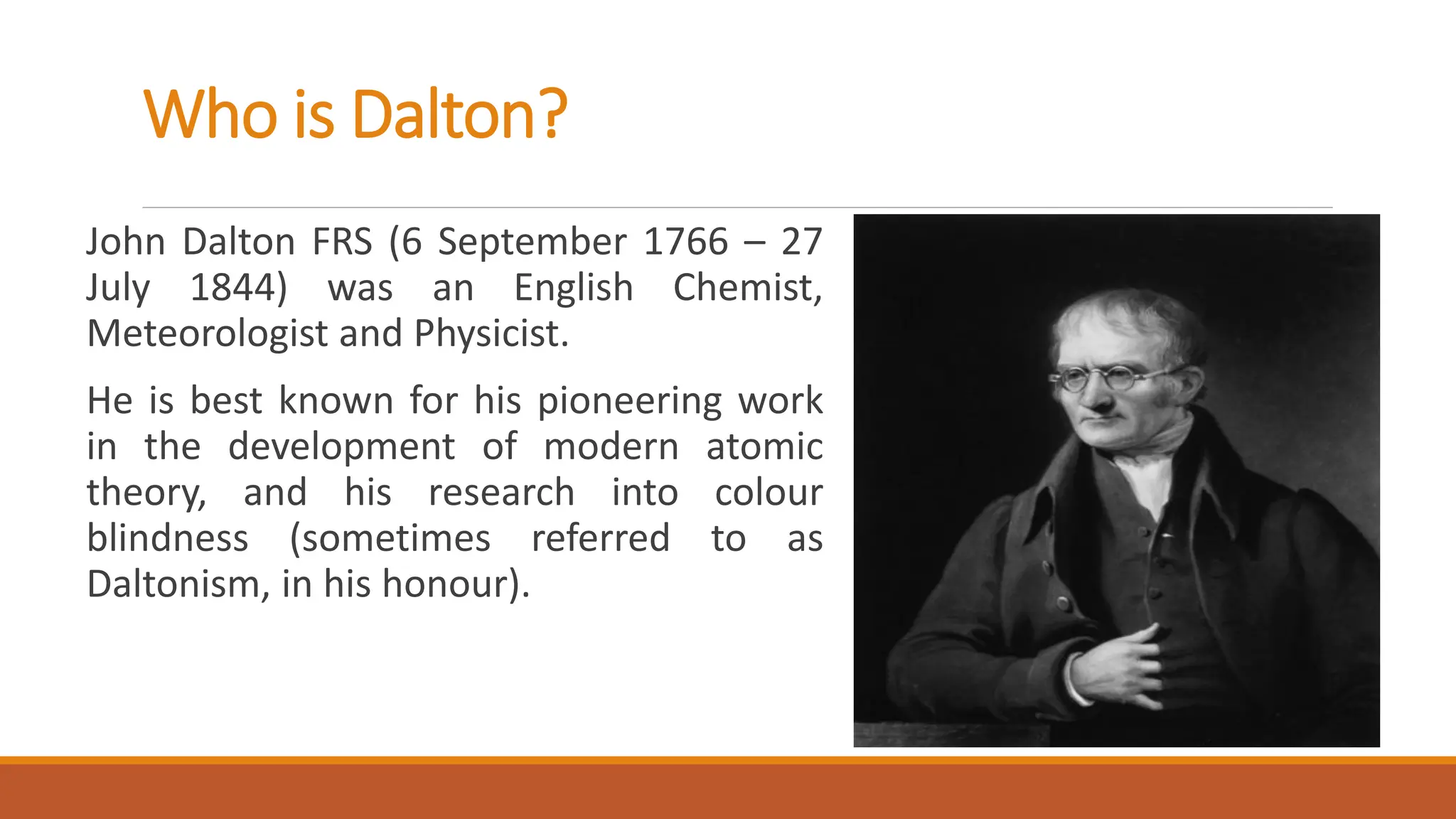
John Dalton FRS (6 September 1766 – 27
July 1844) was an English Chemist,
Meteorologist and Physicist.
He is best known for his pioneering work
in the development of modern atomic
theory, and his research into colour
blindness (sometimes referred to as
Daltonism, in his honour).
Dalton’s Atomic Theory
 About 400 BC the Greek Philosopher Democritus proposed that all matter is
composed of tiny, indivisible particles that he called ATOMS.
 Although Democritus’ idea was not acceptable by his contemporaries, notably
Plato and Aristotle, his suggestion persisted through the centuries.
 Experimental evidence from early scientific investigations provided support for
the concept of atom.
 However, it was not until 1808 that the English Scientist and school teacher,
John Dalton, proposed an atomic theory that marked the beginning of the
modern era of chemistry.
The principal hypothesis of Dalton’s
atomic theory are:
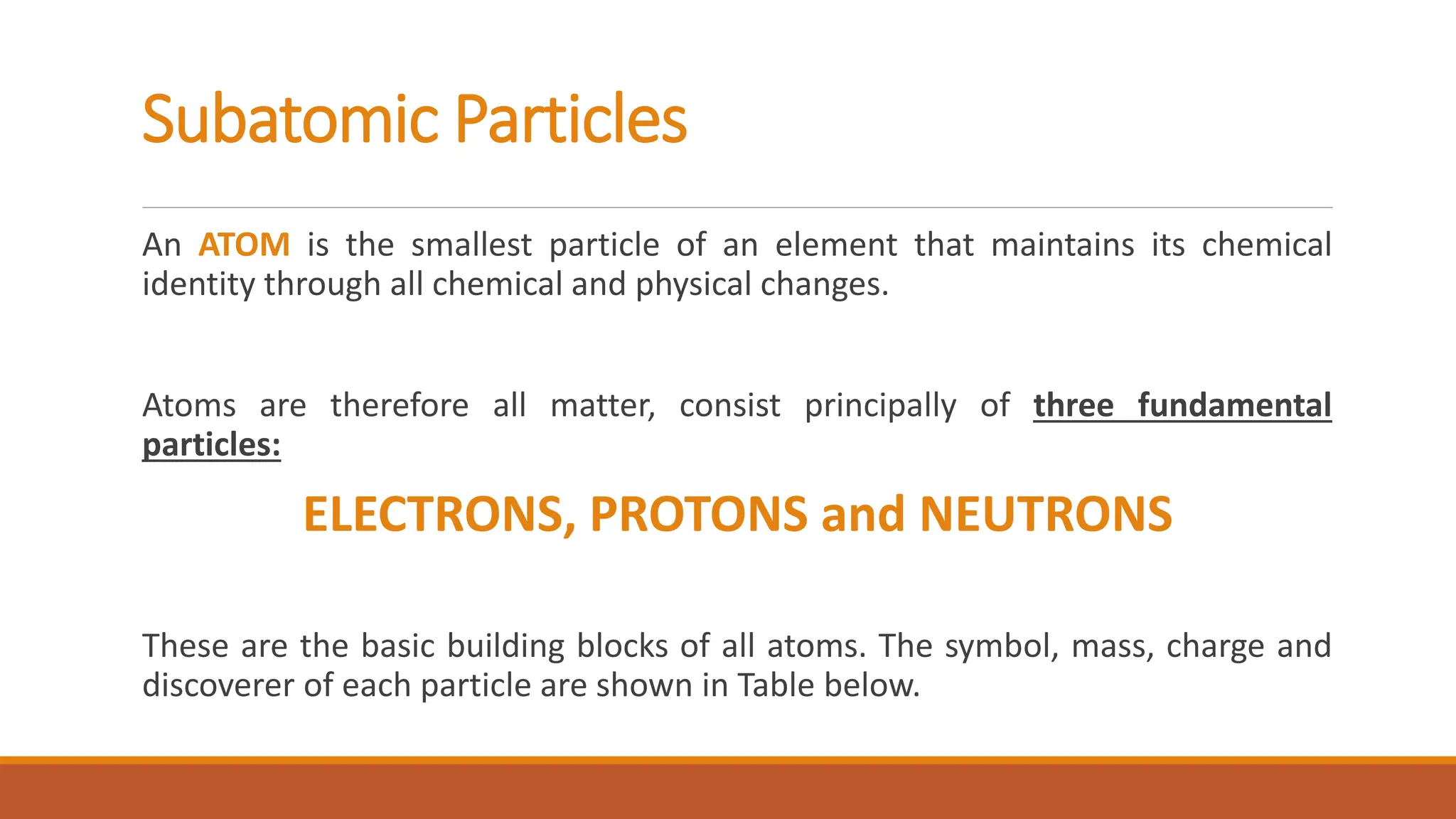
1. Matter consists of tiny particles called ATOMS.
2. Atoms cannot be destroyed nor created during a chemical
process.
3. Atoms combine in simple whole number ratios to form
compounds.
Subatomic Particles
An ATOM is the smallest particle of an element that maintains its chemical
identity through all chemical and physical changes.
Atoms are therefore all matter, consist principally of three fundamental
particles:
ELECTRONS, PROTONS and NEUTRONS
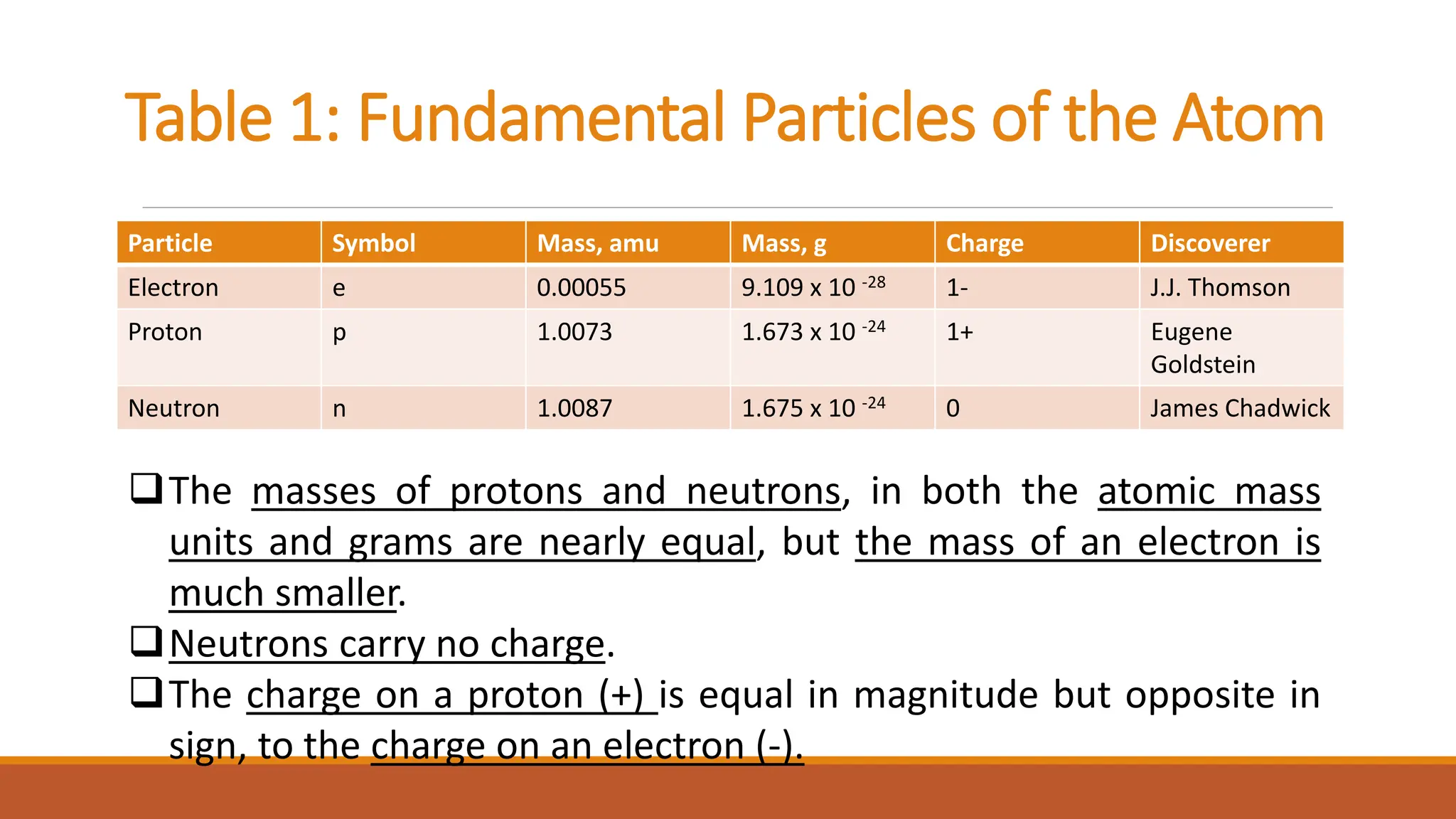
These are the basic building blocks of all atoms. The symbol, mass, charge and
discoverer of each particle are shown in Table below.
Table 1: Fundamental Particles of the Atom
Particle Symbol Mass, amu Mass, g Charge Discoverer
Electron e 0.00055 9.109 x 10 -28 1- J.J. Thomson
Proton p 1.0073 1.673 x 10 -24 1+ Eugene
Goldstein
Neutron n 1.0087 1.675 x 10 -24 0 James Chadwick
The masses of protons and neutrons, in both the atomic mass
units and grams are nearly equal, but the mass of an electron is
much smaller.
Neutrons carry no charge.
The charge on a proton (+) is equal in magnitude but opposite in
sign, to the charge on an electron (-).
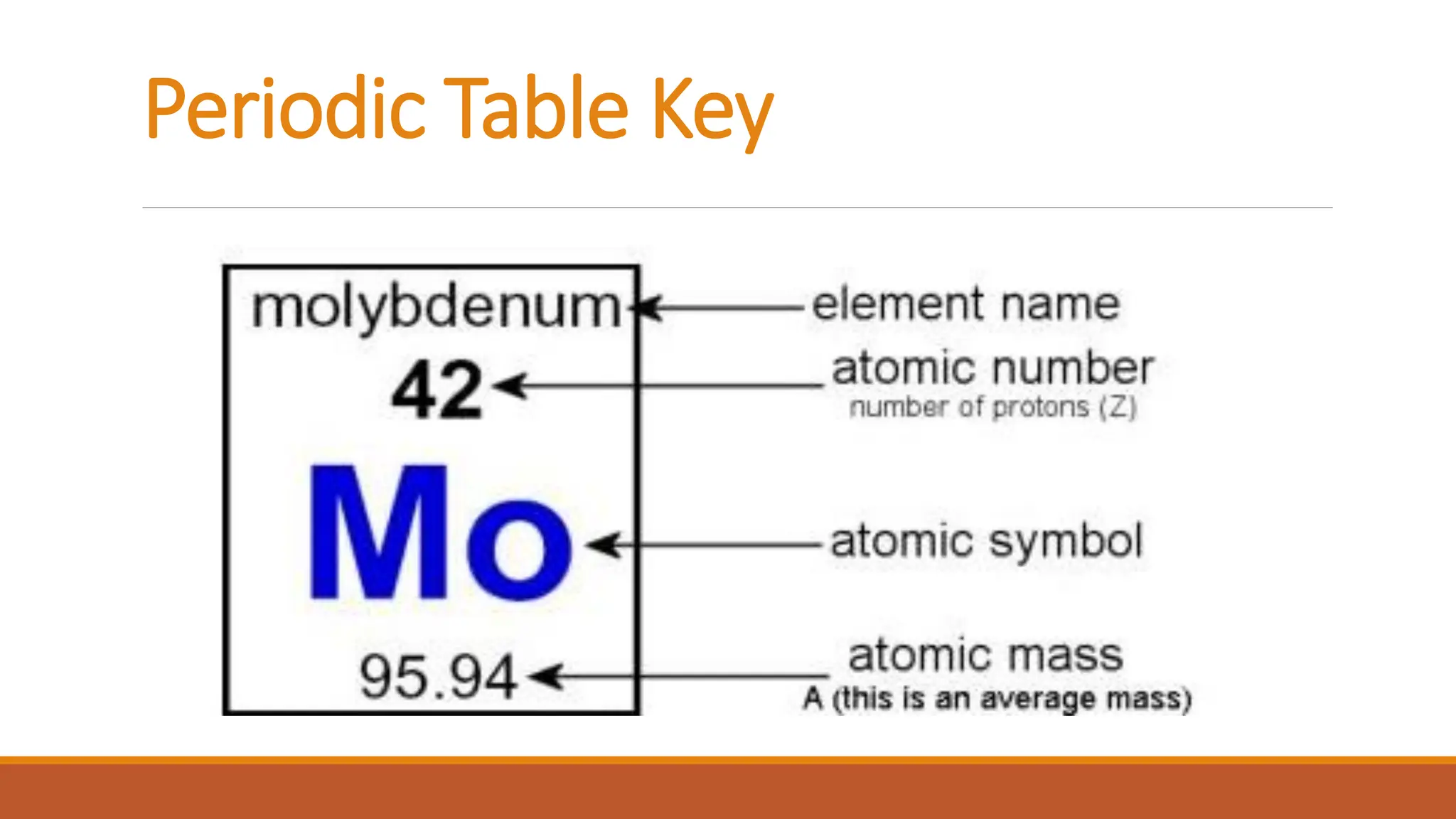
Periodic Table Key
Atomic Symbol
 An atom is identified by two numbers, the atomic number and the
mass number.
1. The ATOMIC NUMBER (Z) is the number of protons in the nucleus
of the atom. The number of protons is always equal to the
number of electrons.
For example:
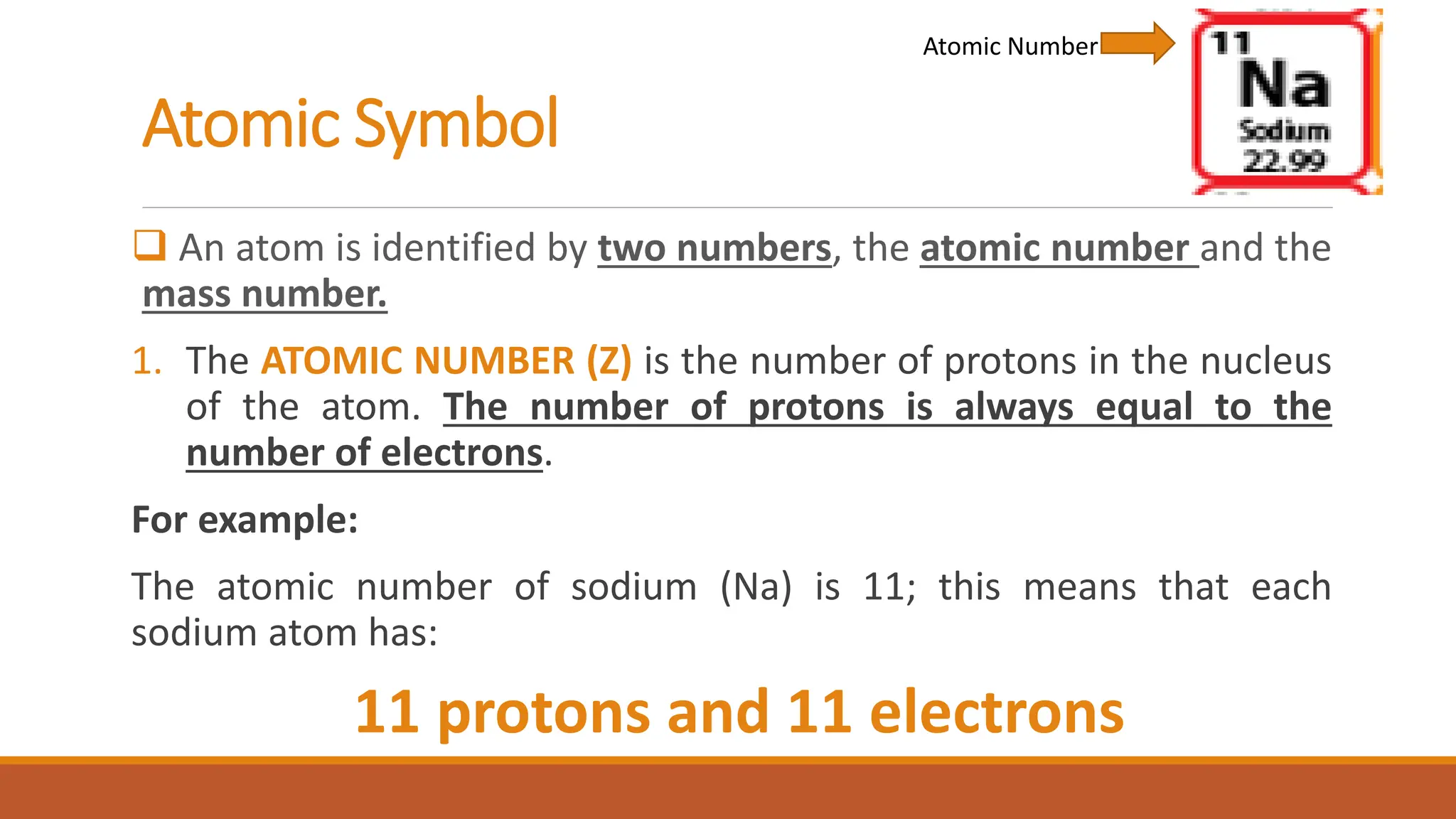
The atomic number of sodium (Na) is 11; this means that each
sodium atom has:
11 protons and 11 electrons
Atomic Number
Example of Protons and Neutrons
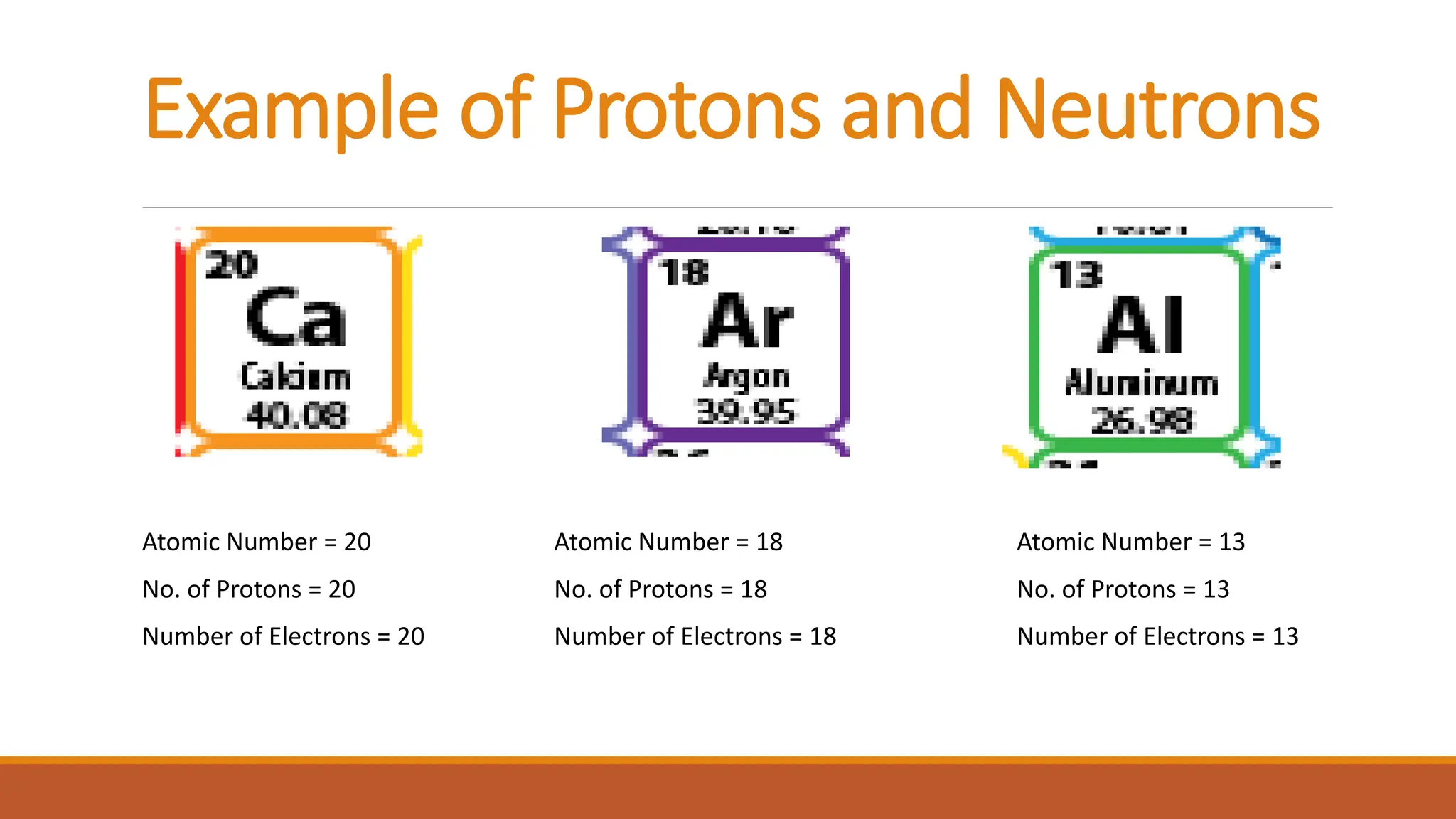
Atomic Number = 20
No. of Protons = 20
Number of Electrons = 20
Atomic Number = 18
No. of Protons = 18
Number of Electrons = 18
Atomic Number = 13
No. of Protons = 13
Number of Electrons = 13
Atomic Symbol
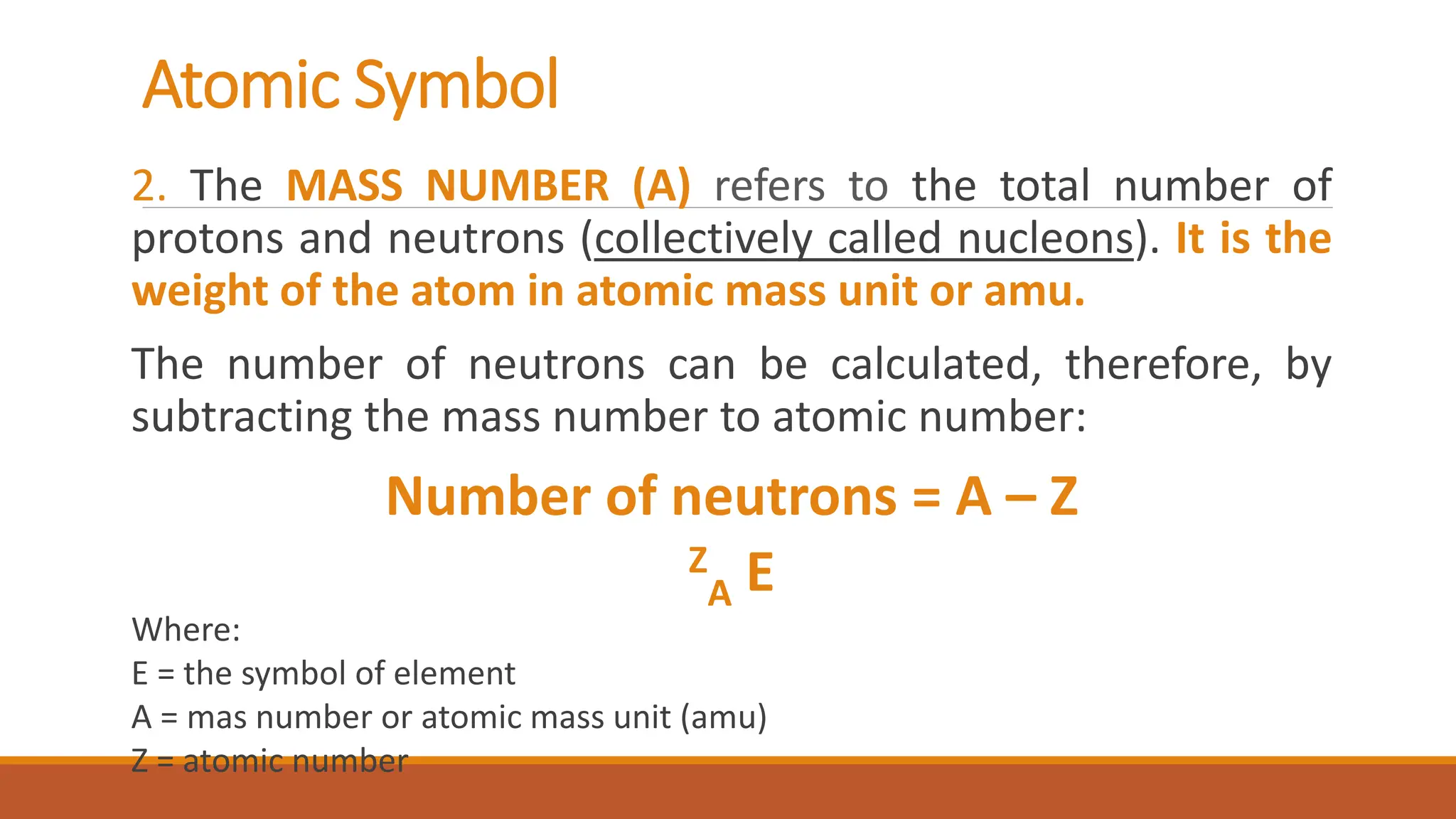
2. The MASS NUMBER (A) refers to the total number of
protons and neutrons (collectively called nucleons). It is the
weight of the atom in atomic mass unit or amu.
The number of neutrons can be calculated, therefore, by
subtracting the mass number to atomic number:
Number of neutrons = A – Z
Z
A E
Where:
E = the symbol of element
A = mas number or atomic mass unit (amu)
Z = atomic number
Number of Neutrons
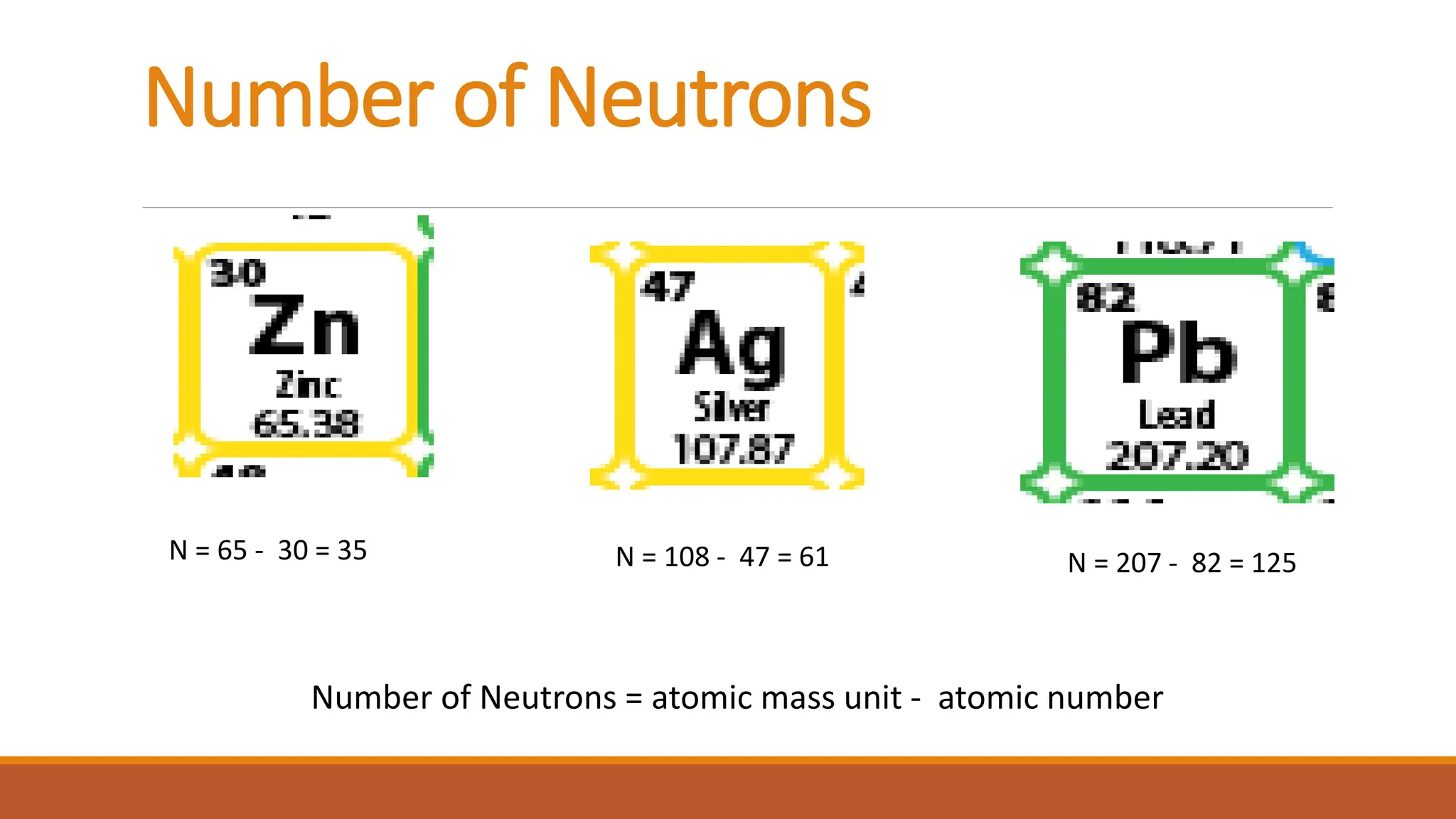
Number of Neutrons = atomic mass unit - atomic number
N = 65 - 30 = 35 N = 108 - 47 = 61 N = 207 - 82 = 125
Seatwork
Time

4. Atomic Structure of elements, Daltons Theory

  • 1.
  • 2.
  • 3.
    Who is Dalton? JohnDalton FRS (6 September 1766 – 27 July 1844) was an English Chemist, Meteorologist and Physicist. He is best known for his pioneering work in the development of modern atomic theory, and his research into colour blindness (sometimes referred to as Daltonism, in his honour).
  • 4.
    Dalton’s Atomic Theory About 400 BC the Greek Philosopher Democritus proposed that all matter is composed of tiny, indivisible particles that he called ATOMS.  Although Democritus’ idea was not acceptable by his contemporaries, notably Plato and Aristotle, his suggestion persisted through the centuries.  Experimental evidence from early scientific investigations provided support for the concept of atom.  However, it was not until 1808 that the English Scientist and school teacher, John Dalton, proposed an atomic theory that marked the beginning of the modern era of chemistry.
  • 5.
    The principal hypothesisof Dalton’s atomic theory are: 1. Matter consists of tiny particles called ATOMS. 2. Atoms cannot be destroyed nor created during a chemical process. 3. Atoms combine in simple whole number ratios to form compounds.
  • 6.
    Subatomic Particles An ATOMis the smallest particle of an element that maintains its chemical identity through all chemical and physical changes. Atoms are therefore all matter, consist principally of three fundamental particles: ELECTRONS, PROTONS and NEUTRONS These are the basic building blocks of all atoms. The symbol, mass, charge and discoverer of each particle are shown in Table below.
  • 7.
    Table 1: FundamentalParticles of the Atom Particle Symbol Mass, amu Mass, g Charge Discoverer Electron e 0.00055 9.109 x 10 -28 1- J.J. Thomson Proton p 1.0073 1.673 x 10 -24 1+ Eugene Goldstein Neutron n 1.0087 1.675 x 10 -24 0 James Chadwick The masses of protons and neutrons, in both the atomic mass units and grams are nearly equal, but the mass of an electron is much smaller. Neutrons carry no charge. The charge on a proton (+) is equal in magnitude but opposite in sign, to the charge on an electron (-).
  • 8.
  • 9.
    Atomic Symbol  Anatom is identified by two numbers, the atomic number and the mass number. 1. The ATOMIC NUMBER (Z) is the number of protons in the nucleus of the atom. The number of protons is always equal to the number of electrons. For example: The atomic number of sodium (Na) is 11; this means that each sodium atom has: 11 protons and 11 electrons Atomic Number
  • 10.
    Example of Protonsand Neutrons Atomic Number = 20 No. of Protons = 20 Number of Electrons = 20 Atomic Number = 18 No. of Protons = 18 Number of Electrons = 18 Atomic Number = 13 No. of Protons = 13 Number of Electrons = 13
  • 11.
    Atomic Symbol 2. TheMASS NUMBER (A) refers to the total number of protons and neutrons (collectively called nucleons). It is the weight of the atom in atomic mass unit or amu. The number of neutrons can be calculated, therefore, by subtracting the mass number to atomic number: Number of neutrons = A – Z Z A E Where: E = the symbol of element A = mas number or atomic mass unit (amu) Z = atomic number
  • 12.
    Number of Neutrons Numberof Neutrons = atomic mass unit - atomic number N = 65 - 30 = 35 N = 108 - 47 = 61 N = 207 - 82 = 125
  • 13.