Download to read offline
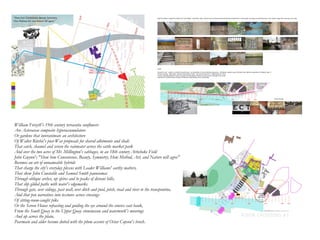
![“A place comes into art loaded with content. An artist comes to a place in one of
two ways: either loaded with content or like a clean slate, ready to receive,
interpret and represent what is already there. If the former, an artist will displace
the resident meanings of a place with his preconceptions about art. If the latter,
(s)he will make those meanings visible as if for the first time.” [Jeff Kelley]](https://image.slidesharecdn.com/mademorningpres-150401081345-conversion-gate01/85/Beyond-the-Gallery-Tamed-Stuart-Mugridge-and-Robert-Colbourne-1-320.jpg)
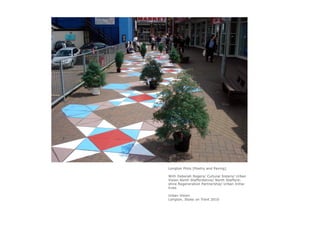
![The crucial issue is not whether but how an artist enters a space."
[Rosalyn Deutsche]](https://image.slidesharecdn.com/mademorningpres-150401081345-conversion-gate01/85/Beyond-the-Gallery-Tamed-Stuart-Mugridge-and-Robert-Colbourne-3-320.jpg)
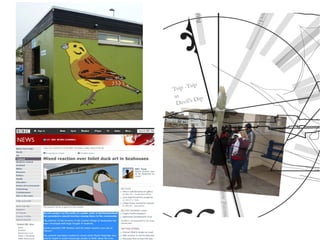
![Breaking with the modernist paradigm, artists of extraterritorial reciprocity
undermine the whole issue of topography inasmuch as they refuse not only
geographical borders but borders of all kinds, including those separating art
from what is not art, from other and sundry social undertakings.
Their artistic practice does not necessarily culminate in the production of
works, but nor is it exclusively process based. Rather, these artists see art as
a system for producing meaning, which is most effective when engaged in
overstepping borders and setting up interdisciplinary 'work sites'
[Stephen Wright]](https://image.slidesharecdn.com/mademorningpres-150401081345-conversion-gate01/85/Beyond-the-Gallery-Tamed-Stuart-Mugridge-and-Robert-Colbourne-5-320.jpg)
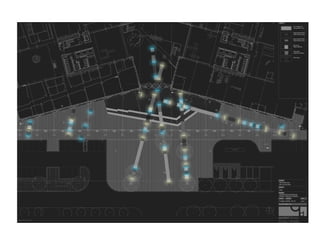
![Maybe you think things are okay and that you are doing ‘all right’.
But someday the monotonous and ugly spaces you live and work in will
be organised as intelligently and as beautifully as the spaces have
been in some paintings. [Ad Reinhardt 28th April 1946]
The best spaces are often the product of creative cross-cutting
between public art and the design professionals, where the continuity
of user experience and expression of place are prioritised over what
separates art from architecture from landscape. [David Patten]](https://image.slidesharecdn.com/mademorningpres-150401081345-conversion-gate01/85/Beyond-the-Gallery-Tamed-Stuart-Mugridge-and-Robert-Colbourne-7-320.jpg)
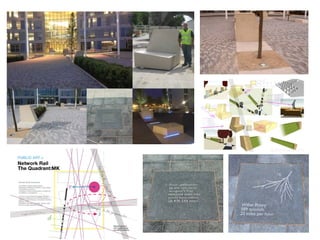
![I will argue that the vast vast majority of artists practicing in the public
realm rely on collaborative, rather than co-optive means of achieving
ideas with the people they work with. [Jack Mackie]](https://image.slidesharecdn.com/mademorningpres-150401081345-conversion-gate01/85/Beyond-the-Gallery-Tamed-Stuart-Mugridge-and-Robert-Colbourne-10-320.jpg)

The document discusses the interaction between artists and their environments, presenting two approaches: artists coming with preconceived notions or as blank slates. It highlights how contemporary artists challenge traditional boundaries between art, geography, and community engagement, advocating for interdisciplinary collaboration in public spaces. The importance of meaningful public art and creative collaboration with design professionals is emphasized, suggesting a future where art enhances everyday environments.


