Macroeconomic
          environment.
                           
 The firm as a Producer in the marketplace , takes
  decisions
 on optimal Production,
 On the Price that it should charge,
 On the Input combination to be employed,
 And , on the Prices that it should buy the inputs at ,
  given the broader environment that it operates in.
 This broader environment is the macroeconomic
  environment.

 It is essential that firms keep a continuous watch
  over the macro environment.
 The Performance of an economy is evaluated by
  considering its Performance indicators.
 Some of these indicators are:
 Aggregate output levels
 Aggregate Price levels
 Aggregate Investment levels
 Aggregate consumption levels
 Balance of Payments

 Each of the above indicators is an aggregate.
 Macro economy is an aggregation of the micro
  entities of households and firms & thus we are
  concerned about national output rather than the
  output of one particular Product ,
 and movements in the overall Price level rather than
  in the Price of any specific commodity.
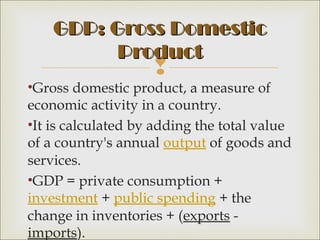
GDP: Gross Domestic
          Product
                    
•Gross domestic product, a measure of
economic activity in a country.
•It is calculated by adding the total value
of a country's annual output of goods and
services.
•GDP = private consumption + 
investment + public spending + the
change in inventories + (exports -
imports).

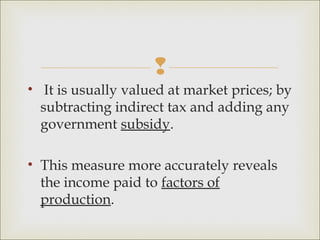
• It is usually valued at market prices; by
  subtracting indirect tax and adding any
  government subsidy.

• This measure more accurately reveals
  the income paid to factors of
  production.
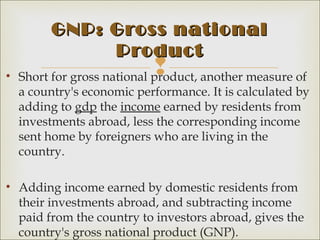
GNP: Gross national
              Product
•                             another measure of
    Short for gross national product,
    a country's economic performance. It is calculated by
    adding to gdp the income earned by residents from
    investments abroad, less the corresponding income
    sent home by foreigners who are living in the
    country.

• Adding income earned by domestic residents from
  their investments abroad, and subtracting income
  paid from the country to investors abroad, gives the
  country's gross national product (GNP).

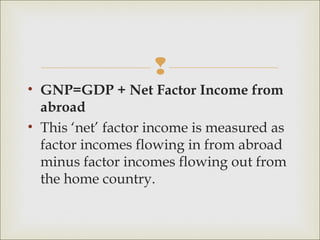
• GNP=GDP + Net Factor Income from
  abroad
• This ‘net’ factor income is measured as
  factor incomes flowing in from abroad
  minus factor incomes flowing out from
  the home country.
Gross Product &Net Product
                       
 If the aggregate value of output is arrived at
  after deducting the depreciation , it is a net
  measure.
 Therefore;
 GDP-Depreciation=Net Domestic Product;
 GNP-Depreciation=Net National Product.

 The Overall Price level is an important indicator of
  the Performance of an economy.
 The method used to aggregate the Prices of different
  commodities is the construction of Index
 There are variety of indices that capture Price
  movement.
 The interest in these movement is due to the effect
  that these movements have on the Purchasing Power
  of money.

 There are three indices that are widely used:

 Consumer Price Index(Cost of Living Index)

   Wholesale Price Index(WPI)

 GDP Deflator
Consumer Price Index:
           
 The CPI Is often used to assess the money outlays
  required to Purchase a basket of consumption goods
  and services.
 This Basket is a representative of the specific group
  of consumers for whom the CPI is being constructed.
 If the basket of goods consumed is significantly
  different for different groups of consumers
 We can have a CPI constructed for each group of
  consumers
 In India there are a CPI for agricultural labourers and
  another is for urban industrial workers.
Wholesale Price Index:
            
 WPI is constructed in a manner similar to CPI , but
  there are differences in the data used as input.
 Differences are:
 The Basket of goods used for the construction of WPI
  is different from the basket of goods used in the case
  of CPI
 The WPI basket includes raw materials used in
  industrial Production ; industrial goods like
  equipments ,machinery ; includes items of food
  category and items in the category of fuel , Power,
  light , and lubricants.

   Thus Main Group Included in the WPI are:
   Primary articles : food, non food , and minerals
   Manufactured Articles
   Fuel , Power, Light, and Lubricants.

 The Prices used are different. The CPI uses retail
  Prices , while the WPI uses wholesale prices.

 The Weights are different.
 For agricultural Products , the value of the
  marketable surplus is used and for
  manufactured Products , the value of
  Production is used.
GDP Deflator:

                            the average Price of
    It refers to the index of
  all the goods and services Produced in the
  economy.
 It is computed as the ratio of the nominal
  GDP in a given year to the real GDP of that
  year.
 The Purpose of GDP deflator is to remove the
  effect of increased Prices in the valuation of
  real GDP
 It is used to know the growth rate of the

Presentation macroeconomic aggregate

  • 2.
    Macroeconomic environment.   The firm as a Producer in the marketplace , takes decisions  on optimal Production,  On the Price that it should charge,  On the Input combination to be employed,  And , on the Prices that it should buy the inputs at , given the broader environment that it operates in.  This broader environment is the macroeconomic environment.
  • 3.
      It isessential that firms keep a continuous watch over the macro environment.  The Performance of an economy is evaluated by considering its Performance indicators.  Some of these indicators are:  Aggregate output levels  Aggregate Price levels  Aggregate Investment levels  Aggregate consumption levels  Balance of Payments
  • 4.
      Each ofthe above indicators is an aggregate.  Macro economy is an aggregation of the micro entities of households and firms & thus we are concerned about national output rather than the output of one particular Product ,  and movements in the overall Price level rather than in the Price of any specific commodity.
  • 5.
    GDP: Gross Domestic Product  •Gross domestic product, a measure of economic activity in a country. •It is calculated by adding the total value of a country's annual output of goods and services. •GDP = private consumption +  investment + public spending + the change in inventories + (exports - imports).
  • 6.
     • It isusually valued at market prices; by subtracting indirect tax and adding any government subsidy. • This measure more accurately reveals the income paid to factors of production.
  • 7.
    GNP: Gross national Product •  another measure of Short for gross national product, a country's economic performance. It is calculated by adding to gdp the income earned by residents from investments abroad, less the corresponding income sent home by foreigners who are living in the country. • Adding income earned by domestic residents from their investments abroad, and subtracting income paid from the country to investors abroad, gives the country's gross national product (GNP).
  • 8.
     • GNP=GDP +Net Factor Income from abroad • This ‘net’ factor income is measured as factor incomes flowing in from abroad minus factor incomes flowing out from the home country.
  • 9.
    Gross Product &NetProduct   If the aggregate value of output is arrived at after deducting the depreciation , it is a net measure.  Therefore;  GDP-Depreciation=Net Domestic Product;  GNP-Depreciation=Net National Product.
  • 10.
      The OverallPrice level is an important indicator of the Performance of an economy.  The method used to aggregate the Prices of different commodities is the construction of Index  There are variety of indices that capture Price movement.  The interest in these movement is due to the effect that these movements have on the Purchasing Power of money.
  • 11.
      There arethree indices that are widely used:  Consumer Price Index(Cost of Living Index)  Wholesale Price Index(WPI)  GDP Deflator
  • 12.
    Consumer Price Index:   The CPI Is often used to assess the money outlays required to Purchase a basket of consumption goods and services.  This Basket is a representative of the specific group of consumers for whom the CPI is being constructed.  If the basket of goods consumed is significantly different for different groups of consumers  We can have a CPI constructed for each group of consumers  In India there are a CPI for agricultural labourers and another is for urban industrial workers.
  • 13.
    Wholesale Price Index:   WPI is constructed in a manner similar to CPI , but there are differences in the data used as input.  Differences are:  The Basket of goods used for the construction of WPI is different from the basket of goods used in the case of CPI  The WPI basket includes raw materials used in industrial Production ; industrial goods like equipments ,machinery ; includes items of food category and items in the category of fuel , Power, light , and lubricants.
  • 14.
      Thus Main Group Included in the WPI are:  Primary articles : food, non food , and minerals  Manufactured Articles  Fuel , Power, Light, and Lubricants.  The Prices used are different. The CPI uses retail Prices , while the WPI uses wholesale prices.
  • 15.
      The Weightsare different.  For agricultural Products , the value of the marketable surplus is used and for manufactured Products , the value of Production is used.
  • 16.
    GDP Deflator:   the average Price of It refers to the index of all the goods and services Produced in the economy.  It is computed as the ratio of the nominal GDP in a given year to the real GDP of that year.  The Purpose of GDP deflator is to remove the effect of increased Prices in the valuation of real GDP  It is used to know the growth rate of the