Economic Policy Problem TOPIC:  MINIMUM WAGEAaron BeyeElliot Haas Shawn HastingsJay Schrade
ECONOMIC PROBLEMMinimum wage raises the total cost for firms, forcing them to reduce levels of employment, which is a major factor  in the current unemployment problem.
PROPOSED SOLUTIONDo away with the minimum wage to boost the employmentof labor in the market. This will decrease unemployment and reduce outsourcing to foreign countries.
Economic Problem of OutsourcingMinimum wage increases has caused firms to move businesses to other countries through outsourcing.  This has lead to greater unemployment and the destruction of low labor jobs in the U.S.
When did outsourcing start?Outsourcing occurred during the 1980’s.This started with the outsourcing of low labor skilled jobs.Occurred because of Reagan's tax system and how it decreased the size of government programs.Is now still occurring but mostly with high skilled labor.
Where has the labor gone?The low skilled labor has gone to China and Mexico.The high skilled labor is currently going to India.With China now starting to become more technologically advanced low skilled labor is starting to move to other Asian countries: such as Malaysia.
Why did outsourcing occur?Companies outsource because the U.S. has higher labor costs than other countries.Here in the U.S. the minimum wage in $7.25 while in china workers work for $1 to $2.Also education levels are rising above the U.S. in other countries, this is why high skilled labor is leaving.Easy to move businesses because no language barrier.
How do we keep jobs here?Abolish the minimum wage so it can settle at equilibrium.Because of increased shipping costs firms will then stay in the U.S. even with a higher wage here in the U.S.Studies show that the wage will settle around $5.
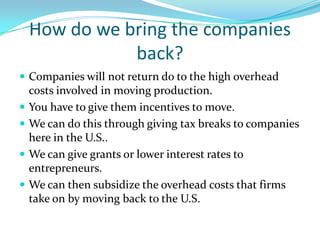
How do we bring the companies back?Companies will not return do to the high overhead costs involved in moving production.You have to give them incentives to move.We can do this through giving tax breaks to companies here in the U.S..We can give grants or lower interest rates to entrepreneurs.We can then subsidize the overhead costs that firms take on by moving back to the U.S.
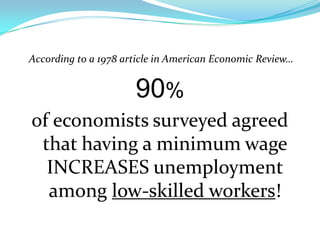
	According to a 1978 article in American Economic Review… 90%of economists surveyed agreed that having a minimum wage INCREASES unemployment among low-skilled workers!
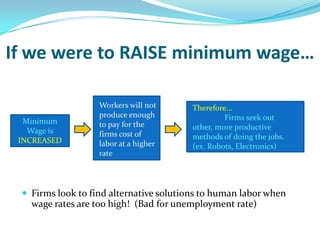
If we were to RAISE minimum wage…Workers will not produce enough to pay for the firms cost of labor at a higher rateTherefore…Firms seek out other, more productive methods of doing the jobs. (ex. Robots, Electronics)Minimum Wage is INCREASEDFirms look to find alternative solutions to human labor when wage rates are too high!  (Bad for unemployment rate)
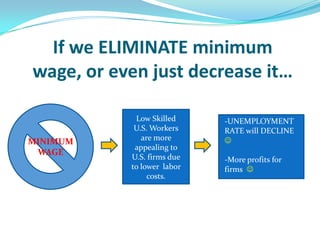
If we ELIMINATE minimum wage, or even just decrease it…MINIMUM WAGELow Skilled U.S. Workers are more appealing to U.S. firms due to lower  labor costs.UNEMPLOYMENT RATE will DECLINE 
More profits for firms  - With the CURRENT minimum wage rate, Illegal immigrants are taken advantage of by paying them below the minimum wage rate, “under the table”, for low skilled jobs. (Hiring, Firing, and Paying without record of transaction)		- One problem with this “under the table” business is that it leads to LESS TAXES PAID BY WORKERS, providing the government with an inadequate amount of tax dollars. 		- Also, this leads to less jobs for low skilled U.S. Citizens who are aware of the minimum wage and desire that rate for a job.Not so obvious PROBLEM in the job market:
THIS policy REDUCES the amount of “Under the Table” labor operations!BENEFITS:Companies will not be as tempted to illegally hire, fire, and pay illegal immigrants with no records of transaction.These low skilled jobs will become more available for “low skilled” U.S. citizens, probably replacing some illegal immigrants that are in the workforce today.
Overall Effects on Low Skilled WorkersFirms will increase use of low skilled laborers More profit for firms, lower unemployment rateLess “Under the Table” payGovernment will receive more income taxes; firms are less likely to take advantage of illegal non-English speaking immigrants when U.S. citizens are willing to work for the same rate
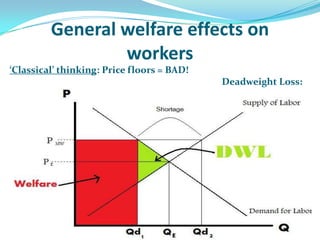
General welfare effects on workers ‘Classical’ thinking: Price floors = BAD!Deadweight Loss:
Ctnd.No consensus in economic academiaMost leaning toward classical thought
Welfare Effects on PoorWhole theoretical idea was to help low-income workersDid it work?Depends on whom you ask, but . . .Minimum wage increases the proportion of families living at or below the poverty line (NSW 2005)Lowers welfare according to all common, traditional welfare measures (GPW 2001)Including the Gini IndexGini = Gap between actual and “equal” distribution of wealth divided by total wealth
ContinuedSome are better offIf they still have a jobSome lose their jobsSome have reduced working timeNet effect of above 3 is a welfare loss for society (NSW 2004)
Some Good ThingsEmployers don’t reduce benefits when minimum wage increases (S&K 2004)Health insurancePensionsHighly inelastic demand for labor can accommodate a minimum wage fairly wellEntirely dependent on the specific market
What Does it All Mean?Let the Market decide!Unionization is good (DFL 1996)Better that unions and firms clash than the government impose a minimum wageMost markets are not uniformOften not even similarHomogeneous standards for a heterogeneous economy will lead to inefficiency and welfare loss
ECONOMIC PROBLEM	Minimum wage raises the total cost for firms, forcing them to reduce levels of employment, which is a major factor in the current unemployment problem.PROPOSED SOLUTIONDo away with the minimum wage to increase competitiveness with foreign markets and boost the employmentof labor in the market.
WHY PROPOSAL SHOULD BE CARRIED OUT Abolition of the minimum wage will bring jobs back to the United States
Minimum wage has adverse effects on low-skilled workers
The supposed benefits of the minimum wage are not so greatBibliographyKanellos, Michael. "How clean tech will bring manufacturing jobs back to U.S.." CNET News. Nov. 1 2007. News blog, Web. 9 Nov 2009. <http://news.cnet.com/8301-10784_3-9808686-7.html>. Engardio, Pete. "Can the U.S. bring jobs back from China?." BusinessWeek. June 19, 2008. Mcgraw-Hill, Web. 9 Nov 2009. <http://www.businessweek.com/magazine/content/08_26/b4090038429655.htm>.McCormack, Richard. "Good luck competing against Chinese Labor Costs." Manufacturing and Technology News. May 2, 2006. Publishers and Producers, Web. 9 Nov 2009. <http://www.manufacturingnews.com/news/06/0502/art1.html>. Constitutional Rights Foundation. summer 2005. Web. 9 Nov 2009. <http://www.crf-usa.org/bill-of-rights-in-action/bria-21-3-c.html>. Seader, David. "The United States' experience with outsourcing, privatization and public- private partnerships." The national council for Public-Private Partnerships, Web. 9 Nov 2009. <www.ncppp.org>. LeVan, David. "Outsourcing Property Taxes to the United States." A Tax to Grind. Oct. 8 2009. Advantax group, Web. 9 Nov 2009. <http://www.advantax.com/ATaxToGrind/post/2009/10/08/Outsourcing-Property-Taxes-to-the-United-States.aspx>. Brownfeld, Peter. "White House Under Fire for Outsourcing Proposal." Fox News. Feb 13,2004. Associated Press, Web. 9 Nov 2009. <http://www.foxnews.com/story/0,2933,111287,00.html>. Williams, Walter E.  “The Minimum Wage Vision”, August 9, 2006.Kearl, J. R., et al., “A Confusion of Economists?” American Economic Review 69 (1979): 28–37.

Economic Policy Proposal (Minimum Wage)

  • 1.
    Economic Policy ProblemTOPIC: MINIMUM WAGEAaron BeyeElliot Haas Shawn HastingsJay Schrade
  • 2.
    ECONOMIC PROBLEMMinimum wageraises the total cost for firms, forcing them to reduce levels of employment, which is a major factor in the current unemployment problem.
  • 3.
    PROPOSED SOLUTIONDo awaywith the minimum wage to boost the employmentof labor in the market. This will decrease unemployment and reduce outsourcing to foreign countries.
  • 4.
    Economic Problem ofOutsourcingMinimum wage increases has caused firms to move businesses to other countries through outsourcing. This has lead to greater unemployment and the destruction of low labor jobs in the U.S.
  • 5.
    When did outsourcingstart?Outsourcing occurred during the 1980’s.This started with the outsourcing of low labor skilled jobs.Occurred because of Reagan's tax system and how it decreased the size of government programs.Is now still occurring but mostly with high skilled labor.
  • 6.
    Where has thelabor gone?The low skilled labor has gone to China and Mexico.The high skilled labor is currently going to India.With China now starting to become more technologically advanced low skilled labor is starting to move to other Asian countries: such as Malaysia.
  • 7.
    Why did outsourcingoccur?Companies outsource because the U.S. has higher labor costs than other countries.Here in the U.S. the minimum wage in $7.25 while in china workers work for $1 to $2.Also education levels are rising above the U.S. in other countries, this is why high skilled labor is leaving.Easy to move businesses because no language barrier.
  • 8.
    How do wekeep jobs here?Abolish the minimum wage so it can settle at equilibrium.Because of increased shipping costs firms will then stay in the U.S. even with a higher wage here in the U.S.Studies show that the wage will settle around $5.
  • 9.
    How do webring the companies back?Companies will not return do to the high overhead costs involved in moving production.You have to give them incentives to move.We can do this through giving tax breaks to companies here in the U.S..We can give grants or lower interest rates to entrepreneurs.We can then subsidize the overhead costs that firms take on by moving back to the U.S.
  • 10.
    According to a1978 article in American Economic Review… 90%of economists surveyed agreed that having a minimum wage INCREASES unemployment among low-skilled workers!
  • 11.
    If we wereto RAISE minimum wage…Workers will not produce enough to pay for the firms cost of labor at a higher rateTherefore…Firms seek out other, more productive methods of doing the jobs. (ex. Robots, Electronics)Minimum Wage is INCREASEDFirms look to find alternative solutions to human labor when wage rates are too high! (Bad for unemployment rate)
  • 12.
    If we ELIMINATEminimum wage, or even just decrease it…MINIMUM WAGELow Skilled U.S. Workers are more appealing to U.S. firms due to lower labor costs.UNEMPLOYMENT RATE will DECLINE 
  • 13.
    More profits forfirms - With the CURRENT minimum wage rate, Illegal immigrants are taken advantage of by paying them below the minimum wage rate, “under the table”, for low skilled jobs. (Hiring, Firing, and Paying without record of transaction) - One problem with this “under the table” business is that it leads to LESS TAXES PAID BY WORKERS, providing the government with an inadequate amount of tax dollars. - Also, this leads to less jobs for low skilled U.S. Citizens who are aware of the minimum wage and desire that rate for a job.Not so obvious PROBLEM in the job market:
  • 14.
    THIS policy REDUCESthe amount of “Under the Table” labor operations!BENEFITS:Companies will not be as tempted to illegally hire, fire, and pay illegal immigrants with no records of transaction.These low skilled jobs will become more available for “low skilled” U.S. citizens, probably replacing some illegal immigrants that are in the workforce today.
  • 15.
    Overall Effects onLow Skilled WorkersFirms will increase use of low skilled laborers More profit for firms, lower unemployment rateLess “Under the Table” payGovernment will receive more income taxes; firms are less likely to take advantage of illegal non-English speaking immigrants when U.S. citizens are willing to work for the same rate
  • 16.
    General welfare effectson workers ‘Classical’ thinking: Price floors = BAD!Deadweight Loss:
  • 17.
    Ctnd.No consensus ineconomic academiaMost leaning toward classical thought
  • 18.
    Welfare Effects onPoorWhole theoretical idea was to help low-income workersDid it work?Depends on whom you ask, but . . .Minimum wage increases the proportion of families living at or below the poverty line (NSW 2005)Lowers welfare according to all common, traditional welfare measures (GPW 2001)Including the Gini IndexGini = Gap between actual and “equal” distribution of wealth divided by total wealth
  • 19.
    ContinuedSome are betteroffIf they still have a jobSome lose their jobsSome have reduced working timeNet effect of above 3 is a welfare loss for society (NSW 2004)
  • 20.
    Some Good ThingsEmployersdon’t reduce benefits when minimum wage increases (S&K 2004)Health insurancePensionsHighly inelastic demand for labor can accommodate a minimum wage fairly wellEntirely dependent on the specific market
  • 21.
    What Does itAll Mean?Let the Market decide!Unionization is good (DFL 1996)Better that unions and firms clash than the government impose a minimum wageMost markets are not uniformOften not even similarHomogeneous standards for a heterogeneous economy will lead to inefficiency and welfare loss
  • 22.
    ECONOMIC PROBLEM Minimum wageraises the total cost for firms, forcing them to reduce levels of employment, which is a major factor in the current unemployment problem.PROPOSED SOLUTIONDo away with the minimum wage to increase competitiveness with foreign markets and boost the employmentof labor in the market.
  • 23.
    WHY PROPOSAL SHOULDBE CARRIED OUT Abolition of the minimum wage will bring jobs back to the United States
  • 24.
    Minimum wage hasadverse effects on low-skilled workers
  • 25.
    The supposed benefitsof the minimum wage are not so greatBibliographyKanellos, Michael. "How clean tech will bring manufacturing jobs back to U.S.." CNET News. Nov. 1 2007. News blog, Web. 9 Nov 2009. <http://news.cnet.com/8301-10784_3-9808686-7.html>. Engardio, Pete. "Can the U.S. bring jobs back from China?." BusinessWeek. June 19, 2008. Mcgraw-Hill, Web. 9 Nov 2009. <http://www.businessweek.com/magazine/content/08_26/b4090038429655.htm>.McCormack, Richard. "Good luck competing against Chinese Labor Costs." Manufacturing and Technology News. May 2, 2006. Publishers and Producers, Web. 9 Nov 2009. <http://www.manufacturingnews.com/news/06/0502/art1.html>. Constitutional Rights Foundation. summer 2005. Web. 9 Nov 2009. <http://www.crf-usa.org/bill-of-rights-in-action/bria-21-3-c.html>. Seader, David. "The United States' experience with outsourcing, privatization and public- private partnerships." The national council for Public-Private Partnerships, Web. 9 Nov 2009. <www.ncppp.org>. LeVan, David. "Outsourcing Property Taxes to the United States." A Tax to Grind. Oct. 8 2009. Advantax group, Web. 9 Nov 2009. <http://www.advantax.com/ATaxToGrind/post/2009/10/08/Outsourcing-Property-Taxes-to-the-United-States.aspx>. Brownfeld, Peter. "White House Under Fire for Outsourcing Proposal." Fox News. Feb 13,2004. Associated Press, Web. 9 Nov 2009. <http://www.foxnews.com/story/0,2933,111287,00.html>. Williams, Walter E. “The Minimum Wage Vision”, August 9, 2006.Kearl, J. R., et al., “A Confusion of Economists?” American Economic Review 69 (1979): 28–37.