Machine Learning : Stock
Price Prediction
Programming Techniques
Professor Carlos Costa
Master in Mathematical Finance
Diogo Bessa l53238
Iñigo Resco l53010
João Salgado l53231
Introduction
 Financial markets are essentially made by buying and selling
several types of financial instruments but it is also a complex and
dynamic system
 One of the hottest topics in financial markets is the stocks
 It is complicated to make the predictions of the stock price and
how it is going to move
 Few methods have been performed:
 Technical analysis (multiple regression types)
 Fundamental analysis
Objective
 The goal is to predict if the price of the stock in the following
week it is higher or lower according to the current week
 We used the Logistic Regression to give us the signal if the
price goes up (1) or goes down (-1)
 Our approach was based on choosing a sample, training our
model on it and testing the accuracy of it
Data:
Given variables
• Open
• Close
• High
• Low
• Volume
New variables
• m10
• Corr
• Open - Close (-1)
• Open - Open (-1)
• EMA
• ROC
 SP500  2010-2019, weekly
 Correlation analysis  not very interesting in
the approach
 Log regression (70-30 split)
 (70%) Training: Estimation, modelling
 (30%) Test: Testing the model
Model:
 Logistic regression
 Ability to make predictions on the dependent variable
 Train dataset
 Good estimator for a certain event occurring (M. Likelihood)
 Predicting class probs (P)  Dependent variable outcomes forced to
[-1 or 1]
 Model score and coefficients
𝑝 =
ex p( 𝛽0 + 𝑖=1
𝑝
𝛽𝑖 𝑋𝑖
1 + ex p( 𝛽0 + 𝑖=1
𝑝
𝛽𝑖 𝑋𝑖
Testing
 Predict p and force to [-1 or 1]
 Actual vs prediction  ACCURACY
Analysis of Classification report:
 Precision: number of true positives over
the number of true positives plus the
number of false positives.
 Recall: number of true positives over the
number of true positives plus the number
of false negatives.
 F1: weighted average of the precision and
recall F1 = 2 * (precision * recall) /
(precision + recall)
Testing
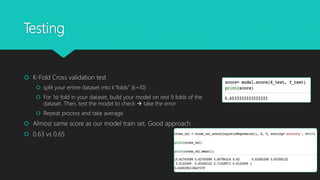
 K-Fold Cross validation test
 split your entire dataset into k”folds” (k=10)
 For 1st fold in your dataset, build your model on rest 9 folds of the
dataset. Then, test the model to check  take the error
 Repeat process and take average
 Almost same score as our model train set. Good approach
 0.63 vs 0.65
Results
Confusion matrix :
 Describes the performance of the model on the
test dataset for which the actual values are known
 (n=150)
 TP: 36
 TN: 62
 Acc= (36+62)/150 = 0.65
Results
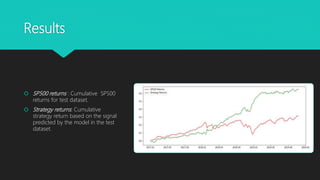
 SP500 returns : Cumulative SP500
returns for test dataset.
 Strategy returns: Cumulative
strategy return based on the signal
predicted by the model in the test
dataset.
Conclusion
Our approach has a low
complexity and is easy to
understand or realize
The accuracy of the model
tell us the model’s
performance is good
Our strategy outperforms
the SP500 “long only”
traditional strategy
Can be used for further
future uses

Machine learning: Stock Price Prediction

  • 1.
    Machine Learning :Stock Price Prediction Programming Techniques Professor Carlos Costa Master in Mathematical Finance Diogo Bessa l53238 Iñigo Resco l53010 João Salgado l53231
  • 2.
    Introduction  Financial marketsare essentially made by buying and selling several types of financial instruments but it is also a complex and dynamic system  One of the hottest topics in financial markets is the stocks  It is complicated to make the predictions of the stock price and how it is going to move  Few methods have been performed:  Technical analysis (multiple regression types)  Fundamental analysis
  • 3.
    Objective  The goalis to predict if the price of the stock in the following week it is higher or lower according to the current week  We used the Logistic Regression to give us the signal if the price goes up (1) or goes down (-1)  Our approach was based on choosing a sample, training our model on it and testing the accuracy of it
  • 4.
    Data: Given variables • Open •Close • High • Low • Volume New variables • m10 • Corr • Open - Close (-1) • Open - Open (-1) • EMA • ROC  SP500  2010-2019, weekly  Correlation analysis  not very interesting in the approach  Log regression (70-30 split)  (70%) Training: Estimation, modelling  (30%) Test: Testing the model
  • 5.
    Model:  Logistic regression Ability to make predictions on the dependent variable  Train dataset  Good estimator for a certain event occurring (M. Likelihood)  Predicting class probs (P)  Dependent variable outcomes forced to [-1 or 1]  Model score and coefficients 𝑝 = ex p( 𝛽0 + 𝑖=1 𝑝 𝛽𝑖 𝑋𝑖 1 + ex p( 𝛽0 + 𝑖=1 𝑝 𝛽𝑖 𝑋𝑖
  • 6.
    Testing  Predict pand force to [-1 or 1]  Actual vs prediction  ACCURACY Analysis of Classification report:  Precision: number of true positives over the number of true positives plus the number of false positives.  Recall: number of true positives over the number of true positives plus the number of false negatives.  F1: weighted average of the precision and recall F1 = 2 * (precision * recall) / (precision + recall)
  • 7.
    Testing  K-Fold Crossvalidation test  split your entire dataset into k”folds” (k=10)  For 1st fold in your dataset, build your model on rest 9 folds of the dataset. Then, test the model to check  take the error  Repeat process and take average  Almost same score as our model train set. Good approach  0.63 vs 0.65
  • 8.
    Results Confusion matrix : Describes the performance of the model on the test dataset for which the actual values are known  (n=150)  TP: 36  TN: 62  Acc= (36+62)/150 = 0.65
  • 9.
    Results  SP500 returns: Cumulative SP500 returns for test dataset.  Strategy returns: Cumulative strategy return based on the signal predicted by the model in the test dataset.
  • 10.
    Conclusion Our approach hasa low complexity and is easy to understand or realize The accuracy of the model tell us the model’s performance is good Our strategy outperforms the SP500 “long only” traditional strategy Can be used for further future uses