SUPORT VECTOR MACHINE –SVM
Nilanjana Pradhan
 SVMs are linear classifiers that find a hyperplane to
separate two class of data, positive and negative.
 A support vector machine (SVM) is a
supervised machine learning model that uses
classification algorithms for two-group classification
problems.
 After giving an SVM model sets of labeled training
data for each category, they’re able to categorize
new text.
3
ANOTHER APPLICATION
 A credit card company receives thousands of
applications for new cards. Each application
contains information about an applicant,
 age
 Marital status
 annual salary
 outstanding debts
 credit rating
 etc.
 Problem: to decide whether an application should
approved, or to classify applications into two
categories, approved and not approved.
AN EXAMPLE OF THE APPLICATION
 An emergency room in a hospital measures 17
variables (e.g., blood pressure, age, etc) of newly
admitted patients.
 A decision is needed: whether to put a new
patient in an intensive-care unit.
 Due to the high cost of ICU, those patients who
may survive less than a month are given higher
priority.
 Problem: to predict high-risk patients and
discriminate them from low-risk patients.
TEXT AND HYPERTEXT CATEGORIZATION
 Allows text and hypertext categorization.
 It Uses training data to classify documents into
different categories such as news articles,
e-mails, and web pages
EXAMPLES:
 Classification of news articles into “business” and
“Movies”
 Classification of web pages into personal home
pages and others
 For each document, calculate a score and compare
it with a predefined threshold value.
 When the score of a document surpasses threshold
value, then the document is classified into a definite
category.
 If it does not surpass threshold value then consider
it as a general document.
 Classify new instances by computing score for each
document and comparing it with the learned
threshold.
 Many marketing problems require accurately
predicting the outcome of a process or the future
state of a system.
 Support vector machine is used to predict
outcomes in emerging environments in marketing,
such as automated modeling, mass-produced
models, intelligent software agents, and data
mining.
HOW DOES SVM WORK?
 The basics of Support Vector Machines and how it
works are best understood with a simple example.
 Let’s imagine we have two tags: red and blue, and
our data has two features: x and y.
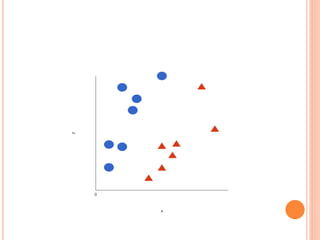
 We want a classifier that, given a pair
of (x,y) coordinates, outputs if it’s either red _or
_blue. We plot our already labeled training data on
a plane:
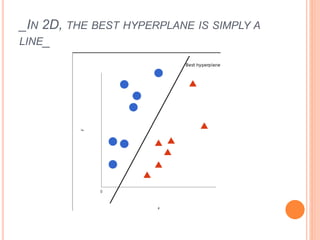
 A support vector machine takes these data points
and outputs the hyperplane (which in two
dimensions it’s simply a line) that best separates
the tags. This line is the decision boundary:
anything that falls to one side of it we will classify
as blue, and anything that falls to the other as red.
_IN 2D, THE BEST HYPERPLANE IS SIMPLY A
LINE_
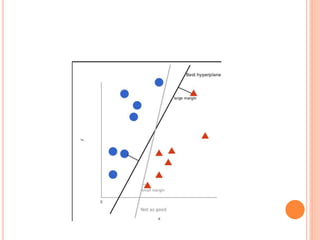
 But, what exactly is the best hyperplane? For SVM,
it’s the one that maximizes the margins from both
tags. In other words: the hyperplane (remember it's
a line in this case) whose distance to the nearest
element of each tag is the largest.
 So, what is linear regression?
 Simply put, machines need to be supervised in
order to effectively learn new things.
 Linear regression is a machine
learning algorithm that enables this.
 The biggest ability of machines is that they can
learn about the problem and execute solutions
seamlessly. This greatly reduces and eliminates
human error.
 It is also used to find the relationship between
forecasting and variables. A task is performed
based on a dependable variable by analyzing the
impact of an independent variable on it. Those
proficient in programming software such as Python,
C can sci-kit learn the library to import the linear
regression model or create their own custom
algorithm before applying it to the machines.
 Forecasting
A top advantage of using a linear regression model in
machine learning is the ability to forecast trends and
make predictions that are feasible.
 Data scientists can use these predictions and make
further deductions based on machine learning. It is
quick, efficient, and accurate.
 This is predominantly since machines process large
volumes of data and there is minimum human
intervention. Once the algorithm is established, the
process of learning becomes simplified.
 Beneficial to small businesses
By altering one or two variables, machines can
understand the impact on sales.
 Since deploying linear regression is cost-effective, it is
greatly advantageous to small businesses since short-
and long-term forecasts can be made when it comes to
sales.
 This means that small businesses can plan their
resources well and create a growth trajectory for
themselves.
 They will also be to understand the market and its
preferences and learn about supply and demand.
 Preparing Strategies
Since machine learning enables prediction, one of
the biggest advantages of a linear regression model
in it is the ability to prepare a strategy for a given
situation, well in advance, and analyze various
outcomes.
 Meaningful information can be derived from the
regression model of forecasting thereby helping
companies plan strategically and make executive
decisions.
THANK YOU

Support Vector Machine

  • 1.
    SUPORT VECTOR MACHINE–SVM Nilanjana Pradhan
  • 2.
     SVMs arelinear classifiers that find a hyperplane to separate two class of data, positive and negative.  A support vector machine (SVM) is a supervised machine learning model that uses classification algorithms for two-group classification problems.  After giving an SVM model sets of labeled training data for each category, they’re able to categorize new text.
  • 3.
    3 ANOTHER APPLICATION  Acredit card company receives thousands of applications for new cards. Each application contains information about an applicant,  age  Marital status  annual salary  outstanding debts  credit rating  etc.  Problem: to decide whether an application should approved, or to classify applications into two categories, approved and not approved.
  • 4.
    AN EXAMPLE OFTHE APPLICATION  An emergency room in a hospital measures 17 variables (e.g., blood pressure, age, etc) of newly admitted patients.  A decision is needed: whether to put a new patient in an intensive-care unit.  Due to the high cost of ICU, those patients who may survive less than a month are given higher priority.  Problem: to predict high-risk patients and discriminate them from low-risk patients.
  • 5.
    TEXT AND HYPERTEXTCATEGORIZATION  Allows text and hypertext categorization.  It Uses training data to classify documents into different categories such as news articles, e-mails, and web pages
  • 6.
    EXAMPLES:  Classification ofnews articles into “business” and “Movies”  Classification of web pages into personal home pages and others  For each document, calculate a score and compare it with a predefined threshold value.  When the score of a document surpasses threshold value, then the document is classified into a definite category.
  • 7.
     If itdoes not surpass threshold value then consider it as a general document.  Classify new instances by computing score for each document and comparing it with the learned threshold.
  • 8.
     Many marketingproblems require accurately predicting the outcome of a process or the future state of a system.  Support vector machine is used to predict outcomes in emerging environments in marketing, such as automated modeling, mass-produced models, intelligent software agents, and data mining.
  • 9.
    HOW DOES SVMWORK?  The basics of Support Vector Machines and how it works are best understood with a simple example.  Let’s imagine we have two tags: red and blue, and our data has two features: x and y.
  • 10.
     We wanta classifier that, given a pair of (x,y) coordinates, outputs if it’s either red _or _blue. We plot our already labeled training data on a plane:
  • 12.
     A supportvector machine takes these data points and outputs the hyperplane (which in two dimensions it’s simply a line) that best separates the tags. This line is the decision boundary: anything that falls to one side of it we will classify as blue, and anything that falls to the other as red.
  • 13.
    _IN 2D, THEBEST HYPERPLANE IS SIMPLY A LINE_
  • 14.
     But, whatexactly is the best hyperplane? For SVM, it’s the one that maximizes the margins from both tags. In other words: the hyperplane (remember it's a line in this case) whose distance to the nearest element of each tag is the largest.
  • 16.
     So, whatis linear regression?  Simply put, machines need to be supervised in order to effectively learn new things.  Linear regression is a machine learning algorithm that enables this.  The biggest ability of machines is that they can learn about the problem and execute solutions seamlessly. This greatly reduces and eliminates human error.
  • 17.
     It isalso used to find the relationship between forecasting and variables. A task is performed based on a dependable variable by analyzing the impact of an independent variable on it. Those proficient in programming software such as Python, C can sci-kit learn the library to import the linear regression model or create their own custom algorithm before applying it to the machines.
  • 18.
     Forecasting A topadvantage of using a linear regression model in machine learning is the ability to forecast trends and make predictions that are feasible.  Data scientists can use these predictions and make further deductions based on machine learning. It is quick, efficient, and accurate.  This is predominantly since machines process large volumes of data and there is minimum human intervention. Once the algorithm is established, the process of learning becomes simplified.
  • 19.
     Beneficial tosmall businesses By altering one or two variables, machines can understand the impact on sales.  Since deploying linear regression is cost-effective, it is greatly advantageous to small businesses since short- and long-term forecasts can be made when it comes to sales.  This means that small businesses can plan their resources well and create a growth trajectory for themselves.  They will also be to understand the market and its preferences and learn about supply and demand.
  • 20.
     Preparing Strategies Sincemachine learning enables prediction, one of the biggest advantages of a linear regression model in it is the ability to prepare a strategy for a given situation, well in advance, and analyze various outcomes.  Meaningful information can be derived from the regression model of forecasting thereby helping companies plan strategically and make executive decisions.
  • 21.