Download to read offline
![International Research Journal of Engineering and Technology (IRJET) e-ISSN: 2395-0056
Volume: 09 Issue: 05 | May 2022 www.irjet.net p-ISSN: 2395-0072
© 2022, IRJET | Impact Factor value: 7.529 | ISO 9001:2008 Certified Journal | Page 2080
M-Learners Performance Using Intelligence and Adaptive E-Learning
Classify the Deep Learning Approaches
Rajalakshmi T1, Kaleeswari S2, Dr. Jai Ruby3, Mrs. E. Julie Ruth4
1, 2PG Scholar, Department of Computer Applications and Research Centre, Sarah Tucker College (Autonomous),
Tirunelveli, Tamil Nadu, India
3Associate Professor, Department of Computer Applications and Research Centre, Sarah Tucker College
(Autonomous), Tirunelveli, Tamil Nadu, India
4Assistant Professor, Department of Computer Applications and Research Centre, Sarah Tucker College
(Autonomous), Tirunelveli, Tamil Nadu, India
---------------------------------------------------------------------***---------------------------------------------------------------------
Abstract - Data mining techniques may assist in closingthe
knowledge gap in higher education. The data mining process
aids in the improvement of educational efficiency. To increase
student accomplishment, data mining techniques such as
classification, association rule mining, clustering, prediction,
and so on are applied. It aids in the management of their life
cycle and the course selection. Classification is a crucial data
mining process that may be used to great advantage in
educational data. The implementation of a classification
algorithm in education data mining is the topic of this
research. The comparison research was carriedoutinorderto
forecast a student's academic achievement based on
socioeconomic variables, previous test marks, and other
factors connected to student performance. The experiment
used the J48, Nave Bayes, Bayes Net, Back Propagation
Network, and Radial Basis Function Network classification
algorithms. The Radial Basis Function Network properly
classified 100% of the instances, which is a high percentage
when compared to other classifiers.
Key Words: RBF Network, Naïve Bayes, Multilayer
Perceptron, J48 algorithm, Educational Data Mining,
Classification, WEKA
1. INTRODUCTION
The application of the data mining method to educational
data is known as educational data mining (EDM). An EDM's
goal is to examine educational data in order to enhance the
performance of teachers, students, and educational
institutions. For the benefit of learners, EDM blends
computational theory, database management, and machine
learning. Because education is so vital in every community,
data mining researchers concentrate on EDM, which has
evolved as a study subject in recent years. Data oneducation
has been gathered from numerous educational surveys and
school records, and data mining techniques like
categorization may be used to enhance academic
achievement. One of the most important requirements for
successful education is student performance. Data mining is
required in education for the benefit of students and
academics. Educational data miningisa setofapproachesfor
extracting new information from educational data, which
may be used to better anticipate student behaviour,
academic achievement, and topic interest, among other
things [1-3]. Figure 1 illustrates the educational data mining
system.
Fig -1: Educational Data Mining System
The figure above depicts the requirement for EDM. In EDM,
all forms of education are considered educational systems,
including conventional classrooms, E-learning systems,
intelligent and adaptable web-based educational systems,
and so on. As an input to the data mining process, task-
relevant data is supplied. During the data mining process,
you may choose a task-specific data-mining approach. The
information and patterns generated by data miningareused
by students, academics, and educators.Thismechanism may
be used to make student recommendations. Academics and
educators sought to enhance theeducational systeminorder
to increase student performance. The information gathered
may be used to enhance the educational system through
organizing courses, academic activities, and student use [2-
5].
2. RELATED RESEARCH
The academic institution must be able to forecast student
academic achievement in order to increase student
performance. Educational data mining has the potential to
help predict student success. As a result, educational data
mining researchers assisted in the development of
supervised learning approaches for predicting student](https://image.slidesharecdn.com/irjet-v9i5514-221005094730-3bd5ff66/85/M-Learners-Performance-Using-Intelligence-and-Adaptive-E-Learning-Classify-the-Deep-Learning-Approaches-1-320.jpg)
![International Research Journal of Engineering and Technology (IRJET) e-ISSN: 2395-0056
Volume: 09 Issue: 05 | May 2022 www.irjet.net p-ISSN: 2395-0072
© 2022, IRJET | Impact Factor value: 7.529 | ISO 9001:2008 Certified Journal | Page 2081
performance. This section will provide a quick overview of
the categorization techniques used to forecast student
performance.
For the prediction of student performance, Kabakchieva [6]
used the decision tree, Bayesian classification, closest
neighbour, and two rule learners (OneR and JRip). The
decision tree classifier (J48) is the most accurate (with the
greatest overall accuracy), followed by the rule learner
(JRip) and the k-NN classifier. The Bayes classifiers aren't as
good as the others. However, all of the examined classifiers
have an overall accuracy of less than70%,indicatingthatthe
error rate is large and the predictions are unreliable.
Norlida et al. [7] used a data mining approach to predict
engineering student performance.Thestudent'ssuccesswas
predicted and classified using the Cumulative Grade Point
(CGPA). This research provided an overview of Neuro-fuzzy
categorization.
Al-Saleem et al. [8] built a performance prediction model
based on prior students' academic records and established
categorization procedures.Themodel wasconstructedusing
decision tree classifications such as ID3 and J48. With the
integration of this model and recommender system, it may
assist students in course selection based on theirgraduating
students' grades.
For the extraction of valuable information, Devasia et al. [9]
used the Nave Bayesian mining approach. The experiment
used a database of 700 students with 19 characteristics.
Nave Bayesian classification was shown to be moreaccurate
than Regression, Decision Trees, and Neural Networks.
For the prediction of a student's academic achievement,
Hamsa et al. [10] used a decision tree and a fuzzy genetic
algorithm. These models were evaluated using internal
marks, sessional marks, and admission scores. The concept
divides pupils into two groups: safe and risk. When
compared to a fuzzy genetic algorithm, the data
demonstrates that decision trees identify more students in
the danger group.
Daud et al. [11] provided a strategy for forecasting student
performance using advanced learning analytics. The
expenditures of the family and the personal information of
the students were evaluated in this research. The
experimental study used the support vector machine, C4.5,
Classification and Regression Tree (CART), Bayes Network,
and Nave Bayes methods. The resultsreveal thatthesupport
vector outperforms the other feature sets in use. The results
also show that Bayes Network and Nave Bayes classifiers
outperform C4.5 and CART in most cases.
3. METHODOLOGY
This document is template. We ask that authors followsome
simple guidelines. In essence,weask youtomakeyourpaper
look exactly like this document. The easiest way to do this is
simply to download the template, and replace(copy-paste)
the content with your own material. Number the reference
items consecutively in square brackets (e.g. [1]). However,
the authors name can be used along with the reference
number in the running text. The order of reference in the
running text should match with the list of references at the
end of the paper.
3.1 Data Set
TheUCImachinelearningrepositoryprovidedthestudent
performance data set. School reports and questionnaires
were used to compile the data collection. There are 32
characteristics in total in the data set. The data attributes
include a student's first, second, and final grades,
demographic information such as age and gender, student
address type (urban or rural), social information such as
mother's and father's educations, and school-related
information such as study time, extra educational support,
and extra paid classes.
3.2 Method of Supervised Learning
The machine learning task of supervised learning is to
learn from a previously known classdata set,oftenknownas
labelled training data set. The training data set includes a
collection of input qualities as well as their corresponding
output values. The classifier model is built by analysing the
training data set and then used to categorize fresh samples
with unknown class labels or desired output values. The
approach for determiningclasslabelsforunknownexamples
is enabled by an ideal scenario. For the learning process to
simplify from the training data to unseen scenarios, a
realistic approach is necessary. J48, Bayes Net, Nave Bayes,
Multilayer Perceptron, and Radial Basis Function
classification algorithms were utilized in this research to
compare and evaluate these approaches for predicting
student performance.
J48 is an ID3 extension. Accounting for missing values,
decision tree pruning, continuous attribute value ranges,
rule generation, and other features are includedinJ48. J48is
an open-source Java implementation of the WEKA data
mining tool.
Bayesian Networks (BN) are a probabilistic classification
approach also known as belief networks. A directed acyclic
graph or tree plus a collection of conditional probability
distributions make up this system. Given the observable
evidences, the purpose is to determine the posterior
conditional probability distribution of each of the potential
unseen causes. The provisional chance on each node is
computed first, followed by the formation of a BN. The best
assumption in Bayes Net is that all attributes are nominal,
that no missing values exist, and that such values are
replaced globally.](https://image.slidesharecdn.com/irjet-v9i5514-221005094730-3bd5ff66/85/M-Learners-Performance-Using-Intelligence-and-Adaptive-E-Learning-Classify-the-Deep-Learning-Approaches-2-320.jpg)
![International Research Journal of Engineering and Technology (IRJET) e-ISSN: 2395-0056
Volume: 09 Issue: 05 | May 2022 www.irjet.net p-ISSN: 2395-0072
© 2022, IRJET | Impact Factor value: 7.529 | ISO 9001:2008 Certified Journal | Page 2082
Models that give class labels to issue occurrences,
represented as vectors of feature values, using the Nave
Bayes (NB) approach. It is a family of techniques for training
such classifiers based on the same principle: all naive Bayes
classifiers assume that the value of one feature is
independent of the value of any other feature, giventheclass
variable.
A Multilayer Perceptron (MLP) is a kindofartificial neural
network that uses layerstoprocessinformation.Thereareat
least three layers of nodes in a Multilayer Perceptron. Each
node, with the exception of the input nodes, is a neuron with
a nonlinear activation function. Back propagation is a
supervised learning approach used by MLP during training.
A Multilayer Perceptron is distinguished from a Linear
Perceptron by its numerouslayersandnon-linearactivation.
It can differentiate non-linearly separable data. Back
propagation network (BPN), a multilayerperceptrondesign,
was employed in this investigation.
Each hidden unit implements a radial activation function,
and each output unit implements a weighted sum of hidden
unit outputs. RBF Network (RBFN) was also constructed, in
which the process is based on a normalized Gaussian radial
basis function network [3].
3.3 Convolutional Neural Networks (CNN)
CNNs are powerful image processing, artificial intelligence
(AI) that use deep learning to perform both generative and
descriptive tasks, often using machine vison that includes
image and video recognition, along with recommender
systems and natural language processing (NLP). A neural
network is a system of hardware and/or software patterned
after the operation of neurons in the human brain.
Traditional neural networks are not ideal for image
processing and must be fed images in reduced-resolution
pieces. CNN have their “neurons” arranged more like those
of the frontal lobe, the area responsible for processingvisual
stimuli in humans and other animals. The layers of neurons
are arranged in such a way as to cover the entire visual field
avoiding the piecemeal image processing problem of
traditional neural networks. A CNN uses a system much like
a multilayer perception that has been designed for reduced
processing requirements. The layers of a CNN consist of an
input layer, an output layer and a hidden layer that includes
multiple convolutional layers,poolinglayers,fullyconnected
layers and normalization layers. The removal of limitations
and increase in efficiency for image processing results in a
system that is far more effective, simpler totrainslimited for
image processing and natural language processing.
Table -1: The performance Comparison for various classifiers
Method/Parameters J48 NB BN BPN RBF
Correctly classified Instances (%) 74.94 75.19 78.73 95.19 100
Incorrectly classified Instances (%) 25.06 24.81 21.26 04.81 0
Kappa statistic 0.72 0.72 0.76 0.94 1
Mean absolute error 0.036 0.037 0.0319 0.0069 0.0001
Root mean squared error 0.1341 0.133 0.1235 0.0583 0.0014
Relative absolute error (%) 37.26 38.87 33.03 7.16 0.0832
Root relative squared error (%) 61.09 60.59 56.26 26.55 0.6467
Total Number of Instances 395 395 395 395 395
4. EXPERIMENT AND RESULTS
The comparison research was carried out using Weka and
the student performance data set. There are 32
characteristics in the student performance data collection.
Age, sex, mother and father education status, study time,
extracurricular activities, health, and other performance
indicator variables were used to train the model, and the
final grade was used as a predictor class.Theperformanceof
several classification methods is shown in table 1.
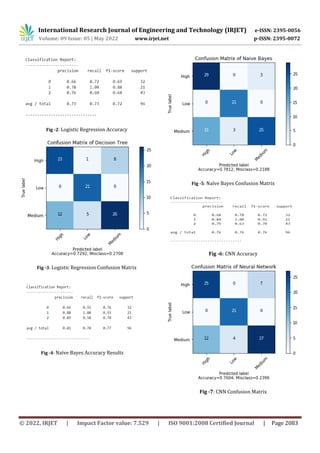
In terms of accurately identified instances, the BPN and RBF
classifiers fared better, with 95.19 percent and 100 percent,
respectively. J48, NB, and BN properly identified instances
are 74.94 percent, 75.19 percent, and 78.73 percent,
respectively, and these algorithms perform poorly when
compared to BPN and RBF.](https://image.slidesharecdn.com/irjet-v9i5514-221005094730-3bd5ff66/85/M-Learners-Performance-Using-Intelligence-and-Adaptive-E-Learning-Classify-the-Deep-Learning-Approaches-3-320.jpg)
![International Research Journal of Engineering and Technology (IRJET) e-ISSN: 2395-0056
Volume: 09 Issue: 05 | May 2022 www.irjet.net p-ISSN: 2395-0072
© 2022, IRJET | Impact Factor value: 7.529 | ISO 9001:2008 Certified Journal | Page 2084
5. CONCLUSIONS
This study describes education data mining and applies
classification approaches to student performance.There are
several classification approaches, however it is crucial to
choose which classification technique will be used on the
data in order to improve student academic performance.
Various categorization techniques were investigated in this
research. RBF and BPN classification were shown to be
superior algorithms for predicting student performanceina
comparative study based on accuracy % in this area. To
summarize, this article will give an insightful look at current
solutions for student performance categorization. This may
give students with self-assistance and anticipate
achievement based on social, educational, and previous
performance. Furthermore, such a method assists teachers
and academic institutions in assessing student performance
prior to the final test and taking required remedial action.
REFERENCES
[1] Romero, C. and Ventura, S., “Educational Data Mining: A
Review of the State of the Art,” IEEE Transactions on
Systems, Man, and Cybernetics, Part C (Applicationsand
Reviews), vol. 40, 2010, pp. 601 - 618, doi:
10.1109/TSMCC.2010.2053532.
[2] Dutt, A., Ismail, M. A. and Herawan, T., “A Systematic
Review on Educational Data Mining,”IEEEAccess,vol.5,
2017, pp. 15991 - 16005, doi:
10.1109/ACCESS.2017.2654247.
[3] Hota, H. S., Sharma, L. K. and Pavani, S., “Fuzzy topsis
method applied for ranking of teacher in higher
education,” Springer IntelligentComputing,Networking
and Informatics, 2014, pp. 1225 - 1232. doi:
https://doi.org/10.1007/978-81-322-1665-0_127.
[4] David, L. M. and Carlos E. G., “Data Mining to Study
Academic Performance of Students of a Tertiary
Institute,” American Journal of Educational Research,
vol. 2, 2014,pp.713-726,doi:10.12691/education-2-9-3.
[5] Romero, C. and Ventura, S., “Educational data mining: A
survey from 1995 to 2005,” Expert Systems with
Applications, vol. 33, Dec. 2007, pp. 135 - 146.
[6] Kabakchieva, D., “Predicting student performance by
using data mining methods for classification,
Cybernetics and Information Technologies,”Cybernetics
and Information Technologies, vol. 13, 2013, pp.61-72,
doi: 10.2478/cait-2013-0006.
[7] Norlida, B., Usamah, M. and Pauziah, M. A., “Educational
data mining for prediction and classification of
engineering students’ achievement,” IEEE 7th
International Conference on Engineering Education
(ICEED), 2015.
[8] Kachwala, T. and Sharma, L.K., “Comparative Study of
supervised learning in customer relationship
management,” International Journal of Computer
Engineering and Technology, vol. 8, 2017, pp. 77 - 82.
[9] Kaur, P., Singh, M. and Singh, G., “Classification and
Prediction Based Data Mining Algorithms to Predict
Slow Learners in Education Sector,” Procedia Computer
Science, vol. 57, 2015, pp. 500 - 508, doi:
https://doi.org/10.1016/j.procs.2015.07.372.
[10] Kotwiantis, S. B., “Supervised machine learning: A
review of classification,” Informatica, vol. 31, 2007, pp.
249 - 268.
[11] Frank E., Hall M. A., and Witten I. H., “The WEKA
Workbench. Online Appendix for Data Mining: Practical
Machine Learning Tools and Techniques,” Morgan
Kaufmann, Fourth Edition, 2016.](https://image.slidesharecdn.com/irjet-v9i5514-221005094730-3bd5ff66/85/M-Learners-Performance-Using-Intelligence-and-Adaptive-E-Learning-Classify-the-Deep-Learning-Approaches-5-320.jpg)

This document discusses using machine learning classification algorithms to predict student performance based on educational data. It compares the performance of five classification algorithms - J48, Naive Bayes, Bayes Net, Backpropagation Network, and Radial Basis Function Network - in predicting student academic achievement using attributes like demographic information, test scores, and academic factors. The experiment found that the Radial Basis Function Network algorithm achieved the highest accuracy, correctly classifying 100% of instances, compared to 75-95% accuracy for the other algorithms. Convolutional neural networks are also discussed as a powerful tool for image and language processing in educational data mining.


