Machine Learning
Algorithms
By:Mohamed Essam
Linear regression
Linear regression is perhaps one of
the most well known and well
understood algorithms in
statistics and machine learning.
Linear regression is perhaps one of the most
well known and well understood
algorithms in statistics and machine
learning.
Linear regression
Machine learning, more specifically the field of predictive
modeling is primarily concerned with minimizing the error
of a model or making the most accurate predictions
possible, at the expense of explain ability.
Example: advertising data
2.Try to be closer for all
data
Linear Regression
1.We Start by draw random
line throw the data.
2.Try to be closer for all
data
2.Try to be closer for all
data
Linear regression
Linear regression is a simple approach to supervised
Learning.
It assumes that the dependence of Y on x1,x2,xp is linear.
Linear regression
As such, linear regression was developed in the field of statistics
and is studied as a model for understanding the
relationship between input and output numerical variables,
but has been borrowed by machine learning. It is both a statistical
algorithm and a machine learning algorithm.
Linear regression
Linear regression is a linear model, e.g. a model that assumes a linear
relationship between the input variables (x) and the single output
variable (y). More specifically, that y can be calculated from a linear
combination of the input variables (x).
When there is a single input variable (x), the method is referred to
as simple linear regression. When there are multiple input
variables, literature from statistics often refers to the method as
multiple linear regression
Example
Questions we might ask:
Is there a relationship between advertising budget and sales?
How strong is the relationship between advertising budget and
sales?
Which media contribute to sales?
How accurately can we predict future sales?
Is the relationship linear?
Is there synergy among the advertising media?
Example
Questions we might ask:
Is there a relationship between advertising budget and sales?
How strong is the relationship between advertising budget and
sales?
Which media contribute to sales?
How accurately can we predict future sales?
Is the relationship linear?
Is there synergy among the advertising media?
Simple linear regression using a
single predictor X.
We assume a model
Y = β0 + β1X + ε,
where β0 and β1 are two unknown constants that represent the
intercept and slope, also known as coefficients or parameters, and ε is
the error term.
 Given some estimates βˆ0 and βˆ1 for the model coefficients, we
predict future sales using
yˆ = βˆ0 + βˆ1x,
where yˆ indicates a prediction of Y on the basis of X = x. The hat
symbol denotes an estimated value.
Example: advertising data
Example
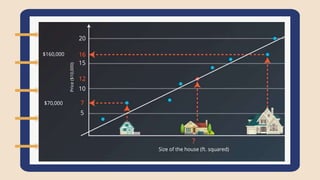
Given a history of sold houses in the last 5 years within a
certain neighborhood, your client wants you to build a
system that can estimate the fair price of a house given its
characteristics (size, number of rooms, etc.)
• What is the output of the model?
• Is it quantitative or qualitative?
• What are the input features?
• Are these features quantitative or qualitative?
Let’s Assume.
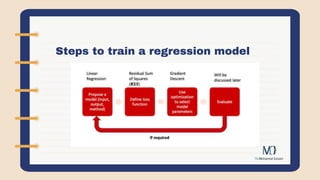
Steps to train a regression model
What Is Mean Squared Error?
The Mean Squared Error measures how
close a regression line is to a set of data
points. It is a risk function corresponding
to the expected value of the squared error
loss.
Mean square error is calculated by taking
the average, specifically the mean, of
errors squared from data as it relates to a
function.
Mean Squared Error
WHY WE DO SQUARE THE
ERROR?
The squaring is necessary to remove any negative signs.
It also gives more weight to larger differences. It's called
the mean squared error as you're finding the average of a
set of errors. The lower the MSE, the better the forecast.
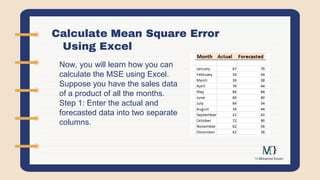
Calculate Mean Square Error
Using Excel
Now, you will learn how you can
calculate the MSE using Excel.
Suppose you have the sales data
of a product of all the months.
Step 1: Enter the actual and
forecasted data into two separate
columns.
Calculate Mean Square Error
Using Excel
Step 2: Calculate the squared error
of each data
The squared error is calculated by
(actual – forecast)2
MSE = (1/12) * (98) = 8.166
The MSE for this model is 8.17.
Gradient Descent
Gradient Descent
Gradient (SGD): in plain terms means slope or slant of a surface. So
gradient descent literally means descending a slope to reach the lowest
point on that surface.
 use linear regression problems to explain the gradient descent
algorithm. The objective of regression is to minimize the sum of squared
residuals. We know that a function reaches its minimum value when the
slope is equal to 0. By using this technique, we solved the linear
regression problem and learned the weight vector. The same problem can
be solved by the gradient descent technique.
Gradient Descent
SGD Equation:
Cost Function Equation:
𝒋𝒕𝒓𝒂𝒊𝒏 𝜽 =
𝟏
𝟐𝒎
𝒊=𝟏
𝒎
(𝒉𝜽 𝒙𝒊
− 𝒚(𝒊)
)𝟐
𝒉𝒚𝒑𝒐𝒕𝒉𝒆𝒔𝒊𝒔 𝒉𝜽 (𝒙) = 𝜽𝒋
𝒏
𝒋=𝟎
𝒙𝒋
Gradient Descent
CREDITS: This presentation template was created by Slidesgo,
including icons by Flaticon, and infographics & images by Freepik
Thank you

Linear_Regression

  • 1.
  • 2.
  • 3.
    Linear regression isperhaps one of the most well known and well understood algorithms in statistics and machine learning.
  • 4.
    Linear regression isperhaps one of the most well known and well understood algorithms in statistics and machine learning.
  • 5.
    Linear regression Machine learning,more specifically the field of predictive modeling is primarily concerned with minimizing the error of a model or making the most accurate predictions possible, at the expense of explain ability.
  • 6.
  • 7.
    2.Try to becloser for all data
  • 8.
  • 9.
    1.We Start bydraw random line throw the data.
  • 10.
    2.Try to becloser for all data
  • 11.
    2.Try to becloser for all data
  • 12.
    Linear regression Linear regressionis a simple approach to supervised Learning. It assumes that the dependence of Y on x1,x2,xp is linear.
  • 13.
    Linear regression As such,linear regression was developed in the field of statistics and is studied as a model for understanding the relationship between input and output numerical variables, but has been borrowed by machine learning. It is both a statistical algorithm and a machine learning algorithm.
  • 14.
    Linear regression Linear regressionis a linear model, e.g. a model that assumes a linear relationship between the input variables (x) and the single output variable (y). More specifically, that y can be calculated from a linear combination of the input variables (x). When there is a single input variable (x), the method is referred to as simple linear regression. When there are multiple input variables, literature from statistics often refers to the method as multiple linear regression
  • 15.
    Example Questions we mightask: Is there a relationship between advertising budget and sales? How strong is the relationship between advertising budget and sales? Which media contribute to sales? How accurately can we predict future sales? Is the relationship linear? Is there synergy among the advertising media?
  • 16.
    Example Questions we mightask: Is there a relationship between advertising budget and sales? How strong is the relationship between advertising budget and sales? Which media contribute to sales? How accurately can we predict future sales? Is the relationship linear? Is there synergy among the advertising media?
  • 17.
    Simple linear regressionusing a single predictor X. We assume a model Y = β0 + β1X + ε, where β0 and β1 are two unknown constants that represent the intercept and slope, also known as coefficients or parameters, and ε is the error term.  Given some estimates βˆ0 and βˆ1 for the model coefficients, we predict future sales using yˆ = βˆ0 + βˆ1x, where yˆ indicates a prediction of Y on the basis of X = x. The hat symbol denotes an estimated value.
  • 18.
  • 19.
    Example Given a historyof sold houses in the last 5 years within a certain neighborhood, your client wants you to build a system that can estimate the fair price of a house given its characteristics (size, number of rooms, etc.) • What is the output of the model? • Is it quantitative or qualitative? • What are the input features? • Are these features quantitative or qualitative?
  • 20.
  • 21.
    Steps to traina regression model
  • 22.
    What Is MeanSquared Error? The Mean Squared Error measures how close a regression line is to a set of data points. It is a risk function corresponding to the expected value of the squared error loss. Mean square error is calculated by taking the average, specifically the mean, of errors squared from data as it relates to a function.
  • 23.
  • 24.
    WHY WE DOSQUARE THE ERROR? The squaring is necessary to remove any negative signs. It also gives more weight to larger differences. It's called the mean squared error as you're finding the average of a set of errors. The lower the MSE, the better the forecast.
  • 25.
    Calculate Mean SquareError Using Excel Now, you will learn how you can calculate the MSE using Excel. Suppose you have the sales data of a product of all the months. Step 1: Enter the actual and forecasted data into two separate columns.
  • 26.
    Calculate Mean SquareError Using Excel Step 2: Calculate the squared error of each data The squared error is calculated by (actual – forecast)2 MSE = (1/12) * (98) = 8.166 The MSE for this model is 8.17.
  • 27.
  • 28.
    Gradient Descent Gradient (SGD):in plain terms means slope or slant of a surface. So gradient descent literally means descending a slope to reach the lowest point on that surface.  use linear regression problems to explain the gradient descent algorithm. The objective of regression is to minimize the sum of squared residuals. We know that a function reaches its minimum value when the slope is equal to 0. By using this technique, we solved the linear regression problem and learned the weight vector. The same problem can be solved by the gradient descent technique.
  • 29.
    Gradient Descent SGD Equation: CostFunction Equation: 𝒋𝒕𝒓𝒂𝒊𝒏 𝜽 = 𝟏 𝟐𝒎 𝒊=𝟏 𝒎 (𝒉𝜽 𝒙𝒊 − 𝒚(𝒊) )𝟐 𝒉𝒚𝒑𝒐𝒕𝒉𝒆𝒔𝒊𝒔 𝒉𝜽 (𝒙) = 𝜽𝒋 𝒏 𝒋=𝟎 𝒙𝒋
  • 30.
  • 31.
    CREDITS: This presentationtemplate was created by Slidesgo, including icons by Flaticon, and infographics & images by Freepik Thank you