C.Vinil Babu Int. Journal of Engineering Research and Applications www.ijera.com 
ISSN : 2248-9622, Vol. 4, Issue 9( Version 5), September 2014, pp.75-80 
www.ijera.com 75 | P a g e 
Behaviour of M30 Grade concrete with confinement under axial compression C.Vinil Babu*, V.K.Visweswara Rao** *(M.Tech Student, Department of Civil Engineering, G.Pulla Reddy Engineering College, Kurnool, A.P) 
** (Assistant Professor, Department of Civil Engineering, G.Pulla Reddy Engineering College, Kurnool,A.P) ABSTRACT The strength and durability of concrete have undergone continuous improvement. Over the years and these improved materials are now commonly used. In the present experimental investigation the behaviour of M30 grade concrete with and without confinement for different percentages of replacement of silica fume is studied under axial compression as per IS mix design. The 150mm x 300mm cylindrical specimens were cast with and without confinement and investigating the mechanical properties like axial compressive strength and stress – strain behaviour. It was observed that the confinement of concrete has increased the 28days strength for different percentages of confinement and that the peak stress and corresponding strain at peak stress increased with increase in percentages of confinement Keywords – Axial compression strength, confinement, cylinders, Silica fume, stress-strain behaviour, 
I. Introduction 
It is generally accepted that plain concrete exhibits a brittle failure when it is compressed, which leads to a rapid loss of load-carrying capacity. The concept of using confinement reinforcement is to restrain the concrete from expansion and thus prolongates the failure[4].[5] The strength and durability of concrete has undergone continuous improvement over the years and these improved materials are now commonly used. The strength of concrete is influenced by the methods of concrete with time and region. In the past, a lot of research has focused on using steel spirals and rings to confine concrete (Ahmad and Shah 1982, El-Dash and Ahmad 1995, and Mander et al 1988). The increase in ductility and strength were prominent. With the advent of composite materials, replacement of steel by confinement seems to be a rational method to solve the corrosion problems. In addition, due to the difference in the stress-strain behaviour of steel, the induced confining pressure is also different when subjected to compression. The stress of steel remains virtually constant after its yield point so the induced pressure cannot increase after yielding. On the other hand, confinement concrete possesses linear elastic properties. The stress of the confinement keeps on increasing with strain, and thus a monotonically increasing confining pressure is produced. The maximum confining pressure is obtained when the ultimate strength of the confinement is reached. When further load is applied, failure of the confined concrete often occurs as a result of fracture of the confinement reinforcement. 
Today, high strength concrete is used in off- shore platforms, sea structures, high-rise buildings and bridges. One of the advantages of using moderate strength to high strength concrete in columns is to reduce the cross section. It was found that using high strength concrete in multi-storey, high-rise buildings is economical. However, using high strength concrete in building columns in seismic areas poses some problems. The high strength concrete has less ductility compared to ordinary concrete[5]. In order to verify this, an experimental programme was carried out and the results are described in this paper. 
II. Materials Used And Properties 
2.1. Cement The Ultra-Tech 53 grade Ordinary Portland Cement (OPC) which conforms to IS 12269-1987, is used in the present study 2.2. Silica Fume The silica fume Astrra Chemical Ltd. Chennai which complies with ASTMC 1240 and IS15388- 2003 is used in the study. It is in white powder form which contains laterently reactive silicon-dioxide and no chloride or other potentially corrosive substance. 2.3. Aggregates 
The fine and coarse aggregates occupy about 60– 75 per cent of the concrete volume (70–85% by mass) and hence strongly influence the properties of fresh as well as hardened concrete, its mixture proportions, and the economy. Aggregates used in concrete should comply with the requirement. 
RESEARCH ARTICLE OPEN ACCESS
C.Vinil Babu Int. Journal of Engineering Research and Applications www.ijera.com 
ISSN : 2248-9622, Vol. 4, Issue 9( Version 5), September 2014, pp.75-80 
www.ijera.com 76 | P a g e 
Aggregates are commonly classified into fine and coarse aggregates. 2.3.1 Fine Aggregates It is generally consisting of natural sand or crushed stone with particle size smaller than about 5 mm (materials passing through 4.75 mm IS sieve). The physical properties like specific gravity, bulk density are tested procured from local market at Kurnool. 2.3.2. Coarse Aggregates It consists of one or a combination of gravels or crushed stone with particle size larger than 5 mm (usually between 10 mm and 40 mm). The crushed coarse aggregate of 20mm maximum size as well as 12mm size are obtained from the local crushing plant at confirming to Zone II, is used in the present study, the physical properties of the coarse aggregate like specific gravity tested. 2.4. Water Water plays an important role in the workability, strength, and durability of concrete. Too much water reduces the concrete strength, whereas too little will make the concrete unworkable. The water used for mixing and curing should be clean and free from injurious amounts of oils, acids, alkalis, salts, sugars, or organic materials, which may affect the concrete or steel . 2.5. Steel The reinforcement size is 2mm diameter is used in the specimen 
III. Experimental Programme 
In this experimental programme specimens were casted using M30 grade mix design and for replacement of cement as a silica fume were used. It varied from 0% to 15% and then the percentages of steel confinement also varied from 0% to 1.2208% and then to examine stress-strain behaviour of concrete. 3.1Specimen Preparation and Testing Standard size of cylinders of 150mm diameter and 300mm length were cast for studying the compressive strength and stress-strain behavior of concrete. The cylinder specimens were cast without any confinement and with different percentages of confinement in the form of rings. The specimens cast were cured for 28 days and tested as per BIS specifications. The cylinder specimens were tested in 1000kN strain control Universal Testing Machine under 0.002mm/s strain rate. 
IV. Discussion And Test Results: 
Different percentages of steel confinements and mechanical properties Axial Compression Strength on Cylindrical Specimen 
S.no 
Confinement (%) 
Silica Fume (0%) 
Silica Fume (5%) 
Silica Fume (10%) 
Silica Fume (15%) 
1 
0 
26.879 
28.299 
32.539 
26.879 
2 
0.7322 
29.7082 
29.708 
35.367 
28.294 
3 
0.9764 
30.291 
32.538 
36.867 
29.708 
4 
1.2208 
32.5383 
32.538 
39.611 
29.708 
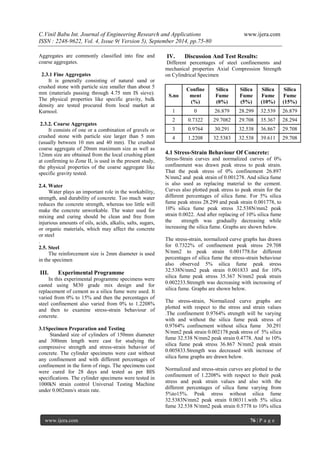
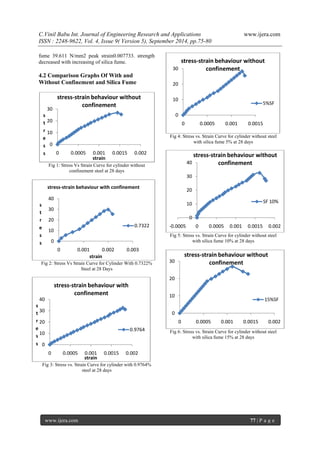
4.1 Stress-Strain Behaviour Of Concrete: Stress-Strain curves and normalized curves of 0% confinement was drawn peak stress to peak strain. That the peak stress of 0% confinement 26.897 N/mm2 and peak strain of 0.001278. And silica fume is also used as replacing material to the cement. Curves also plotted peak stress to peak strain for the different percentages of silica fume. For 5% silica fume peak stress 28.299 and peak strain 0.001778, to 10% silica fume peak stress 32.538N/mm2 peak strain 0.0022. And after replacing of 10% silica fume the strength was gradually decreasing while increasing the silica fume. Graphs are shown below. The stress-strain, normalized curve graphs has drawn for 0.7322% of confinement peak stress 29.708 N/mm2 to peak strain 0.001778.for different percentages of silica fume the stress-strain behaviour also observed 5% silica fume peak stress 32.538N/mm2 peak strain 0.001833 and for 10% silica fume peak stress 35.367 N/mm2 peak strain 0.002233.Strength was decreasing with increasing of silica fume. Graphs are shown below. The stress-strain, Normalized curve graphs are plotted with respect to the stress and strain values .The confinement 0.9764% strength will be varying with and without the silica fume peak stress of 0.9764% confinement without silica fume 30.291 N/mm2 peak strain 0.002178.peak stress of 5% silica fume 32.538 N/mm2 peak strain 0.4778. And to 10% silica fume peak stress 36.867 N/mm2 peak strain 0.005833.Strength was decreased with increase of silica fume graphs are drawn below. 
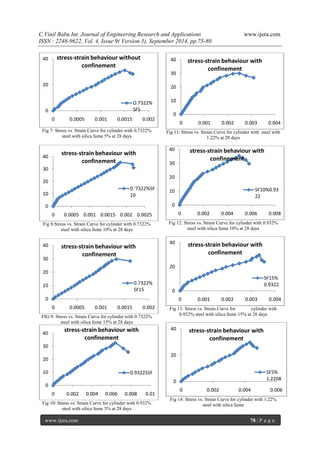
Normalized and stress-strain curves are plotted to the confinement of 1.2208% with respect to their peak stress and peak strain values and also with the different percentages of silica fume varying from 5%to15%. Peak stress without silica fume 32.5383N/mm2 peak strain 0.00311.with 5% silica fume 32.538 N/mm2 peak strain 0.5778 to 10% silica
C.Vinil Babu Int. Journal of Engineering Research and Applications www.ijera.com 
ISSN : 2248-9622, Vol. 4, Issue 9( Version 5), September 2014, pp.75-80 
www.ijera.com 77 | P a g e 
fume 39.611 N/mm2 peak strain0.007733. strength decreased with increasing of silica fume. 4.2 Comparison Graphs Of With and Without Confinement and Silica Fume 
Fig 1: Stress Vs Strain Curve for cylinder without confinement steel at 28 days 
Fig 2: Stress Vs Strain Curve for Cylinder With 0.7322% Steel at 28 Days 
Fig 3: Stress vs. Strain Curve for cylinder with 0.9764% steel at 28 days 
Fig 4: Stress vs. Strain Curve for cylinder without steel with silica fume 5% at 28 days 
Fig 5: Stress vs. Strain Curve for cylinder without steel with silica fume 10% at 28 days 
Fig 6: Stress vs. Strain Curve for cylinder without steel with silica fume 15% at 28 days 
0 
10 
20 
30 
0 
0.0005 
0.001 
0.0015 
0.002 
stress 
strain 
stress-strain behaviour without confinement 
0 
10 
20 
30 
40 
0 
0.001 
0.002 
0.003 
stress 
strain 
stress-strain behaviour with confinement 
0.7322 
0 
10 
20 
30 
40 
0 
0.0005 
0.001 
0.0015 
0.002 
stress 
strain 
stress-strain behaviour with confinement 
0.9764 
0 
10 
20 
30 
0 
0.0005 
0.001 
0.0015 
stress-strain behaviour without confinement 
5%SF 
0 
10 
20 
30 
40 
-0.0005 
0 
0.0005 
0.001 
0.0015 
0.002 
stress-strain behaviour without confinement 
SF 10% 
0 
10 
20 
30 
0 
0.0005 
0.001 
0.0015 
0.002 
stress-strain behaviour without confinement 
15%SF
C.Vinil Babu Int. Journal of Engineering Research and Applications www.ijera.com 
ISSN : 2248-9622, Vol. 4, Issue 9( Version 5), September 2014, pp.75-80 
www.ijera.com 78 | P a g e 
Fig 7: Stress vs. Strain Curve for cylinder with 0.7322% steel with silica fume 5% at 28 days 
Fig 8:Stress vs. Strain Curve for cylinder with 0.7322% steel with silica fume 10% at 28 days 
FIG 9: Stress vs. Strain Curve for cylinder with 0.7322% steel with silica fume 15% at 28 days 
Fig 10: Stress vs. Strain Curve for cylinder with 0.932% steel with silica fume 5% at 28 days 
Fig 11: Stress vs. Strain Curve for cylinder with steel with 1.22% at 28 days 
Fig 12: Stress vs. Strain Curve for cylinder with 0.932% steel with silica fume 10% at 28 days 
Fig 13: Stress vs. Strain Curve for cylinder with 0.932% steel with silica fume 15% at 28 days 
Fig 14: Stress vs. Strain Curve for cylinder with 1.22% steel with silica fume 
0 
20 
40 
0 
0.0005 
0.001 
0.0015 
0.002 
stress-strain behaviour without confinement 
O.7322% SF5 
0 
10 
20 
30 
40 
0 
0.0005 
0.001 
0.0015 
0.002 
0.0025 
stress-strain behaviour with confinement 
0.'7322%SF10 
0 
10 
20 
30 
40 
0 
0.0005 
0.001 
0.0015 
0.002 
stress-strain behaviour with 
confinement 
0.7322% SF15 
0 
10 
20 
30 
40 
0 
0.002 
0.004 
0.006 
0.008 
0.01 
stress-strain behaviour with confinement 
0.93225SF 
0 
10 
20 
30 
40 
0 
0.001 
0.002 
0.003 
0.004 
stress-strain behaviour with confinement 
0 
10 
20 
30 
40 
0 
0.002 
0.004 
0.006 
0.008 
stress-strain behaviour with confinement 
SF10%0.9322 
0 
20 
40 
0 
0.001 
0.002 
0.003 
0.004 
stress-strain behaviour with confinement 
SF15% 0.9322 
0 
20 
40 
0 
0.002 
0.004 
0.006 
stress-strain behaviour with confinement 
SF5% 1.2208
C.Vinil Babu Int. Journal of Engineering Research and Applications www.ijera.com 
ISSN : 2248-9622, Vol. 4, Issue 9( Version 5), September 2014, pp.75-80 
www.ijera.com 79 | P a g e 
Fig 15:Stress vs. Strain Curve for cylinder with 1.22% steel With SF 10% 
Fig 16:Stress vs. Strain Curve for cylinder with 1.22% steel with silica fume 15% at 28 days 
Fig 17: Comparison of Stress vs. Strain graphs of cylinders with different Confinements and different percentages of silica fume at 28 days 
Fig 18: Comparison of normalized Stress vs. Strain graphs of cylinders with different confinements at 28 days 
V. CONCLUSIONS: 
Studies have been carried out on behavior of M30 grade concrete with and without confinement under axial compression. The parameters studied include compressive strength, flexural strength test and comparison of stress-strain calculations of concrete with and without confinement. And also tests are conducted on concrete by partially replacement of cement by silica fume. Based on the study conducted the following conclusions are drawn. 
1. Percentage of Confinement increases the strength of concrete also increased the strengths at 28 days. 
2. Compression strength also increased by partial replacement of cement with silica fume and also with and without confinement. 
3. Cement replacement up to 10% silica fume leads to increase in compressive strength of concrete. Beyond 10 %there is a decrease in compressive strength of concrete. 
4. An increase in volume of confinement improves the ductility factor of confined concrete. 
5. The ductility i.e. the ratio of the strain at peak stress of confined concrete to the strain at peak stress of corresponding unconfined concrete. 
REFERENCES [1]. C.RAJAMALLU,A.BALAJI Rao, Behaviour Of Self Compacting Concrete Under Axial Compression With And Without Confinement (ISSN: 2348-4748,Volume 1,ISSUE 3,March 2014) [2]. NRD Murthy, Ramaseshu D, Rao MVS. “ Constitutive Behaviour Of Fly Ash Concrete With Steel Fibers In Ordinary Grade, IE(Institute Of Engineers) Journal”- Vol,88(2007) 41-46. 
0 
20 
40 
60 
0 
0.002 
0.004 
0.006 
0.008 
stress-strain behaviour with confinement 
SF10% 1.2208 
0 
10 
20 
30 
40 
50 
-0.002 
0 
0.002 
0.004 
0.006 
0.008 
0.01 
stress-strain behaviour 
0 
0.5 
1 
1.5 
-0.5 
0 
0.5 
1 
1.5 
Normalized Stress-strain 
0 
20 
40 
0 
0.001 
0.002 
0.003 
0.004 
stress-strain behaviour with confinement 
SF15% 1.2208
C.Vinil Babu Int. Journal of Engineering Research and Applications www.ijera.com 
ISSN : 2248-9622, Vol. 4, Issue 9( Version 5), September 2014, pp.75-80 
www.ijera.com 80 | P a g e 
[3]. Dr.M.V.Seshagiri Rao “ Self Compacting High Performance Concrete”,JNTUCE, Hyderabad. [4]. H.Y.Leung And C.J.Burgoyne Compressive Behaviour Of Concrete Confined By Aramid Fiber Spirals [5]. Metin Husem and selim pul investigation of stress-strain model for confined high strength concrete [6] T.Suresh Babu ,M.V.Seshagiri Rao And D.Rama Seshu Mechanical Properties And Stress-Strain Behaviour Of Self Compacting Concrete With And Without Glass Fibers Asian Journal Of Civil Engineering VOL.9,NO.5(2008) Pg 457-472 [7]. Marwan N.Youssef,Maria Q.Feng And Ayman S.Stress-Strain Model For Concrete Confined By FRP Composites Engineering Volume 38, Issues 5-6,July-September 2007, And Pages 614-628 [8]. J.B.Mander ,M.J.N.Prisestley And R.Park , Fellow. ASCE Observed Stress-Strain Behaviour Of Confined Concrete [9]. R.Abbasnia ,A.Holakoo ,An Investigation Of Stress-Strain Behaviour Of FRP Confined Concrete Under Cyclic Compressive Loading [10]. T.Shanmugapriya2,Dr.R.N.Uma Experimental Investigation On Silica Fume Aspartial Replacement Of Cement In High Performance Concrete [11]. L.Lam And J.G.Teng Stress-Strain Model For FRP –Confined Concrete Under Cyclic Axial Compression Engineering Structures Volume 31, Issue 2, February 2009, Pages 308-321. [12]. IS12269-1987(Reaffirmed 1999),Specification For 53 Grade Ordinary Portland Cement,1st Reprint, September 1993. [13]. IS 2386-1963, Method Of Tests For Aggregates For Cement. {14]. IS 456-2000, Indian Standard Plain And Reinforced Concrete-Code Of Practice,4th Revision, 1st Reprint, September 2000.

Behaviour of M30 Grade concrete with confinement under axial compression

  • 1.
    C.Vinil Babu Int.Journal of Engineering Research and Applications www.ijera.com ISSN : 2248-9622, Vol. 4, Issue 9( Version 5), September 2014, pp.75-80 www.ijera.com 75 | P a g e Behaviour of M30 Grade concrete with confinement under axial compression C.Vinil Babu*, V.K.Visweswara Rao** *(M.Tech Student, Department of Civil Engineering, G.Pulla Reddy Engineering College, Kurnool, A.P) ** (Assistant Professor, Department of Civil Engineering, G.Pulla Reddy Engineering College, Kurnool,A.P) ABSTRACT The strength and durability of concrete have undergone continuous improvement. Over the years and these improved materials are now commonly used. In the present experimental investigation the behaviour of M30 grade concrete with and without confinement for different percentages of replacement of silica fume is studied under axial compression as per IS mix design. The 150mm x 300mm cylindrical specimens were cast with and without confinement and investigating the mechanical properties like axial compressive strength and stress – strain behaviour. It was observed that the confinement of concrete has increased the 28days strength for different percentages of confinement and that the peak stress and corresponding strain at peak stress increased with increase in percentages of confinement Keywords – Axial compression strength, confinement, cylinders, Silica fume, stress-strain behaviour, I. Introduction It is generally accepted that plain concrete exhibits a brittle failure when it is compressed, which leads to a rapid loss of load-carrying capacity. The concept of using confinement reinforcement is to restrain the concrete from expansion and thus prolongates the failure[4].[5] The strength and durability of concrete has undergone continuous improvement over the years and these improved materials are now commonly used. The strength of concrete is influenced by the methods of concrete with time and region. In the past, a lot of research has focused on using steel spirals and rings to confine concrete (Ahmad and Shah 1982, El-Dash and Ahmad 1995, and Mander et al 1988). The increase in ductility and strength were prominent. With the advent of composite materials, replacement of steel by confinement seems to be a rational method to solve the corrosion problems. In addition, due to the difference in the stress-strain behaviour of steel, the induced confining pressure is also different when subjected to compression. The stress of steel remains virtually constant after its yield point so the induced pressure cannot increase after yielding. On the other hand, confinement concrete possesses linear elastic properties. The stress of the confinement keeps on increasing with strain, and thus a monotonically increasing confining pressure is produced. The maximum confining pressure is obtained when the ultimate strength of the confinement is reached. When further load is applied, failure of the confined concrete often occurs as a result of fracture of the confinement reinforcement. Today, high strength concrete is used in off- shore platforms, sea structures, high-rise buildings and bridges. One of the advantages of using moderate strength to high strength concrete in columns is to reduce the cross section. It was found that using high strength concrete in multi-storey, high-rise buildings is economical. However, using high strength concrete in building columns in seismic areas poses some problems. The high strength concrete has less ductility compared to ordinary concrete[5]. In order to verify this, an experimental programme was carried out and the results are described in this paper. II. Materials Used And Properties 2.1. Cement The Ultra-Tech 53 grade Ordinary Portland Cement (OPC) which conforms to IS 12269-1987, is used in the present study 2.2. Silica Fume The silica fume Astrra Chemical Ltd. Chennai which complies with ASTMC 1240 and IS15388- 2003 is used in the study. It is in white powder form which contains laterently reactive silicon-dioxide and no chloride or other potentially corrosive substance. 2.3. Aggregates The fine and coarse aggregates occupy about 60– 75 per cent of the concrete volume (70–85% by mass) and hence strongly influence the properties of fresh as well as hardened concrete, its mixture proportions, and the economy. Aggregates used in concrete should comply with the requirement. RESEARCH ARTICLE OPEN ACCESS
  • 2.
    C.Vinil Babu Int.Journal of Engineering Research and Applications www.ijera.com ISSN : 2248-9622, Vol. 4, Issue 9( Version 5), September 2014, pp.75-80 www.ijera.com 76 | P a g e Aggregates are commonly classified into fine and coarse aggregates. 2.3.1 Fine Aggregates It is generally consisting of natural sand or crushed stone with particle size smaller than about 5 mm (materials passing through 4.75 mm IS sieve). The physical properties like specific gravity, bulk density are tested procured from local market at Kurnool. 2.3.2. Coarse Aggregates It consists of one or a combination of gravels or crushed stone with particle size larger than 5 mm (usually between 10 mm and 40 mm). The crushed coarse aggregate of 20mm maximum size as well as 12mm size are obtained from the local crushing plant at confirming to Zone II, is used in the present study, the physical properties of the coarse aggregate like specific gravity tested. 2.4. Water Water plays an important role in the workability, strength, and durability of concrete. Too much water reduces the concrete strength, whereas too little will make the concrete unworkable. The water used for mixing and curing should be clean and free from injurious amounts of oils, acids, alkalis, salts, sugars, or organic materials, which may affect the concrete or steel . 2.5. Steel The reinforcement size is 2mm diameter is used in the specimen III. Experimental Programme In this experimental programme specimens were casted using M30 grade mix design and for replacement of cement as a silica fume were used. It varied from 0% to 15% and then the percentages of steel confinement also varied from 0% to 1.2208% and then to examine stress-strain behaviour of concrete. 3.1Specimen Preparation and Testing Standard size of cylinders of 150mm diameter and 300mm length were cast for studying the compressive strength and stress-strain behavior of concrete. The cylinder specimens were cast without any confinement and with different percentages of confinement in the form of rings. The specimens cast were cured for 28 days and tested as per BIS specifications. The cylinder specimens were tested in 1000kN strain control Universal Testing Machine under 0.002mm/s strain rate. IV. Discussion And Test Results: Different percentages of steel confinements and mechanical properties Axial Compression Strength on Cylindrical Specimen S.no Confinement (%) Silica Fume (0%) Silica Fume (5%) Silica Fume (10%) Silica Fume (15%) 1 0 26.879 28.299 32.539 26.879 2 0.7322 29.7082 29.708 35.367 28.294 3 0.9764 30.291 32.538 36.867 29.708 4 1.2208 32.5383 32.538 39.611 29.708 4.1 Stress-Strain Behaviour Of Concrete: Stress-Strain curves and normalized curves of 0% confinement was drawn peak stress to peak strain. That the peak stress of 0% confinement 26.897 N/mm2 and peak strain of 0.001278. And silica fume is also used as replacing material to the cement. Curves also plotted peak stress to peak strain for the different percentages of silica fume. For 5% silica fume peak stress 28.299 and peak strain 0.001778, to 10% silica fume peak stress 32.538N/mm2 peak strain 0.0022. And after replacing of 10% silica fume the strength was gradually decreasing while increasing the silica fume. Graphs are shown below. The stress-strain, normalized curve graphs has drawn for 0.7322% of confinement peak stress 29.708 N/mm2 to peak strain 0.001778.for different percentages of silica fume the stress-strain behaviour also observed 5% silica fume peak stress 32.538N/mm2 peak strain 0.001833 and for 10% silica fume peak stress 35.367 N/mm2 peak strain 0.002233.Strength was decreasing with increasing of silica fume. Graphs are shown below. The stress-strain, Normalized curve graphs are plotted with respect to the stress and strain values .The confinement 0.9764% strength will be varying with and without the silica fume peak stress of 0.9764% confinement without silica fume 30.291 N/mm2 peak strain 0.002178.peak stress of 5% silica fume 32.538 N/mm2 peak strain 0.4778. And to 10% silica fume peak stress 36.867 N/mm2 peak strain 0.005833.Strength was decreased with increase of silica fume graphs are drawn below. Normalized and stress-strain curves are plotted to the confinement of 1.2208% with respect to their peak stress and peak strain values and also with the different percentages of silica fume varying from 5%to15%. Peak stress without silica fume 32.5383N/mm2 peak strain 0.00311.with 5% silica fume 32.538 N/mm2 peak strain 0.5778 to 10% silica
  • 3.
    C.Vinil Babu Int.Journal of Engineering Research and Applications www.ijera.com ISSN : 2248-9622, Vol. 4, Issue 9( Version 5), September 2014, pp.75-80 www.ijera.com 77 | P a g e fume 39.611 N/mm2 peak strain0.007733. strength decreased with increasing of silica fume. 4.2 Comparison Graphs Of With and Without Confinement and Silica Fume Fig 1: Stress Vs Strain Curve for cylinder without confinement steel at 28 days Fig 2: Stress Vs Strain Curve for Cylinder With 0.7322% Steel at 28 Days Fig 3: Stress vs. Strain Curve for cylinder with 0.9764% steel at 28 days Fig 4: Stress vs. Strain Curve for cylinder without steel with silica fume 5% at 28 days Fig 5: Stress vs. Strain Curve for cylinder without steel with silica fume 10% at 28 days Fig 6: Stress vs. Strain Curve for cylinder without steel with silica fume 15% at 28 days 0 10 20 30 0 0.0005 0.001 0.0015 0.002 stress strain stress-strain behaviour without confinement 0 10 20 30 40 0 0.001 0.002 0.003 stress strain stress-strain behaviour with confinement 0.7322 0 10 20 30 40 0 0.0005 0.001 0.0015 0.002 stress strain stress-strain behaviour with confinement 0.9764 0 10 20 30 0 0.0005 0.001 0.0015 stress-strain behaviour without confinement 5%SF 0 10 20 30 40 -0.0005 0 0.0005 0.001 0.0015 0.002 stress-strain behaviour without confinement SF 10% 0 10 20 30 0 0.0005 0.001 0.0015 0.002 stress-strain behaviour without confinement 15%SF
  • 4.
    C.Vinil Babu Int.Journal of Engineering Research and Applications www.ijera.com ISSN : 2248-9622, Vol. 4, Issue 9( Version 5), September 2014, pp.75-80 www.ijera.com 78 | P a g e Fig 7: Stress vs. Strain Curve for cylinder with 0.7322% steel with silica fume 5% at 28 days Fig 8:Stress vs. Strain Curve for cylinder with 0.7322% steel with silica fume 10% at 28 days FIG 9: Stress vs. Strain Curve for cylinder with 0.7322% steel with silica fume 15% at 28 days Fig 10: Stress vs. Strain Curve for cylinder with 0.932% steel with silica fume 5% at 28 days Fig 11: Stress vs. Strain Curve for cylinder with steel with 1.22% at 28 days Fig 12: Stress vs. Strain Curve for cylinder with 0.932% steel with silica fume 10% at 28 days Fig 13: Stress vs. Strain Curve for cylinder with 0.932% steel with silica fume 15% at 28 days Fig 14: Stress vs. Strain Curve for cylinder with 1.22% steel with silica fume 0 20 40 0 0.0005 0.001 0.0015 0.002 stress-strain behaviour without confinement O.7322% SF5 0 10 20 30 40 0 0.0005 0.001 0.0015 0.002 0.0025 stress-strain behaviour with confinement 0.'7322%SF10 0 10 20 30 40 0 0.0005 0.001 0.0015 0.002 stress-strain behaviour with confinement 0.7322% SF15 0 10 20 30 40 0 0.002 0.004 0.006 0.008 0.01 stress-strain behaviour with confinement 0.93225SF 0 10 20 30 40 0 0.001 0.002 0.003 0.004 stress-strain behaviour with confinement 0 10 20 30 40 0 0.002 0.004 0.006 0.008 stress-strain behaviour with confinement SF10%0.9322 0 20 40 0 0.001 0.002 0.003 0.004 stress-strain behaviour with confinement SF15% 0.9322 0 20 40 0 0.002 0.004 0.006 stress-strain behaviour with confinement SF5% 1.2208
  • 5.
    C.Vinil Babu Int.Journal of Engineering Research and Applications www.ijera.com ISSN : 2248-9622, Vol. 4, Issue 9( Version 5), September 2014, pp.75-80 www.ijera.com 79 | P a g e Fig 15:Stress vs. Strain Curve for cylinder with 1.22% steel With SF 10% Fig 16:Stress vs. Strain Curve for cylinder with 1.22% steel with silica fume 15% at 28 days Fig 17: Comparison of Stress vs. Strain graphs of cylinders with different Confinements and different percentages of silica fume at 28 days Fig 18: Comparison of normalized Stress vs. Strain graphs of cylinders with different confinements at 28 days V. CONCLUSIONS: Studies have been carried out on behavior of M30 grade concrete with and without confinement under axial compression. The parameters studied include compressive strength, flexural strength test and comparison of stress-strain calculations of concrete with and without confinement. And also tests are conducted on concrete by partially replacement of cement by silica fume. Based on the study conducted the following conclusions are drawn. 1. Percentage of Confinement increases the strength of concrete also increased the strengths at 28 days. 2. Compression strength also increased by partial replacement of cement with silica fume and also with and without confinement. 3. Cement replacement up to 10% silica fume leads to increase in compressive strength of concrete. Beyond 10 %there is a decrease in compressive strength of concrete. 4. An increase in volume of confinement improves the ductility factor of confined concrete. 5. The ductility i.e. the ratio of the strain at peak stress of confined concrete to the strain at peak stress of corresponding unconfined concrete. REFERENCES [1]. C.RAJAMALLU,A.BALAJI Rao, Behaviour Of Self Compacting Concrete Under Axial Compression With And Without Confinement (ISSN: 2348-4748,Volume 1,ISSUE 3,March 2014) [2]. NRD Murthy, Ramaseshu D, Rao MVS. “ Constitutive Behaviour Of Fly Ash Concrete With Steel Fibers In Ordinary Grade, IE(Institute Of Engineers) Journal”- Vol,88(2007) 41-46. 0 20 40 60 0 0.002 0.004 0.006 0.008 stress-strain behaviour with confinement SF10% 1.2208 0 10 20 30 40 50 -0.002 0 0.002 0.004 0.006 0.008 0.01 stress-strain behaviour 0 0.5 1 1.5 -0.5 0 0.5 1 1.5 Normalized Stress-strain 0 20 40 0 0.001 0.002 0.003 0.004 stress-strain behaviour with confinement SF15% 1.2208
  • 6.
    C.Vinil Babu Int.Journal of Engineering Research and Applications www.ijera.com ISSN : 2248-9622, Vol. 4, Issue 9( Version 5), September 2014, pp.75-80 www.ijera.com 80 | P a g e [3]. Dr.M.V.Seshagiri Rao “ Self Compacting High Performance Concrete”,JNTUCE, Hyderabad. [4]. H.Y.Leung And C.J.Burgoyne Compressive Behaviour Of Concrete Confined By Aramid Fiber Spirals [5]. Metin Husem and selim pul investigation of stress-strain model for confined high strength concrete [6] T.Suresh Babu ,M.V.Seshagiri Rao And D.Rama Seshu Mechanical Properties And Stress-Strain Behaviour Of Self Compacting Concrete With And Without Glass Fibers Asian Journal Of Civil Engineering VOL.9,NO.5(2008) Pg 457-472 [7]. Marwan N.Youssef,Maria Q.Feng And Ayman S.Stress-Strain Model For Concrete Confined By FRP Composites Engineering Volume 38, Issues 5-6,July-September 2007, And Pages 614-628 [8]. J.B.Mander ,M.J.N.Prisestley And R.Park , Fellow. ASCE Observed Stress-Strain Behaviour Of Confined Concrete [9]. R.Abbasnia ,A.Holakoo ,An Investigation Of Stress-Strain Behaviour Of FRP Confined Concrete Under Cyclic Compressive Loading [10]. T.Shanmugapriya2,Dr.R.N.Uma Experimental Investigation On Silica Fume Aspartial Replacement Of Cement In High Performance Concrete [11]. L.Lam And J.G.Teng Stress-Strain Model For FRP –Confined Concrete Under Cyclic Axial Compression Engineering Structures Volume 31, Issue 2, February 2009, Pages 308-321. [12]. IS12269-1987(Reaffirmed 1999),Specification For 53 Grade Ordinary Portland Cement,1st Reprint, September 1993. [13]. IS 2386-1963, Method Of Tests For Aggregates For Cement. {14]. IS 456-2000, Indian Standard Plain And Reinforced Concrete-Code Of Practice,4th Revision, 1st Reprint, September 2000.