IDENTIFYING THE
DIFFERENT RANDOM
SAMPLING TECHNIQUE
VOCABULARY LIST! 
POPULATION The set of all possible values of a variable.
SAMPLE
It consist of one or more data drawn from
the population
RANDOM
SAMPLING
It is a sampling method of choosing
representatives from the population
wherein every sample has an equal chance
of being selected. Accurate data can be
collected using random sampling
techniques.
VOCABULARY LIST! 
1. PROBABILITY SAMPLING
The sampling techniques that
involve random selection
2. NON - PROBABILITY
SAMPLING
The sampling techniques that
do not involve random selection
of data
Types of Random Sampling
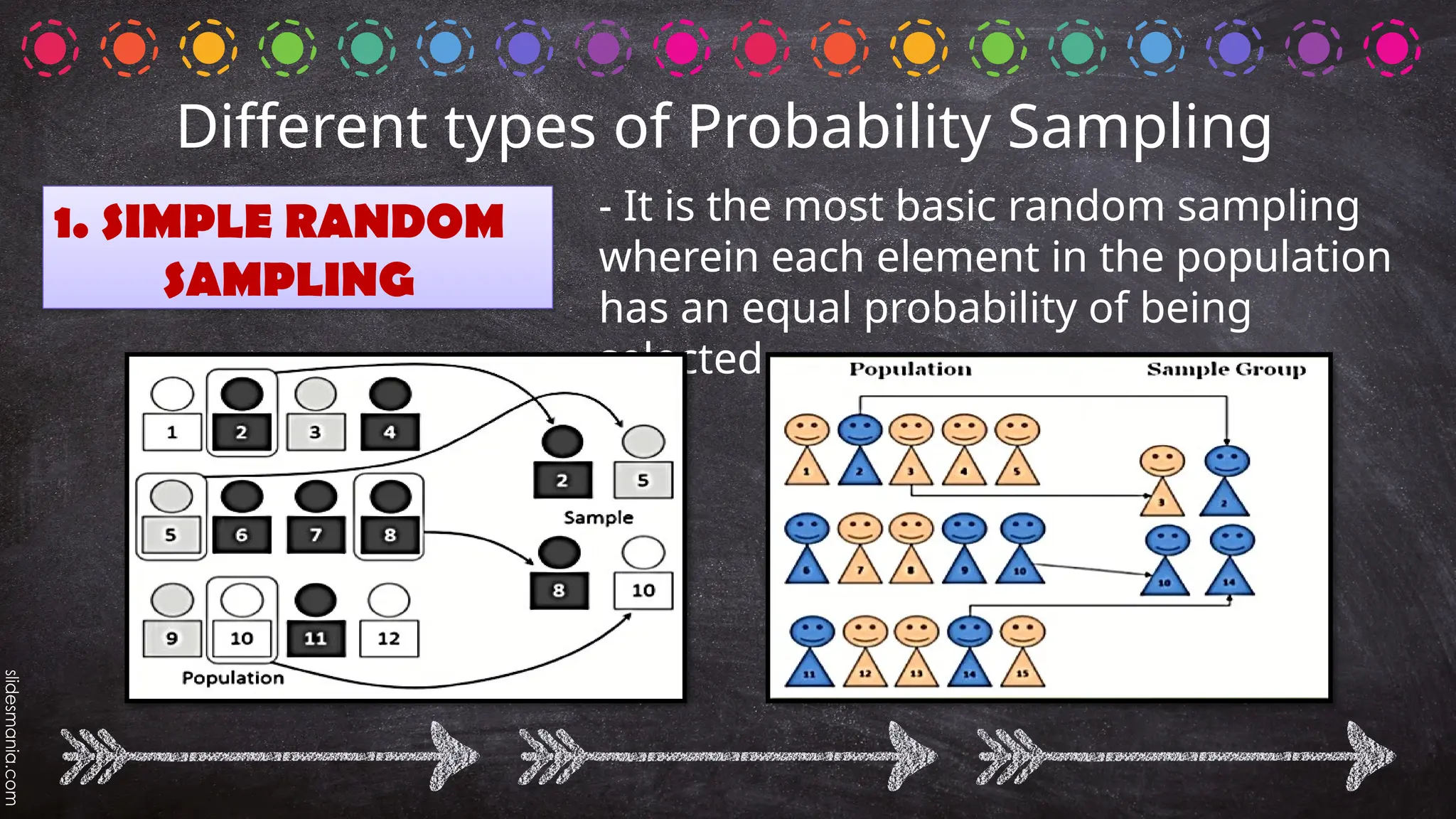
1. SIMPLE RANDOM
SAMPLING
- It is the most basic random sampling
wherein each element in the population
has an equal probability of being
selected.
Different types of Probability Sampling
2. SYSTEMATIC RANDOM SAMPLING
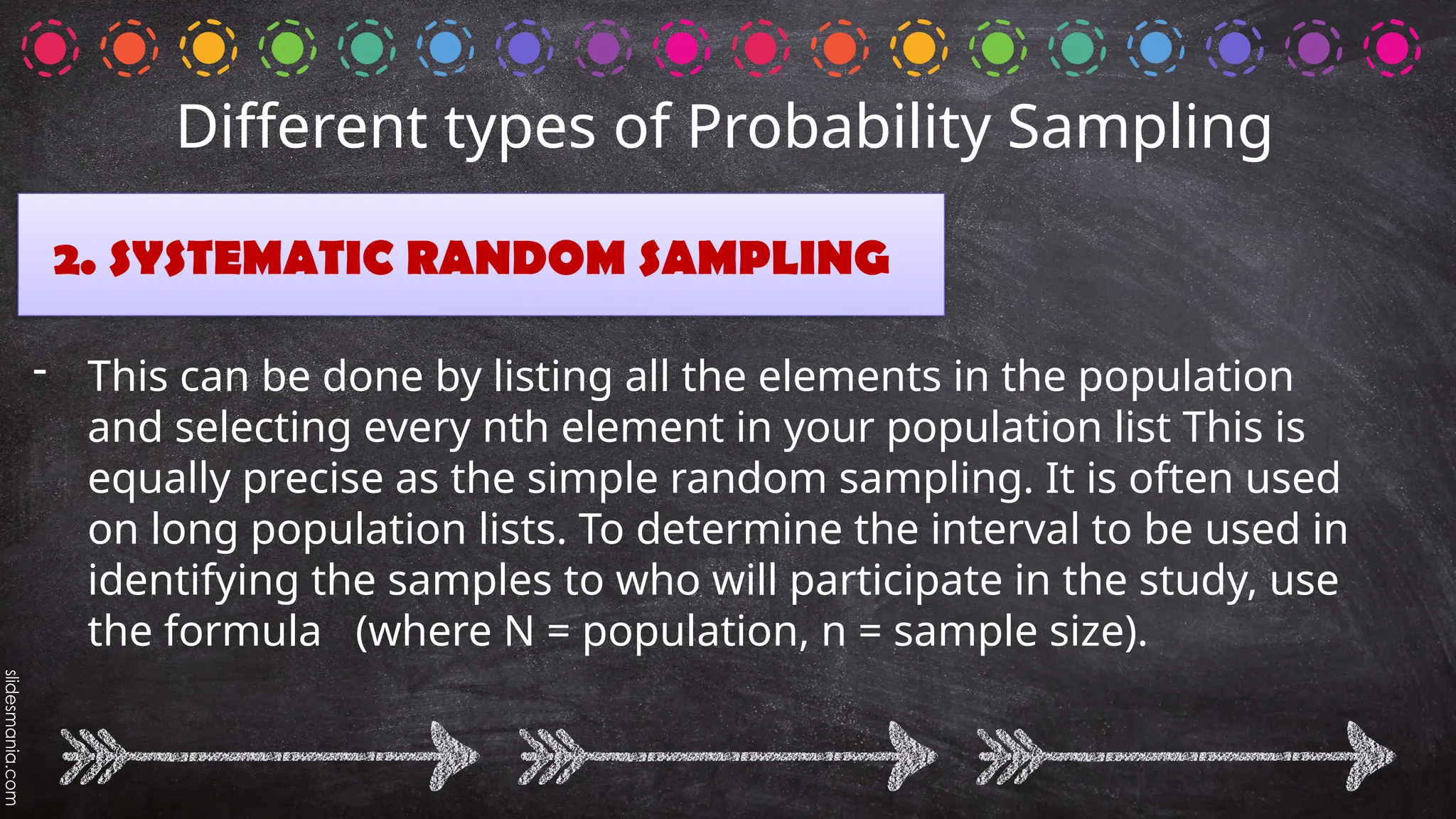
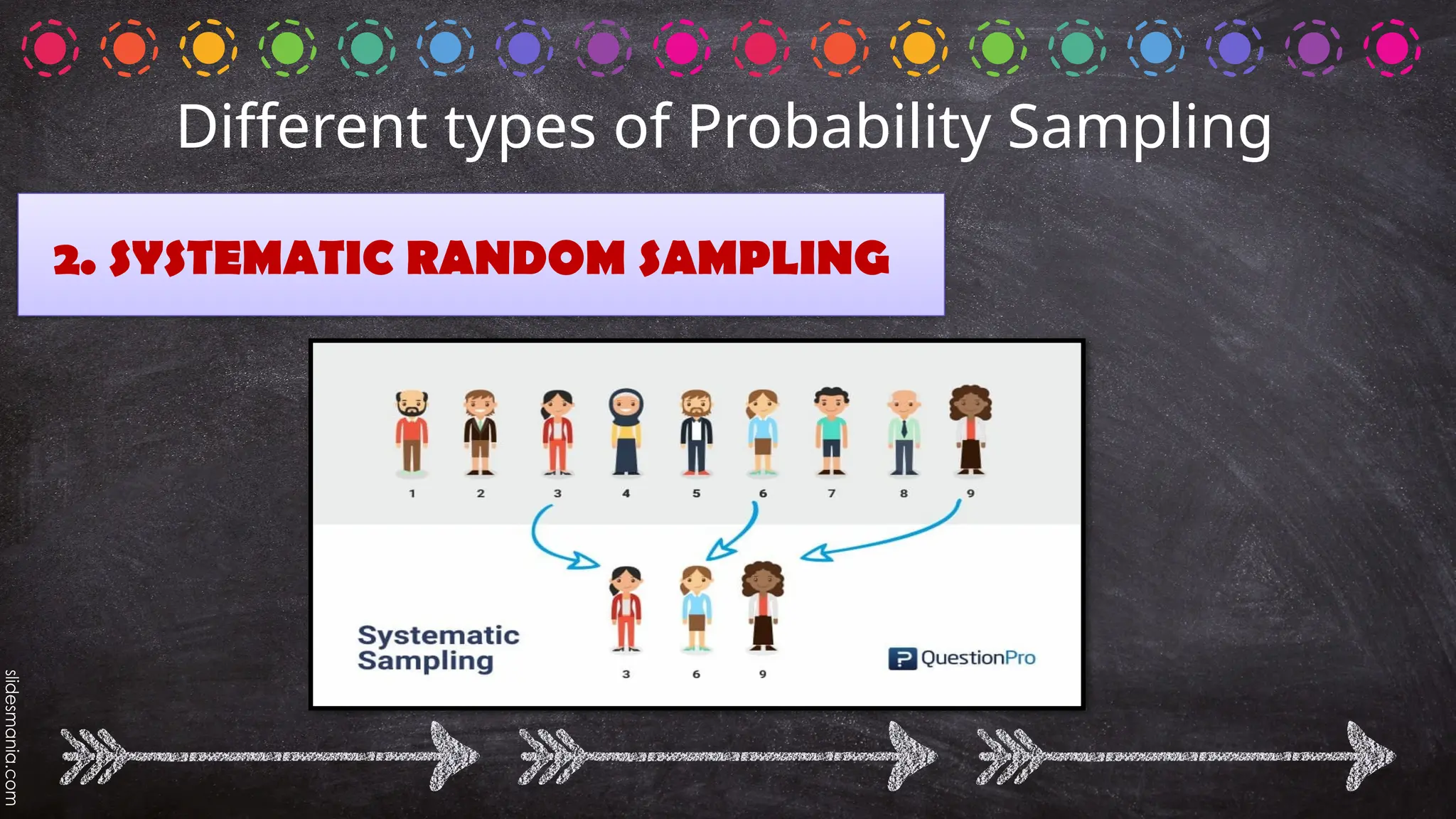
- This can be done by listing all the elements in the population
and selecting every nth element in your population list This is
equally precise as the simple random sampling. It is often used
on long population lists. To determine the interval to be used in
identifying the samples to who will participate in the study, use
the formula (where N = population, n = sample size).
Different types of Probability Sampling
2. SYSTEMATIC RANDOM SAMPLING
Different types of Probability Sampling
3. STRATIFIED RANDOM SAMPLING
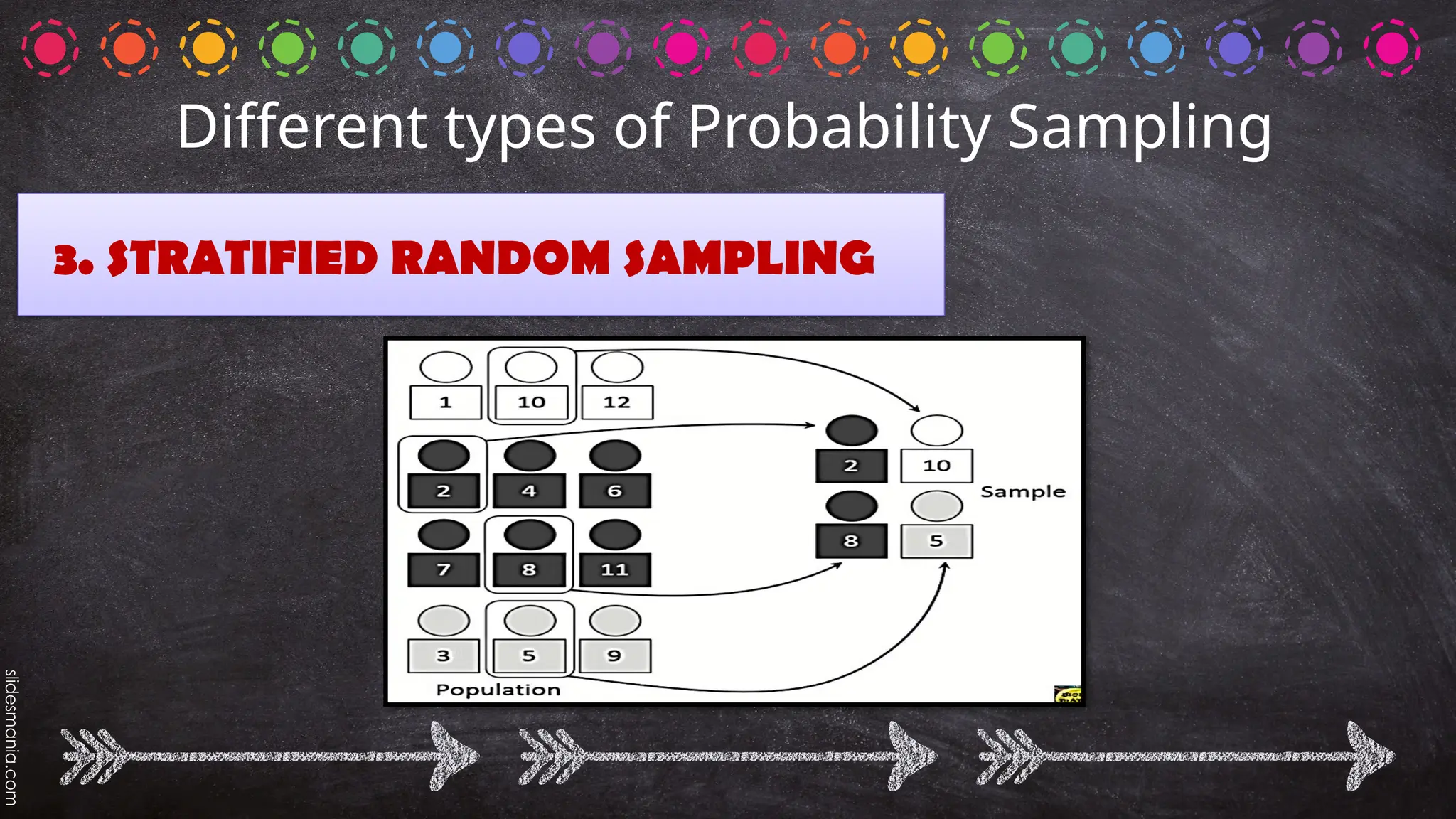
- Is a random sampling wherein the population is divided into
different strata or divisions. The number of the samples will
be proportionally picked in each stratum that is why all strata
are represented in the samples.
Different types of Probability Sampling
3. STRATIFIED RANDOM SAMPLING
Different types of Probability Sampling
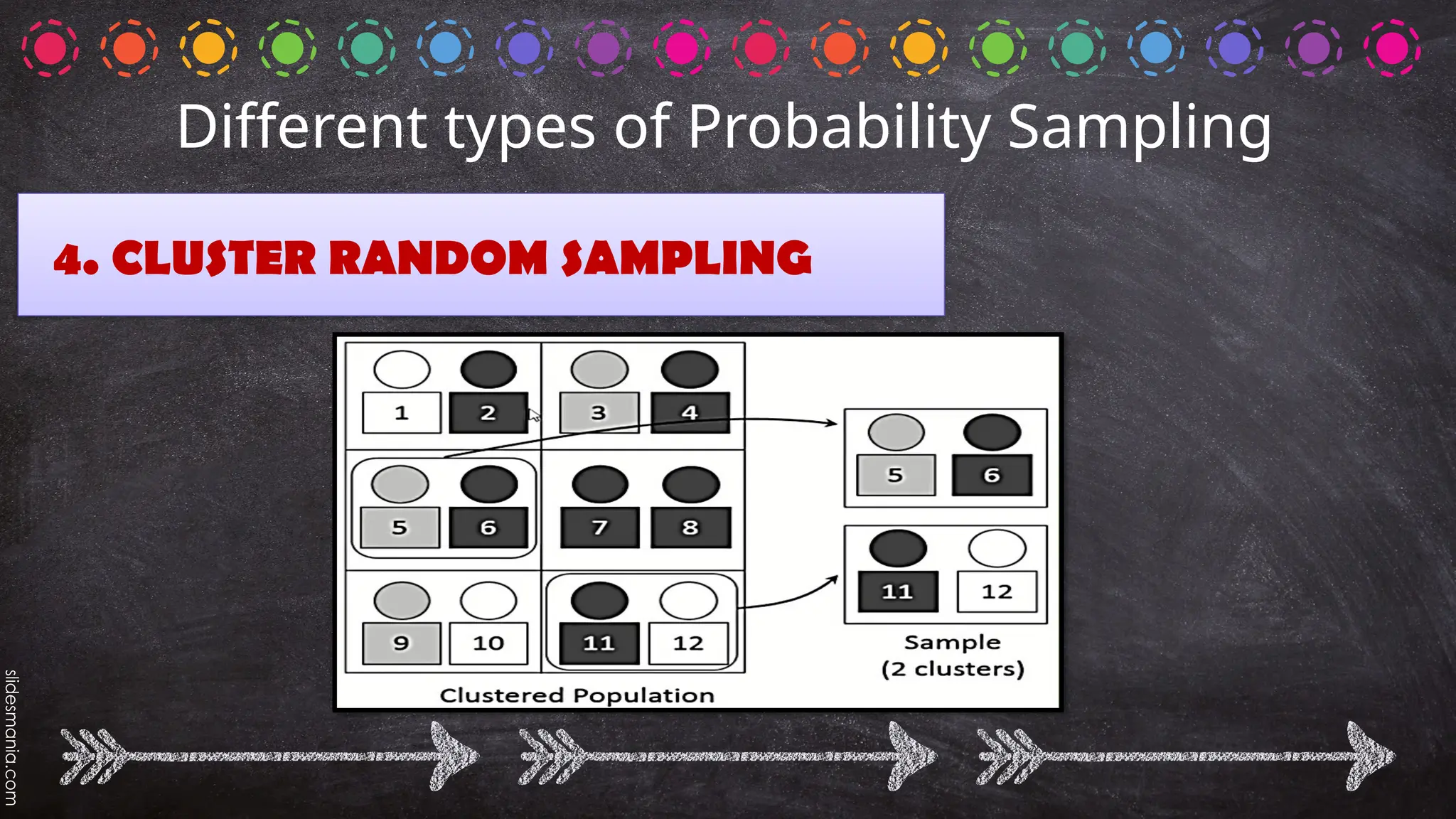
4. CLUSTER RANDOM SAMPLING
- Is a random sampling wherein the population is divided into
clusters or groups and then the clusters are randomly
selected. All elements of the clusters randomly selected are
considered the samples of the study.
Different types of Probability Sampling
4. CLUSTER RANDOM SAMPLING
Different types of Probability Sampling
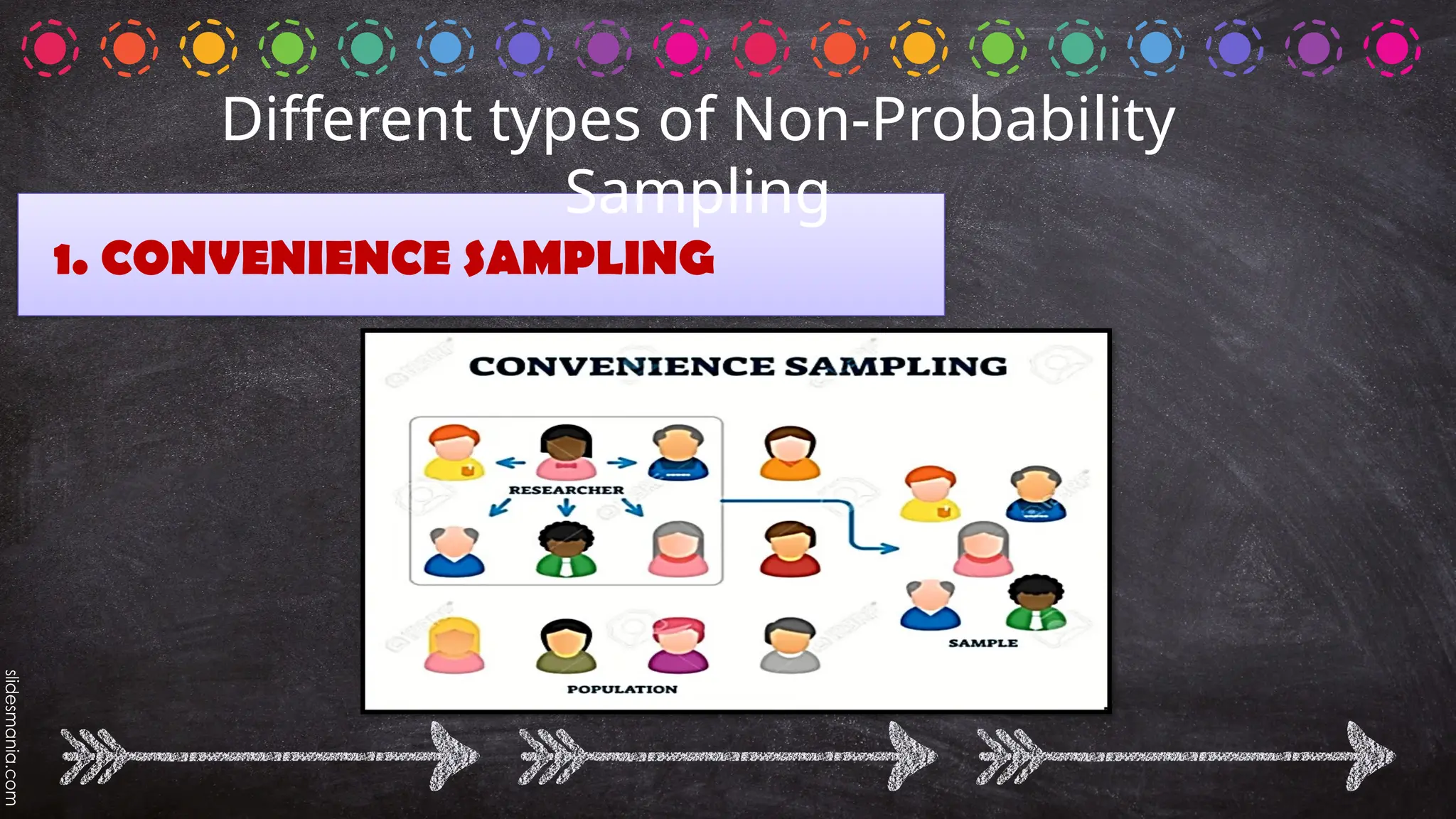
1. CONVENIENCE SAMPLING
- Is a random sampling wherein the researcher gathers data
from nearby sources of information exerting minimal effort.
Convenience is being used by persons giving questionnaires
on the streets to ask the passers-by.
Different types of Non-Probability
Sampling
1. CONVENIENCE SAMPLING
Different types of Non-Probability
Sampling
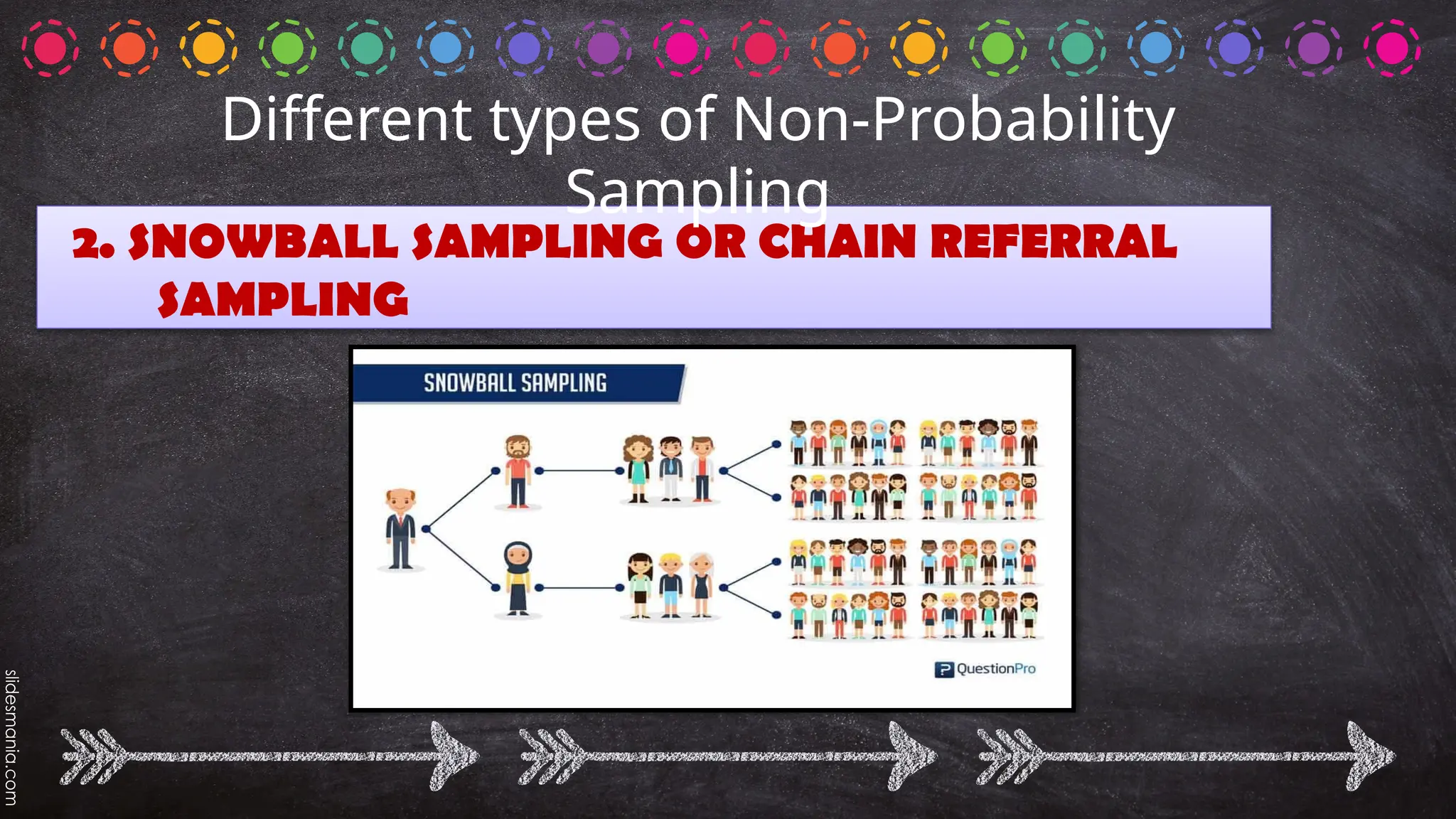
2. SNOWBALL SAMPLING OR CHAIN REFERRAL
SAMPLING
- Is defined as a non-probability sampling technique in which
the samples have traits that are rare to find. This is a sampling
technique in which existing subjects provide referrals to
recruit samples required for a research study.
Different types of Non-Probability
Sampling
2. SNOWBALL SAMPLING OR CHAIN REFERRAL
SAMPLING
Different types of Non-Probability
Sampling
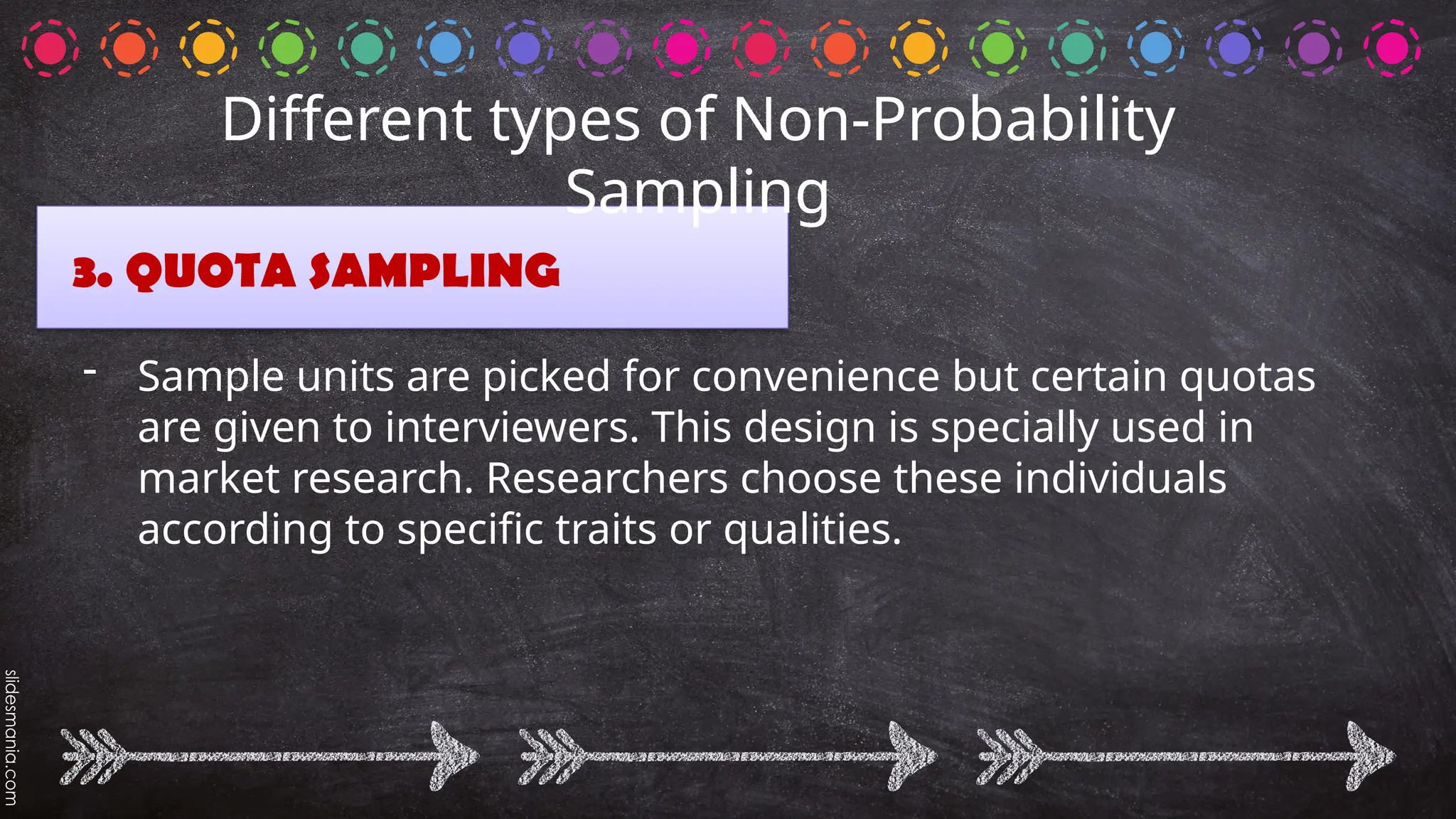
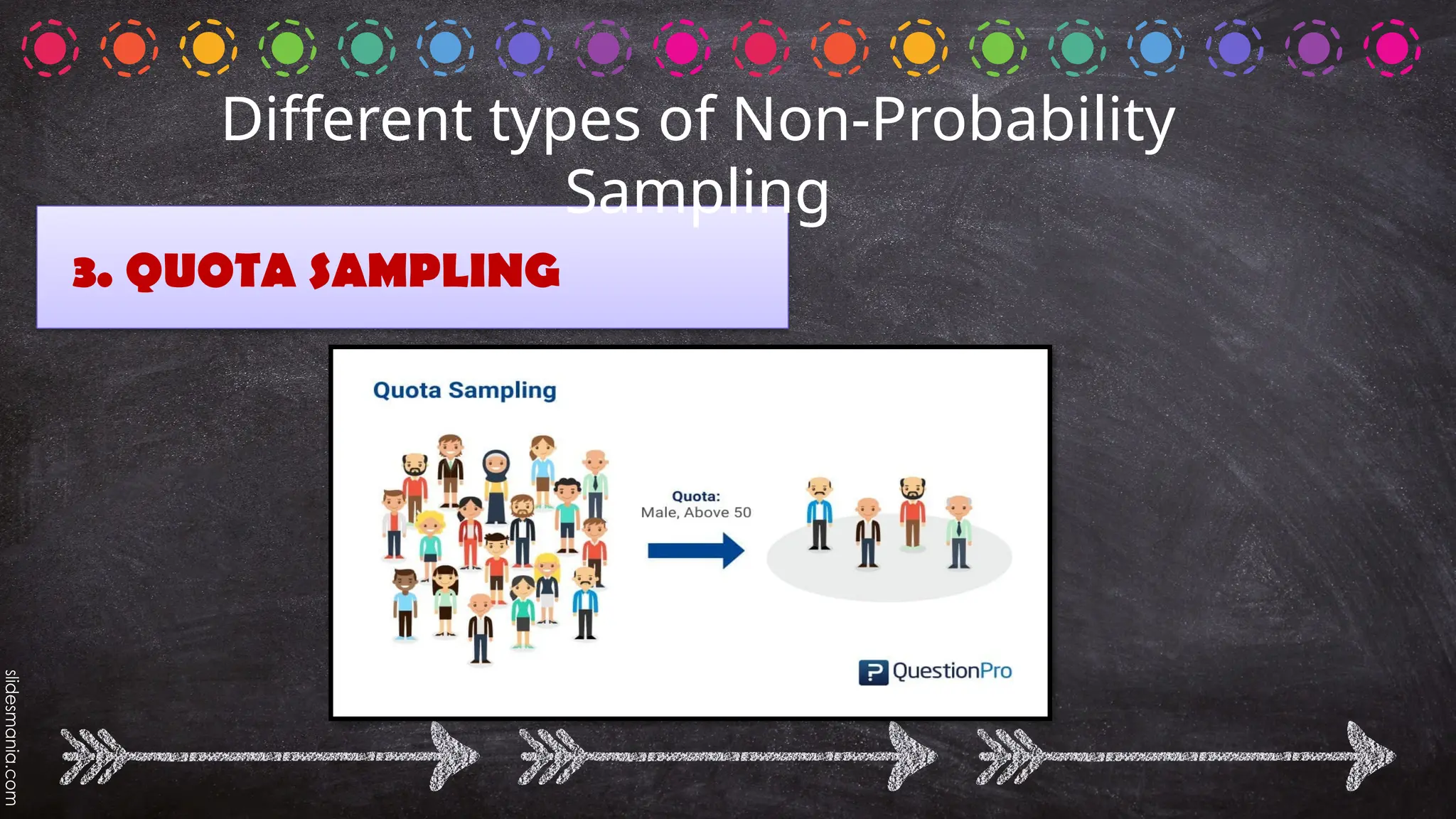
3. QUOTA SAMPLING
- Sample units are picked for convenience but certain quotas
are given to interviewers. This design is specially used in
market research. Researchers choose these individuals
according to specific traits or qualities.
Different types of Non-Probability
Sampling
3. QUOTA SAMPLING
Different types of Non-Probability
Sampling
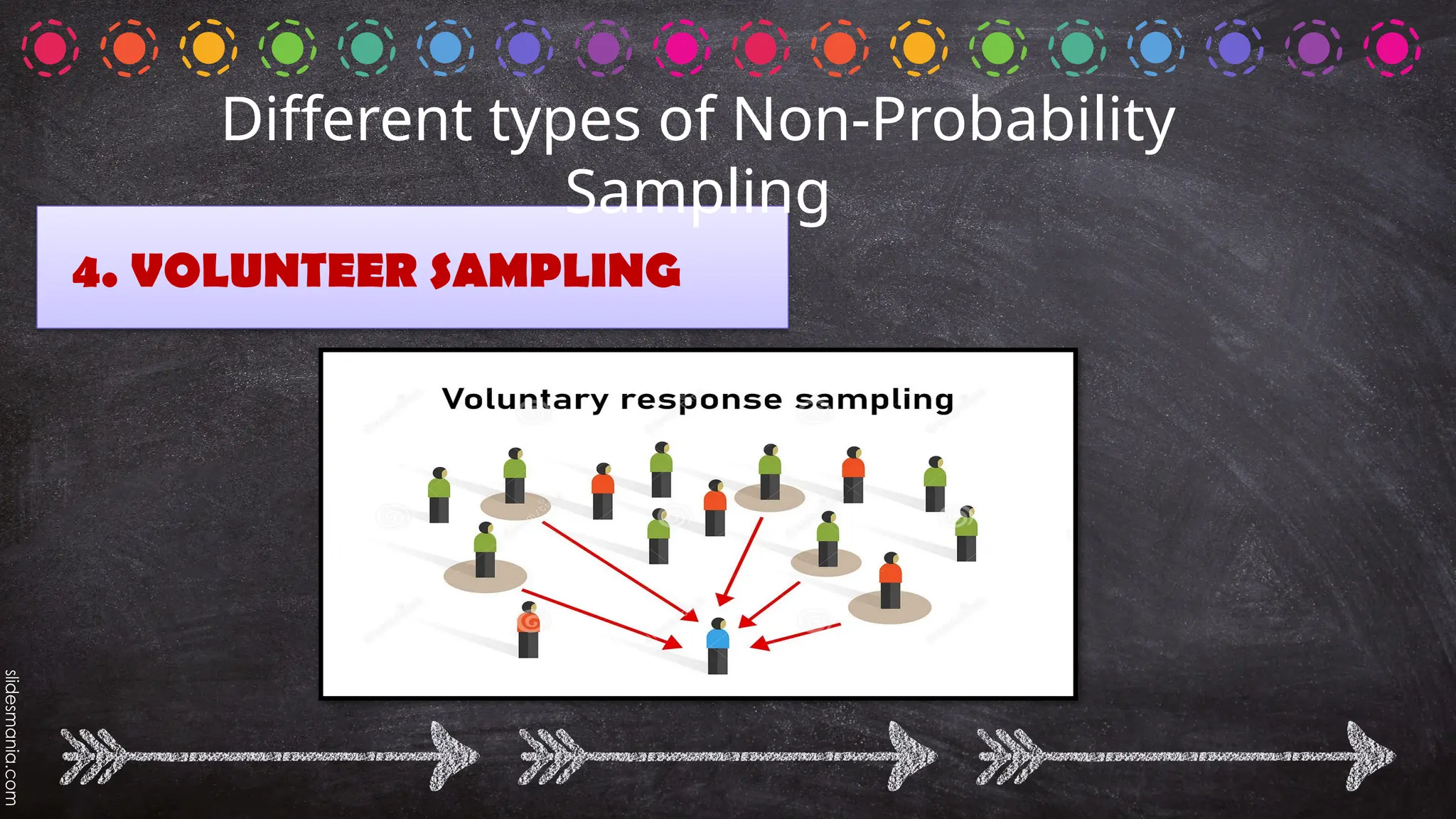
4. VOLUNTEER SAMPLING
- Sample units are volunteers I studies wherein the measuring
process is painful or troublesome to a respondent.
Different types of Non-Probability
Sampling
4. VOLUNTEER SAMPLING
Different types of Non-Probability
Sampling
Test Yourself! 
Identify which sampling method is applied in the following situations.
1. The teacher randomly selects 20 boys and 15 girls from a batch
of learners to be members of a group that will go to a field trip.
2. A sample of 10 mice are selected at random from a set of 40
mice to test the effect of a certain medicine.
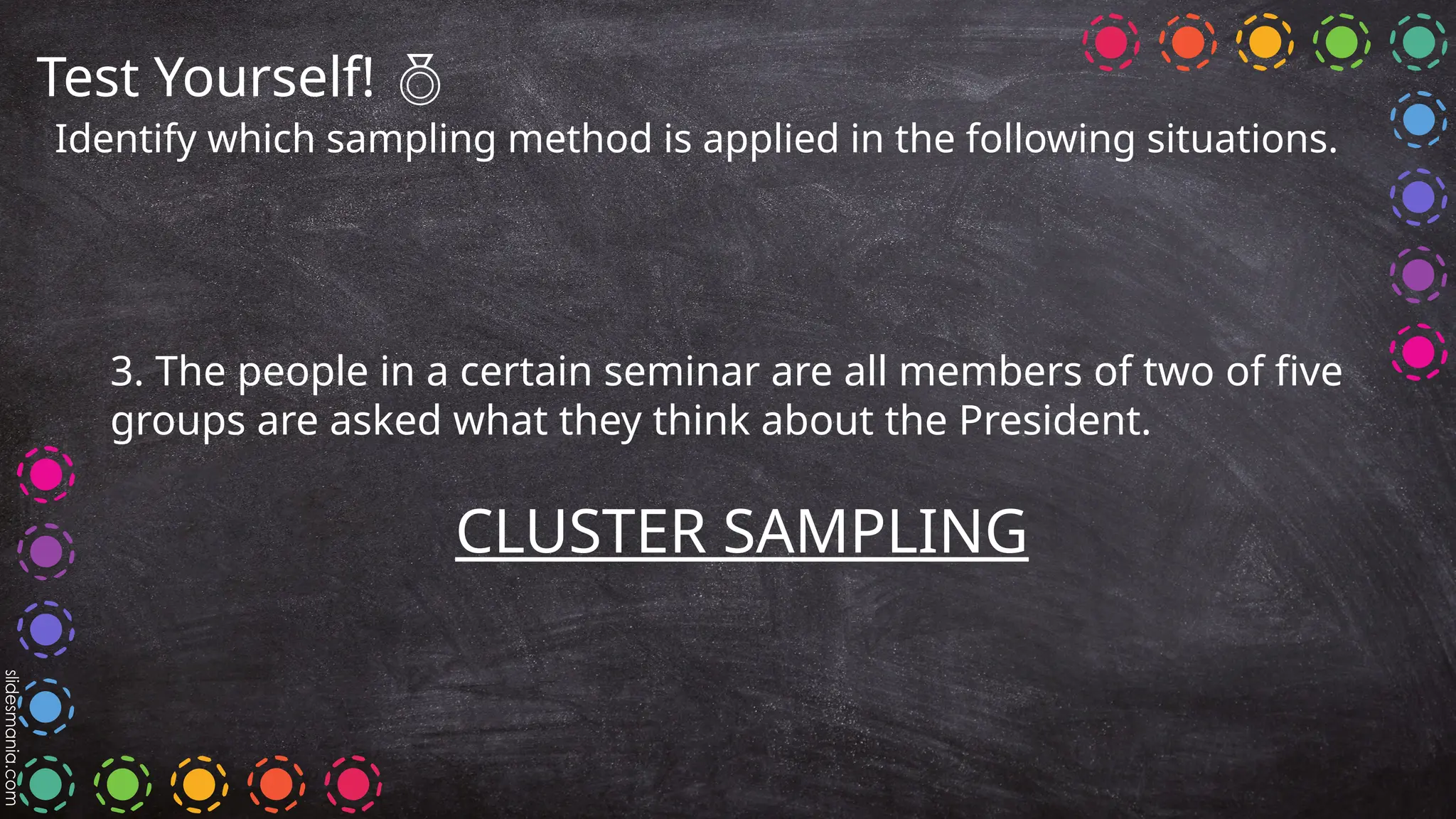
3. The people in a certain seminar are all members of two of five
groups are asked what they think about the President.
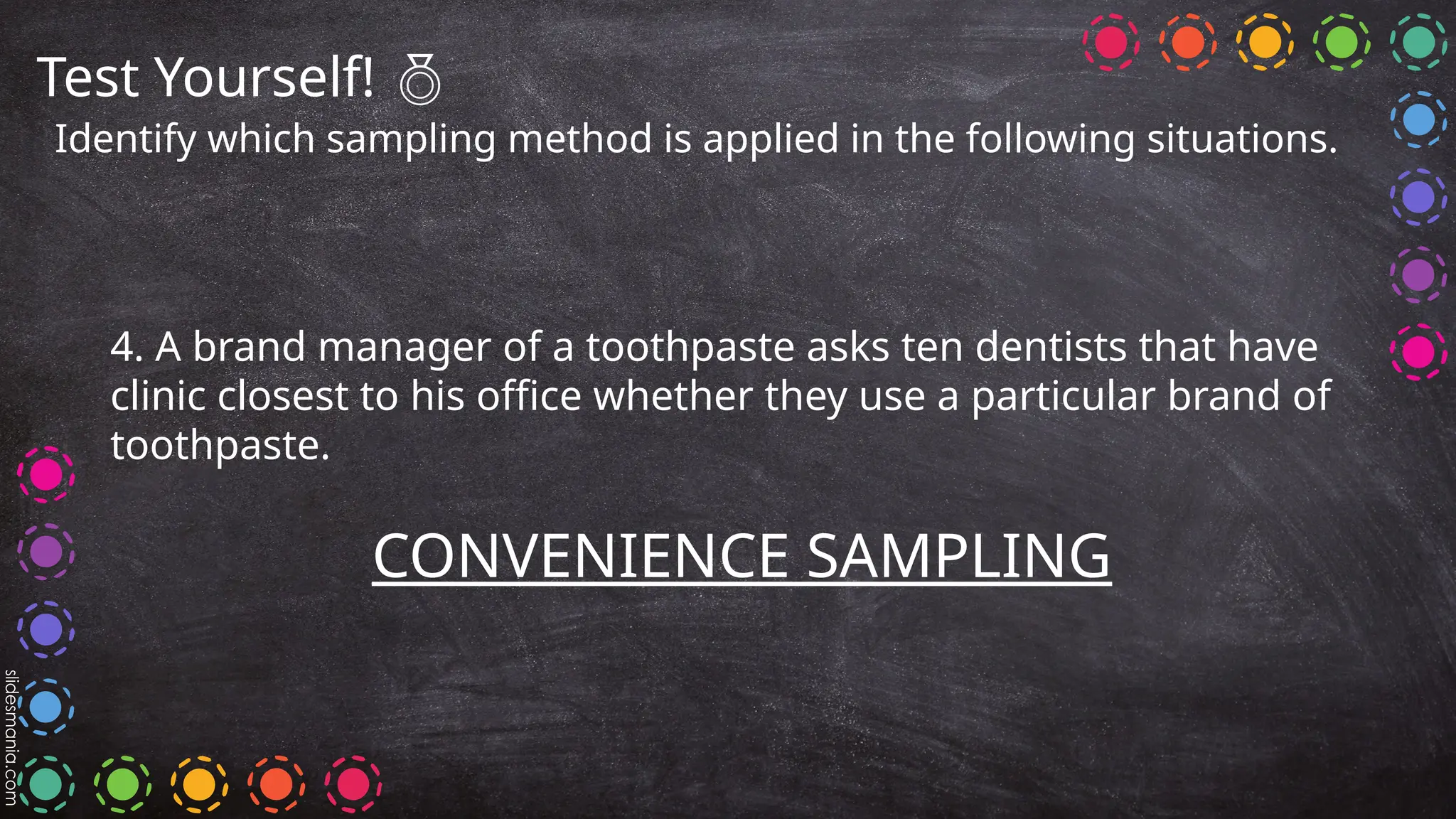
4. A brand manager of a toothpaste asks ten dentists that have
clinic closest to his office whether they use a particular brand of
toothpaste.
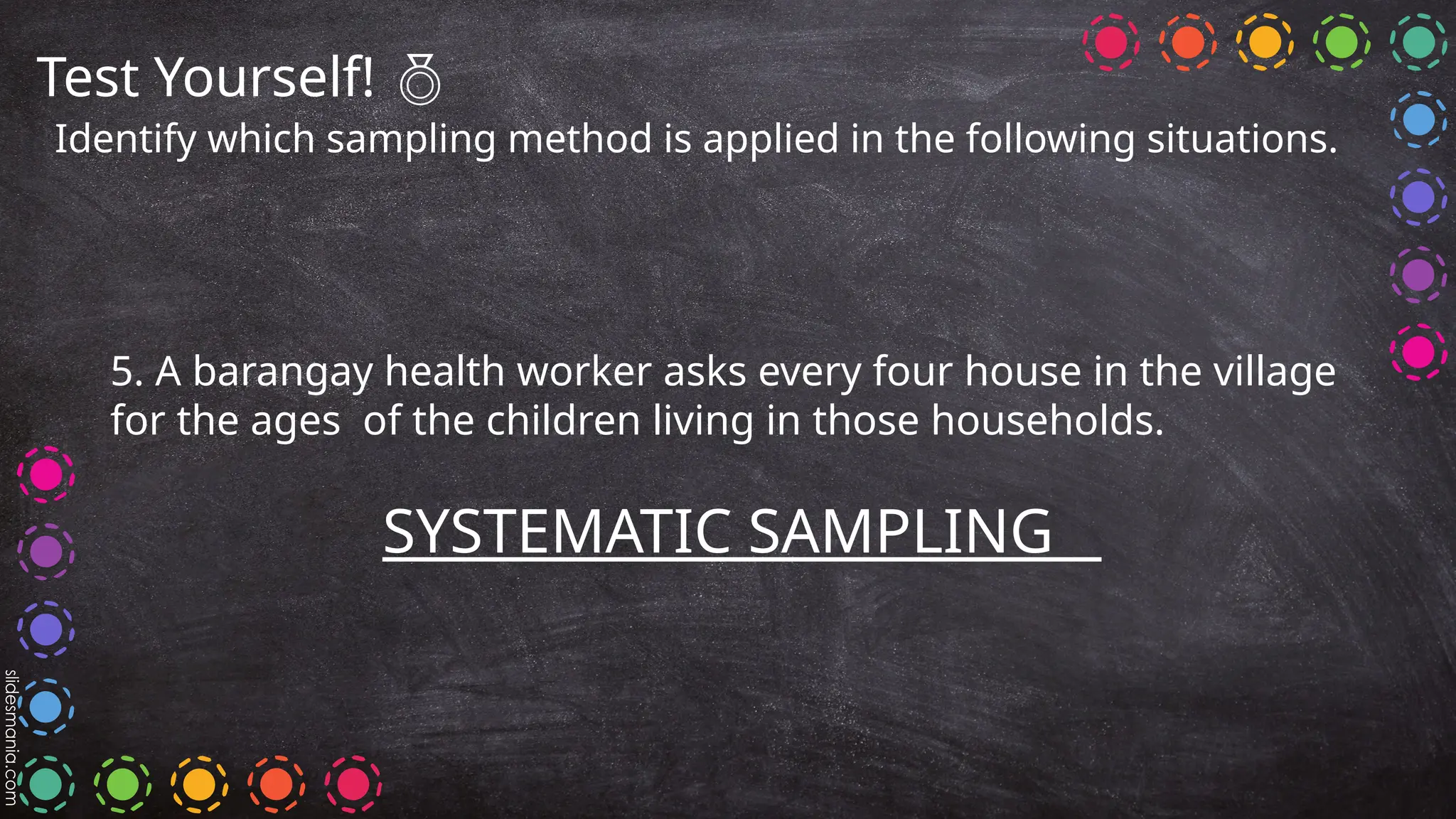
5. A barangay health worker asks every four house in the village
for the ages of the children living in those households.
Test Yourself! 
Identify which sampling method is applied in the following situations.
1. The teacher randomly selects 20 boys and 15 girls from a batch
of learners to be members of a group that will go to a field trip.
STRATEFIED SAMPLING
Test Yourself! 
Identify which sampling method is applied in the following situations.
2. A sample of 10 mice are selected at random from a set of 40
mice to test the effect of a certain medicine.
SIMPLE RANDOM SAMPLING
Test Yourself! 
Identify which sampling method is applied in the following situations.
3. The people in a certain seminar are all members of two of five
groups are asked what they think about the President.
CLUSTER SAMPLING
Test Yourself! 
Identify which sampling method is applied in the following situations.
4. A brand manager of a toothpaste asks ten dentists that have
clinic closest to his office whether they use a particular brand of
toothpaste.
CONVENIENCE SAMPLING
Test Yourself! 
Identify which sampling method is applied in the following situations.
5. A barangay health worker asks every four house in the village
for the ages of the children living in those households.
SYSTEMATIC SAMPLING
경청해 주셔서 감사합니다 

M1_IDENTIFYING THE DIFFERENT RANDOM SAMPLING TECHNIQUE.pptx

  • 1.
  • 2.
    VOCABULARY LIST!  POPULATIONThe set of all possible values of a variable. SAMPLE It consist of one or more data drawn from the population RANDOM SAMPLING It is a sampling method of choosing representatives from the population wherein every sample has an equal chance of being selected. Accurate data can be collected using random sampling techniques.
  • 3.
    VOCABULARY LIST!  1.PROBABILITY SAMPLING The sampling techniques that involve random selection 2. NON - PROBABILITY SAMPLING The sampling techniques that do not involve random selection of data Types of Random Sampling
  • 4.
    1. SIMPLE RANDOM SAMPLING -It is the most basic random sampling wherein each element in the population has an equal probability of being selected. Different types of Probability Sampling
  • 5.
    2. SYSTEMATIC RANDOMSAMPLING - This can be done by listing all the elements in the population and selecting every nth element in your population list This is equally precise as the simple random sampling. It is often used on long population lists. To determine the interval to be used in identifying the samples to who will participate in the study, use the formula (where N = population, n = sample size). Different types of Probability Sampling
  • 6.
    2. SYSTEMATIC RANDOMSAMPLING Different types of Probability Sampling
  • 7.
    3. STRATIFIED RANDOMSAMPLING - Is a random sampling wherein the population is divided into different strata or divisions. The number of the samples will be proportionally picked in each stratum that is why all strata are represented in the samples. Different types of Probability Sampling
  • 8.
    3. STRATIFIED RANDOMSAMPLING Different types of Probability Sampling
  • 9.
    4. CLUSTER RANDOMSAMPLING - Is a random sampling wherein the population is divided into clusters or groups and then the clusters are randomly selected. All elements of the clusters randomly selected are considered the samples of the study. Different types of Probability Sampling
  • 10.
    4. CLUSTER RANDOMSAMPLING Different types of Probability Sampling
  • 11.
    1. CONVENIENCE SAMPLING -Is a random sampling wherein the researcher gathers data from nearby sources of information exerting minimal effort. Convenience is being used by persons giving questionnaires on the streets to ask the passers-by. Different types of Non-Probability Sampling
  • 12.
    1. CONVENIENCE SAMPLING Differenttypes of Non-Probability Sampling
  • 13.
    2. SNOWBALL SAMPLINGOR CHAIN REFERRAL SAMPLING - Is defined as a non-probability sampling technique in which the samples have traits that are rare to find. This is a sampling technique in which existing subjects provide referrals to recruit samples required for a research study. Different types of Non-Probability Sampling
  • 14.
    2. SNOWBALL SAMPLINGOR CHAIN REFERRAL SAMPLING Different types of Non-Probability Sampling
  • 15.
    3. QUOTA SAMPLING -Sample units are picked for convenience but certain quotas are given to interviewers. This design is specially used in market research. Researchers choose these individuals according to specific traits or qualities. Different types of Non-Probability Sampling
  • 16.
    3. QUOTA SAMPLING Differenttypes of Non-Probability Sampling
  • 17.
    4. VOLUNTEER SAMPLING -Sample units are volunteers I studies wherein the measuring process is painful or troublesome to a respondent. Different types of Non-Probability Sampling
  • 18.
    4. VOLUNTEER SAMPLING Differenttypes of Non-Probability Sampling
  • 19.
    Test Yourself!  Identifywhich sampling method is applied in the following situations. 1. The teacher randomly selects 20 boys and 15 girls from a batch of learners to be members of a group that will go to a field trip. 2. A sample of 10 mice are selected at random from a set of 40 mice to test the effect of a certain medicine. 3. The people in a certain seminar are all members of two of five groups are asked what they think about the President. 4. A brand manager of a toothpaste asks ten dentists that have clinic closest to his office whether they use a particular brand of toothpaste. 5. A barangay health worker asks every four house in the village for the ages of the children living in those households.
  • 20.
    Test Yourself!  Identifywhich sampling method is applied in the following situations. 1. The teacher randomly selects 20 boys and 15 girls from a batch of learners to be members of a group that will go to a field trip. STRATEFIED SAMPLING
  • 21.
    Test Yourself!  Identifywhich sampling method is applied in the following situations. 2. A sample of 10 mice are selected at random from a set of 40 mice to test the effect of a certain medicine. SIMPLE RANDOM SAMPLING
  • 22.
    Test Yourself!  Identifywhich sampling method is applied in the following situations. 3. The people in a certain seminar are all members of two of five groups are asked what they think about the President. CLUSTER SAMPLING
  • 23.
    Test Yourself!  Identifywhich sampling method is applied in the following situations. 4. A brand manager of a toothpaste asks ten dentists that have clinic closest to his office whether they use a particular brand of toothpaste. CONVENIENCE SAMPLING
  • 24.
    Test Yourself!  Identifywhich sampling method is applied in the following situations. 5. A barangay health worker asks every four house in the village for the ages of the children living in those households. SYSTEMATIC SAMPLING
  • 25.

Editor's Notes