
UNDERSTANDING AND USAGE OF
QUESTIONING BY MATHEMATICS
TEACHERS: A NARRATIVE INQUIRY
Niroj Dahal
M Phil in Mathematics Education
(2014 Feb. Batch)
Kathmandu University
School of Education
Dissertation Supervisor: Assoc. Dean/Assoc. Prof. Bal Chandra Luitel, PhD
Dissertation Defense
by
(Friday, November 3, 2017
3:00 pm to 4:00 pm)
Outline of the Presentation
• Introduction (1 -11 pages)
• Literature Review (13-34 pages)
– Theoretical Referents (Behaviourism, Constructivism, Social
Constructivism, Criticalism)
• Research Methodology ( 36-52 pages)
• Entry With Narratives (53-90 pages)
• Re-Entry With Narratives (i.e., Meaning-Making of Narratives) (91-119 pages)
• My Reflection and Conclusions (121-134 pages)
– Responding my Research Question
– Implications
– Conclusions
– Future Directions
• References (136- 146 pages)
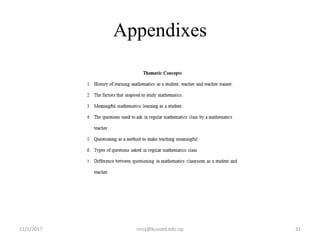
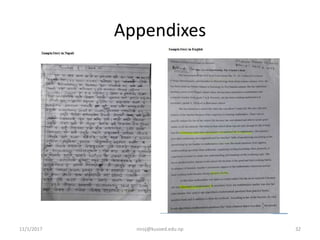
• Appendixes (148- 149 pages)
11/1/2017 2niroj@kusoed.edu.np
Insights
Setting the Scene!
• Who I am?
• As Master and ongoing M Phil student in mathematics education
• As government, private school secondary mathematics teacher
• As visiting facility at one of the renowned universities and community
facilitator of mathematics
• Asking questions was considered to be a sign of disobedience
• Questioning was supposed to be a crime
• Teacher understanding and uses of questioning in mathematics is the focus
• Questioning as major instructional strategies (Shahrill, 2013)
11/1/2017 3niroj@kusoed.edu.np
Nature of the Inquiry
• Learning is possible when individuals interact and get involved
in the discussion (Vygotsky, 1978)
• Opportunities for students to build up knowledge through experiences (Polly et
al., 2014)
• Teaching requires an understanding of what students need to learn and know
and subsequently challenging and supporting them to learn well (NCTM, 2000)
• Questioning is one of the primary and most influential teaching skills that
teachers can use in a mathematics classroom (Cotton, 1989)
• Classroom questions in mathematics are the best used experimental tools o
facilitate the students’ academic improvement or to judge students’ critical
thinking skills (Croom & Stair, 2005)
11/1/2017 4niroj@kusoed.edu.np
Rationale
• Good questioning is a primary tool of successful teachers
• 93% of teacher questions are "lower level" knowledge-based questions
focusing on recall of facts (Daines, 2016)
• Often fail to raise suitable questions in the mathematics classroom and
make the prior assumption that students already know.
• Teachers’ roles, orientations and their philosophical perspective
• Relevant for my future professional career
• Facilitate mathematics curriculum developers, question papers designers,
and textbook writers to improve/incorporate questioning skills
11/1/2017 5niroj@kusoed.edu.np
Statement of the Problem
• 21st-century skills like problem-solving, critical thinking and reasoning has
to be include
• Teachers encourage students to become active participants in the learning
process (Van Zee & Minstrell, 1997)
• Low-level questions are use in mathematics classroom (i.e., closed, direct,
knowledge and recall)
• High-level questions like open-ended, interpretive, evaluative, probing,
inferential, emerging and synthesis-based questions are in minimal use.
• Need for teachers to allow “wait time” for responses from students (Goos,
2004)
• Some of the mathematics teachers who do not possess a strong content
knowledge; they have problems in preparing suitable questions for learners
(Danielson, 1996)
11/1/2017 6niroj@kusoed.edu.np
Purpose of the Study
• To explore the mathematics teachers’
experience on using questioning approaches in
relation to mathematics pedagogy and their
traditions of questioning.
11/1/2017 7niroj@kusoed.edu.np
Research Question
• How do teachers narrate their experience of
understanding and usage of questioning in
relation to mathematics pedagogy?
11/1/2017 8niroj@kusoed.edu.np
Literature Review
Thematic Review of Previous
Research Studies
Questioning in my
Inquiry Theoretical Guideline
11/1/2017 9niroj@kusoed.edu.np
Thematic Review
• Questioning in Mathematics (Callahan & Clark, 2014; Newton,
2012; Harrop & Swinson, 2013)
• Questioning and Critical Thinking (Mason, 2010; Cohen &
Tittle, 2010; Dunn, 2010;Bulach, Lunenburg & Potter, 2011)
• Uses of Questioning in the Mathematics
Classroom (UNESCO, 2014; Beyer, 2000; Treffinger & Isakson, 2001; Blosser,
2000; Hill & Flynn, 2008; Perrott, 2012; Seime, 2015)
• Teacher’s Role in Choosing Questions (Martino & Maher,
1999; Wolfram, 1997; Vogler, 2005; Wilen, 1999; McGrail, 1997; Gall, 2010)
• Teachers’ Beliefs on Mathematical Questioning
(Morgan, 2004; Hancock & Gallard, 2004; Carlsen, 1992; Ornstein, 1995; Good &
Brophy, 2003; Dean, 1996)
• Categories of Questions (Harris , 2000; Woolfolk , 1989;
Cunningham , 1987; Hiebert & Wearne, 1993; Barnes, 1990; Vacc, 1993; Wolf,
1987; Bloom’s taxonomy , 1956; Ilaria, 2009; Anderson, 2001)
11/1/2017 10niroj@kusoed.edu.np
Review of Previous Research Studies
• Higher-level questions lead to better cognitive growth (Dillon, 2004)
• Higher level of thought-provoking questions in mathematics classroom
have encouraged students' performance and thinking (Gall, 2010; Andre, 2015)
• Application of the higher level of questions during mathematical
instruction had a positive effect on students' achievement (Redfield &
Rosseau, 2013)
• Low-level questions were beneficial in helping to improve the performance
of deprived and slow learners (Hewit & Whittier, 2007)
• Questioning in the classroom including teachers' beliefs and practice (Pant,
2015)
11/1/2017 11niroj@kusoed.edu.np
Questioning in my Inquiry
• Cognitive levels of questions draw out the different cognitive
process of critical thinking.
• Two categories: lower-level and higher-level (Bloom et., 1956)
• Questioning have been conducted on utilizing commonly used
research instruments particularly observation and questionnaire.
• Incorporated stories (e.g., teacher's experience) as a research
instrument
• Might not have been carried out in Nepal by using narrative inquiry
• Understanding and uses of questioning in the mathematics
classroom is worth carrying out
11/1/2017 12niroj@kusoed.edu.np
Theoretical Guideline
Behaviourism (Orey, 2001).
(Skinner, 1976; Pitler, Hubbell, Kuhn &
Malenoski, 2007)
Mathematics teachers use these
strategies to ensure that their
mathematics classrooms run smoothly
and effectively.
Constructivism (Larochelle, 2010)
• Students keenly build up their
knowledge, rather than merely
gripping ideas spoken to them
with the help of mathematics
teachers' questioning (Larochelle,
2010)
Social Constructivism:
Higher cognitive processes develop from social interaction (Vygotsky ,1978)
Criticalism: Emphasizes on reflection and imagination (Taylor, 2009)
11/1/2017 13niroj@kusoed.edu.np
• Ontology- nature of reality,
– Multiple realities are replicated by ground reality (Spector-Mersel, 2010)
– Questioning in mathematics classroom also differs from teacher to
teacher
• Epistemology- nature of knowledge
– Truth is constructed through interactions with mathematics teachers
– Knowledge is constructed by the community of mathematics teachers
– Students’ ability, teachers’ knowledge and skill, availability of
classroom resources affect the questioning
– Subjectivism
• Axiology-nature of value
– There are several factors that affect questioning in mathematics for
teachers.
– Understanding is greatly affected by the mathematics teachers
perceptions and realization of things or the world.
Research Methodology
Philosophical Considerations
11/1/2017 14niroj@kusoed.edu.np
Research Paradigm and Research
Design
• Qualitative Approach
– Interpretivism is concerned primarily with generating context-based
understanding of people’s thoughts, beliefs, values and associated
social actions (Taylor, Settelmaier & Luitel, 20012)
– Experiences of mathematics teachers (Clandinin & Connelly, 2013)
• Narrative Inquiry as Research Methodology
– Study of experience as told through stories by mathematics teachers
– Narrative: Meaning the story being told (Riessman, 2008)
– Inquiry: Representing a systematic examination or analysis using
narrative and how they make meaning out of their experience.
• Research Site
– Kathmandu Valley, Nepal
11/1/2017 15niroj@kusoed.edu.np
Research Paradigm and Research
Design Continue…
• Research Participants
– Twenty secondary mathematics teachers’ having at least five years of
mathematics teaching experience (e.g., twelve from private and eight from
public schools) over the telephone and share about the study.
– Six teachers four from private and two from public schools from different parts
of Nepal working in Kathmandu Valley.
• Nature and Source of Data
• Generate a narratives from classroom practices of the mathematics teachers’
experience
• Narrative Generation
– Interview six mathematics teacher (First (45-55 min), Second (15-25 min) and
Third (10-15 min) phase (if necessary) per week interval being flexible
– Meeting with supervisor after each interview
11/1/2017 niroj@kusoed.edu.np 16
Research Paradigm and Research
Design Continue…
• Information Handling
– Transcription Process
– Transcribed the audio-recordings myself to ensure the accuracy of the responses
and the confidentiality of each response of the teachers
– Transcribed accurately
– Names and teachers institutions are pseudo names
– Provide summary to the teacher for second and third interview
– Analysis and Interpretation
• Three guidelines (Squire, 2008)
– Thematic approach (Riessman, 2008)
– Analytical explanations
– Top-down and bottom-up data interpretations
• Entry and Re-entry (Mitchell, 2011)
– “Entry and exit” to present the narratives of mathematics teachers
– “Re-entry and exit” for the meaning-making of the narratives
11/1/2017 niroj@kusoed.edu.np 17
Quality Standards
• Access
– Viewed in two ways (Webster & Mertova, 2007)
– First there is access to the research participants
– Second there is access to the availability and the representation to the same audience of
the research notes, transcripts and data on which the researcher has based the finding.
– Access to the context, process, data and construction of knowledge shared with research
participants.
• Honesty, Verisimilitude and Authenticity
– Naturalistic Inquiry
– Shown through the steps put in place to allow for the most accurate interview, data
collection and interpretation
– Sufficient narrative coherence
• Familiarity
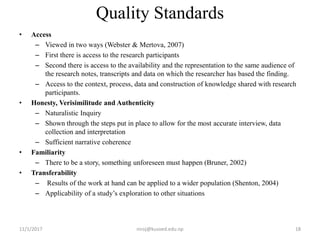
– There to be a story, something unforeseen must happen (Bruner, 2002)
• Transferability
– Results of the work at hand can be applied to a wider population (Shenton, 2004)
– Applicability of a study’s exploration to other situations
11/1/2017 18niroj@kusoed.edu.np
Ethical Considerations
Principles and guidelines that help us uphold
the things we value (Johnson & Christensen
(2008, p. 101)
– Permission letter from the Kathmandu University,
School of Education
– Informed Consent
– Participation is voluntary
– Confidentiality
– Respect of Autonomy
11/1/2017 19niroj@kusoed.edu.np
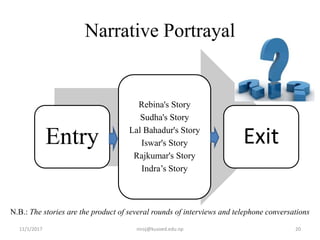
Narrative Portrayal
N.B.: The stories are the product of several rounds of interviews and telephone conversations
11/1/2017 20niroj@kusoed.edu.np
Entry
Rebina's Story
Sudha's Story
Lal Bahadur's Story
Iswar's Story
Rajkumar's Story
Indra’s Story
Exit
Rebina’s Story
She completed her SLC level
from Kanya Ma. Vi., 10 +2
from CCI (Classic College
International), and Bachelor
in Microbiology from Amrit
Science Campus. Now, she
has been studying Master
Degree in Sociology in Tri-
Chandra campus. She has
started her teaching career
from Pragati School where
she worked as a
mathematics and computer
teacher from grade 5 to 8.
Recently, she has been
teaching mathematics at the
secondary level (i.e., grade
IX, X) in Aksharaa school…
Indra’s Story
Indra was born on the ward
no. 3 of Phulbari V.D.C of
Taplejung District. He has
completed his schooling
from St Joseph School,
Biratnagar, B. Sc from
Mahendra Morang and
M.Sc from Patan campus.
He has been teaching
mathematics and science
since 1994. Now, he is an
established mathematics
teacher…
11/1/2017 niroj@kusoed.edu.np 21
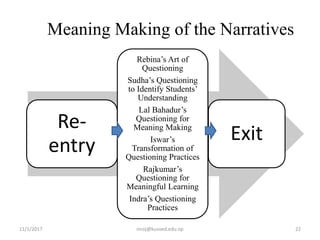
11/1/2017 niroj@kusoed.edu.np 22
Re-
entry
Rebina’s Art of
Questioning
Sudha’s Questioning
to Identify Students’
Understanding
Lal Bahadur’s
Questioning for
Meaning Making
Iswar’s
Transformation of
Questioning Practices
Rajkumar’s
Questioning for
Meaningful Learning
Indra’s Questioning
Practices
Exit
Meaning Making of the Narratives
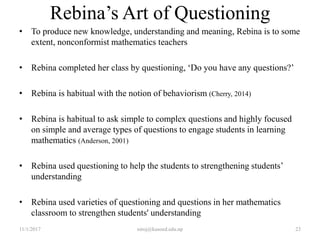
Rebina’s Art of Questioning
• To produce new knowledge, understanding and meaning, Rebina is to some
extent, nonconformist mathematics teachers
• Rebina completed her class by questioning, ‘Do you have any questions?’
• Rebina is habitual with the notion of behaviorism (Cherry, 2014)
• Rebina is habitual to ask simple to complex questions and highly focused
on simple and average types of questions to engage students in learning
mathematics (Anderson, 2001)
• Rebina used questioning to help the students to strengthening students’
understanding
• Rebina used varieties of questioning and questions in her mathematics
classroom to strengthen students' understanding
11/1/2017 niroj@kusoed.edu.np 23
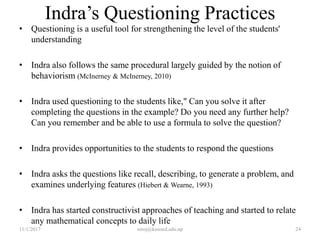
Indra’s Questioning Practices
• Questioning is a useful tool for strengthening the level of the students'
understanding
• Indra also follows the same procedural largely guided by the notion of
behaviorism (McInerney & McInerney, 2010)
• Indra used questioning to the students like," Can you solve it after
completing the questions in the example? Do you need any further help?
Can you remember and be able to use a formula to solve the question?
• Indra provides opportunities to the students to respond the questions
• Indra asks the questions like recall, describing, to generate a problem, and
examines underlying features (Hiebert & Wearne, 1993)
• Indra has started constructivist approaches of teaching and started to relate
any mathematical concepts to daily life
11/1/2017 niroj@kusoed.edu.np 24
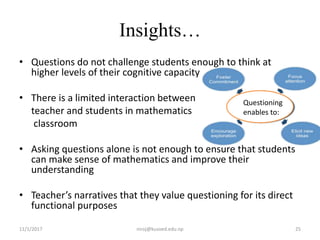
Insights…
• Questions do not challenge students enough to think at
higher levels of their cognitive capacity
• There is a limited interaction between
teacher and students in mathematics
classroom
• Asking questions alone is not enough to ensure that students
can make sense of mathematics and improve their
understanding
• Teacher’s narratives that they value questioning for its direct
functional purposes
11/1/2017 25niroj@kusoed.edu.np
Questioning
enables to:
Responding to My Research Question
• Awareness About Classroom Questioning in
Mathematics
• Democratic Questioning in Mathematics Classroom
• Balanced Incorporation of both Low and High-Level
Questions
• Planned and Emergent Questions
11/1/2017 niroj@kusoed.edu.np 26
Conclusions
• Eye-opener to instruct mathematics teachers on understanding and uses of questioning
• Rebina, Sudha, Lal Bahadur, Iswar, Rajkumar, and Indra may provide a spring entry for the
easy take off to go aboard
• All of the mathematics teachers seems to be conformist mathematics teacher at the
beginning of their teaching career but later on, they were nonconformist by being flexible
enough in asking the questioning
• Asked more questions within the simple to complex level and highly focusing on simple
(low level) questioning, claiming to encourage students in mathematical discussion
• Lower levels questions asked by the mathematics teachers showed that questioning had
been used in a skinny way in their lessons
• In the stories of Rebina, Sudha, and Indra, they ask initiating questions to the whole class,
whereas in stories of Lal Bahadur, Rajkumar and Iswar, they accepted, volunteering
responses from students.
11/1/2017 27niroj@kusoed.edu.np
Conclusions Continue…
• Teachers' lack of knowledge of effective questioning strategies (Morgan, 1994)
may have led them into asking questions that were not contributing to
motivating their students' thinking
• Insufficient wait-time provided by the teachers, teachers’ views about students’
abilities and lack of students’ interaction
• Teachers claims of asking questions at various levels in their lessons seem to be
inconsistent.
• Knowledge of taxonomy is useful for mathematics teachers to ask questions at
various levels
• Teachers may try to lead students to higher-level thinking processes and ask
students as many demanding questions as possible in order to arouse curiosity
and interest to the lesson
11/1/2017 niroj@kusoed.edu.np 28
Implications
• Questioning strategies (institutions would need to conduct workshops, professional
development meetings and encourage mathematics teachers to go for in-service training)
• Not extremely implacable for all
• Can offer some insights to the readers, novice teachers,
novice teacher trainers and educational researchers
• Mathematics teacher would be highly benefited
• Distinguish different types of questioning, such as instruction with regard to lower-level
and higher-level thinking questions with reference to Bloom’s taxonomy (Andorson,
2001), Harris (2000), Convergent to Divergent (Cotton, 1989, Woolfolk, 1989)
• Policymakers and curriculum designers to make some provisions of the questioning
strategies
11/1/2017 niroj@kusoed.edu.np 29
References
Amsterdam, A.G., & Bruner, J. S. (2000). Minding the law. Cambridge, MA: Harvard University Press.
Anderson, L. W. (Eds.). (2001). A Taxonomy for learning, teaching, and assessing: A Revision of Bloom's Taxonomy of educational
objectives. Allyn & Bacon. Boston, MA: Pearson Education Group.
Ayaduray, J. (2016). Can learner strategy instruction succeed? The case of higher order questions an elaborated responses. System,
25(4), 561-570.
Barnes, D. (1990). Oral language and learning. Document resume. Retrieved from
http://files.eric.ed.gov/fulltext/ED318076.pdf#page=47
Belo, N. A. H. (2014). Beyond the dichotomy of teacher- versus student-focused education: A survey study on physics teachers'
beliefs about the goals and pedagogy of physics education. Teaching and Teacher Education, 39, 89-101. doi:
10.1016/j.tate.2013.12.008
Beyer, B. (2000).What research suggests about teaching thinking skills. In A. Costa (Ed.), Developing minds: A resource book for
teaching thinking (pp.275 -286). Alexandria, VA: Association for Supervision and Curriculum Development.
Bloom, L. R. (2002). From self to society: Reflections on the power of narrative inquiry. In S. B. Merriam & Associates (Eds.),
Qualitative research in practice: Examples for discussion and analysis (pp. 310-313). San Francisco, CA: Jossey-Bass.
Blosser, P. (2000). How to ask the right questions. Arlington, VA: National Science Teacher Association.
Bruner, J. S. (2002). Making Stories: Law, literature, life. New York: Farrar, Straus and Giroux.
Bryman, A. (2012). Social research methods (4th ed.). Oxford: Oxford University Press.
Bulach, C. R., Lunenburg, F. C., & Potter, L. (2011). Creating a culture for high-performing schools: A comprehensive approach to
school reform. Lanham, MD: Rowman & Littlefield.
Burden, P. R.,& Byrd, M. D. (1994). Methods for effective teaching. Boston: Allyn and Bacon.
Callahan, J. F., & Clark, L. H. (2014). Teaching in the middle and secondary schools: Planning for competence. New York:
MacMillan Publishing Company.
Caram, C. A., & Davis, P. B. (2005). Inviting student engagement with questioning. Kappa Delta Pi Record, 19-23.
11/1/2017 30niroj@kusoed.edu.np
Appendixes
11/1/2017 31niroj@kusoed.edu.np
Appendixes
11/1/2017 32niroj@kusoed.edu.np
THANK YOU!
11/1/2017 33niroj@kusoed.edu.np

M Phil Dissertation Viva-Voce_Niroj Dahal(Final)

  • 1.
    UNDERSTANDING AND USAGEOF QUESTIONING BY MATHEMATICS TEACHERS: A NARRATIVE INQUIRY Niroj Dahal M Phil in Mathematics Education (2014 Feb. Batch) Kathmandu University School of Education Dissertation Supervisor: Assoc. Dean/Assoc. Prof. Bal Chandra Luitel, PhD Dissertation Defense by (Friday, November 3, 2017 3:00 pm to 4:00 pm)
  • 2.
    Outline of thePresentation • Introduction (1 -11 pages) • Literature Review (13-34 pages) – Theoretical Referents (Behaviourism, Constructivism, Social Constructivism, Criticalism) • Research Methodology ( 36-52 pages) • Entry With Narratives (53-90 pages) • Re-Entry With Narratives (i.e., Meaning-Making of Narratives) (91-119 pages) • My Reflection and Conclusions (121-134 pages) – Responding my Research Question – Implications – Conclusions – Future Directions • References (136- 146 pages) • Appendixes (148- 149 pages) 11/1/2017 2niroj@kusoed.edu.np Insights
  • 3.
    Setting the Scene! •Who I am? • As Master and ongoing M Phil student in mathematics education • As government, private school secondary mathematics teacher • As visiting facility at one of the renowned universities and community facilitator of mathematics • Asking questions was considered to be a sign of disobedience • Questioning was supposed to be a crime • Teacher understanding and uses of questioning in mathematics is the focus • Questioning as major instructional strategies (Shahrill, 2013) 11/1/2017 3niroj@kusoed.edu.np
  • 4.
    Nature of theInquiry • Learning is possible when individuals interact and get involved in the discussion (Vygotsky, 1978) • Opportunities for students to build up knowledge through experiences (Polly et al., 2014) • Teaching requires an understanding of what students need to learn and know and subsequently challenging and supporting them to learn well (NCTM, 2000) • Questioning is one of the primary and most influential teaching skills that teachers can use in a mathematics classroom (Cotton, 1989) • Classroom questions in mathematics are the best used experimental tools o facilitate the students’ academic improvement or to judge students’ critical thinking skills (Croom & Stair, 2005) 11/1/2017 4niroj@kusoed.edu.np
  • 5.
    Rationale • Good questioningis a primary tool of successful teachers • 93% of teacher questions are "lower level" knowledge-based questions focusing on recall of facts (Daines, 2016) • Often fail to raise suitable questions in the mathematics classroom and make the prior assumption that students already know. • Teachers’ roles, orientations and their philosophical perspective • Relevant for my future professional career • Facilitate mathematics curriculum developers, question papers designers, and textbook writers to improve/incorporate questioning skills 11/1/2017 5niroj@kusoed.edu.np
  • 6.
    Statement of theProblem • 21st-century skills like problem-solving, critical thinking and reasoning has to be include • Teachers encourage students to become active participants in the learning process (Van Zee & Minstrell, 1997) • Low-level questions are use in mathematics classroom (i.e., closed, direct, knowledge and recall) • High-level questions like open-ended, interpretive, evaluative, probing, inferential, emerging and synthesis-based questions are in minimal use. • Need for teachers to allow “wait time” for responses from students (Goos, 2004) • Some of the mathematics teachers who do not possess a strong content knowledge; they have problems in preparing suitable questions for learners (Danielson, 1996) 11/1/2017 6niroj@kusoed.edu.np
  • 7.
    Purpose of theStudy • To explore the mathematics teachers’ experience on using questioning approaches in relation to mathematics pedagogy and their traditions of questioning. 11/1/2017 7niroj@kusoed.edu.np
  • 8.
    Research Question • Howdo teachers narrate their experience of understanding and usage of questioning in relation to mathematics pedagogy? 11/1/2017 8niroj@kusoed.edu.np
  • 9.
    Literature Review Thematic Reviewof Previous Research Studies Questioning in my Inquiry Theoretical Guideline 11/1/2017 9niroj@kusoed.edu.np
  • 10.
    Thematic Review • Questioningin Mathematics (Callahan & Clark, 2014; Newton, 2012; Harrop & Swinson, 2013) • Questioning and Critical Thinking (Mason, 2010; Cohen & Tittle, 2010; Dunn, 2010;Bulach, Lunenburg & Potter, 2011) • Uses of Questioning in the Mathematics Classroom (UNESCO, 2014; Beyer, 2000; Treffinger & Isakson, 2001; Blosser, 2000; Hill & Flynn, 2008; Perrott, 2012; Seime, 2015) • Teacher’s Role in Choosing Questions (Martino & Maher, 1999; Wolfram, 1997; Vogler, 2005; Wilen, 1999; McGrail, 1997; Gall, 2010) • Teachers’ Beliefs on Mathematical Questioning (Morgan, 2004; Hancock & Gallard, 2004; Carlsen, 1992; Ornstein, 1995; Good & Brophy, 2003; Dean, 1996) • Categories of Questions (Harris , 2000; Woolfolk , 1989; Cunningham , 1987; Hiebert & Wearne, 1993; Barnes, 1990; Vacc, 1993; Wolf, 1987; Bloom’s taxonomy , 1956; Ilaria, 2009; Anderson, 2001) 11/1/2017 10niroj@kusoed.edu.np
  • 11.
    Review of PreviousResearch Studies • Higher-level questions lead to better cognitive growth (Dillon, 2004) • Higher level of thought-provoking questions in mathematics classroom have encouraged students' performance and thinking (Gall, 2010; Andre, 2015) • Application of the higher level of questions during mathematical instruction had a positive effect on students' achievement (Redfield & Rosseau, 2013) • Low-level questions were beneficial in helping to improve the performance of deprived and slow learners (Hewit & Whittier, 2007) • Questioning in the classroom including teachers' beliefs and practice (Pant, 2015) 11/1/2017 11niroj@kusoed.edu.np
  • 12.
    Questioning in myInquiry • Cognitive levels of questions draw out the different cognitive process of critical thinking. • Two categories: lower-level and higher-level (Bloom et., 1956) • Questioning have been conducted on utilizing commonly used research instruments particularly observation and questionnaire. • Incorporated stories (e.g., teacher's experience) as a research instrument • Might not have been carried out in Nepal by using narrative inquiry • Understanding and uses of questioning in the mathematics classroom is worth carrying out 11/1/2017 12niroj@kusoed.edu.np
  • 13.
    Theoretical Guideline Behaviourism (Orey,2001). (Skinner, 1976; Pitler, Hubbell, Kuhn & Malenoski, 2007) Mathematics teachers use these strategies to ensure that their mathematics classrooms run smoothly and effectively. Constructivism (Larochelle, 2010) • Students keenly build up their knowledge, rather than merely gripping ideas spoken to them with the help of mathematics teachers' questioning (Larochelle, 2010) Social Constructivism: Higher cognitive processes develop from social interaction (Vygotsky ,1978) Criticalism: Emphasizes on reflection and imagination (Taylor, 2009) 11/1/2017 13niroj@kusoed.edu.np
  • 14.
    • Ontology- natureof reality, – Multiple realities are replicated by ground reality (Spector-Mersel, 2010) – Questioning in mathematics classroom also differs from teacher to teacher • Epistemology- nature of knowledge – Truth is constructed through interactions with mathematics teachers – Knowledge is constructed by the community of mathematics teachers – Students’ ability, teachers’ knowledge and skill, availability of classroom resources affect the questioning – Subjectivism • Axiology-nature of value – There are several factors that affect questioning in mathematics for teachers. – Understanding is greatly affected by the mathematics teachers perceptions and realization of things or the world. Research Methodology Philosophical Considerations 11/1/2017 14niroj@kusoed.edu.np
  • 15.
    Research Paradigm andResearch Design • Qualitative Approach – Interpretivism is concerned primarily with generating context-based understanding of people’s thoughts, beliefs, values and associated social actions (Taylor, Settelmaier & Luitel, 20012) – Experiences of mathematics teachers (Clandinin & Connelly, 2013) • Narrative Inquiry as Research Methodology – Study of experience as told through stories by mathematics teachers – Narrative: Meaning the story being told (Riessman, 2008) – Inquiry: Representing a systematic examination or analysis using narrative and how they make meaning out of their experience. • Research Site – Kathmandu Valley, Nepal 11/1/2017 15niroj@kusoed.edu.np
  • 16.
    Research Paradigm andResearch Design Continue… • Research Participants – Twenty secondary mathematics teachers’ having at least five years of mathematics teaching experience (e.g., twelve from private and eight from public schools) over the telephone and share about the study. – Six teachers four from private and two from public schools from different parts of Nepal working in Kathmandu Valley. • Nature and Source of Data • Generate a narratives from classroom practices of the mathematics teachers’ experience • Narrative Generation – Interview six mathematics teacher (First (45-55 min), Second (15-25 min) and Third (10-15 min) phase (if necessary) per week interval being flexible – Meeting with supervisor after each interview 11/1/2017 niroj@kusoed.edu.np 16
  • 17.
    Research Paradigm andResearch Design Continue… • Information Handling – Transcription Process – Transcribed the audio-recordings myself to ensure the accuracy of the responses and the confidentiality of each response of the teachers – Transcribed accurately – Names and teachers institutions are pseudo names – Provide summary to the teacher for second and third interview – Analysis and Interpretation • Three guidelines (Squire, 2008) – Thematic approach (Riessman, 2008) – Analytical explanations – Top-down and bottom-up data interpretations • Entry and Re-entry (Mitchell, 2011) – “Entry and exit” to present the narratives of mathematics teachers – “Re-entry and exit” for the meaning-making of the narratives 11/1/2017 niroj@kusoed.edu.np 17
  • 18.
    Quality Standards • Access –Viewed in two ways (Webster & Mertova, 2007) – First there is access to the research participants – Second there is access to the availability and the representation to the same audience of the research notes, transcripts and data on which the researcher has based the finding. – Access to the context, process, data and construction of knowledge shared with research participants. • Honesty, Verisimilitude and Authenticity – Naturalistic Inquiry – Shown through the steps put in place to allow for the most accurate interview, data collection and interpretation – Sufficient narrative coherence • Familiarity – There to be a story, something unforeseen must happen (Bruner, 2002) • Transferability – Results of the work at hand can be applied to a wider population (Shenton, 2004) – Applicability of a study’s exploration to other situations 11/1/2017 18niroj@kusoed.edu.np
  • 19.
    Ethical Considerations Principles andguidelines that help us uphold the things we value (Johnson & Christensen (2008, p. 101) – Permission letter from the Kathmandu University, School of Education – Informed Consent – Participation is voluntary – Confidentiality – Respect of Autonomy 11/1/2017 19niroj@kusoed.edu.np
  • 20.
    Narrative Portrayal N.B.: Thestories are the product of several rounds of interviews and telephone conversations 11/1/2017 20niroj@kusoed.edu.np Entry Rebina's Story Sudha's Story Lal Bahadur's Story Iswar's Story Rajkumar's Story Indra’s Story Exit
  • 21.
    Rebina’s Story She completedher SLC level from Kanya Ma. Vi., 10 +2 from CCI (Classic College International), and Bachelor in Microbiology from Amrit Science Campus. Now, she has been studying Master Degree in Sociology in Tri- Chandra campus. She has started her teaching career from Pragati School where she worked as a mathematics and computer teacher from grade 5 to 8. Recently, she has been teaching mathematics at the secondary level (i.e., grade IX, X) in Aksharaa school… Indra’s Story Indra was born on the ward no. 3 of Phulbari V.D.C of Taplejung District. He has completed his schooling from St Joseph School, Biratnagar, B. Sc from Mahendra Morang and M.Sc from Patan campus. He has been teaching mathematics and science since 1994. Now, he is an established mathematics teacher… 11/1/2017 niroj@kusoed.edu.np 21
  • 22.
    11/1/2017 niroj@kusoed.edu.np 22 Re- entry Rebina’sArt of Questioning Sudha’s Questioning to Identify Students’ Understanding Lal Bahadur’s Questioning for Meaning Making Iswar’s Transformation of Questioning Practices Rajkumar’s Questioning for Meaningful Learning Indra’s Questioning Practices Exit Meaning Making of the Narratives
  • 23.
    Rebina’s Art ofQuestioning • To produce new knowledge, understanding and meaning, Rebina is to some extent, nonconformist mathematics teachers • Rebina completed her class by questioning, ‘Do you have any questions?’ • Rebina is habitual with the notion of behaviorism (Cherry, 2014) • Rebina is habitual to ask simple to complex questions and highly focused on simple and average types of questions to engage students in learning mathematics (Anderson, 2001) • Rebina used questioning to help the students to strengthening students’ understanding • Rebina used varieties of questioning and questions in her mathematics classroom to strengthen students' understanding 11/1/2017 niroj@kusoed.edu.np 23
  • 24.
    Indra’s Questioning Practices •Questioning is a useful tool for strengthening the level of the students' understanding • Indra also follows the same procedural largely guided by the notion of behaviorism (McInerney & McInerney, 2010) • Indra used questioning to the students like," Can you solve it after completing the questions in the example? Do you need any further help? Can you remember and be able to use a formula to solve the question? • Indra provides opportunities to the students to respond the questions • Indra asks the questions like recall, describing, to generate a problem, and examines underlying features (Hiebert & Wearne, 1993) • Indra has started constructivist approaches of teaching and started to relate any mathematical concepts to daily life 11/1/2017 niroj@kusoed.edu.np 24
  • 25.
    Insights… • Questions donot challenge students enough to think at higher levels of their cognitive capacity • There is a limited interaction between teacher and students in mathematics classroom • Asking questions alone is not enough to ensure that students can make sense of mathematics and improve their understanding • Teacher’s narratives that they value questioning for its direct functional purposes 11/1/2017 25niroj@kusoed.edu.np Questioning enables to:
  • 26.
    Responding to MyResearch Question • Awareness About Classroom Questioning in Mathematics • Democratic Questioning in Mathematics Classroom • Balanced Incorporation of both Low and High-Level Questions • Planned and Emergent Questions 11/1/2017 niroj@kusoed.edu.np 26
  • 27.
    Conclusions • Eye-opener toinstruct mathematics teachers on understanding and uses of questioning • Rebina, Sudha, Lal Bahadur, Iswar, Rajkumar, and Indra may provide a spring entry for the easy take off to go aboard • All of the mathematics teachers seems to be conformist mathematics teacher at the beginning of their teaching career but later on, they were nonconformist by being flexible enough in asking the questioning • Asked more questions within the simple to complex level and highly focusing on simple (low level) questioning, claiming to encourage students in mathematical discussion • Lower levels questions asked by the mathematics teachers showed that questioning had been used in a skinny way in their lessons • In the stories of Rebina, Sudha, and Indra, they ask initiating questions to the whole class, whereas in stories of Lal Bahadur, Rajkumar and Iswar, they accepted, volunteering responses from students. 11/1/2017 27niroj@kusoed.edu.np
  • 28.
    Conclusions Continue… • Teachers'lack of knowledge of effective questioning strategies (Morgan, 1994) may have led them into asking questions that were not contributing to motivating their students' thinking • Insufficient wait-time provided by the teachers, teachers’ views about students’ abilities and lack of students’ interaction • Teachers claims of asking questions at various levels in their lessons seem to be inconsistent. • Knowledge of taxonomy is useful for mathematics teachers to ask questions at various levels • Teachers may try to lead students to higher-level thinking processes and ask students as many demanding questions as possible in order to arouse curiosity and interest to the lesson 11/1/2017 niroj@kusoed.edu.np 28
  • 29.
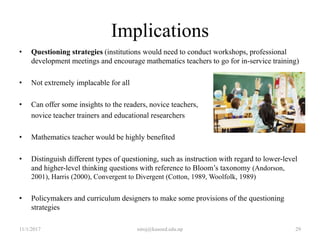
    Implications • Questioning strategies(institutions would need to conduct workshops, professional development meetings and encourage mathematics teachers to go for in-service training) • Not extremely implacable for all • Can offer some insights to the readers, novice teachers, novice teacher trainers and educational researchers • Mathematics teacher would be highly benefited • Distinguish different types of questioning, such as instruction with regard to lower-level and higher-level thinking questions with reference to Bloom’s taxonomy (Andorson, 2001), Harris (2000), Convergent to Divergent (Cotton, 1989, Woolfolk, 1989) • Policymakers and curriculum designers to make some provisions of the questioning strategies 11/1/2017 niroj@kusoed.edu.np 29
  • 30.
    References Amsterdam, A.G., &Bruner, J. S. (2000). Minding the law. Cambridge, MA: Harvard University Press. Anderson, L. W. (Eds.). (2001). A Taxonomy for learning, teaching, and assessing: A Revision of Bloom's Taxonomy of educational objectives. Allyn & Bacon. Boston, MA: Pearson Education Group. Ayaduray, J. (2016). Can learner strategy instruction succeed? The case of higher order questions an elaborated responses. System, 25(4), 561-570. Barnes, D. (1990). Oral language and learning. Document resume. Retrieved from http://files.eric.ed.gov/fulltext/ED318076.pdf#page=47 Belo, N. A. H. (2014). Beyond the dichotomy of teacher- versus student-focused education: A survey study on physics teachers' beliefs about the goals and pedagogy of physics education. Teaching and Teacher Education, 39, 89-101. doi: 10.1016/j.tate.2013.12.008 Beyer, B. (2000).What research suggests about teaching thinking skills. In A. Costa (Ed.), Developing minds: A resource book for teaching thinking (pp.275 -286). Alexandria, VA: Association for Supervision and Curriculum Development. Bloom, L. R. (2002). From self to society: Reflections on the power of narrative inquiry. In S. B. Merriam & Associates (Eds.), Qualitative research in practice: Examples for discussion and analysis (pp. 310-313). San Francisco, CA: Jossey-Bass. Blosser, P. (2000). How to ask the right questions. Arlington, VA: National Science Teacher Association. Bruner, J. S. (2002). Making Stories: Law, literature, life. New York: Farrar, Straus and Giroux. Bryman, A. (2012). Social research methods (4th ed.). Oxford: Oxford University Press. Bulach, C. R., Lunenburg, F. C., & Potter, L. (2011). Creating a culture for high-performing schools: A comprehensive approach to school reform. Lanham, MD: Rowman & Littlefield. Burden, P. R.,& Byrd, M. D. (1994). Methods for effective teaching. Boston: Allyn and Bacon. Callahan, J. F., & Clark, L. H. (2014). Teaching in the middle and secondary schools: Planning for competence. New York: MacMillan Publishing Company. Caram, C. A., & Davis, P. B. (2005). Inviting student engagement with questioning. Kappa Delta Pi Record, 19-23. 11/1/2017 30niroj@kusoed.edu.np
  • 31.
  • 32.
  • 33.