




Luxun - A Persistent Messaging
 System Tailored for Big Data
    Collecting & Analytics
                              By William
           http://bulldog2011.github.com
Performance Highlight

   On Single Server Grade Machine with Single
    Topic
       Average producing throughput > 100MBps, peak
        > 200MBps
       Average consuming throughput > 100MBps, peak
        > 200MBps
   In Networking Case,
       Throughput only limited by network and disk IO
        bandwidth
Typical Big Data or Activity Stream

   Logs generated by frontend applications or
    backend services
   User behavior data
   Application or system performance trace
   Business, application or system metrics data
   Events that need immediate action
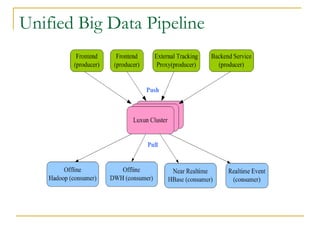
Unified Big Data Pipeline
Luxun Design Objectives
   Fast & High-Throughput
       Top priority, close to O(1) memory access
   Persistent & Durable
       All data is persistent on disk and is crash resistant
   Producer & Consumer Separation
       Each one can work without knowing the existence of the other
   Realtime
       Produced message will be immediately visible to consumer
   Distributed
       Horizontal scalable with commodity machines
   Multiple Clients Support
       Easy integration with clients from different platforms, such as Java, C#, PHP, Ruby,
        Python, C++…
   Flexible consuming semantics
       Consume once, fanout, can even consume by index
   Light Weight
       Small footprint binary, no Zookeeper coordination
Basic Concepts
   Topic
     Logically it’s a named place to send messages to or to consume
      messages from, physically it’s a persistent queue
   Broker
     Aka Luxun server

   Message
     Datum to produce or consume

   Producer
     A role which will send messages to topics

   Consumer
     A role which will consume messages from topics

   Consumer Group
     A group of consumers that will receive only one copy of a
      message from a topic
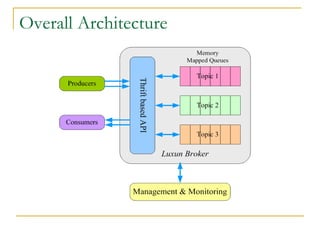
Overall Architecture
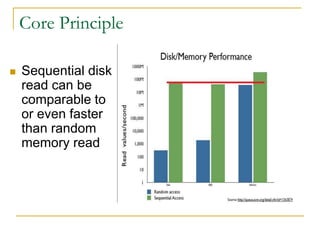
Core Principle

   Sequential disk
    read can be
    comparable to
    or even faster
    than random
    memory read
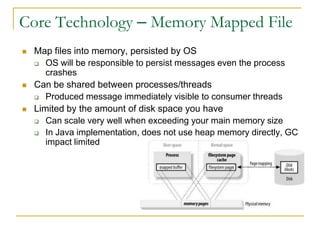
Core Technology – Memory Mapped File
   Map files into memory, persisted by OS
     OS will be responsible to persist messages even the process
       crashes
   Can be shared between processes/threads
     Produced message immediately visible to consumer threads

   Limited by the amount of disk space you have
     Can scale very well when exceeding your main memory size

     In Java implementation, does not use heap memory directly, GC
       impact limited
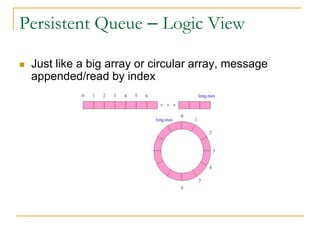
Persistent Queue – Logic View

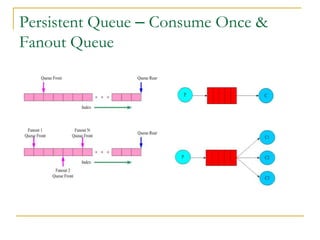
   Just like a big array or circular array, message
    appended/read by index
Persistent Queue – Consume Once &
Fanout Queue
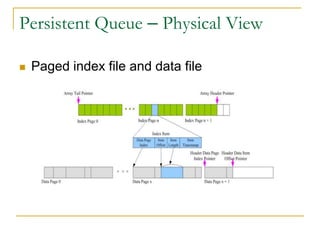
Persistent Queue – Physical View

   Paged index file and data file
Persistent Queue - Concurrency

   Append operation is synchronized in queue
    implementation
   Read operation is already thread safe
   Array Header Index Pointer is a read/write
    barrier
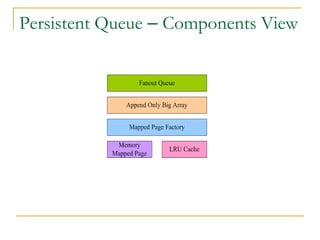
Persistent Queue – Components View
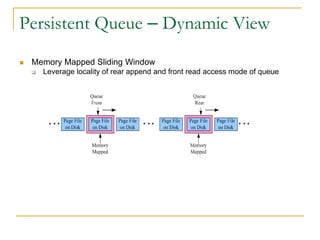
Persistent Queue – Dynamic View
   Memory Mapped Sliding Window
       Leverage locality of rear append and front read access mode of queue
Communication Layer – Why Thrift

   Stable & Mature
       Created by Facebook, used in Cassandra and HBase
   High Performance
       Binary serialization protocol and non-blocking server model
   Simple & Light-Weight
       IDL driven development, auto-generate client & server side
        proxy
   Cross-Language
       Auto-generate clients for Java, C#, C++, PHP, Ruby,
        Python, …
   Flexible & Pluggable Architecture
       Programming like playing with building blocks, components
        are replaceable as needed.
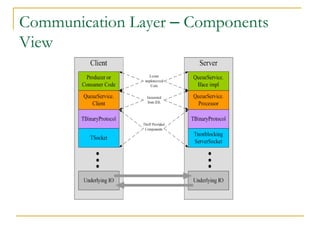
Communication Layer – Components
View
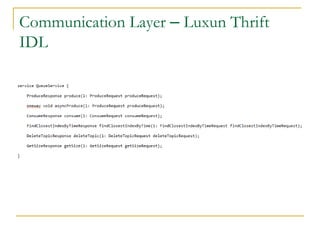
Communication Layer – Luxun Thrift
IDL
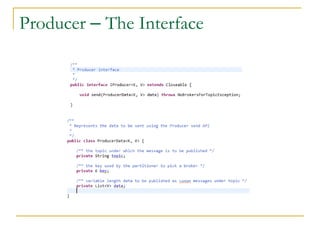
Producer – The Interface
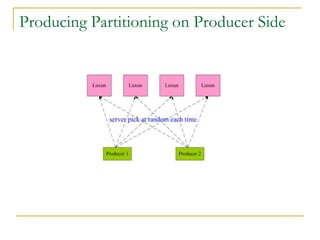
Producing Partitioning on Producer Side
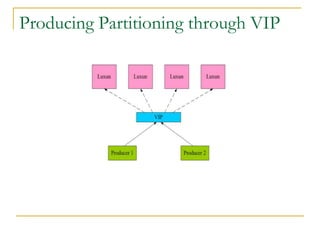
Producing Partitioning through VIP
Producing Compression

   Current Support
       0 – No compression
       1 – GZip compression
       2 – Snappy compression
   Enable Compression for better utilization of
       Network bandwidth
       Disk space
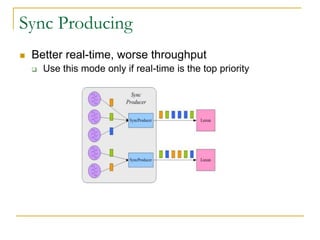
Sync Producing
   Better real-time, worse throughput
       Use this mode only if real-time is the top priority
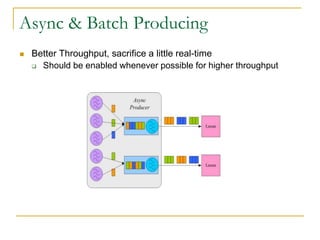
Async & Batch Producing
   Better Throughput, sacrifice a little real-time
     Should be enabled whenever possible for higher throughput
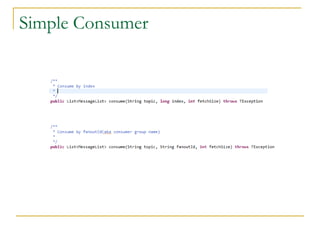
Simple Consumer
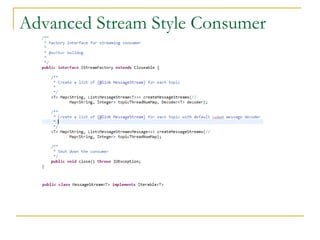
Advanced Stream Style Consumer
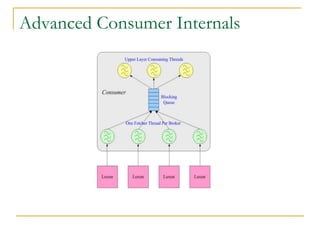
Advanced Consumer Internals
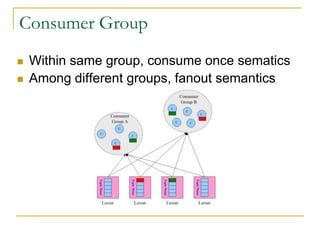
Consumer Group
   Within same group, consume once sematics
   Among different groups, fanout semantics
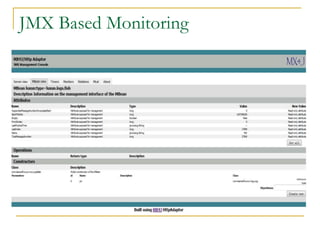
JMX Based Monitoring
Key Performance Test Observations

   On single machine, throughput is only limited
    by disk IO bandwidth
   In networking case, throughput is only limited
    by network bandwidth
       1Gbps network is ok, 10Gbps network is
        recommended
   Not sensitive to JVM heap setting,
       Memory mapped file uses off-heap memory
       4GB is ok, >8GB is recommended
   Throughput > 50 MBps even on normal PC
Key Performance Test Observations
Continue
   Performs good on both Windows and Linux
    platforms
   The throughput of async batch producing is order of
    magnitude better than sycn producing
   Flush on broker has negative impact on throughput,
    recommend to disable flush because of unique
    feature of memoy mapped file
   The throughput of one way not confirmed produce
    interface is 3 times better than two way confirmed
    produce interface
Key Performance Test Observations
Continue
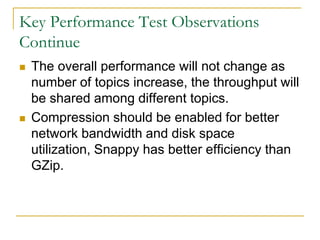
   The overall performance will not change as
    number of topics increase, the throughput will
    be shared among different topics.
   Compression should be enabled for better
    network bandwidth and disk space utilization,
    Snappy has better efficiency than GZip.
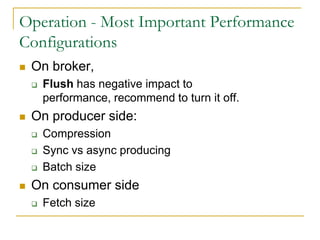
Operation - Most Important Performance
Configurations
   On broker
       Flush has negative impact to performance,
        recommend to turn it off.
   On producer side
       Compression
       Sync vs async producing
       Batch size
   On consumer side
       Fetch size
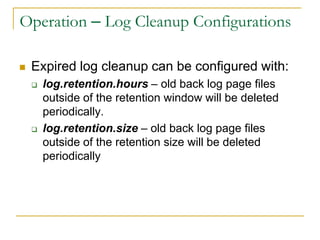
Operation – Log Cleanup Configurations

   Expired log cleanup can be configured with:
       log.retention.hours – old back log page files
        outside of the retention window will be deleted
        periodically.
       log.retention.size – old back log page files
        outside of the retention size will be deleted
        periodically
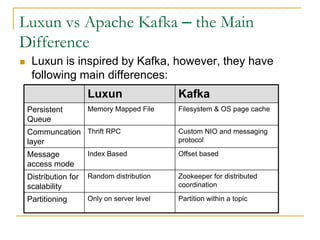
Luxun vs Apache Kafka – the Main
Difference
    Luxun is inspired by Kafka, however, they have
     following main differences:
                       Luxun                  Kafka
    Persistent         Memory Mapped File     Filesystem & OS page cache
    Queue
    Communcation Thrift RPC                   Custom NIO and messaging
    layer                                     protocol

    Message            Index Based            Offset based
    access mode
    Distribution for   Random distribution    Zookeeper for distributed
    scalability                               coordination

    Partitioning       Only on server level   Partition within a topic
Credits

   Luxun borrowed design ideas and adapted source
    from following open source projects:
       Apache Kafka - http://kafka.apache.org/index.html
       Jafka - https://github.com/adyliu/jafka
       Java Chronicle - https://github.com/peter-lawrey/Java-
        Chronicle
       Fqueue - http://code.google.com/p/fqueue/
       Ashes-queue - http://code.google.com/p/ashes-queue/
       Kestrel - https://github.com/robey/kestrel
Next Steps

   Add a sharding layer for distribution and
    replication
   More clients, C#, PHP, Ruby, Python, C++,
    etc
   Big data apps, such as centralized logging,
    tracing, metrics and events systems based
    on Luxun.
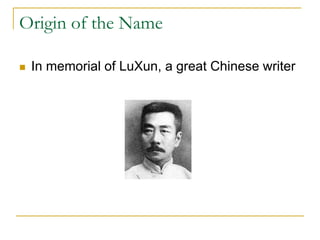
Origin of the Name

   In memorial of LuXun, a great Chinese writer
Source, Docs and Downloadable


   https://github.com/bulldog2011/luxun

Luxun a Persistent Messaging System Tailored for Big Data Collecting & Analytics

  • 1.
    Luxun - APersistent Messaging System Tailored for Big Data Collecting & Analytics By William http://bulldog2011.github.com
  • 2.
    Performance Highlight  On Single Server Grade Machine with Single Topic  Average producing throughput > 100MBps, peak > 200MBps  Average consuming throughput > 100MBps, peak > 200MBps  In Networking Case,  Throughput only limited by network and disk IO bandwidth
  • 3.
    Typical Big Dataor Activity Stream  Logs generated by frontend applications or backend services  User behavior data  Application or system performance trace  Business, application or system metrics data  Events that need immediate action
  • 4.
  • 5.
    Luxun Design Objectives  Fast & High-Throughput  Top priority, close to O(1) memory access  Persistent & Durable  All data is persistent on disk and is crash resistant  Producer & Consumer Separation  Each one can work without knowing the existence of the other  Realtime  Produced message will be immediately visible to consumer  Distributed  Horizontal scalable with commodity machines  Multiple Clients Support  Easy integration with clients from different platforms, such as Java, C#, PHP, Ruby, Python, C++…  Flexible consuming semantics  Consume once, fanout, can even consume by index  Light Weight  Small footprint binary, no Zookeeper coordination
  • 6.
    Basic Concepts  Topic  Logically it’s a named place to send messages to or to consume messages from, physically it’s a persistent queue  Broker  Aka Luxun server  Message  Datum to produce or consume  Producer  A role which will send messages to topics  Consumer  A role which will consume messages from topics  Consumer Group  A group of consumers that will receive only one copy of a message from a topic
  • 7.
  • 8.
    Core Principle  Sequential disk read can be comparable to or even faster than random memory read
  • 9.
    Core Technology –Memory Mapped File  Map files into memory, persisted by OS  OS will be responsible to persist messages even the process crashes  Can be shared between processes/threads  Produced message immediately visible to consumer threads  Limited by the amount of disk space you have  Can scale very well when exceeding your main memory size  In Java implementation, does not use heap memory directly, GC impact limited
  • 10.
    Persistent Queue –Logic View  Just like a big array or circular array, message appended/read by index
  • 11.
    Persistent Queue –Consume Once & Fanout Queue
  • 12.
    Persistent Queue –Physical View  Paged index file and data file
  • 13.
    Persistent Queue -Concurrency  Append operation is synchronized in queue implementation  Read operation is already thread safe  Array Header Index Pointer is a read/write barrier
  • 14.
    Persistent Queue –Components View
  • 15.
    Persistent Queue –Dynamic View  Memory Mapped Sliding Window  Leverage locality of rear append and front read access mode of queue
  • 16.
    Communication Layer –Why Thrift  Stable & Mature  Created by Facebook, used in Cassandra and HBase  High Performance  Binary serialization protocol and non-blocking server model  Simple & Light-Weight  IDL driven development, auto-generate client & server side proxy  Cross-Language  Auto-generate clients for Java, C#, C++, PHP, Ruby, Python, …  Flexible & Pluggable Architecture  Programming like playing with building blocks, components are replaceable as needed.
  • 17.
    Communication Layer –Components View
  • 18.
    Communication Layer –Luxun Thrift IDL
  • 19.
  • 20.
  • 21.
  • 22.
    Producing Compression  Current Support  0 – No compression  1 – GZip compression  2 – Snappy compression  Enable Compression for better utilization of  Network bandwidth  Disk space
  • 23.
    Sync Producing  Better real-time, worse throughput  Use this mode only if real-time is the top priority
  • 24.
    Async & BatchProducing  Better Throughput, sacrifice a little real-time  Should be enabled whenever possible for higher throughput
  • 25.
  • 26.
  • 27.
  • 28.
    Consumer Group  Within same group, consume once sematics  Among different groups, fanout semantics
  • 29.
  • 30.
    Key Performance TestObservations  On single machine, throughput is only limited by disk IO bandwidth  In networking case, throughput is only limited by network bandwidth  1Gbps network is ok, 10Gbps network is recommended  Not sensitive to JVM heap setting,  Memory mapped file uses off-heap memory  4GB is ok, >8GB is recommended  Throughput > 50 MBps even on normal PC
  • 31.
    Key Performance TestObservations Continue  Performs good on both Windows and Linux platforms  The throughput of async batch producing is order of magnitude better than sycn producing  Flush on broker has negative impact on throughput, recommend to disable flush because of unique feature of memoy mapped file  The throughput of one way not confirmed produce interface is 3 times better than two way confirmed produce interface
  • 32.
    Key Performance TestObservations Continue  The overall performance will not change as number of topics increase, the throughput will be shared among different topics.  Compression should be enabled for better network bandwidth and disk space utilization, Snappy has better efficiency than GZip.
  • 33.
    Operation - MostImportant Performance Configurations  On broker  Flush has negative impact to performance, recommend to turn it off.  On producer side  Compression  Sync vs async producing  Batch size  On consumer side  Fetch size
  • 34.
    Operation – LogCleanup Configurations  Expired log cleanup can be configured with:  log.retention.hours – old back log page files outside of the retention window will be deleted periodically.  log.retention.size – old back log page files outside of the retention size will be deleted periodically
  • 35.
    Luxun vs ApacheKafka – the Main Difference  Luxun is inspired by Kafka, however, they have following main differences: Luxun Kafka Persistent Memory Mapped File Filesystem & OS page cache Queue Communcation Thrift RPC Custom NIO and messaging layer protocol Message Index Based Offset based access mode Distribution for Random distribution Zookeeper for distributed scalability coordination Partitioning Only on server level Partition within a topic
  • 36.
    Credits  Luxun borrowed design ideas and adapted source from following open source projects:  Apache Kafka - http://kafka.apache.org/index.html  Jafka - https://github.com/adyliu/jafka  Java Chronicle - https://github.com/peter-lawrey/Java- Chronicle  Fqueue - http://code.google.com/p/fqueue/  Ashes-queue - http://code.google.com/p/ashes-queue/  Kestrel - https://github.com/robey/kestrel
  • 37.
    Next Steps  Add a sharding layer for distribution and replication  More clients, C#, PHP, Ruby, Python, C++, etc  Big data apps, such as centralized logging, tracing, metrics and events systems based on Luxun.
  • 38.
    Origin of theName  In memorial of LuXun, a great Chinese writer
  • 39.
    Source, Docs andDownloadable https://github.com/bulldog2011/luxun