Convenience or Credibility? A Study of College Student Online Research BehaviorsJ. Patrick BiddixaChung JooChungb*   Han Woo Parkc**a Department of Curriculum, Leadership, and TechnologyValdosta State Universityb Department of Communication The State University of New York at Buffaloc Department of Media and Communication, WCU WebometricsInstituteYeungNam University
1. IntroductionToday’s student has more information readily available to them than any other prior generation. Students turn to a variety of sources for information when completing academic work ranging from Wikipedia to Google Scholar, course management systems (CMS)
1. Introduction Little doubt How are students using these tools?
Is distinguishing and evaluating sources part of the retrieval process or are they simply trading the afforded ease offered by a blazing Internet connection for good work?How students search for academic support material, followed by a review of studies focused on how students evaluate and access online sources.
2. Review of literature(Madden & Jones, 2002)   - College student use of the Internet   - 79% of college Internet users believed the Internet had a positive impact on their academic experience, 73% of college students used the Internet for research more than the library.(Jones, Johnson-Yale, Millermaier, and Perez 2008)   Overall use of the Internet for academic purposes has increased and that students were generally pleased with the Internet's utility for academic work
2. Review of literatureThe consensus was that students turned to search engines (De Rosa et al., 2005; Emde, Currie, Devlin, & Graves, 2008; Griffiths & Brophy, 2005; Jones, 2002; Martin, 2008; Van Scoyoc & Cason, 2006); or even Wikipedia (Head & Eisenberg, 2009) before library databases (Hampton-Reeves et al., 2009); though CMS/class websites fared respectably.(Rainie & Tancer, 2007) 50% of college graduates used the site (86% if those with college experience were included), while 46% of current full- or part-time college students used Wikipedia. Head and Eisenberg (2009) a consensus among students they interviewed that Wikipedia was a first stop for research, students referred to the site as a “preresearch tool” or a “step .05” that preceded scholarly databases and helped students funnel or refine their topics.2.1. The search process
2. Review of literature(Park, Barnett, and Nam 2002) credibility with respect to online information as having two major components: trustworthiness, which is related to author/producer authority or reputation, and expertise, which is how useful (e.g., complete, timely) the content is compared to others.(Currie, Devlin, Emde, & Graves, 2010). Undergraduates understand the importance of using credible information for their academic work but often lacked the skills to critically evaluate a potential source(Head & Eisenberg, 2009) “finding materials they desired, knew existed, and needed on a ‘just in time’ basis”2.2. Information credibility and accessibility
3. MethodsCATPAC, a self-organizing artificial neural network analysis program (Woelfel, 1993, 1998)Semantic analysis is a form of social network analysis used to identify the structure of concepts or symbols in a set of answers on open questions
3. MethodsParticipants :Introductory communication classes (n = 282, 59% female) at a large, public four-year research university (RU/VH) in the northeast.
The mean age was 20 years
Nearly 97% used English (n = 272).
On average, participants used the Internet for more than a decade (m = 10.02).
 average hours per day : five (m = 4.88)3.1 Participants
3. Methods8 questions  : demographics of participants    (e.g., age, gender or Internet usage experience). 5questions : Internet usage and behaviors related to academic activities(1) study-related information seeking practices(2) Internet usage patterns during recent project online(3) reasons for using the Internet for academic purpose(4) reliability perception of academic information obtained on the Internet(5) effective usage of the Internet to improve academic performance3.2 Instrument
3. MethodsCATPAC is a neural network computer program optimized for analyzing text & produces visual relationships among the words using a dendogram, a graphical representation of the resultant clusters (Woelfel, 1993, 1998). To prepare data, a list of meaningless words distorting the analysis (Lim, 2009)- articles, prepositions, conjunctions, and transitive verbs were excluded.    - the past tense and past perfect tense were modified into the present tense.    - similar words were combined into single words to facilitate the analysis3.3 Analysis
3. MethodsThe potential data loss through mining procedures versus traditional quantitative survey or qualitative coding analyses. Sophisticated questionnaires and careful understanding of findings through CATPAC are needed to realize the idea of the semantic web that is the creation of collective human knowledge (Lim, 2009).3.4 Limitations
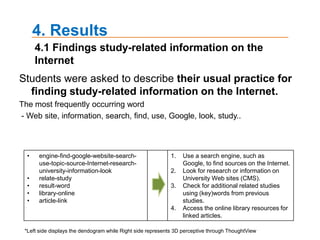
4. Results4.1 Findings study-related information on the InternetStudents were asked to describe their usual practice for finding study-related information on the Internet.The most frequently occurring word- Web site, information, search, find, use, Google, look, study.. *Left side displays the dendogramwhile Right side represents 3D perceptive through ThoughtView
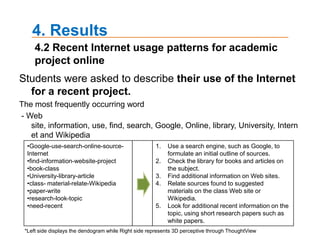
4. Results4.2 Recent Internet usage patterns for academic project onlineStudents were asked to describe their use of the Internet for a recent project.The most frequently occurring word - Web site, information, use, find, search, Google, Online, library, University, Internet and Wikipedia*Left side displays the dendogramwhile Right side represents 3D perceptive through ThoughtView
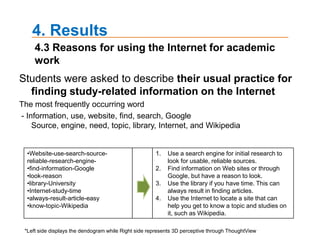
4. Results4.3 Reasons for using the Internet for academic workStudents were asked to describe their usual practice for finding study-related information on the InternetThe most frequently occurring word - Information, use, website, find, search, Google Source, engine, need, topic, library, Internet, and Wikipedia*Left side displays the dendogramwhile Right side represents 3D perceptive through ThoughtView
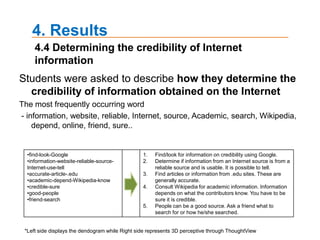
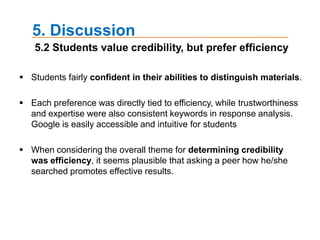
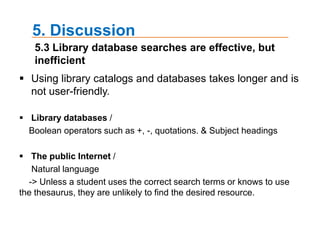
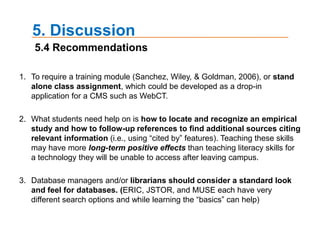
4. Results4.4 Determining the credibility of Internet informationStudents were asked to describe how they determine the credibility of information obtained on the InternetThe most frequently occurring word- information, website, reliable, Internet, source, Academic, search, Wikipedia, depend, online, friend, sure.. *Left side displays the dendogramwhile Right side represents 3D perceptive through ThoughtView
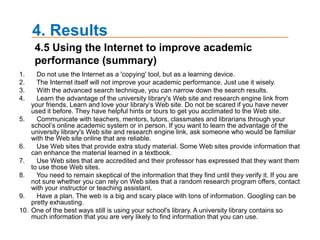
4. Results4.5 Using the Internet to improve academic performance (summary)   Do not use the Internet as a 'copying' tool, but as a learning device.   The Internet itself will not improve your academic performance. Just use it wisely.   With the advanced search technique, you can narrow down the search results.   Learn the advantage of the university library's Web site and research engine link from your friends. Learn and love your library’s Web site. Do not be scared if you have never used it before. They have helpful hints or tours to get you acclimated to the Web site.   Communicate with teachers, mentors, tutors, classmates and librarians through your school’s online academic system or in person. If you want to learn the advantage of the university library's Web site and research engine link, ask someone who would be familiar with the Web site online that are reliable.   Use Web sites that provide extra study material. Some Web sites provide information that can enhance the material learned in a textbook.   Use Web sites that are accredited and their professor has expressed that they want them to use those Web sites.   You need to remain skeptical of the information that they find until they verify it. If you are not sure whether you can rely on Web sites that a random research program offers, contact with your instructor or teaching assistant.   Have a plan. The web is a big and scary place with tons of information. Googling can be pretty exhausting.One of the best ways still is using your school's library. A university library contains so much information that you are very likely to find information that you can use.
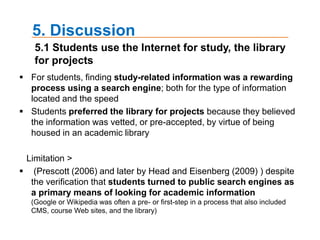
5. Discussion5.1 Students use the Internet for study, the library for projectsFor students, finding study-related information was a rewarding process using a search engine; both for the type of information located and the speed

Convenience or credibility

  • 1.
    Convenience or Credibility?A Study of College Student Online Research BehaviorsJ. Patrick BiddixaChung JooChungb* Han Woo Parkc**a Department of Curriculum, Leadership, and TechnologyValdosta State Universityb Department of Communication The State University of New York at Buffaloc Department of Media and Communication, WCU WebometricsInstituteYeungNam University
  • 2.
    1. IntroductionToday’s studenthas more information readily available to them than any other prior generation. Students turn to a variety of sources for information when completing academic work ranging from Wikipedia to Google Scholar, course management systems (CMS)
  • 3.
    1. Introduction Littledoubt How are students using these tools?
  • 4.
    Is distinguishing andevaluating sources part of the retrieval process or are they simply trading the afforded ease offered by a blazing Internet connection for good work?How students search for academic support material, followed by a review of studies focused on how students evaluate and access online sources.
  • 5.
    2. Review ofliterature(Madden & Jones, 2002) - College student use of the Internet - 79% of college Internet users believed the Internet had a positive impact on their academic experience, 73% of college students used the Internet for research more than the library.(Jones, Johnson-Yale, Millermaier, and Perez 2008) Overall use of the Internet for academic purposes has increased and that students were generally pleased with the Internet's utility for academic work
  • 6.
    2. Review ofliteratureThe consensus was that students turned to search engines (De Rosa et al., 2005; Emde, Currie, Devlin, & Graves, 2008; Griffiths & Brophy, 2005; Jones, 2002; Martin, 2008; Van Scoyoc & Cason, 2006); or even Wikipedia (Head & Eisenberg, 2009) before library databases (Hampton-Reeves et al., 2009); though CMS/class websites fared respectably.(Rainie & Tancer, 2007) 50% of college graduates used the site (86% if those with college experience were included), while 46% of current full- or part-time college students used Wikipedia. Head and Eisenberg (2009) a consensus among students they interviewed that Wikipedia was a first stop for research, students referred to the site as a “preresearch tool” or a “step .05” that preceded scholarly databases and helped students funnel or refine their topics.2.1. The search process
  • 7.
    2. Review ofliterature(Park, Barnett, and Nam 2002) credibility with respect to online information as having two major components: trustworthiness, which is related to author/producer authority or reputation, and expertise, which is how useful (e.g., complete, timely) the content is compared to others.(Currie, Devlin, Emde, & Graves, 2010). Undergraduates understand the importance of using credible information for their academic work but often lacked the skills to critically evaluate a potential source(Head & Eisenberg, 2009) “finding materials they desired, knew existed, and needed on a ‘just in time’ basis”2.2. Information credibility and accessibility
  • 8.
    3. MethodsCATPAC, aself-organizing artificial neural network analysis program (Woelfel, 1993, 1998)Semantic analysis is a form of social network analysis used to identify the structure of concepts or symbols in a set of answers on open questions
  • 9.
    3. MethodsParticipants :Introductorycommunication classes (n = 282, 59% female) at a large, public four-year research university (RU/VH) in the northeast.
  • 10.
    The mean agewas 20 years
  • 11.
    Nearly 97% usedEnglish (n = 272).
  • 12.
    On average, participantsused the Internet for more than a decade (m = 10.02).
  • 13.
    average hoursper day : five (m = 4.88)3.1 Participants
  • 14.
    3. Methods8 questions : demographics of participants (e.g., age, gender or Internet usage experience). 5questions : Internet usage and behaviors related to academic activities(1) study-related information seeking practices(2) Internet usage patterns during recent project online(3) reasons for using the Internet for academic purpose(4) reliability perception of academic information obtained on the Internet(5) effective usage of the Internet to improve academic performance3.2 Instrument
  • 15.
    3. MethodsCATPAC isa neural network computer program optimized for analyzing text & produces visual relationships among the words using a dendogram, a graphical representation of the resultant clusters (Woelfel, 1993, 1998). To prepare data, a list of meaningless words distorting the analysis (Lim, 2009)- articles, prepositions, conjunctions, and transitive verbs were excluded. - the past tense and past perfect tense were modified into the present tense. - similar words were combined into single words to facilitate the analysis3.3 Analysis
  • 16.
    3. MethodsThe potentialdata loss through mining procedures versus traditional quantitative survey or qualitative coding analyses. Sophisticated questionnaires and careful understanding of findings through CATPAC are needed to realize the idea of the semantic web that is the creation of collective human knowledge (Lim, 2009).3.4 Limitations
  • 17.
    4. Results4.1 Findingsstudy-related information on the InternetStudents were asked to describe their usual practice for finding study-related information on the Internet.The most frequently occurring word- Web site, information, search, find, use, Google, look, study.. *Left side displays the dendogramwhile Right side represents 3D perceptive through ThoughtView
  • 18.
    4. Results4.2 RecentInternet usage patterns for academic project onlineStudents were asked to describe their use of the Internet for a recent project.The most frequently occurring word - Web site, information, use, find, search, Google, Online, library, University, Internet and Wikipedia*Left side displays the dendogramwhile Right side represents 3D perceptive through ThoughtView
  • 19.
    4. Results4.3 Reasonsfor using the Internet for academic workStudents were asked to describe their usual practice for finding study-related information on the InternetThe most frequently occurring word - Information, use, website, find, search, Google Source, engine, need, topic, library, Internet, and Wikipedia*Left side displays the dendogramwhile Right side represents 3D perceptive through ThoughtView
  • 20.
    4. Results4.4 Determiningthe credibility of Internet informationStudents were asked to describe how they determine the credibility of information obtained on the InternetThe most frequently occurring word- information, website, reliable, Internet, source, Academic, search, Wikipedia, depend, online, friend, sure.. *Left side displays the dendogramwhile Right side represents 3D perceptive through ThoughtView
  • 21.
    4. Results4.5 Usingthe Internet to improve academic performance (summary) Do not use the Internet as a 'copying' tool, but as a learning device. The Internet itself will not improve your academic performance. Just use it wisely. With the advanced search technique, you can narrow down the search results. Learn the advantage of the university library's Web site and research engine link from your friends. Learn and love your library’s Web site. Do not be scared if you have never used it before. They have helpful hints or tours to get you acclimated to the Web site. Communicate with teachers, mentors, tutors, classmates and librarians through your school’s online academic system or in person. If you want to learn the advantage of the university library's Web site and research engine link, ask someone who would be familiar with the Web site online that are reliable. Use Web sites that provide extra study material. Some Web sites provide information that can enhance the material learned in a textbook. Use Web sites that are accredited and their professor has expressed that they want them to use those Web sites. You need to remain skeptical of the information that they find until they verify it. If you are not sure whether you can rely on Web sites that a random research program offers, contact with your instructor or teaching assistant. Have a plan. The web is a big and scary place with tons of information. Googling can be pretty exhausting.One of the best ways still is using your school's library. A university library contains so much information that you are very likely to find information that you can use.
  • 22.
    5. Discussion5.1 Studentsuse the Internet for study, the library for projectsFor students, finding study-related information was a rewarding process using a search engine; both for the type of information located and the speed