Learning EnvironmentsSteven Lopes AbrantesInstituto Politécnico de Viseu(Portugal)steven@di.estv.ipv.ptLuis Borges GouveiaUniversidade Fernando Pessoa(Portugal)lmbg@ufp.ptInSite 201022-June-2010
Study main purposeEvaluate the use of mobile devices in an higher education contextEvaluate the perception and potential use of mobile applications to support collaborative environments
Natural LearningA natural learning environment is characterized by:A variety of situations where people live, learn and play;Providing a natural and comfortable environment;Allowing everyone to have the chance to participate;Allowing both learners and their relatives to participate in routines and activities that are important to them;Being organized in patterns of daily living.
Natural LearningThere are several ways of learning in natural environments:A set of friends discussing a particular subject through traditional modes of communication (coffee shops, meeting rooms, meetings at a friend's house, etc.);A set of friends discussion a particular subject through the use of the new (digital ) technologies (MSN, e-mail, forums, among many other services).
Technology EnvironmentsNew technologies allow the creation of new knowledge spaces;Now, besides the school, also the working place and the home have become places foreducation and learning;The number of people in their homes using the Internet to increase their knowledge is increasing;The computer can still be understood, not as one common tool, but a tool for collaborative learning .
Technology EnvironmentsFor a long time, it was felt that teaching was primarily (1) the transmission of knowledge (content), (2) the training of the memory, and (3) the sharing of the society values in students;It was felt that learning was to acquire knowledge through a process of attention, memorization, and reproduction of it;The integration of computer in education is now a reality impossible to ignore and one that must be studied;Although the computer is not by itself  an education technology, its characteristics ofinteraction and the system of choice for dealing with information makes it a very useful and a very promising tool .
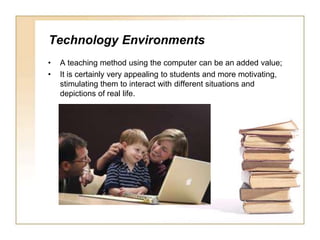
Technology EnvironmentsA teaching method using the computer can be an added value;It is certainly very appealing to students and more motivating, stimulating them to interact with different situations and depictions of real life.
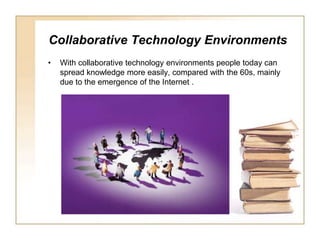
Collaborative Technology EnvironmentsWith collaborative technology environments people today can spread knowledge more easily, compared with the 60s, mainly due to the emergence of the Internet .
Collaborative Technology EnvironmentsThe use of new technologies leads us increasingly to a student-centered model;This model is essential to have an intensive communication  both among students, and between students and teachers;The forums are one of the key components for this type of communication;Forum popularity is due to the fact that it is available 24 hours, 7 days a week, allowingusersto operate anytime and anywhere
Collaborative Technology EnvironmentsThe actual advancement of the new technologies allows collaborative learning among the people, through synchronous and asynchronous mechanisms;The teaching of online groups, also known as collaborative learning supported by computers (CSCL – Computer Supported Collaborative Learning), if implemented properly, could become an ideal environment where interaction between students predominate in the teachingprocess;
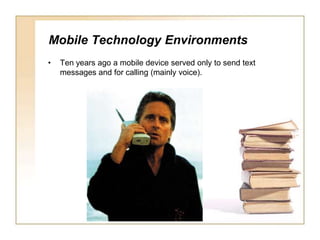
Mobile Technology EnvironmentsTen years ago a mobile device served only to send text messages and for calling (mainly voice).
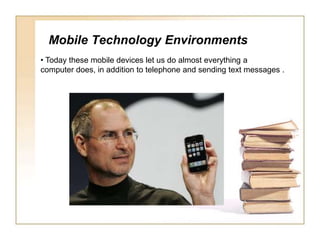
Mobile Technology Environments Today these mobile devices let us do almost everything a computer does, in addition to telephone and sending text messages .
Mobile Technology EnvironmentsMobile devices change the paradigm of teacher-centered education to education at first hand at the right time and for a lifetime;With the advancement of mobile technologies, the use of a computer is no longer restricted to a computer lab, the classroom, or even the workplace, and can be realized  anywhere and anytime; Mobile devices enable groups of students to distribute, aggregate, and share information easily, resulting in a more rich and (hope) successful collaboration
The StudyObjectives:Evaluate the use of mobile devices in an higher education context;Evaluate the perception and potential of mobile applications in supporting collaborative environments
The StudyThis study had two distinct phases: The first phase involves students that responded to a survey about their experience with mobile devices and collaborative environments (eighty-three valid questionnaires); The second phase involves students that answered a survey about their perception of the use of mobile applications for collaborative environments (one hundred and eighty respondents).
The Study – Phase 1The use of mobile devices in higher education In this study we verified: 79.52% males, of which 83.13% were older than 20 years;  The most frequently used mobile devices are mobile phones (74) and laptops (69); Regarding the use of the e-mail on mobile devices: 22 do not use this application (26.51%) 13 indicate that they use it (15.66%). Regarding the usefulness of the e-mail on 	mobile devices, 58 (69.88%) totally agree 	with the usefulness of this application
The Study – Phase 1The use of mobile devices in higher education In this study we verified: Regarding to the use of Internet access in a mobile device16 do not use it (19.28%) 37 indicate that they use it (44.58%). Regarding the usefulness of Internet access on mobile devices, 66 are fully agreed on the 	usefulness of this application (79.52%).
The Study – Phase 1The use of mobile devices in higher education In this study we verified: Regarding the use of the camera in a mobile device: 9 do not use it (10.84%) 28 indicate that the use it (33.73%). Regarding the usefulness of the camera on mobile devices, 31 are fully agreed on the usefulness of this application (37.35%).
The Study – Phase 2Perception and potential of mobile applications in collaborative environments In this study we verified: All the students know Hi5 (100%) and their majority uses it (79%);Mostly, the inquired students know Facebook and the majority does not use it (83% and 71%, respectively).Regarding the use of Orkut, 54% know it and 88% do not use it;Mostly, the inquired know Google Groups 	and the majority does not use it (58% and 70%, respectively) Mostly, the inquired are familiar with Yahoo Groups and the majority does not use it (56% and 75%, respectively)
The Study – Phase 2Perception and potential of mobile applications in collaborative environments In this study we verified: As regards to MSN, it appears that, mostly, the inquired know MSN and that most use it (98% and 93%, respectively);Half of the inquired know Twitter and very few use it (50% and 11%, respectively);The majority knows Wiki services (66%); The majority of students inquired does not 	know Flikr and does not use it (65% and 93%) 	and they do not know Twain (94%), Digg (80%) 	and del.icio.us (88%).
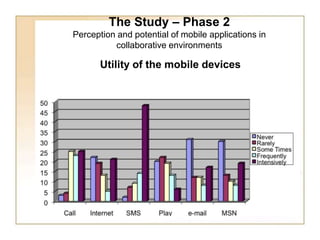
The Study – Phase 2Perception and potential of mobile applications in collaborative environments Utility of the mobile devices
      ConclusionsRegarding the use of e-mail on mobile devices, most do not use this application, but those who do not use it want to use it in the future.The majority uses the Internet on a mobile device, but those who do not use it want to use it in the future;Regarding the use of file transport on a mobile device the majority uses it, but those who do not use it want to use it in the future
     ConclusionsThe most familiar applications are Hi5, Facebook, MySpace, Google Groups, Yahoo Groups, SMS, MSN, Twitter, Wiki, Blogs and YouTube. For Flikr, Twain, Digg and del.icio.us, most of the respondents did not know these applications.For the use of mobile applications in collaborative environments, respondents reported only applications as Hi5, SMS, MSN, wiki, blogs and YouTube
     ConclusionsWe can conclude that:They know a lot of mobile applications in collaborative environments;They use only the most common and popular, and are not willing, for most of them, to pay to use them; They are also people who use common 	applications on mobile devices, and those 	who do not use it want to use them in the future.

Learning Environments

  • 1.
    Learning EnvironmentsSteven LopesAbrantesInstituto Politécnico de Viseu(Portugal)steven@di.estv.ipv.ptLuis Borges GouveiaUniversidade Fernando Pessoa(Portugal)lmbg@ufp.ptInSite 201022-June-2010
  • 2.
    Study main purposeEvaluatethe use of mobile devices in an higher education contextEvaluate the perception and potential use of mobile applications to support collaborative environments
  • 3.
    Natural LearningA naturallearning environment is characterized by:A variety of situations where people live, learn and play;Providing a natural and comfortable environment;Allowing everyone to have the chance to participate;Allowing both learners and their relatives to participate in routines and activities that are important to them;Being organized in patterns of daily living.
  • 4.
    Natural LearningThere areseveral ways of learning in natural environments:A set of friends discussing a particular subject through traditional modes of communication (coffee shops, meeting rooms, meetings at a friend's house, etc.);A set of friends discussion a particular subject through the use of the new (digital ) technologies (MSN, e-mail, forums, among many other services).
  • 5.
    Technology EnvironmentsNew technologiesallow the creation of new knowledge spaces;Now, besides the school, also the working place and the home have become places foreducation and learning;The number of people in their homes using the Internet to increase their knowledge is increasing;The computer can still be understood, not as one common tool, but a tool for collaborative learning .
  • 6.
    Technology EnvironmentsFor along time, it was felt that teaching was primarily (1) the transmission of knowledge (content), (2) the training of the memory, and (3) the sharing of the society values in students;It was felt that learning was to acquire knowledge through a process of attention, memorization, and reproduction of it;The integration of computer in education is now a reality impossible to ignore and one that must be studied;Although the computer is not by itself an education technology, its characteristics ofinteraction and the system of choice for dealing with information makes it a very useful and a very promising tool .
  • 7.
    Technology EnvironmentsA teachingmethod using the computer can be an added value;It is certainly very appealing to students and more motivating, stimulating them to interact with different situations and depictions of real life.
  • 8.
    Collaborative Technology EnvironmentsWithcollaborative technology environments people today can spread knowledge more easily, compared with the 60s, mainly due to the emergence of the Internet .
  • 9.
    Collaborative Technology EnvironmentsTheuse of new technologies leads us increasingly to a student-centered model;This model is essential to have an intensive communication both among students, and between students and teachers;The forums are one of the key components for this type of communication;Forum popularity is due to the fact that it is available 24 hours, 7 days a week, allowingusersto operate anytime and anywhere
  • 10.
    Collaborative Technology EnvironmentsTheactual advancement of the new technologies allows collaborative learning among the people, through synchronous and asynchronous mechanisms;The teaching of online groups, also known as collaborative learning supported by computers (CSCL – Computer Supported Collaborative Learning), if implemented properly, could become an ideal environment where interaction between students predominate in the teachingprocess;
  • 11.
    Mobile Technology EnvironmentsTenyears ago a mobile device served only to send text messages and for calling (mainly voice).
  • 12.
    Mobile Technology EnvironmentsToday these mobile devices let us do almost everything a computer does, in addition to telephone and sending text messages .
  • 13.
    Mobile Technology EnvironmentsMobiledevices change the paradigm of teacher-centered education to education at first hand at the right time and for a lifetime;With the advancement of mobile technologies, the use of a computer is no longer restricted to a computer lab, the classroom, or even the workplace, and can be realized anywhere and anytime; Mobile devices enable groups of students to distribute, aggregate, and share information easily, resulting in a more rich and (hope) successful collaboration
  • 14.
    The StudyObjectives:Evaluate theuse of mobile devices in an higher education context;Evaluate the perception and potential of mobile applications in supporting collaborative environments
  • 15.
    The StudyThis studyhad two distinct phases: The first phase involves students that responded to a survey about their experience with mobile devices and collaborative environments (eighty-three valid questionnaires); The second phase involves students that answered a survey about their perception of the use of mobile applications for collaborative environments (one hundred and eighty respondents).
  • 16.
    The Study –Phase 1The use of mobile devices in higher education In this study we verified: 79.52% males, of which 83.13% were older than 20 years; The most frequently used mobile devices are mobile phones (74) and laptops (69); Regarding the use of the e-mail on mobile devices: 22 do not use this application (26.51%) 13 indicate that they use it (15.66%). Regarding the usefulness of the e-mail on mobile devices, 58 (69.88%) totally agree with the usefulness of this application
  • 17.
    The Study –Phase 1The use of mobile devices in higher education In this study we verified: Regarding to the use of Internet access in a mobile device16 do not use it (19.28%) 37 indicate that they use it (44.58%). Regarding the usefulness of Internet access on mobile devices, 66 are fully agreed on the usefulness of this application (79.52%).
  • 18.
    The Study –Phase 1The use of mobile devices in higher education In this study we verified: Regarding the use of the camera in a mobile device: 9 do not use it (10.84%) 28 indicate that the use it (33.73%). Regarding the usefulness of the camera on mobile devices, 31 are fully agreed on the usefulness of this application (37.35%).
  • 19.
    The Study –Phase 2Perception and potential of mobile applications in collaborative environments In this study we verified: All the students know Hi5 (100%) and their majority uses it (79%);Mostly, the inquired students know Facebook and the majority does not use it (83% and 71%, respectively).Regarding the use of Orkut, 54% know it and 88% do not use it;Mostly, the inquired know Google Groups and the majority does not use it (58% and 70%, respectively) Mostly, the inquired are familiar with Yahoo Groups and the majority does not use it (56% and 75%, respectively)
  • 20.
    The Study –Phase 2Perception and potential of mobile applications in collaborative environments In this study we verified: As regards to MSN, it appears that, mostly, the inquired know MSN and that most use it (98% and 93%, respectively);Half of the inquired know Twitter and very few use it (50% and 11%, respectively);The majority knows Wiki services (66%); The majority of students inquired does not know Flikr and does not use it (65% and 93%) and they do not know Twain (94%), Digg (80%) and del.icio.us (88%).
  • 21.
    The Study –Phase 2Perception and potential of mobile applications in collaborative environments Utility of the mobile devices
  • 22.
    ConclusionsRegarding the use of e-mail on mobile devices, most do not use this application, but those who do not use it want to use it in the future.The majority uses the Internet on a mobile device, but those who do not use it want to use it in the future;Regarding the use of file transport on a mobile device the majority uses it, but those who do not use it want to use it in the future
  • 23.
    ConclusionsThe most familiar applications are Hi5, Facebook, MySpace, Google Groups, Yahoo Groups, SMS, MSN, Twitter, Wiki, Blogs and YouTube. For Flikr, Twain, Digg and del.icio.us, most of the respondents did not know these applications.For the use of mobile applications in collaborative environments, respondents reported only applications as Hi5, SMS, MSN, wiki, blogs and YouTube
  • 24.
    ConclusionsWe can conclude that:They know a lot of mobile applications in collaborative environments;They use only the most common and popular, and are not willing, for most of them, to pay to use them; They are also people who use common applications on mobile devices, and those who do not use it want to use them in the future.