+ 
Exploring the Use of E-Books: 
An Investigation of 
Reading Habits and 
Practices in Academia 
QQML 2014: 6th Qualitative 
and Quantitative Methods 
in Libraries International 
Conference
+ 
Lisa Peet, Dan Nishimoto, 
Josephine Evans, and Irene 
Lopatovska 
Pratt Institute 
SWOT Analysis of 
Emerging 
Technology: The Case 
of E-books
+ 
E-books in Academia 
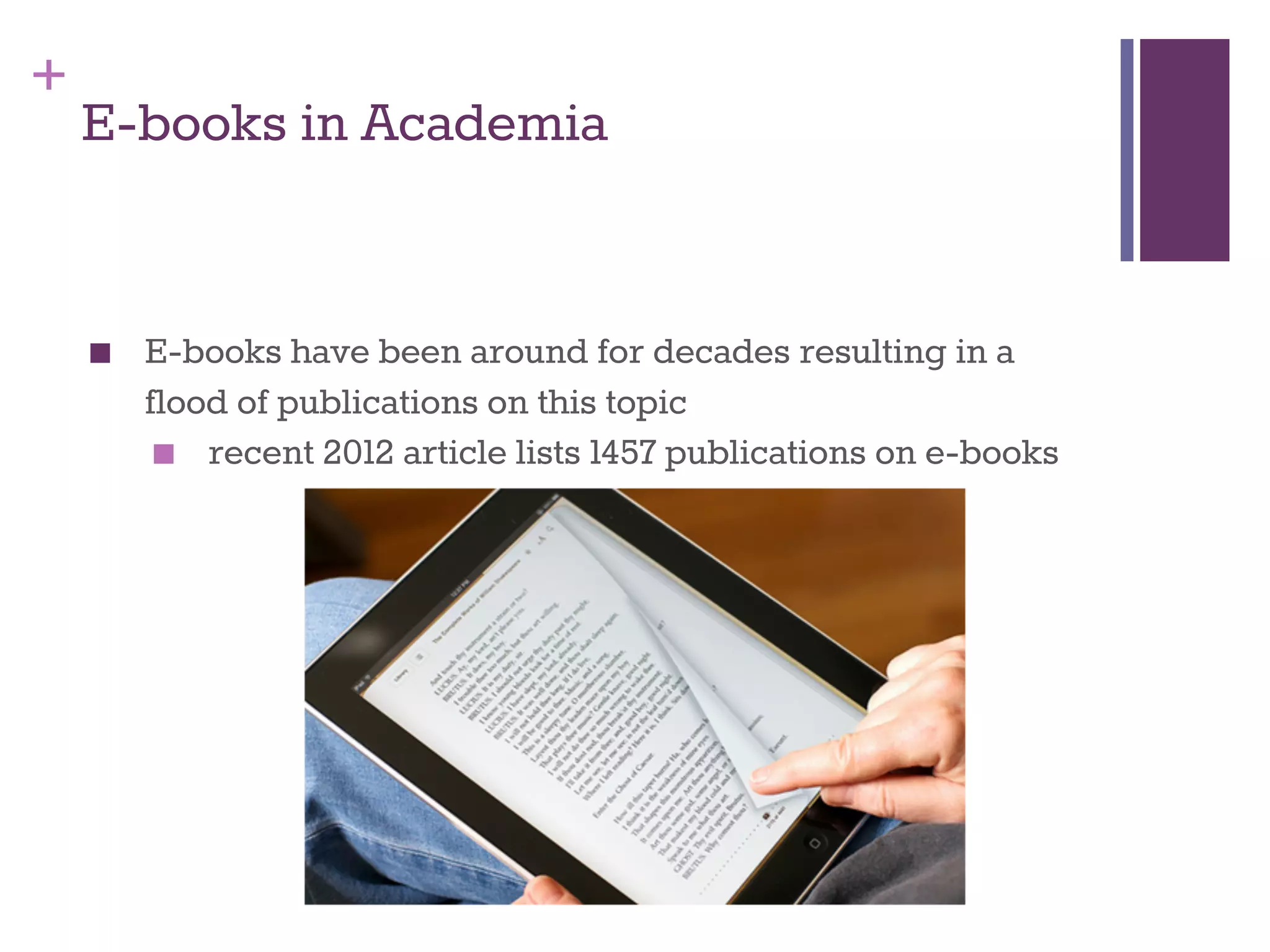
■ E-books have been around for decades resulting in a 
flood of publications on this topic 
■ recent 2012 article lists 1457 publications on e-books
+ 
SWOT 
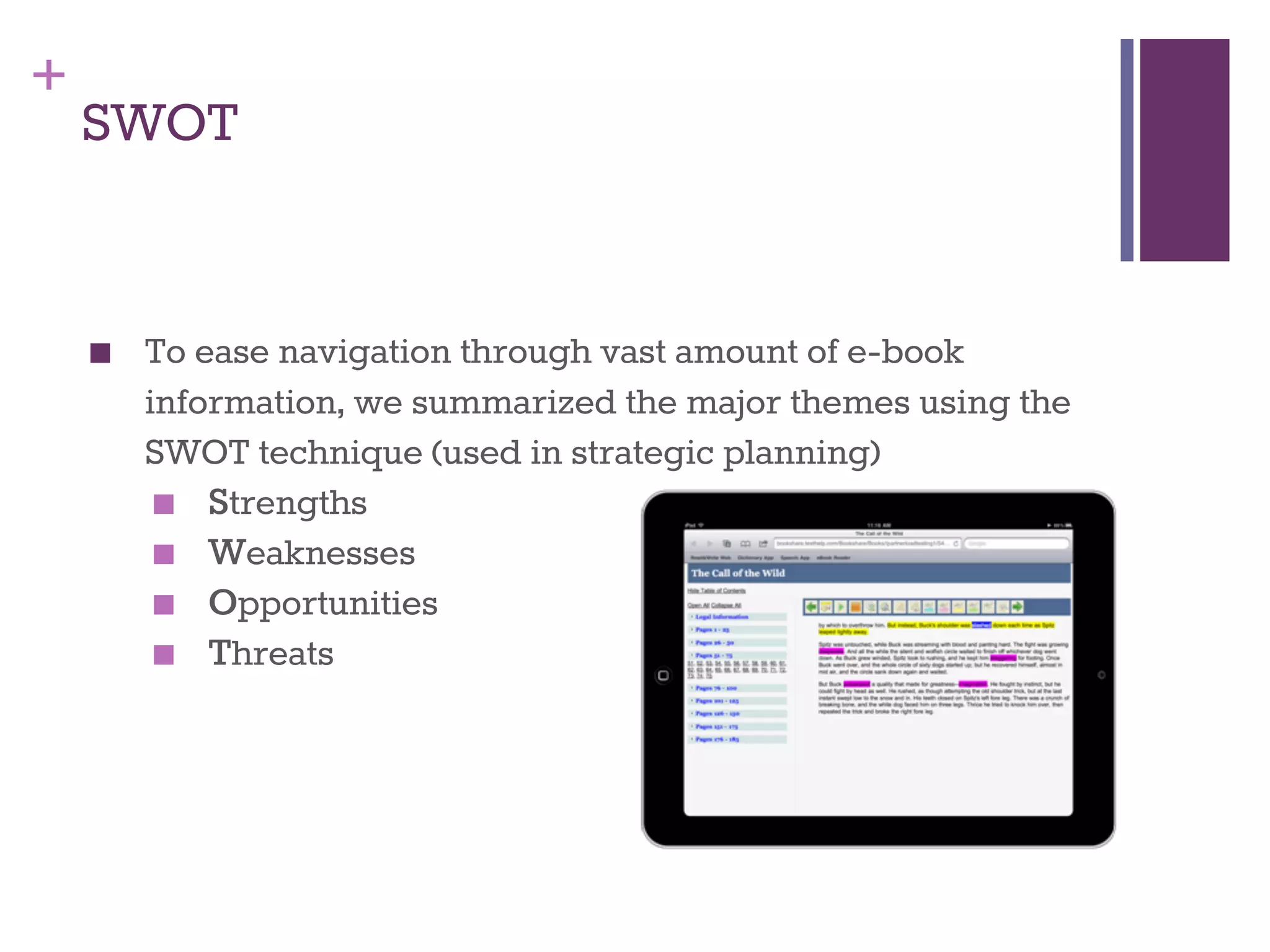
■ To ease navigation through vast amount of e-book 
information, we summarized the major themes using the 
SWOT technique (used in strategic planning) 
■ Strengths 
■ Weaknesses 
■ Opportunities 
■ Threats
+ 
E-book Strengths 
■ Increased accessibility, and portability of collections 
■ Semi-permanency, physical resiliency, and durability 
■ Interactivity and availability of keyword searching, 
annotation, and hyperlinked navigable text features 
■ Support for interactive and contextual learning 
■ Catalog synchronization 
■ Intra- and interuniversity consortial programs that 
increase content offerings at low cost
+ 
E-book Weaknesses 
■ Limited content accessibility related to 
a. e-book/e-reader functionality and 
b. licensing and copyright issues 
■ Costs associated with e-book pricing, licensing, and 
processing
+ 
Opportunities Created by E-books 
■ Increased collaboration and partnership 
■ Enhanced content 
■ Empowered library workforce 
■ Enriched distance education 
■ Platform innovation
+ 
Threats to E-books 
■ Culture of print book readership 
■ Usability and awareness of e-books 
■ Lack of diverse e-book offerings 
■ Lack of viable business models
+ 
Summary 
SWOT 
■ Helped to identify the embedded features of e-book 
technology that make it desirable or undesirable for 
academic libraries and their users 
■ Outlined external factors (reading culture, legal and 
business realities) affecting the current and future uses of 
this technology
+ Project Introduction: E-Reading in the 
Academy 
LIS 608: Human-Information Behavior 
LIS 630: Information Science Research 
Investigating Relationship of media choices to reading 
practices in academia 
Partner Institutions Research Samples collected from: 
Barnard College at Columbia University 
Brooklyn College 
Teacher’s College 
Pratt Institute SILS 
Funding American Library Association (ALA) Carroll 
Preston Barber Research Grant 
Two 
Classes
+ 
M. Christina Pattuelli, 
Elizabeth Kaufer, Gina 
Shelton, and Storey Sitwala 
Pratt Institute 
Real-time Reading: 
A Twitter-based 
Diary Study of 
College Students
+ 
PROBLEM STATEMENT 
■ What everyday life circumstances contribute to decisions 
around reading experiences? 
■ How is the nature of reading changing in the digital age? 
■ How do readers make decisions about reading format?
+ 
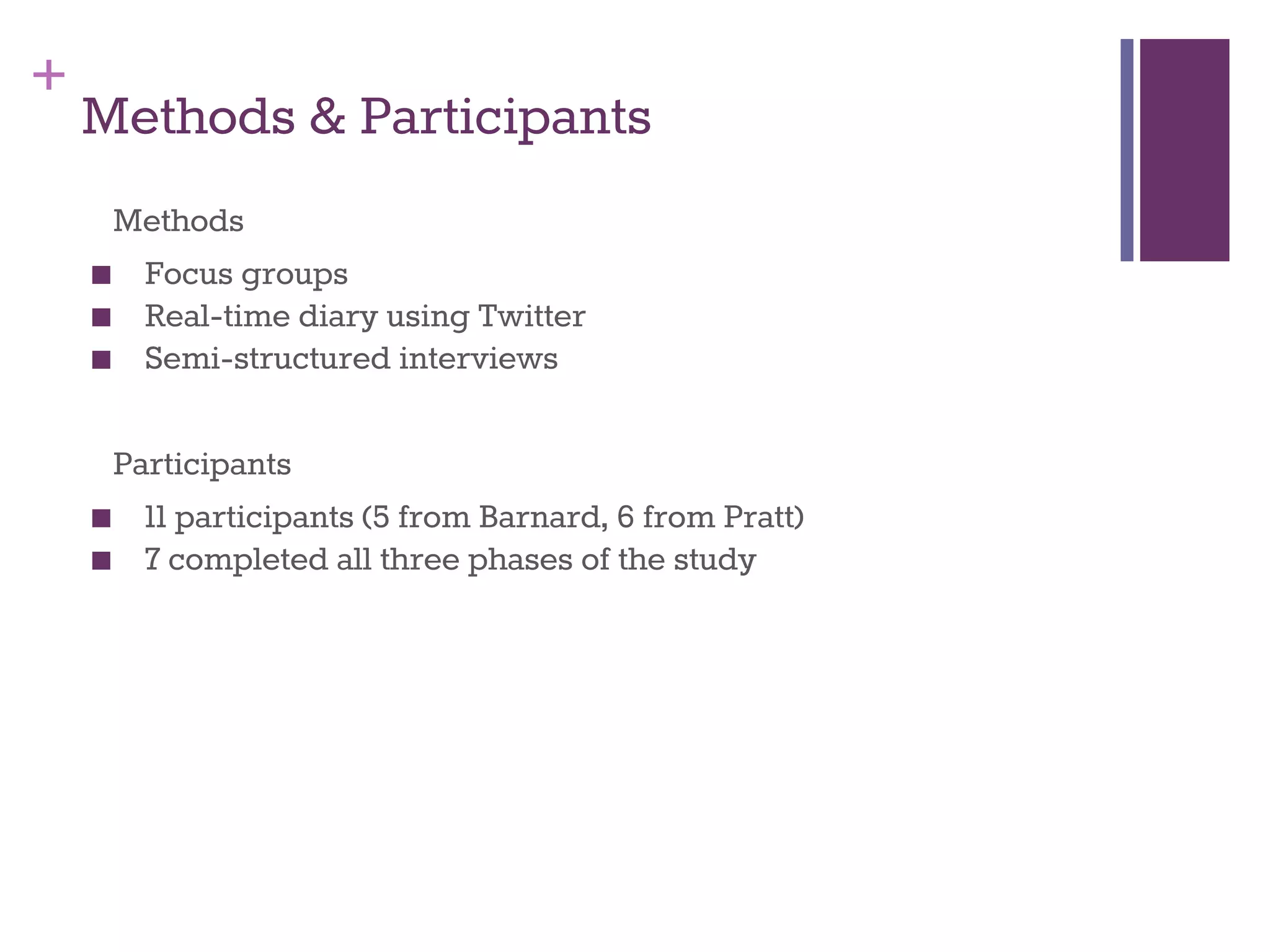
Methods & Participants 
Methods 
■ Focus groups 
■ Real-time diary using Twitter 
■ Semi-structured interviews 
Participants 
■ 11 participants (5 from Barnard, 6 from Pratt) 
■ 7 completed all three phases of the study
+ 
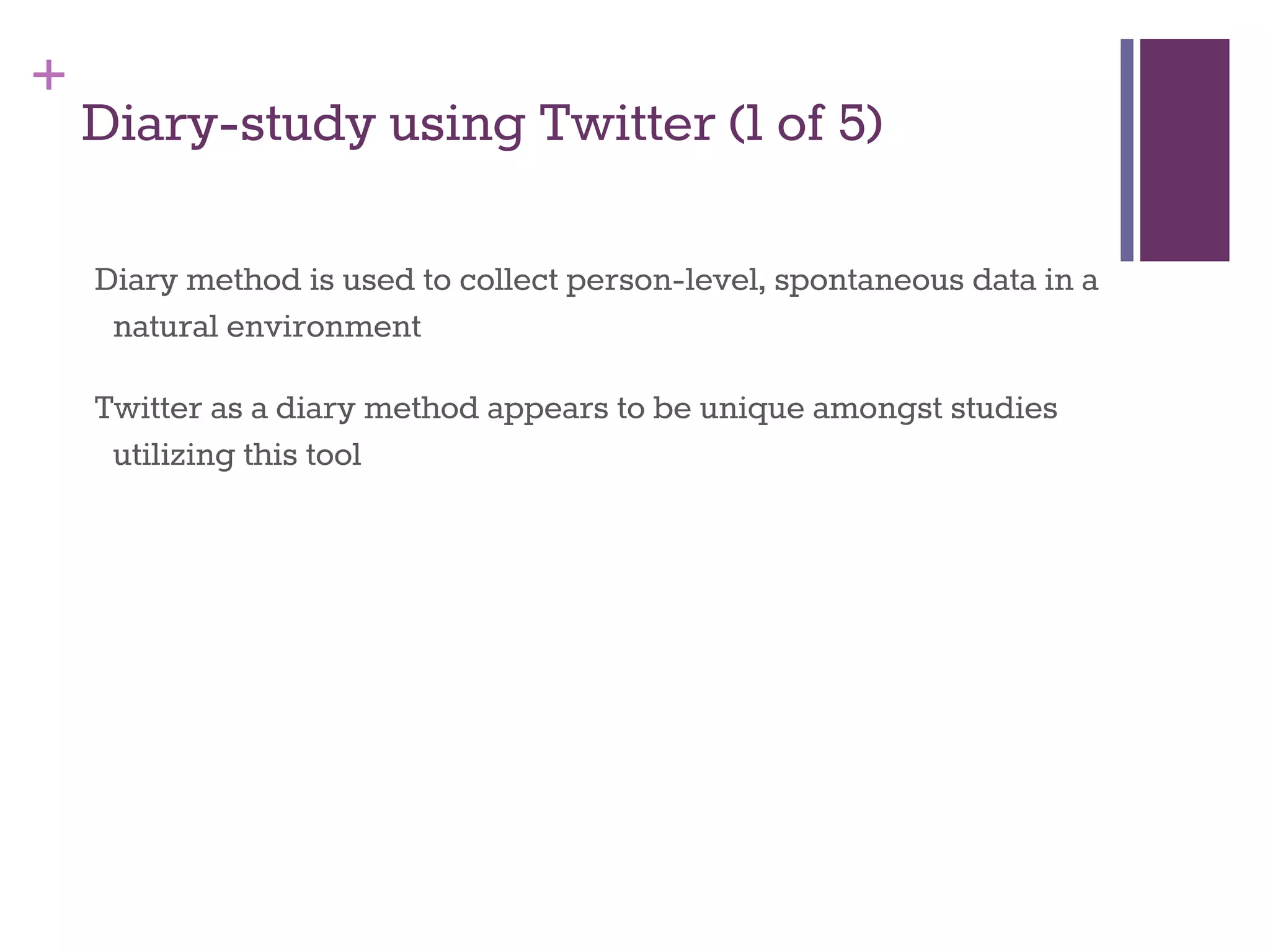
Diary-study using Twitter (1 of 5) 
Diary method is used to collect person-level, spontaneous data in a 
natural environment 
Twitter as a diary method appears to be unique amongst studies 
utilizing this tool
+ 
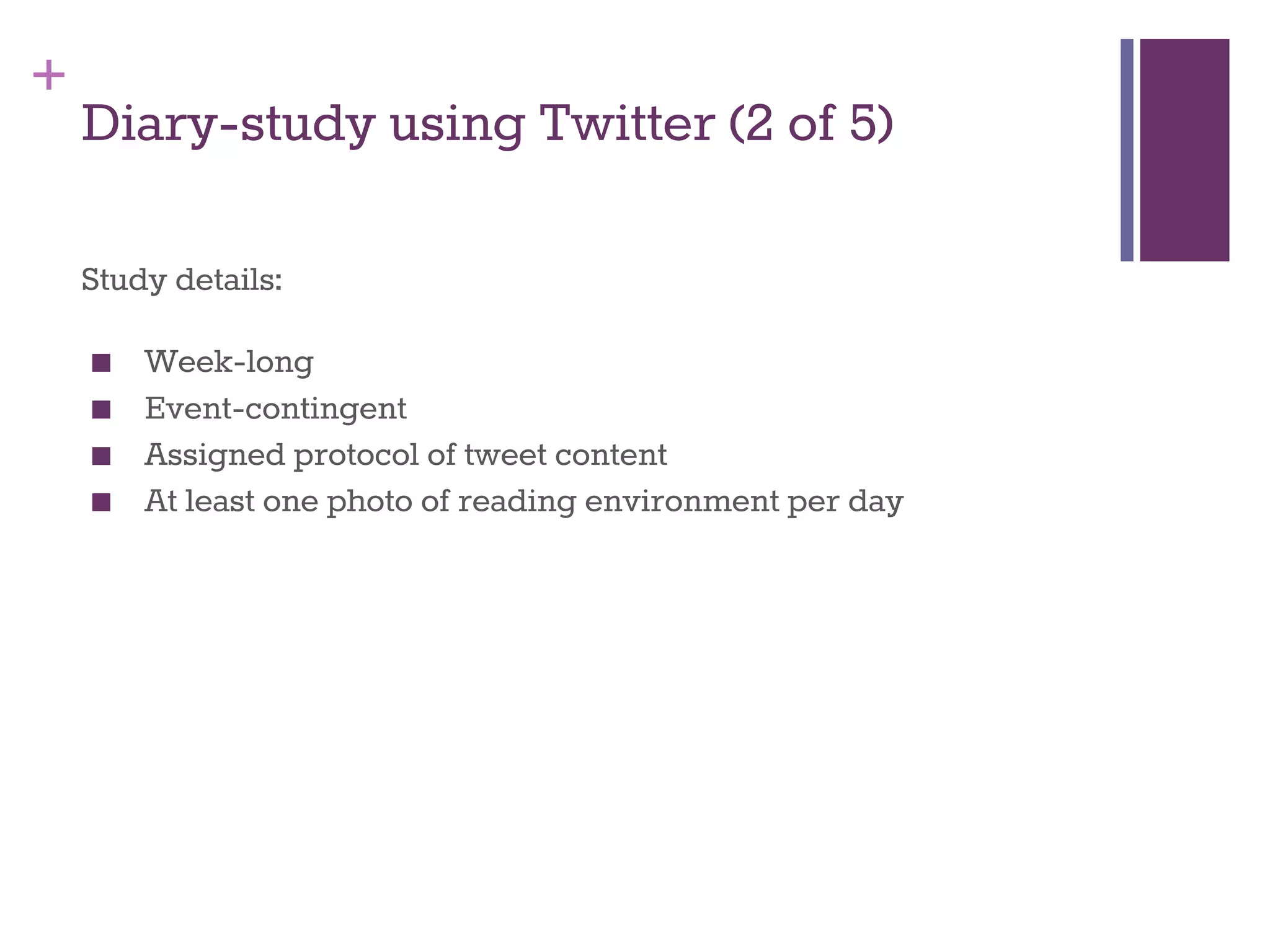
Diary-study using Twitter (2 of 5) 
Study details: 
■ Week-long 
■ Event-contingent 
■ Assigned protocol of tweet content 
■ At least one photo of reading environment per day
+ 
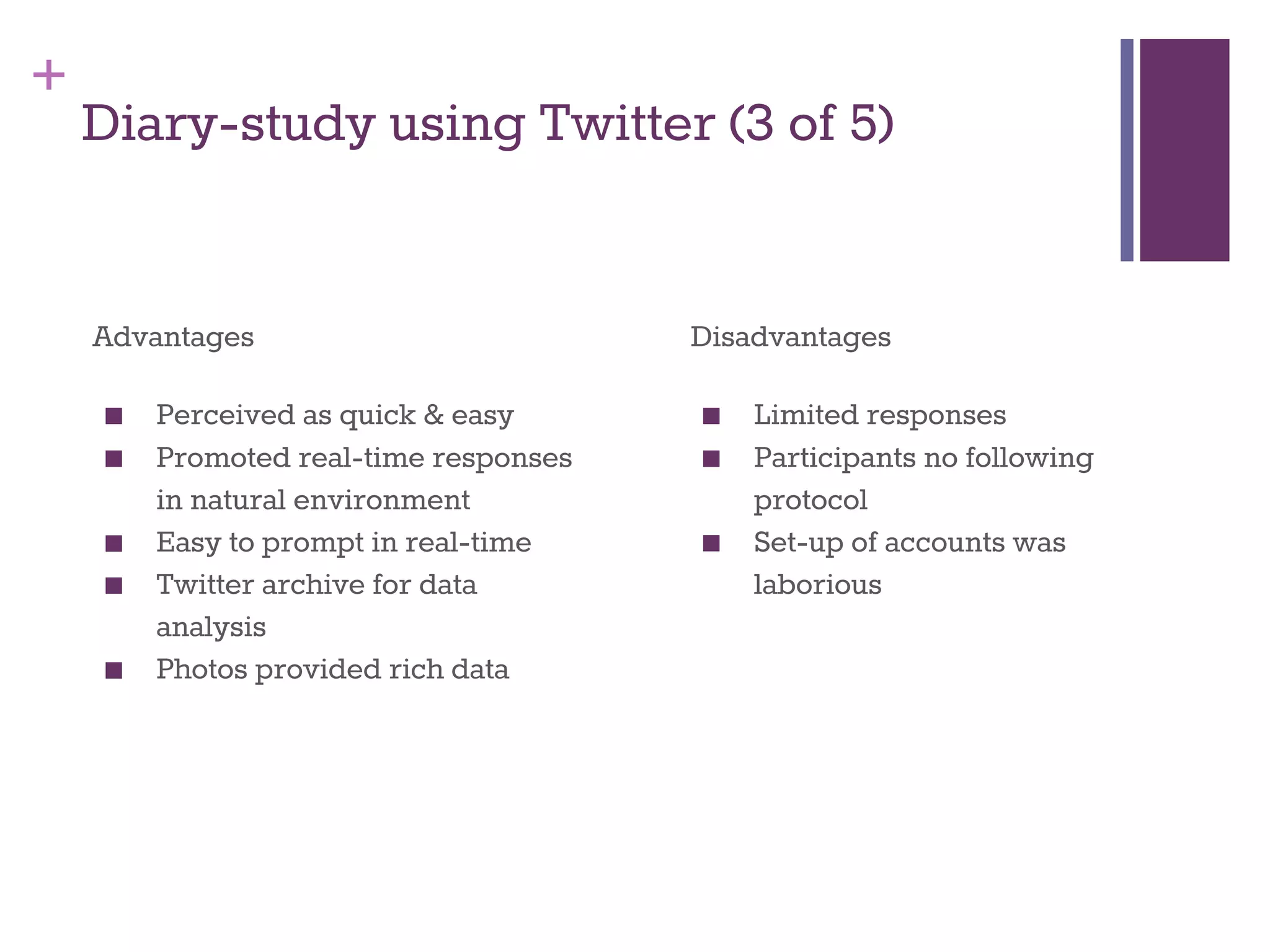
Diary-study using Twitter (3 of 5) 
Advantages 
■ Perceived as quick & easy 
■ Promoted real-time responses 
in natural environment 
■ Easy to prompt in real-time 
■ Twitter archive for data 
analysis 
■ Photos provided rich data 
Disadvantages 
■ Limited responses 
■ Participants no following 
protocol 
■ Set-up of accounts was 
laborious
+ 
Diary-study using Twitter (4 of 5) 
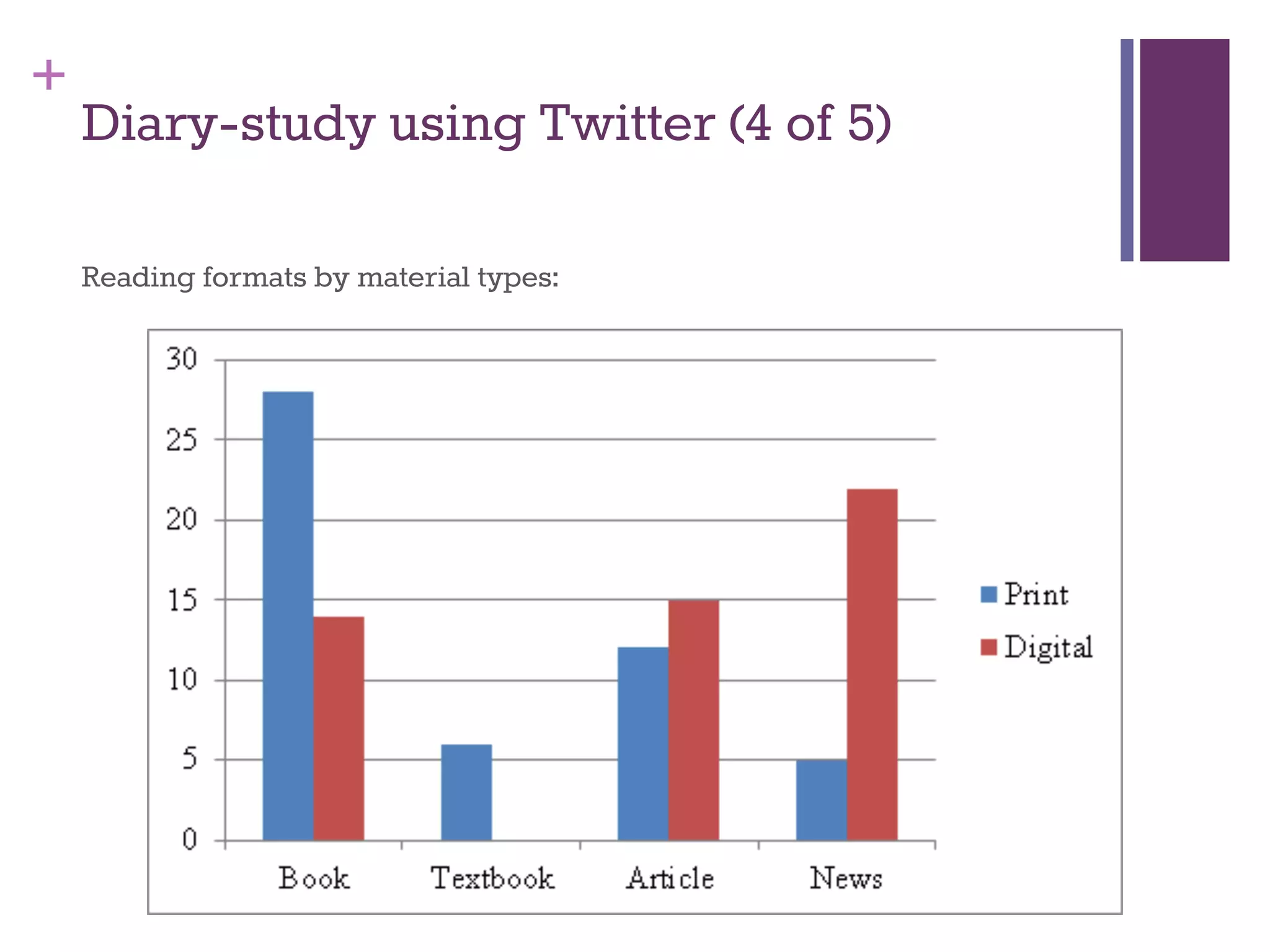
Reading formats by material types:
+ 
Diary-study using Twitter (5 of 5) 
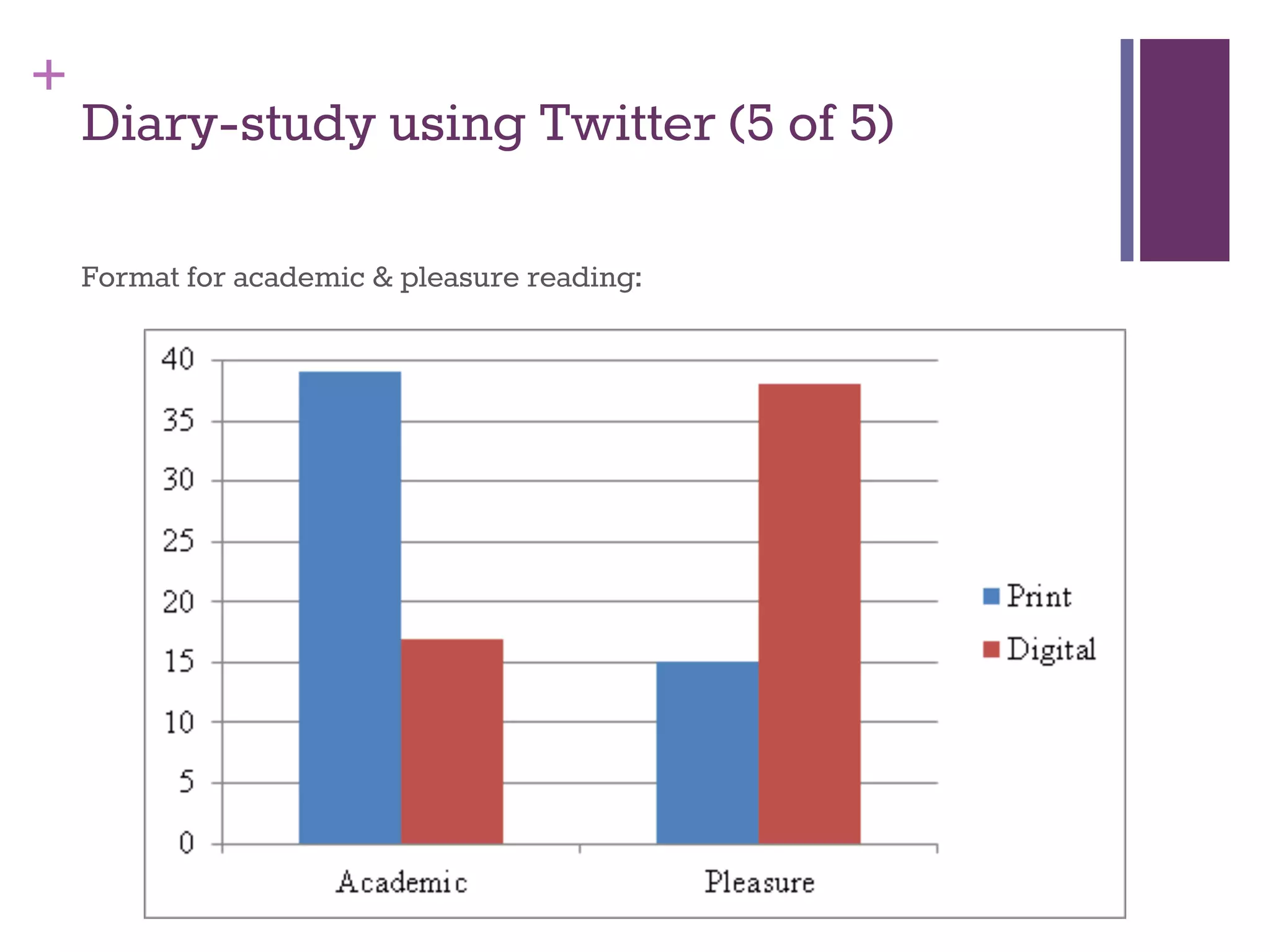
Format for academic & pleasure reading:
+ 
Summary of Results 
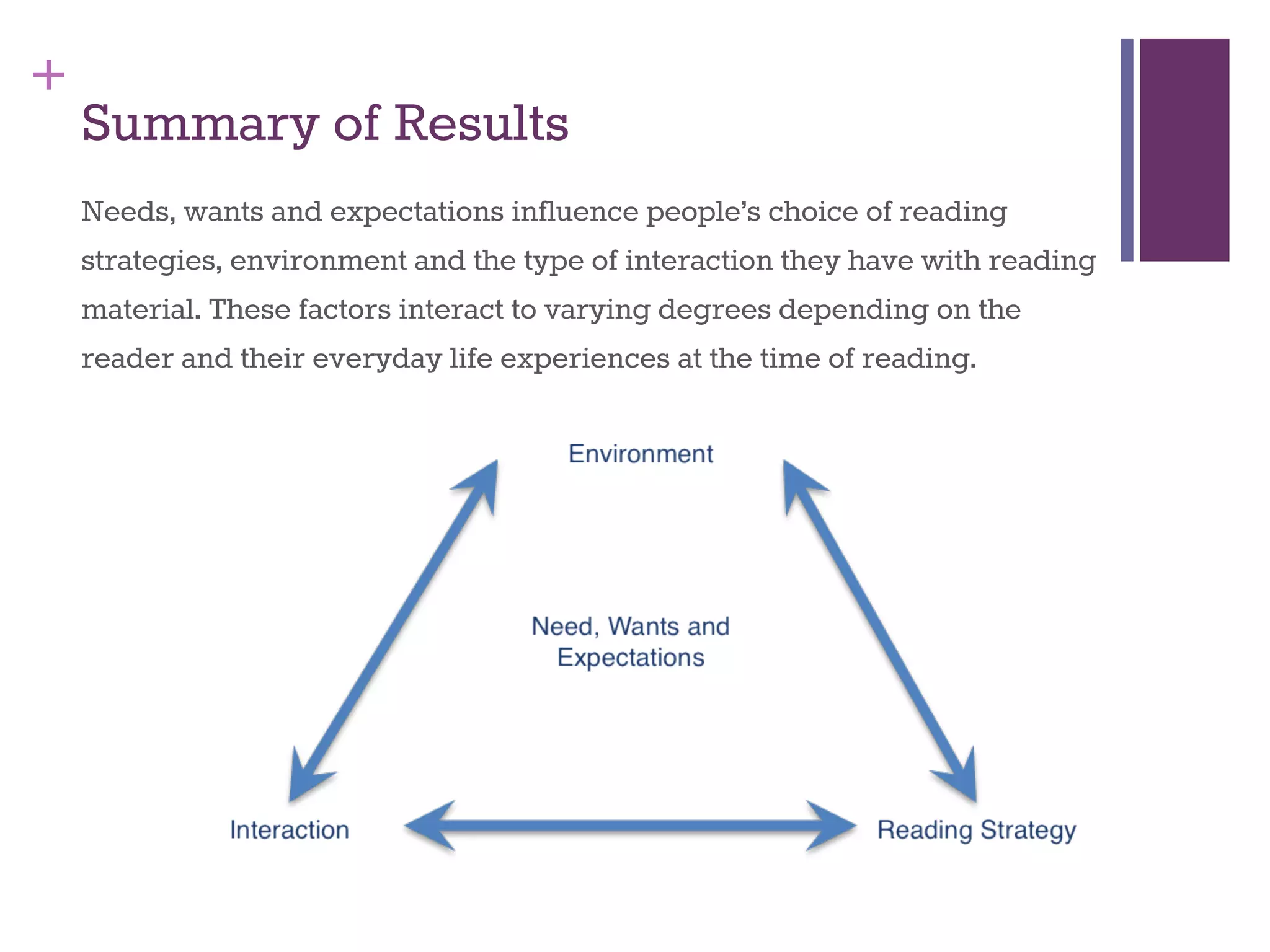
Needs, wants and expectations influence people’s choice of reading 
strategies, environment and the type of interaction they have with reading 
material. These factors interact to varying degrees depending on the 
reader and their everyday life experiences at the time of reading.
+ 
Theme 1: Environment 
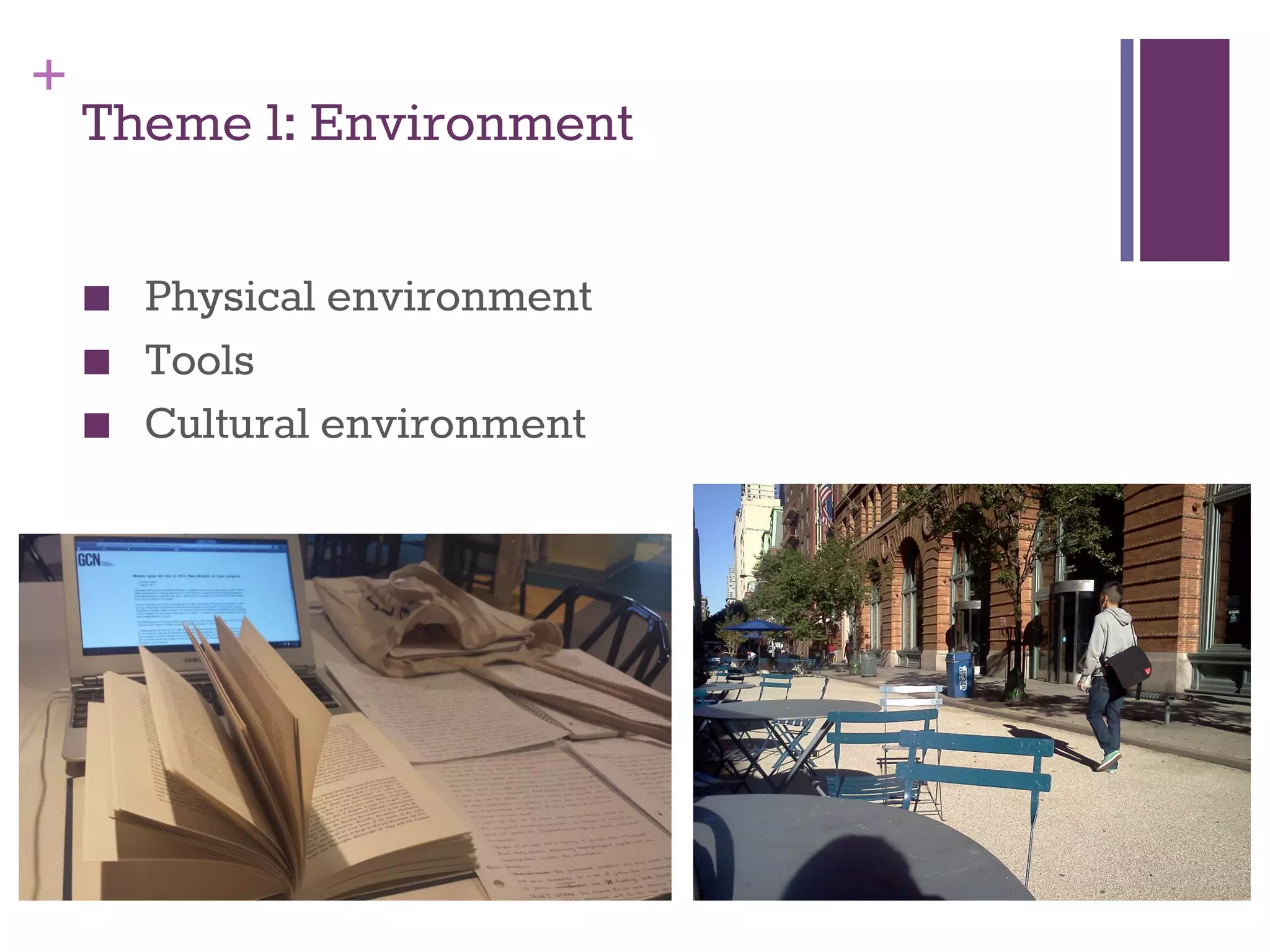
■ Physical environment 
■ Tools 
■ Cultural environment
+ 
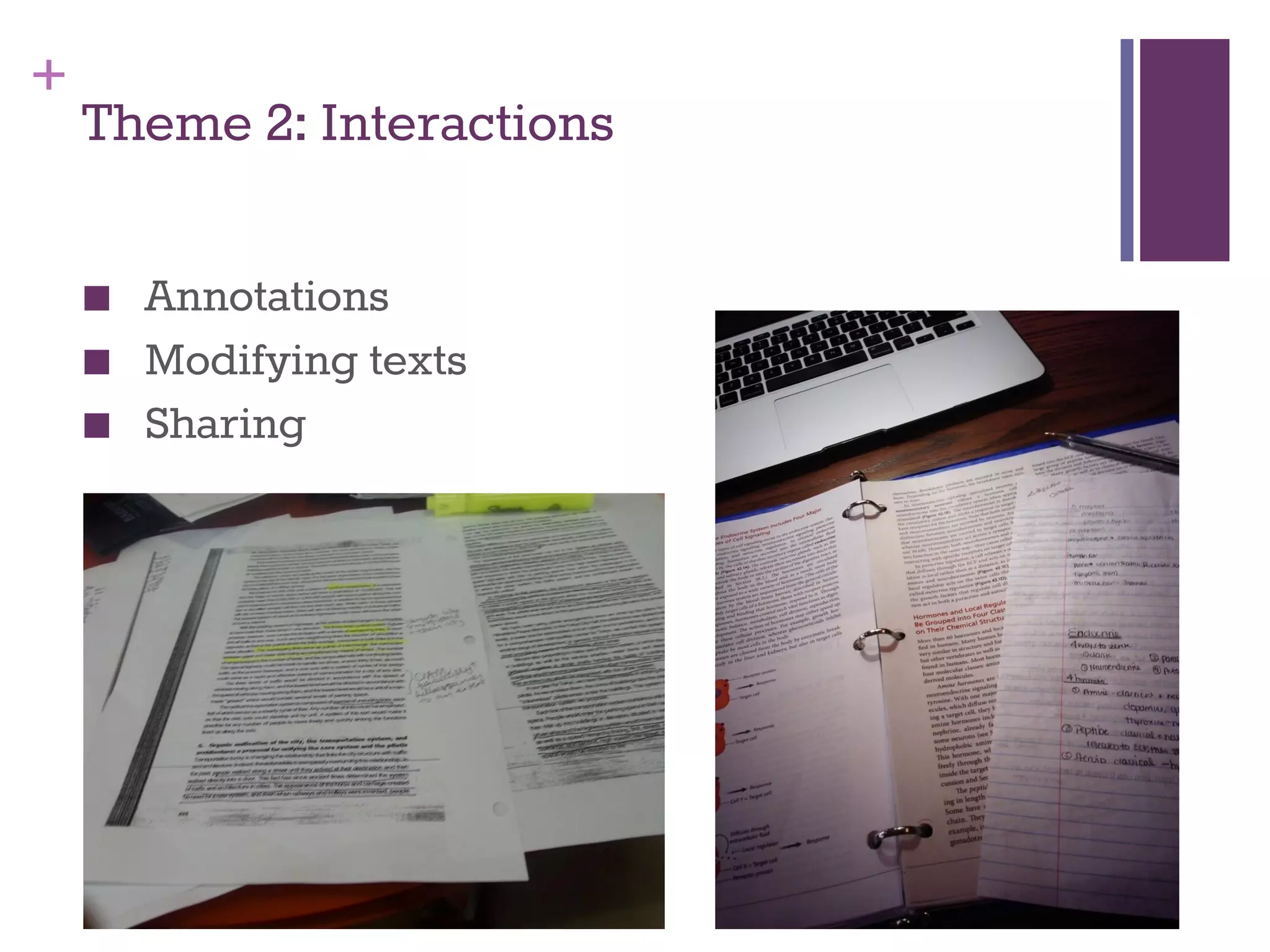
Theme 2: Interactions 
■ Annotations 
■ Modifying texts 
■ Sharing
+ 
Theme 3: Reading Strategies 
■ Receptive-Immersive: 
“getting lost in a story” 
■ Receptive-Inspectional: 
Digital reading is easier to 
“skim,” search within 
documents”, but harder to 
create a cognitive map (e.g., 
“don’t know what 53% means) 
■ Responsive-Analytical: 
“it (online reading) was slower to 
read… and to remember what I was 
doing” 
■ Responsive- Exploratory: 
About clicking on characters in e-book 
to learn more,, “fabulous… but 
a different type of reading 
experience” 
■ Responsive-Syntopical: “various (5-10) online articles 
and blogs in prep for LIS info professionals blog I'm writing”
+ 
Deanna Sessions and 
Storey Sitwala 
Pratt Institute 
A model of reading 
in academia: 
Relationships 
among academic 
tasks, information-seeking 
stages and 
reading strategies
+ 
Research Questions 
■ Does academic task impact reading strategies and 
information-seeking tactics? 
■ Do task-related reading strategies and information-seeking 
tactics influence selection of source and medium?
+ 
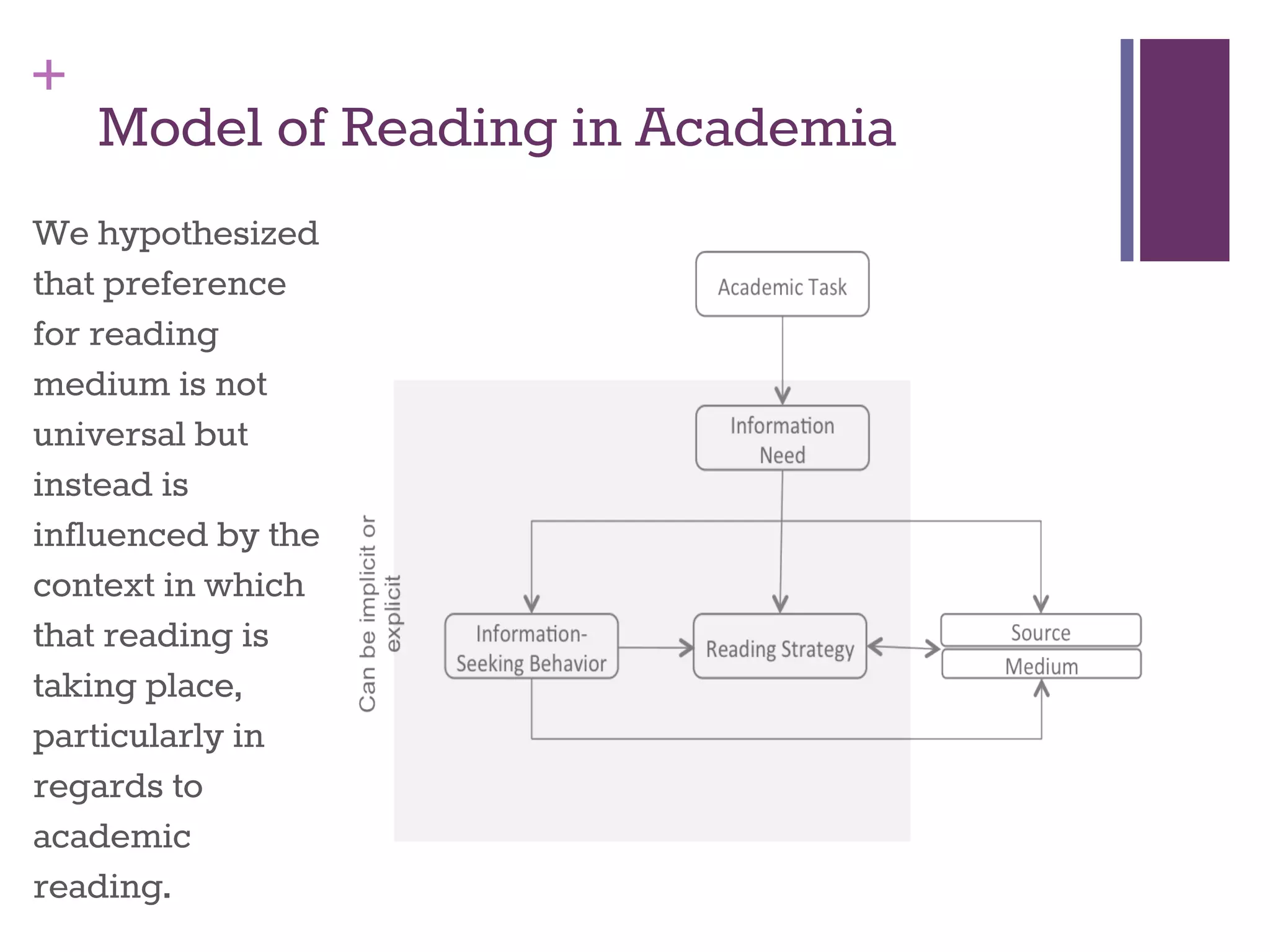
Model of Reading in Academia 
We hypothesized 
that preference 
for reading 
medium is not 
universal but 
instead is 
influenced by the 
context in which 
that reading is 
taking place, 
particularly in 
regards to 
academic 
reading.
+ 
Academic Tasks 
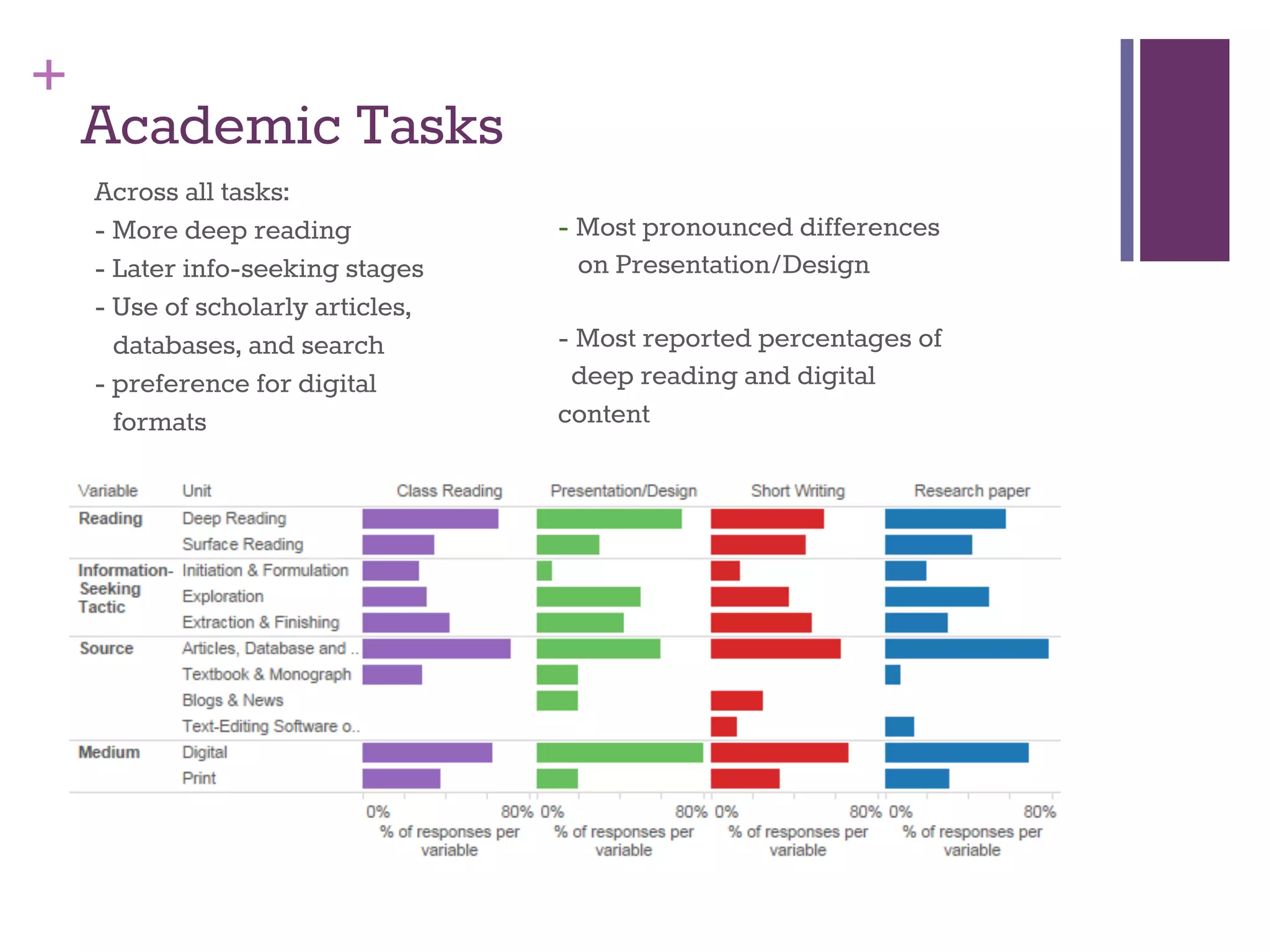
Across all tasks: 
- More deep reading 
- Later info-seeking stages 
- Use of scholarly articles, 
databases, and search 
- preference for digital 
formats 
- Most pronounced differences 
on Presentation/Design 
- Most reported percentages of 
deep reading and digital 
content
+ 
Reading Strategies and Styles 
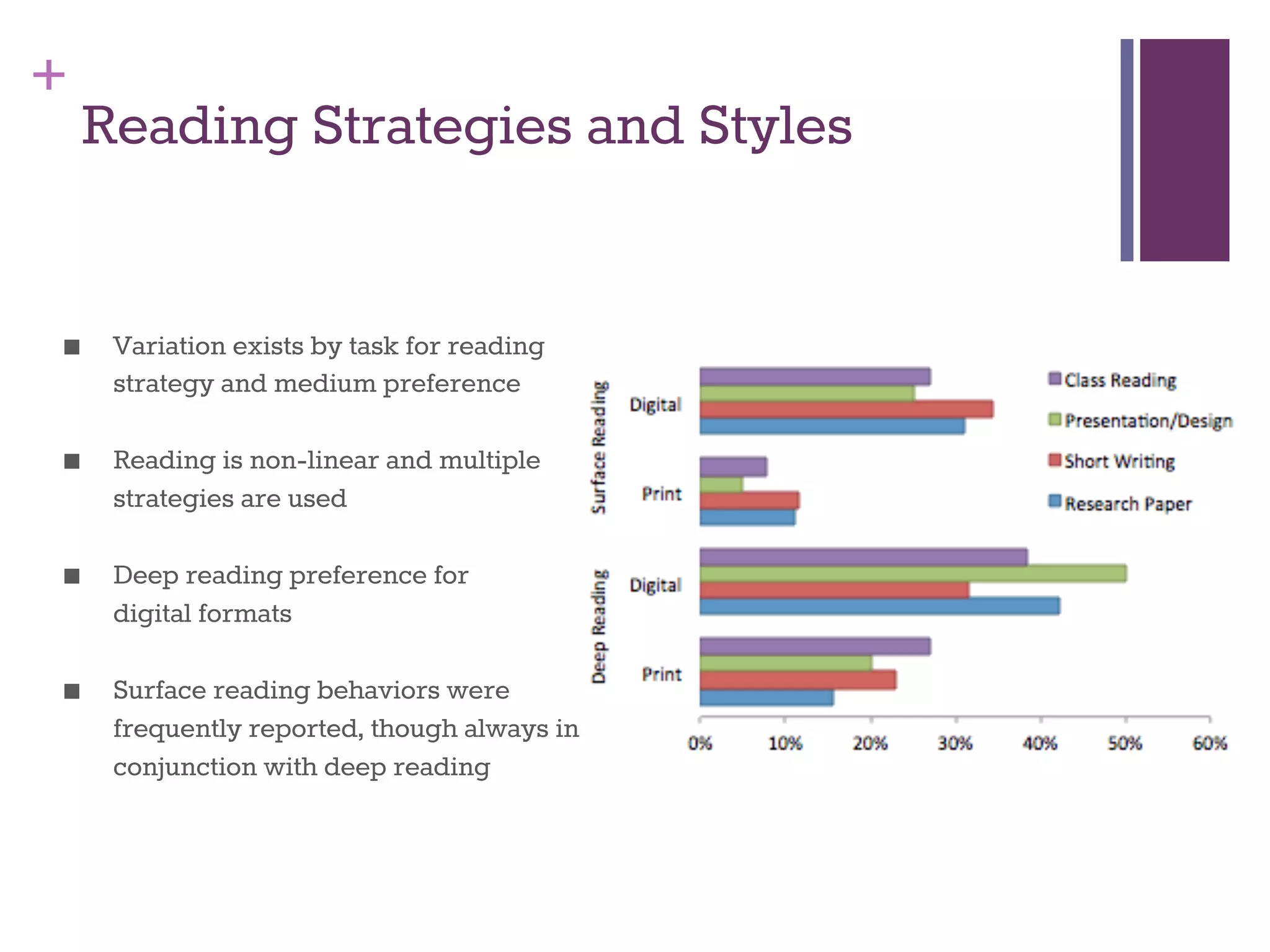
■ Variation exists by task for reading 
strategy and medium preference 
■ Reading is non-linear and multiple 
strategies are used 
■ Deep reading preference for 
digital formats 
■ Surface reading behaviors were 
frequently reported, though always in 
conjunction with deep reading
+ 
Information-Seeking Tactics 
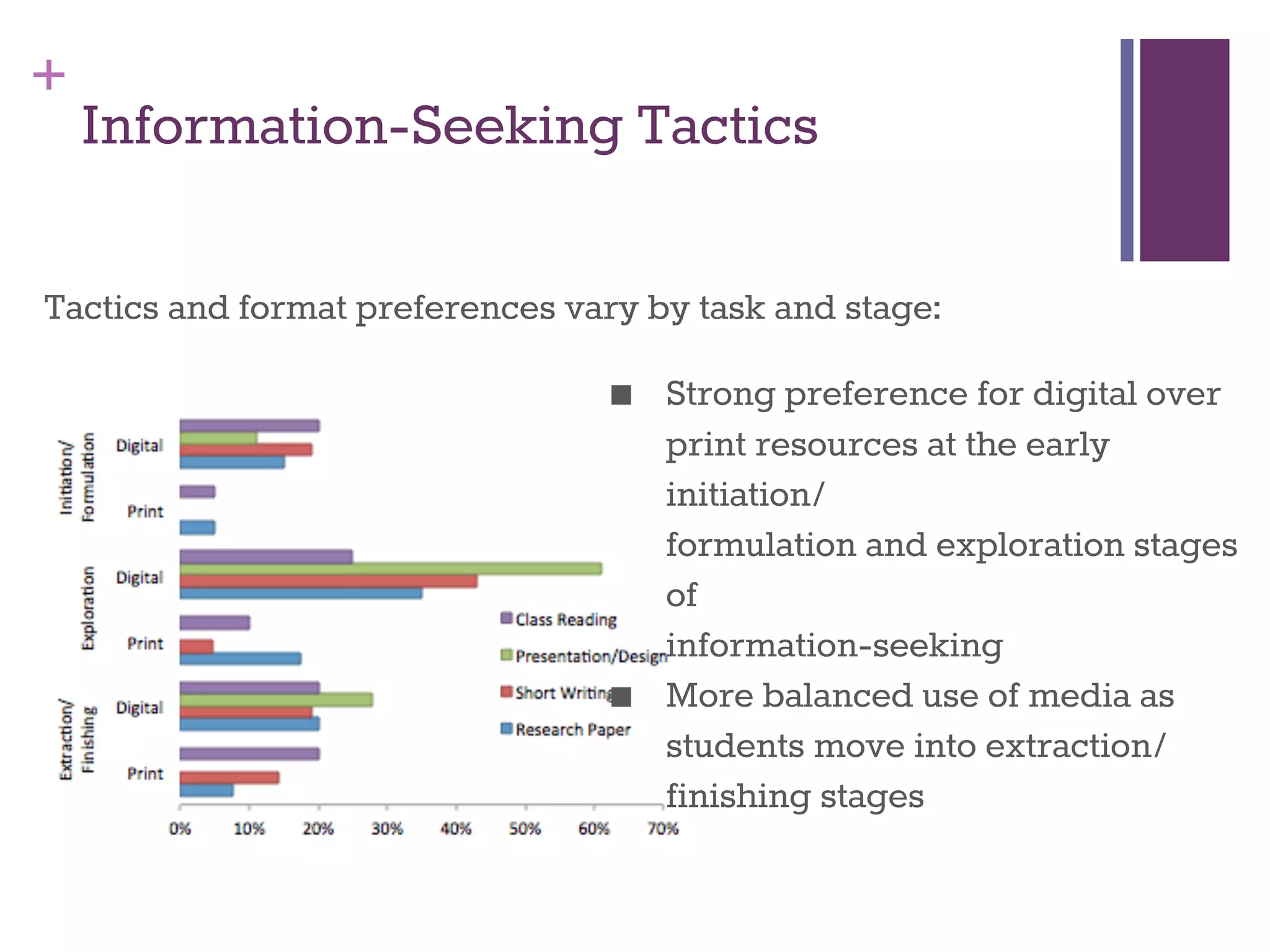
Tactics and format preferences vary by task and stage: 
■ Strong preference for digital over 
print resources at the early 
initiation/ 
formulation and exploration stages 
of 
information-seeking 
■ More balanced use of media as 
students move into extraction/ 
finishing stages
+ 
Source and Medium 
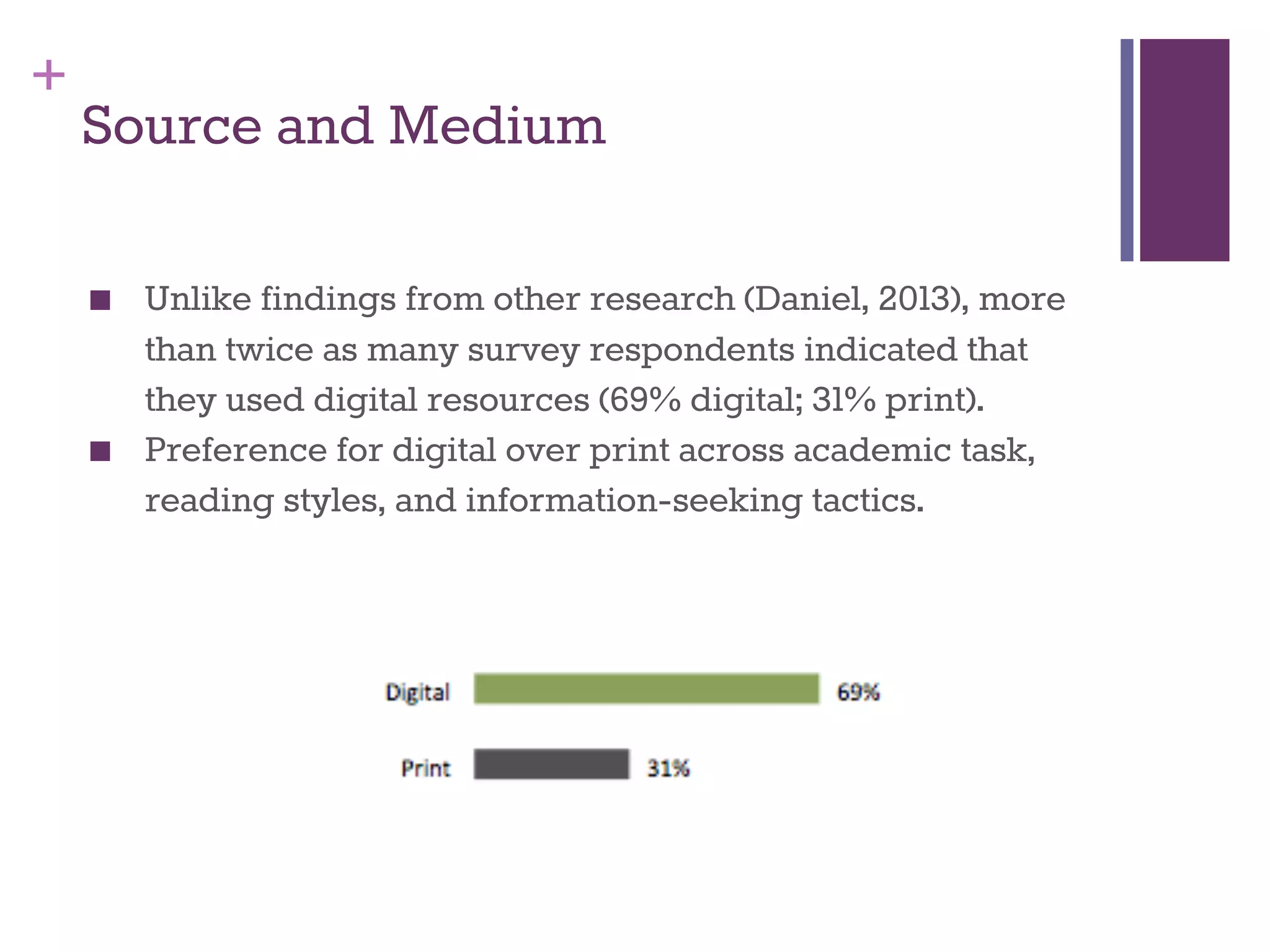
■ Unlike findings from other research (Daniel, 2013), more 
than twice as many survey respondents indicated that 
they used digital resources (69% digital; 31% print). 
■ Preference for digital over print across academic task, 
reading styles, and information-seeking tactics.
+ 
Recommendations 
■ Academic librarians working in an environment where 
students are frequently assigned art and design tasks 
should remember students overwhelming preference for 
digital. 
■ The deep reading/digital preference indicates academic 
librarians should consider providing digital content that 
supports deep reading behaviors, such as re-reading, 
note-taking, annotation, highlighting, and working with 
multiple documents. 
■ Features that assist with surface reading, such as search 
functionality and pagination, which supports flipping 
behaviors, may not be as crucial to digital collection 
development decisions.
+ 
Peter Nicholas Otis and 
Ashley Kelleher 
Pratt Institute 
Dimensions of 
Control: Use of 
Electronic Text and 
Print Resources in 
Academic Work
Problem Set 
Q: How often do students simultaneously use multiple 
reading technologies in a single workspace? 
Q: Why do students integrate multiple reading technologies 
within a single workspace? 
Q: Do students feel a greater sense of control when 
simultaneously commanding multiple reading resources 
or technologies? 
tronic Text and Print Resources in Academic Work
METHODOLOGY 
Online Questionnaire (Survey Instrument I) 
■ Remains the predominant form of qualitative research in the LIS field 
Distribution, Term and Respondents 
■ Disseminated via email to Pratt Institute, Brooklyn College, Teachers College 
Columbia University, and Barnard College, Columbia University 
■ Open from September 09, 2013 to November 07, 2013 
■ 83 Total Responses collected over two months returned from 30 graduate students, 4 
undergraduates, 1 full time non-degree student, and 48 undeclared.of Electronic 
Text and Print Resources in Academic Work
+ 
FINDINGS 
Q: How often do students simultaneously use multiple 
reading technologies in a single workspace? 
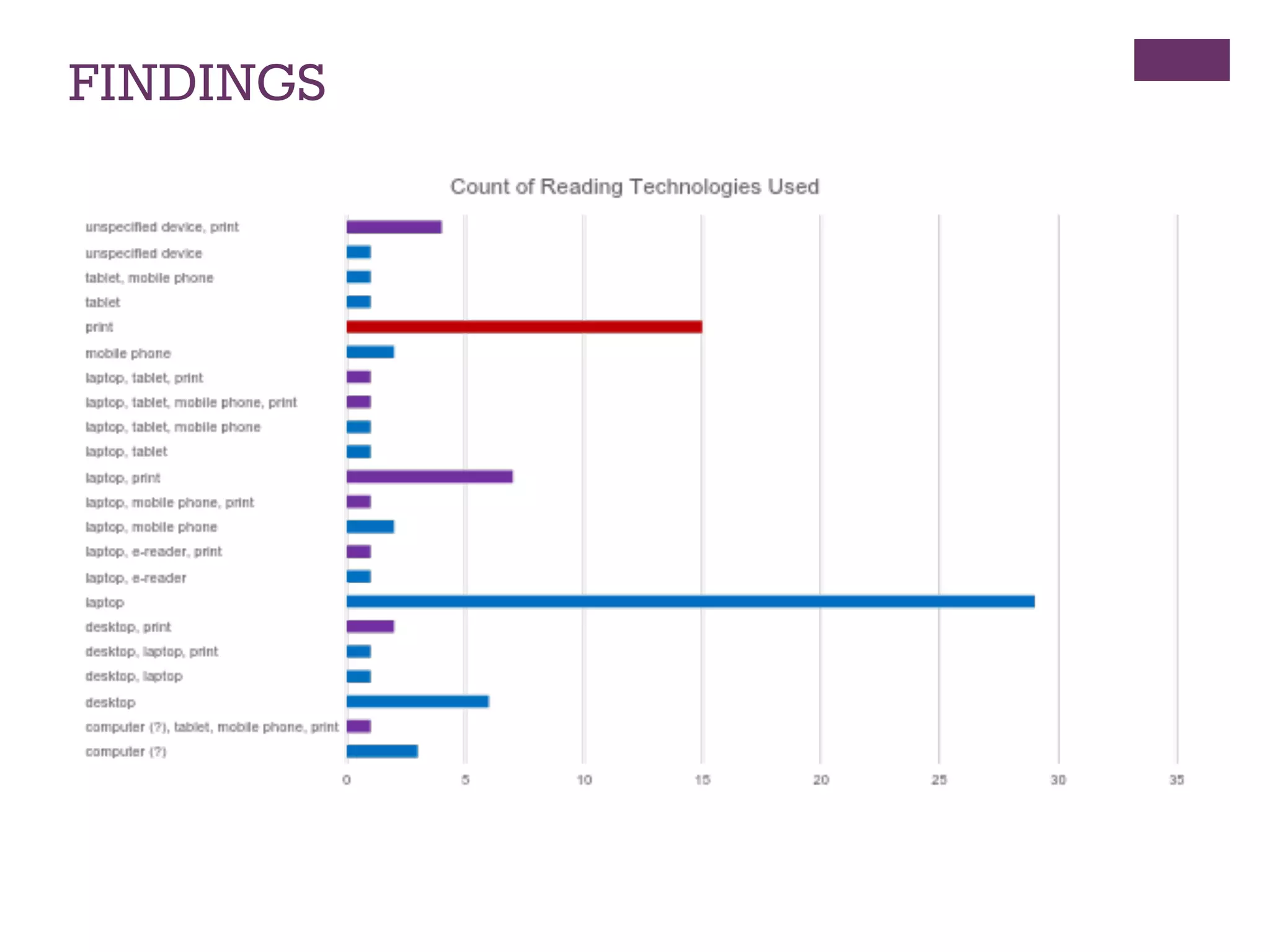
■ A: 71% of respondents reported solely using one type of 
reading technology. 
■ A: 13% reported using one or more digital devices in 
conjunction with printed ones.
FINDINGS
+ 
FINDINGS 
Q: Why do students integrate multiple reading technologies 
within a single workspace? 
■ A: Prominent trends in existing field literature affirmed: 
■ Digital devices are best suited to quick information finding and gathering 
■ Students prefer the print medium to annotate, highlight, and cognitively map 
ideas 
■ Users may prefer to engage resources on multiple monitors or digital surfaces 
for subjective applications 
■ Here, qualitative data proved fruitful: 
■ “I like using paper printouts to read articles because notetaking is easier. I'm using two 
computers at the moment because I want Gmail available on two monitors…one 
computer with two separate monitors like graphic designers use would be nice.”
+ 
FINDINGS 
Q: Do students feel a greater sense of control when 
simultaneously commanding multiple reading resources 
or technologies? 
■ “The laptop is excellent for browsing through and saving articles...I also keep 
a Word document open and type in notes or paste in sections I may quote in a 
paper. However, when doing readings for class, I prefer to print because I 
can highlight and add notes more easily, and having a stack of paper that I've 
finished reading gives me more of a feeling of accomplishment.”
+ 
Irene Lopatovska, Pratt 
Institute 
Mariana Regalado, Brooklyn College, Library 
Department 
Regalado@brooklyn.cuny.edu 
Eat, Rest, Work: A 
Case Study of Four 
Academic Libraries
+ 
Study of academic library spaces 
■ RQ1: Are academic library spaces used? 
■ RQ2: If so, how? 
■ During one week in November 2013, we observed four 
partner libraries: 
■ Barnard College 
■ Brooklyn College 
■ Pratt Institute 
■ Teacher’s College
+ 
Libraries are booming! 
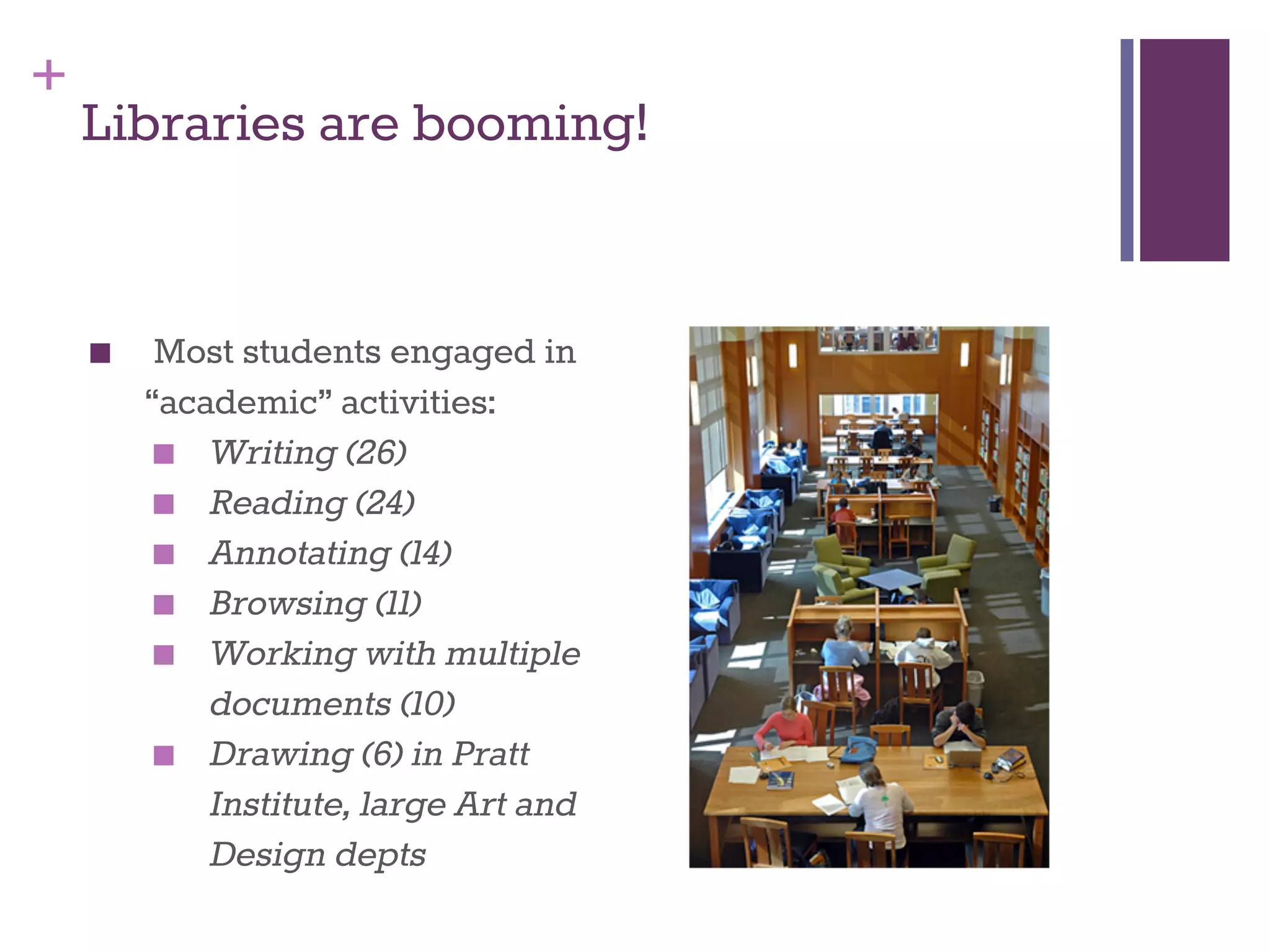
■ Most students engaged in 
“academic” activities: 
■ Writing (26) 
■ Reading (24) 
■ Annotating (14) 
■ Browsing (11) 
■ Working with multiple 
documents (10) 
■ Drawing (6) in Pratt 
Institute, large Art and 
Design depts
+ 
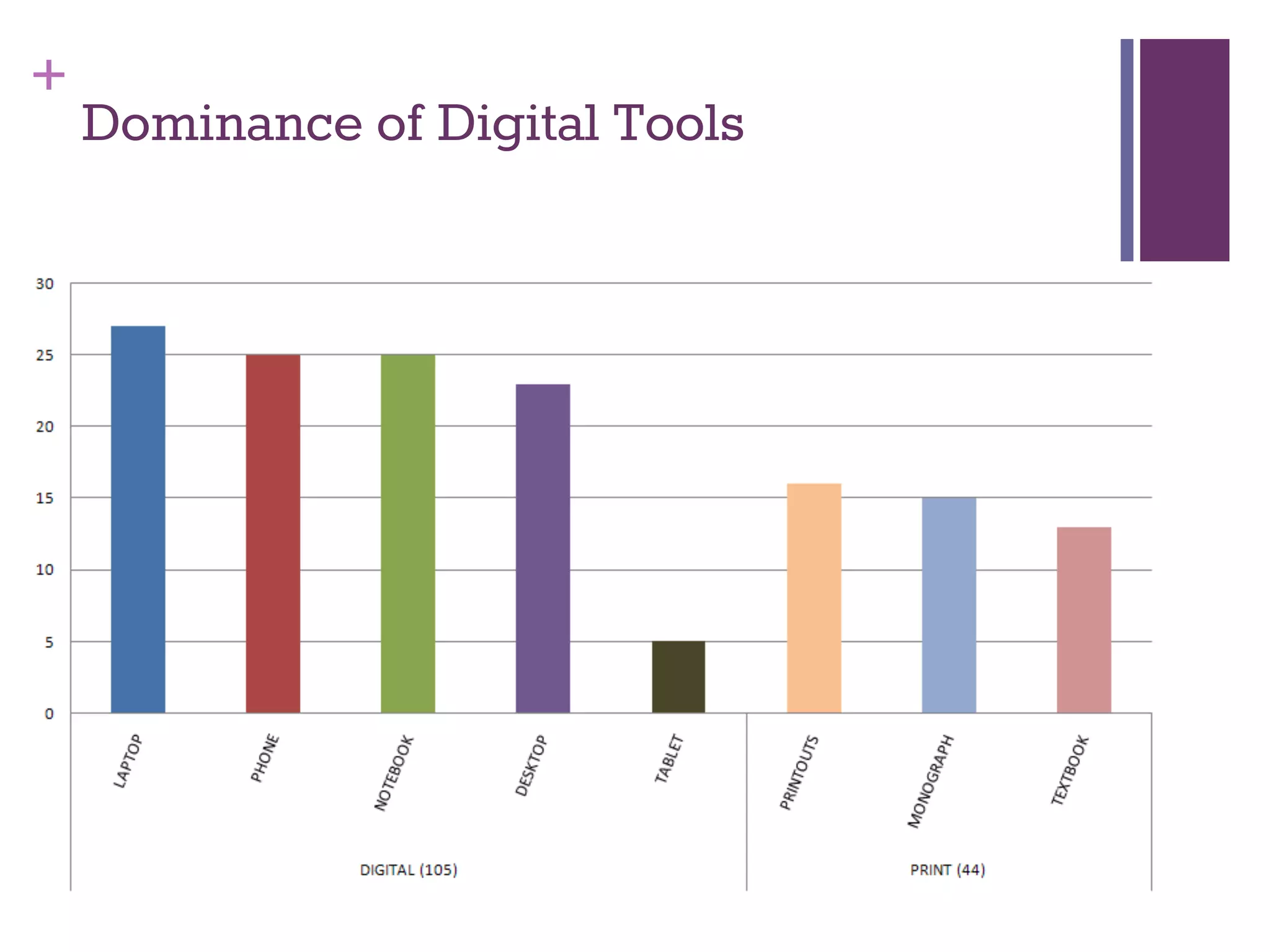
Dominance of Digital Tools
+ 
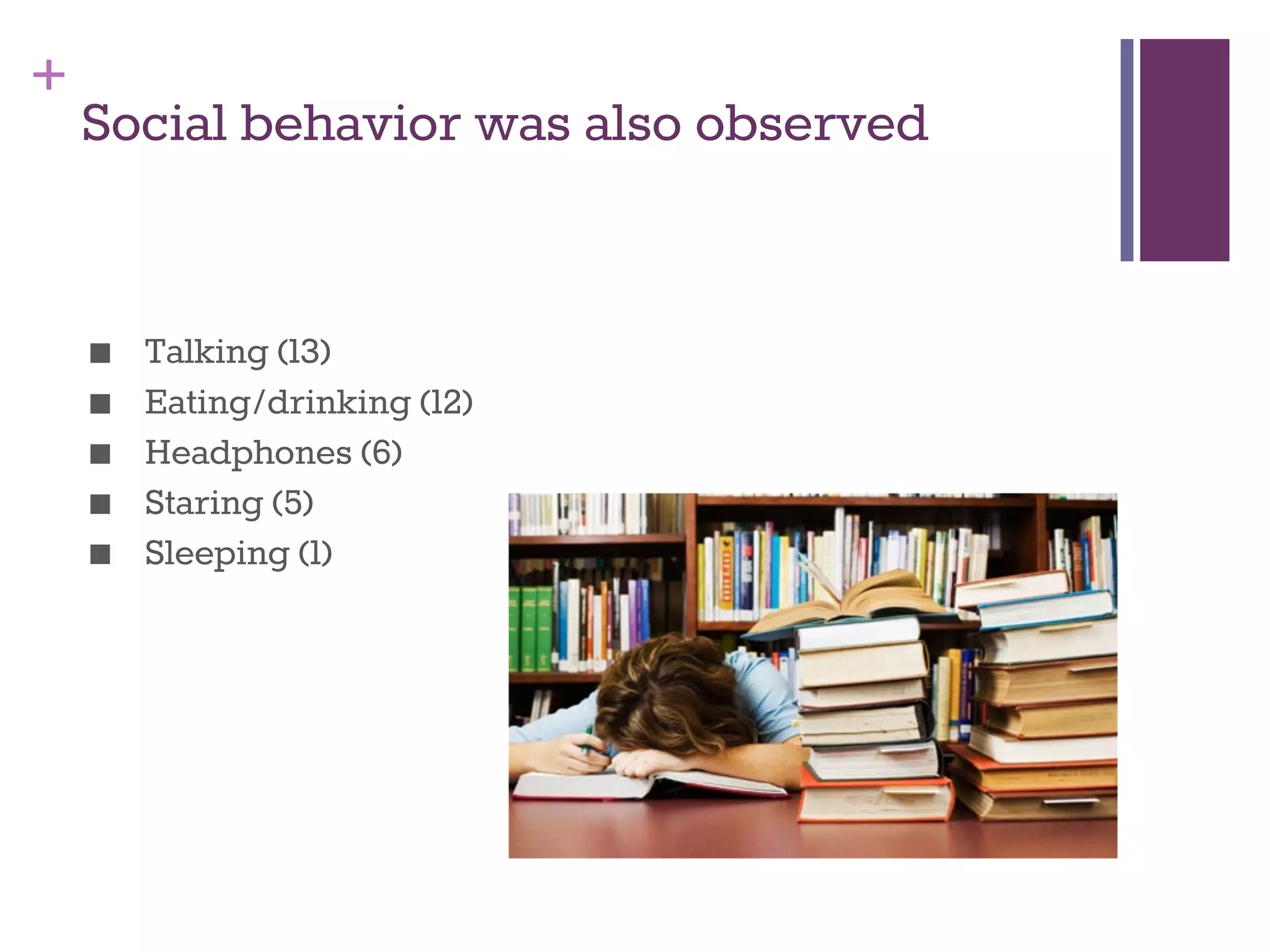
Social behavior was also observed 
■ Talking (13) 
■ Eating/drinking (12) 
■ Headphones (6) 
■ Staring (5) 
■ Sleeping (1)
+ 
Conclusion 
■ Academic culture coexists with social; digital media with 
print 
■ Analysis indicated similar patterns in students behavior 
across the four partner libraries 
■ Pratt students used the library for art projects and 
drawing - relates to the parent institute focus on Art 
and Design education
+ 
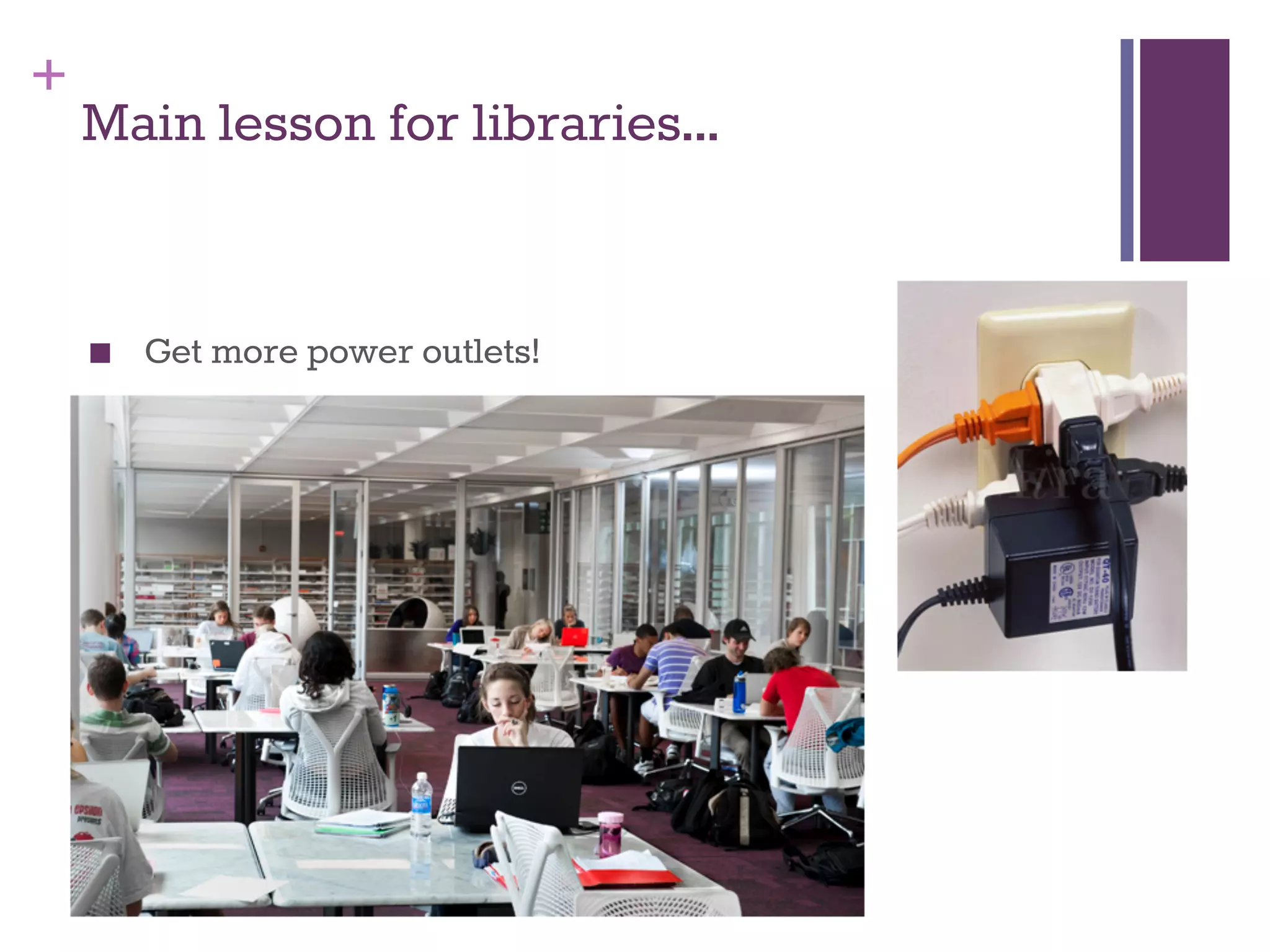
Main lesson for libraries... 
■ Get more power outlets!

QQML Panel 2014: Pratt Institute SILS

  • 1.
    + Exploring theUse of E-Books: An Investigation of Reading Habits and Practices in Academia QQML 2014: 6th Qualitative and Quantitative Methods in Libraries International Conference
  • 2.
    + Lisa Peet,Dan Nishimoto, Josephine Evans, and Irene Lopatovska Pratt Institute SWOT Analysis of Emerging Technology: The Case of E-books
  • 3.
    + E-books inAcademia ■ E-books have been around for decades resulting in a flood of publications on this topic ■ recent 2012 article lists 1457 publications on e-books
  • 4.
    + SWOT ■To ease navigation through vast amount of e-book information, we summarized the major themes using the SWOT technique (used in strategic planning) ■ Strengths ■ Weaknesses ■ Opportunities ■ Threats
  • 5.
    + E-book Strengths ■ Increased accessibility, and portability of collections ■ Semi-permanency, physical resiliency, and durability ■ Interactivity and availability of keyword searching, annotation, and hyperlinked navigable text features ■ Support for interactive and contextual learning ■ Catalog synchronization ■ Intra- and interuniversity consortial programs that increase content offerings at low cost
  • 6.
    + E-book Weaknesses ■ Limited content accessibility related to a. e-book/e-reader functionality and b. licensing and copyright issues ■ Costs associated with e-book pricing, licensing, and processing
  • 7.
    + Opportunities Createdby E-books ■ Increased collaboration and partnership ■ Enhanced content ■ Empowered library workforce ■ Enriched distance education ■ Platform innovation
  • 8.
    + Threats toE-books ■ Culture of print book readership ■ Usability and awareness of e-books ■ Lack of diverse e-book offerings ■ Lack of viable business models
  • 9.
    + Summary SWOT ■ Helped to identify the embedded features of e-book technology that make it desirable or undesirable for academic libraries and their users ■ Outlined external factors (reading culture, legal and business realities) affecting the current and future uses of this technology
  • 10.
    + Project Introduction:E-Reading in the Academy LIS 608: Human-Information Behavior LIS 630: Information Science Research Investigating Relationship of media choices to reading practices in academia Partner Institutions Research Samples collected from: Barnard College at Columbia University Brooklyn College Teacher’s College Pratt Institute SILS Funding American Library Association (ALA) Carroll Preston Barber Research Grant Two Classes
  • 11.
    + M. ChristinaPattuelli, Elizabeth Kaufer, Gina Shelton, and Storey Sitwala Pratt Institute Real-time Reading: A Twitter-based Diary Study of College Students
  • 12.
    + PROBLEM STATEMENT ■ What everyday life circumstances contribute to decisions around reading experiences? ■ How is the nature of reading changing in the digital age? ■ How do readers make decisions about reading format?
  • 13.
    + Methods &Participants Methods ■ Focus groups ■ Real-time diary using Twitter ■ Semi-structured interviews Participants ■ 11 participants (5 from Barnard, 6 from Pratt) ■ 7 completed all three phases of the study
  • 14.
    + Diary-study usingTwitter (1 of 5) Diary method is used to collect person-level, spontaneous data in a natural environment Twitter as a diary method appears to be unique amongst studies utilizing this tool
  • 15.
    + Diary-study usingTwitter (2 of 5) Study details: ■ Week-long ■ Event-contingent ■ Assigned protocol of tweet content ■ At least one photo of reading environment per day
  • 16.
    + Diary-study usingTwitter (3 of 5) Advantages ■ Perceived as quick & easy ■ Promoted real-time responses in natural environment ■ Easy to prompt in real-time ■ Twitter archive for data analysis ■ Photos provided rich data Disadvantages ■ Limited responses ■ Participants no following protocol ■ Set-up of accounts was laborious
  • 17.
    + Diary-study usingTwitter (4 of 5) Reading formats by material types:
  • 18.
    + Diary-study usingTwitter (5 of 5) Format for academic & pleasure reading:
  • 19.
    + Summary ofResults Needs, wants and expectations influence people’s choice of reading strategies, environment and the type of interaction they have with reading material. These factors interact to varying degrees depending on the reader and their everyday life experiences at the time of reading.
  • 20.
    + Theme 1:Environment ■ Physical environment ■ Tools ■ Cultural environment
  • 21.
    + Theme 2:Interactions ■ Annotations ■ Modifying texts ■ Sharing
  • 22.
    + Theme 3:Reading Strategies ■ Receptive-Immersive: “getting lost in a story” ■ Receptive-Inspectional: Digital reading is easier to “skim,” search within documents”, but harder to create a cognitive map (e.g., “don’t know what 53% means) ■ Responsive-Analytical: “it (online reading) was slower to read… and to remember what I was doing” ■ Responsive- Exploratory: About clicking on characters in e-book to learn more,, “fabulous… but a different type of reading experience” ■ Responsive-Syntopical: “various (5-10) online articles and blogs in prep for LIS info professionals blog I'm writing”
  • 23.
    + Deanna Sessionsand Storey Sitwala Pratt Institute A model of reading in academia: Relationships among academic tasks, information-seeking stages and reading strategies
  • 24.
    + Research Questions ■ Does academic task impact reading strategies and information-seeking tactics? ■ Do task-related reading strategies and information-seeking tactics influence selection of source and medium?
  • 25.
    + Model ofReading in Academia We hypothesized that preference for reading medium is not universal but instead is influenced by the context in which that reading is taking place, particularly in regards to academic reading.
  • 26.
    + Academic Tasks Across all tasks: - More deep reading - Later info-seeking stages - Use of scholarly articles, databases, and search - preference for digital formats - Most pronounced differences on Presentation/Design - Most reported percentages of deep reading and digital content
  • 27.
    + Reading Strategiesand Styles ■ Variation exists by task for reading strategy and medium preference ■ Reading is non-linear and multiple strategies are used ■ Deep reading preference for digital formats ■ Surface reading behaviors were frequently reported, though always in conjunction with deep reading
  • 28.
    + Information-Seeking Tactics Tactics and format preferences vary by task and stage: ■ Strong preference for digital over print resources at the early initiation/ formulation and exploration stages of information-seeking ■ More balanced use of media as students move into extraction/ finishing stages
  • 29.
    + Source andMedium ■ Unlike findings from other research (Daniel, 2013), more than twice as many survey respondents indicated that they used digital resources (69% digital; 31% print). ■ Preference for digital over print across academic task, reading styles, and information-seeking tactics.
  • 30.
    + Recommendations ■Academic librarians working in an environment where students are frequently assigned art and design tasks should remember students overwhelming preference for digital. ■ The deep reading/digital preference indicates academic librarians should consider providing digital content that supports deep reading behaviors, such as re-reading, note-taking, annotation, highlighting, and working with multiple documents. ■ Features that assist with surface reading, such as search functionality and pagination, which supports flipping behaviors, may not be as crucial to digital collection development decisions.
  • 31.
    + Peter NicholasOtis and Ashley Kelleher Pratt Institute Dimensions of Control: Use of Electronic Text and Print Resources in Academic Work
  • 32.
    Problem Set Q:How often do students simultaneously use multiple reading technologies in a single workspace? Q: Why do students integrate multiple reading technologies within a single workspace? Q: Do students feel a greater sense of control when simultaneously commanding multiple reading resources or technologies? tronic Text and Print Resources in Academic Work
  • 33.
    METHODOLOGY Online Questionnaire(Survey Instrument I) ■ Remains the predominant form of qualitative research in the LIS field Distribution, Term and Respondents ■ Disseminated via email to Pratt Institute, Brooklyn College, Teachers College Columbia University, and Barnard College, Columbia University ■ Open from September 09, 2013 to November 07, 2013 ■ 83 Total Responses collected over two months returned from 30 graduate students, 4 undergraduates, 1 full time non-degree student, and 48 undeclared.of Electronic Text and Print Resources in Academic Work
  • 34.
    + FINDINGS Q:How often do students simultaneously use multiple reading technologies in a single workspace? ■ A: 71% of respondents reported solely using one type of reading technology. ■ A: 13% reported using one or more digital devices in conjunction with printed ones.
  • 35.
  • 36.
    + FINDINGS Q:Why do students integrate multiple reading technologies within a single workspace? ■ A: Prominent trends in existing field literature affirmed: ■ Digital devices are best suited to quick information finding and gathering ■ Students prefer the print medium to annotate, highlight, and cognitively map ideas ■ Users may prefer to engage resources on multiple monitors or digital surfaces for subjective applications ■ Here, qualitative data proved fruitful: ■ “I like using paper printouts to read articles because notetaking is easier. I'm using two computers at the moment because I want Gmail available on two monitors…one computer with two separate monitors like graphic designers use would be nice.”
  • 37.
    + FINDINGS Q:Do students feel a greater sense of control when simultaneously commanding multiple reading resources or technologies? ■ “The laptop is excellent for browsing through and saving articles...I also keep a Word document open and type in notes or paste in sections I may quote in a paper. However, when doing readings for class, I prefer to print because I can highlight and add notes more easily, and having a stack of paper that I've finished reading gives me more of a feeling of accomplishment.”
  • 38.
    + Irene Lopatovska,Pratt Institute Mariana Regalado, Brooklyn College, Library Department Regalado@brooklyn.cuny.edu Eat, Rest, Work: A Case Study of Four Academic Libraries
  • 39.
    + Study ofacademic library spaces ■ RQ1: Are academic library spaces used? ■ RQ2: If so, how? ■ During one week in November 2013, we observed four partner libraries: ■ Barnard College ■ Brooklyn College ■ Pratt Institute ■ Teacher’s College
  • 40.
    + Libraries arebooming! ■ Most students engaged in “academic” activities: ■ Writing (26) ■ Reading (24) ■ Annotating (14) ■ Browsing (11) ■ Working with multiple documents (10) ■ Drawing (6) in Pratt Institute, large Art and Design depts
  • 41.
    + Dominance ofDigital Tools
  • 42.
    + Social behaviorwas also observed ■ Talking (13) ■ Eating/drinking (12) ■ Headphones (6) ■ Staring (5) ■ Sleeping (1)
  • 43.
    + Conclusion ■Academic culture coexists with social; digital media with print ■ Analysis indicated similar patterns in students behavior across the four partner libraries ■ Pratt students used the library for art projects and drawing - relates to the parent institute focus on Art and Design education
  • 44.
    + Main lessonfor libraries... ■ Get more power outlets!