November 2013

lunaves - revisiting moon watching
Can moon watching be an effective technique for bird
migration studies?
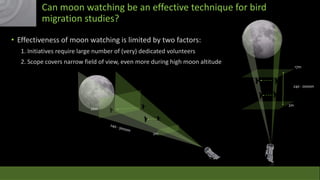
• Effectiveness of moon watching is limited by two factors:
1. Initiatives require large number of (very) dedicated volunteers
2. Scope covers narrow field of view, even more during high moon altitude

17m

240 - 2000m

2m

26m

2m
Yet, we still lack suitable alternatives
• There are other techniques to observe nocturnal migration:

• Ringing is relevant mainly for stopover points
• Data from weather radars data not available in Europe as in US
• Mobile radar units are expensive, impractical except for specialised research

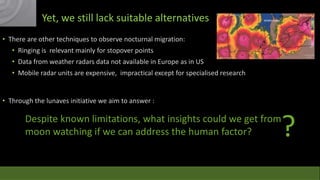
• Through the lunaves initiative we aim to answer :

?

Despite known limitations, what insights could we get from
moon watching if we can address the human factor?
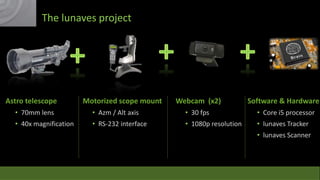
The lunaves project

Astro telescope

Motorized scope mount

Webcam (x2)

Software & Hardware

• 70mm lens

• Azm / Alt axis

• 30 fps

• Core i5 processor

• 40x magnification

• RS-232 interface

• 1080p resolution

• lunaves Tracker
• lunaves Scanner
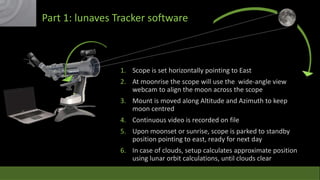
Part 1: lunaves Tracker software

1. Scope is set horizontally pointing to East
2. At moonrise the scope will use the wide-angle view
webcam to align the moon across the scope
3. Mount is moved along Altitude and Azimuth to keep
moon centred
4. Continuous video is recorded on file
5. Upon moonset or sunrise, scope is parked to standby
position pointing to east, ready for next day
6. In case of clouds, setup calculates approximate position
using lunar orbit calculations, until clouds clear
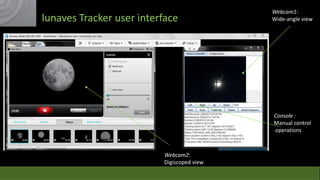
lunaves Tracker user interface

Webcam1:
Wide-angle view

Console :
Manual control
operations

Webcam2:
Digiscoped view
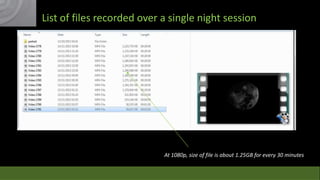
List of files recorded over a single night session

At 1080p, size of file is about 1.25GB for every 30 minutes
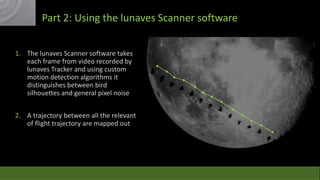
Part 2: Using the lunaves Scanner software
1. The lunaves Scanner software takes
each frame from video recorded by
lunaves Tracker and using custom
motion detection algorithms it
distinguishes between bird
silhouettes and general pixel noise
2. A trajectory between all the relevant
of flight trajectory are mapped out
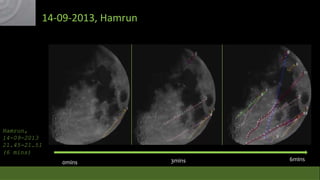
14-09-2013, Hamrun

Hamrun,
14-09-2013
21.45-21.51
(6 mins)
0mins

3mins

6mins
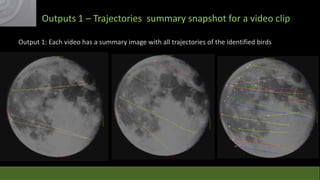
Outputs 1 – Trajectories summary snapshot for a video clip
Output 1: Each video has a summary image with all trajectories of the identified birds
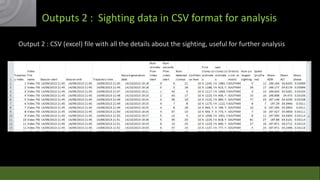
Outputs 2 : Sighting data in CSV format for analysis
Output 2 : CSV (excel) file with all the details about the sighting, useful for further analysis
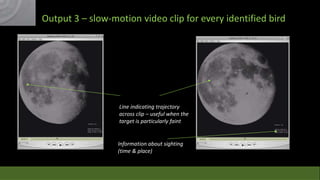
Output 3 – slow-motion video clip for every identified bird

Line indicating trajectory
across clip – useful when the
target is particularly faint

Information about sighting
(time & place)
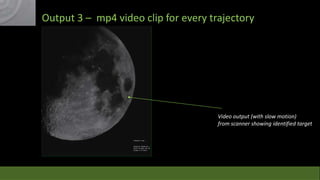
Output 3 – mp4 video clip for every trajectory

Video output (with slow motion)
from scanner showing identified target
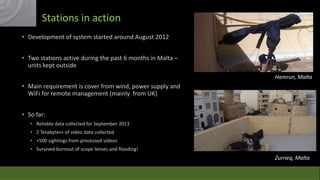
Stations in action
• Development of system started around August 2012
• Two stations active during the past 6 months in Malta –
units kept outside
Hamrun, Malta

• Main requirement is cover from wind, power supply and
WiFi for remote management (mainly from UK)
• So far:
• Reliable data collected for September 2013
• 2 Terabytes+ of video data collected
• +500 sightings from processed videos
• Survived burnout of scope lenses and flooding!

Zurrieq, Malta
Observation 1 : Eye versus Camera : 0 - 1
1. Capturing 30 frames per second on film and algorithm are much sharper than human eye – can
collect records which previously would have been missed
2. Level of detail makes possible attempts at identification
3. Consistent and uniform readings – not dependent on experience of watcher
4. Detection can be achieved also for the smaller phases of moon, this extending the period of
observation (clouds permitting)
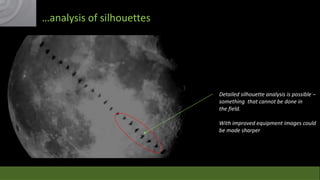
…analysis of silhouettes

Detailed silhouette analysis is possible –
something that cannot be done in
the field.
With improved equipment images could
be made sharper
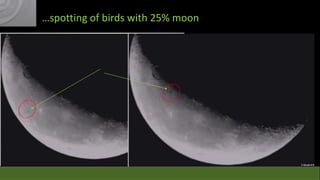
…spotting of birds with 25% moon
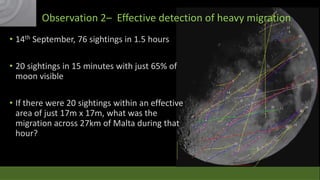
Observation 2– Effective detection of heavy migration
• 14th September, 76 sightings in 1.5 hours

47 sightings
73 sightings

• 20 sightings in 15 minutes with just 65% of
moon visible
• If there were 20 sightings within an effective
area of just 17m x 17m, what was the
migration across 27km of Malta during that
hour?
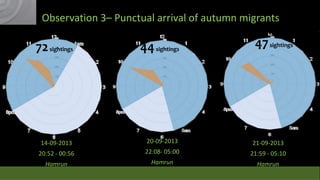
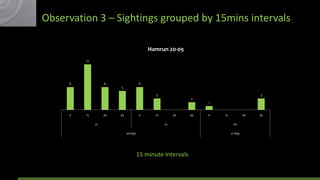
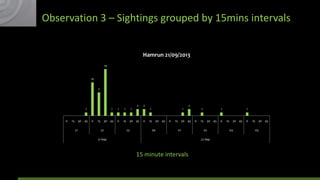
Observation 3– Punctual arrival of autumn migrants

47 sightings

73 sightings
72 sightings

44 sightings
45 sightings

14-09-2013

20-09-2013

21-09-2013

20:52 - 00:56

22:08- 05:00

21:59 - 05:10

Hamrun

Hamrun

Hamrun

73 sightings
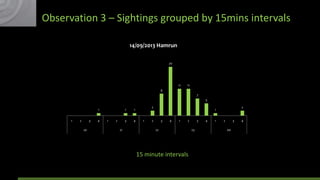
Observation 3 – Sightings grouped by 15mins intervals
14/09/2013 Hamrun
20

11

11

9
7
5
1

1

2

3
20

4

1

1

3

2
21

4

2

1

1

2

1

2

3

4

1

2

22

15 minute intervals

3
23

4

1

2

3
00

4
Observation 3 – Sightings grouped by 15mins intervals
Hamrun 20-09
12

6

6

6
5
3

3
2
1

0

15

30

45

0

22

15

30
23

20-Sep

45

0

15

30
00

21-Sep

15 minute intervals

45
Observation 3 – Sightings grouped by 15mins intervals
Hamrun 21/09/2013
14

10
7

2
1

0

15

30 45
21

1

0

15

30 45
22

1

1

0

15

2

1

30 45
23

2
1

0

15

1

30 45
00

0

15

30 45
01

21-Sep

1

0

15

1

30 45
02

22-Sep

15 minute intervals

0

1

15

30 45
03

0

15

30 45
05
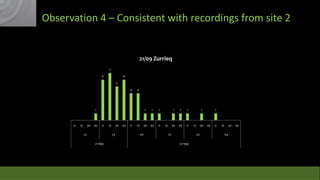
Observation 4 – Consistent with recordings from site 2

21/09 Zurrieq
7
6

6
5
4

4

1

0

15

30

45

1

0

22

15

30
23

21-Sep

45

0

00

1

30

15

1

45

0

1

1

30

15

1

45

0

01

1

15

30
02

22-Sep

1

45

0

15

30
04

45
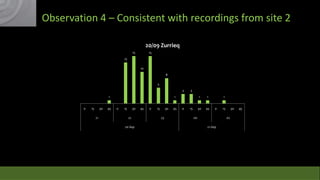
Observation 4 – Consistent with recordings from site 2
20/09 Zurrieq
15

15

13
10
8
5
3
1

0

15

30
21

45

3

1

0

15

30
22

20-Sep

45

0

15

30
23

45

1

0

30

15

1

45

1

0

00

15

30
02

21-Sep

45
Observation 5 – Variety of readings (switch to video)

Check out the youtube videos on lunaves.org
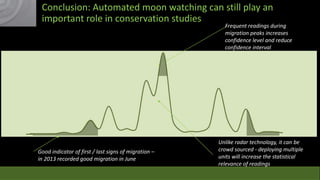
Conclusion: Automated moon watching can still play an
important role in conservation studies

Frequent readings during
migration peaks increases
confidence level and reduce
confidence interval

Good indicator of first / last signs of migration –
in 2013 recorded good migration in June

Unlike radar technology, it can be
crowd sourced - deploying multiple
units will increase the statistical
relevance of readings
Roadmap
• Consolidating lunaves.org - an organisation that advances research on nocturnal migration
• Life+ initiative for conservation projects with European research institutes / interested
parties such as BirdLife. Possibility of a Mediterrenean initiative?

• Deploy units on Europe’s main migration routes - Eilat (Israel), Gibraltar and
Falsterbo(Sweden)
• Improvement of optics and cameras (upgrade to 60 fps) and further software
development
• Investigate use of low-cost hardware to allow scaling up and deployment of hundreds of
cheap units
Get in touch…

Blog : www.lunaves.org
Email: lunaves@lunaves.org
: www.facebook.com/lunaves.org

Lunaves - an overview and the results so far

  • 1.
    November 2013 lunaves -revisiting moon watching
  • 2.
    Can moon watchingbe an effective technique for bird migration studies? • Effectiveness of moon watching is limited by two factors: 1. Initiatives require large number of (very) dedicated volunteers 2. Scope covers narrow field of view, even more during high moon altitude 17m 240 - 2000m 2m 26m 2m
  • 3.
    Yet, we stilllack suitable alternatives • There are other techniques to observe nocturnal migration: • Ringing is relevant mainly for stopover points • Data from weather radars data not available in Europe as in US • Mobile radar units are expensive, impractical except for specialised research • Through the lunaves initiative we aim to answer : ? Despite known limitations, what insights could we get from moon watching if we can address the human factor?
  • 4.
    The lunaves project Astrotelescope Motorized scope mount Webcam (x2) Software & Hardware • 70mm lens • Azm / Alt axis • 30 fps • Core i5 processor • 40x magnification • RS-232 interface • 1080p resolution • lunaves Tracker • lunaves Scanner
  • 5.
    Part 1: lunavesTracker software 1. Scope is set horizontally pointing to East 2. At moonrise the scope will use the wide-angle view webcam to align the moon across the scope 3. Mount is moved along Altitude and Azimuth to keep moon centred 4. Continuous video is recorded on file 5. Upon moonset or sunrise, scope is parked to standby position pointing to east, ready for next day 6. In case of clouds, setup calculates approximate position using lunar orbit calculations, until clouds clear
  • 6.
    lunaves Tracker userinterface Webcam1: Wide-angle view Console : Manual control operations Webcam2: Digiscoped view
  • 7.
    List of filesrecorded over a single night session At 1080p, size of file is about 1.25GB for every 30 minutes
  • 8.
    Part 2: Usingthe lunaves Scanner software 1. The lunaves Scanner software takes each frame from video recorded by lunaves Tracker and using custom motion detection algorithms it distinguishes between bird silhouettes and general pixel noise 2. A trajectory between all the relevant of flight trajectory are mapped out
  • 9.
  • 10.
    Outputs 1 –Trajectories summary snapshot for a video clip Output 1: Each video has a summary image with all trajectories of the identified birds
  • 11.
    Outputs 2 :Sighting data in CSV format for analysis Output 2 : CSV (excel) file with all the details about the sighting, useful for further analysis
  • 12.
    Output 3 –slow-motion video clip for every identified bird Line indicating trajectory across clip – useful when the target is particularly faint Information about sighting (time & place)
  • 13.
    Output 3 –mp4 video clip for every trajectory Video output (with slow motion) from scanner showing identified target
  • 14.
    Stations in action •Development of system started around August 2012 • Two stations active during the past 6 months in Malta – units kept outside Hamrun, Malta • Main requirement is cover from wind, power supply and WiFi for remote management (mainly from UK) • So far: • Reliable data collected for September 2013 • 2 Terabytes+ of video data collected • +500 sightings from processed videos • Survived burnout of scope lenses and flooding! Zurrieq, Malta
  • 15.
    Observation 1 :Eye versus Camera : 0 - 1 1. Capturing 30 frames per second on film and algorithm are much sharper than human eye – can collect records which previously would have been missed 2. Level of detail makes possible attempts at identification 3. Consistent and uniform readings – not dependent on experience of watcher 4. Detection can be achieved also for the smaller phases of moon, this extending the period of observation (clouds permitting)
  • 16.
    …analysis of silhouettes Detailedsilhouette analysis is possible – something that cannot be done in the field. With improved equipment images could be made sharper
  • 17.
    …spotting of birdswith 25% moon
  • 18.
    Observation 2– Effectivedetection of heavy migration • 14th September, 76 sightings in 1.5 hours 47 sightings 73 sightings • 20 sightings in 15 minutes with just 65% of moon visible • If there were 20 sightings within an effective area of just 17m x 17m, what was the migration across 27km of Malta during that hour?
  • 19.
    Observation 3– Punctualarrival of autumn migrants 47 sightings 73 sightings 72 sightings 44 sightings 45 sightings 14-09-2013 20-09-2013 21-09-2013 20:52 - 00:56 22:08- 05:00 21:59 - 05:10 Hamrun Hamrun Hamrun 73 sightings
  • 20.
    Observation 3 –Sightings grouped by 15mins intervals 14/09/2013 Hamrun 20 11 11 9 7 5 1 1 2 3 20 4 1 1 3 2 21 4 2 1 1 2 1 2 3 4 1 2 22 15 minute intervals 3 23 4 1 2 3 00 4
  • 21.
    Observation 3 –Sightings grouped by 15mins intervals Hamrun 20-09 12 6 6 6 5 3 3 2 1 0 15 30 45 0 22 15 30 23 20-Sep 45 0 15 30 00 21-Sep 15 minute intervals 45
  • 22.
    Observation 3 –Sightings grouped by 15mins intervals Hamrun 21/09/2013 14 10 7 2 1 0 15 30 45 21 1 0 15 30 45 22 1 1 0 15 2 1 30 45 23 2 1 0 15 1 30 45 00 0 15 30 45 01 21-Sep 1 0 15 1 30 45 02 22-Sep 15 minute intervals 0 1 15 30 45 03 0 15 30 45 05
  • 23.
    Observation 4 –Consistent with recordings from site 2 21/09 Zurrieq 7 6 6 5 4 4 1 0 15 30 45 1 0 22 15 30 23 21-Sep 45 0 00 1 30 15 1 45 0 1 1 30 15 1 45 0 01 1 15 30 02 22-Sep 1 45 0 15 30 04 45
  • 24.
    Observation 4 –Consistent with recordings from site 2 20/09 Zurrieq 15 15 13 10 8 5 3 1 0 15 30 21 45 3 1 0 15 30 22 20-Sep 45 0 15 30 23 45 1 0 30 15 1 45 1 0 00 15 30 02 21-Sep 45
  • 25.
    Observation 5 –Variety of readings (switch to video) Check out the youtube videos on lunaves.org
  • 26.
    Conclusion: Automated moonwatching can still play an important role in conservation studies Frequent readings during migration peaks increases confidence level and reduce confidence interval Good indicator of first / last signs of migration – in 2013 recorded good migration in June Unlike radar technology, it can be crowd sourced - deploying multiple units will increase the statistical relevance of readings
  • 27.
    Roadmap • Consolidating lunaves.org- an organisation that advances research on nocturnal migration • Life+ initiative for conservation projects with European research institutes / interested parties such as BirdLife. Possibility of a Mediterrenean initiative? • Deploy units on Europe’s main migration routes - Eilat (Israel), Gibraltar and Falsterbo(Sweden) • Improvement of optics and cameras (upgrade to 60 fps) and further software development • Investigate use of low-cost hardware to allow scaling up and deployment of hundreds of cheap units
  • 28.
    Get in touch… Blog: www.lunaves.org Email: lunaves@lunaves.org : www.facebook.com/lunaves.org