1
COURSE RAD331
Layout and design by A Musa, Department of Radiological Sciences,
Faculty of Applied Medical Sciences, King Saud University, Riyadh, Copyright  2003 A Musa
2
TECHNICAL ASPECTS
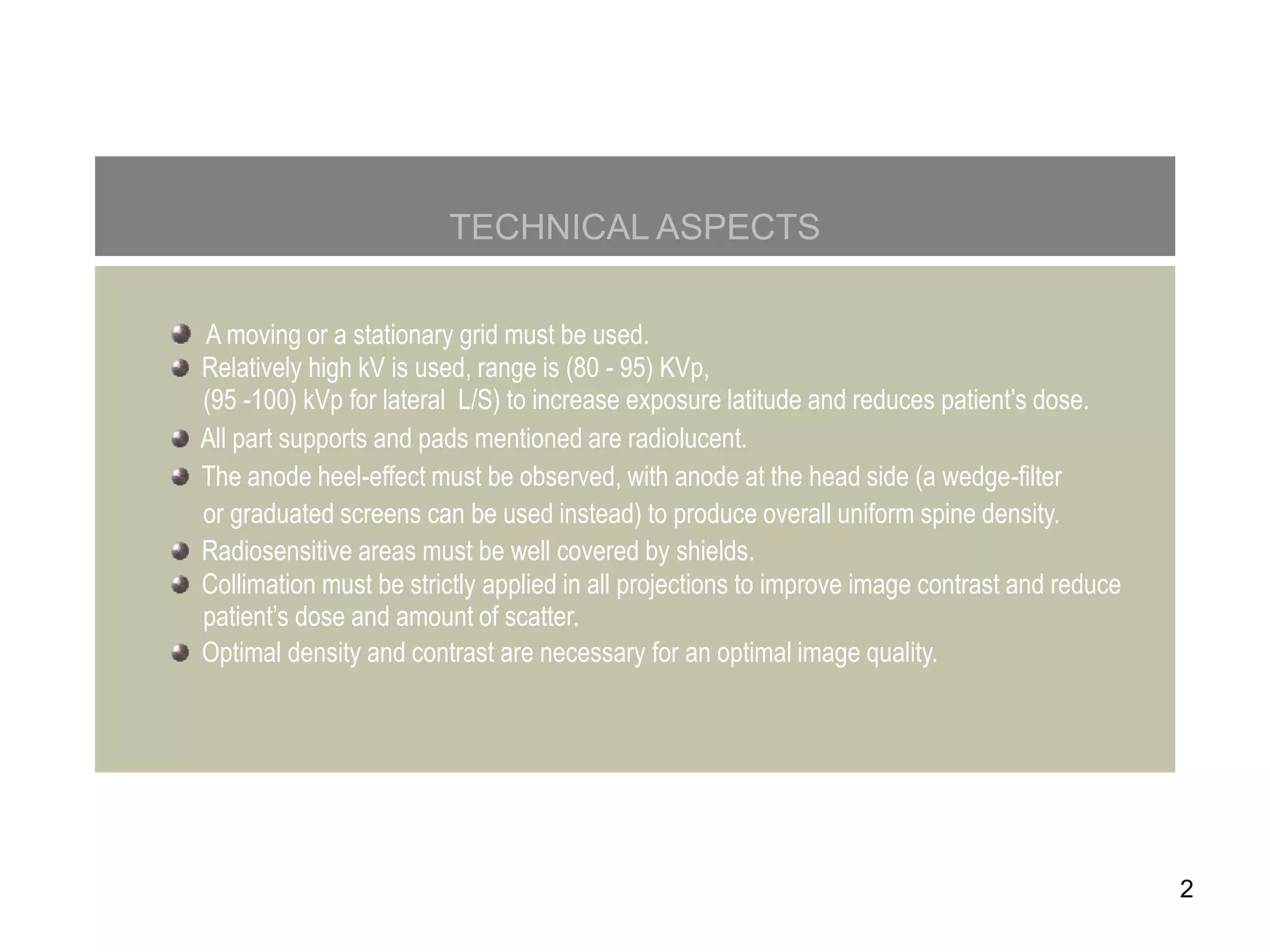
A moving or a stationary grid must be used.
Relatively high kV is used, range is (80 - 95) KVp,
(95 -100) kVp for lateral L/S) to increase exposure latitude and reduces patient’s dose.
All part supports and pads mentioned are radiolucent.
The anode heel-effect must be observed, with anode at the head side (a wedge-filter
or graduated screens can be used instead) to produce overall uniform spine density.
Radiosensitive areas must be well covered by shields.
Collimation must be strictly applied in all projections to improve image contrast and reduce
patient’s dose and amount of scatter.
Optimal density and contrast are necessary for an optimal image quality.
3
AP thoracic (dorsal) spine B
AP thoracic (dorsal spine): For #s and pathology (compression,
kyphosis, and subluxation).
Patient supine with head under anode side to observe to observe
the heel-effect, both knees and hips flexed and arms stretched by
the side. Exposure at end of arrested expiration to reduce volume
of air in thorax for more uniform density of whole dorsal vertebrae.
MSP: 90 to the film, MCP: parallel to film (no rotation).
Film: HD 35x43 cm, lengthwise.
CP: T7 ( 3 – 5 cm below the sternal angle, or 8 – 10 cm below
jugular notch) as for the PA chest.
CR: 90 Vertically to the thoracic spine
Layout and design by A Musa, Department of Radiological Sciences, Faculty of Applied Medical Sciences, King Saud University, Riyadh, Copyright  2003 A Musa
4
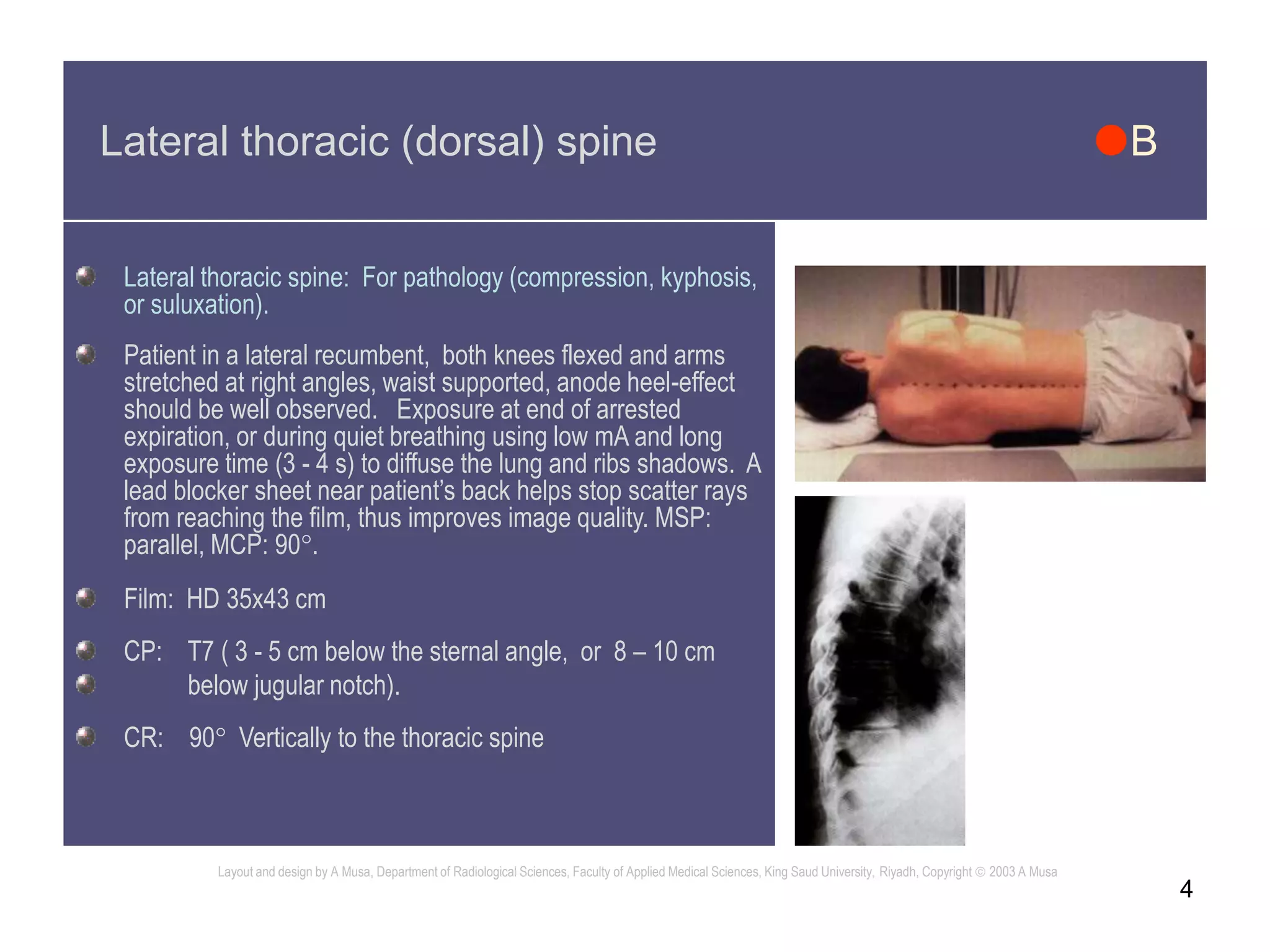
Lateral thoracic (dorsal) spine B
Lateral thoracic spine: For pathology (compression, kyphosis,
or suluxation).
Patient in a lateral recumbent, both knees flexed and arms
stretched at right angles, waist supported, anode heel-effect
should be well observed. Exposure at end of arrested
expiration, or during quiet breathing using low mA and long
exposure time (3 - 4 s) to diffuse the lung and ribs shadows. A
lead blocker sheet near patient’s back helps stop scatter rays
from reaching the film, thus improves image quality. MSP:
parallel, MCP: 90.
Film: HD 35x43 cm
CP: T7 ( 3 - 5 cm below the sternal angle, or 8 – 10 cm
below jugular notch).
CR: 90 Vertically to the thoracic spine
Layout and design by A Musa, Department of Radiological Sciences, Faculty of Applied Medical Sciences, King Saud University, Riyadh, Copyright  2003 A Musa
5
PAO (or APO) thoracic spine B
Zygapophyseal joints of the thoracic spine.
Patient in a lateral recumbent or in lateral erect, body rotated 20
from true lateral, arm nearest couch must be down, arm nearest
tube must be up and forward. Exposure at end of suspended
full expiration.
Film: HD 35x43 cm
CP: T7 ( 5 cm below the sternal angle, 8 – 10 cm below jugular
notch).
CR: 90 V/H to film center.
Layout and design by A Musa, Department of Radiological Sciences, Faculty of Applied Medical Sciences, King Saud University, Riyadh, Copyright  2003 A Musa
6
AP lumbar spine B
AP five lumbar vertebral bodies and intervertebral spaces,
spinous and transverse processes, S.I. joints and sacrum.
For #s, pathology (scoliosis and neoplastic processes of
the thoracic spine).
Patient supine or erect, knees flexed with soles of feet on
the couch top, arms at the sides or on the chest, exam can
be done in the erect position, a compression band is used
which will greatly improve contras, exposure must be
during a quiet breathing at low mA and long exposure time
to diffuse colonic gas shadows. Exposure at end of full
expiration.
Film: HD 35x43 cm
CP: Large film (35x43) cm: L4 – L5 (level of iliac crest).
Small film (30x24) cm: L3 (level of lower costal
margins).
CR: 90 V/H to film center.
Layout and design by A Musa, Department of Radiological Sciences, Faculty of Applied Medical Sciences, King Saud University, Riyadh, Copyright  2003 A Musa
7
Lateral Lumbar Spine B
Lateral lumbar vertebral bodies, spinous processes, L5 – S1
junction, and sacrum. Rules-out compression # of lumbar bodies.
Patient in a lateral recumbent, knees flexed, support between
knees and ankles, pad under the waist, a piece of lead rubber
behind the lumbar region on couch top to improve contrast (by
absorbing scatter). Exposure at end of arrested expiration.
Film: HD 35x43 cm
CP: Large film: L4 – L5 (level of iliac crest).
Small film: L3 (level f lower costal margins).
CR: 90 V to center of film
NB/ Lateral for trauma can be done with patient in (supine decubitus),
with same CP and horizontal beam.
Layout and design by A Musa, Department of Radiological Sciences, Faculty of Applied Medical Sciences, King Saud University, Riyadh, Copyright  2003 A Musa
8
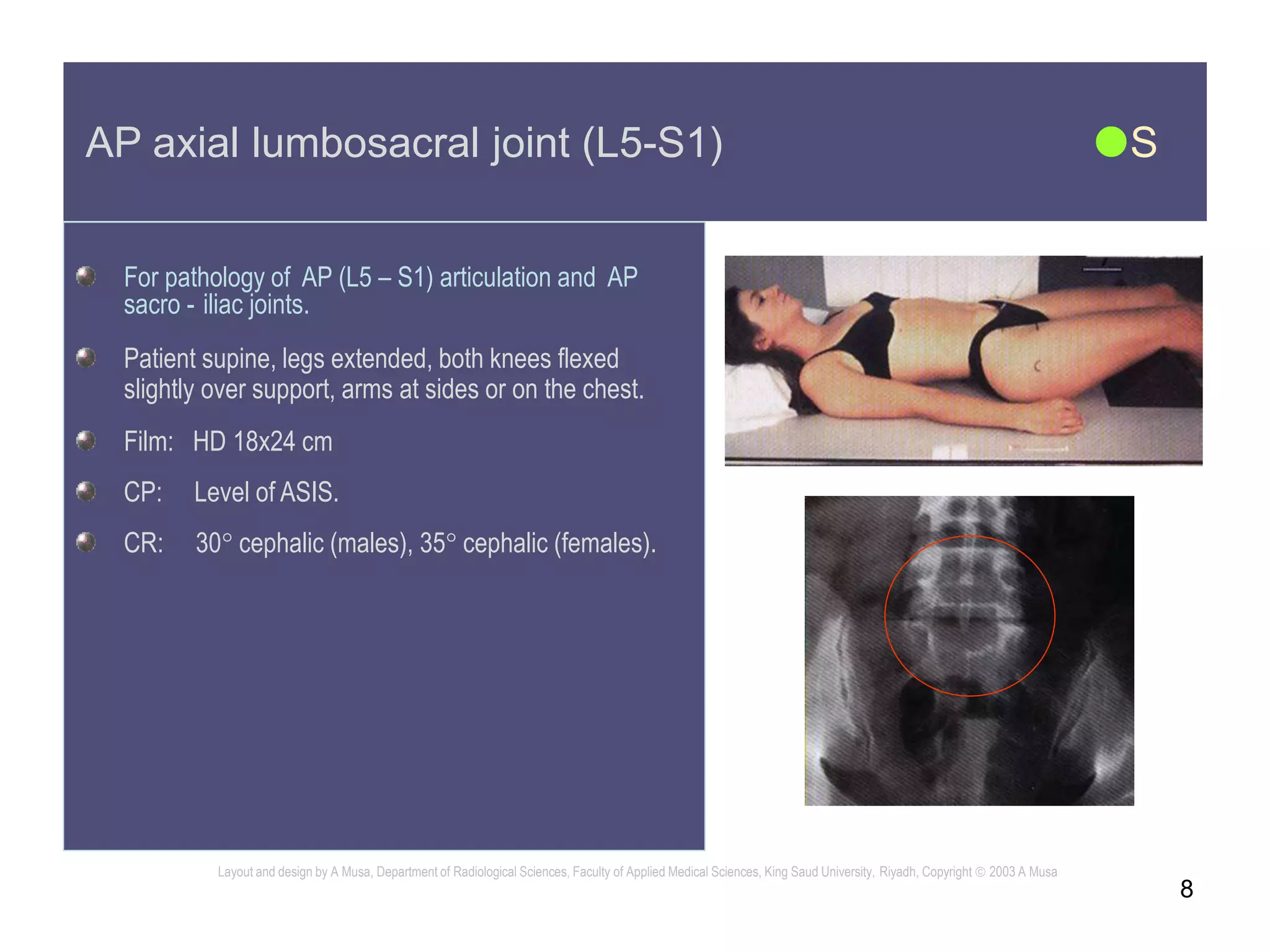
AP axial lumbosacral joint (L5-S1) S
For pathology of AP (L5 – S1) articulation and AP
sacro - iliac joints.
Patient supine, legs extended, both knees flexed
slightly over support, arms at sides or on the chest.
Film: HD 18x24 cm
CP: Level of ASIS.
CR: 30 cephalic (males), 35 cephalic (females).
Layout and design by A Musa, Department of Radiological Sciences, Faculty of Applied Medical Sciences, King Saud University, Riyadh, Copyright  2003 A Musa
9
Lateral lumbosacral spine (L5 – S1) B
For lat L5 – S1 joint space, and for spondylolisthesis or other
pathologies of L4 to L5, or L5 to S1
Patient in a lateral recumbent, the knees flexed, support
between knees and the ankles, pad under the waist, rubber
sheet behind the lumbar region.
Film: HD 18x24 cm
CP: 4 cm below iliac crest, 4 cm anterior to the posterior
surface of the body.
CR: 90 V to film center (with sufficient waist support), 8
caudal for waist (with no support).
NB/ Close collimation is necessary because of the high amount of
secondary radiation produced in this view.
Layout and design by A Musa, Department of Radiological Sciences, Faculty of Applied Medical Sciences, King Saud University, Riyadh, Copyright  2003 A Musa
10
AO lumbar spine B
For zygoapophyseal joints.
Patient semiprone (or semi-prone), body then rotated 45,
knee flexed, lower back supported with pads.
Film: HD 30x35 cm
CP: Level of 3 – 4 cm above level of iliac crest.
CR: 90 to film center
NB/ Semi-supine: 45 RPO (for R downside zygo. joints).
Semi-prone : 45 LAO (for L downside zygo. joints).
Layout and design by A Musa, Department of Radiological Sciences, Faculty of Applied Medical Sciences, King Saud University, Riyadh, Copyright  2003 A Musa
11
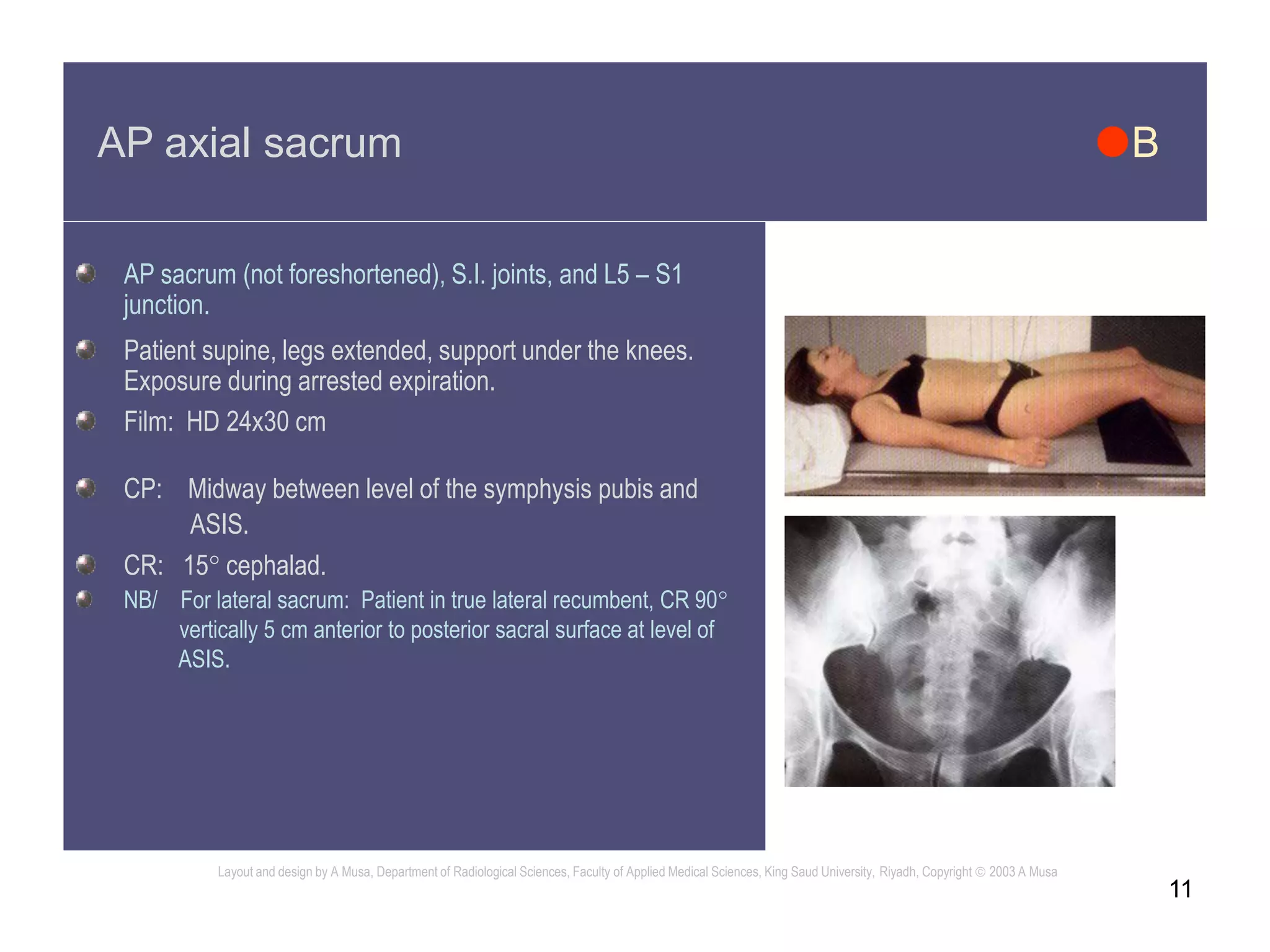
AP axial sacrum B
AP sacrum (not foreshortened), S.I. joints, and L5 – S1
junction.
Patient supine, legs extended, support under the knees.
Exposure during arrested expiration.
Film: HD 24x30 cm
CP: Midway between level of the symphysis pubis and
ASIS.
CR: 15 cephalad.
NB/ For lateral sacrum: Patient in true lateral recumbent, CR 90
vertically 5 cm anterior to posterior sacral surface at level of
ASIS.
Layout and design by A Musa, Department of Radiological Sciences, Faculty of Applied Medical Sciences, King Saud University, Riyadh, Copyright  2003 A Musa
12
AP axial coccyx B
For pathology of the coccyx. Urinary bladder should be
Emptied before this examination Cleansing enema must
Also be done to clean the colon of fecal material.
Patient supine, legs extended, support under the knees
Film: HD 24x30 cm
CP: 5 cm superior to the symphysis pubis.
CR: 10 caudad.
Layout and design by A Musa, Department of Radiological Sciences, Faculty of Applied Medical Sciences, King Saud University, Riyadh, Copyright  2003 A Musa
13
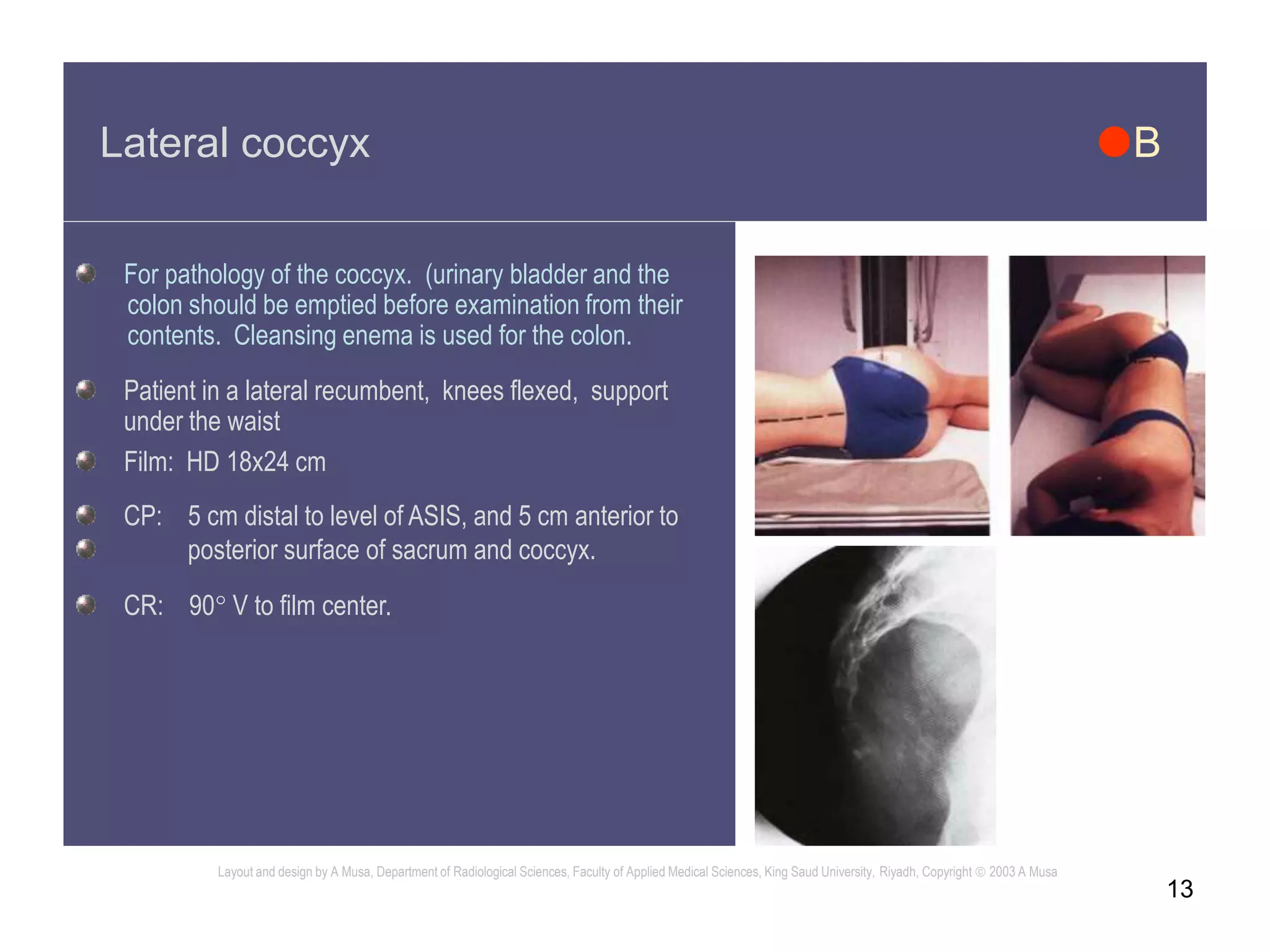
Lateral coccyx B
For pathology of the coccyx. (urinary bladder and the
colon should be emptied before examination from their
contents. Cleansing enema is used for the colon.
Patient in a lateral recumbent, knees flexed, support
under the waist
Film: HD 18x24 cm
CP: 5 cm distal to level of ASIS, and 5 cm anterior to
posterior surface of sacrum and coccyx.
CR: 90 V to film center.
Layout and design by A Musa, Department of Radiological Sciences, Faculty of Applied Medical Sciences, King Saud University, Riyadh, Copyright  2003 A Musa
14
TABLE 4 (Exposure Factors)
PROJECTION kVp mAs
AP Thoracic Spine 90 7
Lateral Thoracic Spine 80 50
AO Thoracic Spine 80 26
AP Lumbar Spine 80 15
AP Axial Lumbosacral Spine Joint (L5 – S1) 80 20
Lateral Lumbosacral Spine Joint (L5 – S1) 100 50
Lateral Lumbar Spine 90 65
AO Lumbar Spine 85 15
Layout and design by A Musa, Department of Radiological Sciences, Faculty of Applied Medical Sciences, King Saud University, Riyadh, Copyright  2003 A Musa
15
TABLE 4 (Exposure Factors)
PROJECTION kVp mAs
AP Axial Sacrum 80 15
AP Axial Coccyx 80 15
Lateral Coccyx 90 55
Layout and design by A Musa, Department of Radiological Sciences, Faculty of Applied Medical Sciences, King Saud University, Riyadh, Copyright  2003 A Musa

lumber spine radiography .ppt

  • 1.
    1 COURSE RAD331 Layout anddesign by A Musa, Department of Radiological Sciences, Faculty of Applied Medical Sciences, King Saud University, Riyadh, Copyright  2003 A Musa
  • 2.
    2 TECHNICAL ASPECTS A movingor a stationary grid must be used. Relatively high kV is used, range is (80 - 95) KVp, (95 -100) kVp for lateral L/S) to increase exposure latitude and reduces patient’s dose. All part supports and pads mentioned are radiolucent. The anode heel-effect must be observed, with anode at the head side (a wedge-filter or graduated screens can be used instead) to produce overall uniform spine density. Radiosensitive areas must be well covered by shields. Collimation must be strictly applied in all projections to improve image contrast and reduce patient’s dose and amount of scatter. Optimal density and contrast are necessary for an optimal image quality.
  • 3.
    3 AP thoracic (dorsal)spine B AP thoracic (dorsal spine): For #s and pathology (compression, kyphosis, and subluxation). Patient supine with head under anode side to observe to observe the heel-effect, both knees and hips flexed and arms stretched by the side. Exposure at end of arrested expiration to reduce volume of air in thorax for more uniform density of whole dorsal vertebrae. MSP: 90 to the film, MCP: parallel to film (no rotation). Film: HD 35x43 cm, lengthwise. CP: T7 ( 3 – 5 cm below the sternal angle, or 8 – 10 cm below jugular notch) as for the PA chest. CR: 90 Vertically to the thoracic spine Layout and design by A Musa, Department of Radiological Sciences, Faculty of Applied Medical Sciences, King Saud University, Riyadh, Copyright  2003 A Musa
  • 4.
    4 Lateral thoracic (dorsal)spine B Lateral thoracic spine: For pathology (compression, kyphosis, or suluxation). Patient in a lateral recumbent, both knees flexed and arms stretched at right angles, waist supported, anode heel-effect should be well observed. Exposure at end of arrested expiration, or during quiet breathing using low mA and long exposure time (3 - 4 s) to diffuse the lung and ribs shadows. A lead blocker sheet near patient’s back helps stop scatter rays from reaching the film, thus improves image quality. MSP: parallel, MCP: 90. Film: HD 35x43 cm CP: T7 ( 3 - 5 cm below the sternal angle, or 8 – 10 cm below jugular notch). CR: 90 Vertically to the thoracic spine Layout and design by A Musa, Department of Radiological Sciences, Faculty of Applied Medical Sciences, King Saud University, Riyadh, Copyright  2003 A Musa
  • 5.
    5 PAO (or APO)thoracic spine B Zygapophyseal joints of the thoracic spine. Patient in a lateral recumbent or in lateral erect, body rotated 20 from true lateral, arm nearest couch must be down, arm nearest tube must be up and forward. Exposure at end of suspended full expiration. Film: HD 35x43 cm CP: T7 ( 5 cm below the sternal angle, 8 – 10 cm below jugular notch). CR: 90 V/H to film center. Layout and design by A Musa, Department of Radiological Sciences, Faculty of Applied Medical Sciences, King Saud University, Riyadh, Copyright  2003 A Musa
  • 6.
    6 AP lumbar spineB AP five lumbar vertebral bodies and intervertebral spaces, spinous and transverse processes, S.I. joints and sacrum. For #s, pathology (scoliosis and neoplastic processes of the thoracic spine). Patient supine or erect, knees flexed with soles of feet on the couch top, arms at the sides or on the chest, exam can be done in the erect position, a compression band is used which will greatly improve contras, exposure must be during a quiet breathing at low mA and long exposure time to diffuse colonic gas shadows. Exposure at end of full expiration. Film: HD 35x43 cm CP: Large film (35x43) cm: L4 – L5 (level of iliac crest). Small film (30x24) cm: L3 (level of lower costal margins). CR: 90 V/H to film center. Layout and design by A Musa, Department of Radiological Sciences, Faculty of Applied Medical Sciences, King Saud University, Riyadh, Copyright  2003 A Musa
  • 7.
    7 Lateral Lumbar SpineB Lateral lumbar vertebral bodies, spinous processes, L5 – S1 junction, and sacrum. Rules-out compression # of lumbar bodies. Patient in a lateral recumbent, knees flexed, support between knees and ankles, pad under the waist, a piece of lead rubber behind the lumbar region on couch top to improve contrast (by absorbing scatter). Exposure at end of arrested expiration. Film: HD 35x43 cm CP: Large film: L4 – L5 (level of iliac crest). Small film: L3 (level f lower costal margins). CR: 90 V to center of film NB/ Lateral for trauma can be done with patient in (supine decubitus), with same CP and horizontal beam. Layout and design by A Musa, Department of Radiological Sciences, Faculty of Applied Medical Sciences, King Saud University, Riyadh, Copyright  2003 A Musa
  • 8.
    8 AP axial lumbosacraljoint (L5-S1) S For pathology of AP (L5 – S1) articulation and AP sacro - iliac joints. Patient supine, legs extended, both knees flexed slightly over support, arms at sides or on the chest. Film: HD 18x24 cm CP: Level of ASIS. CR: 30 cephalic (males), 35 cephalic (females). Layout and design by A Musa, Department of Radiological Sciences, Faculty of Applied Medical Sciences, King Saud University, Riyadh, Copyright  2003 A Musa
  • 9.
    9 Lateral lumbosacral spine(L5 – S1) B For lat L5 – S1 joint space, and for spondylolisthesis or other pathologies of L4 to L5, or L5 to S1 Patient in a lateral recumbent, the knees flexed, support between knees and the ankles, pad under the waist, rubber sheet behind the lumbar region. Film: HD 18x24 cm CP: 4 cm below iliac crest, 4 cm anterior to the posterior surface of the body. CR: 90 V to film center (with sufficient waist support), 8 caudal for waist (with no support). NB/ Close collimation is necessary because of the high amount of secondary radiation produced in this view. Layout and design by A Musa, Department of Radiological Sciences, Faculty of Applied Medical Sciences, King Saud University, Riyadh, Copyright  2003 A Musa
  • 10.
    10 AO lumbar spineB For zygoapophyseal joints. Patient semiprone (or semi-prone), body then rotated 45, knee flexed, lower back supported with pads. Film: HD 30x35 cm CP: Level of 3 – 4 cm above level of iliac crest. CR: 90 to film center NB/ Semi-supine: 45 RPO (for R downside zygo. joints). Semi-prone : 45 LAO (for L downside zygo. joints). Layout and design by A Musa, Department of Radiological Sciences, Faculty of Applied Medical Sciences, King Saud University, Riyadh, Copyright  2003 A Musa
  • 11.
    11 AP axial sacrumB AP sacrum (not foreshortened), S.I. joints, and L5 – S1 junction. Patient supine, legs extended, support under the knees. Exposure during arrested expiration. Film: HD 24x30 cm CP: Midway between level of the symphysis pubis and ASIS. CR: 15 cephalad. NB/ For lateral sacrum: Patient in true lateral recumbent, CR 90 vertically 5 cm anterior to posterior sacral surface at level of ASIS. Layout and design by A Musa, Department of Radiological Sciences, Faculty of Applied Medical Sciences, King Saud University, Riyadh, Copyright  2003 A Musa
  • 12.
    12 AP axial coccyxB For pathology of the coccyx. Urinary bladder should be Emptied before this examination Cleansing enema must Also be done to clean the colon of fecal material. Patient supine, legs extended, support under the knees Film: HD 24x30 cm CP: 5 cm superior to the symphysis pubis. CR: 10 caudad. Layout and design by A Musa, Department of Radiological Sciences, Faculty of Applied Medical Sciences, King Saud University, Riyadh, Copyright  2003 A Musa
  • 13.
    13 Lateral coccyx B Forpathology of the coccyx. (urinary bladder and the colon should be emptied before examination from their contents. Cleansing enema is used for the colon. Patient in a lateral recumbent, knees flexed, support under the waist Film: HD 18x24 cm CP: 5 cm distal to level of ASIS, and 5 cm anterior to posterior surface of sacrum and coccyx. CR: 90 V to film center. Layout and design by A Musa, Department of Radiological Sciences, Faculty of Applied Medical Sciences, King Saud University, Riyadh, Copyright  2003 A Musa
  • 14.
    14 TABLE 4 (ExposureFactors) PROJECTION kVp mAs AP Thoracic Spine 90 7 Lateral Thoracic Spine 80 50 AO Thoracic Spine 80 26 AP Lumbar Spine 80 15 AP Axial Lumbosacral Spine Joint (L5 – S1) 80 20 Lateral Lumbosacral Spine Joint (L5 – S1) 100 50 Lateral Lumbar Spine 90 65 AO Lumbar Spine 85 15 Layout and design by A Musa, Department of Radiological Sciences, Faculty of Applied Medical Sciences, King Saud University, Riyadh, Copyright  2003 A Musa
  • 15.
    15 TABLE 4 (ExposureFactors) PROJECTION kVp mAs AP Axial Sacrum 80 15 AP Axial Coccyx 80 15 Lateral Coccyx 90 55 Layout and design by A Musa, Department of Radiological Sciences, Faculty of Applied Medical Sciences, King Saud University, Riyadh, Copyright  2003 A Musa