Strategic Management Communication for Leaders 3rd Edition Walker Solutions Manual
Strategic Management Communication for Leaders 3rd Edition Walker Solutions Manual
Strategic Management Communication for Leaders 3rd Edition Walker Solutions Manual
Strategic Management Communication for Leaders 3rd Edition Walker Solutions Manual
Strategic Management Communication for Leaders 3rd Edition Walker Solutions Manual
1.
Download Reliable StudyMaterials and full Test Banks at testbankmall.com
Strategic Management Communication for Leaders 3rd
Edition Walker Solutions Manual
https://testbankmall.com/product/strategic-management-
communication-for-leaders-3rd-edition-walker-solutions-
manual/
OR CLICK HERE
DOWLOAD NOW
Visit now to discover comprehensive Test Banks for All Subjects at testbankmall.com
2.
Instant digital products(PDF, ePub, MOBI) ready for you
Download now and discover formats that fit your needs...
Start reading on any device today!
Test Bank for Business Communication: Developing Leaders
for a Networked World, 3rd Edition, Peter Cardon
https://testbankmall.com/product/test-bank-for-business-communication-
developing-leaders-for-a-networked-world-3rd-edition-peter-cardon/
testbankmall.com
Solution Manual for Strategic Management 3rd Edition
https://testbankmall.com/product/solution-manual-for-strategic-
management-3rd-edition/
testbankmall.com
Strategic Management 2nd Edition Rothaermel Solutions
Manual
https://testbankmall.com/product/strategic-management-2nd-edition-
rothaermel-solutions-manual/
testbankmall.com
Strategic Management Pearce 14th Edition Solutions Manual
https://testbankmall.com/product/strategic-management-pearce-14th-
edition-solutions-manual/
testbankmall.com
3.
Solution Manual forEssentials of Strategic Management,
3rd Edition
https://testbankmall.com/product/solution-manual-for-essentials-of-
strategic-management-3rd-edition/
testbankmall.com
Strategic Management 3rd Edition Rothaermel Test Bank
https://testbankmall.com/product/strategic-management-3rd-edition-
rothaermel-test-bank/
testbankmall.com
Strategic Management Concepts and Cases 1st Edition Dyer
Solutions Manual
https://testbankmall.com/product/strategic-management-concepts-and-
cases-1st-edition-dyer-solutions-manual/
testbankmall.com
Strategic Management Concepts and Cases David 13th Edition
Solutions Manual
https://testbankmall.com/product/strategic-management-concepts-and-
cases-david-13th-edition-solutions-manual/
testbankmall.com
Strategic Management Text and Cases 8th Edition Dess
Solutions Manual
https://testbankmall.com/product/strategic-management-text-and-
cases-8th-edition-dess-solutions-manual/
testbankmall.com
Notes:
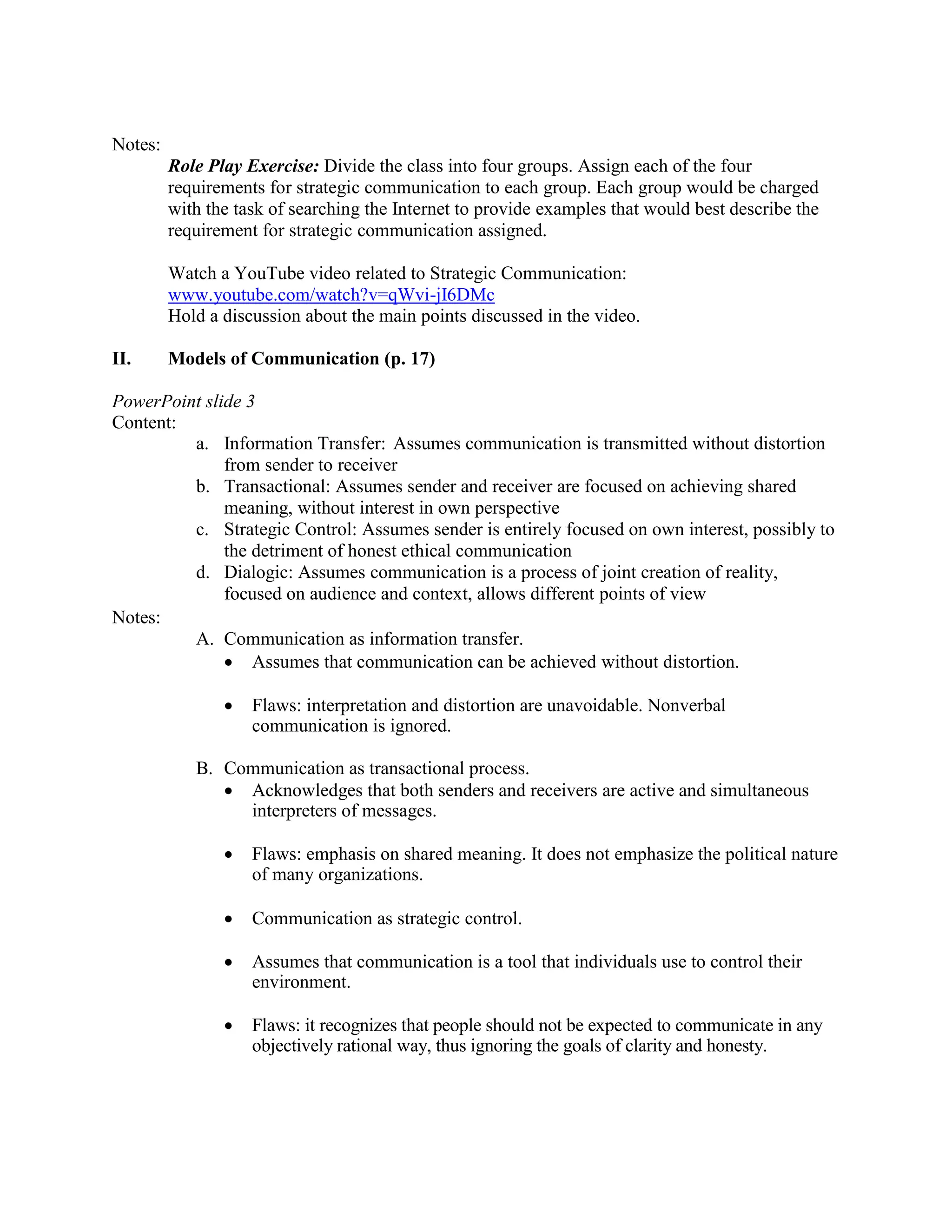
Role Play Exercise:Divide the class into four groups. Assign each of the four
requirements for strategic communication to each group. Each group would be charged
with the task of searching the Internet to provide examples that would best describe the
requirement for strategic communication assigned.
Watch a YouTube video related to Strategic Communication:
www.youtube.com/watch?v=qWvi-jI6DMc
Hold a discussion about the main points discussed in the video.
II. Models of Communication (p. 17)
PowerPoint slide 3
Content:
a. Information Transfer: Assumes communication is transmitted without distortion
from sender to receiver
b. Transactional: Assumes sender and receiver are focused on achieving shared
meaning, without interest in own perspective
c. Strategic Control: Assumes sender is entirely focused on own interest, possibly to
the detriment of honest ethical communication
d. Dialogic: Assumes communication is a process of joint creation of reality,
focused on audience and context, allows different points of view
Notes:
A. Communication as information transfer.
• Assumes that communication can be achieved without distortion.
• Flaws: interpretation and distortion are unavoidable. Nonverbal
communication is ignored.
B. Communication as transactional process.
• Acknowledges that both senders and receivers are active and simultaneous
interpreters of messages.
• Flaws: emphasis on shared meaning. It does not emphasize the political nature
of many organizations.
• Communication as strategic control.
• Assumes that communication is a tool that individuals use to control their
environment.
• Flaws: it recognizes that people should not be expected to communicate in any
objectively rational way, thus ignoring the goals of clarity and honesty.
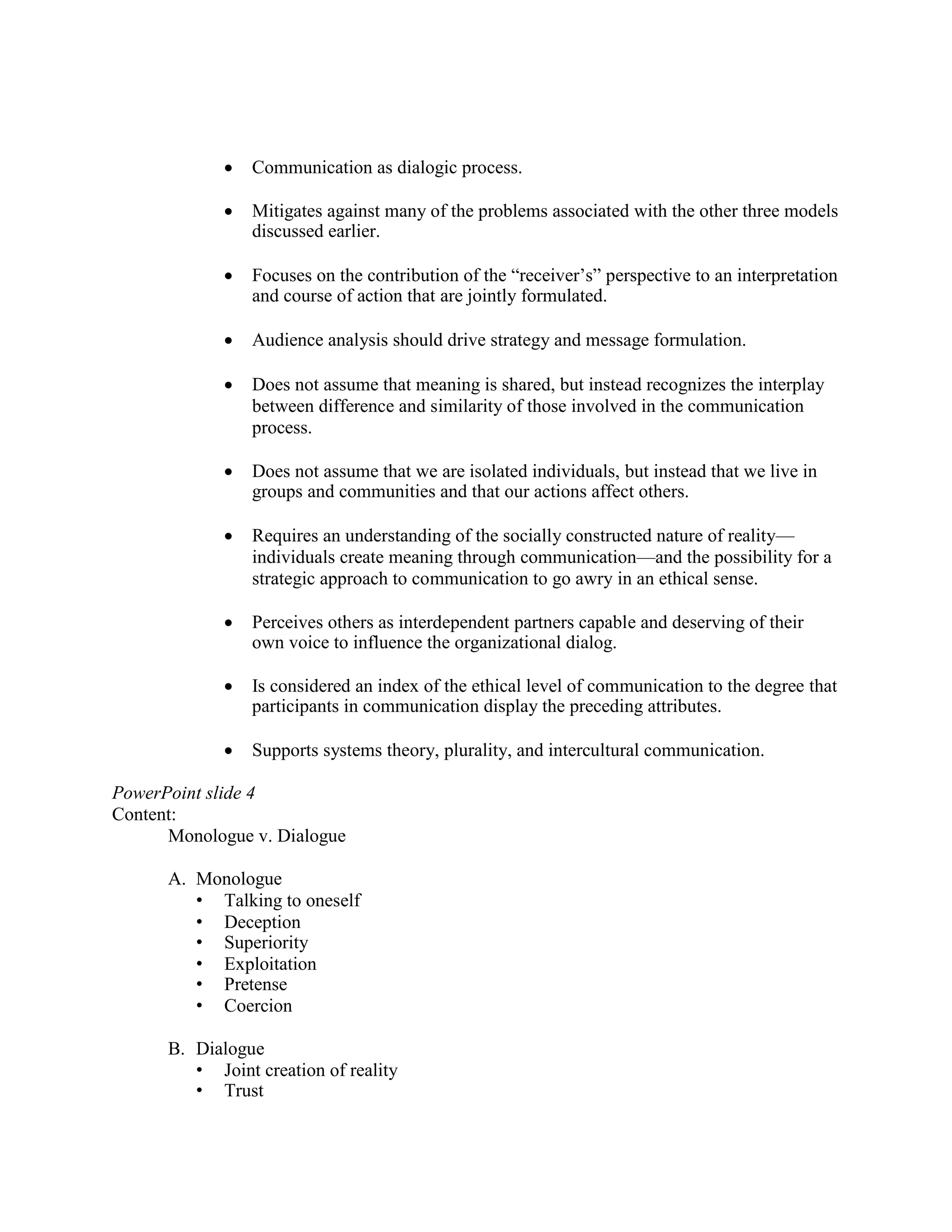
7.
• Communication asdialogic process.
• Mitigates against many of the problems associated with the other three models
discussed earlier.
• Focuses on the contribution of the “receiver’s” perspective to an interpretation
and course of action that are jointly formulated.
• Audience analysis should drive strategy and message formulation.
• Does not assume that meaning is shared, but instead recognizes the interplay
between difference and similarity of those involved in the communication
process.
• Does not assume that we are isolated individuals, but instead that we live in
groups and communities and that our actions affect others.
• Requires an understanding of the socially constructed nature of reality—
individuals create meaning through communication—and the possibility for a
strategic approach to communication to go awry in an ethical sense.
• Perceives others as interdependent partners capable and deserving of their
own voice to influence the organizational dialog.
• Is considered an index of the ethical level of communication to the degree that
participants in communication display the preceding attributes.
• Supports systems theory, plurality, and intercultural communication.
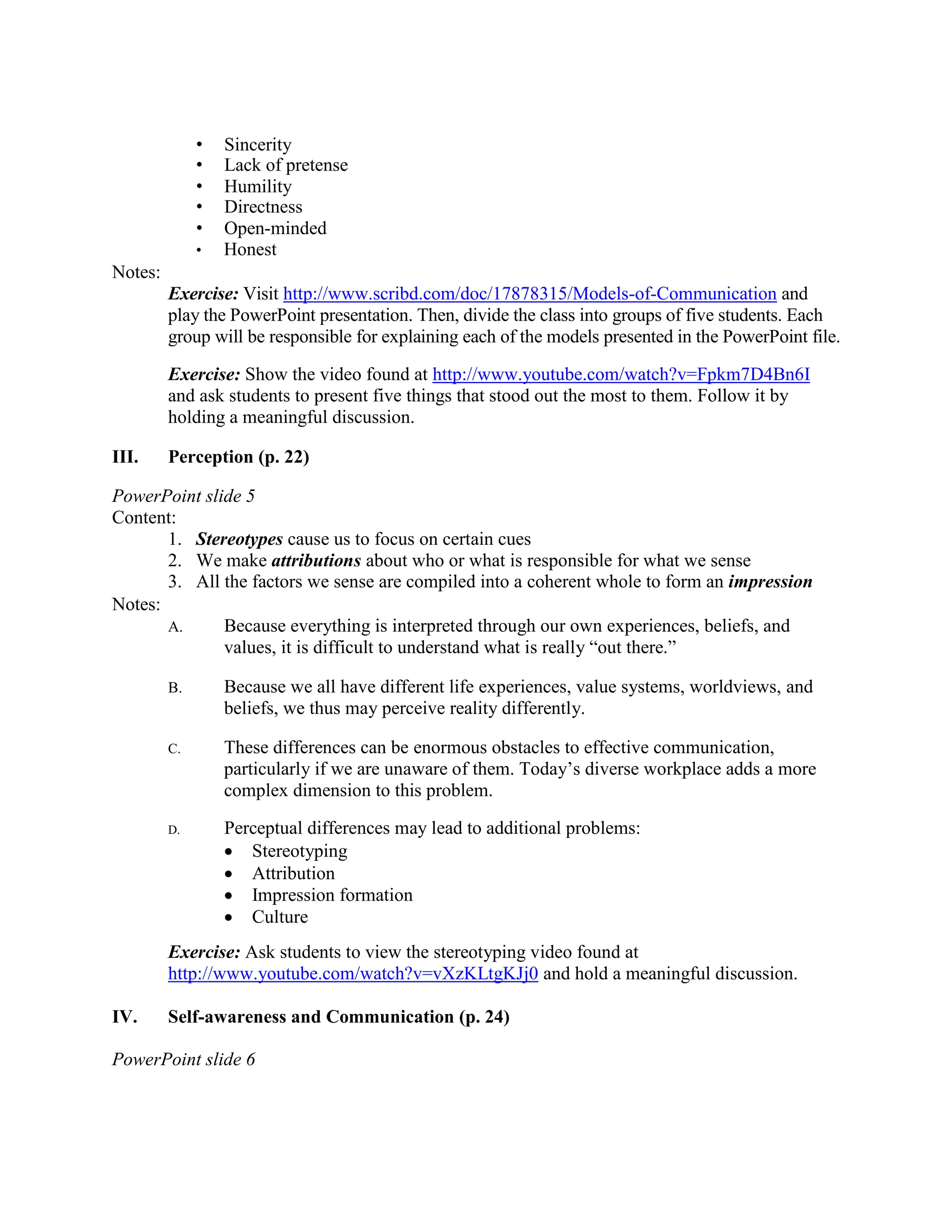
PowerPoint slide 4
Content:
Monologue v. Dialogue
A. Monologue
• Talking to oneself
• Deception
• Superiority
• Exploitation
• Pretense
• Coercion
B. Dialogue
• Joint creation of reality
• Trust
8.
• Sincerity
• Lackof pretense
• Humility
• Directness
• Open-minded
• Honest
Notes:
Exercise: Visit http://www.scribd.com/doc/17878315/Models-of-Communication and
play the PowerPoint presentation. Then, divide the class into groups of five students. Each
group will be responsible for explaining each of the models presented in the PowerPoint file.
Exercise: Show the video found at http://www.youtube.com/watch?v=Fpkm7D4Bn6I
and ask students to present five things that stood out the most to them. Follow it by
holding a meaningful discussion.
III. Perception (p. 22)
PowerPoint slide 5
Content:
1. Stereotypes cause us to focus on certain cues
2. We make attributions about who or what is responsible for what we sense
3. All the factors we sense are compiled into a coherent whole to form an impression
Notes:
A. Because everything is interpreted through our own experiences, beliefs, and
values, it is difficult to understand what is really “out there.”
B. Because we all have different life experiences, value systems, worldviews, and
beliefs, we thus may perceive reality differently.
C. These differences can be enormous obstacles to effective communication,
particularly if we are unaware of them. Today’s diverse workplace adds a more
complex dimension to this problem.
D. Perceptual differences may lead to additional problems:
• Stereotyping
• Attribution
• Impression formation
• Culture
Exercise: Ask students to view the stereotyping video found at
http://www.youtube.com/watch?v=vXzKLtgKJj0 and hold a meaningful discussion.
IV. Self-awareness and Communication (p. 24)
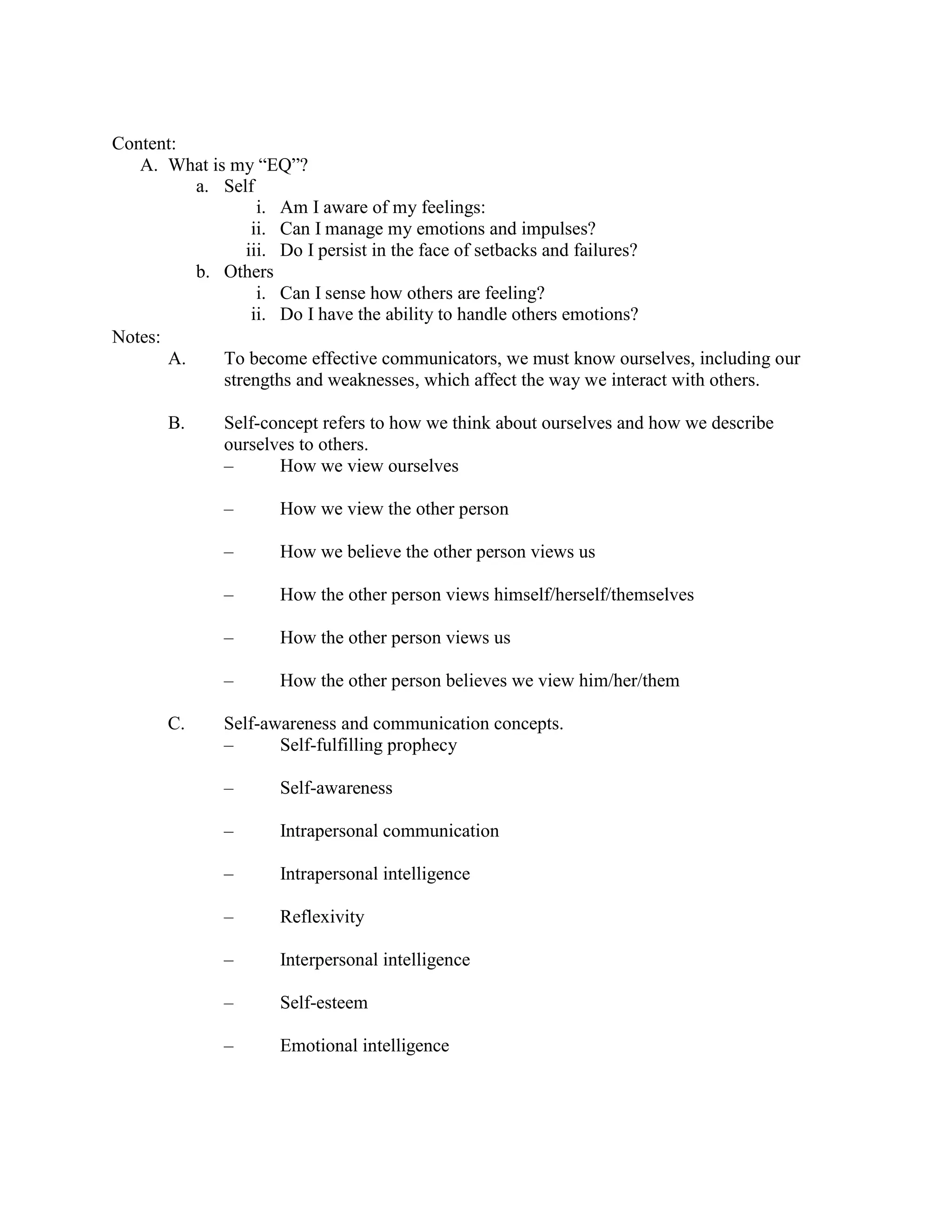
PowerPoint slide 6
9.
Content:
A. What ismy “EQ”?
a. Self
i. Am I aware of my feelings:
ii. Can I manage my emotions and impulses?
iii. Do I persist in the face of setbacks and failures?
b. Others
i. Can I sense how others are feeling?
ii. Do I have the ability to handle others emotions?
Notes:
A. To become effective communicators, we must know ourselves, including our
strengths and weaknesses, which affect the way we interact with others.
B. Self-concept refers to how we think about ourselves and how we describe
ourselves to others.
– How we view ourselves
– How we view the other person
– How we believe the other person views us
– How the other person views himself/herself/themselves
– How the other person views us
– How the other person believes we view him/her/them
C. Self-awareness and communication concepts.
– Self-fulfilling prophecy
– Self-awareness
– Intrapersonal communication
– Intrapersonal intelligence
– Reflexivity
– Interpersonal intelligence
– Self-esteem
– Emotional intelligence
10.
Exercise: Show thevideo found at http://www.youtube.com/watch?v=Pfp_ti1NQZ8 and
hold a meaningful discussion.
V. Obstacles to Strategic Communication (p. 28)
PowerPoint slide 7
Content:
Obstacles to Strategic and Ethical Communication
1. Perceptual mindset
2. Inferential Errors
3. Thinking Style
Notes:
A. Perceptual mindsets.
– Confirmation bias
– False dichotomies
– Inferential errors
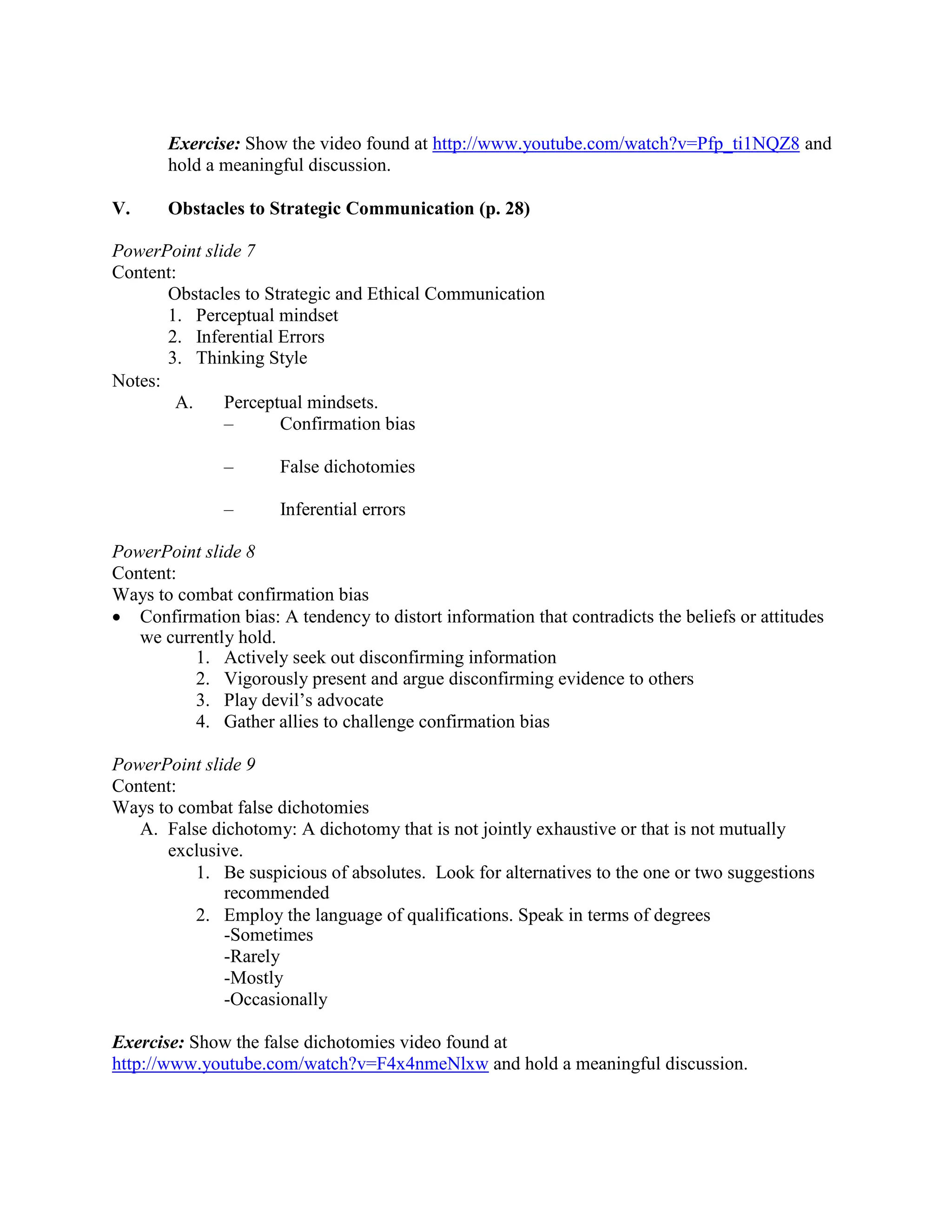
PowerPoint slide 8
Content:
Ways to combat confirmation bias
• Confirmation bias: A tendency to distort information that contradicts the beliefs or attitudes
we currently hold.
1. Actively seek out disconfirming information
2. Vigorously present and argue disconfirming evidence to others
3. Play devil’s advocate
4. Gather allies to challenge confirmation bias
PowerPoint slide 9
Content:
Ways to combat false dichotomies
A. False dichotomy: A dichotomy that is not jointly exhaustive or that is not mutually
exclusive.
Be suspicious of absolutes. Look for alternatives to the one or two suggestions
recommended
Employ the language of qualifications. Speak in terms of degrees
-Sometimes
-Rarely
-Mostly
-Occasionally
Exercise: Show the false dichotomies video found at
http://www.youtube.com/watch?v=F4x4nmeNlxw and hold a meaningful discussion.
11.
PowerPoint slide 10
Content:
Whatcauses inferential errors?
▪ Vividness: “I heard about a terrible tragedy that happened to someone who did
that…”
▪ Unrepresentativeness: “That restaurant is no good, I went there one time and I
didn’t like it…”
▪ Correlation: “Every time I’ve gotten sick, I was wearing these shoes…”
PowerPoint slide 11
Content:
Other perceptual errors
• Oversimplifying: Tendency to prefer simplicity over complexity because it is less
effort
• Imposing consistency: Tendency to impose patterns where they don’t exist
• Focusing on the negative: Tendency to perceive negative characteristics as more
important than positive
• Making a fundamental attribution error: Tendency to assume that others’ failures
are their own fault, but that success is due to situational factors
• Exhibiting a self-serving bias: Tendency to assume that our own failures are due
to situational factors, but our success is due to our personal qualities
Thinking styles
–
▪
Sponge:
Indiscriminant absorption of information
▪
▪
Passive
No method for deciding usefulness
–
▪
Filter:
Critical absorption of relevant information
▪ Active processing
▪ Ask questions of material to determine usefulness
ANSWERS TO CHAPTER DISCUSSION QUESTIONS
1. Explain each of the four models of communication and what distinguishes them,
including their strengths and weaknesses. Why might the dialogic model better meet
the needs of today’s workplace?
A. Communication as information transfer.
12.
• Assumes thatcommunication can be achieved without distortion.
• Flaws: interpretation and distortion are unavoidable. Nonverbal
communication is ignored.
B. Communication as transactional process.
• Acknowledges that both senders and receivers are active and simultaneous
interpreters of messages.
• Flaws: emphasis on shared meaning. It does not emphasize the political
nature of many organizations.
C. Communication as strategic control.
• Assumes that communication is a tool that individuals use to control their
environment.
• Flaws: it recognizes that people should not be expected to communicate in
any objectively rational way, thus ignoring the goals of clarity and honesty.
D. Communication as dialogic process.
• Mitigates against many of the problems associated with the other three
models discussed earlier.
• Focuses on the contribution of the “receiver’s” perspective to an
interpretation and course of action that are jointly formulated.
• Audience analysis should drive strategy and message formulation.
• Does not assume that meaning is shared, but instead recognizes the
interplay between difference and similarity of those involved in the
communication process.
• Does not assume that we are isolated individuals, but instead that we live
in groups and communities and that our actions affect others.
• Requires an understanding of the socially constructed nature of reality—
individuals create meaning through communication—and the possibility
for a strategic approach to communication to go awry in an ethical sense.
• Perceives others as interdependent partners capable and deserving of their
own voice to influence the organizational dialog.
• Is considered an index of the ethical level of communication to the degree
that participants in communication display the preceding attributes.
• Supports systems theory, plurality, and intercultural communication.
13.
The dialogic modelbetter meets the needs of today’s workplace because of its numerous
advantages discussed above. In short, it mitigates against many of the problems
associated with the other three models.
Tags:
BUSPROG: Communication | Diversity
DISC: Stakeholders | Conclusion
LO: 2-1 | 2-4
Bloom’s: Evaluation
Difficulty: Difficult
Topic: A-Head: Models of Communication
2. Identify examples of the use of moral exclusion and describe the intent and effect of
their use. Based on this analysis, discuss whether such practices are ethical. Support
your response with evidence.
Moral exclusion occurs when the application of moral values, rules, and fairness is not
considered necessary for particular individuals or groups. The practice of moral exclusion
results in individuals being perceived as nonentities, expendable, or undeserving. The
result is that harming such individuals becomes acceptable, appropriate, or just.
Persons who are morally excluded are thus denied their rights, dignity, and autonomy.
Examples include showing the superiority of oneself or one’s group by making unflattering
comparisons to other individuals or groups; characterizing people as lower life forms or as
inferior beings; placing the blame for any harm on the victim; justifying harmful acts by
claiming that the morally condemnable acts committed by “the enemy” are worse;
misrepresenting harmful behaviors by masking or conferring respectability on them through
the use of neutral, positive, technical, or euphemistic terms to describe them; and justifying
harmful behavior by claiming that everyone is doing it or that is an isolated case.
Tags:
BUSPROG: Ethics
DISC: Conclusion
LO: 2-4
Bloom’s: Analysis
Difficulty: Moderate
Topic: A-Head: Models of Communication
3. How have differing perceptions affected your communication with others? What
steps might you take to avoid misunderstandings created by perceptual differences?
A. Because everything is interpreted through our own experiences, beliefs, and
values, it is difficult to understand what is really “out there.”
14.
B. Because weall have different life experiences, value systems, worldviews, and
beliefs, we thus may perceive reality differently.
C. These differences can be enormous obstacles to effective communication,
particularly if we are unaware of them. Today’s diverse workplace adds a more
complex dimension to this problem.
D. Perceptual differences may lead to additional problems:
• Stereotyping: can be a label for making sense out of what we perceive by
categorizing or generalizing about it or it can be an oversimplified way of
labeling people with the intention of denigrating them in some way.
• Attribution: the assignment of meaning to other people’s behavior.
• Impression formation: process of integrating a variety of observations about a
person into a coherent impression of that person.
• Culture: the totality of what is learned by individuals as members of a society
and shared by others of that society. It is a way of life, a mode of acting,
feeling, and thinking.
To avoid misunderstandings, we must recognize the contested perceptual nature of reality
and our interpretation of it. It thus requires openness to others’ views and opinions, if we
are to communicate effectively to reach anything approaching shared meaning.
Tags:
BUSPROG: Analytic
DISC: Conclusion | Consequences
LO: 2-2
Bloom’s: Application
Difficulty: Moderate
Topic: A-Head: Perception
4. What are three different errors that may occur due to our perceptual mindsets?
How might these be avoided?
Perceptual mindsets lead to the following errors:
– Confirmation bias
– False dichotomies
– Inferential errors
• Vividness
• Unrepresentativeness
• Correlation
15.
– Other perceptualerrors
• Oversimplifying
• Imposing consistency
• Focusing on the negative
• Making a fundamental attribution error
• Exhibiting a self-serving bias
To avoid these errors, we must become critical thinkers. Critical thinking is discussed
below.
Critical Thinking:
In the past, the focus on feelings went too far. The result is the neglect of thinking. We
must answer that neglect. Students must be taught how to sort out their feelings, decide to
what extent their feelings have been shaped by external influences, and evaluate them
carefully when those feelings conflict among themselves or with the feelings of others. In
short, students must be taught to think critically.
Feeling and thought are complementary. Feeling is an excellent beginning to the
development of a conclusion. Thought provides a way to identify the best and most
appropriate feeling. Students must acquire the intellectual skills necessary to solve the
challenging problems of today and tomorrow.
The critical thinking strategy may be summarized as follows:
1. Knows oneself and remains mindful of the ways in which own habits of mind
undermine own treatment of issues.
2. Is observant and reflects on what is seen and heard.
3. When an issue is identified, clarification is sought by listing its subheadings and
raising probing questions about each.
4. Conducts a thorough inquiry, obtaining all relevant facts and informed opinions.
5. Evaluates own findings, and then forms and expresses own judgment.
Generic guide for facilitating critical thinking:
A. What do I think about this matter?
B. What line of reasoning led me to that conclusion?
C. What evidence supports my position?
D. Can I give an example?
E. How typical is that example?
F. In what way does my experience support or challenge my idea?
G. What additional information can help me reach a conclusion? Where can I find
that information?
H. What objections could be raised to my idea?
I. Are any of these objections wholly or partially valid? Explain.
J. What other views of this issue are possible? Which of those is most reasonable?
16.
Ruggiero, V. (1998).Beyond feelings. A guide to critical thinking. Mountain View, CA:
Mayfield Publishing Company.
Tags:
BUSPROG: Analytic
DISC: Conclusion
LO: 2-4
Bloom’s: Application
Difficulty: Moderate
Topic: A-Head: Obstacles to Strategic and Ethical Communication
5. What are some examples of black-and-white, or dichotomous, thinking from recent
news reports or opinion columns you have seen or read? What other possibilities
may exist to broaden the views or options presented in these reports?
Student responses should discuss how dichotomous thinking is basically the tendency to
see the world in terms of “either-or.” Such thinking is typically false because there are
almost always more than two possibilities in our complex world. This tendency creates a
false dichotomy, which blinds people to other possibilities.
To avoid the pitfalls of false dichotomies, individuals should:
A. Be suspicious of absolutes. Look for alternatives to the one or two suggestions
recommended.
B. Employ the language of qualifications. Speak in terms of degrees by using such
terms as sometimes, rarely, occasionally, mostly, usually, and moderately.
Tags:
BUSPROG: Analytic
DISC: Conclusion
LO: 2-4
Bloom’s: Application
Difficulty: Moderate
Topic: A-Head: Obstacles to Strategic and Ethical Communication
6. What are the benefits of thinking critically?
Critical thinking is an important skill with many benefits. Critical thinkers communicate
ethically to the extent that their acknowledgement of multiple possible hypotheses or
sources of information allows them to communicate a position honestly and clearly. In
addition, being a critical thinker allows individuals to learn to deal with ambiguity and
appreciate the complexity of our world. Finally, thinking critically can help an individual
gather better information, and ultimately make better decisions. This skill results in
increased credibility for the critical thinker.
17.
Tags:
BUSPROG: Analytic
DISC: Conclusion| Consequences
LO: 2-4
Bloom’s: Comprehension
Difficulty: Moderate
Topic: A-Head: Obstacles to Strategic and Ethical Communication
APPLICATIONS
1. Use a SWOT (strengths, weaknesses, opportunities, and threats) analysis to
determine your career goals. This is an exercise in analysis, evaluation, and
ultimately, strategic thinking. First, identify the opportunities available to you and
the possible risks; second, identify your strengths and weaknesses; third, identify
the resources available to you to attain these opportunities; and fourth, match the
opportunities available to you with those that are attainable. From this analysis
should emerge an attainable career goal. It should also help you identify personal
characteristics that you may leverage in a career search as well as those liabilities
that you may set goals to eliminate or reduce.
Student responses should include a thorough SWOT analysis to identify the opportunities
ßavailable to them and the possible risks; identify their strengths and weaknesses;
identify the resources available to them to attain these opportunities; and match the
opportunities available to them with those that are attainable. The end result should be the
establishment of an attainable career goal and a better understanding of themselves.
Tags:
BUSPROG: Analytic
DISC: Conclusion
LO: 2-3
Bloom’s: Analysis
Difficulty: Moderate
Topic: A-Head: Self-Awareness and Communication
2. Using the Internet, search for free online self-assessments of emotional intelligence,
locus of control, leadership traits, and self-monitoring. One place to start is at
www.queendom.com. After completing the assessments and reading the results,
summarize them and then write three goals for self-improvement for each
personality measure, including your plan for achieving each of them.
Student responses should include a summary of the results of completing the assessments
and a statement related to three goals for self-improvement, including their plan for
achieving such goals.
Tags:
18.
BUSPROG: Analytic
DISC: Conclusion
LO:2-3
Bloom’s: Analysis
Difficulty: Moderate
Topic: A-Head: Self-Awareness and Communication
3. Using YouTube, identify examples of persons who you think exemplify a leader. Make
a list of your observations: What does the person do that exemplifies leadership? You
may look at the way he or she speaks, looks, or behaves. From this list, what traits of a
leader did you infer from your observations? What did you notice about the way this
person communicated? Set some personal goals for yourself to help you to begin to
incorporate the traits you identified in your own communication practices.
Student responses should discuss how an effective leader is an effective strategic
communicator. This leader requires a number of skills and abilities as well as certain
knowledge; some might say it requires a certain mindset. These skills and abilities
include understanding principles and concepts considered to be the foundation of
effective communication, especially a high level of self-awareness, an ability to
understand other people (who often have differing experiences, values, and interests from
our own, including cultural differences), a basic knowledge of the complexity of the
communication process itself, and the ability to think critically—to analyze and evaluate
situations, and use that information to formulate effective communication strategies.
Tags:
BUSPROG: Analytic
DISC: Conclusion | Consequences | Patterns
LO: 2-1
Bloom’s: Analysis
Difficulty: Moderate
Topic: A-Head: Self-Awareness and Communication
4. Choose a culture that differs from your own and then describe your benefits and
attitudes about and perceptions of this culture. Now conduct research to find out as
much about the culture and its values, beliefs, and practices as you can. You may
also wish to interview someone from this culture, if this opportunity is available.
After learning more about the culture, what perceptions did you hold about it? Has
your research changed your attitudes and beliefs about the culture?
Student responses should include that, most likely, after conducting research about the
chosen culture, their perceptions changed about that culture. In other words, ethnocentric
behavior is our natural tendency. Upon gaining of a better understanding of a given
culture, we begin to move from ethnocentrism to cultural relativism. Cultural relativism
refers to seeing a particular culture through the eyes of that culture, as opposed to the
eyes of our own culture.
19.
Tags:
BUSPROG: Analytic |Diversity
DISC: Conclusion
LO: 2-2
Bloom’s: Analysis
Difficulty: Moderate
Topic: A-Head: Perception
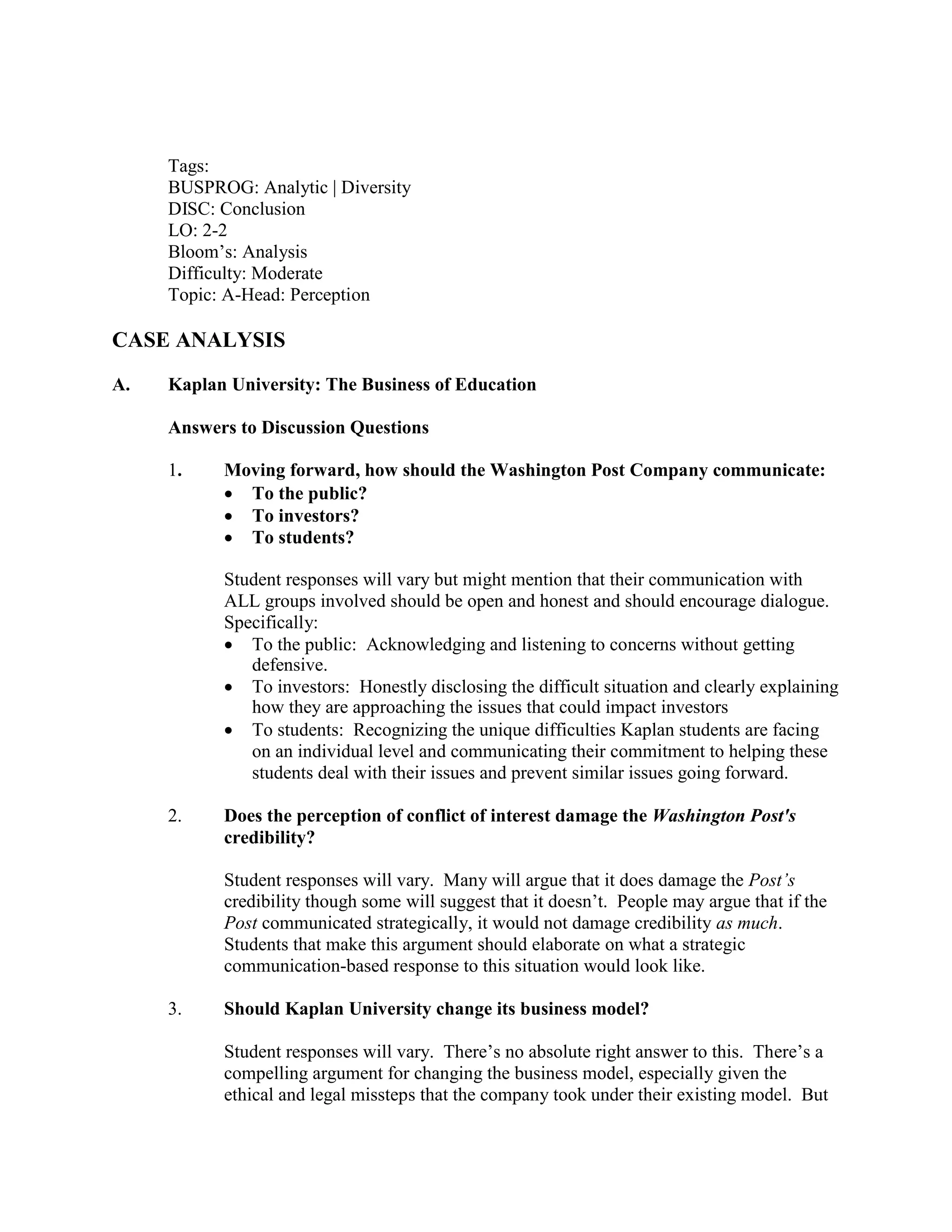
CASE ANALYSIS
A. Kaplan University: The Business of Education
Answers to Discussion Questions
1. Moving forward, how should the Washington Post Company communicate:
• To the public?
• To investors?
• To students?
Student responses will vary but might mention that their communication with
ALL groups involved should be open and honest and should encourage dialogue.
Specifically:
• To the public: Acknowledging and listening to concerns without getting
defensive.
• To investors: Honestly disclosing the difficult situation and clearly explaining
how they are approaching the issues that could impact investors
• To students: Recognizing the unique difficulties Kaplan students are facing
on an individual level and communicating their commitment to helping these
students deal with their issues and prevent similar issues going forward.
2. Does the perception of conflict of interest damage the Washington Post's
credibility?
Student responses will vary. Many will argue that it does damage the Post’s
credibility though some will suggest that it doesn’t. People may argue that if the
Post communicated strategically, it would not damage credibility as much.
Students that make this argument should elaborate on what a strategic
communication-based response to this situation would look like.
3. Should Kaplan University change its business model?
Student responses will vary. There’s no absolute right answer to this. There’s a
compelling argument for changing the business model, especially given the
ethical and legal missteps that the company took under their existing model. But
20.
students may arguethat Kaplan should keep its current business model and
change their practices. Students should support either argument with evidence.
4. What can Kaplan University do to build more credibility for its academic
programs?
Student responses will vary. One key (communication-related) action that would
be an important step toward building more credibility for its academic programs
would be to engage in a rich dialogue with its most important audience—past,
current, and potential students—and then develop plans for change based on this
feedback. Demonstrating that the company is truly listening and responding to its
most important audience would begin to develop some of the credibility the
company has lost.
5. What should be done by the Washington Post Company or Kaplan, Inc. in
response to the online petition to close Kaplan University?
Student responses will vary but good responses will note that the one thing
Washington Post Company and Kaplan, Inc. should not do is ignore the online
petition to close Kaplan University. Ignoring the petition could make it look like
Kaplan either finds the issue to be insignificant (which could be a big mistake
given the growth in attention to the issue) or doesn’t know how to manage/deal
with the petition (which could make the company look incompetent).
6. What steps can the Washington Post Company and Kaplan University take
to prepare for future communication challenges?
Student responses will vary, but they should include some of the steps that
Washington Post Company and Kaplan University might take in developing the
infrastructure that would simplify future communication challenges. These might
include establishing regular dialogue with key stakeholder groups or improving
communication metrics and integrating these metrics into regular organizational
planning.
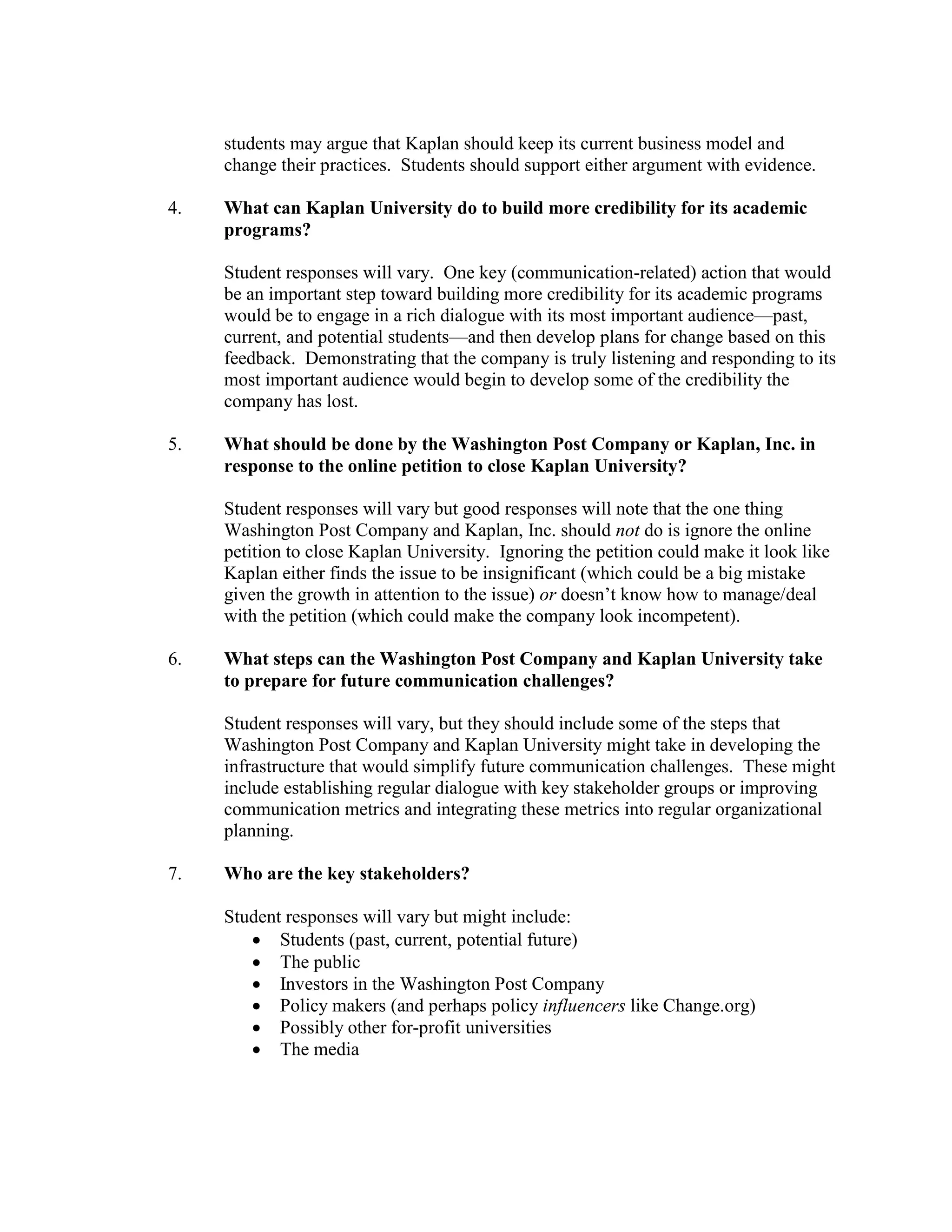
7. Who are the key stakeholders?
Student responses will vary but might include:
• Students (past, current, potential future)
• The public
• Investors in the Washington Post Company
• Policy makers (and perhaps policy influencers like Change.org)
• Possibly other for-profit universities
• The media
This ebook isfor the use of anyone anywhere in the United
States and most other parts of the world at no cost and with
almost no restrictions whatsoever. You may copy it, give it away
or re-use it under the terms of the Project Gutenberg License
included with this ebook or online at www.gutenberg.org. If you
are not located in the United States, you will have to check the
laws of the country where you are located before using this
eBook.
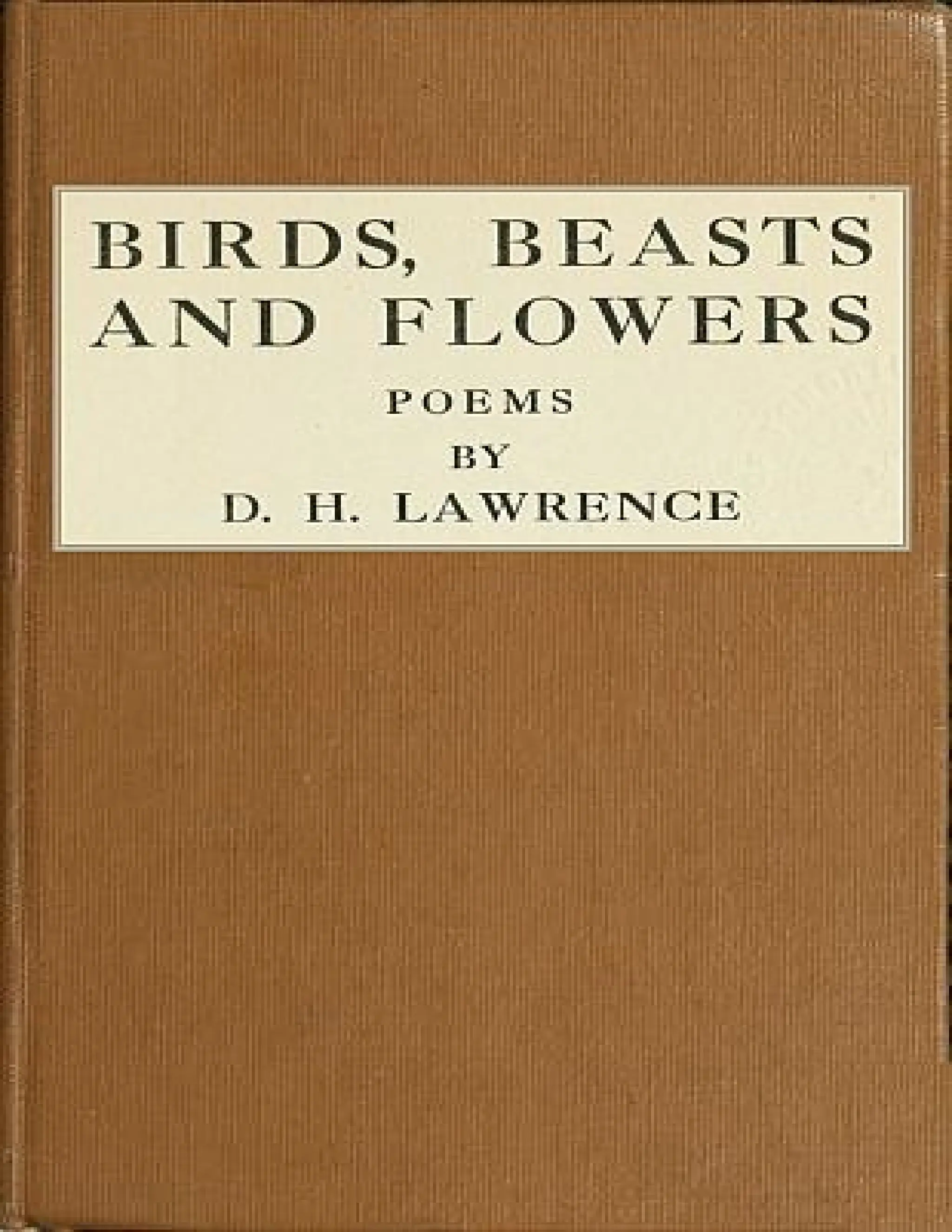
Title: Birds, Beasts and Flowers
Author: D. H. Lawrence
Release date: September 21, 2019 [eBook #60337]
Most recently updated: October 17, 2024
Language: English
Credits: Produced by Tim Lindell, Chuck Greif and the Online
Distributed Proofreading Team at http://www.pgdp.net
(This
file was produced from images generously made
available
by The Internet Archive/Canadian Libraries)
*** START OF THE PROJECT GUTENBERG EBOOK BIRDS, BEASTS
AND FLOWERS ***
27.
BIRDS, BEASTS AND
FLOWERS
Bythe same Author
The Lost Girl
Women in Love
Aaron’s Rod
The Ladybird
Kangaroo
Sea and Sardinia
New Poems
Psychoanalysis and the Unconscious
Fantasia of the Unconscious
BIRDS, BEASTS
AND FLOWERS
P O E M S
BY
D. H. LAWRENCE
LONDON
MARTIN SECKER
NUMBER FIVE JOHN STREET
ADELPHI
28.
Printed in GreatBritain
by The Riverside Press Limited
Edinburgh
LONDON: MARTIN SECKER (LTD.) 1923
Some of these poems have
appeared in Poetry, The
Dial, The New Republic,
The Bookman, The English
Review.
29.
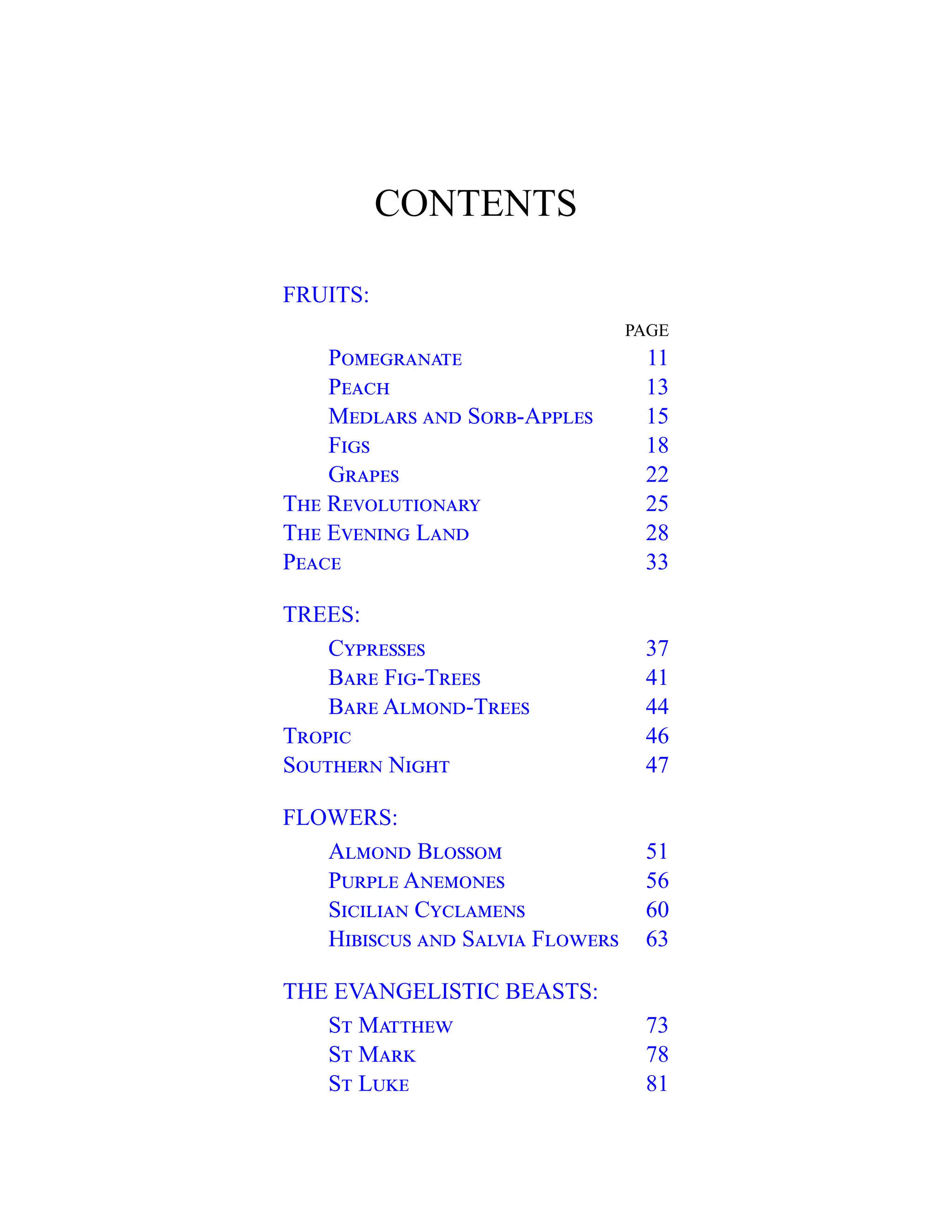
CONTENTS
FRUITS:
PAGE
Pomegranate 11
Peach 13
Medlarsand Sorb-Apples 15
Figs 18
Grapes 22
The Revolutionary 25
The Evening Land 28
Peace 33
TREES:
Cypresses 37
Bare Fig-Trees 41
Bare Almond-Trees 44
Tropic 46
Southern Night 47
FLOWERS:
Almond Blossom 51
Purple Anemones 56
Sicilian Cyclamens 60
Hibiscus and Salvia Flowers 63
THE EVANGELISTIC BEASTS:
St Matthew 73
St Mark 78
St Luke 81
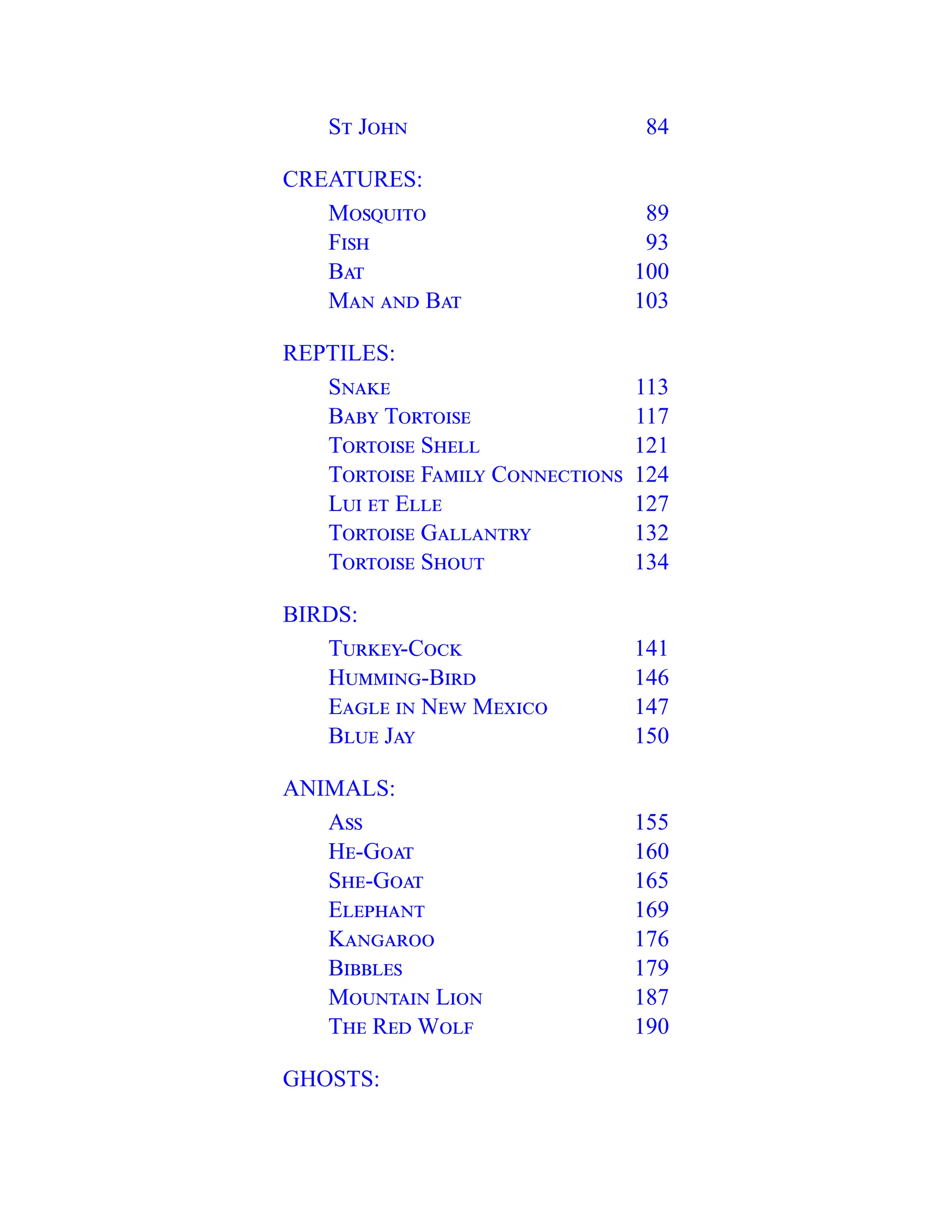
30.
St John 84
CREATURES:
Mosquito89
Fish 93
Bat 100
Man and Bat 103
REPTILES:
Snake 113
Baby Tortoise 117
Tortoise Shell 121
Tortoise Family Connections 124
Lui et Elle 127
Tortoise Gallantry 132
Tortoise Shout 134
BIRDS:
Turkey-Cock 141
Humming-Bird 146
Eagle in New Mexico 147
Blue Jay 150
ANIMALS:
Ass 155
He-Goat 160
She-Goat 165
Elephant 169
Kangaroo 176
Bibbles 179
Mountain Lion 187
The Red Wolf 190
GHOSTS:
31.
Men in NewMexico 197
Autumn at Taos 199
Spirits summoned West 201
The American Eagle 205
You tell meI am wrong.
Who are you, who is anybody to tell me I am wrong?
I am not wrong.
In Syracuse, rock left bare by the viciousness of Greek women,
No doubt you have forgotten the pomegranate-trees in flower,
Oh so red, and such a lot of them.
Whereas at Venice
Abhorrent, green, slippery city
Whose Doges were old, and had ancient eyes,
In the dense foliage of the inner garden
Pomegranates like bright green stone,
And barbed, barbed with a crown.
Oh, crown of spiked green metal
Actually growing!
Now in Tuscany,
Pomegranates to warm your hands at;
And crowns, kingly, generous, tilting crowns
Over the left eyebrow.
And, if you dare, the fissure!
Do you mean to tell me you will see no fissure?
Do you prefer to look on the plain side?
For all that, the setting suns are open.
The end cracks open with the beginning:
Rosy, tender, glittering within the fissure.
Do you mean to tell me there should be no fissure?
No glittering, compact drops of dawn?
Do you mean it is wrong, the gold-filmed skin, integument, shown
ruptured?
34.
For my part,I prefer my heart to be broken.
It is so lovely, dawn-kaleidoscopic within the crack.
San Gervasio in Tuscany.
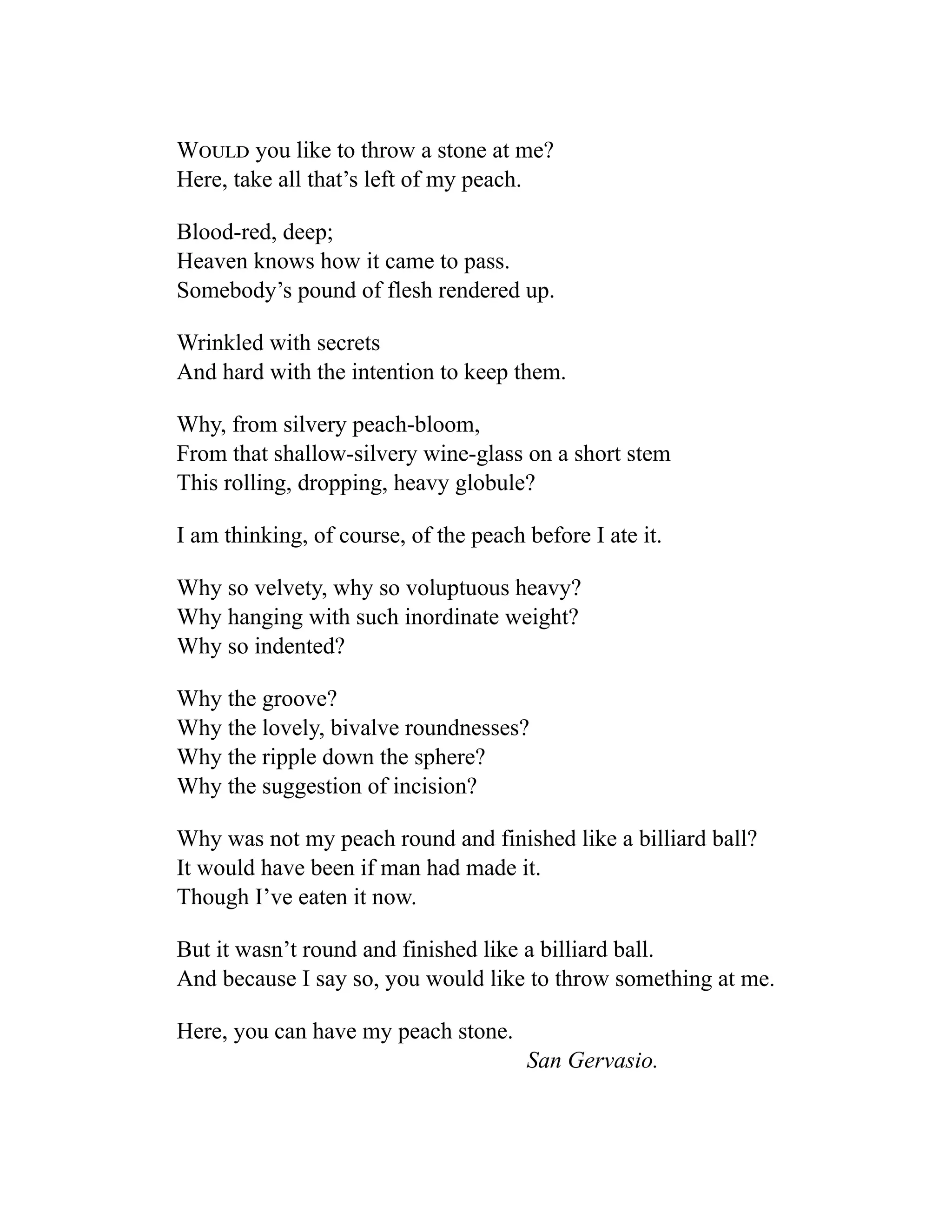
PEACH
35.
Would you liketo throw a stone at me?
Here, take all that’s left of my peach.
Blood-red, deep;
Heaven knows how it came to pass.
Somebody’s pound of flesh rendered up.
Wrinkled with secrets
And hard with the intention to keep them.
Why, from silvery peach-bloom,
From that shallow-silvery wine-glass on a short stem
This rolling, dropping, heavy globule?
I am thinking, of course, of the peach before I ate it.
Why so velvety, why so voluptuous heavy?
Why hanging with such inordinate weight?
Why so indented?
Why the groove?
Why the lovely, bivalve roundnesses?
Why the ripple down the sphere?
Why the suggestion of incision?
Why was not my peach round and finished like a billiard ball?
It would have been if man had made it.
Though I’ve eaten it now.
But it wasn’t round and finished like a billiard ball.
And because I say so, you would like to throw something at me.
Here, you can have my peach stone.
San Gervasio.
I love you,rotten,
Delicious rottenness.
I love to suck you out from your skins
So brown and soft and coming suave,
So morbid, as the Italians say.
What a rare, powerful, reminiscent flavour
Comes out of your falling through the stages of decay:
Stream within stream.
Something of the same flavour as Syracusan muscat wine
Or vulgar Marsala.
Though even the word Marsala will smack of preciosity
Soon in the pussy-foot West.
What is it?
What is it, in the grape turning raisin,
In the medlar, in the sorb-apple,
Wineskins of brown morbidity,
Autumnal excrementa;
What is it that reminds us of white gods?
Gods nude as blanched nut-kernels,
Strangely, half-sinisterly flesh-fragrant
As if with sweat,
And drenched with mystery.
Sorb-apples, medlars with dead crowns.
I say, wonderful are the hellish experiences
Orphic, delicate
Dionysos of the Underworld.
A kiss and a vivid spasm of farewell a moment’s orgasm of rupture
38.
A kiss, anda vivid spasm of farewell, a moment s orgasm of rupture,
Then along the damp road alone, till the next turning.
And there, a new partner, a new parting, a new unfusing into twain,
A new gasp of further isolation,
A new intoxication of loneliness, among decaying, frost-cold leaves.
Going down the strange lanes of hell, more and more intensely alone,
The fibres of the heart parting one after the other
And yet the soul continuing, naked-footed, ever more vividly embodied
Like a flame blown whiter and whiter
In a deeper and deeper darkness
Ever more exquisite, distilled in separation.
So, in the strange retorts of medlars and sorb-apples
The distilled essence of hell.
The exquisite odour of leave-taking.
Jamque vale!
Orpheus, and the winding, leaf-clogged, silent lanes of hell.
Each soul departing with its own isolation,
Strangest of all strange companions,
And best.
Medlars, sorb-apples
More than sweet
Flux of autumn
Sucked out of your empty bladders
And sipped down, perhaps, with a sip of Marsala
So that the rambling, sky-dropped grape can add its music to yours,
Orphic farewell, and farewell, and farewell
And the ego sum of Dionysos
The sono io of perfect drunkenness
Intoxication of final loneliness.
San Gervasio.
The proper wayto eat a fig, in society,
Is to split it in four, holding it by the stump,
And open it, so that it is a glittering, rosy, moist, honied, heavy-petalled
four-petalled flower.
Then you throw away the skin
Which is just like a four-sepalled calyx,
After you have taken off the blossom with your lips.
But the vulgar way
Is just to put your mouth to the crack, and take out the flesh in one bite.
Every fruit has its secret.
The fig is a very secretive fruit.
As you see it standing growing, you feel at once it is symbolic:
And it seems male.
But when you come to know it better, you agree with the Romans, it is
female.
The Italians vulgarly say, it stands for the female part; the fig-fruit:
The fissure, the yoni,
The wonderful moist conductivity towards the centre.
Involved,
Inturned,
The flowering all inward and womb-fibrilled;
And but one orifice.
The fig, the horse-shoe, the squash-blossom.
Symbols.
There was a flower that flowered inward, womb-ward;
Now there is a fruit like a ripe womb.
It was always a secret
41.
It was alwaysa secret.
That’s how it should be, the female should always be secret.
There never was any standing aloft and unfolded on a bough
Like other flowers, in a revelation of petals;
Silver-pink peach, Venetian green glass of medlars and sorb-apples,
Shallow wine-cups on short, bulging stems
Openly pledging heaven:
Here’s to the thorn in flower! Here is to Utterance!
The brave, adventurous rosaceæ.
Folded upon itself, and secret unutterable,
And milky-sapped, sap that curdles milk and makes ricotta,
Sap that smells strange on your fingers, that even goats won’t taste it;
Folded upon itself, enclosed like any Mohammedan woman,
Its nakedness all within-walls, its flowering forever unseen,
One small way of access only, and this close-curtained from the light;
Fig, fruit of the female mystery, covert and inward,
Mediterranean fruit, with your covert nakedness,
Where everything happens invisible, flowering and fertilisation, and
fruiting
In the inwardness of your you, that eye will never see
Till it’s finished, and you’re over-ripe, and you burst to give up your ghost.
Till the drop of ripeness exudes,
And the year is over.
And then the fig has kept her secret long enough.
So it explodes, and you see through the fissure the scarlet.
And the fig is finished, the year is over.
That’s how the fig dies, showing her crimson through the purple slit
Like a wound, the exposure of her secret, on the open day.
Like a prostitute, the bursten fig, making a show of her secret.
That’s how women die too.





![This ebook is for the use of anyone anywhere in the United
States and most other parts of the world at no cost and with
almost no restrictions whatsoever. You may copy it, give it away
or re-use it under the terms of the Project Gutenberg License
included with this ebook or online at www.gutenberg.org. If you
are not located in the United States, you will have to check the
laws of the country where you are located before using this
eBook.
Title: Birds, Beasts and Flowers
Author: D. H. Lawrence
Release date: September 21, 2019 [eBook #60337]
Most recently updated: October 17, 2024
Language: English
Credits: Produced by Tim Lindell, Chuck Greif and the Online
Distributed Proofreading Team at http://www.pgdp.net
(This
file was produced from images generously made
available
by The Internet Archive/Canadian Libraries)
*** START OF THE PROJECT GUTENBERG EBOOK BIRDS, BEASTS
AND FLOWERS ***](https://image.slidesharecdn.com/5740-250227125302-8626063f/75/Strategic-Management-Communication-for-Leaders-3rd-Edition-Walker-Solutions-Manual-26-2048.jpg)