
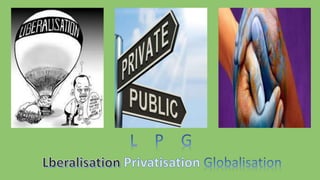





Economic Crisis 1991- LPG (Liberalisation ,Privatisation ,Globalisation)Economic Crisis 1991- LPG (Liberalisation ,Privatisation ,Globalisation)
Team Members
1.Aatish Raj
2.Ashutosh Vyas
3.Tarun Bhatt
4.Surendar Singh
5.Ankit boratkar
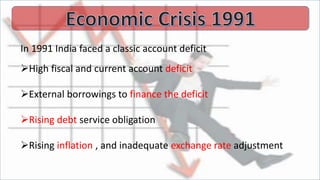
In 1991 India faced a classic account deficit
High fiscal and current account deficit
External borrowings to finance the deficit
Rising debt service obligation
Rising inflation , and inadequate exchange rate adjustment
In 1979,
oil shock
Agriculture subsidies pushed the deficit
In mid 1980’s,
 Defence Expenditure
 Reduction of direct taxes
 Increased dependence on foreign oil import
Reliance on external funds
Negligible foreign investment i.e 0.1% of GDP
Reliance on commercial borrowing
Financial needs were met by external assitanace
Soft loans declined from 89% To 39%
Started dominating Balance sheet at 38.7%
3 WEEKS FOR INDIA
TO SURVIVE
Liberalisation
 Act of making less Strict.
 Relaxation of govt. restriction
 Removal of tariff , subsidies and other restriction on
the flow of good and services.
 Basically meant for Economic liberalisation and Trade
liberalisation.
o Reached its peak in 2007 and recorded growth rate 9%
o 2nd fastest economy in world after china.
o Flow of money was increased in economy.
o Played important role in bringing out India out of
inflation.
o Increased purchasing power of citizens of India
Impact of Liberalisation
The low annual growth rate of the economy of India went up its peak
Increase Per capita income of country.
Increased infrastructure of the nation.
Removing barriers to international investing.
Increased willingness to do business in the country
Privatization
Transfer of ownership, property or business from the government to the
private sector is termed privatization.
The government ceases to be the owner of the entity or business.
The process in which a publicly-traded company is taken over by a few
people is also called privatization.
Impact of Privatization
• Privatization may help in reviving sick units which have become a
liability on govt.
• It frees the resources for a more productive utilization.
• Private concerns tend to be profit oriented and transparent in their
functioning.
• It reduces political influence on decision making of managers.
• It helps in making public sector unit more competitive.
• Lagan jute machinery company limited (LJMC).
• Modern food industries limited (MFIL)
• Paradeep Phosphates Limited (PPL)
• Bharat aluminium company limited (BALCO)
• Hotel Corporation of India limited (HCI)
• Hindustan Zinc limited (HZL)
Successful Privatizations in India
LPG model after 1991 Economic Crisis

LPG model after 1991 Economic Crisis

  • 1.
    Economic Crisis 1991-LPG (Liberalisation ,Privatisation ,Globalisation)Economic Crisis 1991- LPG (Liberalisation ,Privatisation ,Globalisation) Team Members 1.Aatish Raj 2.Ashutosh Vyas 3.Tarun Bhatt 4.Surendar Singh 5.Ankit boratkar
  • 2.
    In 1991 Indiafaced a classic account deficit High fiscal and current account deficit External borrowings to finance the deficit Rising debt service obligation Rising inflation , and inadequate exchange rate adjustment
  • 3.
    In 1979, oil shock Agriculturesubsidies pushed the deficit In mid 1980’s,  Defence Expenditure  Reduction of direct taxes  Increased dependence on foreign oil import
  • 4.
    Reliance on externalfunds Negligible foreign investment i.e 0.1% of GDP Reliance on commercial borrowing Financial needs were met by external assitanace
  • 5.
    Soft loans declinedfrom 89% To 39% Started dominating Balance sheet at 38.7%
  • 6.
    3 WEEKS FORINDIA TO SURVIVE
  • 10.
    Liberalisation  Act ofmaking less Strict.  Relaxation of govt. restriction  Removal of tariff , subsidies and other restriction on the flow of good and services.  Basically meant for Economic liberalisation and Trade liberalisation.
  • 11.
    o Reached itspeak in 2007 and recorded growth rate 9% o 2nd fastest economy in world after china. o Flow of money was increased in economy. o Played important role in bringing out India out of inflation. o Increased purchasing power of citizens of India
  • 12.
    Impact of Liberalisation Thelow annual growth rate of the economy of India went up its peak Increase Per capita income of country. Increased infrastructure of the nation. Removing barriers to international investing. Increased willingness to do business in the country
  • 13.
    Privatization Transfer of ownership,property or business from the government to the private sector is termed privatization. The government ceases to be the owner of the entity or business. The process in which a publicly-traded company is taken over by a few people is also called privatization.
  • 14.
    Impact of Privatization •Privatization may help in reviving sick units which have become a liability on govt. • It frees the resources for a more productive utilization. • Private concerns tend to be profit oriented and transparent in their functioning. • It reduces political influence on decision making of managers. • It helps in making public sector unit more competitive.
  • 15.
    • Lagan jutemachinery company limited (LJMC). • Modern food industries limited (MFIL) • Paradeep Phosphates Limited (PPL) • Bharat aluminium company limited (BALCO) • Hotel Corporation of India limited (HCI) • Hindustan Zinc limited (HZL) Successful Privatizations in India