Time ManagementBrought to you by your Student Success Mentors:David BeerSean FitzgibbonDebra O’Shaughnessy
Time Management	Having good personal time management skills are essential for a happy, successful career.	Good use of time: increases productivity reduces tension	 increases success	 promotes better health	 ensures more enjoyment in life
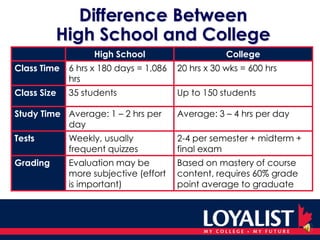
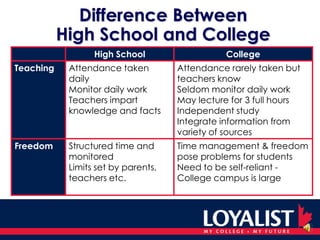
Difference BetweenHigh School and College
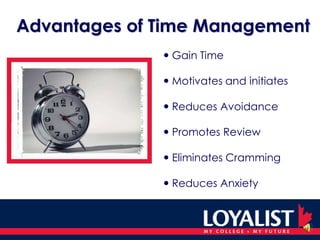
Advantages of Time Management Gain Time
 Motivates and initiates
 Reduces Avoidance Promotes Review Eliminates Cramming Reduces Anxiety
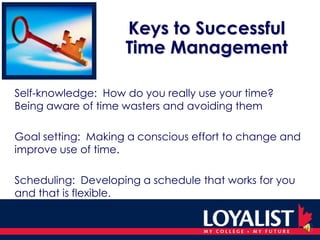
Keys to SuccessfulTime ManagementSelf-knowledge:  How do you really use your time?   Being aware of time wasters and avoiding themGoal setting:  Making a conscious effort to change and improve use of time.Scheduling:  Developing a schedule that works for you and that is flexible.
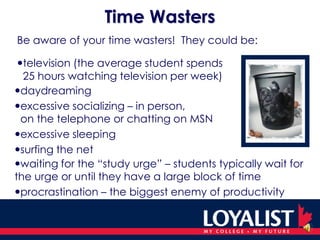
Time WastersBe aware of your time wasters!  They could be:television (the average student spends   25 hours watching television per week)daydreaming
excessive socializing – in person,   on the telephone or chatting on MSNexcessive sleeping
surfing the net
waiting for the “study urge” – students typically wait for the urge or until they have a large block of time
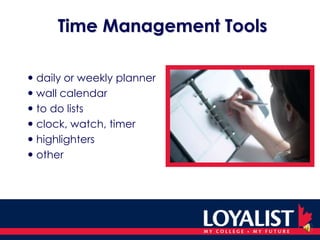
procrastination – the biggest enemy of productivityTime Management Toolsdaily or weekly planner	  wall calendar	  to do lists	  clock, watch, timer	  highlighters	  other
How Hard Will it Be?Time management strategies are for the most part fairly simple.	You need to have: basic attitude the skills to do itsupport from others in your life	 persistence
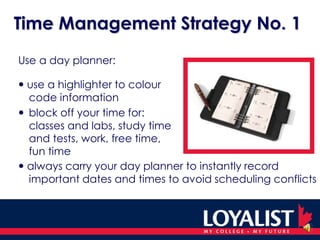
Time Management Strategy No. 1	Use a day planner: use a highlighter to colour 	code information	 	block off your time for:  	classes and labs, study time 	and tests, work, free time, 	fun time always carry your day planner to instantly record 	important dates and times to avoid scheduling conflicts
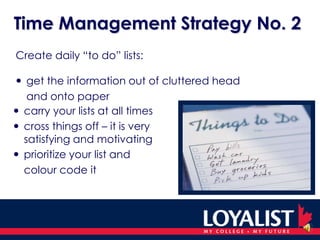
Time Management Strategy No. 2	Create daily “to do” lists: 	get the information out of cluttered head 		and onto paper 	carry your lists at all times	 	cross things off – it is very 	satisfying and motivating	 	prioritize your list and		colour code it
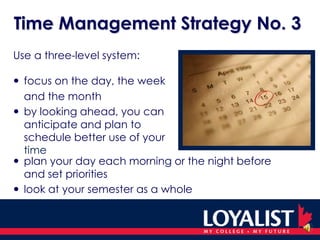
Time Management Strategy No. 3	Use a three-level system: 	focus on the day, the week 		and the month	 	by looking ahead, you can 	anticipate and plan to 	schedule better use of your 	time	 	plan your day each morning or the night before 	and set priorities	 	look at your semester as a whole
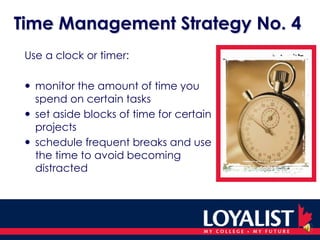
Time Management Strategy No. 4	Use a clock or timer: 	monitor the amount of time you 	spend on certain tasks	 	set aside blocks of time for certain 	projects	 	schedule frequent breaks and use 	the time to avoid becoming 	distracted
Time Management Strategy No. 5Prioritize your tasks:	concentrate on the important tasks first 	or the ones that will take more time	 	save the easy and/or repetitive 	tasks for last	 	analyze what needs to be done – 			set realistic goals	 	ask yourself frequently “What is the 	best use of my time NOW?”
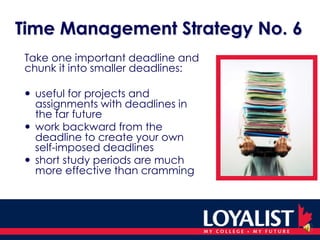
Time Management Strategy No. 6	Take one important deadline and chunk it into smaller deadlines:	useful for projects and 	assignments with deadlines in 	the far future	 	work backward from the 	deadline to create your own 	self-imposed deadlines	 	short study periods are much 	more effective than cramming

Loyalist College | Time Management

  • 1.
    Time ManagementBrought toyou by your Student Success Mentors:David BeerSean FitzgibbonDebra O’Shaughnessy
  • 2.
    Time Management Having goodpersonal time management skills are essential for a happy, successful career. Good use of time: increases productivity reduces tension  increases success  promotes better health  ensures more enjoyment in life
  • 3.
  • 4.
  • 5.
    Advantages of TimeManagement Gain Time
  • 6.
  • 7.
    Reduces AvoidancePromotes Review Eliminates Cramming Reduces Anxiety
  • 8.
    Keys to SuccessfulTimeManagementSelf-knowledge: How do you really use your time? Being aware of time wasters and avoiding themGoal setting: Making a conscious effort to change and improve use of time.Scheduling: Developing a schedule that works for you and that is flexible.
  • 9.
    Time WastersBe awareof your time wasters! They could be:television (the average student spends 25 hours watching television per week)daydreaming
  • 10.
    excessive socializing –in person, on the telephone or chatting on MSNexcessive sleeping
  • 11.
  • 12.
    waiting for the“study urge” – students typically wait for the urge or until they have a large block of time
  • 13.
    procrastination – thebiggest enemy of productivityTime Management Toolsdaily or weekly planner  wall calendar  to do lists  clock, watch, timer  highlighters  other
  • 14.
    How Hard Willit Be?Time management strategies are for the most part fairly simple. You need to have: basic attitude the skills to do itsupport from others in your life  persistence
  • 15.
    Time Management StrategyNo. 1 Use a day planner: use a highlighter to colour code information  block off your time for: classes and labs, study time and tests, work, free time, fun time always carry your day planner to instantly record important dates and times to avoid scheduling conflicts
  • 16.
    Time Management StrategyNo. 2 Create daily “to do” lists: get the information out of cluttered head and onto paper carry your lists at all times  cross things off – it is very satisfying and motivating  prioritize your list and colour code it
  • 17.
    Time Management StrategyNo. 3 Use a three-level system: focus on the day, the week and the month  by looking ahead, you can anticipate and plan to schedule better use of your time  plan your day each morning or the night before and set priorities  look at your semester as a whole
  • 18.
    Time Management StrategyNo. 4 Use a clock or timer: monitor the amount of time you spend on certain tasks  set aside blocks of time for certain projects  schedule frequent breaks and use the time to avoid becoming distracted
  • 19.
    Time Management StrategyNo. 5Prioritize your tasks: concentrate on the important tasks first or the ones that will take more time  save the easy and/or repetitive tasks for last  analyze what needs to be done – set realistic goals  ask yourself frequently “What is the best use of my time NOW?”
  • 20.
    Time Management StrategyNo. 6 Take one important deadline and chunk it into smaller deadlines: useful for projects and assignments with deadlines in the far future  work backward from the deadline to create your own self-imposed deadlines  short study periods are much more effective than cramming