 Identification on distribution system general components.
(Fig.1)
 Why we use circuit breakers?
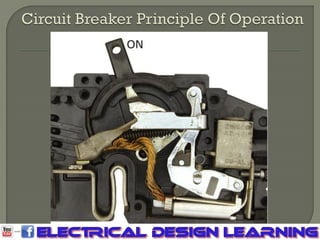
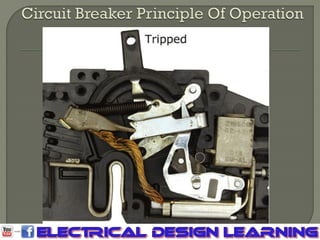
 Circuit breaker construction& principle of operation.
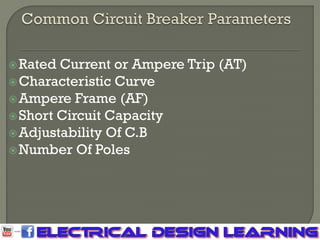
 Main circuit breaker parameters.
 Circuit breaker types.
 Circuit breaker sizing.
 Factors which determines selection the type of CB.
To protect the different system components
and persons from the destroying effect of the
faults and overloads.
There are a lot of applications at which the
circuit breaker is preferred more than fuse.
Rated Current or Ampere Trip (AT)
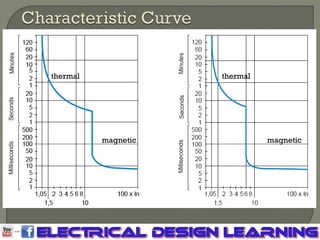
Characteristic Curve
Ampere Frame (AF)
Short Circuit Capacity
Adjustability Of C.B
Number Of Poles
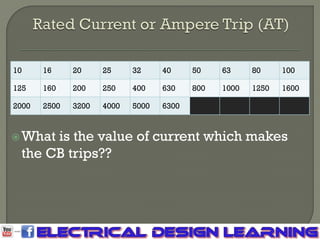
10 16 20 25 32 40 50 63 80 100
125 160 200 250 400 630 800 1000 1250 1600
2000 2500 3200 4000 5000 6300
What is the value of current which makes
the CB trips??
magnetic
thermalthermal
magnetic
 The Ampere frame is a number which indicates the
maximum size of a new CB which can be installed
instead of the existing circuit breaker.
 It shows the required space for each CB in the DB.
 For any CB, AF can take values more than or equals
the AT
 Example : the CBs with ratings from 40 to 100 A can
take ampere frame of 100 A.
 It is the max. fault current (KA) which the CB can
carry and trip without damaging.
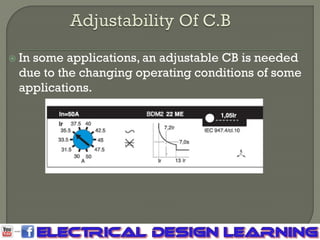
 In some applications, an adjustable CB is needed
due to the changing operating conditions of some
applications.
 Most types of circuit breakers are available with
different number of poles (1,2,3or 4) to suit all types
of feeder systems.
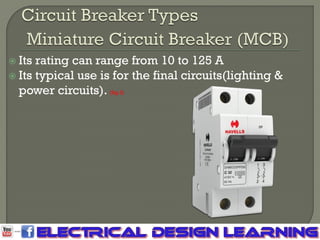
 Its rating can range from 10 to 125 A
 Its typical use is for the final circuits(lighting &
power circuits). (fig.2)
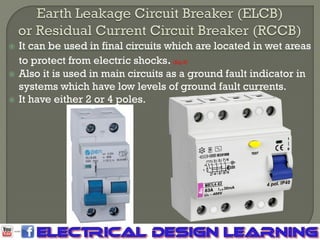
 It can be used in final circuits which are located in wet areas
to protect from electric shocks. (fig.3)
 Also it is used in main circuits as a ground fault indicator in
systems which have low levels of ground fault currents.
 It have either 2 or 4 poles.
 It is a circuit breaker which is designed especially to protect
electric motors.
 It contains thermal protection with delayed time to allow
starting current, it also contains magnetic protection.
 It can trip the circuit in case of three phase unbalance and
phase failure.
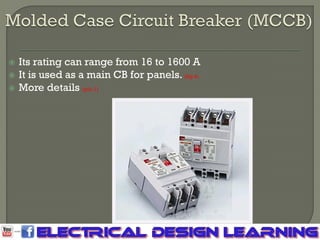
 Its rating can range from 16 to 1600 A
 It is used as a main CB for panels. (fig.4)
 More details (pic.1)
 Its rating can range from 630 to 6300 A
 It is used at main incoming for MDBs. (fig.5)
 Calculating the size of a circuit breaker depends on the
magnitude of the electric load which the CB will protect.
 First, get the design current:
𝐼 𝑏 =
𝑀𝑎𝑥.𝑑𝑒𝑚𝑎𝑛𝑑(𝐾𝑊)
3∗𝑉 𝑙.𝑙(𝐾𝑉)∗𝑃.𝐹
 Multiply 𝐼 𝑏 by 1.25 to get 𝐼2
 Get the nearest nominal CB current more than 𝐼2
 Example:
 For load 80 kw, p.f = 0.8
 𝐼 𝑏 =
80
3∗0.38∗.8
= 151.9 A → 𝐼2= 1.25*151.9 = 189.9 A
 Select a CB with nominal current = 200 A with type MCCB
 1.The magnitude of load which determine the required
CB size.
 2.The nature of load and the position in the system.
Lighting& power circuits: MCB
Motor loads: MPCB
Circuits in wet areas: ELCB
Main CB for a distribution board: MCB or MCCB
Main CB for a main distribution board: ACB

Low voltage circuit breakers

  • 2.
     Identification ondistribution system general components. (Fig.1)  Why we use circuit breakers?  Circuit breaker construction& principle of operation.  Main circuit breaker parameters.  Circuit breaker types.  Circuit breaker sizing.  Factors which determines selection the type of CB.
  • 3.
    To protect thedifferent system components and persons from the destroying effect of the faults and overloads. There are a lot of applications at which the circuit breaker is preferred more than fuse.
  • 7.
    Rated Current orAmpere Trip (AT) Characteristic Curve Ampere Frame (AF) Short Circuit Capacity Adjustability Of C.B Number Of Poles
  • 8.
    10 16 2025 32 40 50 63 80 100 125 160 200 250 400 630 800 1000 1250 1600 2000 2500 3200 4000 5000 6300 What is the value of current which makes the CB trips??
  • 9.
  • 10.
     The Ampereframe is a number which indicates the maximum size of a new CB which can be installed instead of the existing circuit breaker.  It shows the required space for each CB in the DB.  For any CB, AF can take values more than or equals the AT  Example : the CBs with ratings from 40 to 100 A can take ampere frame of 100 A.
  • 11.
     It isthe max. fault current (KA) which the CB can carry and trip without damaging.
  • 12.
     In someapplications, an adjustable CB is needed due to the changing operating conditions of some applications.
  • 13.
     Most typesof circuit breakers are available with different number of poles (1,2,3or 4) to suit all types of feeder systems.
  • 14.
     Its ratingcan range from 10 to 125 A  Its typical use is for the final circuits(lighting & power circuits). (fig.2)
  • 15.
     It canbe used in final circuits which are located in wet areas to protect from electric shocks. (fig.3)  Also it is used in main circuits as a ground fault indicator in systems which have low levels of ground fault currents.  It have either 2 or 4 poles.
  • 16.
     It isa circuit breaker which is designed especially to protect electric motors.  It contains thermal protection with delayed time to allow starting current, it also contains magnetic protection.  It can trip the circuit in case of three phase unbalance and phase failure.
  • 17.
     Its ratingcan range from 16 to 1600 A  It is used as a main CB for panels. (fig.4)  More details (pic.1)
  • 18.
     Its ratingcan range from 630 to 6300 A  It is used at main incoming for MDBs. (fig.5)
  • 19.
     Calculating thesize of a circuit breaker depends on the magnitude of the electric load which the CB will protect.  First, get the design current: 𝐼 𝑏 = 𝑀𝑎𝑥.𝑑𝑒𝑚𝑎𝑛𝑑(𝐾𝑊) 3∗𝑉 𝑙.𝑙(𝐾𝑉)∗𝑃.𝐹  Multiply 𝐼 𝑏 by 1.25 to get 𝐼2  Get the nearest nominal CB current more than 𝐼2  Example:  For load 80 kw, p.f = 0.8  𝐼 𝑏 = 80 3∗0.38∗.8 = 151.9 A → 𝐼2= 1.25*151.9 = 189.9 A  Select a CB with nominal current = 200 A with type MCCB
  • 20.
     1.The magnitudeof load which determine the required CB size.  2.The nature of load and the position in the system. Lighting& power circuits: MCB Motor loads: MPCB Circuits in wet areas: ELCB Main CB for a distribution board: MCB or MCCB Main CB for a main distribution board: ACB