TransportEnergyInfrastructure
Roadmapto2050
HYDROGENROADMAP
PreparedfortheLowCVPbyElementEnergyLtd
CelineCluzel&AlastairHope–Morley
JUNE2015
ProjectSteeringGroup
AutogasLimited
BOCLimited
BEAMA
CalorGasLtd
EDFEnergy
ElectricityNetworksAssociation
NationalGrid
OfficeforLowEmissionVehicles
RenewableEnergyAssociation
TransportforLondon
TransportScotland
UKPetroleumAssociation
LowCVPProjectManager
JonathanMurray,
PolicyandOperationsDirector
Contractor
PreparedbyElementEnergyLtd
Authors
CelineCluzel
AlastairHope-Morley
Reviewers
AlexStewart
MikeDolman
BenMadden
TransportEnergyInfrastructure
Roadmapto2050
HYDROGENROADMAP
JUNE2015
Disclaimer
Whiletheauthorsconsiderthatthedataandopinionscontainedinthisreportaresound,allparties
mustrelyupontheirownskillandjudgementwhenusingit.Theauthorsdonotmakeany
representationorwarranty,expressedorimplied,astotheaccuracyorcompletenessofthereport.
3
Acknowledgements
TheLowCVPaimsto:
Developinitiativestopromotethesaleandsupplyoflowcarbonvehiclesandfuels
ProvideinputandadviceonGovernmentpolicy
Provideaforumforstakeholderstoshareknowledgeandinformation
EnsurethatUKmotor,fuelandrelatedbusinessesarebestplacedtocapitaliseontheopportunitiesinthelowcarbon
marketsofthefuture
ContributetotheachievementofUKGovernmenttargetsforroadtransportcarbonreduction
AutogasLimited
BOCLimited
BEAMA
CalorGasLtd
EDFEnergy
ElectricityNetworksAssociation
NationalGrid
OfficeforLowEmissionVehicles
RenewableEnergyAssociation
TransportforLondon
TransportScotland
UKPetroleumAssociation
TheLowCVP,establishedin2003,isapublic-privatepartnershipthat
existstoaccelerateasustainableshifttolowercarbonvehiclesand
fuelsandcreateopportunitiesforUKbusiness.
AberdeenCityCouncil
AirProducts
BRC
BYD
Calorgas
CNGFuels
CNGServices
DearmanEngineCompanyLtd
DownstreamFuelAssociation
DrivelectricLtd.
ENNGroupEurope
GasBusAlliance
Gasrec
GTC
IntelligentEnergy
Nissan
Openenergi
Riversimple
Scania
SGN
SMMT
TfL
Thriev
TowerTransit
UKLPG
UKPN
ULEMCo
UPS
Wales&WestUtilities
ProjectSteeringCommitteeWorkshopattendees
4
Contents
−Introductionandcontext
−Backgroundandstatusquo
−Futurerefuellinginfrastructurerequirementsand
barrierstodeployment
−Summaryroadmapandrecommendations
−Appendix
5
Background-a‘TransportInfrastructureroadmap’isneededto
complementexistingvehicleandfuelroadmaps
Source:AutoCouncilandLowCVP
Vehicleroadmaps
Transportfuelroadmaps
Source:AutoCouncilandElementEnergyfortheLowCVP
Inthecontextoftheexpectedtransitiontolowercarbonpowertrains
andfuels,theAutoCouncilvehicleroadmapshaveproventobea
usefultooltofocusresearch,fundingandpolicy,bringingintoone
placetheindustry’sviewsonfuturetechnologyoptions,deployment
stepsandcorrespondingpolicydrivers.
Tocomplementthesepowertraintechnologiesroadmaps,the
LowCVPcommissionedaRoadTransportFuelsRoadmapin2013-14,
whichalsoprovedsuccessfulinbringingclaritytothefueloptions
availableandmappingtheenablingmilestones.
ThisInfrastructureroadmapisthe‘missingpiece’thatwillsupport
newpowertrainsandnewfuels.Thisroadmapisallthemore
necessaryastheneedsandbarriersfordeploymentofelectric,
hydrogenandgasrefuellingstationsdiffersignificantlyand
refuelling/recharginginfrastructureisakeyenablerforlowemission
vehicles.
TheobjectivesoftheInfrastructureRoadmapareto:
−Assesstheinfrastructureneedsandbarriersfordeploymentof
electric,hydrogenandgasrefuellingstationsto2050,including
impactonupstreamdistribution,aswellastoconsider
‘conventional’liquidfuels
−Makerecommendationsfordeliveryofinfrastructure
deployment,bothatnationalandlocalgovernmentlevel.
Source:ElementEnergy
6
TheInfrastructureRoadmapcoversprivateandpublicinfrastructure,
forallmainroadvehiclesandbothcurrentandfuturefuels
Depotbasedrefuellingforfleetoperatorsandreturntobase
operators
Homerechargingforprivateand(some)commercialvehicles
Publicforecourtrefuelling/recharging
Refuellinginfrastructuretypes
Fuels/energyvectorsconsidered
Zerotailpipeemissionfuels:electricityandhydrogen
‘Conventional’liquidfuels:gasoline(E5toE20,inlinewith
theTransportFuelsRoadmap),diesel,LPG/bio-propane
Methane:CompressedNaturalGas(CNG),LiquefiedNG(LNG)
andbiomethane
Niche/futurefuels:methanol,liquidairandahighbioethanol
blend(E85)
TheUK’slegallybindingtargettoreducetotalGHGemissionsbyatleast80%(relativeto1990levels)by2050,
andtransportcontributestoc.25%ofUKtotalGHGemissions;
EUlevelregulations(gCO2/km,AirQualitytargetsandEUROspec),Directives(RenewableEnergy,FuelQuality,
CleanPowerforTransport)andTransportWhitePaper
Driversforchangeinthetransportenergysystem
Vehicletypes
Source:ElementEnergy
7
ThedevelopmentoftheInfrastructureRoadmapbenefittedfrominput
fromawiderangeofstakeholders,manyconsultedthroughworkshops
Developuptakescenarios
for%salesofelectricand
ICEvehicles
InputintoElementEnergy
fleetmodel
Outputnumbersof
vehiclesinthefleetand
MJusedperenergyvector
ICEvehicles:diesel,petrol,LPG,gasvehicles
Electricvehicles:Battery(BEV),Plug-inHybrid(PHEV),
Range-Extended(RE-EV)andhydrogenfuelcell(FCEV)
Niche/futurefuelsconsidered:E85,methanol,liquidair
PrepareInfrastructure
Roadmap
Reviewexistingliterature
onrefuellingand
upstreaminfrastructure
Industryconsultation
withLowCVPFuels
workinggroup
ReviewbySteering
Committee
Preparedraftreport
Completefinalreport
Hoststakeholder
workshops
Fourdedicatedfuelworkshopswereconducted
Workshopthemes:electricity,liquidfuels,methane,hydrogen
38attendeesincluded:Infrastructuremanufacturers,installers,
operators,DNOs,energycompanies,fuelsuppliers,OEM/vehicle
suppliers,endusers,localgovernment/regulator
Reportpreparation
Externalinput
Source:ElementEnergy
vkt:vehiclekmtravelled
Seefullreportsfor
furtherdetailsoffuel
uptakescenarios
Scrappagerate,stockandmileageinputsbasedonDfTdata/projections:c.40%increaseinstockand
vktby2050(39millionvehicles,740billionvkt);VehicleefficiencybasedonCommitteeonClimate
Changemodelling
8
Fourseparatereportshavebeendeveloped–thisreportisdedicated
tothecaseofmethaneasatransportfuel
Finalreport
summarising
findingsfromeach
energyvectors
Fourseparatereportswereproducedtocapturethedifferences
betweentheenergyvectors/fuelsunderconsideration
This
report
9
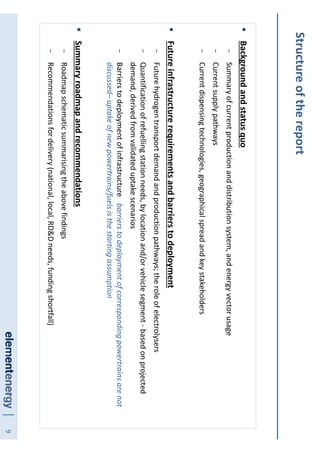
Structureofthereport
Backgroundandstatusquo
−Summaryofcurrentproductionanddistributionsystem,andenergyvectorusage
−Currentsupplypathways
−Currentdispensingtechnologies,geographicalspreadandkeystakeholders
Futureinfrastructurerequirementsandbarrierstodeployment
−Futurehydrogentransportdemandandproductionpathways;theroleofelectrolysers
−Quantificationofrefuellingstationneeds,bylocationand/orvehiclesegment-basedonprojected
demand,derivedfromvalidateduptakescenarios
−Barrierstodeploymentofinfrastructure-barrierstodeploymentofcorrespondingpowertrainsarenot
discussed–uptakeofnewpowertrains/fuelsisthestartingassumption
Summaryroadmapandrecommendations
−Roadmapschematicsummarisingtheabovefindings
−Recommendationsfordelivery(national,local,RD&Dneeds,fundingshortfall)
10
Contents
−Introductionandcontext
−Backgroundandstatusquo
−Futurerefuellinginfrastructurerequirementsand
barrierstodeployment
−Summaryroadmapandrecommendations
−Appendix
11
H2refuelling
stationwith
electrolyser
Untilnow,theUKhydrogenindustryhasbeenoverwhelminglygeared
towardsmeetingdemandinrefineryandindustrialprocesses
Sources:AllfiguresrefertotheUKandarefromDUKES(2014),DECC(2014),Roads2HycomDeliverable2.1and2.1a(2007)
Note:SomehydrogenisalsoimportedtotheUK
SMR
plant
Naturalgas
H2merchant
compressedgas
loadingstations
Transport
demand
UpstreamMidstreamDownstream
Oil
Oil
refineries
Fossilfuel
powerplant
Lowcarbon
powersource
Naturalgas,coal,oil
Transmission
grid
Renewableand
nuclearinstalled
capacity:23.1GWInstalled
capacity:
61.8GW
Distribution
grid
Total
cabling:
>10,000km
Total
cabling:
>700,000kmTube
trailers:
>100inUK
Large-scaleindustrialproductionSmall-scaleon-siteproduction
H2production
unit
Small
distributed
demand
<1ktpa
c.6%
Purification
Large
industrial
demand
c.94%
Producedand
consumed
on-site,or
deliveredvia
pipeline
c.690ktpa
Chloro-
alkali
By-
product
12
Severalnon-OEMmanufacturersaredeveloping
hydrogen(fuelcellorICE)-basedmobilityconcepts
acrossarangeofsegments,manyalreadyavailable:
Whilstsomeofthesevehicleswillrelyonstand-alone
depot-basedrefuellinginfrastructure,manywillalso
relyontheavailabilityofpublicrefuellingnetworks
Thenon-OEMvehiclesoftenhavedifferentrefuelling
requirementsversusOEMcars(e.g.differentrefuelling
pressures,refuellingfrequency,tanksize,etc.)
ThereisthereforeaneedtoensureH2infrastructureis
compatiblewithallvehicletypesfromOEMsand
othersuppliers
Hydrogen-poweredvehicleswillstarttobedeployedinthe2015-
2020period,withanexpectedramp-upbeyond2020
Dependingonthedeploymentrateofpassengercars,othervehicle
typesmayplayanimportantroleinincreasingtheutilisationofthe
earlyrefuellingstationnetwork
Considerationshouldbegiventomakingrefuellingstations
compatiblewithawiderangeofvehicles
Thisdocumentsummarisesthelikelyinfrastructureneedsfor
hydrogen-fuelledvehiclesinthe2015-2050period
ArangeofOEMshaveannouncedplanstobringFCEVstomarketin
the2015-2018period,aimingtohave1,000’sdeployedby2020:
Thesevehicleswillrequireextensiverefuellinginfrastructurein
theirtargetmarkets,toofferanattractiveconsumerproposition
Theywillbelaunchedinmarketswherethebestconditionsexistin
termsofcustomerdemandandincentives,regulatorypushand
availabilityofinfrastructure
Severalmanufacturersplantocommercialisehydrogenvehiclesinthe
comingyears,withassociatedrefuellinginfrastructurerequirements
MajorvehicleOEMsSmallmanufacturers
Implicationsforrefuellinginfrastructure
Hyundaiix35FCEV
–launched2014
ToyotaMirai–
launched2014/5
HondaFCV–
launch2016
Daimlernextgen.
FC–launch2017
SymbioFCrange
extendedKangoo
–launched2014
VanHoolFCbus–
launched2013
ULEMCoH2-ICEVan
–launched2012
HyPulsionFCforklift
–softlaunch2014
Riversimplecar–
launchc.2018
SymbioFCrange-
extendedtruck–
launchc.2017
FC=FuelCell,FCEV=FuelCellElectricVehicle
Source:ElementEnergy
Expectedtoalwaysrequirestand-alonerefuellingfacilities
13
Hydrogenisproducedatacentralised,largescale
plantviaaseriesofavailableindustrialpathways.1
Thehydrogenfuelmustthenbetransportedtoa
retailsiteviahighpressuretubetrailer,liquidH2
trailer,manifoldcylinderpack(MCP)orpipeline
E.g.AirProductshasusedbothliquidand500bar
tubetrailerstosupplyTfL’sLeaInterchangebus
depot
Hydrogenrefuellingstations(HRS)canbesuppliedbydeliveredor
on-siteproducedhydrogen,withtwomaindispensingpressures
1Steammethanereforming(usingmethaneorbiogasfeedstock),methanolreforming,autothermalreforming,chloralkaliby-
product,gasification(usingwaste,coalorbiomassfeedstock),centralisedwaterelectrolysis(usingalkalineorPEMtechnology)
A)H2producedoff-siteanddeliveredtoHRSB)H2producedon-siteattheHRS
Hydrogenisgeneratedon-siteviaaco-locatedH2
productionunit,usingwaterelectrolysis,orsmall
scalesteammethanereforming
Thisapproacheliminatesallfueldistributioncosts
butincreasestheHRScapitalcost
E.g.BOCgeneratesH2atAberdeenCityCouncil’s
KittybrewsterHRSviaanon-siteelectrolyser
Dispensingpressurelevelsavailable
Twopressurelevelsavailable:350barand700bar:
‒MostOEMvehicleshave700barH2tanksbutarecompatiblewithboth350and700bar
dispensers,withthehigherpressurerequiredforafulltankfill(350baroffersac.60%
fill).OEMconsensusfavours700barrefuellingtomaximiserangehowevercertainkey
playersconsiderthehigherpressuretonotbeessentialformarketdevelopment
‒Currentlymostothervehicles,e.g.H2buses,forkliftsandsomevansuse350bar
technology,toachievelowerrefuellingstationandtankcosts-higherpressuresmaybe
requiredinfuturewhenspaceconstrainedvehiclesareconsidered(doubledeckerbuses)
14
Today’searlypublicHRSaregenerallybasedoncontainerisedsolutions;
futureHRSwillbemorefullyintegratedwithexistingforecourts
Source:AirProducts,www.hydrogen.energy.gov
CurrentHRSlayoutsCharacteristicsoftoday’sHRS
FutureHRSwillbeintegratedwithexistingforecourts
ItisenvisagedthatfutureHRS(e.g.beyond2020)willincreasinglybeintegrated
withinconventionalexistingpetrolstations.Furthermore,thecoexistenceofEV
andFCEVinfrastructureshouldbeconsidered
Generallybasedoncontainerisedsolutions–typicallystandardISOshipping
containers
Theyareoftenstand-alonestationsondedicatedland
HRSequipmentisofteninISO(20ft)shippingcontainers.Overallfootprintof
~150m2dependingonmanoeuvringspaceetc.
AlocalH2storeintheformofcompressedgasisgenerallypresent
Refuellingnozzleisindustrystandard,safe,reliableanduserfriendly
Refuellingtakesasimilartimetoconventionalfuel(3–4minutes)
Thisislikelytobethelong-
termsolutiononceFCEVsreach
commercialisationbutwill
requirewelldesignedandfully
integratedH2storage,
distributionandsafetysystems,
aswellasdevelopmentsin
nationalregulations
Anumberoffuelretailershavealreadytrialledthesesolutions,and
integratedstationsarealreadypresentinGermanyandCalifornia
UKHRSarecurrentlystand-aloneor
‘hosted’sitesi.e.notfullyintegrated
withconventionalforecourts
Dispenserisaccessibletovehicleusers,
whilehydrogenstorage,compressors
etc.aresecuredfrompublicaccess
Somesitesuse‘trailerswapping’,where
ahydrogentraileractsasanon-site
hydrogenstoreratherthanoffloadingto
otherstoragetanks
15
EarlyHRSarelikelytobeinthe‘small’range
Asvehiclenumbersanddemandgrow,largerstationswithsuperior
economicswillincreasinglybedeployed
HRSeconomicsarestronglylinkedtostationsizeandloadinglevels,
whichcanbeoptimisedbytargetingmultiplevehicletypes
ThreetypicalsizesdefinedforHRSHRSeconomicsareheavilyinfluencedby
sizeanddemandfromvariousvehicletypes
HRScapexdoesnotvarylinearlywithdispensing
capacity,assuchcostsperkgaresubstantially
higherforsmallstationswiththesame%loading
Stationloadingiscriticalindeterminingeconomics:
‒‘Small’stationsrequireveryhighloading/
utilisationtobreakeven,evenwith
financialsupporte.g.capitalfunding
‒Largerstationscanbreakevenatmuch
lowerloadinglevels
Largervehiclesusesignificantlymorehydrogenper
daythanpassengercars,andcanmakeauseful
‘baseload’contributiontothehydrogendemandat
anearbystation
AssuchthereisastrongdrivertoensurethatHRS
canmeettechnicalrequirementsofasdiversea
rangeofvehiclesaspossible–thiswillensure
higherloadfactors(andfavourableeconomics),as
wellashelpingtode-riskanyover-relianceona
singlevehicletype.
However,thismusttakeintoaccountpractical/
operationalconstraintsthatmaypreventcarsand
largevehicles(e.g.buses)fromsharingHRS
ThesizeofHRSdeployedwillevolveasdemandgrows
>1,000kg/dayc.500kg/day<100kg/day
Small:Medium:Large:ItisusefultodefineHRS
intothreemainsize
ranges,basedondaily
dispensingcapacity:
Anumberofverysmall
options(e.g.<50kg/day)
mayalsocometomarket
HRSsizedistributionforUKH2Mobility
infrastructurerollout
Source:UKH2MobilityPhase1(publicreport),ForecourtTraderFuelMarketReview(2014)
<20cars/dayc.100cars/day>200cars/day
Averagecommercialliquidfuelforecourtdispenses
11,400Litres/day,equivalenttoc.300-400cars/day
16
UKactivitiesexclusivelybasedinLondon:
TherearefiveoperationalHRSintheUKwithacombinedcapacityof
c.1tonne-H2/day,withsevenmoreplannedbytheend2015
†:Notethisdoesnotincludesmall-scaleHRSinBirmingham,Coventry,Glamorgan,IsleofLewis,Loughborough,Nottingham,
UniversityofSouthWales.ItdoesnotincludeHRSfundedunderthe2015OLEVscheme(2newHRSand2mobilerefuellers)
HydrogeninfrastructureintheUKtoday†KeyplayersactiveinhydrogentransportintheUK
Retailers,manufacturers,suppliers,
installers,associatedenergycompanies
OEMs,vehiclesuppliers,endusers,local
authorities
Evolutionofhydrogenvehicle/HRSdeploymentsintheUK
Eightfullyoperational
FCbusesandoneHRS
deployedThreenewpublicHRS
andc.50newFCEVsto
bedeployedinLondon
overthreeyears
OnepubliclyaccessibleHRS,fiveFC
taxis,andafleetofFCpassengercars
Onepubliclyaccessible
HRSinstalledalongside
asupermarket
forecourt,afleetofH2
vansandFCEVs
FirstpubliclyaccessibleHRS
withon-siteproductionof
‘green’H2inSwindon
Developmentofnationalrollout
plansbegunforH2infrastructure
andpassengervehicles
TenFCbusesandoneHRS
deployedinAberdeen
Keymilestones
HRScompletedand
currentlyoperational
HRStobecommissioned
in2015
London
Illustrative
locationsof3
additional
stationsto
beinstalled
in2015
underHyFIVE
17
ManyH2productionpathwaysexistwithvaryingcostsandCO2emission
rates–mostoptionsareavailabletotheUKtodayorinthefuture
Biogas,CCS&novelroutes
H2canbeproducedfromvarious
alternativesources,includingwaste
gasification,fromanaerobicdigestion,
orasanindustrialorCCSby-product
Sometechnologieswouldproduce
largequantitiesofcheap,‘green’H2if
developed,e.g.CCS
Industrywillonlyconsiderdeveloping
novelpathwayswhenastrong,reliable
energysectordemandisestablished
Hydrocarbon-basedproduction
Themostcommonformofindustrial
H2productiontoday
Involvesreformingmethaneorother
hydrocarbonstoproducesyngasand
subsequentlyusingthewater-gas-shift
reactiontoextracthydrogen
Highlymaturetechnologyallowing
low-cost,large-scaleproduction
Pathwaycanpotentiallybedecarbon-
isedwithcarboncaptureandstorage
Waterelectrolysis
Maturetechnologybutfurther
developmentsneededforwidespread
transportuse
Allowson-siteproductionatHRS
Requiresaccesstolowcostelectricity
toachieveaffordableH2costs
Usingrenewableelectricityproduces
‘green’hydrogen
Potentialforuseinrefineryprocesses
ifsufficientlylowcost
Technologytype1
1.Distributedwaterelectrolysis
2.Conventionalwaterelectrolysis
3.Coalgasification+CCS
4.CentralisedSMR+CCS
5.IGCC+CCS
6.DistributedSMR
7.ConventionalSMR
8.IGCC
9.Coalgasification
LargeproductioncapacityintheUKSeveralsuppliersbasedintheUKTechs.atvariousdevelopmentstages
Sourceofgraph:Aportfolioofpower-trainsforEurope:afact-basedanalysis,McKinsey&Co,2011
CCS=carboncaptureandstorage,SMR=steammethanereforming1Assumesaccesstogreenelectricityforelectrolysers
(Technicaltargetstoreduce
carbonfootprintofhydrogen
asatransportfuel)
18
Alackofwell-developed
distributionsystemsforhigh-
purityhydrogenwillleadto
theinitialdominanceofWE
usingon-siteproduction
Beyond2030,‘green’H2
willincreasingly
dominateduetoclimate
change/CO2targets.
‘Green’hydrogentransitiontrajectory
Likelyproductionmixwillbeofmethane-basedandelectrolytic‘green’
H2inthemedium-term,withmore‘green’sourcesinthelongerterm
1:UKH2MobilityPhase1,
publicreport
VarioussourcesarelikelytoberelevanttoH2productiongoingforward
TargetCO2trajectoryforfuelcellvehicles1
Likelyproductionmixtrajectorythroughtime
100%
80%
60%
40%
20%
0%
2030202520202015
Share of total production mix
2050
New’green’production*
Existingcapacities
WE
NewSMR
*:New‘green’productioncouldincludewastegasification,CCS,etc.Thedevelopment
pathwayforthesetechnologieswillstronglyinfluencethe2050productionmix
From2015to2030,amixofmethane-basedand‘green’water
electrolysishydrogenproductionwilldominate:
UKH2Mobilitypresentsaplantoachievealowcarbon
trajectoryforthefuel(implyinguseofrenewableelectricity
forelectrolysers),whilstensuringthefuelisaffordable
(leadingtotheuseoffossilhydrocarbons)
ThestrategymatchestheCO2performanceofplug-in
hybridsasthegriddecarbonises,whilstidentifyingaleast
costproductionmix–leadingtoaroughlyequalmixof
methaneandelectrolysisoptions
SimilarWelltoWheelperformanceexpectedbeyond2030
Inthe2020-2030period,overalldemandwillexceedexistingsparecapacityanda
mixtureofnewon-site/centralisedWEandcentralisedSMRwillbedeveloped,with
associateddistributioninfrastructure.ClearpolicywillbeneededtodelivergreenH2
123
1
2
3Awidervarietyofsourcesarelikelytobecome
available,e.g.wastegasification,CCSwiththechoice
ofsourcebeingspecifictothecostsinspecific
locations,ratherthanasingletechnologydominating
Asguaranteedpuritybecomesmoreprevalent
fromexistingcentralisedsourcesanddemand
canjustifyinvestmentinhigh-capacity
distribution,thedominanceofWEisreduced
from2020,asexistingH2sourcesaretapped
19
Hydrogenrefuellingpointsshallemploycompliant
fuellingalgorithmsandequipment
Hydrogenpuritydispensedbyhydrogenrefuelling
points
Connectorsformotorvehiclesfortherefuellingof
gaseoushydrogen
In2014,theEuropeanCommissionissuedadirectivetohelp
harmonisetechnicalspecificationsforhydrogenrefuellingequipment
Source:EuropeanCommissionPressReleaseDatabase
FromNov2017,allpublicHRSintheEUmustbecompliantwiththetechnicalspecification
TheCleanPowerforTransportprogramme,initiatedin2013,aimstofacilitatethe
developmentofasinglemarketforalternativefuelsfortransportinEurope
Theresulting2014/94/EUdirectiveon‘thedeploymentofalternativefuelsinfrastructure’
aimsto:
1)Harmonisetechnicalspecificationsforrechargingandrefuellingstations
2)Developclear,transparentfuelpricecomparisonmethodologies
3)EnsureMemberStatesdevelopnationalpolicyframeworkstosupportthe
deploymentofalternativefueltechnologiesandinfrastructure
Clarityonuseof700/350barordual-pressurerefuellingremainsnotfullyaddressedby
theDirective,asconformityispossibleat700baror350barpressures
ISO/TS20100
GaseousHydrogenFuellingspecification
ISO14687-2
HydrogenPurityStandard
ISO17268
GaseousHydrogenMotorVehicle
RefuellingConnectionDevicesStandard
21
Contents
−Introductionandcontext
−Backgroundandstatusquo
−Futurerefuellinginfrastructurerequirementsand
barrierstodeployment
−Futurehydrogentransportdemandscenarios
−Hydrogenproductionandtheroleofelectrolysers
−Futurerefuellinginfrastructurerequirementsandbarriersto
deployment
−Vehicle-specificinfrastructuredeployments
−Summaryroadmapandrecommendations
−Appendix
22
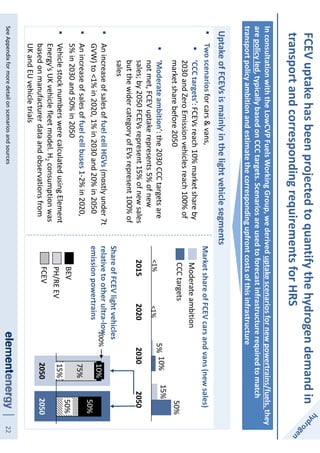
FCEVuptakehasbeenprojectedtoquantifythehydrogendemandin
transportandcorrespondingrequirementsforHRS
Twoscenariosforcars&vans,
‘CCCtargets’:FCEVsreach10%marketshareby
2030andZeroEmissionvehiclesreach100%of
marketsharebefore2050
‘Moderateambition’:the2030CCCtargetsare
notmet,FCEVuptakerepresents5%ofnew
sales;by2050FCEVsrepresent15%ofnewsales
butthewidercategoryofEVsrepresent100%of
sales
AnincreaseofsalesoffuelcellHGVs(mostlyunder7t
GVW)to<1%in2020,1%in2030and20%in2050
Anincreaseofsalesoffuelcellbuses1-2%in2020,
5%in2030and50%in2050
VehiclestocknumberswerecalculatedusingElement
Energy’sUKvehiclefleetmodel.H2consumptionwas
basedonmanufacturerdataandobservationsfrom
UKandEUvehicletrials
2015
10%
2030
15%
2020
5%
50%
2050
CCCtargets
Moderateambition
<1%
20502050
15%
75%
10%
50%
50%
100%
PH/REEV
FCEV
BEV
ShareofFCEVlightvehicles
relativetootherultra-low
emissionpowertrains
MarketshareofFCEVcarsandvans(newsales)
UptakeofFCEVsismainlyinthelightvehiclesegments
<1%
SeeAppendixformoredetailonscenariosandsources
InconsultationwiththeLowCVPFuelsWorkingGroup,wederiveduptakescenariosfornewpowertrains/fuels,they
arepolicyled,typicallybasedonCCCtargets.Scenariosareusedtoforecastinfrastructurerequiredtomatch
transportpolicyambitionandestimatethecorrespondingupfrontcostsofthisinfrastructure
23
Contents
−Introductionandcontext
−Backgroundandstatusquo
−Futurerefuellinginfrastructurerequirementsand
barrierstodeployment
−Futurehydrogentransportdemandscenarios
−Hydrogenproductionandtheroleofelectrolysers
−Futurerefuellinginfrastructurerequirementsandbarriersto
deployment
−Vehicle-specificinfrastructuredeployments
−Summaryroadmapandrecommendations
−Appendix
24
Growthinhydrogendemandto2050fromtransportwillrequire
significantcapacity,particularlyinlowcarbonproductionroutes
Source:UKH2MobilityPhase1publicreport,Roads2HycomDeliverable2.1and2.1a,ElementEnergy
1:Basedon100ktpa(largestcurrentUKSMRplant)2:Basedon70%efficiencyand80%loadfactor
Hydrogendemandtodayandin2050
Underthehighuptakecasehydrogendemandfortransportwillexceedexistingproductioncapacityinthe2030s
‒Existingproductioncapacitystandsatc.690kt/yearofwhich650kt/yearisdedicatedtousebyheavy
industry,leaving41kt/yearthatisdistributedbytubetrailer
‒Totaldemandfromtransportby2050equatestoc.2,300kt/yearunderthehighuptakescenario
Thisadditionaldemandpresentsasignificantchallengeintermsofbothproductionanddistributioncapacity:
‒Aquadruplingofexistingproductioncapacitywouldberequired:additionalproductionisequivalenttoc.23
largeSMRplants1,orc.15GWofgrid-connectedelectrolysers2
‒Ifthishydrogenwasallproducedcentrally,thiswouldlikelyrequirearound2,000tubetrailers,basedon
existingtechnology(1.1tpertrailer,500bar)andtwotripsperday,comparedto<100trailerstoday.
‒Alternatively,higherdemandcouldattractlargegascompaniestodeploycentralisedliquefactionfacilities
anddevelopliquidhydrogenlogisticsnetworksbenefittingfromgreatervehiclecapacity(c.3tpertrailer)
‒Thecaseofelectrolysisproduction(whichcanbecentralisedoron-site)isdetailedonthenextslide
Projectedgrowthinhydrogendemandforuseintransport(Highuptakecasereachingaparcofc.10millionvehiclesby2050)
0
1,000
2,000
3,000
3
Hydrogendemand(ktpa)
2015
2,300
194
2025
56
205020302020
690
Demandfromlightvehicles
Demandfromheavyvehicles
Existingmerchantdistributioncapacity
Existingproductioncapacity
25
ExpecteddevelopmentofelectrolyserapplicationsthroughtimeItisexpectedthatgrowthinelectrolyser
numberswillbeledbyanumberof
applications:
‒ThecommercialisationofFCEVsinthe
2015-2025period,leadingtoademand
forhigh-purity,lowcarbonH2
‒Othermarketsforelectrolysismayopen
inthepowertogasandchemicals
sectorsinparalleltotransport
Growthinelectrolysisisexpectedassumingtherightconditionsaremet
On-siteelectrolysis(asopposedtocentralisedproduction)islikelytodominateinshorttermasthereisabettermatchwiththescale
ofdemandatrefuellingstations.Groupsofon-siteelectrolyserscanprovidegridservicesthroughpooling/aggregation
Inthemediumterm,choiceofon-siteversuscentralisedproductionwilldependoneconomiesofscale,accesstolowelectricity
pricesversusdistributioncostsandpossiblecolocationwithotherdemands(e.g.powertogas,pre-combustioncarboncaptureand
storage)
GreenH2couldalsodisplaceconventionalH2inrefineryprocessesifavailableatsufficientlylowcost
Source:DevelopmentofWaterElectrolysisintheEuropeanUnion,FCHJU,2014
Accesstolow-costelectricity
Abilitytoaccesspaymentsfromenergynetwork
operatorsfromprovisionofgridservices
Optimisedeconomicsarekey
Improvementsincapex,systemsize,efficiencyandlifetimewillbe
requiredtoimproveoveralleconomics
TheseincrementalchangeswillbekeytothewidespreadrolloutofWE
Improvementsinperformanceandcapexalsorequired
1
2
Oncecommerciallyproven,H2fromwaterelectrolysis(WE)isexpected
toseesignificantgrowthto2030,driveninitiallybythetransportsector
26
Variableoperatingcosts,i.e.electricityinputcostsmakeupthelargestportionofthelevelisedcostofH2production
Themaincomponentofthecostofhydrogenproductionfrom
electrolysisisthevariableelectricityinputcosts
Thecostofhydrogenproductionismadeupofanumberofcomponents,dominatedbyvariablecosts
Capitalcosts(capex)
Allcapitalcosts(includingfinancecosts)
spreadovereachkgofH2delivered
Fixedoperatingcosts(fixedopex)
Includesservicing,maintenance,insurance,
landrentetc.
Variableoperatingcosts(variableopex)
Dominatedbyelectricitycost,butalso
includeswaterfeedstock
Coststructureisdominatedbyvariable
costs2.Lowelectricitypricesarerequired
tobecompetitivewithpetrol/dieselona
perkmbasis,whichisapproximately
£7/kgequivalentincludingtheHRS
1MWalkalineWEsystem2015costsfromFCHJUelectrolyserstudy(2014):capex=£760/kW,opex=£27/kW(excludesstackreplacement),electricitypricerange=
£0.05-0.11/kWh(lower-boundcorrespondstoelectrolyserprovidinge.g.gridbalancingservices,etc.orprivatewireconnectiontoarenewablesgenerator,upper-bound
correspondstousingretailelectricityprices),interestrate=7%,lifetime=15years,WEconsumption=55kWh/kgH2,utilisation=80%,excludesredundancycosts
Only4%ofexistingglobalH2production(mainlyforindustrialuse)isbasedonWE,1duetothehighercostsofWEinmostmarkets
comparedtoalternativese.g.SMR,orindustrialby-products
Morerecently,increasingdemandforlowercarboncontentandhigherpurityH2fortransportapplicationsisleadingtoincreased
demandforH2fromWE(whichproducesverypureH2,canbedeployedon-site,andcanbepoweredbyrenewableelectricity)
ThisnewdemandtiesinwellwiththeemergenceofWEasasolutionforenergystorageandgridbalancingapplications
NewapplicationsforelectrolyticH2areemerging
Source:ElementEnergyanalysis1IEA(2007),2Thisassumedawell-utilisedelectrolyser.Asutilisation
decreases,capexandfixedoperatingcostsbecomealargerproportionoftheoverallcostofH2produced
1
2.80
6.10
0.20
0.20
0.703.70
7.000.70
Lowelectricitycost(5p/kWh)
Highelectricitycost(11p/kWh)
FixedopexCapexVariableopexIllustrativeH2productioncostfromwaterelectrolysis,£/kg
27
TheeconomicsofH2fromelectrolysisareheavilydependentonthe
abilitytoaccessaffordableelectricityandtoprovideservicestothegrid
Source:DevelopmentofWaterElectrolysisintheEuropeanUnion,FCHJU,2014
2030H2costatthenozzlefortransportapplicationsintheUK
IntheUK,twomainwaystolowervariablecostscanbeenvisaged:
Reducingthecostofelectricitypurchased,throughe.g.
avoidingdistributionnetworkcharges–thiscanbeachieved
throughconnectingtheelectrolyserdirectlytoarenewable
generator,withoutgoingviathedistribution/transmissiongrid
Accessingpaymentsfromthegridoperatortohelpbalance
thegridbystoringenergyattimesofhighproduction/low
demand,orprovidingfrequencyresponseservices–theH2
producedfromenergystoragecanbeusedfortransport,re-
electrifiedviaafuelcell,orinjectedintothegasgrid
OptionsforminimisingdominantvariablecostsGridservicesimpact
2030H2productioncostinGermanyunderfull-andpart-
loadoperatingstrategies,offeringbalancingservices
Impactofoff-gridconnectionforelectrolyser
Savingsfromusingaprivatewire
connectioncanleadtoattractive
economicsvs.SMRin2030
Additionalsavings(e.g.c€1/kg)
canbemadefromofferinggrid
balancingservices–providedthe
rightbalancingpaymentsregime
isinplace
ResultingH2economics
2
28
Contents
−Introductionandcontext
−Backgroundandstatusquo
−Futurerefuellinginfrastructurerequirementsand
barrierstodeployment
−Futurehydrogentransportdemandscenarios
−Hydrogenproductionandtheroleofelectrolysers
−Futurerefuellinginfrastructurerequirementsandbarriersto
deployment
−Vehicle-specificinfrastructuredeployments
−Summaryroadmapandrecommendations
−Appendix
29
EarlypubliclyaccessibleHRSarelikelytorequirepublicfunding,beyond
2020HRSwillofferincreasinglyattractiveinvestmentpropositions
FCEVcostsarelikelytobehigherthandieseland
plug-invehiclesuntil2ndgen.in~2020orbeyond
FCEVcarsalesof100s-1000sexpectedbefore2020
Basedoncurrentuptake,pre-2020deploymentsare
likelytobeconcentratedinmajorurbancentres
HRSdeploymentslikelytobe10sofrelativelysmall
stations,withlowutilisationinearlyyears
Vans/captivefleetvehiclescouldhelpprovideabase
loaddemandforHRS.Locationsofthesevehicleswill
bedrivenbylocalcustomerdemand
FCEVpassengercarrolloutwilloccurslowlypre-2020
Pre-2020HRSarelikelytorequirepublicfunding
HRSinvestmentswillberequiredearlyinorderto
ensureearlyFCEVshaveaccesstohydrogen,despite
challengingeconomicsofsmall,under-utilisedHRS
Inmostcases(excepte.g.heavily-loadedcaptive
fleetHRS)European,nationalorregional
governmentinterventionwillberequiredtobridge
thefundinggap
Arangeoffundingsourcesisavailable–nextslide
Post-2020,HRSwillofferimprovingeconomics
AsFCEVnumbersrampuppost-2020,larger,more
profitableHRScanbebuilt
Withmorevehiclesprovidinghigherloadfactors,
theseHRSwilloffermorefavourableeconomics
Atthispoint,acommerciallysustainablerolloutis
possible,withincreasinginterestfromexisting
petrolstationoperatorsornewentrants.
Fundingnolongerneededonaperstationbasis
AB
Source:UKH2MobilityPhase1report
30
Arangeofpublicfundingsourceswillsupporthydrogenrefuelling
infrastructuredeploymentsinthepre-2020period
FundingbodyDescriptionFundingrateTimescales
FCHJU
(FCH2JU)
Public-privatepartnershipbetweenECand
industry,toadvancethecommercialisationof
hydrogenandfuelcells
Upto70%ofprojectvalue
underHorizon2020
Annualcallsforproposals
2014-20
EU
StructuralFunds
EUfundsforencouragingdevelopmentacross
arangeofthematicobjectives(total
~€10.7bn2014-2020fortheUK)
Upto60%ofprojectvalue
Annualcallsforproposals
2014-20
EUTEN-T/CEF
Funding
Fundingtoimprovekeytransportcorridorsin
Europe,acrossarangeofmodes(total
€26.3bn2014-2020acrossEurope)
Variesupto50%
dependingontypeof
project
Annualworkprogrammes
2014-2020
UKGovernment
UKGovernmentUltra-LowEmissionsStrategy
(£500m)includesfundingtosupportH2
infrastructureintheUK(announcedOctober
2014)
Initialfunding:£11minc.
newHRS(£7m),upgrades
(£2m)andvehicles(£2m)
•First£5.5mcall:closed
6thMarch2015
•Futurecallsuncertain
InnovateUK
UKGovernment-runbodytohelpfund
innovationinarangeoftechnologyareas
Upto50%ofprojectvalue
(60%forSMEs)
Regularcallsforproposals
Someuncertaintyremainsaroundtheendofpublicsupportbeyond2020
MultiplefundingsourcesareavailabletosupportnewrefuellinginfrastructureintheearlyyearsofFCEV
commercialisation,upto2020,howeverbeyond2020itisunclearwhichsourcesoffundingwillberenewed
Theremaybeaneedtoreviewpublicfundingaround2018,toevaluatetheneedforfunding/policies/other
supportmechanismsbeyond2020andensurethatadequatesupportisinplaceforhydrogentransport
commercialisationtocontinuebeyond2020
Source:ElementEnergy
31AD=Anaerobicdigestion
BarrierDescriptionExamplesolution
Costand
reliabilityofHRS
Today’sHRSareproducedinlowvolumes,
withbespoke,lowvolumecomponents.
Reliabilitynotyetequaltopetrolforecourts
Introductionofseriesproductionandstandardised
designs
Reducedcostandstandardisationof
compression/pre-coolingcomponents
Mobileback-upstationstogivenetworkredundancy
Customer
experience
Consistentcustomerexperiencee.g.‘lookand
feel’ofstations,easeofpayment,pricingetc.
notyetestablished
Industry-agreedguidanceforcustomerexperience
Appstohelpnavigatesparseearlynetwork
Regulatoryand
approvalsprocess
Regulatoryregimesoftendifferbetweensites,
withnostandardisedapprovalsprocessyet
defined
IntroductionofEU-wideregulationsforsafedesign
ofHRS
Standardisedandstreamlinedapprovalsprocesses
Safetyrestrictions
Statichydrogenstorageregulationsrestrict
sizingofrefuellingstations
AmendCOMAH(andother)regulationstoreflectthe
needsofthehydrogentransportsector
Stationsiting
Challengingtofindsuitablesitesinspace-
constrainedurbanareas
Developmentworktoreducestationfootprints
Involvementoffuelretailers/sitehostsrequired
H2quality
assuranceand
metering
QualityassuranceprocedurestomeetISO-
definedpuritylimitsnotyetfinalised
AccurateH2fuelmeteringtechnologyis
immature
Developmentofstandardised,low-cost,in-linefuel
qualitymeasurementtechniques
SimplifiedH2purityregulationsfromOEMs
Volume-producedH2meteringtechnology
Thehydrogensectorisworkingtoaddressseveralbarrierstoallow
thetransitionfromdemonstrationactivitiestoacommercialrollout
32
Contents
−Introductionandcontext
−Backgroundandstatusquo
−Futurerefuellinginfrastructurerequirementsand
barrierstodeployment
−Futurehydrogentransportdemandscenarios
−Hydrogenproductionandtheroleofelectrolysers
−Futurerefuellinginfrastructurerequirementsandbarriersto
deployment
−Vehicle-specificinfrastructuredeployments
−Summaryroadmapandrecommendations
−Appendix
33
H2demand(ktpa):
Passengercars-fullnationalcoverageforhydrogenrefuellingfor
carsisexpectedby2030,tosupportincreasingFCEVnumbers
TotalFCEVsinthevehicleparcbeyond2020
Source:UKH2MobilityPhase1publicreport,DECC2050pathwaysanalysis
Thousand
FCEVs
218-3465-130340-1300
First10-15HRS
deployedin2015
Gradualramp-upto
65by2020before
furtherdeployments
Likelymostly‘small’
(<100kg/day)–
HRSsupportedby
publicfunding
Dominatedbystand-
aloneHRS,some
forecourtintegration
2015-2020
Ramp-uppost-2020
with2ndgen.FCEVs
>300HRSdeployed
by2025
Shifttolarger,
profitablestations
Shifttoforecourt
stationsandmarket
entrybymajor
retailers
2020-2025
Furthermass-market
vehiclegrowth
Rapidrolloutof
large,forecourt-
integratedHRS
Fullnational
coverageachieved
by2030,with>1,000
HRSdeployed
Interventionto
ensuresufficient
greenH2in
productionmix
2025-2030
Continuedgrowthin
linewithFCEVsales,
whichareexpected
tomakeup20-50%
ofthevehicleparc
by2050
Hydrogena
‘standard’offerat
majorityofrefuelling
stationsduringthis
phase
2030-2050
4,300
180680
16,800
3501,400
205020252030
ModeratescenarioCCCtargetscenario
2
2020
34
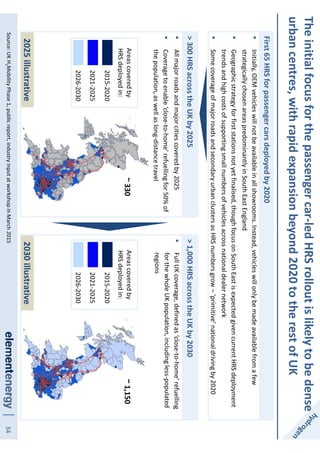
First65HRSforpassengercarsdeployedby2020
Initially,OEMvehicleswillnotbeavailableinallshowrooms.Instead,vehicleswillonlybemadeavailablefromafew
strategicallychosenareaspredominantlyinSouthEastEngland
Geographicstrategyforfirststationsnotyetfinalised,thoughfocusonSouthEastisexpectedgivencurrentHRSdeployment
trendsandhighcostsofsupportingsmallnumbersofvehiclesacrossnationaldealernetwork
SomecoverageofmajorroadsandsecondaryurbanclustersasHRSnumbersgrow–‘primitive’nationaldrivingby2020
>300HRSacrosstheUKby2025
Allmajorroadsandmajorcitiescoveredby2025
Coveragetoenable‘close-to-home’refuellingfor50%of
thepopulation,aswellaslong-distancetravel
>1,000HRSacrosstheUKby2030
FullUKcoverage,definedas‘close-to-home’refuelling
forthewholeUKpopulation,includingless-populated
regions
Source:UKH2MobilityPhase1,publicreport,industryinputatworkshopinMarch2015
2025illustrative
2015-2020
Areascoveredby
HRSdeployedin:
2021-2025
2026-2030
2015-2020
Areascoveredby
HRSdeployedin:
2021-2025
2026-2030
~330~1,150
2030illustrative
Theinitialfocusforthepassengercar-ledHRSrolloutislikelytobedense
urbancentres,withrapidexpansionbeyond2020totherestofUK
35
Vans-useofpassengercarstations,withasmallnumberof
dedicatedHRSatdepotsby2030
Growthinhydrogenvansexpectedbeyond2025asmorevehiclesbecomeavailableandpricesdrop
MostH2vansdeployedin
relativelysmallnumbers,
reliantonfullypublic
infrastructure
AdditionalH2vanoptions
likelyavailable,e.g.from
OEMsgreaterpenetration
amongstfleetoperators
Ascostsapproachdiesel
parity,rapidgrowthin
adoptionofH2vansin
applicationsthatcannotbe
metbybatteryelectricvans
2015-20202020-20252025-2050
UseofpublicHRSpreferableto
provide‘baseload’H2demand
Somevanscurrentlyrequire
350barrefuelling–dual-
pressureHRSmaybeneeded
wherethisisjustifiedbylocal
vehicledemand
Avoiddepot-basedrefuelling
wherepossible,deploying
vehiclesinfleetsabletouse
theemergingpublic
infrastructure
Maximisepublicavailability
2015-2020
Increaseddeploymentsof
vans,particularlydrivenby
urbanairqualityrestrictions
Continueduseofpublic
refuellingwherepossible
Emergenceofdepot-based
refuellingwhereneededfor
operationalreasonsandfor
largefleets
Potentialshiftto700bartanks
reducingtheneedfordual-
pressurestations
2020-2025
Widespreaddeploymentof
hydrogenvans
StrongutilisationofHRSby
carsreducesimportanceof
non-depotrefuellingforvans
(i.e.baseloaddemandis
alreadypresent)
Useofdepot-basedfuelling
wherevermoreconvenient
forfleetoperators
2025-2030
36
H2demand(ktpa):
Buses(+trucks)-significantnumbersofdepot-basedHRSare
expectedby2030,likelyfocusedinmajorurbancentres
TotalFCEVbusesandHGVsintheUKfleet
Numberof
HGVsandbuses
31023440
Uptoc.5depot-
based350barHRS
withuptoc.1tpd
Unlikelytobe
publiclyaccessible
Locationsdrivenby
localpolitical
ambitionandair
qualitytargets
Limited
demonstrationsof
H2lighttrucks
2015-2020
Furtherdeployments
ofe.g.20buses(1-2
routes)inleading
cities.1depotHRS
percity(~1tpd)
Reducedpublic
fundingforrefuelling
infrastructure
IncreasinguseofH2
inlighttrucksto
complementEVsfor
longerdutycycles
2020-2025
Multipleroutes
usingfuelcellbuses
inleadingcities
Larger~2-5tpdHRS
indepots
Novelengineering
solutionsrequired
fortheselarger
depots
GrowingroleforH2
inlargertrucks,likely
usingdepotbased
refuelling
2025-2030
Hydrogenbecomes
oneofthedominant
fuelsforbuses
alongsideother
ULEVpowertrains
Widespread
availabilityofhigh-
capacity350barHRS
developedindepots
acrossthecountry
Widespreaduseof
H2intrucks
2030-2050
130,000
8,0003,000Low100s
2020202520302050
37
Forklifts-theforkliftHRSmarketislikelytogrowrapidlybeyond2020,
providedthetechnologycancompeteoneconomictermsintheUK
Growthinhydrogenforkliftsexpectedbeyond2025asmorevehiclesbecomeavailableandpricesdrop
Smallnumberofdeployment
projectsto2020totestthe
cost-effectivenessoffuelcell
forkliftsintheUKmarket
Iffuelcellforkliftscanprove
theircost-effectiveness
relativetoelectric/hybridin
theUKmarket,deployments
inlargernumberswilloccur
Continuedrolloutof
hydrogenforkliftstoexisting
customers,untilalltheir
majorlogisticcentreshave
beencovered
2015-20202020-20252025-2050
Trialfleetsusing350bar
indoorHRS,capacitiesupto
50kg/day(c.25vehiclesper
site)
Likelyfocusedonmajor
logisticaloperatorsinstrategic
locationswherebattery
technologycurrentlyinuse–
uptoc.10sites
USdeploymentssuggestfocus
isonlargestsitesinitially,
whereeconomicsaremost
favourable
2015-2020
Indoorrefuellingwith
capacitiesuptoc.100-
200kg/day(uptoc.100
vehiclespersite)
Focusedonmajorlogistical
operationsinstrategic
locations(e.g.ports,large
retailerdistributioncentres,
airports,etc.)–likelystarting
withexpandedfleetsatinitial
trialsites,with10’sof
additionaldeployments
beyondthat
2020-2025
Likelylow100’sofsites
suitableintheUKwithsimilar
specs(i.e.100-200kg/day)by
2030
Beyond2030,ascostsstartto
competewithincumbent
technologies,e.g.gasor
diesel,customersinlocations
withloweroperatinghours
andfewervehicles–maybe
indoorsoroutdoorsandcover
rangeofcapacities
2025-2030
38
Source:H2TINA(2015).Costs=HRScosts80kg/day:£0.8m(2012),£0.4m(2025).500kg/day:£1.4m(2012),£0.7m(2025).
1000kg/day:£2.4m(2012),£1.3m(2025).Nocostreductionfor2030&2050.
20302025
£400m-£700m1
£6,750m
2050
£50m£180m
2020
Approximatecumulativepublicinfrastructureinvestment
required(stationcapitalandcivilscostsonly)
Productionanddistributioncapacityhasnotbeenconsideredwhenestimatingoverallstationnumbers.
Investmentneedsinhydrogenstationsareexpectedtobeupto£700m
by2030,risingsignificantlyto2050toservealargeUKvehiclefleet
1LowerboundbasedonUKH2MobilityPhase1report,assuming1,150stationsby2030.UpperboundbasedonHRScostdatafromH2TINA
65HRSc.250HRSc.700HRSc.6,000HRS
Marketdriven/private
investment
Earlymarket–somesupportto
investmentlikelytobeneeded
39
Contents
−Introductionandcontext
−Backgroundandstatusquo
−Futurerefuellinginfrastructurerequirementsand
barrierstodeployment
−Summaryroadmapandrecommendations
−Appendix
40
Basicnationalcoverage
Public
accessHRS#’s
First65‘small’HRS
HDVdepots
Pressure
350bar
Van/smalltruckdepots
Indoorforklifts350bar
Nextc.250‘medium’
and‘largeHRS
Nextc.700‘medium’
and‘large’HRS
Continuedgrowth
basedondemand
700barSAE-compliantfuellingforcars.HRS
investorsencouragedtomake350barH2available
tosupportothervehicletypeswhereneeded
Upto5additionalc.
1t/daydepot-basedHRS
Emergenceofmulti-tonne/daydepotsinmajor
urbanareas,coveringmultiplerouteseach
Nationwidedeployment
oflargebusdepots
GradualgrowthinindoorHRSasmarketdevelops,
movingfromsmall(<50kg/day)tolarge(>100kg/day)
Conversionofmultiplelargelogisticscentres
frombatteriestofuelcellswithindoorlargeHRS
TheH2infrastructureroadmapreflectsthediverserefuellingneedsof
differentvehicletypesandtheuncertaintyaboutthespeedoftherollout
Location
20152050202020302025
Fullnationalcoverage
Dashedlinesrepresent
highuncertainty
Majormilestone
/enabler
Productioncapacitylargely
forindustryapplication
Providebaseloadtounderutilisednetworkinearlyyears
H2supplyand
logistics
c.3ktpa
Production
capacity
Transport
demand
Provisionofnewcentralisedcapacity
tosupporton-sitedeployments
2015
production
capacity
exceeded
c.190ktpac.2.3Mtpa
Increasingforecourtintegration/decreasingstand-aloneHRS
Limiteduseofdepot-basedrefuelling
wherecost-effective/convenient
HRS:hydrogenrefuellingstation
Cars
Vans
HDVs
Thousandvehicles
Projectionsarebasedonpolicy-
leduptakescenariospresented
onpage22
Datasupportedquantificationof
infrastructurerequirements
Hydrogenvehiclestock
4,200-
16,800
750-
3,000
130
680-
1,400
100-
200
8
180-
350
30-60
3
2
<1
<1
Infrastructureroadmap
2050202020302025
c.£40mc.£180m£400-700mc.£6,800m
41
Industryandgovernmentwillneedtoworkcloselytosecurethe
deploymentoftheearlypublicHRSnetworkandhydrogenvehicles
SecuringdeploymentoftheearlypublicHRSnetwork1
AcertainnumberofHRS(e.g.65setoutbythe
H2Mobilitystrategy)islikelytobeneededtomeetthe
needsoftheearliestcustomersandtocontinueto
attractOEMstotheUK
LowutilisationmeansthattheseearlyHRSwillneed
publicfundingtoattractprivateinvestment
HRSinvestorswillalsorequireconfidencefromvehicle
suppliersonthetimingandambitionofvehicle
deployments
Customerincentivesarelikelytobeneededto
encourageearlyvehiclesalesasOEMstransitionto
lowercostsecondgenerationvehicles
Thenetworkwillalsoneedtoofferaconsistentandhigh
qualitycustomerexperience,intermsofthestation
‘lookandfeel’,easeofuse,paymentmethodsetc.
Source:ElementEnergy
Recommendations
CentralGovernment:Providefinancialsupport
toearlyHRS,usingfundingconditionstoensure
highqualityuserexperienceandcoherent
geographicstrategy.Providesupporttovehicles
throughexistingULEVincentives
LocalGovernment:Helpprovide‘baseload’
demandtopublicHRS(e.g.FCEVprocurement
forpublicfleets)andmakesitesavailablefor
refuellingstationswherepossible
OEMs:Providetransparencyonnumbersand
locationsofvehicledeployments(asfaras
possible)tomaximiseconfidenceofHRS
investors
HRSoperators/suppliers:Workcloselywith
vehiclesuppliersandtheircustomerstoensure
thatHRSsitingandspecificationsmeettheir
needs
42
Ensuringinfrastructureiscompatiblewithallvehicletypesandpublicly
accessiblewillmaximisestationutilisation
MaximisingutilisationofearlystationsCoordination
23
Asthenetworkgrows,coordinationofHRSsitingis
likelytobeneededtooptimisecoverageand
customerconvenience
Coordinationisalsolikelytobeneededoncross-
cuttingtopicse.g.securingdeploymentsof‘green
hydrogen’productioncapacity,meteringandbilling,
progresstowardsfullyforecourt-integratedstations
IfuseofstandaloneHRScontinues,HRSoperators
shouldworkcloselytodefineaconsistentapproach
tositingand‘lookandfeel’toallowdriverstofind
andusetheinfrastructure
Recommendations
AllH2stakeholders:Identifyanappropriateforumto
allowdiscussionofthesecoordinationactivities,andto
presentanalignedUKstrategyinoutreachto
internationalOEMstomaximiseappetitetobring
vehiclestotheUK
Earlynetworkislikelytouse700barrefuelling,
basedonrequirementsofOEMpassengercars
Othervehicletypes(e.g.vans,smalltrucks)
currentlyuse350bartankswhicharenot
compatiblewithhigherpressuredispensers
Theuseofdual-pressurestations(700/350bar)
allowspublicHRStomeetrefuellingdemandsof
thesevehicles,increasingearlyusagewhere
demandexists
Fleetvehicleusersshouldalsobeencouraged
tousepublicHRSratherthandepotsolutions
wherefeasibletofurtherincreaseutilisation
Recommendations
HRSinvestors:Workwithvehiclesuppliersto
identifyneedsfordual-pressureHRSsites
Localgovernment:Encouragefleetstationstobe
publiclyaccessibleforprivatecustomerswhere
feasible(e.g.throughplanningsystem)
Source:ElementEnergy
43
Existingregulationsshouldbeamendedtoharmonisetheplanning
approvalprocess,therebystreamlininginfrastructureinstallation
Sitingandplanningprocess4
LackofguidanceonHRSsafety
requirementscanleadtoplanningdelays
andinconsistentuserexperience
Transitionfromstandalonetoforecourt-
integratedsiteslikelytowards2020
WorktoincludehydrogenintheBlue
Book1isunderwaytorepresenthydrogen,
inparticularaddressingelectrical
hazardouszonesandsafetydistances,
givingclearguidanceforusebydevelopers
andpetroleumofficersindesigningand
approvingHRSonforecourts
Recommendations
LocalAuthorityplanningteamsand
regulatoryauthorities:Supporttheapproval
ofintegratinghydrogeninfrastructureinto
existingforecourts;produceguidance
documentsforstandaloneHRS
1NationalGuidancedocumentjointlypublishedbytheEnergyInstituteandAssociationforPetroleumand
Explosives(APEA)usedtoassessandsignoffthesafetyofnewforecourtinstallationsandupgrades
Innovationopportunities5
ReducingthecostofHRS,H2production
anddistributionandvehicleswillbe
requiredtoallowmass-market
deployments
QualityassuranceofH2(lowercost
analysis,continuousmonitoringetc.)needs
tobefurtherdevelopedandstandardised
Engineeringsolutionsarerequiredforlarge
scaledepotrefuellingbeyondcurrentfleet
sizes(e.g.c.100busdepotrequiringc.2
tonnes/day)
Fullintegrationofwaterelectrolysersinto
thegridwillrequirefurthertrialsof
technicalandcommercialarrangements
Recommendations
Innovationfundingbodies:Workwithindustry
todefineclearinnovationneedsthatcanbe
deliveredthroughR&Dfundingandtrials
44
Newpolicymayberequiredinthemediumtermtoensurethatthe
futurehydrogenproductionmixdeliversCO2emissionssavings
Hydrogenproductionpathways6
CurrentUKhydrogenproductioncapacityis
insufficienttomeettransportdemandfromthe
mid2030s
Thereforenewproductioncapacitywillneedto
beintroducedconcurrentlywithvehicledemand
growth,takingintoaccountGHGemission
reductiontargets
Astrategywillbeneededonhowthiscapacity
willbedelivered(basedontheexpected
volumesofhydrogenvehicles)whileensuring
thattheoverallproductionmixdeliversverylow
well-to-wheelemissions
Recommendations
CentralGovernment:Considerpolicymechanisms
toensuresufficientvolumesoflowcarbonhydrogen
sources
R&Dbodies:Investigatelowcostgreenhydrogen
productiontechnologies
Technologytype
1.Distributedwaterelectrolysis
2.Conventionalwaterelectrolysis
3.Coalgasification+carboncaptureandstorage
4.CentralisedSMR+carboncaptureandstorage
5.IGCC+carboncaptureandstorage
6.Distributedsteammethanereforming
7.Conventionalsteammethanereforming
8.Internalgasificationcombinedcycle
9.Coalgasification
Source:Aportfolioofpower-trainsforEurope:afact-basedanalysis,McKinsey&Co,2011
Targets:technicaltargetstoreducecarbonfootprintofhydrogenasatransportfuel
45
Contents
−Introductionandcontext
−Backgroundandstatusquo
−Futurerefuellinginfrastructurerequirementsand
barrierstodeployment
−Summaryroadmapandrecommendations
−Appendix
46
References
−Aportfolioofpower-trainsforEurope:afact-basedanalysis,2011
−BPStatisticalEnergyReview,2014
−Datafromindustry,including:Shell,AirProducts
−DECC,EnergyconsumptionintheUK,2014
−DECC,2050energypathwaysanalysis,2013
−DfT,RoadlengthsinGreatBritain,2013
−DUKESChapter3/4/5,2015
−ElementEnergyandE4TechfortheFCHJU,DevelopmentofWaterElectrolysisintheEuropeanUnion,2014
−ElementEnergyforBirminghamCityCouncil,ACityBluePrintforLowCarbonFuelRefuellingInfrastructure,2015
−ElementEnergyforDfT,Ultralowemissionvanstudy,2012
−ElementEnergy,OptionsandrecommendationstomeettheREDtransporttarget,2014
−ETI,AnaffordabletransitiontosustainableandsecureenergyforlightvehiclesintheUK,2013
−EuropeanParliamentandCouncil,Directive2009/30/EC,2009
−IEA,HydrogenProductionandDistribution,2007
−ForecourtTrader,FuelMarketReview,2014
−JRC,WTTanalysisoffutureautomotivefuelsandpowertrainsintheEuropeancontext,2014
−Roads2HycomDeliverable2.1and2.1a,2007
−UKH2MobilityPhase1,publicreport,2013
47
Acronyms
AFVAlternativeFuelVehicle
CCCCommitteeonClimateChange
CCSCarbonCaptureandStorage
CHPCombinedHeatandPower
COMAHControlofMajorAccidentHazard
DECCDepartmentofEnergy&ClimateChange
DfTDepartmentforTransport
DUKESDigestofUnitedKingdomEnergyStatistics
ECEuropeanCommission
EEElementEnergy
ETIEnergyTechnologiesInstitute
EUEuropeanUnion
FCFuelCell
FCEVFuelCellElectricVehicle
FCHJUFuelCellHydrogenJointUndertaking
FLTForkLiftTruck
H2Hydrogen
HDVHeavyDutyvehicle
HGVHeavyGoodsVehicle
HRSHydrogenRefuellingStation
HSEHealthandSafetyExecutive
ICEInternalCombustionEngine
ktpathousandstonnesperannum
LCNLowCarbonNetwork
MtMilliontonnes
NGNationalGrid
NPPFNationalPlanningPolicyFramework
OEMOriginalEquipmentManufacturer
OLEVOfficeforLowEmissionVehicles
PMParticulateMatter
R&DResearchandDevelopment
REDRenewableEnergyDirective
SMRSteamMethaneReforming
TEN-TTrans-EuropeanTransportNetworks
TSBTechnologyStrategyBoard
TTWTank-to-Wheel
ULEVUltra-LowEmissionsVehicle
WEWaterElectrolysis
WTTWell-to-Tank
WTWWell-to-Wheel
48
TotalUKvehiclestock(millionvehicles)
Futurevehicleprojectionsusefigures
providedbyDfT:
−Carsstocktoincreasefromc.30
millionto39millionandc.550billion
vehiclekmtravelledby2050
−Vansstocktoincreasefromc.
3.5millionto7millionby2050
−HGVsstocktoincreasefromc.500
thousandstodaytoc.630thousand
by2050
−Busesstockandvehiclekmtravelled
tostaybroadlyconstantataround
170thousandunitsand5billion
vehiclekmtravelled
Overallfleetandkmincreaseofc.40%
between2015and2050
ThemodellingofthefutureUKfleetisbasedonDfTtrafficandpark
sizeprojections
7
5
4
4
30
39
20302020
37
32
2015
34
+37%
2050
47
41
35
CarsVansHGVsBuses
103
142
82
72
413
449
+43%
2015
517
5
512556
27
2050
738
2030
305
5
528
650
2020
35
564
Totalvehiclekmtravelled(billionkm)
Source:DfTRoadtransportforecasts(availableonline)aswellasdirectsupplyofNationalTravel
Modeloutputsforthecaseofcars
49
Thepowertrain/fueluptakescenariosunderpinningthe
InfrastructureRoadmaparepolicyled
Uptakescenariosfocusonalternativefuels
Thescenariosusedarenotintendedtocoverallpossibleoutcomesbutinsteadfocuson
caseswithambitiousuptakeofalternativefuels
Scenariosarepolicyled,typicallybasedontargetssetbytheCommitteeonClimateChange
(sourcesshownnext);theyareillustrativeratherthanbasedondetailedofnewmodelling
technologycostsandcustomerdecisionmakingbehaviour
Thereforetheuptakescenariosrepresentpossiblefutureswherelowandultralowemission
powertrainsaresuccessfullydeployed
FocusisintendedtoprovidethemostinterestinginputsfortheanalysisoftheInfrastructure
Roadmap–e.g.a‘businessasusual’casewherepetrolanddieselcontinuetoprovideover
98%ofroadtransportenergywouldnotrequirenewrefuelling/recharginginfrastructure
InaccordancewiththeFuelRoadmap,blendshigherthanB7arenotconsideredforthe
mainstreamfuelsandE20isconsideredonlyfromthe2030s
Scenarioshaveenabledfutureinfrastructurerequirementstobequantifiedandupfrontcosts
capitalcostsforpublicinfrastructurehavebeenestimated.Costofsettingnewfuel
productionassets,distribution/logisticscostsandgeneralinfrastructureoperatingcostshave
notbeenconsidered.Costsofotherincentivesthatmightberequiredtoachievetheuptake
scenarios(e.g.vehiclegrants)havennotbeenestimatedinthisstudy
50
Overviewofthepowertrainoptionsconsideredandkeysources
CarsandvansBusesHGVsNRMM
HGV=HeavyGoodsVehicles,NRMM=NonRoadMobileMachinery
ICE:petrol,diesel,
LPG,(gas),(H2in
earlyyears)
EVs:BatteryEVs,
plug-inhybridEVs,
fuelcell(FCEVs)
TheCarbonPlan
andthe
Committeeon
ClimateChange’s
recommendations
H2MobilityPhase
1report,2013
Historictrendsfor
petrol/dieselsplit
ICE:diesel,
(bio)methane
EVs:BEV,PH/RE,
FCEV
(Liquidairfor
cooling/hybrid
power)
Currentand
announced
commercial
availability,policy
drivers
Alternative
Powertrainfor
Urbanbuses,2012
CCC–4thCarbon
BudgetReview
ICE:diesel,
(bio)methane,
(methanol)
EVs-inlighter
segmentsonly
Currentand
announced
commercial
availability
DfTHGVTask
Force
TSB-DfTLow
CarbonTruckTrial
CCC–4thCarbon
BudgetReview
ICE:diesel,LPG,
(gas),Liquidairfor
refrigerationunits
(Batteriesand
FuelCells–in
some
applications)
Dataonfuelusage
ofNRMMis
sparse
Morequalitative
approach
suggested
Parenthesesindicatesthepowertrain/fueloptionisexpectedtostaynicheinthe2050horizon RELEVANT
POWERTRAINS /FUELS
KEY SOURCES / INDICATORS
51
Carsandvansareexpectedtotransitiontozeroemissionpowertrains
fortheUKtomeetitsGHGreductiontargets
Source:ElementEnergy
Carsandlightcommercialvehicles(‘vans’)aretreatedtogetherastheyhavethe
sametechnologyoptionsandfallunderthesameelectrificationtargetsinthe
CarbonPlan.
Salesofvansrunningonmethanearenotconsideredinthemodellingonthebasis
ofthelowcommercialavailability(only2modelsonthemarket),lackofpolicy
driversforgrowthandaforementionedelectrificationtargets.Anygasdemand
resultingfromvanswouldbesmallenoughtobeconsiderednegligible,in
comparisontothepotentialgasdemandfromtrucks.
DualfuelvansrunningondieselandhydrogenandRangeExtenderFuelCell
electricvans(beingdeployedcurrentlyintheUKandincontinentalEurope)arenot
modelledexplicitly.Instead,theirhydrogendemandisaccountedforinthe‘FCEV’
heading.Thespecificrequirementsfordualfuelandrange-extenderH2vansare
howeverconsideredintheInfrastructureRoadmap(e.g.dispensingpressure).
52
Sources:ElementEnergy,UKH2MobilityreportPhase1(2013),PathwaystohighpenetrationofEVs,EEfortheCCC(2013),
OptionsandrecommendationstomeettheREDtransporttarget,EEforLowCVP(2014)
2030
60%
30%
2020
100%
2050
100%
3%
2015
9%
Moderateambition
CCCtargets
<1%
MarketshareofEVs(newsales)
50%60%
50%
75%
50%39%35%50%
0%
20302050
10%
15%
2020
15%0%
100%
2050
50%
2015
1%
BEVFCEVPH/REEV
BreakdownofmarketshareofEVs
TwoEVuptakescenarioshave
beenused:
−‘CCCtargets’:EVsreach60%
marketshareby2030andZero
Emissionvehiclesreach100%
ofmarketsharebefore2050
−‘Moderateambition’:the
2030CCCtargetsarenotmet
butEVuptakeisnonetheless
high(30%newsales);by2050
EVsrepresent100%ofsales
butaremainlyPHEVsorRE-
EVs,i.e.stillreliantonliquid
fuels
Scenarios
WestudiedinfrastructurerequirementssetbytheCommitteeonClimate
ChangetargetsaswellasacasewithaslowerEVuptake
53Sources:ElementEnergy,SMMTdatafor2000-2013sales,UKLPGforLPG2013figures
SalesofnewcarswithInternalCombustionEnginevehicles-split
betweenspark-ignition(‘petrol’type)andcompressionignition
engines(‘diesel’type)
37%46%51%50%50%
86%
63%54%49%50%50%
20052000
14%
2020-502013
100%
20102012
CompressionignitionSpark-ignition
PROPOSED
SCENARIO
RiseofdieselStabilisation
2013
5.0%
2030
0.6%
Shareofspark-ignitioncars(ICEandHEV)stockthatrunonLPG
c.112,000units
c.800,000units
Weassumedthatthecurrentsplitof
petrol/dieselenginesfornewcars(50/50)
ismaintainedgoingforward
InlinewiththeFuelsRoadmap,dieselwill
beB7(EN590)withanincreasingamount
ofdrop-inrenewablediesel–i.e.no
compatibilityissuetobeconsideredforthe
distributioninfrastructure
Forpetrolengines,wewillevaluatethe
amountof:
−EthanolneedediftheE10becomes
themaingradeby2020andE20by
2032
−LPGneededforacasewheretherate
ofconversion(orsalesifOEMsupply
isputinplace)acceleratestoreach
5%ofthepetrolcarstock(equivalent
toc.40,000conversionsperyear
until2030)
Allnewvansareassumedtorunondiesel
Scenarios
Weassumedcontinuationoftheobservedpetrol/dieselshareforcars
andmodelledanambitiousLPGuptake
Decreasingstock
post-2030asnonew
conversion/salesare
assumed
54
Source:ElementEnergy,DfTStatisticsTableVEH0601,LowCVPLowCarbonEmissionBusMarketMonitoring(Jan2015),CCC,
4thCarbonbudget,20131-AlternativePowertrainforUrbanbusesstudy(2012)
30%
10%
60%
Singledeckbus/coach
Doubledeckbus/coach
Minibus
UKbusfleet,c.165,000vehicles:
UKlowemissionbuses(allsingleordoubledeck,
nomini-buses)
274
12785
18
2014
1,787
FCEV
BatteryEV
Biomethane
Micro-hybrid
Hybrid
ScenarioCurrentUKbusmarket
Werampedupthealternativefuelmarketsharefrom
2030,inlinewiththeEuropeanstudy1thatsuggeststhat
theTCOofbatteryandFCe-citybuseswillbecome
comparableandcompetitivewithdieselandCNGbusesby
20301
Weassume90%uptakeforZeroEmissionVehiclesby2050
Thisislowerthatthe100%FCEVsassumedintheCCC
projections,toreflectthefactthatdoubledeckerbuses
(andbusesinhighlyruralareas)mightrequiregas
0%
92%
60%
80%
10%
40%
5%
15%
15%5%
2020
100%
2050
50%
20402030
2%
10%
10%
4%
Newbusessalesscenario:
‘Diesel’referstoablendofB7
anddrop-inrenewablediesel,
aspertheFuelsRoadmapDiesel,includeshybridBEV
FCEV(Bio)methane
Buseshavemanypowertrainoptionsbutoverallsmallfuelusesowe
usedonlyonescenario,wherealltechnologiesseehighsales
55
Source:ElementEnergy,DfTStatistics,BirminghamCityBlueprintforlowcarbonfuelsrefuellinginfrastructure,EEfor
BirminghamCityCouncil(2015),LowEmissionHGVTaskForce(2014),HMRC(2014),CCC,4thCarbonbudget,2013
29%32%
39%
>31tGVW-articulated
>8tto31tGVW-mostlyrigid
>3.5tto8tGVW-rigid
UKHGVfleet,c.460,000vehicles:
UKlowemissiontrucks-estimates
<100
c.1,000
2014
Methane
BatteryEV
94%79%
0%
45%
20%
5%5%
20%
10%1%
2050
0%1%10%
40%
20%15%
2020
1%
2040
100%
10%
25%
2030
Newtrucksalesscenario:
Gastrucksallover18tGVW,mostly
dualfuel(dieselandmethane)
Electrictrucksallunder18tGVW
FCEVlighttrucksatearlydemostage
‘Diesel’referstoablend
ofB7anddrop-in
renewablediesel,asper
theFuelsRoadmap
Diesel,includeshybrid
Methane
BEV
FCEV
DieselLPGdualfuel
ScenarioCurrentUKHeavyGoodsVehiclemarket
WetomodelledaHighAlternativeFuelUptakecasewhere
bothpureelectricandgastrucksreachasignificantsales
levelsintheirrespectivemarkets(lightandheavytrucks)
FCEVsalsocapturealargeshareofthemarket,asperthe
CCC’svisionoftheroleofhydrogen
ForHeavyGoodsVehicles,wetestedahighuptakeofbothelectric
(batteryandfuelcell)andgastrucks
56
Non-RoadMobileMachinerytypicallyrefuelsinprivatedepots/premises
butthecaseofLPG,liquidairandhydrogenwereconsidered
Source:ElementEnergyanalysisbased,onDfTstatisticsrequestedinJan2015andNon-RoadMobileMachineryUsage,
LifeandCorrectionFactorsAEAforDt(2004),industryinputforLPGuseinforklift
10%
7%
23%
17%
42%
Forklifts
Otheroff-roads
Agriculturaltractors
RefrigerationunitsonHGVs
Portablegeneratorsets
Otheroff-roads:TelescopicHandlers,BackhoeLoaders,Excavators,Cranes,Bulldozers,Compressorsetc.
UKNRMMfleetforindustry,constructionand
agriculture,c.700,000unitsin2014:
(CouldtransitiontoLPG,BatteryandFuelCellpacksforsomeuses)
LPG,couldtransitiontoLiquidAir
UseofLPG(alreadyusedbyc.30%offorklifts)andbatteries
couldincrease,couldtransitiontohydrogen
(Limitedoptions,possibly(bio)methaneorhighblendbiodiesel)
Scenario
(LPG,limitedalternativefueloptions)
Beyondtheblendingofrenewabledrop-indieselindiesel,
optionsforcleanerfuelsare:
Wetoconsidered(qualitatively,consideringthe
lackofdisaggregateddataonfueluse)the
infrastructureimpactsof:
−AtransitiontoLiquidAirforHGV
refrigerationunits
−AnincreaseinLPG,batteryandhydrogenuse
forforklifts
57
Appendix–Therearebroadlytwotypesofrefuellinginfrastructure
forliquidfuelsintheUK
Source:ElementEnergy,DfTModes3study(2011)
Largefleetoperatorsincludingpublic
transportoperators,hauliers,logistics
companies,forkliftoperatorstendtooperate
designatedrefuellingdepotssuitedtotheir
‘returntobase’operations
Suchfacilitiestendtobeprivateand
exclusivelyserviceasinglevehicletype
Mostbusesandheavygoodvehiclesrefuel
indepots–shareofdieselsuppliedthrough
depot:
90%forbuses,40%forcoaches
80%articulatedtrucks,45%rigidtrucks
Refuellingatprivatedepots:c.25%fuelsalesRefuellingatpublicforecourts:c.75%fuelsales
Generally,publicvehiclerefuelling(passenger
cars,vans,motorbikes,scooters)isfacilitatedby
oneoftheUK’sc.8,600forecourts
Refuellingforecourtsarepubliclyaccessibleand
aregenerallyownedandoperatedbylargeoil
companies(e.g.Shell,BP,Esso,etc.),
independentretailersandsupermarketchains
58
Appendix–NationalGrid“Futureenergyscenarios”
SOURCE:NationalGrid“FutureEnergyScenarios”(2014)
NationalGridhasdevelopedfourscenariosforfutureelectricitygenerationandgas
supplysourcesto2050
59
Appendix–TEN-TCoreNetwork
200km
Source:ElementEnergy,basedonEuropeanCommissiondata

Low cvp+infrastructure+roadmap hydrogen+report