Concrete is Essentialin every Market
After water, concrete is the most widely used
material in the world
2x more than plastic, steel, aluminum, wood and
combined
CO2 from cement:
Global = 5%
U.S. < 1.5%
Organized by Bahiru Bewket(PhD)
4.
Cement. Key Reactions
CaCO3,calcium carbonate, is usually obtained from
limestone
CaCO3 CaO + CO2 @ 1,100 to 1,650 °F
→
Clinkering (combining CaO) with silicates,
aluminates and ferrites) requires additional energy
Combustion 35 – 40%
Calcining 60- 65%
Organized by Bahiru Bewket(PhD)
Continuous Improvement Goals
By2020 the following reductions:
Reduce carbon dioxide - 10% *
Reduce energy use – 20% *
Reduce cement kiln dust – 60% *
Environmental Management Systems
Organized by Bahiru Bewket(PhD)
7.
Sustainable must beDurable
Optimal material utilization – less waste from
replacement
Lower maintenance costs
Lower total cost of ownership
Long life
Organized by Bahiru Bewket(PhD)
8.
Less Frequent Reconstruction(Longevity)
Lessraw materials
Cement, aggregates, steel
Lower energy
Manufacturing , construction, maintenance, replacement
Lower community impact
Construction congestion
Less cost and waste
Organized by Bahiru Bewket(PhD)
9.
Green Beyond Longevity
ReducedEnergy During Construction
Improved Fuel Economy
Lighter and Cooler
Recycling and Waste Reduction
Water Efficiency Sustainable Sites
Organized by Bahiru Bewket(PhD)
10.
Recycling and Reuse
Concreteis 100% recyclable
Recycled concrete aggregate (RCA) can be used in
new concrete
Sub base
granular fill
Recycled Content
Recycled Aggregate
Fly ash
Slag
Silica Fume
Organized by Bahiru Bewket(PhD)
11.
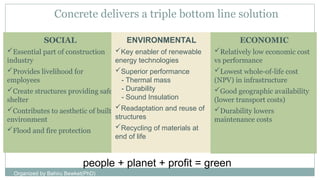
SOCIAL
Concrete delivers atriple bottom line solution
SOCIAL
Essential part of construction
industry
Provides livelihood for
employees
Create structures providing safe
shelter
Contributes to aesthetic of built
environment
Flood and fire protection
ENVIRONMENTAL
Key enabler of renewable
energy technologies
Superior performance
- Thermal mass
- Durability
- Sound Insulation
Readaptation and reuse of
structures
Recycling of materials at
end of life
ECONOMIC
Relatively low economic cost
vs performance
Lowest whole-of-life cost
(NPV) in infrastructure
Good geographic availability
(lower transport costs)
Durability lowers
maintenance costs
people + planet + profit = green
Organized by Bahiru Bewket(PhD)
12.
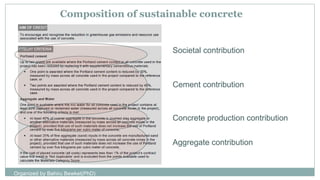
Composition of sustainableconcrete
Societal contribution
Cement contribution
Concrete production contribution
Aggregate contribution
Organized by Bahiru Bewket(PhD)
13.
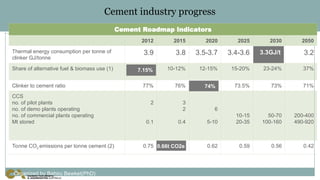
Cement industry progress
CementRoadmap Indicators
2012 2015 2020 2025 2030 2050
Thermal energy consumption per tonne of
clinker GJ/tonne
3.9 3.8 3.5-3.7 3.4-3.6 3.3-3.4 3.2
Share of alternative fuel & biomass use (1) 5-10% 10-12% 12-15% 15-20% 23-24% 37%
Clinker to cement ratio 77% 76% 74% 73.5% 73% 71%
CCS
no. of pilot plants
no. of demo plants operating
no. of commercial plants operating
Mt stored
2
0.1
3
2
0.4
6
5-10
10-15
20-35
50-70
100-160
200-400
490-920
Tonne CO2 emissions per tonne cement (2) 0.75 0.66 0.62 0.59 0.56 0.42
3.3GJ/t
7.15%
74%
0.66t CO2e
Organized by Bahiru Bewket(PhD)
14.
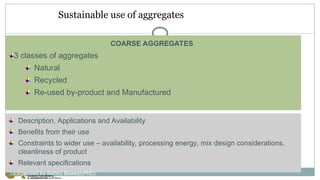
Sustainable use ofaggregates
COARSE AGGREGATES
3 classes of aggregates
Natural
Recycled
Re-used by-product and Manufactured
Description, Applications and Availability
Benefits from their use
Constraints to wider use – availability, processing energy, mix design considerations,
cleanliness of product
Relevant specifications
Organized by Bahiru Bewket(PhD)
15.
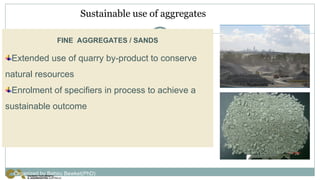
Sustainable use ofaggregates
FINE AGGREGATES / SANDS
Extended use of quarry by-product to conserve
natural resources
Enrolment of specifiers in process to achieve a
sustainable outcome
Organized by Bahiru Bewket(PhD)
16.
Brick Sustainable
The Competitionseeks integrative solutions for a building
using clay masonry units (brick) as a primary material.
This competition seeks to explore the potential of brick
construction.
Design teams are challenged to maximize the physical
characteristics of construction in the creation of
integrated design solutions utilizing the the material such as thermal
mass, porosity, modularity, color, etc.
Organized by Bahiru Bewket(PhD)
17.
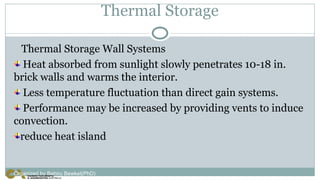
Thermal Storage
Thermal StorageWall Systems
Heat absorbed from sunlight slowly penetrates 10-18 in.
brick walls and warms the interior.
Less temperature fluctuation than direct gain systems.
Performance may be increased by providing vents to induce
convection.
reduce heat island
Organized by Bahiru Bewket(PhD)
18.
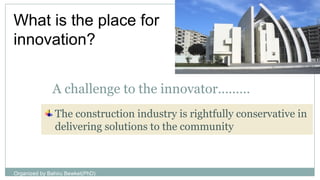
A challenge tothe innovator………
The construction industry is rightfully conservative in
delivering solutions to the community
What is the place for
innovation?
Organized by Bahiru Bewket(PhD)
19.
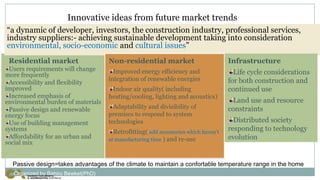
Innovative ideas fromfuture market trends
Residential market
Users requirements will change
more frequently
Accessibility and flexibility
improved
Increased emphasis of
environmental burden of materials
Passive design and renewable
energy focus
Use of building management
systems
Affordability for an urban and
social mix
“a dynamic of developer, investors, the construction industry, professional services,
industry suppliers:- achieving sustainable development taking into consideration
environmental, socio-economic and cultural issues”
Infrastructure
Life cycle considerations
for both construction and
continued use
Land use and resource
constraints
Distributed society
responding to technology
evolution
Non-residential market
Improved energy efficiency and
integration of renewable energies
Indoor air quality( including
heating/cooling, lighting and acoustics)
Adaptability and divisibility of
premises to respond to system
technologies
Retrofitting( add accessories which haven’t
at manufacturing time ) and re-use
Passive design=takes advantages of the climate to maintain a confortable temperature range in the home
Organized by Bahiru Bewket(PhD)
20.
Alternative binders
DRIVERS
Environmental
Greenhouse andGovernment incentives
Technical
Durability and less permeable; strength and set control
Special properties
Binding ability, cheap aggregate
Hi Tech applications
Economical
High material cost, lower production cost, Looking application benefits
Availability and control
Waste treatment/reduction
Binding capacity, low permeability for toxic and nuclear waste
Cement production capacity
Additional capacity in times of high demand
Organized by Bahiru Bewket(PhD)
21.
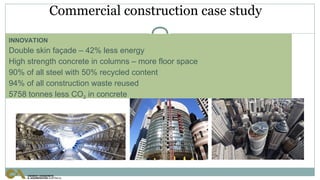
Commercial construction casestudy
INNOVATION
Double skin façade – 42% less energy
High strength concrete in columns – more floor space
90% of all steel with 50% recycled content
94% of all construction waste reused
5758 tonnes less CO2 in concrete
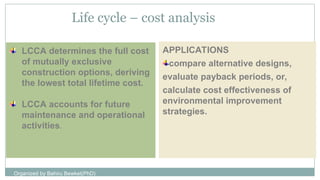
LCCA determines thefull cost
of mutually exclusive
construction options, deriving
the lowest total lifetime cost.
LCCA accounts for future
maintenance and operational
activities.
Life cycle – cost analysis
APPLICATIONS
compare alternative designs,
evaluate payback periods, or,
calculate cost effectiveness of
environmental improvement
strategies.
Organized by Bahiru Bewket(PhD)
Editor's Notes
#11 Climate change is a key challenge of our time. Urgent action must be taken to reduce greenhouse gas emissions in order to avoid likely dangerous effects of climate change.
Most of the potential low cost greenhouse gas emissions (carbon) saving opportunities are known to be in the built environment. However, past experience suggests that market failure/ barriers will prevent uptake of these opportunities (even with a price on carbon).
The aim of the CRC is to provide government and industry with social, technological and policy tools to overcome identified market barriers preventing adoption of cost effective low carbon products and services, while maintaining industry competitiveness and improving quality of life.
The CRC assembles, for the first time, the necessary critical mass and diversity of built environment stakeholders to address this complex multidisciplinary task, and provides government and industry with a vehicle for trialling alternative infrastructure and community engagement solutions. The CRC participants include 26 industry organisations, 16 government agencies and 6 research institutions.
Outcomes from the CRC include:
Reduced built environment carbon emissions by 10MTCO2-e/yr by 2020; and
Adoption of government policies and industry business models that set Australia on a pathway for future deep carbon reductions.
The CRC includes three programs of research consistent with major industry recommendations:
Integrated Building Systems: This program will develop (i) low-carbon-lifecycle building construction components/ materials, and (ii) building-integrated multipurpose solar products. These outputs target next generation construction practice, where step-change emissions cuts are required. New design tools, rating frameworks and Australian Standards will underpin and stimulate the market for low carbon products and services. Design tools and a solar product will be commercialised in partnership with SMEs.
Low Carbon Precincts: This program will develop tools that enable the design of, and stimulate the market for, low carbon infrastructure at 'precinct' scale. This will facilitate property developers and local government partners providing low carbon infrastructure at the development planning point of delivery. An emphasis on research education and training in building information modelling (BIM), and extension to a new precinct scale (PIM) platform, will dramatically improve SME design productivity. Health and productivity co-benefits analysis will demonstrate the increased value and stimulate demand for low carbon precincts.
Engaged Communities: This program will focus on understanding and influencing behaviour and purchasing decisions. Policy scenario analysis will quantify the effectiveness of alternative options leading to policy adoption by government partners. New low carbon living strategies that mobilize cultural and social capitals will be demonstrated. CRC research findings will be fully road tested in 'living laboratories' to ensure that results are robust, tangible and appealing. Results will be used to develop community education and training resources including for mass media dissemination.
#13 with global warming, weather conditions are becoming more extreme
more +40C days in summer, with low humidities and high winds
all buildings within 1 km of temperate/sub-tropical bushland should be designed as for high- risk areas
#21 1 Bligh Street is the next generation in high performing sustainable office space, with a 6 Star Green Star - Office Design v2 rating and a number of innovative sustainability strategies that are 'firsts' in the market place.
1 Bligh Street has a 5 star NABERS Energy commitment which is the highest achievable energy rating possible in Australia, and is also aiming to achieve a 6 Star Green Star Office as Built rating in 2011.
DEXUS Property Group Chief Executive Officer, Victor Hoog Antink, said: "Every aspect of 1 Bligh Street - from its double skin façade (an Australian high rise first) to the unique, full building height, naturally ventilated atrium - is designed to optimise sustainability and tenant amenity throughout the 28 level development."
A new face in town
The development's double skin façade system is a major contributor to the 6 Star Green Star rating. This naturally-ventilated glass façade was designed to optimise occupant amenity. Views are maintained, with 70 per cent of the Net Lettable Area (NLA) within eight metres of either the façade or the atrium, while providing optimum daylight entry and solar control. The components of the façade system include a double-glazed inner skin of high-performance glass and an outer skin of clear glass separated by an accessible cavity which is naturally
ventilated and contains an automated blind.
The unique façade allows 45 per cent of the office NLA to achieve high daylight levels, reducing the need for artificial lighting. This, combined with reduced heat loads, helps keep energy consumption to a minimum, and enables energy performance to achieve the 5 Star NABERS Energy requirements, with a 42 per cent carbon dioxide reduction when compared to a similar-sized conventional office tower.
Super cool
The design of 1 Bligh Street incorporates an innovative hybrid tri-generation arrangement that uses gas and solar energy to generate cooling, heating and electricity. An array of 500m2 of roof-mounted solar panels provides free cooling for the building, and in combination with the large trigeneration unit, reduces the load on grid power by more than 27 per cent.
Minimising materials
Green Star rewards building projects that both minimise materials wastage and select environmentally-preferable materials. In 1 Bligh Street, the specially-formulated high-strength concrete used, as well as the design which reduces the number of columns required, has in turn reduced the amount of concrete needed.
In addition, 20 per cent of all aggregate used in the concrete is recycled, and around 41 per cent of all cement required for the structure was replaced with industrial waste by-products. ninety per cent of the steel used has a recycled content greater than 50 per cent, and the project team worked to ensure than all timber used is either FSC Certified or re-used from a previous application
Grocon Chief Executive Officer, Daniel Grollo, who was an original board member of the Green Building Council of Australia, has said that "the use of unique high-strength concrete with a lower cement content means there is 5,768 tonnes less of carbon dioxide being released into the atmosphere and, to date, we have recycled 37,000 tonnes or 94 per cent of all construction waste produced on the project."
Water-wise
1 Bligh Street is the first building to use blackwater recycling in a high-rise office building in Sydney. Waste water is treated via a central blackwater treatment plant and recycled for toilet flushing and make-up water to the cooling towers. This will save approximately 100,000 litres of water a day which, when annualised, is equivalent to an Olympic swimming pool every two weeks.
In addition, a 65,000 litre rainwater harvest tank recycles rainwater for irrigation. Water-efficient appliances are used throughout, using 3 star WELS-rated showerheads, 5 star-rated hand wash basin taps and 4 star-rated toilets. All water use is monitored via the building management system. As a result of these systems being implemented, reliance on municipal potable water sources has been reduced by more than 90 per cent.
Total Innovation
The team behind 1 Bligh Street was awarded five innovation points (out of a possible five) from the GBCA for setting new innovation benchmarks in Australia.These points were awarded for:
Naturally-ventilated double skin façade development and the evaluation of improved amenity for the occupants in relation to view, glare and thermal comfort
Hybrid trigeneration using gas-fired power generation, absorption chillers and solar cooling to reduce peak and annual energy consumption
The tempered environment - applying a different set of comfort criteria to break-out spaces and the main lobby entrance of the building, and maintaining year-round comfort conditions using recycled heat and relief air
Full height naturally-ventilated atrium that encourages occupant wellbeing and satisfaction
Greatly reduced building embodied energy via the use of cement replacement technologies in highstrength concrete without significantly affecting the construction program and structural climbing cycles.
"Achieving five innovation points out of a possible five reflects 1 Bligh Street's position as a truly ground-breaking green building," says the GBCA's Chief Executive, Romilly Madew. "This building will provide a new benchmark for sustainable office space in Australia."
ESD initiatives featured in the project
Indoor Environment Quality
Full height, naturally-ventilated internal atrium
Double skin column-free façade system, promoting maximum
daylight and views
Low VOC paints, sealants, adhesives and carpets are
used throughout the building to improve air quality
Energy
Roof-top solar thermal collectors which inject high-temperature energy into a solar cooling system; provides enough energy to allow 100 per cent more fresh air to be pumped through the building without any additional running costs
Low-temperature VAV hybrid with chilled beam within naturally-ventilated spaces
High-efficiency lighting
Perimeter lighting controlled by automatic photocell control
Timed lighting switches with manual override
Transport
270 bicycle spaces with accompanying locker and shower facilities
Water
The first use of blackwater recycling in a high-rise office building in Sydney that will save 100,000 litres of water a day, equivalent to an Olympic swimming pool every two weeks
Rainwater recycling for irrigation of plants on rooftop
Land Use and Ecology
Glazed and naturally-ventilated wintergarden space at ground floor level