594 ACI Materials Journal/September-October 2000
ACI Materials Journal, V. 97, No. 5, September-October 2000.
MS No. 99-231 received December 1, 1999, and reviewed under Institute publica-
tion policies. Copyright  2000, American Concrete Institute. All rights reserved,
including the making of copies unless permission is obtained from the copyright pro-
prietors. Pertinent discussion will be published in the July-August 2001 ACI Materials
Journal if received by April 1, 2001
ACI MATERIALS JOURNAL TECHNICAL PAPER
Drying shrinkage of alkali-activated slag concrete (AASC) is
higher than that of ordinary portland cement concrete (OPCC).
AASC, however, has lower elastic modulus, higher creep, and
higher tensile strength than OPCC, and these combined effects can
reduce the cracking tendency. This paper describes the develop-
ment of a numerical modeling of the behavior of restrained beams
as a method towards understanding the relative contributions of
parameters towards the risk of cracking. A stress-based model was
developed, with a numerical solution obtained using a step-by-step
method with small time increments. The numerical model results
are compared with experimental results obtained from restrained
beams. Reasonable estimation of time-to-cracking was achieved
with the numerical model. The cracking tendency of different con-
crete types was ranked.
Keywords: alkali-activated slag; cracking (fracturing); ground-granulated
blast-furnace slag; numerical modeling; shrinkage.
INTRODUCTION
Alkali-activated slag (AAS) is a cementitious binder con-
sisting of ground-granulated iron blast-furnace slag (slag)
and an alkali activator. The binder is different from slag
blended cement in that the binder consists 100% of slag plus
an alkali activator, whereas in slag blended cement the ordi-
nary portland cement (OPC) acts as the activator.
The magnitude of drying shrinkage of AAS concrete
(AASC) can be significantly greater than OPC concrete
(OPCC).1-13 The cracking tendency of AASC following dry-
ing shrinkage under restrained conditions was first reported
by Collins12 and Collins and Sanjayan14 as a result of re-
strained beam tests. Details of the development of the test
method have been previously reported.12,14 This paper de-
scribes the development of numerical modeling of the be-
havior of the restrained beams as a method of understanding
the relative contributions of parameters towards the risk of
cracking.
RESEARCH SIGNIFICANCE
Higher drying shrinkage found in AASC can discourage
its use in construction. The magnitude of drying shrinkage of
a concrete, which is measured on standard unrestrained
prisms, is commonly used to assess the cracking tendency of
the concrete under restrained conditions. When comparing
AASC and OPCC, the magnitude of drying shrinkage alone
is insufficient for assessing the cracking risk because the two
concrete types have significantly different creep, elastic
modulus, and tensile strength properties. This investigation
sought to assess cracking tendency of AASC and to relate
experimental restrained shrinkage data with a numerical
model.
EXPERIMENTAL PROGRAM
Materials and concrete mixtures
The binders used are slag and OPC. The term water-binder
ratio (w/b) is used instead of water-cement ratio (w/c) to refer
to both binders previously mentioned. The slag is supplied
with preblended gypsum (2% SO3). The activators utilized
were powdered sodium metasilicate and hydrated lime, and
the method of use in concrete was previously outlined by
Collins and Sanjayan.9 The physical and chemical
composition of the slag and OPC are summarized in Table 1.
The normalweight aggregates consisted of 14 mm maximum
size basalt and river sand. Air-cooled blast-furnace slag was
also used as coarse aggregate in mixture Type AASC/BFS. The
properties of the aggregates, proportioning, and method of
presaturation of the BFS aggregate have been described by
Collins and Sanjayan.13 A further mixture type, AASC/SR,
contained shrinkage reducing chemical admixture based on
glycol derivatives and the method of use is described by
Title no. 97-M68
Numerical Modeling of Alkali-Activated Slag Concrete
Beams Subjected to Restrained Shrinkage
by Frank Collins and Jay G. Sanjayan
Table 1—Properties of cementitious materials
Constituent/property Slag
Ordinary portland
cement
SiO2, % 35.04 19.90
Al2O3, % 13.91 4.62
Fe2O3, % 0.29 3.97
MgO, % 6.13 1.73
CaO, % 39.43 64.27
Na2O, % 0.34 —
TiO2, % 0.42 —
K2O, % 0.39 0.57
P2O5, %  0.1 —
MnO, % 0.43 —
Total sulfur as SO3, % 2.43 2.56
Sulfur as S2– 0.44 —
Cl, p.p.m. 80 —
Fineness, m2
/kg 460 342
Specific gravity 2.85 3.15
Loss on ignition, % 1.45 2.90
Time to initial set, h N/A 2.0
Strength of
70 x 70 x 70 mm
mortar cubes, MPa
3 days
N/A
32.7
7 days 42.0
28 days 54.1
595ACI Materials Journal/September-October 2000
Collins.12 A series of restrained beam tests were conducted
on mixture types OPCC, AASC, AASC/BFS, and AASC/SR
with w/b of 0.5. The composition of the concrete mixtures is
summarized in Table 2. Allowance for moisture content in
the aggregates (based on saturated and surface dry
conditions), powdered sodium silicate activator, and
hydrated lime slurry was made to ensure correct free water
content in the mixture.
Restrained beam test
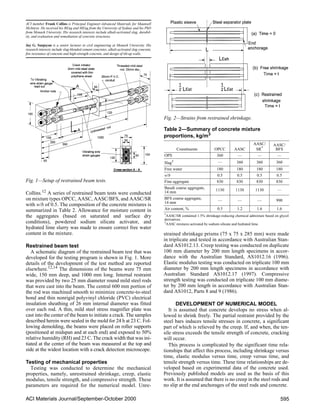
A schematic diagram of the restrained beam test that was
developed for the testing program is shown in Fig. 1. More
details of the development of the test method are reported
elsewhere.12,14 The dimensions of the beams were 75 mm
wide, 150 mm deep, and 1000 mm long. Internal restraint
was provided by two 25 mm diameter round mild steel rods
that were cast into the beam. The central 600 mm portion of
the rod was machined smooth to minimize concrete-to-steel
bond and thin nonrigid polyvinyl chloride (PVC) electrical
insulation sheathing of 26 mm internal diameter was fitted
over each rod. A thin, mild steel stress magnifier plate was
cast into the center of the beam to initiate a crack. The samples
described herein were sealed in the mold for 24 h at 23 C. Fol-
lowing demolding, the beams were placed on roller supports
(positioned at midspan and at each end) and exposed to 50%
relative humidity (RH) and 23 C. The crack width that was ini-
tiated at the center of the beam was measured at the top and
side at the widest location with a crack detection microscope.
Testing of mechanical properties
Testing was conducted to determine the mechanical
properties, namely, unrestrained shrinkage, creep, elastic
modulus, tensile strength, and compressive strength. These
parameters are required for the numerical model. Unre-
strained shrinkage prisms (75 x 75 x 285 mm) were made
in triplicate and tested in accordance with Australian Stan-
dard AS1012.13. Creep testing was conducted on duplicate
100 mm diameter by 200 mm length specimens in accor-
dance with the Australian Standard, AS1012.16 (1996).
Elastic modulus testing was conducted on triplicate 100 mm
diameter by 200 mm length specimens in accordance with
Australian Standard AS1012.17 (1997). Compressive
strength testing was conducted on triplicate 100 mm diame-
ter by 200 mm length in accordance with Australian Stan-
dard AS1012, Parts 8 and 9 (1986).
DEVELOPMENT OF NUMERICAL MODEL
It is assumed that concrete develops no stress when al-
lowed to shrink freely. The partial restraint provided by the
steel bars induces tensile stresses in concrete, a significant
part of which is relieved by the creep. If, and when, the ten-
sile stress exceeds the tensile strength of concrete, cracking
will occur.
This process is complicated by the significant time rela-
tionships that affect this process, including shrinkage versus
time, elastic modulus versus time, creep versus time, and
tensile strength versus time. These time relationships are de-
veloped based on experimental data of the concrete used.
Previously published models are used as the basis of this
work. It is assumed that there is no creep in the steel rods and
no slip at the end anchorages of the steel rods and concrete.
ACI member Frank Collins is Principal Engineer-Advanced Materials for Maunsell
McIntyre. He received his BEng and MEng from the University of Sydney and his PhD
from Monash University. His research interests include alkali-activated slag, durabil-
ity, and evaluation and remediation of concrete structures.
Jay G. Sanjayan is a senior lecturer in civil engineering at Monash University. His
research interests include slag-blended cement concretes, alkali-activated slag concrete,
fire resistance of concrete and high-strength concrete, and design of tilt-up walls.
Table 2—Summary of concrete mixture
proportions, kg/m3
Constituents OPCC AASC
AASC/
SR*
AASC/
BFS
OPS 360 — — —
Slag† — 360 360 360
Free water 180 180 180 180
w/b 0.5 0.5 0.5 0.5
Fine aggregate 830 830 830 830
Basalt coarse aggregate,
14 mm
1130 1130 1130 —
BFS coarse aggregate,
14 mm
— — — 990
Air content, % 0.5 1.2 1.6 1.6
*AASC/SR contained 1.5% shrinkage-reducing chemical admixture based on glycol
derivatives.
†AASC mixtures activated by sodium silicate and hydrated lime.
Fig. 1—Setup of restrained beam tests.
Fig. 2—Strains from restrained shrinkage.
596 ACI Materials Journal/September-October 2000
Figure 2 shows the relationship between the induced
strains following restraint of a beam subjected to drying
shrinkage. The PVC sheathed steel reinforcing rods are un-
bonded along the length of the beam; however, they are sub-
ject to end anchorage by threaded ends with nuts.
The unrestrained shrinkage contraction of the beam is
L.εsh, as shown in Fig. 2(b), where εsh is the amount of free
shrinkage at time t, and L is the length of the beam. Due to
the partial restraints provided by the steel rods, the free
shrinkage contraction is shared by extension of concrete L.εc
and compression of steel rods L.εst, as shown in Fig. 2(c).
Therefore
(1)
Because the length of concrete and the steel rods are the
same, the strains are independent of the length of the beam L
(2)
where
εsh(t) = shrinkage strain at time t;
εst(t) = strain in steel rods; and
εc(t) = concrete strain.
It should be noted that the shrinkage strains and steel strains
are in compression (or contraction) while concrete strains are
in tension (expansion).
The strain developed in the concrete εc is composed of
creep and elastic components, both of which are functions of
the stress developed in the concrete. The stresses developed
in the concrete beam are not uniform, due to the stress mag-
nifier plate embedded in the middle. The stress near the mid-
dle is much higher and concentrated in the outer regions of
the cross section, whereas, in regions away from the middle,
the stresses are more uniform across the cross section.
A finite elemental analysis was conducted to study the ex-
tent of the nonuniformity of stress distribution in the beam.12
From the stress distribution analysis, the disturbance created
by the stress magnifier plate was found to extend approxi-
mately 80 mm from the center of the beam and the average
stress developed in the model was found to be very close to
the stress in the beam estimated without the stress magnifier
plate. Therefore, in the following derivation and calcula-
tions, the uniform stress away from the stress magnifier plate
is used for creep and elastic deformation calculations. The
highest value of stress, which is found where the stress mag-
nifier plate is located, determines the cracking tendency.
A relationship between the two concrete stresses and the
stress in the steel can be formulated based on equilibrium of
forces
(3)
where
σcMag = magnified stress at the stress magnifier plate
section;
σc = uniform stress away from the plate;
Ac = cross-sectional area of the concrete in the beam;
Ap = cross-sectional area of the stress magnifier
plate; and
Ast = total cross-sectional area of all the steel rods.
L.εsh t( ) L.εc t( ) L.εst t( )+=
εsh t( ) εc t( ) εst t( )+=
σcMag t( ). Ac Ap–[ ] σc t( ).Ac σst t( ).Ast= =
Because the elastic modulus and stresses are changing
with time, the elastic strain in concrete at time t is given in
Eq. (4)
/Ec(t).dσc(t)/dt.dt (4)
where Ec(t) = elastic modulus at time t. Equation (4) can be
written as in Eq. (5)
(5)
The total creep strain at time t is given in Eq. (6)
εcreep(t) = /Ec(τ).dσc(τ)/dτ.φ(t,τ).dτ (6)
where φ(t, τ) = creep coefficient at time t due to a stress ap-
plied at time τ.
Equation (6) can be written in series form as in Eq. (7)
εcreep(t) = ∆σc(τ0)/Ec(τ0).φ(t,τ0) + (7)
∆σc(τ1)/Ec(τ1).φ(t,τ1) + + ∆σc(τi)/Ec(τi).φ(t,τi) +
+ ∆σc(τn)/Ec(τn).φ(t,τn)
The expansion of concrete due to creep and elastic strain
combined with the contraction in steel accommodates the
shrinkage of concrete, as described in Eq. (2)
εe(t) + εcreep(t) + εst(t) = εsh(t) (8)
The strain in steel can be written as a function of concrete
stress using Eq. (3)
εst(t) = σst(t)/Es = Ac/Ast.σc(t)/Es (9)
Substituting Eq. (9) into Eq. (8)
σc(t) = Es.Ast/Ac.[εst(t) − εe(t) − εcreep(t)] (10)
The strains εe(t) and εcreep(t) are functions of σc(t) and, by
substituting Eq. (4) and Eq. (6) into Eq. (10), a single equa-
tion with σc(t) as the only variable can be obtained. This dif-
ferential equation may be theoretically solved. In this study,
however, a numerical solution is obtained using a step-by-
step method, assuming the elastic and creep strains at time t
+ ∆t is the same at time t. This assumption does not introduce
any significant error as long as the time steps are small
σc(t + ∆t) = Es.Ast/Ac.[εsh(t + ∆t) − εe(t) − εcreep(t)] (11)
εe t( ) 1
t 0=
t t=
∫=
εe t( ) ∆σc t0( ) Ec t0( ) ∆σc t1( ) Ec t1( ) ……+ +⁄+⁄=
∆σc tn( ) Ec tn( )⁄
1
τ 0=
τ t=
∫
……
……
ACI Materials Journal/September-October 2000 597
The concrete stress σc(t + ∆t) is then used to calculate the
elastic and creep strains (Eq. (5) and Eq. (7)) at time t + ∆t.
This method is similar to the method described in Gilbert.1
The magnified stress at the middle section is then calculated
using Eq. (3) as follows
σcMag(t) = [Ac/(Ac − Ap)].σc(t) (12)
where
Ac = concrete cross-sectional area; and
Ap = cross-sectional area of the plate.
When σcMag(t)  ft(t), cracking would occur, where ft(t) is
the tensile strength of concrete at time t.
DEVELOPMENT OF EMPIRICAL FUNCTIONS
Drying shrinkage
For the drying shrinkage data obtained in this investiga-
tion, the functions that provided the best-fit estimation of
drying shrinkage with time were
εsh(t) = [tα/(f + tα)].εshu (13)
where
α, f = constants; and
εshu = ultimate shrinkage strain.
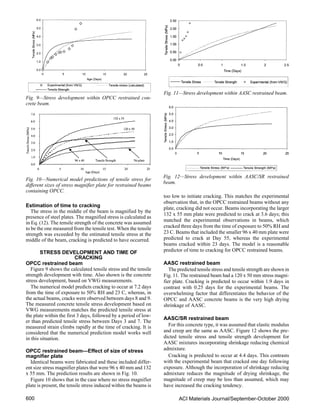
The functions that best describe drying shrinkage for each
of the concrete types are summarized in Table 3 and Fig. 3.
For the data collected in this investigation, best-fit curves
were obtained by setting α = 1.0. Table 3 also shows the
standard error estimate s of the best-fit presented (see Nota-
tions for the formula used for calculating the values of s).
The standard errors for this best-fit are within the acceptable
range as they are not significantly different from the expected
experimental accuracy of measuring shrinkage.
Inclusion of shrinkage reducing chemical admixture re-
duces the magnitude of εshu for AASC, however, the rate of
early age strain development is greater than AASC. AASC
containing BFS aggregate has considerably lower rate of
strain development than for AASC, however, the magnitude
of εshu is high.
Creep
For this investigation, compressive creep was assumed to be
equal to tensile creep. There is some debate, however, as to
whether the magnitude of creep in compression is equal to the
magnitude of creep in tension.16 At low stress levels, Koyana-
gi et al. 17 determined that the unit creep strains in compres-
sion and tension are approximately the same and the stress/
strength ratio does not affect tensile creep behavior at low
stress. Brooks and Neville,18
Neville,19
and Brooks et al.,20
however, found that for mass concrete, creep in uniaxial ten-
sion can be 20 to 30% higher than compressive creep. For con-
crete loaded at a later age, Brooks and Neville19 found less
total creep in tension than total creep in compression.
The Australian Standard, AS3600 (1994) proposes a creep
function as given in Eq. (14)
φ(t,τ) = k2.k3.φcc,b (14)
where
φ(t,τ) = creep factor at time t, when loaded at time τ;
φcc,b = basic creep factor;
k2 = a parameter that depends on the section geometry,
relative humidity, and duration of loading; and
k3 = a parameter that depends on the age of the concrete
at the time of loading τ, and is a function of the
strength ratio, fc(τ)/fc(28).
The parameter k2, as given in the charts in AS 3600
(1994), can be fitted by the formula15 as given in Eq. (15)
k2 = (k7.k8.t0.7)/(t0.7 + k9) (15)
where
t = time in days;
k7 = 0.76 + 0.9e–0.008th;
th = hypothetical thickness of the structural member,
in mm = (2 x gross cross-sectional area)/(exposed
perimeter of the member cross section);
k8 = 1.37 – 0.011h, where h is the relative humidity
(%); and
k9 = 0.15th.
The parameter k3 is a function of strength ratio fc(τ)/fc(28),
as described in Eq. (16), (17), and (18)
k3 = 1.9 – 0.8.(fc(τ)/fc(28)) for 0.5  fc(τ)/fc(28)  1.0 (16)
Table 3—Best-fit parameters
Property
Equation
no. Parameter
Concrete type
OPCC AASC
AASC/
SR
AASC/
BFS
Drying
shrinkage 13
f 10 30 12 150
εshu
(× 10–6
)
575 1850 735 2000
s (× 10–6
) 33 39 25 24
Creep 14
φcc,b 1.75 1.55 — —
s (× 10–6) 29 32 — —
Compres-
sive
strength
21
α 1.0 1.1 2.1 0.45
β 0.94 1.0 0.95 0.96
fc(28) 41.1 40.1 45.6 41.4
s (× 10–6) 2.8 1.8 4.4 4.9
Elastic
modulus
22
k 1030 16,400 — —
x 0.95 0.1 — —
s (× 10–6
) 1226 973 — —
Tensile
strength
23
α 1.25 2.3 1.8 2.0
β 1.0 0.97 1.02 1.0
ft(28) 3.95 4.32 3.98 4.74
s (× 10–6
) 0.12 0.41 0.49 0.51
Fig. 3—Drying shrinkage versus time.
598 ACI Materials Journal/September-October 2000
k3= 1.6 – 0.5.(fc(τ)/fc(28)) for 1.0  fc(τ)/fc(28)  1.4 (17)
k3 = 0.9 for fc(τ)/fc(28)  1.4 (18)
The creep specimens were concrete cylinders with 100 mm
diameter and 200 mm length, and hence th is 50 mm and the
constants k7 and k9 become 1.363 and 7.5. The test condi-
tions at the time of loading were 50% RH and, therefore, the
constant k8 is 0.82, so, the Parameter k2 becomes as given in
Eq. (19)
k2 = 1.118t0.7/(t0.7 + 7.5) (19)
Because the samples were loaded at 28 days, the constant k3
is 1.1. The estimated creep strain was calculated as in Eq. (20)
εcreep = [0.4fc(28)/E28].k2.k3.φcc,b (20)
where E28 = 28-day elastic modulus under standard moist
curing conditions when tested to the Australian Standard,
AS1012.17 (1997). The value of φcc,b was chosen to obtain
the best fit creep strain function to the test data.
The 28-day elastic moduli were 41,700 and 36,700 MPa
for OPCC and AASC, respectively. The 28-day compressive
strengths were 46.1 and 51.3 MPa for OPCC and AASC, re-
spectively. The best-fit value of φcc,b was 1.75 and 1.55 for
OPCC and AASC, respectively, as shown in Fig. 4. The stan-
dard errors for the best-fits are 29 and 32 microstrains, which
are within the acceptable limits.
Compressive strength
Best-fit functions for compressive strength were derived
to assist in the calculation of the creep constant k3 and also
for the purpose of estimating elastic modulus. The general-
ized function used for the estimation of compressive strength
with time was as given in Eq. (21)
fc(t) = [t/(α + βt)].fc(28) (21)
where
α, β = constants; and
fc(28) = 28-day compressive strength (exposed curing from
Day 1 onwards).
The values of α and β were adjusted iteratively until best-
fit curves were achieved and the values are summarized in
Table 3 along with the standard error estimates s. Best-fit
functions are summarized in Fig. 5. The standard error esti-
mates for OPCC and AASC best-fits are within acceptable
limits. The s values of AASC/SR and AASC/BFS best-fits,
however, are excessive and mainly caused by the large devi-
ation of 1-day strengths.
OPCC and AASC show similar strength gain, as reflected
by the values of α and β. AASC/SR shows considerably lower
1-day strength than OPCC and AASC, whereas the 28-day
strength of AASC /SR exceeds both OPCC and AASC. This
is reflected in the higher value of α for AASC/SR. In contrast
with AASC/SR, AASC/BFS shows better initial strength
than OPCC and AASC and this is reflected by a lower value
of α.
Elastic modulus
An empirical function of elastic modulus was utilized as
given in Eq. (22)
Ec(t) = k.( fc)x (22)
where
Ec(t) = elastic modulus at time t;
k, x = constants; and
fc = compressive strength at time t, derived from Eq. (22).
Samples of OPCC and AASC were tested in triplicate at 3,
7, and 28 days. The values of k and x were adjusted iteratively
until best-fit curves were achieved. The k and x constants that
showed the best fit were 1030 and 0.95 for OPCC and 16,400
and 0.1 for AASC. The measured and best-fit functions are
Fig. 4—Creep versus time.
Fig. 5—Compressive strength versus time.
Fig. 6—Elastic modulus versus time.
ACI Materials Journal/September-October 2000 599
shown in Fig. 6. The standard error estimates s are 1226 and
973 MPa for OPCC and AASC, respectively, which are
within the acceptable limits.
Tensile strength
To enable the estimation of the time of cracking, a func-
tion of tensile strength versus time was developed. The base
function used for the fitting of tensile strength data with time
was as given in Eq. (23)
ft(t) = [t/(α + βt)].ft(28) (23)
where
α, β = constants;
ft(28) = 28-day tensile strength (exposed curing from Day 1
onwards); and
t = time in days.
The values of α and β were adjusted iteratively until best-fit
curves were achieved. The functions, which best describe ten-
sile strength for each of the concrete types, and the standard er-
ror estimates are summarized in Table 3 and Fig. 7. The s
values are less than 0.5 MPa, which is within acceptable limits.
The higher value of α for each activated slag concrete re-
flects the significantly lower tensile strength at 1 day when
compared with OPCC.
METHODS OF CALCULATION AND
ASSUMPTIONS
Cross-sectional area of concrete
It was assumed that the area of concrete Ac, which affects
the majority of the restrained beam, is the cross-sectional
area of the beam minus the area of the restraining steel rods.
This area was used to calculate the stresses and creep and
elastic strains developing within the beam. At the midpoint
of the beam where the stress magnifier plate is located, how-
ever, the tensile stress in the concrete is magnified by a factor
Ac/(Ac − Ap). The magnified stress is designated as σcMag, as
in Eq. (12).
Calculation of creep in restrained beams
Because the restrained beams are subject to shrinkage
strains from Day 1 onwards, the beam becomes incrementally
loaded with time. Rather than load being applied at one con-
crete age, the stress increases as the concrete progressively
shrinks. The value of k2 and subsequent creep strain εcreep
was calculated for each time increment. Therefore, the esti-
mated creep strain at any given time is the aggregate sum of
the creep strains incrementally developed as the tensile load-
ing increases with time.
Values of k3 were calculated using Eq. (16), (17), and (18)
for fc(τ)/fc(28)  0.5. At very early ages of concrete, for
fc(τ)/fc(28)  0.5, no guidance is provided by Australian
Standard AS3600 (1994) for the calculation of k3. The Pa-
rameter k3 takes into account the age of concrete at the time
of loading. The behavior of k3 at very early ages of concrete
is unknown and extremely difficult to measure by direct
tests. Therefore, the strain measurements obtained from the
vibrating wire strain gages (VWGs) at very early ages are
used to back calculate the values of k3. The VWGs were lo-
cated in the concrete away from the stress magnifier plate.
The strains recorded in the VWGs (εVWG) would be the
shrinkage strain in concrete minus the expansion of concrete
due to tensile stress and creep, as shown in Eq. (24)
εVWG = εsh(t) - [εe(t) + εcreep(t)] (24)
The values of k3 were chosen such that the calculated
strains of εVWG using Eq. (24) obtain the best fit with the
measured strains. Figure 8 shows the best fit between the ex-
perimental and calculated strains for OPCC. Values of k3
that provided the best-fit were k3 = 4.0 and 1.8 at time = 0.4
and 0.8 days, respectively. Beyond this time, the calculation
of k3 followed Eq. (16), (17), and (18).
For creep calculations, elastic modulus was calculated uti-
lizing Eq. (22) considering the elastic modulus versus time
variation to account for the progressive nature of the beam
loading.
Calculation of concrete stress from VWG data
The concrete stress was calculated by utilizing the VWG
strain data for the strain gages located away from the center
of the beam. Comparison of Eq. (8) and (24) shows that the
strains measured in the VWG are the same as the strains ex-
perienced by the steel rods. Therefore, substituting εVWG in
place of εst in Eq. (9), the stress in the concrete can be calcu-
lated as follows
σc = (Ast/Ac).Es.εVWG (25)
where
εVWG = strain measured within the VWG strain gages that
were embedded within the beams;
Ast = total cross-sectional area of the steel in the beam;
Ac = cross-sectional area of concrete in the beam; and
Es = elastic modulus of steel.
Fig. 7—Tensile strength versus time.
Fig. 8—Best-fit curve for steel strain achieved by choosing
k3 parameter at 0.4 and 0.8 days.
600 ACI Materials Journal/September-October 2000
Estimation of time to cracking
The stress in the middle of the beam is magnified by the
presence of steel plates. The magnified stress is calculated as
in Eq. (12). The tensile strength of the concrete was assumed
to be the one measured from the tensile test. When the tensile
strength was exceeded by the estimated tensile stress at the
middle of the beam, cracking is predicted to have occurred.
STRESS DEVELOPMENT AND TIME OF
CRACKING
OPCC restrained beam
Figure 9 shows the calculated tensile stress and the tensile
strength development with time. Also shown is the concrete
stress development, based on VWG measurements.
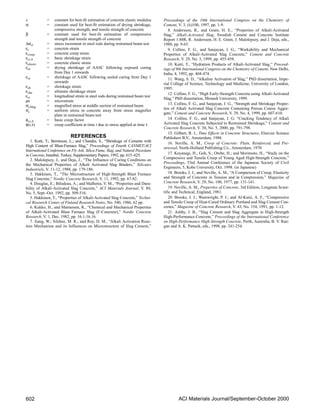
The numerical model predicts cracking to occur at 7.2 days
from the time of exposure to 50% RH and 23 C, whereas, in
the actual beams, cracks were observed between days 8 and 9.
The measured concrete tensile stress development based on
VWG measurements matches the predicted tensile stress at
the plate within the first 3 days, followed by a period of low-
er than predicted tensile stress between Days 3 and 7. The
measured strain climbs rapidly at the time of cracking. It is
considered that the numerical prediction model works well
in this situation.
OPCC restrained beam—Effect of size of stress
magnifier plate
Identical beams were fabricated and these included differ-
ent size stress magnifier plates that were 96 x 40 mm and 132
x 55 mm. The prediction results are shown in Fig. 10.
Figure 10 shows that in the case where no stress magnifier
plate is present, the tensile stress induced within the beams is
too low to initiate cracking. This matches the experimental
observation that, in the OPCC restrained beams without any
plate, cracking did not occur. Beams incorporating the larger
132 x 55 mm plate were predicted to crack at 3.6 days; this
matched the experimental observations in beams, which
cracked three days from the time of exposure to 50% RH and
23 C. Beams that included the smaller 96 x 40 mm plate were
predicted to crack at Day 55, whereas the experimental
beams cracked within 23 days. The model is a reasonable
predictor of time to cracking for OPCC restrained beams.
AASC restrained beam
The predicted tensile stress and tensile strength are shown in
Fig. 11. The restrained beam had a 120 x 50 mm stress magni-
fier plate. Cracking is predicted to occur within 1.9 days in
contrast with 0.25 days for the experimental beams. The
overwhelming factor that differentiates the behavior of the
OPCC and AASC concrete beams is the very high drying
shrinkage of AASC.
AASC/SR restrained beam
For this concrete type, it was assumed that elastic modulus
and creep are the same as AASC. Figure 12 shows the pre-
dicted tensile stress and tensile strength development for
AASC mixtures incorporating shrinkage reducing chemical
admixture.
Cracking is predicted to occur at 4.4 days. This contrasts
with the experimental beam that cracked one day following
exposure. Although the incorporation of shrinkage reducing
admixture reduces the magnitude of drying shrinkage, the
magnitude of creep may be less than assumed, which may
have increased the cracking tendency.
Fig. 9—Stress development within OPCC restrained con-
crete beam.
Fig. 10—Numerical model predictions of tensile stress for
different sizes of stress magnifier plate for restrained beams
containing OPCC.
Fig. 11—Stress development within AASC restrained beam.
Fig. 12—Stress development within AASC/SR restrained
beam.
ACI Materials Journal/September-October 2000 601
AASC/BFS restrained beam
For this concrete type, it was assumed that elastic modulus
and creep are the same as AASC. This follows work by
Ashby21
that showed OPCC behaved similarly with respect
to creep and elastic modulus when comparing concrete com-
posed of normal and BFS aggregates. Figure 13 shows the
predicted tensile stress and tensile strength development for
the AASC/BFS mixture that incorporated BFS as the coarse
aggregate.
Cracking was predicted to occur at 24.8 days, whereas the
experimental beams showed hairline cracking at Day 10.
The hairline cracking was difficult to define and has not
grown. The difference in calculated and experimental values
may be for the same reason as explained for the AASC/SR
beam; that is, the creep may also be reduced along with the
shrinkage that it needs to be taken into account in the calcu-
lation. The cracking tendency behavior of the AASC/BFS
beams is significantly better than both AASC and OPCC and
this can be explained by the following reasons:
1. AASC/BFS has lower magnitude of drying shrinkage
than AASC, as shown in the data presented earlier;
2. Higher tensile strength of AASC/BFS. The 28 day ten-
sile strength of AASC/BFS is 10% greater than AASC and
20.3% higher than OPCC; and
3. The BFS aggregate may be less stiff than the basalt thus
accommodating more strain than concrete composed with
normalweight aggregate.
CONCLUSIONS
A numerical model has been developed to describe the be-
havior of the restrained beams to assist the understanding of
the relative contributions of parameters towards the risk of
cracking. The key outcomes were as follows:
1. A stress-based model was utilized, with a numerical so-
lution obtained using a step-by-step method with small time
increments;
2. The various parameters affecting cracking tendency, in-
cluding drying shrinkage, creep, elastic modulus, and tensile
strength were described by developing best-fit functions to
the test data;
3. Finite elemental analysis of the stresses within the beam
showed the crack initiation plate magnifies the stress at the
center of the beam; however, the region of influence extends
only approximately 80 mm, beyond which the stress distri-
bution is essentially uniform;
4. In the case of OPCC, the numerical model produced rea-
sonable estimation of time to cracking;
5. The estimated time to cracking for AASC was longer
than the experimental observation; however, it was consid-
erably lower than OPCC to enable reasonable ranking of
the two binders; and
6. The numerical model over-estimated the time to crack-
ing in the cases of AASC/SR and AASC/BFS and this may
be due to creep and elastic modulus properties of these con-
crete types that were not measured in this investigation.
The effect of wet-curing on reducing the cracking tendency
is significant,12 however, numerical modeling has not been
used herein to analyze that factor.
ACKNOWLEDGMENTS
The financial support for this project was jointly provided by Independent
Cement and Lime Pty Ltd., Blue Circle Southern Cement Ltd., and Australian
Steel Mill Services. The authors thank the sponsors, especially Alan Dow, Tom
Wauer, Katherine Turner, Wayne James, Paul Ratcliff, John Ashby, and Ihor
Hinczak for their guidance and support. The enthusiastic participation of final
year students Lee Tuan Kuan and Eric Tan in this project is very much appre-
ciated. The efforts and assistance with the laboratory work provided by Jeff
Doddrell, Roger Doulis, and Peter Dunbar are also gratefully acknowledged.
CONVERSION FACTORS
NOTATIONS
A = cross-sectional area
Ac = cross-sectional area of concrete in restrained beam
Ap = cross-sectional area of stress magnifier plate in restrained
beam
Ast = total cross-sectional area of all steel rods in restrained beam
AAS = alkali-activated slag
AASC = alkali-activated slag concrete, with slag activator consist-
ing of powdered sodium silicate plus hydrated lime
AASC/BFS = identical to AASC, except coarse aggregate consists of air
cooled blast-furnace slag aggregate
AASC/SR = identical to AASC, except shrinkage reducing chemical
admixture has been included in mixture
E28 = elastic modulus of concrete at 28 days
Ec = elastic modulus of concrete
Ec(t) = elastic modulus of concrete at time t
Es = elastic modulus of steel
f = constant used for best-fit estimation of drying shrinkage
fc(28) = compressive strength of concrete at 28 days
fc(τ) = compressive strength of concrete when loaded at time τ
ft(t) = concrete tensile strength at time t
h = relative humidity for creep calculations
k = constant for best-fit estimation of concrete elastic modulus
k1 = shrinkage strain coefficient based on relative humidity,
theoretical thickness, and age
k2 = creep parameter dependent upon section geometry, rela-
tive humidity, and duration of loading
k3 = creep parameter dependent upon age of concrete at time of
loading τ and obtained from strength ratio fc(τ)/fc(28)
k7, k9 = creep parameter dependent upon hypothetical thickness of
structural member
k8 = creep parameter dependent upon relative humidity
L = length of sample; length of restrained beam
Ms = silicate modulus of sodium silicate activator, SiO2/Na2O
OPC = ordinary portland cement
OPCC = ordinary portland cement concrete with w/b = 0.5
RH = relative humidity
s = standard error estimate
= √[(experimental values − predicted values)2
/number of
points]
t = time
th = hypothetical thickness of structural member
= (2 × gross cross-sectional area)/(exposed perimeter of
member cross section)
VWG = vibrating wire strain gage
w/b = water-binder ratio
1 kg/m3
= 1.685 lb/yd3
1 mm = 0.039 in.
1 mm2
= 0.00152 in.2
1 MPa = 145 psi
Fig. 13—Stress development within AASC/BFS restrained
beam.
602 ACI Materials Journal/September-October 2000
x = constant for best-fit estimation of concrete elastic modulus
α = constant used for best-fit estimation of drying shrinkage,
compressive strength, and tensile strength of concrete
β = constant used for best-fit estimation of compressive
strength and tensile strength of concrete
∆σst = stress increment in steel rods during restrained beam test
εc = concrete strain
εcreep = concrete creep strain
εcs.b = basic shrinkage strain
εelastic = concrete elastic strain
εex = drying shrinkage of AASC following exposed curing
from Day 1 onwards
εse = shrinkage of AASC following sealed curing from Day 1
onwards
εsh = shrinkage strain
εshu = ultimate shrinkage strain
εst = longitudinal strain in steel rods during restrained beam test
µε = microstrain
σcMag = magnified stress at middle section of restrained beam
σc = uniform stress in concrete away from stress magnifier
plate in restrained beam test
φcc,b = basic creep factor
φ(t,τ) = creep coefficient at time t due to stress applied at time τ
REFERENCES
1. Kutti, T.; Berntsson, L.; and Chandra, S., “Shrinkage of Cements with
High Content of Blast-Furnace Slag,” Proceedings of Fourth CANMET/ACI
International Conference on Fly Ash, Silica Fume, Slag, and Natural Pozzolans
in Concrete, Istanbul, Turkey, Supplementary Papers, 1992, pp. 615–625.
2. Malolepszy, J., and Deja, J., “The Influence of Curing Conditions on
the Mechanical Properties of Alkali Activated Slag Binders,” Silicates
Industriels, V. 11-12, 1988, pp. 179-186.
3. Hakkinen, T., “The Microstructure of High-Strength Blast Furnace
Slag Concrete,” Nordic Concrete Research, V. 11, 1992, pp. 67-82.
4. Douglas, E.; Bilodeau, A.; and Malhotra, V. M., “Properties and Dura-
bility of Alkali-Activated Slag Concrete,” ACI Materials Journal, V. 89,
No. 5, Sept.-Oct. 1992, pp. 509-516.
5. Hakkinen, T., “Properties of Alkali-Activated Slag Concrete,” Techni-
cal Research Center of Finland Research Notes, No. 540, 1986, 62 pp.
6. Kukko, H., and Mannonen, R., “Chemical and Mechanical Properties
of Alkali-Activated Blast Furnace Slag (F-Concrete),” Nordic Concrete
Research, V. 1, Dec. 1982, pp. 16.1-16.16.
7. Jiang, W.; Silsbee, M. R.; and Roy, D. M., “Alkali Activation Reac-
tion Mechanism and its Influences on Microstructure of Slag Cement,”
Proceedings of the 10th International Congress on the Chemistry of
Cement, V. 3, (ii)100, 1997, pp. 1-9.
8. Andersson, R., and Gram, H. E., “Properties of Alkali-Activated
Slag,” Alkali-Activated Slag, Swedish Cement and Concrete Institute
Report 1.88R, R. Andersson, H. E. Gram, J. Malolepszy, and J. Deja, eds.,
1988, pp. 9-65.
9. Collins, F. G., and Sanjayan, J. G., “Workability and Mechanical
Properties of Alkali-Activated Slag Concrete,” Cement and Concrete
Research, V. 29, No. 3, 1999, pp. 455-458.
10. Kutti, T., “Hydration Products of Alkali-Activated Slag,” Proceed-
ings of 9th International Congress on the Chemistry of Cement, New Delhi,
India, 4, 1992, pp. 468-474.
11. Wang, S. D., “Alkaline Activation of Slag,” PhD dissertation, Impe-
rial College of Science, Technology and Medicine, University of London,
1995.
12. Collins, F. G., “High Early-Strength Concrete using Alkali-Activated
Slag,” PhD dissertation, Monash University, 1999.
13. Collins, F. G., and Sanjayan, J. G., “Strength and Shrinkage Proper-
ties of Alkali Activated Slag Concrete Containing Porous Coarse Aggre-
gate,” Cement and Concrete Research, V. 29, No. 4, 1999, pp. 607-610.
14. Collins, F. G., and Sanjayan, J. G. “Cracking Tendency of Alkali
Activated Slag Concrete Subjected to Restrained Shrinkage,” Cement and
Concrete Research, V. 30, No. 5, 2000, pp. 791-798.
15. Gilbert, R. I., Time Effects in Concrete Structures, Elsevier Science
Publishers B.V., Amsterdam, 1988.
16. Neville, A. M., Creep of Concrete: Plain, Reinforced, and Pre-
stressed, North-Holland Publishing Co., Amsterdam, 1970.
17. Koyanagi, H.; Goh, S.; Otobe, H.; and Morimoto, H., “Study on the
Compressive and Tensile Creep of Young Aged High-Strength Concrete,”
Proceedings, 53rd Annual Conference of the Japanese Society of Civil
Engineers, 5, Kobe University, Oct. 1998. (in Japanese)
18. Brooks, J. J., and Neville, A. M., “A Comparison of Creep, Elasticity
and Strength of Concrete in Tension and in Compression,” Magazine of
Concrete Research, V. 29, No. 100, 1977, pp. 131-141.
19. Neville, A. M., Properties of Concrete, 3rd Edition, Longman Scien-
tific and Technical, England, 1981.
20. Brooks, J. J.; Wainwright, P. J.; and Al-Kaisi, A. F., “Compressive
and Tensile Creep of Heat-Cured Ordinary Portland and Slag Cement Con-
cretes,” Magazine of Concrete Research, V. 43, No. 154, 1991, pp. 1-12.
21. Ashby, J. B., “Slag Cement and Slag Aggregate in High-Strength
High-Performance Concrete,” Proceedings of the International Conference
on High-Performance High-Strength Concrete, Perth, Australia, B. V. Ran-
gan and A. K. Patnaik, eds., 1998, pp. 241-254.

ACIMaterialsJournalV97(5)

  • 1.
    594 ACI MaterialsJournal/September-October 2000 ACI Materials Journal, V. 97, No. 5, September-October 2000. MS No. 99-231 received December 1, 1999, and reviewed under Institute publica- tion policies. Copyright  2000, American Concrete Institute. All rights reserved, including the making of copies unless permission is obtained from the copyright pro- prietors. Pertinent discussion will be published in the July-August 2001 ACI Materials Journal if received by April 1, 2001 ACI MATERIALS JOURNAL TECHNICAL PAPER Drying shrinkage of alkali-activated slag concrete (AASC) is higher than that of ordinary portland cement concrete (OPCC). AASC, however, has lower elastic modulus, higher creep, and higher tensile strength than OPCC, and these combined effects can reduce the cracking tendency. This paper describes the develop- ment of a numerical modeling of the behavior of restrained beams as a method towards understanding the relative contributions of parameters towards the risk of cracking. A stress-based model was developed, with a numerical solution obtained using a step-by-step method with small time increments. The numerical model results are compared with experimental results obtained from restrained beams. Reasonable estimation of time-to-cracking was achieved with the numerical model. The cracking tendency of different con- crete types was ranked. Keywords: alkali-activated slag; cracking (fracturing); ground-granulated blast-furnace slag; numerical modeling; shrinkage. INTRODUCTION Alkali-activated slag (AAS) is a cementitious binder con- sisting of ground-granulated iron blast-furnace slag (slag) and an alkali activator. The binder is different from slag blended cement in that the binder consists 100% of slag plus an alkali activator, whereas in slag blended cement the ordi- nary portland cement (OPC) acts as the activator. The magnitude of drying shrinkage of AAS concrete (AASC) can be significantly greater than OPC concrete (OPCC).1-13 The cracking tendency of AASC following dry- ing shrinkage under restrained conditions was first reported by Collins12 and Collins and Sanjayan14 as a result of re- strained beam tests. Details of the development of the test method have been previously reported.12,14 This paper de- scribes the development of numerical modeling of the be- havior of the restrained beams as a method of understanding the relative contributions of parameters towards the risk of cracking. RESEARCH SIGNIFICANCE Higher drying shrinkage found in AASC can discourage its use in construction. The magnitude of drying shrinkage of a concrete, which is measured on standard unrestrained prisms, is commonly used to assess the cracking tendency of the concrete under restrained conditions. When comparing AASC and OPCC, the magnitude of drying shrinkage alone is insufficient for assessing the cracking risk because the two concrete types have significantly different creep, elastic modulus, and tensile strength properties. This investigation sought to assess cracking tendency of AASC and to relate experimental restrained shrinkage data with a numerical model. EXPERIMENTAL PROGRAM Materials and concrete mixtures The binders used are slag and OPC. The term water-binder ratio (w/b) is used instead of water-cement ratio (w/c) to refer to both binders previously mentioned. The slag is supplied with preblended gypsum (2% SO3). The activators utilized were powdered sodium metasilicate and hydrated lime, and the method of use in concrete was previously outlined by Collins and Sanjayan.9 The physical and chemical composition of the slag and OPC are summarized in Table 1. The normalweight aggregates consisted of 14 mm maximum size basalt and river sand. Air-cooled blast-furnace slag was also used as coarse aggregate in mixture Type AASC/BFS. The properties of the aggregates, proportioning, and method of presaturation of the BFS aggregate have been described by Collins and Sanjayan.13 A further mixture type, AASC/SR, contained shrinkage reducing chemical admixture based on glycol derivatives and the method of use is described by Title no. 97-M68 Numerical Modeling of Alkali-Activated Slag Concrete Beams Subjected to Restrained Shrinkage by Frank Collins and Jay G. Sanjayan Table 1—Properties of cementitious materials Constituent/property Slag Ordinary portland cement SiO2, % 35.04 19.90 Al2O3, % 13.91 4.62 Fe2O3, % 0.29 3.97 MgO, % 6.13 1.73 CaO, % 39.43 64.27 Na2O, % 0.34 — TiO2, % 0.42 — K2O, % 0.39 0.57 P2O5, % 0.1 — MnO, % 0.43 — Total sulfur as SO3, % 2.43 2.56 Sulfur as S2– 0.44 — Cl, p.p.m. 80 — Fineness, m2 /kg 460 342 Specific gravity 2.85 3.15 Loss on ignition, % 1.45 2.90 Time to initial set, h N/A 2.0 Strength of 70 x 70 x 70 mm mortar cubes, MPa 3 days N/A 32.7 7 days 42.0 28 days 54.1
  • 2.
    595ACI Materials Journal/September-October2000 Collins.12 A series of restrained beam tests were conducted on mixture types OPCC, AASC, AASC/BFS, and AASC/SR with w/b of 0.5. The composition of the concrete mixtures is summarized in Table 2. Allowance for moisture content in the aggregates (based on saturated and surface dry conditions), powdered sodium silicate activator, and hydrated lime slurry was made to ensure correct free water content in the mixture. Restrained beam test A schematic diagram of the restrained beam test that was developed for the testing program is shown in Fig. 1. More details of the development of the test method are reported elsewhere.12,14 The dimensions of the beams were 75 mm wide, 150 mm deep, and 1000 mm long. Internal restraint was provided by two 25 mm diameter round mild steel rods that were cast into the beam. The central 600 mm portion of the rod was machined smooth to minimize concrete-to-steel bond and thin nonrigid polyvinyl chloride (PVC) electrical insulation sheathing of 26 mm internal diameter was fitted over each rod. A thin, mild steel stress magnifier plate was cast into the center of the beam to initiate a crack. The samples described herein were sealed in the mold for 24 h at 23 C. Fol- lowing demolding, the beams were placed on roller supports (positioned at midspan and at each end) and exposed to 50% relative humidity (RH) and 23 C. The crack width that was ini- tiated at the center of the beam was measured at the top and side at the widest location with a crack detection microscope. Testing of mechanical properties Testing was conducted to determine the mechanical properties, namely, unrestrained shrinkage, creep, elastic modulus, tensile strength, and compressive strength. These parameters are required for the numerical model. Unre- strained shrinkage prisms (75 x 75 x 285 mm) were made in triplicate and tested in accordance with Australian Stan- dard AS1012.13. Creep testing was conducted on duplicate 100 mm diameter by 200 mm length specimens in accor- dance with the Australian Standard, AS1012.16 (1996). Elastic modulus testing was conducted on triplicate 100 mm diameter by 200 mm length specimens in accordance with Australian Standard AS1012.17 (1997). Compressive strength testing was conducted on triplicate 100 mm diame- ter by 200 mm length in accordance with Australian Stan- dard AS1012, Parts 8 and 9 (1986). DEVELOPMENT OF NUMERICAL MODEL It is assumed that concrete develops no stress when al- lowed to shrink freely. The partial restraint provided by the steel bars induces tensile stresses in concrete, a significant part of which is relieved by the creep. If, and when, the ten- sile stress exceeds the tensile strength of concrete, cracking will occur. This process is complicated by the significant time rela- tionships that affect this process, including shrinkage versus time, elastic modulus versus time, creep versus time, and tensile strength versus time. These time relationships are de- veloped based on experimental data of the concrete used. Previously published models are used as the basis of this work. It is assumed that there is no creep in the steel rods and no slip at the end anchorages of the steel rods and concrete. ACI member Frank Collins is Principal Engineer-Advanced Materials for Maunsell McIntyre. He received his BEng and MEng from the University of Sydney and his PhD from Monash University. His research interests include alkali-activated slag, durabil- ity, and evaluation and remediation of concrete structures. Jay G. Sanjayan is a senior lecturer in civil engineering at Monash University. His research interests include slag-blended cement concretes, alkali-activated slag concrete, fire resistance of concrete and high-strength concrete, and design of tilt-up walls. Table 2—Summary of concrete mixture proportions, kg/m3 Constituents OPCC AASC AASC/ SR* AASC/ BFS OPS 360 — — — Slag† — 360 360 360 Free water 180 180 180 180 w/b 0.5 0.5 0.5 0.5 Fine aggregate 830 830 830 830 Basalt coarse aggregate, 14 mm 1130 1130 1130 — BFS coarse aggregate, 14 mm — — — 990 Air content, % 0.5 1.2 1.6 1.6 *AASC/SR contained 1.5% shrinkage-reducing chemical admixture based on glycol derivatives. †AASC mixtures activated by sodium silicate and hydrated lime. Fig. 1—Setup of restrained beam tests. Fig. 2—Strains from restrained shrinkage.
  • 3.
    596 ACI MaterialsJournal/September-October 2000 Figure 2 shows the relationship between the induced strains following restraint of a beam subjected to drying shrinkage. The PVC sheathed steel reinforcing rods are un- bonded along the length of the beam; however, they are sub- ject to end anchorage by threaded ends with nuts. The unrestrained shrinkage contraction of the beam is L.εsh, as shown in Fig. 2(b), where εsh is the amount of free shrinkage at time t, and L is the length of the beam. Due to the partial restraints provided by the steel rods, the free shrinkage contraction is shared by extension of concrete L.εc and compression of steel rods L.εst, as shown in Fig. 2(c). Therefore (1) Because the length of concrete and the steel rods are the same, the strains are independent of the length of the beam L (2) where εsh(t) = shrinkage strain at time t; εst(t) = strain in steel rods; and εc(t) = concrete strain. It should be noted that the shrinkage strains and steel strains are in compression (or contraction) while concrete strains are in tension (expansion). The strain developed in the concrete εc is composed of creep and elastic components, both of which are functions of the stress developed in the concrete. The stresses developed in the concrete beam are not uniform, due to the stress mag- nifier plate embedded in the middle. The stress near the mid- dle is much higher and concentrated in the outer regions of the cross section, whereas, in regions away from the middle, the stresses are more uniform across the cross section. A finite elemental analysis was conducted to study the ex- tent of the nonuniformity of stress distribution in the beam.12 From the stress distribution analysis, the disturbance created by the stress magnifier plate was found to extend approxi- mately 80 mm from the center of the beam and the average stress developed in the model was found to be very close to the stress in the beam estimated without the stress magnifier plate. Therefore, in the following derivation and calcula- tions, the uniform stress away from the stress magnifier plate is used for creep and elastic deformation calculations. The highest value of stress, which is found where the stress mag- nifier plate is located, determines the cracking tendency. A relationship between the two concrete stresses and the stress in the steel can be formulated based on equilibrium of forces (3) where σcMag = magnified stress at the stress magnifier plate section; σc = uniform stress away from the plate; Ac = cross-sectional area of the concrete in the beam; Ap = cross-sectional area of the stress magnifier plate; and Ast = total cross-sectional area of all the steel rods. L.εsh t( ) L.εc t( ) L.εst t( )+= εsh t( ) εc t( ) εst t( )+= σcMag t( ). Ac Ap–[ ] σc t( ).Ac σst t( ).Ast= = Because the elastic modulus and stresses are changing with time, the elastic strain in concrete at time t is given in Eq. (4) /Ec(t).dσc(t)/dt.dt (4) where Ec(t) = elastic modulus at time t. Equation (4) can be written as in Eq. (5) (5) The total creep strain at time t is given in Eq. (6) εcreep(t) = /Ec(τ).dσc(τ)/dτ.φ(t,τ).dτ (6) where φ(t, τ) = creep coefficient at time t due to a stress ap- plied at time τ. Equation (6) can be written in series form as in Eq. (7) εcreep(t) = ∆σc(τ0)/Ec(τ0).φ(t,τ0) + (7) ∆σc(τ1)/Ec(τ1).φ(t,τ1) + + ∆σc(τi)/Ec(τi).φ(t,τi) + + ∆σc(τn)/Ec(τn).φ(t,τn) The expansion of concrete due to creep and elastic strain combined with the contraction in steel accommodates the shrinkage of concrete, as described in Eq. (2) εe(t) + εcreep(t) + εst(t) = εsh(t) (8) The strain in steel can be written as a function of concrete stress using Eq. (3) εst(t) = σst(t)/Es = Ac/Ast.σc(t)/Es (9) Substituting Eq. (9) into Eq. (8) σc(t) = Es.Ast/Ac.[εst(t) − εe(t) − εcreep(t)] (10) The strains εe(t) and εcreep(t) are functions of σc(t) and, by substituting Eq. (4) and Eq. (6) into Eq. (10), a single equa- tion with σc(t) as the only variable can be obtained. This dif- ferential equation may be theoretically solved. In this study, however, a numerical solution is obtained using a step-by- step method, assuming the elastic and creep strains at time t + ∆t is the same at time t. This assumption does not introduce any significant error as long as the time steps are small σc(t + ∆t) = Es.Ast/Ac.[εsh(t + ∆t) − εe(t) − εcreep(t)] (11) εe t( ) 1 t 0= t t= ∫= εe t( ) ∆σc t0( ) Ec t0( ) ∆σc t1( ) Ec t1( ) ……+ +⁄+⁄= ∆σc tn( ) Ec tn( )⁄ 1 τ 0= τ t= ∫ …… ……
  • 4.
    ACI Materials Journal/September-October2000 597 The concrete stress σc(t + ∆t) is then used to calculate the elastic and creep strains (Eq. (5) and Eq. (7)) at time t + ∆t. This method is similar to the method described in Gilbert.1 The magnified stress at the middle section is then calculated using Eq. (3) as follows σcMag(t) = [Ac/(Ac − Ap)].σc(t) (12) where Ac = concrete cross-sectional area; and Ap = cross-sectional area of the plate. When σcMag(t) ft(t), cracking would occur, where ft(t) is the tensile strength of concrete at time t. DEVELOPMENT OF EMPIRICAL FUNCTIONS Drying shrinkage For the drying shrinkage data obtained in this investiga- tion, the functions that provided the best-fit estimation of drying shrinkage with time were εsh(t) = [tα/(f + tα)].εshu (13) where α, f = constants; and εshu = ultimate shrinkage strain. The functions that best describe drying shrinkage for each of the concrete types are summarized in Table 3 and Fig. 3. For the data collected in this investigation, best-fit curves were obtained by setting α = 1.0. Table 3 also shows the standard error estimate s of the best-fit presented (see Nota- tions for the formula used for calculating the values of s). The standard errors for this best-fit are within the acceptable range as they are not significantly different from the expected experimental accuracy of measuring shrinkage. Inclusion of shrinkage reducing chemical admixture re- duces the magnitude of εshu for AASC, however, the rate of early age strain development is greater than AASC. AASC containing BFS aggregate has considerably lower rate of strain development than for AASC, however, the magnitude of εshu is high. Creep For this investigation, compressive creep was assumed to be equal to tensile creep. There is some debate, however, as to whether the magnitude of creep in compression is equal to the magnitude of creep in tension.16 At low stress levels, Koyana- gi et al. 17 determined that the unit creep strains in compres- sion and tension are approximately the same and the stress/ strength ratio does not affect tensile creep behavior at low stress. Brooks and Neville,18 Neville,19 and Brooks et al.,20 however, found that for mass concrete, creep in uniaxial ten- sion can be 20 to 30% higher than compressive creep. For con- crete loaded at a later age, Brooks and Neville19 found less total creep in tension than total creep in compression. The Australian Standard, AS3600 (1994) proposes a creep function as given in Eq. (14) φ(t,τ) = k2.k3.φcc,b (14) where φ(t,τ) = creep factor at time t, when loaded at time τ; φcc,b = basic creep factor; k2 = a parameter that depends on the section geometry, relative humidity, and duration of loading; and k3 = a parameter that depends on the age of the concrete at the time of loading τ, and is a function of the strength ratio, fc(τ)/fc(28). The parameter k2, as given in the charts in AS 3600 (1994), can be fitted by the formula15 as given in Eq. (15) k2 = (k7.k8.t0.7)/(t0.7 + k9) (15) where t = time in days; k7 = 0.76 + 0.9e–0.008th; th = hypothetical thickness of the structural member, in mm = (2 x gross cross-sectional area)/(exposed perimeter of the member cross section); k8 = 1.37 – 0.011h, where h is the relative humidity (%); and k9 = 0.15th. The parameter k3 is a function of strength ratio fc(τ)/fc(28), as described in Eq. (16), (17), and (18) k3 = 1.9 – 0.8.(fc(τ)/fc(28)) for 0.5 fc(τ)/fc(28) 1.0 (16) Table 3—Best-fit parameters Property Equation no. Parameter Concrete type OPCC AASC AASC/ SR AASC/ BFS Drying shrinkage 13 f 10 30 12 150 εshu (× 10–6 ) 575 1850 735 2000 s (× 10–6 ) 33 39 25 24 Creep 14 φcc,b 1.75 1.55 — — s (× 10–6) 29 32 — — Compres- sive strength 21 α 1.0 1.1 2.1 0.45 β 0.94 1.0 0.95 0.96 fc(28) 41.1 40.1 45.6 41.4 s (× 10–6) 2.8 1.8 4.4 4.9 Elastic modulus 22 k 1030 16,400 — — x 0.95 0.1 — — s (× 10–6 ) 1226 973 — — Tensile strength 23 α 1.25 2.3 1.8 2.0 β 1.0 0.97 1.02 1.0 ft(28) 3.95 4.32 3.98 4.74 s (× 10–6 ) 0.12 0.41 0.49 0.51 Fig. 3—Drying shrinkage versus time.
  • 5.
    598 ACI MaterialsJournal/September-October 2000 k3= 1.6 – 0.5.(fc(τ)/fc(28)) for 1.0 fc(τ)/fc(28) 1.4 (17) k3 = 0.9 for fc(τ)/fc(28) 1.4 (18) The creep specimens were concrete cylinders with 100 mm diameter and 200 mm length, and hence th is 50 mm and the constants k7 and k9 become 1.363 and 7.5. The test condi- tions at the time of loading were 50% RH and, therefore, the constant k8 is 0.82, so, the Parameter k2 becomes as given in Eq. (19) k2 = 1.118t0.7/(t0.7 + 7.5) (19) Because the samples were loaded at 28 days, the constant k3 is 1.1. The estimated creep strain was calculated as in Eq. (20) εcreep = [0.4fc(28)/E28].k2.k3.φcc,b (20) where E28 = 28-day elastic modulus under standard moist curing conditions when tested to the Australian Standard, AS1012.17 (1997). The value of φcc,b was chosen to obtain the best fit creep strain function to the test data. The 28-day elastic moduli were 41,700 and 36,700 MPa for OPCC and AASC, respectively. The 28-day compressive strengths were 46.1 and 51.3 MPa for OPCC and AASC, re- spectively. The best-fit value of φcc,b was 1.75 and 1.55 for OPCC and AASC, respectively, as shown in Fig. 4. The stan- dard errors for the best-fits are 29 and 32 microstrains, which are within the acceptable limits. Compressive strength Best-fit functions for compressive strength were derived to assist in the calculation of the creep constant k3 and also for the purpose of estimating elastic modulus. The general- ized function used for the estimation of compressive strength with time was as given in Eq. (21) fc(t) = [t/(α + βt)].fc(28) (21) where α, β = constants; and fc(28) = 28-day compressive strength (exposed curing from Day 1 onwards). The values of α and β were adjusted iteratively until best- fit curves were achieved and the values are summarized in Table 3 along with the standard error estimates s. Best-fit functions are summarized in Fig. 5. The standard error esti- mates for OPCC and AASC best-fits are within acceptable limits. The s values of AASC/SR and AASC/BFS best-fits, however, are excessive and mainly caused by the large devi- ation of 1-day strengths. OPCC and AASC show similar strength gain, as reflected by the values of α and β. AASC/SR shows considerably lower 1-day strength than OPCC and AASC, whereas the 28-day strength of AASC /SR exceeds both OPCC and AASC. This is reflected in the higher value of α for AASC/SR. In contrast with AASC/SR, AASC/BFS shows better initial strength than OPCC and AASC and this is reflected by a lower value of α. Elastic modulus An empirical function of elastic modulus was utilized as given in Eq. (22) Ec(t) = k.( fc)x (22) where Ec(t) = elastic modulus at time t; k, x = constants; and fc = compressive strength at time t, derived from Eq. (22). Samples of OPCC and AASC were tested in triplicate at 3, 7, and 28 days. The values of k and x were adjusted iteratively until best-fit curves were achieved. The k and x constants that showed the best fit were 1030 and 0.95 for OPCC and 16,400 and 0.1 for AASC. The measured and best-fit functions are Fig. 4—Creep versus time. Fig. 5—Compressive strength versus time. Fig. 6—Elastic modulus versus time.
  • 6.
    ACI Materials Journal/September-October2000 599 shown in Fig. 6. The standard error estimates s are 1226 and 973 MPa for OPCC and AASC, respectively, which are within the acceptable limits. Tensile strength To enable the estimation of the time of cracking, a func- tion of tensile strength versus time was developed. The base function used for the fitting of tensile strength data with time was as given in Eq. (23) ft(t) = [t/(α + βt)].ft(28) (23) where α, β = constants; ft(28) = 28-day tensile strength (exposed curing from Day 1 onwards); and t = time in days. The values of α and β were adjusted iteratively until best-fit curves were achieved. The functions, which best describe ten- sile strength for each of the concrete types, and the standard er- ror estimates are summarized in Table 3 and Fig. 7. The s values are less than 0.5 MPa, which is within acceptable limits. The higher value of α for each activated slag concrete re- flects the significantly lower tensile strength at 1 day when compared with OPCC. METHODS OF CALCULATION AND ASSUMPTIONS Cross-sectional area of concrete It was assumed that the area of concrete Ac, which affects the majority of the restrained beam, is the cross-sectional area of the beam minus the area of the restraining steel rods. This area was used to calculate the stresses and creep and elastic strains developing within the beam. At the midpoint of the beam where the stress magnifier plate is located, how- ever, the tensile stress in the concrete is magnified by a factor Ac/(Ac − Ap). The magnified stress is designated as σcMag, as in Eq. (12). Calculation of creep in restrained beams Because the restrained beams are subject to shrinkage strains from Day 1 onwards, the beam becomes incrementally loaded with time. Rather than load being applied at one con- crete age, the stress increases as the concrete progressively shrinks. The value of k2 and subsequent creep strain εcreep was calculated for each time increment. Therefore, the esti- mated creep strain at any given time is the aggregate sum of the creep strains incrementally developed as the tensile load- ing increases with time. Values of k3 were calculated using Eq. (16), (17), and (18) for fc(τ)/fc(28) 0.5. At very early ages of concrete, for fc(τ)/fc(28) 0.5, no guidance is provided by Australian Standard AS3600 (1994) for the calculation of k3. The Pa- rameter k3 takes into account the age of concrete at the time of loading. The behavior of k3 at very early ages of concrete is unknown and extremely difficult to measure by direct tests. Therefore, the strain measurements obtained from the vibrating wire strain gages (VWGs) at very early ages are used to back calculate the values of k3. The VWGs were lo- cated in the concrete away from the stress magnifier plate. The strains recorded in the VWGs (εVWG) would be the shrinkage strain in concrete minus the expansion of concrete due to tensile stress and creep, as shown in Eq. (24) εVWG = εsh(t) - [εe(t) + εcreep(t)] (24) The values of k3 were chosen such that the calculated strains of εVWG using Eq. (24) obtain the best fit with the measured strains. Figure 8 shows the best fit between the ex- perimental and calculated strains for OPCC. Values of k3 that provided the best-fit were k3 = 4.0 and 1.8 at time = 0.4 and 0.8 days, respectively. Beyond this time, the calculation of k3 followed Eq. (16), (17), and (18). For creep calculations, elastic modulus was calculated uti- lizing Eq. (22) considering the elastic modulus versus time variation to account for the progressive nature of the beam loading. Calculation of concrete stress from VWG data The concrete stress was calculated by utilizing the VWG strain data for the strain gages located away from the center of the beam. Comparison of Eq. (8) and (24) shows that the strains measured in the VWG are the same as the strains ex- perienced by the steel rods. Therefore, substituting εVWG in place of εst in Eq. (9), the stress in the concrete can be calcu- lated as follows σc = (Ast/Ac).Es.εVWG (25) where εVWG = strain measured within the VWG strain gages that were embedded within the beams; Ast = total cross-sectional area of the steel in the beam; Ac = cross-sectional area of concrete in the beam; and Es = elastic modulus of steel. Fig. 7—Tensile strength versus time. Fig. 8—Best-fit curve for steel strain achieved by choosing k3 parameter at 0.4 and 0.8 days.
  • 7.
    600 ACI MaterialsJournal/September-October 2000 Estimation of time to cracking The stress in the middle of the beam is magnified by the presence of steel plates. The magnified stress is calculated as in Eq. (12). The tensile strength of the concrete was assumed to be the one measured from the tensile test. When the tensile strength was exceeded by the estimated tensile stress at the middle of the beam, cracking is predicted to have occurred. STRESS DEVELOPMENT AND TIME OF CRACKING OPCC restrained beam Figure 9 shows the calculated tensile stress and the tensile strength development with time. Also shown is the concrete stress development, based on VWG measurements. The numerical model predicts cracking to occur at 7.2 days from the time of exposure to 50% RH and 23 C, whereas, in the actual beams, cracks were observed between days 8 and 9. The measured concrete tensile stress development based on VWG measurements matches the predicted tensile stress at the plate within the first 3 days, followed by a period of low- er than predicted tensile stress between Days 3 and 7. The measured strain climbs rapidly at the time of cracking. It is considered that the numerical prediction model works well in this situation. OPCC restrained beam—Effect of size of stress magnifier plate Identical beams were fabricated and these included differ- ent size stress magnifier plates that were 96 x 40 mm and 132 x 55 mm. The prediction results are shown in Fig. 10. Figure 10 shows that in the case where no stress magnifier plate is present, the tensile stress induced within the beams is too low to initiate cracking. This matches the experimental observation that, in the OPCC restrained beams without any plate, cracking did not occur. Beams incorporating the larger 132 x 55 mm plate were predicted to crack at 3.6 days; this matched the experimental observations in beams, which cracked three days from the time of exposure to 50% RH and 23 C. Beams that included the smaller 96 x 40 mm plate were predicted to crack at Day 55, whereas the experimental beams cracked within 23 days. The model is a reasonable predictor of time to cracking for OPCC restrained beams. AASC restrained beam The predicted tensile stress and tensile strength are shown in Fig. 11. The restrained beam had a 120 x 50 mm stress magni- fier plate. Cracking is predicted to occur within 1.9 days in contrast with 0.25 days for the experimental beams. The overwhelming factor that differentiates the behavior of the OPCC and AASC concrete beams is the very high drying shrinkage of AASC. AASC/SR restrained beam For this concrete type, it was assumed that elastic modulus and creep are the same as AASC. Figure 12 shows the pre- dicted tensile stress and tensile strength development for AASC mixtures incorporating shrinkage reducing chemical admixture. Cracking is predicted to occur at 4.4 days. This contrasts with the experimental beam that cracked one day following exposure. Although the incorporation of shrinkage reducing admixture reduces the magnitude of drying shrinkage, the magnitude of creep may be less than assumed, which may have increased the cracking tendency. Fig. 9—Stress development within OPCC restrained con- crete beam. Fig. 10—Numerical model predictions of tensile stress for different sizes of stress magnifier plate for restrained beams containing OPCC. Fig. 11—Stress development within AASC restrained beam. Fig. 12—Stress development within AASC/SR restrained beam.
  • 8.
    ACI Materials Journal/September-October2000 601 AASC/BFS restrained beam For this concrete type, it was assumed that elastic modulus and creep are the same as AASC. This follows work by Ashby21 that showed OPCC behaved similarly with respect to creep and elastic modulus when comparing concrete com- posed of normal and BFS aggregates. Figure 13 shows the predicted tensile stress and tensile strength development for the AASC/BFS mixture that incorporated BFS as the coarse aggregate. Cracking was predicted to occur at 24.8 days, whereas the experimental beams showed hairline cracking at Day 10. The hairline cracking was difficult to define and has not grown. The difference in calculated and experimental values may be for the same reason as explained for the AASC/SR beam; that is, the creep may also be reduced along with the shrinkage that it needs to be taken into account in the calcu- lation. The cracking tendency behavior of the AASC/BFS beams is significantly better than both AASC and OPCC and this can be explained by the following reasons: 1. AASC/BFS has lower magnitude of drying shrinkage than AASC, as shown in the data presented earlier; 2. Higher tensile strength of AASC/BFS. The 28 day ten- sile strength of AASC/BFS is 10% greater than AASC and 20.3% higher than OPCC; and 3. The BFS aggregate may be less stiff than the basalt thus accommodating more strain than concrete composed with normalweight aggregate. CONCLUSIONS A numerical model has been developed to describe the be- havior of the restrained beams to assist the understanding of the relative contributions of parameters towards the risk of cracking. The key outcomes were as follows: 1. A stress-based model was utilized, with a numerical so- lution obtained using a step-by-step method with small time increments; 2. The various parameters affecting cracking tendency, in- cluding drying shrinkage, creep, elastic modulus, and tensile strength were described by developing best-fit functions to the test data; 3. Finite elemental analysis of the stresses within the beam showed the crack initiation plate magnifies the stress at the center of the beam; however, the region of influence extends only approximately 80 mm, beyond which the stress distri- bution is essentially uniform; 4. In the case of OPCC, the numerical model produced rea- sonable estimation of time to cracking; 5. The estimated time to cracking for AASC was longer than the experimental observation; however, it was consid- erably lower than OPCC to enable reasonable ranking of the two binders; and 6. The numerical model over-estimated the time to crack- ing in the cases of AASC/SR and AASC/BFS and this may be due to creep and elastic modulus properties of these con- crete types that were not measured in this investigation. The effect of wet-curing on reducing the cracking tendency is significant,12 however, numerical modeling has not been used herein to analyze that factor. ACKNOWLEDGMENTS The financial support for this project was jointly provided by Independent Cement and Lime Pty Ltd., Blue Circle Southern Cement Ltd., and Australian Steel Mill Services. The authors thank the sponsors, especially Alan Dow, Tom Wauer, Katherine Turner, Wayne James, Paul Ratcliff, John Ashby, and Ihor Hinczak for their guidance and support. The enthusiastic participation of final year students Lee Tuan Kuan and Eric Tan in this project is very much appre- ciated. The efforts and assistance with the laboratory work provided by Jeff Doddrell, Roger Doulis, and Peter Dunbar are also gratefully acknowledged. CONVERSION FACTORS NOTATIONS A = cross-sectional area Ac = cross-sectional area of concrete in restrained beam Ap = cross-sectional area of stress magnifier plate in restrained beam Ast = total cross-sectional area of all steel rods in restrained beam AAS = alkali-activated slag AASC = alkali-activated slag concrete, with slag activator consist- ing of powdered sodium silicate plus hydrated lime AASC/BFS = identical to AASC, except coarse aggregate consists of air cooled blast-furnace slag aggregate AASC/SR = identical to AASC, except shrinkage reducing chemical admixture has been included in mixture E28 = elastic modulus of concrete at 28 days Ec = elastic modulus of concrete Ec(t) = elastic modulus of concrete at time t Es = elastic modulus of steel f = constant used for best-fit estimation of drying shrinkage fc(28) = compressive strength of concrete at 28 days fc(τ) = compressive strength of concrete when loaded at time τ ft(t) = concrete tensile strength at time t h = relative humidity for creep calculations k = constant for best-fit estimation of concrete elastic modulus k1 = shrinkage strain coefficient based on relative humidity, theoretical thickness, and age k2 = creep parameter dependent upon section geometry, rela- tive humidity, and duration of loading k3 = creep parameter dependent upon age of concrete at time of loading τ and obtained from strength ratio fc(τ)/fc(28) k7, k9 = creep parameter dependent upon hypothetical thickness of structural member k8 = creep parameter dependent upon relative humidity L = length of sample; length of restrained beam Ms = silicate modulus of sodium silicate activator, SiO2/Na2O OPC = ordinary portland cement OPCC = ordinary portland cement concrete with w/b = 0.5 RH = relative humidity s = standard error estimate = √[(experimental values − predicted values)2 /number of points] t = time th = hypothetical thickness of structural member = (2 × gross cross-sectional area)/(exposed perimeter of member cross section) VWG = vibrating wire strain gage w/b = water-binder ratio 1 kg/m3 = 1.685 lb/yd3 1 mm = 0.039 in. 1 mm2 = 0.00152 in.2 1 MPa = 145 psi Fig. 13—Stress development within AASC/BFS restrained beam.
  • 9.
    602 ACI MaterialsJournal/September-October 2000 x = constant for best-fit estimation of concrete elastic modulus α = constant used for best-fit estimation of drying shrinkage, compressive strength, and tensile strength of concrete β = constant used for best-fit estimation of compressive strength and tensile strength of concrete ∆σst = stress increment in steel rods during restrained beam test εc = concrete strain εcreep = concrete creep strain εcs.b = basic shrinkage strain εelastic = concrete elastic strain εex = drying shrinkage of AASC following exposed curing from Day 1 onwards εse = shrinkage of AASC following sealed curing from Day 1 onwards εsh = shrinkage strain εshu = ultimate shrinkage strain εst = longitudinal strain in steel rods during restrained beam test µε = microstrain σcMag = magnified stress at middle section of restrained beam σc = uniform stress in concrete away from stress magnifier plate in restrained beam test φcc,b = basic creep factor φ(t,τ) = creep coefficient at time t due to stress applied at time τ REFERENCES 1. Kutti, T.; Berntsson, L.; and Chandra, S., “Shrinkage of Cements with High Content of Blast-Furnace Slag,” Proceedings of Fourth CANMET/ACI International Conference on Fly Ash, Silica Fume, Slag, and Natural Pozzolans in Concrete, Istanbul, Turkey, Supplementary Papers, 1992, pp. 615–625. 2. Malolepszy, J., and Deja, J., “The Influence of Curing Conditions on the Mechanical Properties of Alkali Activated Slag Binders,” Silicates Industriels, V. 11-12, 1988, pp. 179-186. 3. Hakkinen, T., “The Microstructure of High-Strength Blast Furnace Slag Concrete,” Nordic Concrete Research, V. 11, 1992, pp. 67-82. 4. Douglas, E.; Bilodeau, A.; and Malhotra, V. M., “Properties and Dura- bility of Alkali-Activated Slag Concrete,” ACI Materials Journal, V. 89, No. 5, Sept.-Oct. 1992, pp. 509-516. 5. Hakkinen, T., “Properties of Alkali-Activated Slag Concrete,” Techni- cal Research Center of Finland Research Notes, No. 540, 1986, 62 pp. 6. Kukko, H., and Mannonen, R., “Chemical and Mechanical Properties of Alkali-Activated Blast Furnace Slag (F-Concrete),” Nordic Concrete Research, V. 1, Dec. 1982, pp. 16.1-16.16. 7. Jiang, W.; Silsbee, M. R.; and Roy, D. M., “Alkali Activation Reac- tion Mechanism and its Influences on Microstructure of Slag Cement,” Proceedings of the 10th International Congress on the Chemistry of Cement, V. 3, (ii)100, 1997, pp. 1-9. 8. Andersson, R., and Gram, H. E., “Properties of Alkali-Activated Slag,” Alkali-Activated Slag, Swedish Cement and Concrete Institute Report 1.88R, R. Andersson, H. E. Gram, J. Malolepszy, and J. Deja, eds., 1988, pp. 9-65. 9. Collins, F. G., and Sanjayan, J. G., “Workability and Mechanical Properties of Alkali-Activated Slag Concrete,” Cement and Concrete Research, V. 29, No. 3, 1999, pp. 455-458. 10. Kutti, T., “Hydration Products of Alkali-Activated Slag,” Proceed- ings of 9th International Congress on the Chemistry of Cement, New Delhi, India, 4, 1992, pp. 468-474. 11. Wang, S. D., “Alkaline Activation of Slag,” PhD dissertation, Impe- rial College of Science, Technology and Medicine, University of London, 1995. 12. Collins, F. G., “High Early-Strength Concrete using Alkali-Activated Slag,” PhD dissertation, Monash University, 1999. 13. Collins, F. G., and Sanjayan, J. G., “Strength and Shrinkage Proper- ties of Alkali Activated Slag Concrete Containing Porous Coarse Aggre- gate,” Cement and Concrete Research, V. 29, No. 4, 1999, pp. 607-610. 14. Collins, F. G., and Sanjayan, J. G. “Cracking Tendency of Alkali Activated Slag Concrete Subjected to Restrained Shrinkage,” Cement and Concrete Research, V. 30, No. 5, 2000, pp. 791-798. 15. Gilbert, R. I., Time Effects in Concrete Structures, Elsevier Science Publishers B.V., Amsterdam, 1988. 16. Neville, A. M., Creep of Concrete: Plain, Reinforced, and Pre- stressed, North-Holland Publishing Co., Amsterdam, 1970. 17. Koyanagi, H.; Goh, S.; Otobe, H.; and Morimoto, H., “Study on the Compressive and Tensile Creep of Young Aged High-Strength Concrete,” Proceedings, 53rd Annual Conference of the Japanese Society of Civil Engineers, 5, Kobe University, Oct. 1998. (in Japanese) 18. Brooks, J. J., and Neville, A. M., “A Comparison of Creep, Elasticity and Strength of Concrete in Tension and in Compression,” Magazine of Concrete Research, V. 29, No. 100, 1977, pp. 131-141. 19. Neville, A. M., Properties of Concrete, 3rd Edition, Longman Scien- tific and Technical, England, 1981. 20. Brooks, J. J.; Wainwright, P. J.; and Al-Kaisi, A. F., “Compressive and Tensile Creep of Heat-Cured Ordinary Portland and Slag Cement Con- cretes,” Magazine of Concrete Research, V. 43, No. 154, 1991, pp. 1-12. 21. Ashby, J. B., “Slag Cement and Slag Aggregate in High-Strength High-Performance Concrete,” Proceedings of the International Conference on High-Performance High-Strength Concrete, Perth, Australia, B. V. Ran- gan and A. K. Patnaik, eds., 1998, pp. 241-254.