Read-talk-repeat
Working together
Teri Lesesne
(rhymes with insane)
doctorL@shsu.edu
@professornana
www.Professornana.livejournal.com
And
Listen
Congratulations!
AND, i have served on selection
committeesQuick Picks for Reluctant Readers, 3 years
Margaret Edwards Award
Printz Award
Odyssey Award, one as member and once as chair
YALSA Award for Excellence in Nonfiction
Morris Debut Novel Committee, chair
Amelia Elizabeth Walden Award, 4 years
Teachers’ Choices, ILA
YA Choices and Children’s Choices, ILA
What i have learned
Sometimes folks know more than I do at the outset, but each committee
service has been a learning experience.
Sometimes there are processes in place for reading, annotating, and
discussing.
Sometimes the committee arrives at these processes autonomously.
Sometimes people need a refresher in what to include in their observations
and discussion.
So, what are your questions and
concerns?
Eleven by
sandra
cisneros
https://www.yo
utube.com/wat
ch?v=o4k8pPg
QJoQ
https://www.yo
utube.com/wat
ch?v=2QktGit
dU3Q
Where to
begin
Back to class
Literary Elements
● Antagonist
● Character
● Conflict
● Mood And Tone
● Plot
● Protagonist
● Setting
● Themes
Literary Devices
● Allegory
● Allusion
● Archetype
● Deus ex machina
● Hyperbole
● Imagery
● Metaphor
● Motif
● Point of view
● Simile
Resources for Definitions and Examples
http://literary-devices.com
http://literarydevices.net
http://www.ode.state.or.us/teachlearn/subjects/elarts/reading/resources/readingglossary.pdf
http://www.uncp.edu/home/canada/work/allam/general/glossary.html
Set
parameters
There is no such thing as a perfect book.
Questions to consider
What if you read something in ARC and find errors?
How much “fact-checking” are you responsible for?
What are your OWN “line in the sand” criteria?
What can and should disqualify a book?
How do you “verify” cultural authenticity?
What does “balance” mean to YOU?
Proceed
with
Caution
Determining appropriate
audience
Mental and emotional
“levels”
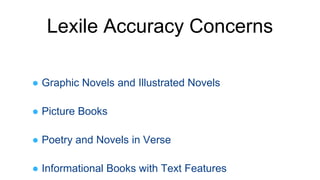
Not lexiles and levels
Read books across a range of difficulty.
● Graphic Novels and Illustrated Novels
● Picture Books
● Poetry and Novels in Verse
● Informational Books with Text Features
Lexile Accuracy Concerns
Eyes on the
prize
Managing the reading load
What was the load in the past?
What time frame is set for
reading?
How will you schedule the
reading?
What plans do you need to have
for “push” time?
Keeping up with the reading
Set daily goals
Alternate book selections
Short and slim vs. voluminous
Favorite genres vs. outside of comfort zone
Keep books at hand for those edge or fringe times
Put aside a book that is moving slowly for you. Come back to it later
Let the
reading
begin
Keeping track
Methods for your madness
Tracking books received
Noting books read
Keeping comments organized
Inside or outside?
Criteria covered
Personal vs. Professional
Keeping it
civil
Discussion guidelines
Set guidelines for the committee.
Talk about the guidelines, offer
examples.
Try them out and adjust as
necessary.
Some tips
Keep it professional
Focus on the criteria
Listen
Listen
Listen
Respond with a reread, reconsideration
What
makes a
book
“Good?”
Advice
from
Dr. ted
beats others at
the common
games:
vocabulary,
character
development,
The book has
classroom (or
classroom
library)
usefulness.
The book
reflects real
life and has
artistry in
detail.
questions?
For your
considerat
on
Options may vary
Is there a set process for
your committee?
Has your committee chair
established a process?
Will a process be determined
by the committee?
Annual assembly

Annual assembly