Readicide: How Schools Are Killing
Reading and What You Can Do About It
Book by: Kelly Gallagher, 2009, Stenhouse Publishers
Discussion Facilitator: Dr. Lynn Warren
Slides are excerpts from the book for discussion only.
Kelly Gallagher
• 22 years as a classroom teacher
• Teaches English in an urban high school, most
recently New York inner city
• Addresses “the systematic killing of the love of
reading often exacerbated by the inane, mind-
numbing practices found in schools”
• Intentions are not the problem, practices are
Our Questions
• Are we contributing to Readicide? If
yes, how are we causing it?
• How do we end Readicide?
Aliteracy
Quotes from Readicide
• Ray Bradbury
“You do not have to burn books to destroy
culture. Just get people to stop reading them.”
• Reading At Risk study from 2004 found that
54% of adults were nonliterary text readers.
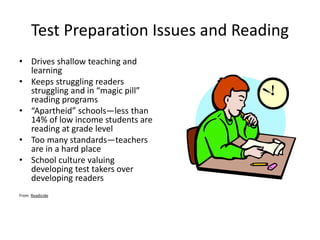
Test Preparation Issues and Reading
• Drives shallow teaching and
learning
• Keeps struggling readers
struggling and in “magic pill”
reading programs
• “Apartheid” schools—less than
14% of low income students are
reading at grade level
• Too many standards—teachers
are in a hard place
• School culture valuing
developing test takers over
developing readers
From Readicide
The Kill-a-Reader Casserole (Overteaching
with the Chop Chop Curriculum)
• Take one large novel. Dice it into as many pieces
as possible.
• Douse with sticky notes.
• Remove book from oven every five minutes and
insert worksheets.
• Add more sticky notes.
• Baste until novel is unrecognizable, far beyond
well done.
• Serve in choppy bite-size chunks. (page 73, Readicide)
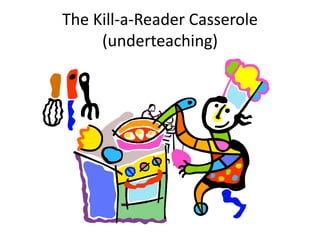
The Kill-a-Reader Casserole
(underteaching)
Role of Recreational Reading
• What is it? Why is it important? What are we
doing to promote free voluntary reading? How
much of this kind of reading should students be
doing?
• NAEP study: Students who read out of school for
fun almost everyday scored higher than students
who read once or twice a week who scored
higher than those who read only once or twice a
month who scored higher than those who hardly
ever read for fun outside of school. EdResearch.info Quote
from Readicide
How do you find the “Sweet Spot” of
Instruction?
• Students need the
proper level of
instructional support
without abandoning or
drowning them. What
is the right balance of
help?
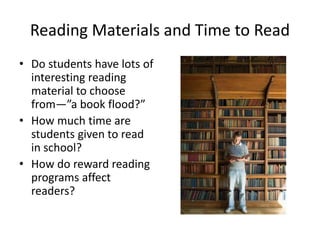
Reading Materials and Time to Read
• Do students have lots of
interesting reading
material to choose
from—”a book flood?”
• How much time are
students given to read
in school?
• How do reward reading
programs affect
readers?
Are we fixing the wrong things?
• What do we do to prevent Readicide?
In today’s data-happy era of accountability, testing and
No Child Left Behind, here is the most astonishing
statistic in the whole field of education: an increasing
number of researchers are saying that nearly 1 out of 3
public high school students won’t graduate…For
Latinos and African Americans, the rate approaches an
alarming 50%. Virtually no community , small or large,
rural or urban, has escaped the problem.” (Thornburgh 2006
in Time Magazine “Dropout Nation” quoted in Readicide)
What we can do to prevent Readicide

Readicide

  • 1.
    Readicide: How SchoolsAre Killing Reading and What You Can Do About It Book by: Kelly Gallagher, 2009, Stenhouse Publishers Discussion Facilitator: Dr. Lynn Warren Slides are excerpts from the book for discussion only.
  • 2.
    Kelly Gallagher • 22years as a classroom teacher • Teaches English in an urban high school, most recently New York inner city • Addresses “the systematic killing of the love of reading often exacerbated by the inane, mind- numbing practices found in schools” • Intentions are not the problem, practices are
  • 3.
    Our Questions • Arewe contributing to Readicide? If yes, how are we causing it? • How do we end Readicide?
  • 4.
    Aliteracy Quotes from Readicide •Ray Bradbury “You do not have to burn books to destroy culture. Just get people to stop reading them.” • Reading At Risk study from 2004 found that 54% of adults were nonliterary text readers.
  • 5.
    Test Preparation Issuesand Reading • Drives shallow teaching and learning • Keeps struggling readers struggling and in “magic pill” reading programs • “Apartheid” schools—less than 14% of low income students are reading at grade level • Too many standards—teachers are in a hard place • School culture valuing developing test takers over developing readers From Readicide
  • 6.
    The Kill-a-Reader Casserole(Overteaching with the Chop Chop Curriculum) • Take one large novel. Dice it into as many pieces as possible. • Douse with sticky notes. • Remove book from oven every five minutes and insert worksheets. • Add more sticky notes. • Baste until novel is unrecognizable, far beyond well done. • Serve in choppy bite-size chunks. (page 73, Readicide)
  • 7.
  • 8.
    Role of RecreationalReading • What is it? Why is it important? What are we doing to promote free voluntary reading? How much of this kind of reading should students be doing? • NAEP study: Students who read out of school for fun almost everyday scored higher than students who read once or twice a week who scored higher than those who read only once or twice a month who scored higher than those who hardly ever read for fun outside of school. EdResearch.info Quote from Readicide
  • 9.
    How do youfind the “Sweet Spot” of Instruction? • Students need the proper level of instructional support without abandoning or drowning them. What is the right balance of help?
  • 10.
    Reading Materials andTime to Read • Do students have lots of interesting reading material to choose from—”a book flood?” • How much time are students given to read in school? • How do reward reading programs affect readers?
  • 11.
    Are we fixingthe wrong things? • What do we do to prevent Readicide? In today’s data-happy era of accountability, testing and No Child Left Behind, here is the most astonishing statistic in the whole field of education: an increasing number of researchers are saying that nearly 1 out of 3 public high school students won’t graduate…For Latinos and African Americans, the rate approaches an alarming 50%. Virtually no community , small or large, rural or urban, has escaped the problem.” (Thornburgh 2006 in Time Magazine “Dropout Nation” quoted in Readicide)
  • 12.
    What we cando to prevent Readicide