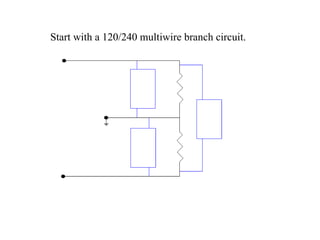
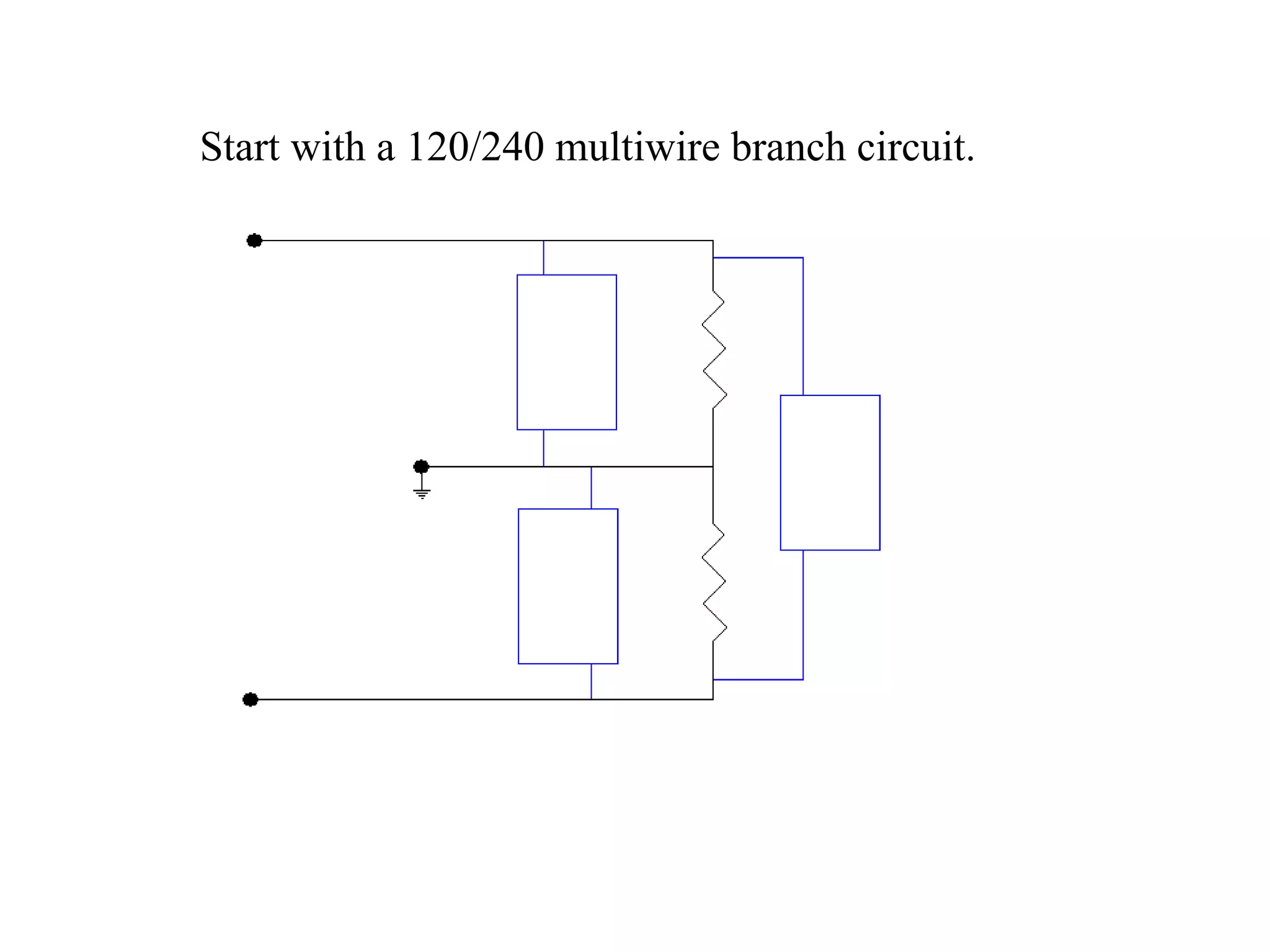
Start with a 120/240 multiwire branch circuit.
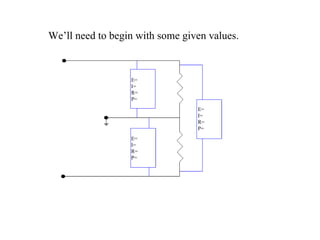
E= I= R= P= E= I= R= P= E= I= R= P= We’ll need to begin with some given values.
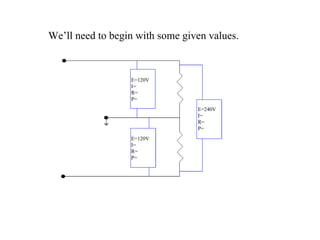
We’ll need to begin with some given values. E=120V I= R= P= E=120V I= R= P= E=240V I= R= P=
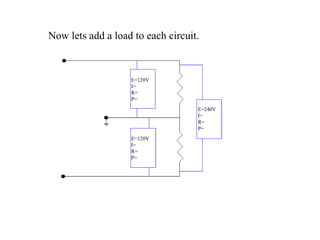
Now lets add a load to each circuit. E=120V I= R= P= E=120V I= R= P= E=240V I= R= P=
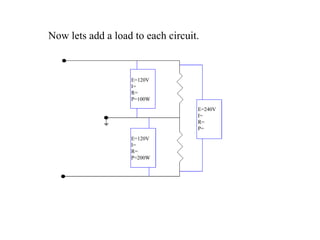
Now lets add a load to each circuit. E=120V I= R= P=100W E=120V I= R= P=200W E=240V I= R= P=
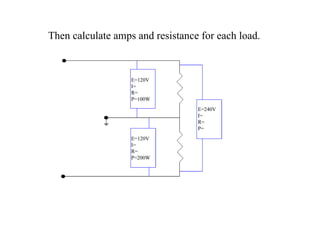
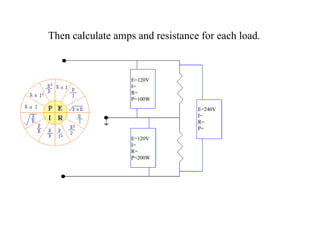
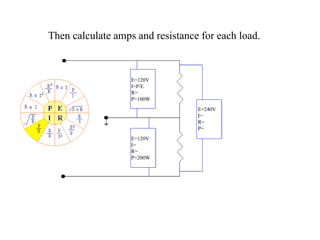
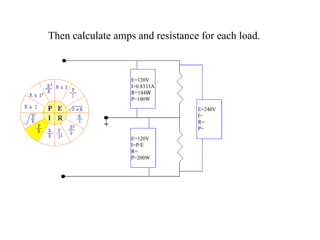
Then calculate amps and resistance for each load. E=120V I= R= P=100W E=120V I= R= P=200W E=240V I= R= P=
Then calculate amps and resistance for each load. E=120V I=P/E R= P=100W E=120V I= R= P=200W E=240V I= R= P=
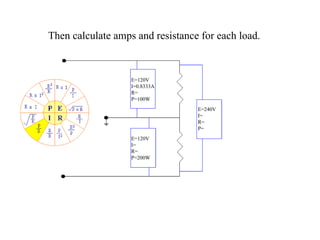
Then calculate amps and resistance for each load. E=120V I=0.8333A R= P=100W E=120V I= R= P=200W E=240V I= R= P=
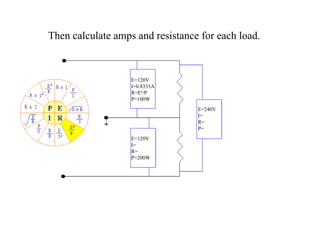
Then calculate amps and resistance for each load. E=120V I=0.8333A R=E²/P P=100W E=120V I= R= P=200W E=240V I= R= P=
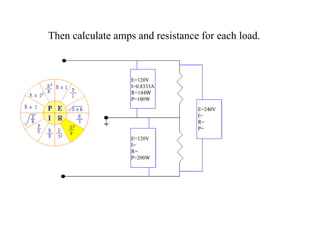
Then calculate amps and resistance for each load. E=120V I=0.8333A R=144 W P=100W E=120V I= R= P=200W E=240V I= R= P=
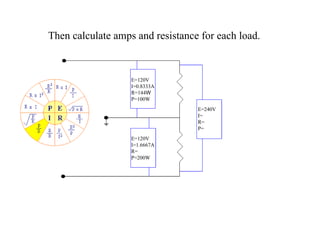
Then calculate amps and resistance for each load. E=120V I=0.8333A R=144 W P=100W E=120V I=P/E R= P=200W E=240V I= R= P=
Then calculate amps and resistance for each load. E=120V I=0.8333A R=144 W P=100W E=120V I=1.6667A R= P=200W E=240V I= R= P=
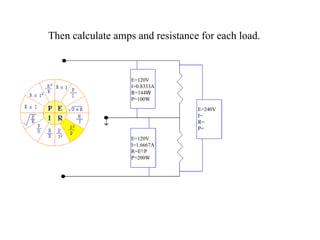
Then calculate amps and resistance for each load. E=120V I=0.8333A R=144 W P=100W E=120V I=1.6667A R=E²/P P=200W E=240V I= R= P=
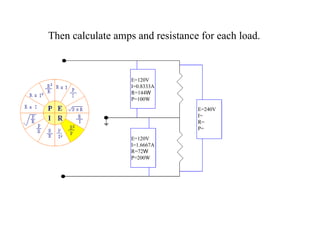
Then calculate amps and resistance for each load. E=120V I=0.8333A R=144 W P=100W E=120V I=1.6667A R=72 W P=200W E=240V I= R= P=
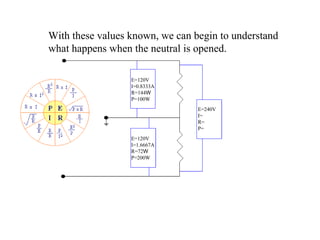
With these values known, we can begin to understand what happens when the neutral is opened. E=120V I=0.8333A R=144 W P=100W E=120V I=1.6667A R=72 W P=200W E=240V I= R= P=
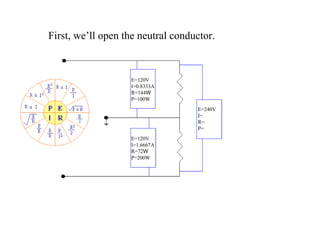
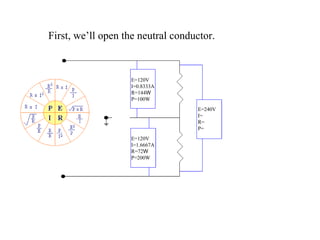
First, we’ll open the neutral conductor. E=120V I=0.8333A R=144 W P=100W E=120V I=1.6667A R=72 W P=200W E=240V I= R= P=
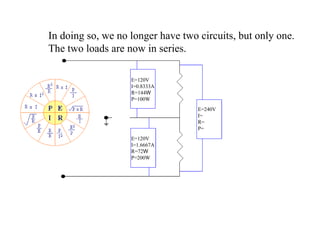
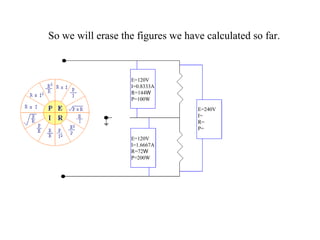
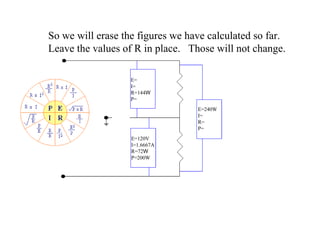
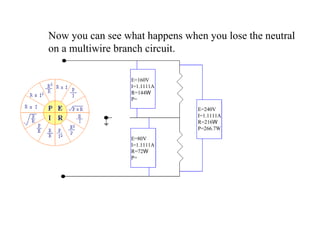
In doing so, we no longer have two circuits, but only one. The two loads are now in series. E=120V I=0.8333A R=144 W P=100W E=120V I=1.6667A R=72 W P=200W E=240V I= R= P=
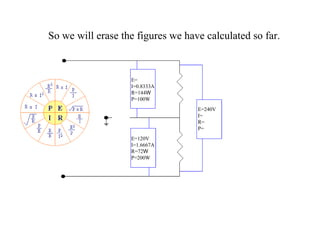
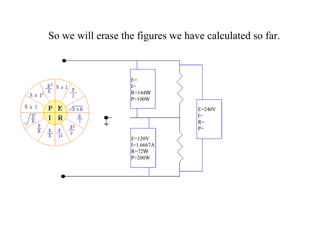
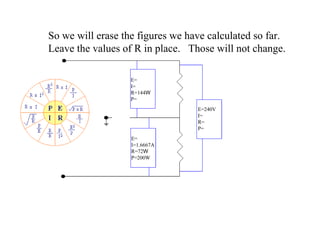
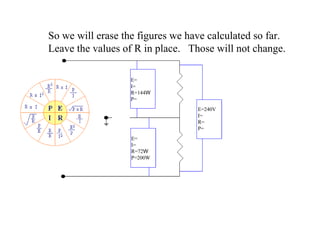
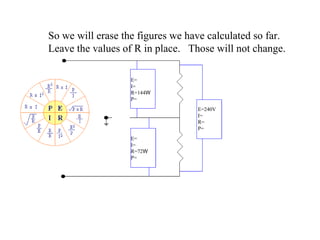
So we will erase the figures we have calculated so far. E=120V I=0.8333A R=144 W P=100W E=120V I=1.6667A R=72 W P=200W E=240V I= R= P=
So we will erase the figures we have calculated so far. E= I=0.8333A R=144 W P=100W E=120V I=1.6667A R=72 W P=200W E=240V I= R= P=
So we will erase the figures we have calculated so far. E= I= R=144 W P=100W E=120V I=1.6667A R=72 W P=200W E=240V I= R= P=
So we will erase the figures we have calculated so far. Leave the values of R in place.  Those will not change. E= I= R=144 W P= E=120V I=1.6667A R=72 W P=200W E=240W I= R= P=
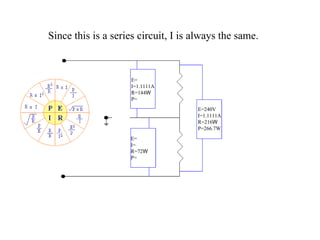
So we will erase the figures we have calculated so far. Leave the values of R in place.  Those will not change. E= I= R=144 W P= E= I=1.6667A R=72 W P=200W E=240V I= R= P=
So we will erase the figures we have calculated so far. Leave the values of R in place.  Those will not change. E= I= R=144 W P= E= I= R=72 W P=200W E=240V I= R= P=
So we will erase the figures we have calculated so far. Leave the values of R in place.  Those will not change. E= I= R=144 W P= E= I= R=72 W P= E=240V I= R= P=
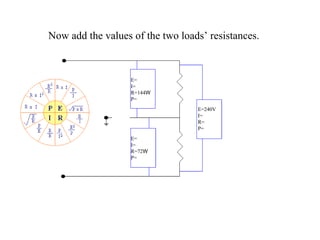
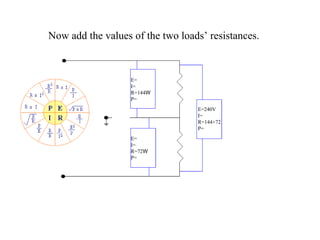
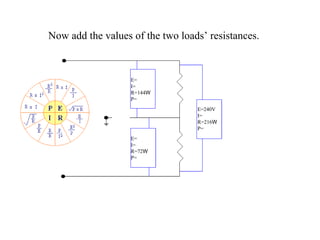
Now add the values of the two loads’ resistances. E= I= R=144 W P= E= I= R=72 W P= E=240V I= R= P=
Now add the values of the two loads’ resistances. E= I= R=144 W P= E= I= R=72 W P= E=240V I= R=144+72 P=
Now add the values of the two loads’ resistances. E= I= R=144 W P= E= I= R=72 W P= E=240V I= R=216 W P=
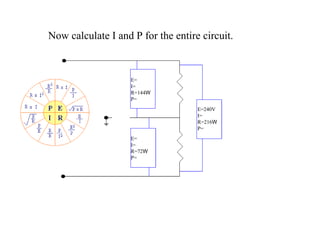
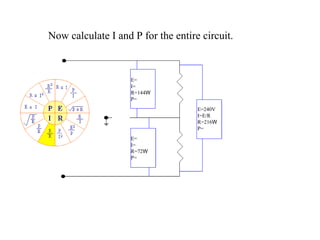
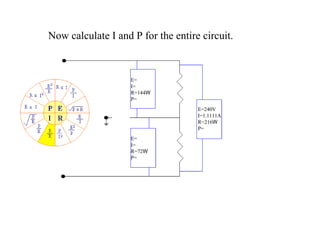
Now calculate I and P for the entire circuit. E= I= R=144 W P= E= I= R=72 W P= E=240V I= R=216 W P=
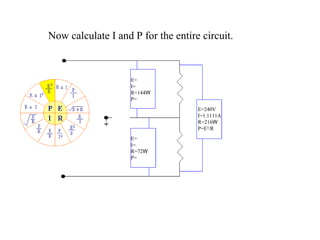
Now calculate I and P for the entire circuit. E= I= R=144 W P= E= I= R=72 W P= E=240V I=E/R R=216 W P=
Now calculate I and P for the entire circuit. E= I= R=144 W P= E= I= R=72 W P= E=240V I=1.1111A R=216 W P=
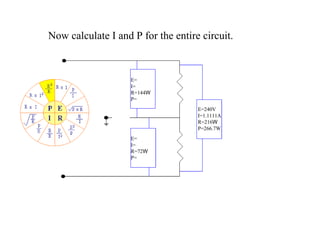
Now calculate I and P for the entire circuit. E= I= R=144 W P= E= I= R=72 W P= E=240V I=1.1111A R=216 W P=E²/R
Now calculate I and P for the entire circuit. E= I= R=144 W P= E= I= R=72 W P= E=240V I=1.1111A R=216 W P=266.7W
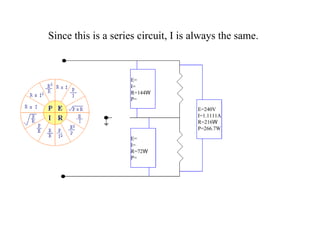
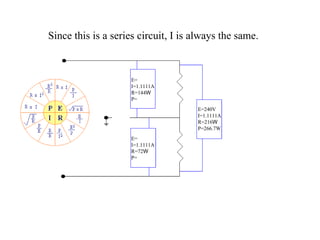
Since this is a series circuit, I is always the same. E= I= R=144 W P= E= I= R=72 W P= E=240V I=1.1111A R=216 W P=266.7W
Since this is a series circuit, I is always the same. E= I=1.1111A R=144 W P= E= I= R=72 W P= E=240V I=1.1111A R=216 W P=266.7W
Since this is a series circuit, I is always the same. E= I=1.1111A R=144 W P= E= I=1.1111A R=72 W P= E=240V I=1.1111A R=216 W P=266.7W
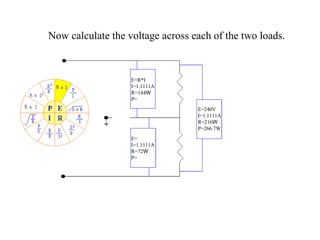
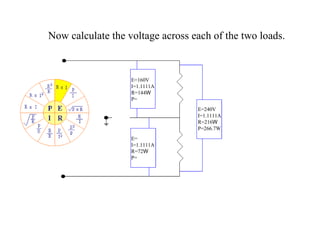
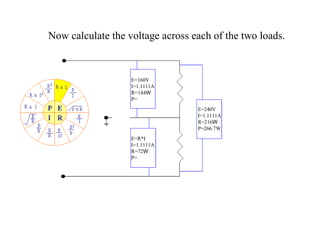
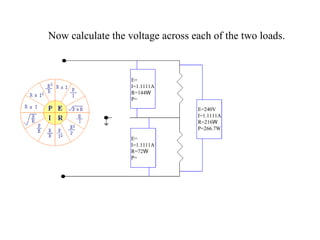
Now calculate the voltage across each of the two loads. E= I=1.1111A R=144 W P= E= I=1.1111A R=72 W P= E=240V I=1.1111A R=216 W P=266.7W
Now calculate the voltage across each of the two loads. E=R*I I=1.1111A R=144 W P= E= I=1.1111A R=72 W P= E=240V I=1.1111A R=216 W P=266.7W
Now calculate the voltage across each of the two loads. E=160V I=1.1111A R=144 W P= E= I=1.1111A R=72 W P= E=240V I=1.1111A R=216 W P=266.7W
Now calculate the voltage across each of the two loads. E=160V I=1.1111A R=144 W P= E=R*I I=1.1111A R=72 W P= E=240V I=1.1111A R=216 W P=266.7W
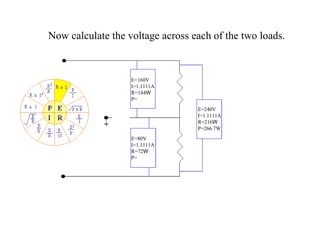
Now calculate the voltage across each of the two loads. E=160V I=1.1111A R=144 W P= E=80V I=1.1111A R=72 W P= E=240V I=1.1111A R=216 W P=266.7W
Now you can see what happens when you lose the neutral on a multiwire branch circuit. E=160V I=1.1111A R=144 W P= E=80V I=1.1111A R=72 W P= E=240V I=1.1111A R=216 W P=266.7W
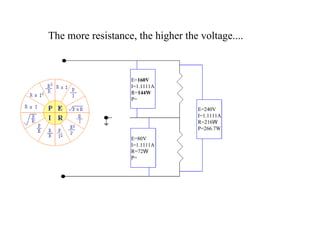
The more resistance, the higher the voltage.... E= 160V I=1.1111A R= 144 W P= E=80V I=1.1111A R=72 W P= E=240V I=1.1111A R=216 W P=266.7W
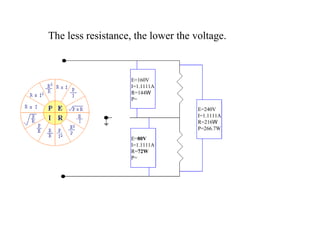
The less resistance, the lower the voltage. E=160V I=1.1111A R=144 W P= E= 80V I=1.1111A R= 72 W P= E=240V I=1.1111A R=216 W P=266.7W
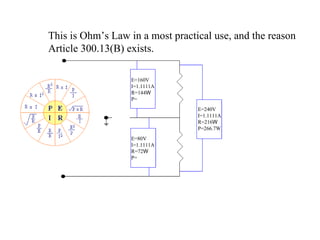
This is Ohm’s Law in a most practical use, and the reason Article 300.13(B) exists. E=160V I=1.1111A R=144 W P= E=80V I=1.1111A R=72 W P= E=240V I=1.1111A R=216 W P=266.7W

Lost Neutral

  • 1.
    Start with a120/240 multiwire branch circuit.
  • 2.
    E= I= R=P= E= I= R= P= E= I= R= P= We’ll need to begin with some given values.
  • 3.
    We’ll need tobegin with some given values. E=120V I= R= P= E=120V I= R= P= E=240V I= R= P=
  • 4.
    Now lets adda load to each circuit. E=120V I= R= P= E=120V I= R= P= E=240V I= R= P=
  • 5.
    Now lets adda load to each circuit. E=120V I= R= P=100W E=120V I= R= P=200W E=240V I= R= P=
  • 6.
    Then calculate ampsand resistance for each load. E=120V I= R= P=100W E=120V I= R= P=200W E=240V I= R= P=
  • 7.
    Then calculate ampsand resistance for each load. E=120V I= R= P=100W E=120V I= R= P=200W E=240V I= R= P=
  • 8.
    Then calculate ampsand resistance for each load. E=120V I=P/E R= P=100W E=120V I= R= P=200W E=240V I= R= P=
  • 9.
    Then calculate ampsand resistance for each load. E=120V I=0.8333A R= P=100W E=120V I= R= P=200W E=240V I= R= P=
  • 10.
    Then calculate ampsand resistance for each load. E=120V I=0.8333A R=E²/P P=100W E=120V I= R= P=200W E=240V I= R= P=
  • 11.
    Then calculate ampsand resistance for each load. E=120V I=0.8333A R=144 W P=100W E=120V I= R= P=200W E=240V I= R= P=
  • 12.
    Then calculate ampsand resistance for each load. E=120V I=0.8333A R=144 W P=100W E=120V I=P/E R= P=200W E=240V I= R= P=
  • 13.
    Then calculate ampsand resistance for each load. E=120V I=0.8333A R=144 W P=100W E=120V I=1.6667A R= P=200W E=240V I= R= P=
  • 14.
    Then calculate ampsand resistance for each load. E=120V I=0.8333A R=144 W P=100W E=120V I=1.6667A R=E²/P P=200W E=240V I= R= P=
  • 15.
    Then calculate ampsand resistance for each load. E=120V I=0.8333A R=144 W P=100W E=120V I=1.6667A R=72 W P=200W E=240V I= R= P=
  • 16.
    With these valuesknown, we can begin to understand what happens when the neutral is opened. E=120V I=0.8333A R=144 W P=100W E=120V I=1.6667A R=72 W P=200W E=240V I= R= P=
  • 17.
    First, we’ll openthe neutral conductor. E=120V I=0.8333A R=144 W P=100W E=120V I=1.6667A R=72 W P=200W E=240V I= R= P=
  • 18.
    First, we’ll openthe neutral conductor. E=120V I=0.8333A R=144 W P=100W E=120V I=1.6667A R=72 W P=200W E=240V I= R= P=
  • 19.
    In doing so,we no longer have two circuits, but only one. The two loads are now in series. E=120V I=0.8333A R=144 W P=100W E=120V I=1.6667A R=72 W P=200W E=240V I= R= P=
  • 20.
    So we willerase the figures we have calculated so far. E=120V I=0.8333A R=144 W P=100W E=120V I=1.6667A R=72 W P=200W E=240V I= R= P=
  • 21.
    So we willerase the figures we have calculated so far. E= I=0.8333A R=144 W P=100W E=120V I=1.6667A R=72 W P=200W E=240V I= R= P=
  • 22.
    So we willerase the figures we have calculated so far. E= I= R=144 W P=100W E=120V I=1.6667A R=72 W P=200W E=240V I= R= P=
  • 23.
    So we willerase the figures we have calculated so far. Leave the values of R in place. Those will not change. E= I= R=144 W P= E=120V I=1.6667A R=72 W P=200W E=240W I= R= P=
  • 24.
    So we willerase the figures we have calculated so far. Leave the values of R in place. Those will not change. E= I= R=144 W P= E= I=1.6667A R=72 W P=200W E=240V I= R= P=
  • 25.
    So we willerase the figures we have calculated so far. Leave the values of R in place. Those will not change. E= I= R=144 W P= E= I= R=72 W P=200W E=240V I= R= P=
  • 26.
    So we willerase the figures we have calculated so far. Leave the values of R in place. Those will not change. E= I= R=144 W P= E= I= R=72 W P= E=240V I= R= P=
  • 27.
    Now add thevalues of the two loads’ resistances. E= I= R=144 W P= E= I= R=72 W P= E=240V I= R= P=
  • 28.
    Now add thevalues of the two loads’ resistances. E= I= R=144 W P= E= I= R=72 W P= E=240V I= R=144+72 P=
  • 29.
    Now add thevalues of the two loads’ resistances. E= I= R=144 W P= E= I= R=72 W P= E=240V I= R=216 W P=
  • 30.
    Now calculate Iand P for the entire circuit. E= I= R=144 W P= E= I= R=72 W P= E=240V I= R=216 W P=
  • 31.
    Now calculate Iand P for the entire circuit. E= I= R=144 W P= E= I= R=72 W P= E=240V I=E/R R=216 W P=
  • 32.
    Now calculate Iand P for the entire circuit. E= I= R=144 W P= E= I= R=72 W P= E=240V I=1.1111A R=216 W P=
  • 33.
    Now calculate Iand P for the entire circuit. E= I= R=144 W P= E= I= R=72 W P= E=240V I=1.1111A R=216 W P=E²/R
  • 34.
    Now calculate Iand P for the entire circuit. E= I= R=144 W P= E= I= R=72 W P= E=240V I=1.1111A R=216 W P=266.7W
  • 35.
    Since this isa series circuit, I is always the same. E= I= R=144 W P= E= I= R=72 W P= E=240V I=1.1111A R=216 W P=266.7W
  • 36.
    Since this isa series circuit, I is always the same. E= I=1.1111A R=144 W P= E= I= R=72 W P= E=240V I=1.1111A R=216 W P=266.7W
  • 37.
    Since this isa series circuit, I is always the same. E= I=1.1111A R=144 W P= E= I=1.1111A R=72 W P= E=240V I=1.1111A R=216 W P=266.7W
  • 38.
    Now calculate thevoltage across each of the two loads. E= I=1.1111A R=144 W P= E= I=1.1111A R=72 W P= E=240V I=1.1111A R=216 W P=266.7W
  • 39.
    Now calculate thevoltage across each of the two loads. E=R*I I=1.1111A R=144 W P= E= I=1.1111A R=72 W P= E=240V I=1.1111A R=216 W P=266.7W
  • 40.
    Now calculate thevoltage across each of the two loads. E=160V I=1.1111A R=144 W P= E= I=1.1111A R=72 W P= E=240V I=1.1111A R=216 W P=266.7W
  • 41.
    Now calculate thevoltage across each of the two loads. E=160V I=1.1111A R=144 W P= E=R*I I=1.1111A R=72 W P= E=240V I=1.1111A R=216 W P=266.7W
  • 42.
    Now calculate thevoltage across each of the two loads. E=160V I=1.1111A R=144 W P= E=80V I=1.1111A R=72 W P= E=240V I=1.1111A R=216 W P=266.7W
  • 43.
    Now you cansee what happens when you lose the neutral on a multiwire branch circuit. E=160V I=1.1111A R=144 W P= E=80V I=1.1111A R=72 W P= E=240V I=1.1111A R=216 W P=266.7W
  • 44.
    The more resistance,the higher the voltage.... E= 160V I=1.1111A R= 144 W P= E=80V I=1.1111A R=72 W P= E=240V I=1.1111A R=216 W P=266.7W
  • 45.
    The less resistance,the lower the voltage. E=160V I=1.1111A R=144 W P= E= 80V I=1.1111A R= 72 W P= E=240V I=1.1111A R=216 W P=266.7W
  • 46.
    This is Ohm’sLaw in a most practical use, and the reason Article 300.13(B) exists. E=160V I=1.1111A R=144 W P= E=80V I=1.1111A R=72 W P= E=240V I=1.1111A R=216 W P=266.7W