Photo by 'PixelPlacebo' - Creative Commons Attribution-NonCommercial-ShareAlike License https://www.flickr.com/photos/12142259@N00 Created with Haiku Deck
What Is a Logic Model?
A logic Model, or Logical Framework Matrix as
it is sometimes called, is a framework for your
proposal. It is a tool to help you think through
all of the key elements of your project to frame
it so you can ensure its stability, soundness,
innovation, and sustainability.
Why do I need a Logic Model?
 To ensure that you have all the proposal
elements in place
 To help get everyone on the same page with
the project by thinking it through.
 To more easily see any gaps in your project
idea.
Photo by WorldIslandInfo.com - Creative Commons Attribution License https://www.flickr.com/photos/76074333@N00 Created with Haiku Deck
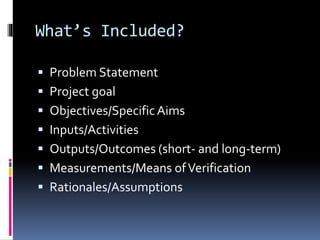
What’s Included?
 Problem Statement
 Project goal
 Objectives/SpecificAims
 Inputs/Activities
 Outputs/Outcomes (short- and long-term)
 Measurements/Means ofVerification
 Rationales/Assumptions
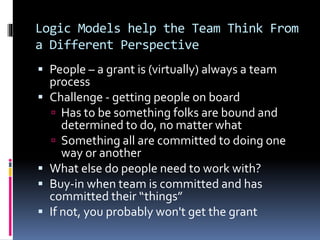
Logic Models help the Team Think From
a Different Perspective
 People – a grant is (virtually) always a team
process
 Challenge - getting people on board
 Has to be something folks are bound and
determined to do, no matter what
 Something all are committed to doing one
way or another
 What else do people need to work with?
 Buy-in when team is committed and has
committed their “things”
 If not, you probably won't get the grant
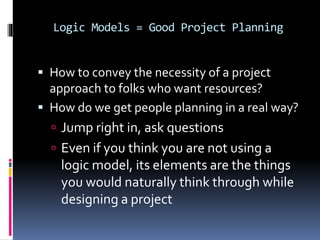
Logic Models = Good Project Planning
 How to convey the necessity of a project
approach to folks who want resources?
 How do we get people planning in a real way?
 Jump right in, ask questions
 Even if you think you are not using a
logic model, its elements are the things
you would naturally think through while
designing a project
Photo by Leo Reynolds - Creative Commons Attribution-NonCommercial-ShareAlike License https://www.flickr.com/photos/49968232@N00 Created with Haiku Deck
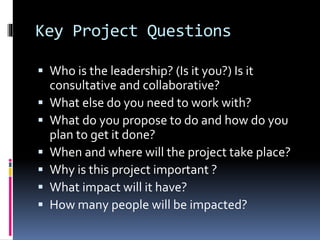
Key Project Questions
 Who is the leadership? (Is it you?) Is it
consultative and collaborative?
 What else do you need to work with?
 What do you propose to do and how do you
plan to get it done?
 When and where will the project take place?
 Why is this project important ?
 What impact will it have?
 How many people will be impacted?
Photo by FlickrJunkie - Creative Commons Attribution-NonCommercial-ShareAlike License https://www.flickr.com/photos/89035753@N00 Created with Haiku Deck
More Project Planning Questions
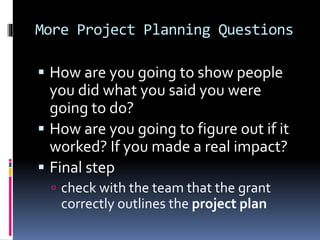
 How are you going to show people
you did what you said you were
going to do?
 How are you going to figure out if it
worked? If you made a real impact?
 Final step
 check with the team that the grant
correctly outlines the project plan
Photo by cvanstane - Creative Commons Attribution License https://www.flickr.com/photos/22901163@N03 Created with Haiku Deck
Conclusion is the Beginning
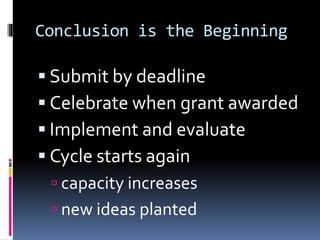
 Submit by deadline
 Celebrate when grant awarded
 Implement and evaluate
 Cycle starts again
 capacity increases
 new ideas planted
Photo by carnagenyc - Creative Commons Attribution-NonCommercial License https://www.flickr.com/photos/7752651@N05 Created with Haiku Deck
HOW TO LOGIN & GET STARTED
• http://www.innonet.org
• Register yourself and your organization (first time)
• Under “EvaluationTools and Resources” click “Login”
• Enter your username and password
• Under “Get Started” click on “Assess your strengths, plan & evaluate
programs”
• Under “Start Here” click on “Logic Model Builder”
Photo by JD Hancock - Creative Commons Attribution License https://www.flickr.com/photos/83346641@N00 Created with Haiku Deck

GPA MA Chapter March 27: Logic Models a Different Perspective

  • 1.
    Photo by 'PixelPlacebo'- Creative Commons Attribution-NonCommercial-ShareAlike License https://www.flickr.com/photos/12142259@N00 Created with Haiku Deck
  • 2.
    What Is aLogic Model? A logic Model, or Logical Framework Matrix as it is sometimes called, is a framework for your proposal. It is a tool to help you think through all of the key elements of your project to frame it so you can ensure its stability, soundness, innovation, and sustainability.
  • 3.
    Why do Ineed a Logic Model?  To ensure that you have all the proposal elements in place  To help get everyone on the same page with the project by thinking it through.  To more easily see any gaps in your project idea.
  • 4.
    Photo by WorldIslandInfo.com- Creative Commons Attribution License https://www.flickr.com/photos/76074333@N00 Created with Haiku Deck
  • 5.
    What’s Included?  ProblemStatement  Project goal  Objectives/SpecificAims  Inputs/Activities  Outputs/Outcomes (short- and long-term)  Measurements/Means ofVerification  Rationales/Assumptions
  • 6.
    Logic Models helpthe Team Think From a Different Perspective  People – a grant is (virtually) always a team process  Challenge - getting people on board  Has to be something folks are bound and determined to do, no matter what  Something all are committed to doing one way or another  What else do people need to work with?  Buy-in when team is committed and has committed their “things”  If not, you probably won't get the grant
  • 7.
    Logic Models =Good Project Planning  How to convey the necessity of a project approach to folks who want resources?  How do we get people planning in a real way?  Jump right in, ask questions  Even if you think you are not using a logic model, its elements are the things you would naturally think through while designing a project
  • 8.
    Photo by LeoReynolds - Creative Commons Attribution-NonCommercial-ShareAlike License https://www.flickr.com/photos/49968232@N00 Created with Haiku Deck
  • 9.
    Key Project Questions Who is the leadership? (Is it you?) Is it consultative and collaborative?  What else do you need to work with?  What do you propose to do and how do you plan to get it done?  When and where will the project take place?  Why is this project important ?  What impact will it have?  How many people will be impacted?
  • 10.
    Photo by FlickrJunkie- Creative Commons Attribution-NonCommercial-ShareAlike License https://www.flickr.com/photos/89035753@N00 Created with Haiku Deck
  • 11.
    More Project PlanningQuestions  How are you going to show people you did what you said you were going to do?  How are you going to figure out if it worked? If you made a real impact?  Final step  check with the team that the grant correctly outlines the project plan
  • 12.
    Photo by cvanstane- Creative Commons Attribution License https://www.flickr.com/photos/22901163@N03 Created with Haiku Deck
  • 13.
    Conclusion is theBeginning  Submit by deadline  Celebrate when grant awarded  Implement and evaluate  Cycle starts again  capacity increases  new ideas planted
  • 14.
    Photo by carnagenyc- Creative Commons Attribution-NonCommercial License https://www.flickr.com/photos/7752651@N05 Created with Haiku Deck
  • 15.
    HOW TO LOGIN& GET STARTED • http://www.innonet.org • Register yourself and your organization (first time) • Under “EvaluationTools and Resources” click “Login” • Enter your username and password • Under “Get Started” click on “Assess your strengths, plan & evaluate programs” • Under “Start Here” click on “Logic Model Builder”
  • 16.
    Photo by JDHancock - Creative Commons Attribution License https://www.flickr.com/photos/83346641@N00 Created with Haiku Deck

Editor's Notes

  • #7 This is talking about inputs, when you use Logic Model terminology. If you don’t achieve this level of buy-in, the grant is not meant to happen, IMHO.
  • #8 The “loneliness of the grant writer” needing to push colleagues to really explain what seems obvious to them.
  • #10 Things – 1 & 2 are inputs. Clearer definition of people, and what works best to make sure you have covered all bases. Things – stuff you need to work with Activities and how they will be done. Outputs – can be PD sessions for teachers, referrals to counseling, additional counseling,
  • #12 Evaluation. Double check for reality – is this for real?