Logic Gates
&
Number System
AND Gate
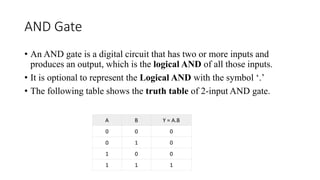
• An AND gate is a digital circuit that has two or more inputs and
produces an output, which is the logical AND of all those inputs.
• It is optional to represent the Logical AND with the symbol ‘.’
• The following table shows the truth table of 2-input AND gate.
A B Y = A.B
0 0 0
0 1 0
1 0 0
1 1 1
AND Gate
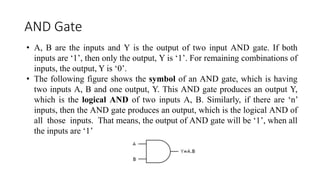
• A, B are the inputs and Y is the output of two input AND gate. If both
inputs are ‘1’, then only the output, Y is ‘1’. For remaining combinations of
inputs, the output, Y is ‘0’.
• The following figure shows the symbol of an AND gate, which is having
two inputs A, B and one output, Y. This AND gate produces an output Y,
which is the logical AND of two inputs A, B. Similarly, if there are ‘n’
inputs, then the AND gate produces an output, which is the logical AND of
all those inputs. That means, the output of AND gate will be ‘1’, when all
the inputs are ‘1’
OR gate
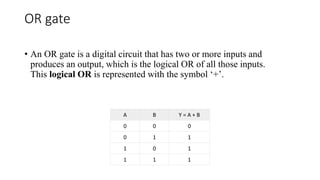
• An OR gate is a digital circuit that has two or more inputs and
produces an output, which is the logical OR of all those inputs.
This logical OR is represented with the symbol ‘+’.
A B Y = A + B
0 0 0
0 1 1
1 0 1
1 1 1
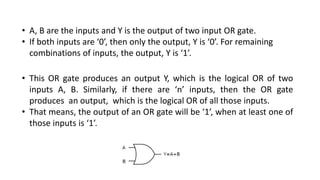
• A, B are the inputs and Y is the output of two input OR gate.
• If both inputs are ‘0’, then only the output, Y is ‘0’. For remaining
combinations of inputs, the output, Y is ‘1’.
• This OR gate produces an output Y, which is the logical OR of two
inputs A, B. Similarly, if there are ‘n’ inputs, then the OR gate
produces an output, which is the logical OR of all those inputs.
• That means, the output of an OR gate will be ‘1’, when at least one of
those inputs is ‘1’.
NOT gate
• A NOT gate is a digital circuit that has single input and
single output. The output of NOT gate is the logical
inversion of input. Hence, the NOT gate is also called
as inverter.
A Y = A’
0 1
1 0
Universal gates
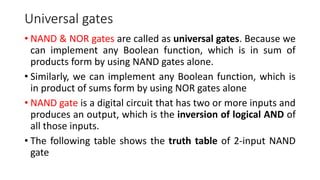
• NAND & NOR gates are called as universal gates. Because we
can implement any Boolean function, which is in sum of
products form by using NAND gates alone.
• Similarly, we can implement any Boolean function, which is
in product of sums form by using NOR gates alone
• NAND gate is a digital circuit that has two or more inputs and
produces an output, which is the inversion of logical AND of
all those inputs.
• The following table shows the truth table of 2-input NAND
gate
NAND GATE A B Y = (A.B)’
0 0 1
0 1 1
1 0 1
1 1 0
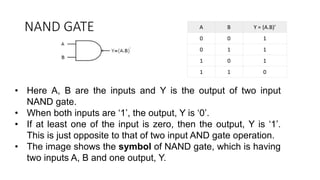
• Here A, B are the inputs and Y is the output of two input
NAND gate.
• When both inputs are ‘1’, the output, Y is ‘0’.
• If at least one of the input is zero, then the output, Y is ‘1’.
This is just opposite to that of two input AND gate operation.
• The image shows the symbol of NAND gate, which is having
two inputs A, B and one output, Y.
NOR gate
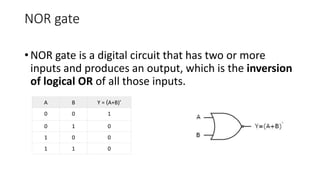
• NOR gate is a digital circuit that has two or more
inputs and produces an output, which is the inversion
of logical OR of all those inputs.
A B Y = (A+B)’
0 0 1
0 1 0
1 0 0
1 1 0
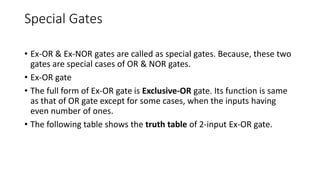
Special Gates
• Ex-OR & Ex-NOR gates are called as special gates. Because, these two
gates are special cases of OR & NOR gates.
• Ex-OR gate
• The full form of Ex-OR gate is Exclusive-OR gate. Its function is same
as that of OR gate except for some cases, when the inputs having
even number of ones.
• The following table shows the truth table of 2-input Ex-OR gate.
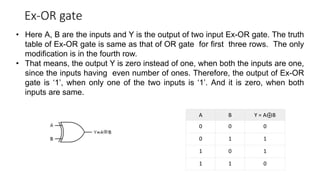
Ex-OR gate
A B Y = A⊕B
0 0 0
0 1 1
1 0 1
1 1 0
• Here A, B are the inputs and Y is the output of two input Ex-OR gate. The truth
table of Ex-OR gate is same as that of OR gate for first three rows. The only
modification is in the fourth row.
• That means, the output Y is zero instead of one, when both the inputs are one,
since the inputs having even number of ones. Therefore, the output of Ex-OR
gate is ‘1’, when only one of the two inputs is ‘1’. And it is zero, when both
inputs are same.
EX-NOR gate
Truth Table
2-
input
Ex-
NOR
Gate
B A Q
0 0 1
0 1 0
1 0 0
1 1 1
Boolean Expression Q = (A ⊕ B)’
Logic gates using NAND gates
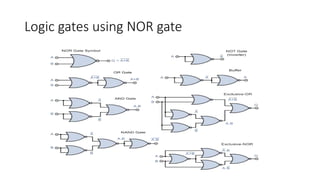
Logic gates using NOR gate
Number System
• When we type some letters or words, the computer translates
them in numbers as computers can understand only numbers.
• A computer can understand the positional number system
where there are only a few symbols called digits and these
symbols represent different values depending on the position
they occupy in the number.
• The value of each digit in a number can be determined using −
• The digit
• The position of the digit in the number
• The base of the number system (where the base is defined as the total
number of digits available in the number system)
Decimal Number System
• The number system that we use in our day-to-day life is the
decimal number system.
• Decimal number system has base 10 as it uses 10 digits from 0
to 9. In decimal number system, the successive positions to the
left of the decimal point represent units, tens, hundreds,
thousands, and so on.
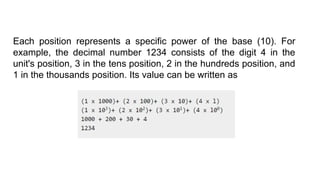
Each position represents a specific power of the base (10). For
example, the decimal number 1234 consists of the digit 4 in the
unit's position, 3 in the tens position, 2 in the hundreds position, and
1 in the thousands position. Its value can be written as
Logic gates and Digital system.pptx

Logic gates and Digital system.pptx

  • 1.
  • 2.
    AND Gate • AnAND gate is a digital circuit that has two or more inputs and produces an output, which is the logical AND of all those inputs. • It is optional to represent the Logical AND with the symbol ‘.’ • The following table shows the truth table of 2-input AND gate. A B Y = A.B 0 0 0 0 1 0 1 0 0 1 1 1
  • 3.
    AND Gate • A,B are the inputs and Y is the output of two input AND gate. If both inputs are ‘1’, then only the output, Y is ‘1’. For remaining combinations of inputs, the output, Y is ‘0’. • The following figure shows the symbol of an AND gate, which is having two inputs A, B and one output, Y. This AND gate produces an output Y, which is the logical AND of two inputs A, B. Similarly, if there are ‘n’ inputs, then the AND gate produces an output, which is the logical AND of all those inputs. That means, the output of AND gate will be ‘1’, when all the inputs are ‘1’
  • 4.
    OR gate • AnOR gate is a digital circuit that has two or more inputs and produces an output, which is the logical OR of all those inputs. This logical OR is represented with the symbol ‘+’. A B Y = A + B 0 0 0 0 1 1 1 0 1 1 1 1
  • 5.
    • A, Bare the inputs and Y is the output of two input OR gate. • If both inputs are ‘0’, then only the output, Y is ‘0’. For remaining combinations of inputs, the output, Y is ‘1’. • This OR gate produces an output Y, which is the logical OR of two inputs A, B. Similarly, if there are ‘n’ inputs, then the OR gate produces an output, which is the logical OR of all those inputs. • That means, the output of an OR gate will be ‘1’, when at least one of those inputs is ‘1’.
  • 6.
    NOT gate • ANOT gate is a digital circuit that has single input and single output. The output of NOT gate is the logical inversion of input. Hence, the NOT gate is also called as inverter. A Y = A’ 0 1 1 0
  • 7.
    Universal gates • NAND& NOR gates are called as universal gates. Because we can implement any Boolean function, which is in sum of products form by using NAND gates alone. • Similarly, we can implement any Boolean function, which is in product of sums form by using NOR gates alone • NAND gate is a digital circuit that has two or more inputs and produces an output, which is the inversion of logical AND of all those inputs. • The following table shows the truth table of 2-input NAND gate
  • 8.
    NAND GATE AB Y = (A.B)’ 0 0 1 0 1 1 1 0 1 1 1 0 • Here A, B are the inputs and Y is the output of two input NAND gate. • When both inputs are ‘1’, the output, Y is ‘0’. • If at least one of the input is zero, then the output, Y is ‘1’. This is just opposite to that of two input AND gate operation. • The image shows the symbol of NAND gate, which is having two inputs A, B and one output, Y.
  • 9.
    NOR gate • NORgate is a digital circuit that has two or more inputs and produces an output, which is the inversion of logical OR of all those inputs. A B Y = (A+B)’ 0 0 1 0 1 0 1 0 0 1 1 0
  • 10.
    Special Gates • Ex-OR& Ex-NOR gates are called as special gates. Because, these two gates are special cases of OR & NOR gates. • Ex-OR gate • The full form of Ex-OR gate is Exclusive-OR gate. Its function is same as that of OR gate except for some cases, when the inputs having even number of ones. • The following table shows the truth table of 2-input Ex-OR gate.
  • 11.
    Ex-OR gate A BY = A⊕B 0 0 0 0 1 1 1 0 1 1 1 0 • Here A, B are the inputs and Y is the output of two input Ex-OR gate. The truth table of Ex-OR gate is same as that of OR gate for first three rows. The only modification is in the fourth row. • That means, the output Y is zero instead of one, when both the inputs are one, since the inputs having even number of ones. Therefore, the output of Ex-OR gate is ‘1’, when only one of the two inputs is ‘1’. And it is zero, when both inputs are same.
  • 12.
    EX-NOR gate Truth Table 2- input Ex- NOR Gate BA Q 0 0 1 0 1 0 1 0 0 1 1 1 Boolean Expression Q = (A ⊕ B)’
  • 13.
  • 14.
  • 15.
    Number System • Whenwe type some letters or words, the computer translates them in numbers as computers can understand only numbers. • A computer can understand the positional number system where there are only a few symbols called digits and these symbols represent different values depending on the position they occupy in the number. • The value of each digit in a number can be determined using − • The digit • The position of the digit in the number • The base of the number system (where the base is defined as the total number of digits available in the number system)
  • 16.
    Decimal Number System •The number system that we use in our day-to-day life is the decimal number system. • Decimal number system has base 10 as it uses 10 digits from 0 to 9. In decimal number system, the successive positions to the left of the decimal point represent units, tens, hundreds, thousands, and so on.
  • 17.
    Each position representsa specific power of the base (10). For example, the decimal number 1234 consists of the digit 4 in the unit's position, 3 in the tens position, 2 in the hundreds position, and 1 in the thousands position. Its value can be written as