Isaac Halle
Planning and Research
Music Magazine – Genre research
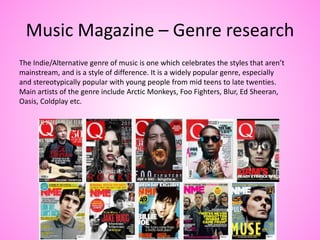
The Indie/Alternative genre of music is one which celebrates the styles that aren’t
mainstream, and is a style of difference. It is a widely popular genre, especially
and stereotypically popular with young people from mid teens to late twenties.
Main artists of the genre include Arctic Monkeys, Foo Fighters, Blur, Ed Sheeran,
Oasis, Coldplay etc.
My magazine of inspiration
My magazine of inspiration is NME
This is because NME is the same genre as my media product
(Indie/Alternative).
Therefore it’s style, codes and conventions are very similar to
what I aim to replicate with my magazine.
Through ‘repetition and difference’ (Neale) my media product
can be as effective and professional as magazines such as
NME through imitating effective conventions however I will
change some aspects in order to make my magazine unique
and give in a unique selling point which can give my magazine
an advantage over competitors.
NME stands for ‘new musical express’
NME is a music magazine, and typically features
music of the ‘indie’ or ‘alternative’ genre of
music.
NME were launched in 1952.
In 2015 they became a free magazine.
Publisher research
http://www.timeincuk.com/brands/nme/
The publishing company of my magazine of inspiration-NME, is
timeinc.uk
The chief executive is Marcus Rich.
Timeinc.uk publish many different magazines of different genres, for example;
What’s on TV, World Soccer, Shooting times and Soaplife.
We can see that timeinc.uk own various brands of different genres in order to
have a greater mass appeal. They engage with almost half of all UK adults
(around 26 million people). 2015 profits were about £23 million.
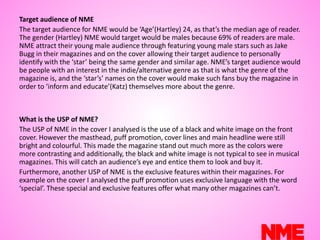
Target audience of NME
The target audience for NME would be ‘Age’(Hartley) 24, as that’s the median age of reader.
The gender (Hartley) NME would target would be males because 69% of readers are male.
NME attract their young male audience through featuring young male stars such as Jake
Bugg in their magazines and on the cover allowing their target audience to personally
identify with the ‘star’ being the same gender and similar age. NME’s target audience would
be people with an interest in the indie/alternative genre as that is what the genre of the
magazine is, and the ‘star’s’ names on the cover would make such fans buy the magazine in
order to ‘inform and educate’(Katz) themselves more about the genre.
What is the USP of NME?
The USP of NME in the cover I analysed is the use of a black and white image on the front
cover. However the masthead, puff promotion, cover lines and main headline were still
bright and colourful. This made the magazine stand out much more as the colors were
more contrasting and additionally, the black and white image is not typical to see in musical
magazines. This will catch an audience’s eye and entice them to look and buy it.
Furthermore, another USP of NME is the exclusive features within their magazines. For
example on the cover I analysed the puff promotion uses exclusive language with the word
‘special’. These special and exclusive features offer what many other magazines can’t.
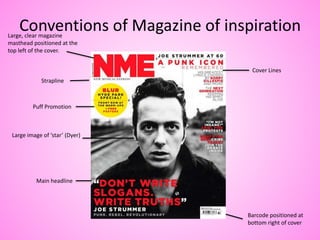
Conventions of Magazine of inspirationLarge, clear magazine
masthead positioned at the
top left of the cover.
Large image of ‘star’ (Dyer)
Barcode positioned at
bottom right of cover
Cover Lines
Main headline
Puff Promotion
Strapline
My other magazine of inspiration is Q
I have chosen Q as a magazine of inspiration because it is the same genre of magazine
as I am making mine to be. This is the music genre-more specifically, the
indie/alternative genre.
I have also chosen it because it is one of the top magazines in this genre therefore
replicating the codes and conventions of a successful magazine mean that mine can be
of similar quality. I will do this through ‘repetition and difference’(Steve Neale) by
replicating effective codes and conventions to make my magazine of high standard but
change things to make my magazine unique, and give it a USP.
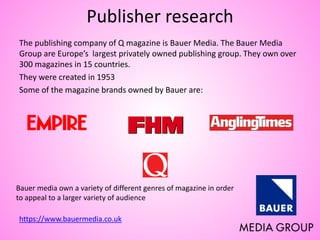
Publisher research
The publishing company of Q magazine is Bauer Media. The Bauer Media
Group are Europe’s largest privately owned publishing group. They own over
300 magazines in 15 countries.
They were created in 1953
Some of the magazine brands owned by Bauer are:
https://www.bauermedia.co.uk
Bauer media own a variety of different genres of magazine in order
to appeal to a larger variety of audience
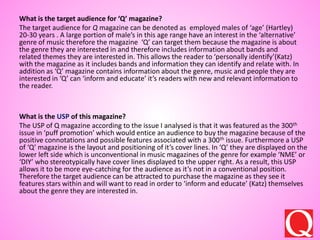
What is the target audience for ‘Q’ magazine?
The target audience for Q magazine can be denoted as employed males of ‘age’ (Hartley)
20-30 years . A large portion of male’s in this age range have an interest in the ‘alternative’
genre of music therefore the magazine ‘Q’ can target them because the magazine is about
the genre they are interested in and therefore includes information about bands and
related themes they are interested in. This allows the reader to ‘personally identify’(Katz)
with the magazine as it includes bands and information they can identify and relate with. In
addition as ‘Q’ magazine contains information about the genre, music and people they are
interested in ‘Q’ can ‘inform and educate’ it’s readers with new and relevant information to
the reader.
What is the USP of this magazine?
The USP of Q magazine according to the issue I analysed is that it was featured as the 300th
issue in ‘puff promotion’ which would entice an audience to buy the magazine because of the
positive connotations and possible features associated with a 300th issue. Furthermore a USP
of ‘Q’ magazine is the layout and positioning of it’s cover lines. In ‘Q’ they are displayed on the
lower left side which is unconventional in music magazines of the genre for example ‘NME’ or
‘DIY’ who stereotypically have cover lines displayed to the upper right. As a result, this USP
allows it to be more eye-catching for the audience as it’s not in a conventional position.
Therefore the target audience can be attracted to purchase the magazine as they see it
features stars within and will want to read in order to ‘inform and educate’ (Katz) themselves
about the genre they are interested in.
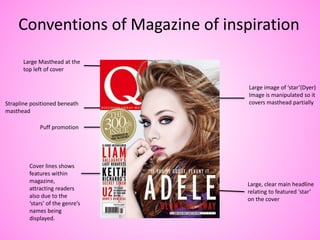
Large Masthead at the
top left of cover
Strapline positioned beneath
masthead
Large image of ‘star’(Dyer)
Image is manipulated so it
covers masthead partially
Puff promotion
Large, clear main headline
relating to featured ‘star’
on the cover
Cover lines shows
features within
magazine,
attracting readers
also due to the
‘stars’ of the genre’s
names being
displayed.
Conventions of Magazine of inspiration
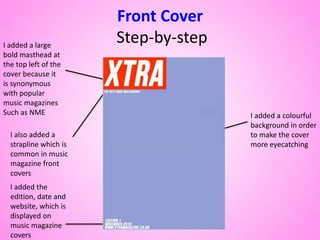
Front Cover
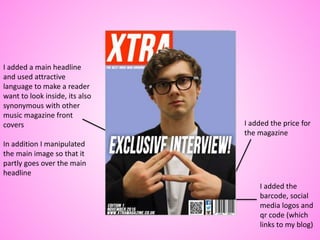
Step-by-stepI added a large
bold masthead at
the top left of the
cover because it
is synonymous
with popular
music magazines
Such as NME I added a colourful
background in order
to make the cover
more eyecatching
I added the
edition, date and
website, which is
displayed on
music magazine
covers
I also added a
strapline which is
common in music
magazine front
covers
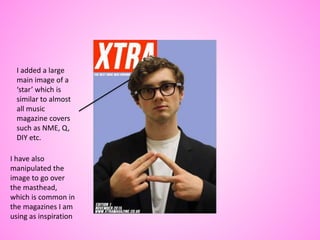
I added a large
main image of a
‘star’ which is
similar to almost
all music
magazine covers
such as NME, Q,
DIY etc.
I have also
manipulated the
image to go over
the masthead,
which is common in
the magazines I am
using as inspiration
I added the price for
the magazine
I added the
barcode, social
media logos and
qr code (which
links to my blog)
I added a main headline
and used attractive
language to make a reader
want to look inside, its also
synonymous with other
music magazine front
covers
In addition I manipulated
the main image so that it
partly goes over the main
headline
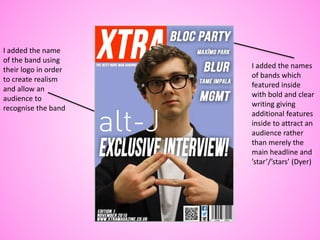
I added the name
of the band using
their logo in order
to create realism
and allow an
audience to
recognise the band
I added the names
of bands which
featured inside
with bold and clear
writing giving
additional features
inside to attract an
audience rather
than merely the
main headline and
’star’/’stars’ (Dyer)
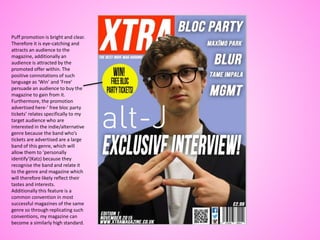
Puff promotion is bright and clear.
Therefore it is eye-catching and
attracts an audience to the
magazine, additionally an
audience is attracted by the
promoted offer within. The
positive connotations of such
language as ‘Win’ and ‘Free’
persuade an audience to buy the
magazine to gain from it.
Furthermore, the promotion
advertised here-’ free bloc party
tickets’ relates specifically to my
target audience who are
interested in the indie/alternative
genre because the band who’s
tickets are advertised are a large
band of this genre, which will
allow them to ‘personally
identify’(Katz) because they
recognise the band and relate it
to the genre and magazine which
will therefore likely reflect their
tastes and interests.
Additionally this feature is a
common convention in most
successful magazines of the same
genre so through replicating such
conventions, my magazine can
become a similarly high standard.
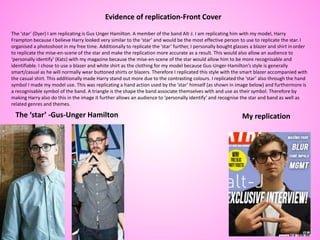
The ‘star’ (Dyer) I am replicating is Gus Unger Hamilton. A member of the band Alt-J. I am replicating him with my model, Harry
Frampton because I believe Harry looked very similar to the ‘star’ and would be the most effective person to use to replicate the star. I
organised a photoshoot in my free time. Additionally to replicate the ‘star’ further, I personally bought glasses a blazer and shirt in order
to replicate the mise-en-scene of the star and make the replication more accurate as a result. This would also allow an audience to
‘personally identify’ (Katz) with my magazine because the mise-en-scene of the star would allow him to be more recognisable and
identifiable. I chose to use a blazer and white shirt as the clothing for my model because Gus-Unger-Hamilton’s style is generally
smart/casual as he will normally wear buttoned shirts or blazers. Therefore I replicated this style with the smart blazer accompanied with
the casual shirt. This additionally made Harry stand out more due to the contrasting colours. I replicated the ‘star’ also through the hand
symbol I made my model use. This was replicating a hand action used by the ‘star’ himself (as shown in image below) and furthermore is
a recognisable symbol of the band. A triangle is the shape the band associate themselves with and use as their symbol. Therefore by
making Harry also do this in the image it further allows an audience to ‘personally identify’ and recognise the star and band as well as
related genres and themes.
Evidence of replication-Front Cover
The ‘star’ -Gus-Unger Hamilton My replication
Contents Page
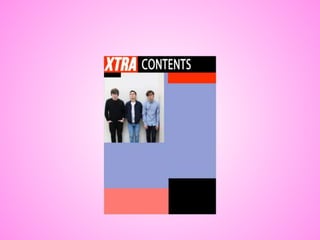
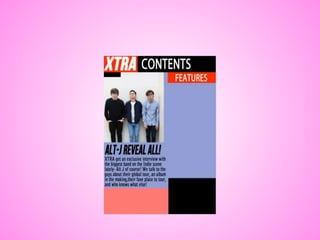
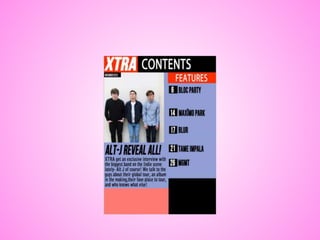
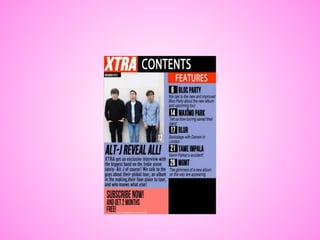
Step-by-step
Evidence of replication- Contents
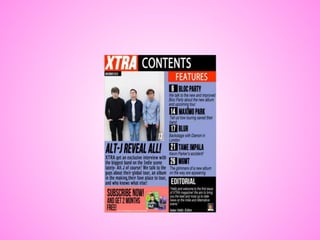
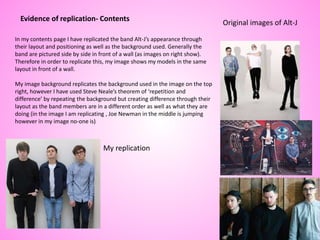
In my contents page I have replicated the band Alt-J’s appearance through
their layout and positioning as well as the background used. Generally the
band are pictured side by side in front of a wall (as images on right show).
Therefore in order to replicate this, my image shows my models in the same
layout in front of a wall.
My image background replicates the background used in the image on the top
right, however I have used Steve Neale’s theorem of ‘repetition and
difference’ by repeating the background but creating difference through their
layout as the band members are in a different order as well as what they are
doing (in the image I am replicating , Joe Newman in the middle is jumping
however in my image no-one is)
My replication
Original images of Alt-J
Evidence of replication
Contents
Mise-en-scene
Thom Green
I have replicated Thom Green with my model Kieran Smith through the
mise-en-scene of the black jacket and white T-shirt.
Additionally, I have positioned Kieran in a leaning pose as commonly the
‘star’ appears to do this in pictures
Evidence of replication
Contents
Mise-en-scene
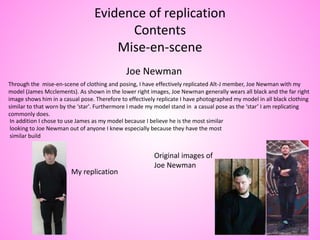
Joe Newman
Through the mise-en-scene of clothing and posing, I have effectively replicated Alt-J member, Joe Newman with my
model (James Mcclements). As shown in the lower right images, Joe Newman generally wears all black and the far right
image shows him in a casual pose. Therefore to effectively replicate I have photographed my model in all black clothing
similar to that worn by the ‘star'. Furthermore I made my model stand in a casual pose as the ‘star’ I am replicating
commonly does.
In addition I chose to use James as my model because I believe he is the most similar
looking to Joe Newman out of anyone I knew especially because they have the most
similar build
My replication
Original images of
Joe Newman
Evidence of replication
Contents
Mise-en-scene
Gus Unger-Hamilton
I have replicated Gus Unger-Hamilton with my model Harry Frampton
through the mise-en-scene of the glasses and blue shirt. I chose Harry
specifically as a model because he looks very similar to Gus and would
therefore be best to replicate him.

Logbook+

  • 1.
  • 2.
    Music Magazine –Genre research The Indie/Alternative genre of music is one which celebrates the styles that aren’t mainstream, and is a style of difference. It is a widely popular genre, especially and stereotypically popular with young people from mid teens to late twenties. Main artists of the genre include Arctic Monkeys, Foo Fighters, Blur, Ed Sheeran, Oasis, Coldplay etc.
  • 3.
    My magazine ofinspiration My magazine of inspiration is NME This is because NME is the same genre as my media product (Indie/Alternative). Therefore it’s style, codes and conventions are very similar to what I aim to replicate with my magazine. Through ‘repetition and difference’ (Neale) my media product can be as effective and professional as magazines such as NME through imitating effective conventions however I will change some aspects in order to make my magazine unique and give in a unique selling point which can give my magazine an advantage over competitors.
  • 4.
    NME stands for‘new musical express’ NME is a music magazine, and typically features music of the ‘indie’ or ‘alternative’ genre of music. NME were launched in 1952. In 2015 they became a free magazine.
  • 5.
    Publisher research http://www.timeincuk.com/brands/nme/ The publishingcompany of my magazine of inspiration-NME, is timeinc.uk The chief executive is Marcus Rich. Timeinc.uk publish many different magazines of different genres, for example; What’s on TV, World Soccer, Shooting times and Soaplife. We can see that timeinc.uk own various brands of different genres in order to have a greater mass appeal. They engage with almost half of all UK adults (around 26 million people). 2015 profits were about £23 million.
  • 6.
    Target audience ofNME The target audience for NME would be ‘Age’(Hartley) 24, as that’s the median age of reader. The gender (Hartley) NME would target would be males because 69% of readers are male. NME attract their young male audience through featuring young male stars such as Jake Bugg in their magazines and on the cover allowing their target audience to personally identify with the ‘star’ being the same gender and similar age. NME’s target audience would be people with an interest in the indie/alternative genre as that is what the genre of the magazine is, and the ‘star’s’ names on the cover would make such fans buy the magazine in order to ‘inform and educate’(Katz) themselves more about the genre. What is the USP of NME? The USP of NME in the cover I analysed is the use of a black and white image on the front cover. However the masthead, puff promotion, cover lines and main headline were still bright and colourful. This made the magazine stand out much more as the colors were more contrasting and additionally, the black and white image is not typical to see in musical magazines. This will catch an audience’s eye and entice them to look and buy it. Furthermore, another USP of NME is the exclusive features within their magazines. For example on the cover I analysed the puff promotion uses exclusive language with the word ‘special’. These special and exclusive features offer what many other magazines can’t.
  • 7.
    Conventions of Magazineof inspirationLarge, clear magazine masthead positioned at the top left of the cover. Large image of ‘star’ (Dyer) Barcode positioned at bottom right of cover Cover Lines Main headline Puff Promotion Strapline
  • 8.
    My other magazineof inspiration is Q I have chosen Q as a magazine of inspiration because it is the same genre of magazine as I am making mine to be. This is the music genre-more specifically, the indie/alternative genre. I have also chosen it because it is one of the top magazines in this genre therefore replicating the codes and conventions of a successful magazine mean that mine can be of similar quality. I will do this through ‘repetition and difference’(Steve Neale) by replicating effective codes and conventions to make my magazine of high standard but change things to make my magazine unique, and give it a USP.
  • 9.
    Publisher research The publishingcompany of Q magazine is Bauer Media. The Bauer Media Group are Europe’s largest privately owned publishing group. They own over 300 magazines in 15 countries. They were created in 1953 Some of the magazine brands owned by Bauer are: https://www.bauermedia.co.uk Bauer media own a variety of different genres of magazine in order to appeal to a larger variety of audience
  • 10.
    What is thetarget audience for ‘Q’ magazine? The target audience for Q magazine can be denoted as employed males of ‘age’ (Hartley) 20-30 years . A large portion of male’s in this age range have an interest in the ‘alternative’ genre of music therefore the magazine ‘Q’ can target them because the magazine is about the genre they are interested in and therefore includes information about bands and related themes they are interested in. This allows the reader to ‘personally identify’(Katz) with the magazine as it includes bands and information they can identify and relate with. In addition as ‘Q’ magazine contains information about the genre, music and people they are interested in ‘Q’ can ‘inform and educate’ it’s readers with new and relevant information to the reader. What is the USP of this magazine? The USP of Q magazine according to the issue I analysed is that it was featured as the 300th issue in ‘puff promotion’ which would entice an audience to buy the magazine because of the positive connotations and possible features associated with a 300th issue. Furthermore a USP of ‘Q’ magazine is the layout and positioning of it’s cover lines. In ‘Q’ they are displayed on the lower left side which is unconventional in music magazines of the genre for example ‘NME’ or ‘DIY’ who stereotypically have cover lines displayed to the upper right. As a result, this USP allows it to be more eye-catching for the audience as it’s not in a conventional position. Therefore the target audience can be attracted to purchase the magazine as they see it features stars within and will want to read in order to ‘inform and educate’ (Katz) themselves about the genre they are interested in.
  • 11.
    Large Masthead atthe top left of cover Strapline positioned beneath masthead Large image of ‘star’(Dyer) Image is manipulated so it covers masthead partially Puff promotion Large, clear main headline relating to featured ‘star’ on the cover Cover lines shows features within magazine, attracting readers also due to the ‘stars’ of the genre’s names being displayed. Conventions of Magazine of inspiration
  • 12.
    Front Cover Step-by-stepI addeda large bold masthead at the top left of the cover because it is synonymous with popular music magazines Such as NME I added a colourful background in order to make the cover more eyecatching I added the edition, date and website, which is displayed on music magazine covers I also added a strapline which is common in music magazine front covers
  • 13.
    I added alarge main image of a ‘star’ which is similar to almost all music magazine covers such as NME, Q, DIY etc. I have also manipulated the image to go over the masthead, which is common in the magazines I am using as inspiration
  • 14.
    I added theprice for the magazine I added the barcode, social media logos and qr code (which links to my blog) I added a main headline and used attractive language to make a reader want to look inside, its also synonymous with other music magazine front covers In addition I manipulated the main image so that it partly goes over the main headline
  • 15.
    I added thename of the band using their logo in order to create realism and allow an audience to recognise the band I added the names of bands which featured inside with bold and clear writing giving additional features inside to attract an audience rather than merely the main headline and ’star’/’stars’ (Dyer)
  • 16.
    Puff promotion isbright and clear. Therefore it is eye-catching and attracts an audience to the magazine, additionally an audience is attracted by the promoted offer within. The positive connotations of such language as ‘Win’ and ‘Free’ persuade an audience to buy the magazine to gain from it. Furthermore, the promotion advertised here-’ free bloc party tickets’ relates specifically to my target audience who are interested in the indie/alternative genre because the band who’s tickets are advertised are a large band of this genre, which will allow them to ‘personally identify’(Katz) because they recognise the band and relate it to the genre and magazine which will therefore likely reflect their tastes and interests. Additionally this feature is a common convention in most successful magazines of the same genre so through replicating such conventions, my magazine can become a similarly high standard.
  • 17.
    The ‘star’ (Dyer)I am replicating is Gus Unger Hamilton. A member of the band Alt-J. I am replicating him with my model, Harry Frampton because I believe Harry looked very similar to the ‘star’ and would be the most effective person to use to replicate the star. I organised a photoshoot in my free time. Additionally to replicate the ‘star’ further, I personally bought glasses a blazer and shirt in order to replicate the mise-en-scene of the star and make the replication more accurate as a result. This would also allow an audience to ‘personally identify’ (Katz) with my magazine because the mise-en-scene of the star would allow him to be more recognisable and identifiable. I chose to use a blazer and white shirt as the clothing for my model because Gus-Unger-Hamilton’s style is generally smart/casual as he will normally wear buttoned shirts or blazers. Therefore I replicated this style with the smart blazer accompanied with the casual shirt. This additionally made Harry stand out more due to the contrasting colours. I replicated the ‘star’ also through the hand symbol I made my model use. This was replicating a hand action used by the ‘star’ himself (as shown in image below) and furthermore is a recognisable symbol of the band. A triangle is the shape the band associate themselves with and use as their symbol. Therefore by making Harry also do this in the image it further allows an audience to ‘personally identify’ and recognise the star and band as well as related genres and themes. Evidence of replication-Front Cover The ‘star’ -Gus-Unger Hamilton My replication
  • 18.
  • 25.
    Evidence of replication-Contents In my contents page I have replicated the band Alt-J’s appearance through their layout and positioning as well as the background used. Generally the band are pictured side by side in front of a wall (as images on right show). Therefore in order to replicate this, my image shows my models in the same layout in front of a wall. My image background replicates the background used in the image on the top right, however I have used Steve Neale’s theorem of ‘repetition and difference’ by repeating the background but creating difference through their layout as the band members are in a different order as well as what they are doing (in the image I am replicating , Joe Newman in the middle is jumping however in my image no-one is) My replication Original images of Alt-J
  • 26.
    Evidence of replication Contents Mise-en-scene ThomGreen I have replicated Thom Green with my model Kieran Smith through the mise-en-scene of the black jacket and white T-shirt. Additionally, I have positioned Kieran in a leaning pose as commonly the ‘star’ appears to do this in pictures
  • 27.
    Evidence of replication Contents Mise-en-scene JoeNewman Through the mise-en-scene of clothing and posing, I have effectively replicated Alt-J member, Joe Newman with my model (James Mcclements). As shown in the lower right images, Joe Newman generally wears all black and the far right image shows him in a casual pose. Therefore to effectively replicate I have photographed my model in all black clothing similar to that worn by the ‘star'. Furthermore I made my model stand in a casual pose as the ‘star’ I am replicating commonly does. In addition I chose to use James as my model because I believe he is the most similar looking to Joe Newman out of anyone I knew especially because they have the most similar build My replication Original images of Joe Newman
  • 28.
    Evidence of replication Contents Mise-en-scene GusUnger-Hamilton I have replicated Gus Unger-Hamilton with my model Harry Frampton through the mise-en-scene of the glasses and blue shirt. I chose Harry specifically as a model because he looks very similar to Gus and would therefore be best to replicate him.