Lockout/Tagout
Worker Training of Electrical Hazards Including
Arc Flash SH-16614-07
This material was produced under grant number
SH-16614-07 from the Occupational Safety and
Health Administration, U.S. Department of
Labor. It does not necessarily reflect the views
or policies of the U.S. Department of Labor, nor
does mention of trade names, commercial
products, or organizations imply endorsement by
the U.S. Government.

2
Overview
•
•
•
•
•
•

3

Introduction
Application
LO/TO Program
Lockouts Types
Training
Contractors
Introduction
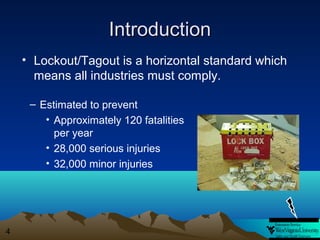
• Lockout/Tagout is a horizontal standard which
means all industries must comply.
– Estimated to prevent
• Approximately 120 fatalities
per year
• 28,000 serious injuries
• 32,000 minor injuries

4
Introduction
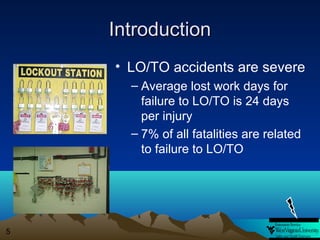
• LO/TO accidents are severe
– Average lost work days for
failure to LO/TO is 24 days
per injury
– 7% of all fatalities are related
to failure to LO/TO

5
Introduction
• Purpose of the Control of Hazardous
Energy Program:
– If a risk exists to any person on unexpected
start up, all protective measures are taken to
isolate all sources of hazardous energy.

6
Application
Application of Lockout/Tagout is required:
– when servicing and/or maintaining machines
or equipment,
– if it is necessary to remove a guard or bypass
safety device or interlock,
– if employee has the potential to be exposed to
material being processed or machine cycle.

7
Application
The Lockout/Tagout standard does not apply to:
– Cord and Plug Electrical Equipment
• plug under exclusive control of employee
performing servicing or maintenance
– Hot Tap operations..transmission and distribution
systems..water,gas, stream or petroleum products
• continuity of service essential
• shutdown of system is impractical
• documented procedures are followed
8
LO/TO Program
• Responsibility of the program is assigned to a
responsible person.
– lock acquisition
– safe work procedures
– training coordination
– contractor coordination
– assist supervisors in implementation and
enforcement of disciplinary actions for noncompliance
9
LO/TO Program
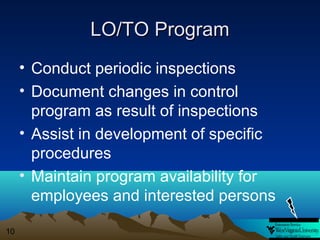
• Conduct periodic inspections
• Document changes in control
program as result of inspections
• Assist in development of specific
procedures
• Maintain program availability for
employees and interested persons
10
LO/TO Program
• Any employee who may be involved
in the operation, installation, service
or maintenance of any machine or
equipment that has potential for
release of hazardous energy is
authorized to Lockout/Tagout if he or
she is trained.
11
LO/TO Program
Authorized Employee
• Person who locks
out or tags out
machine
• Appendix of the
LO/TO Program
contains a list of
Authorized
Employees
12
LO/TO Program
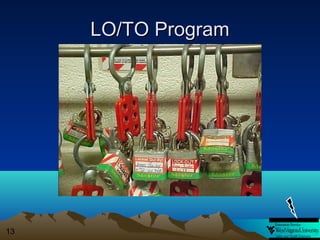
Authorized

13
LO/TO Program
• Affected employees are those employees
whose job requires them to operate
machine or process on which
maintenance or service is being
performed.
– Need to be notified on shutdown and start up.

14
Lockouts
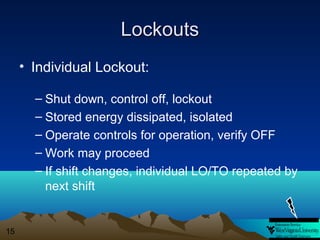
• Individual Lockout:
– Shut down, control off, lockout
– Stored energy dissipated, isolated
– Operate controls for operation, verify OFF
– Work may proceed
– If shift changes, individual LO/TO repeated by
next shift

15
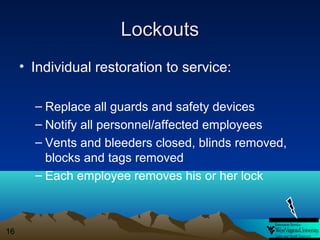
Lockouts
• Individual restoration to service:
– Replace all guards and safety devices
– Notify all personnel/affected employees
– Vents and bleeders closed, blinds removed,
blocks and tags removed
– Each employee removes his or her lock

16
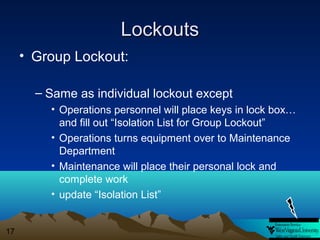
Lockouts
• Group Lockout:
– Same as individual lockout except
• Operations personnel will place keys in lock box…
and fill out “Isolation List for Group Lockout”
• Operations turns equipment over to Maintenance
Department
• Maintenance will place their personal lock and
complete work
• update “Isolation List”
17
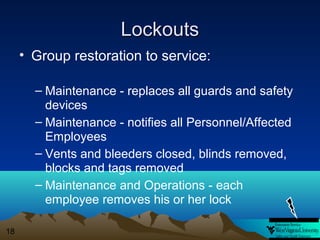
Lockouts
• Group restoration to service:
– Maintenance - replaces all guards and safety
devices
– Maintenance - notifies all Personnel/Affected
Employees
– Vents and bleeders closed, blinds removed,
blocks and tags removed
– Maintenance and Operations - each
employee removes his or her lock
18
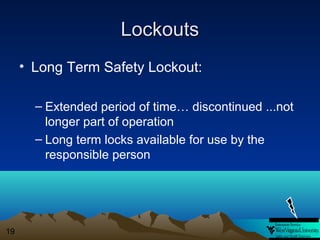
Lockouts
• Long Term Safety Lockout:
– Extended period of time… discontinued ...not
longer part of operation
– Long term locks available for use by the
responsible person

19
Training
Additional Training for Authorized Persons
– When implementation is required.
– Recognition of hazardous energies.
– Returning equipment to service.
– If questions on application specific actions to
be taken.

20
Training
Additional training
required if . . .
– new equipment is
introduced
– changes in LO/TO
equipment
– periodic audit
identifies need

21
MCC

22
Contractors
• Exchange of LO/TO procedures
• Agreement of procedures before
work begins
• Discipline of contractor and/or
contractor employee(s) for failure
to LO/TO
23
DANGER!

24
Questions?

25

Lockout tagout2

  • 1.
  • 2.
    Worker Training ofElectrical Hazards Including Arc Flash SH-16614-07 This material was produced under grant number SH-16614-07 from the Occupational Safety and Health Administration, U.S. Department of Labor. It does not necessarily reflect the views or policies of the U.S. Department of Labor, nor does mention of trade names, commercial products, or organizations imply endorsement by the U.S. Government. 2
  • 3.
  • 4.
    Introduction • Lockout/Tagout isa horizontal standard which means all industries must comply. – Estimated to prevent • Approximately 120 fatalities per year • 28,000 serious injuries • 32,000 minor injuries 4
  • 5.
    Introduction • LO/TO accidentsare severe – Average lost work days for failure to LO/TO is 24 days per injury – 7% of all fatalities are related to failure to LO/TO 5
  • 6.
    Introduction • Purpose ofthe Control of Hazardous Energy Program: – If a risk exists to any person on unexpected start up, all protective measures are taken to isolate all sources of hazardous energy. 6
  • 7.
    Application Application of Lockout/Tagoutis required: – when servicing and/or maintaining machines or equipment, – if it is necessary to remove a guard or bypass safety device or interlock, – if employee has the potential to be exposed to material being processed or machine cycle. 7
  • 8.
    Application The Lockout/Tagout standarddoes not apply to: – Cord and Plug Electrical Equipment • plug under exclusive control of employee performing servicing or maintenance – Hot Tap operations..transmission and distribution systems..water,gas, stream or petroleum products • continuity of service essential • shutdown of system is impractical • documented procedures are followed 8
  • 9.
    LO/TO Program • Responsibilityof the program is assigned to a responsible person. – lock acquisition – safe work procedures – training coordination – contractor coordination – assist supervisors in implementation and enforcement of disciplinary actions for noncompliance 9
  • 10.
    LO/TO Program • Conductperiodic inspections • Document changes in control program as result of inspections • Assist in development of specific procedures • Maintain program availability for employees and interested persons 10
  • 11.
    LO/TO Program • Anyemployee who may be involved in the operation, installation, service or maintenance of any machine or equipment that has potential for release of hazardous energy is authorized to Lockout/Tagout if he or she is trained. 11
  • 12.
    LO/TO Program Authorized Employee •Person who locks out or tags out machine • Appendix of the LO/TO Program contains a list of Authorized Employees 12
  • 13.
  • 14.
    LO/TO Program • Affectedemployees are those employees whose job requires them to operate machine or process on which maintenance or service is being performed. – Need to be notified on shutdown and start up. 14
  • 15.
    Lockouts • Individual Lockout: –Shut down, control off, lockout – Stored energy dissipated, isolated – Operate controls for operation, verify OFF – Work may proceed – If shift changes, individual LO/TO repeated by next shift 15
  • 16.
    Lockouts • Individual restorationto service: – Replace all guards and safety devices – Notify all personnel/affected employees – Vents and bleeders closed, blinds removed, blocks and tags removed – Each employee removes his or her lock 16
  • 17.
    Lockouts • Group Lockout: –Same as individual lockout except • Operations personnel will place keys in lock box… and fill out “Isolation List for Group Lockout” • Operations turns equipment over to Maintenance Department • Maintenance will place their personal lock and complete work • update “Isolation List” 17
  • 18.
    Lockouts • Group restorationto service: – Maintenance - replaces all guards and safety devices – Maintenance - notifies all Personnel/Affected Employees – Vents and bleeders closed, blinds removed, blocks and tags removed – Maintenance and Operations - each employee removes his or her lock 18
  • 19.
    Lockouts • Long TermSafety Lockout: – Extended period of time… discontinued ...not longer part of operation – Long term locks available for use by the responsible person 19
  • 20.
    Training Additional Training forAuthorized Persons – When implementation is required. – Recognition of hazardous energies. – Returning equipment to service. – If questions on application specific actions to be taken. 20
  • 21.
    Training Additional training required if. . . – new equipment is introduced – changes in LO/TO equipment – periodic audit identifies need 21
  • 22.
  • 23.
    Contractors • Exchange ofLO/TO procedures • Agreement of procedures before work begins • Discipline of contractor and/or contractor employee(s) for failure to LO/TO 23
  • 24.
  • 25.

Editor's Notes

  • #5 Estimated to: Cost about 135 million each per year Affect approximately 631,000 employers Affect approximately 39 million employees
  • #6 This is for FY 1988, quote for LO/TO preamble to the LO/TO Standard effective Oct. 31, 1989 National Average lost work days per injury are 14 days 2% of all non-fatal injuries are related to failure to LO/TO
  • #7 The program establishes minimum requirements for energy isolating sources. If employees or contractor employees perform any installation, service, or maintenance where the unexpected activation, start up, or release of stored energy could represent risk to any employees or equipment, all protective measures are to be taken to isolate all sources of hazardous energy.
  • #16 Isolated by breaking joint, placing blind Operating controls for operation, return control to off