GUIDELINES IN THE
ACCREDITATION OF
CIVIL SOCIETY
ORGANIZATIONS AND
SELECTION OF
REPRESENTATIVES
TO THE LOCAL
SPECIAL BODIES
Municipal Planning and
Development Office
BASIS
DILG MEMORANDUM CIRCULAR NO. 2022-083: Guidelines on the
Accreditation of Civil Society Organizations and Selection of
Representatives to the Local Special Bodies
BASIS
COVERAGE
All provinces, cities and municipalities, and all civil society
organizations intending to apply for accreditation to seek
representation in the LSBs.
The directory shall contain the following
information for each CSO:
Name of the Organization
Contact information
Organization’s objectives or
purposes
Services offered
Community or communities served
or currently being served
Project development and
implementation track record
Name and mobile number of the
officer-in-charge or a responsible
official of the organization
National, regional, provincial, city
and municipal affiliations, if any
Registration and/or accreditation
information
INVENTORY AND
DIRECTORY OF
CIVIL SOCIETY
ORGANIZATIONS
The final updated Directory
shall serve as the source
document for the issuance
of Notice of Call for
Accreditation.
CALL FOR ACCREDITATION
• Within the 1st week of August, the Sanggunian, in coordination
with the CSO Desk Officer, shall issue a Notice of Call for
Accreditation and send an invitation to all the CSOs listed in
the final updated Directory of CSOs, through the conduct of a
CSO Conference that shall be conducted by the local
government unit.
• Concurrent with the call for accreditation, the LGU through the
CSO Desk Officer, shall hold as CSO Conference to orient
participants in the accreditation guidelines and raise their
awareness on the importance of civil society participation in
the local governance processes, and to encourage CSOs to
apply for accreditation with their local sanggunian.
Relevance of participatory governance
Guidelines on LGU accreditation of CSOs and reconstitution of
LSBs, including discussion on accomplishing the forms and
requirements
Avenues of CSO participation as provided for in RA 7160 and
other relevant policies and issuances
Encouraging the formation and/or expansion of a local CSO
Network and/or local People’s Council if not already established.
THE CSO CONFERENCE SHALL COVER
FOUR MAJOR TOPICS
Within the 2nd week of
August, but not later
than the last working
day of the 3rd week,
every organization
seeking for
accreditation, or
renewal, shall submit
one (1) copy of each
of the following
requirements:
Letter of Application
Duly accomplished Application Form for Accreditation
Duly approved Board Resolution signifying intention for
accreditation for the purpose of representation in a local special
body
Certificate of Registration or existing valid Certificate of
Accreditation from any NGA
List of current Officers
For CSOs that have been in operation for at least one (1) year,
Minutes of the Annual Meetings of the immediately preceding year
as certified by the organization’s board secretary or Certification
from the board secretary certifying the annual meeting’s conduct
including the date, location, attendees, and agenda
For CSOs that have been in operation for at least one (1) year,
Financial Statement, signed by the executive officers of the
organization, also of the immediately preceding year, and
indicating therein other information such as revenue, expenses
and the sources of funds
ACCREDITATION PROPER
The Sanggunian, through a resolution, shall evaluate all
applications for accreditation starting on the 3rd week but not
later than the last working day of August, on the basis of the
following criteria:
Registration with SEC, CDA, DOLE, or DHSUD, or
accreditation with any NGA that is empowered by law or
policy to accredit such organizations;
Organization purposes and objectives which include
community organization and development, institution-
building, local enterprise development, livelihood
development, capacity building, and similar development
objectives and considerations;
Sanggunian shall accredit CSOs which comply with all the
administrative requirements and satisfy all the criteria enumerated.
Community-based and sectoral-based with project development
and implementation track record in the province, city or
municipality of at least one (1) year;
Reliability as evidenced by the preparation of annual reports
and conduct of annual meetings duly certified by the board
secretary of the organization;
THE SANGGUNIAN SHALL ISSUE NOT LATER THAN
THE LAST WORKING DAY OF AUGUST THE
FOLLOWING:
A Certificate of Accreditation to every qualified CSO and shall be valid
until June 30, 2025, subject to revocation, based on the grounds
stated on the DILG Memorandum Circular.
Notice to every organization, which applied and satisfied in the set
criteria but failed to submit all the requirements encouraging them to
complete the lacking requirements.
Notice of Non-Qualification to CSOs that were not able to satisfy the
requirements and set criteria, informing them of the reason/s for said
non-qualification, and encouraging them to participate in other
avenues for civil society participation in local governance.
A Certificate of Recognition issued to a CSO that meet and pass all the
requirements except the Certificate of Registration from any NGA. A
Certificate of Recognition shall be valid until June 30, 2025, subject to
revocation, based on the grounds stated on the DILG Memorandum
Circular.
1st week of September
After the accreditation, the DILG Provincial Director, CLGOO
and MLGOO, as the case may be, in coordination with the CSO
Desk Officer, MPDO or a duly designated LGU appointive official,
shall issue a notice to all accredited CSOs for a meeting on the
selection of representatives to the LSBs.
2nd week of September
Conduct an orientation on the functions of the Local Special
Bodies and responsibilities of the CSO that will be selected during
the same meeting.
SELECTION OF REPRESENTATIVES TO THE
LSBs
The executive officers, or the duly authorized representatives of the selected
CSOs shall designate their principal and alternate representatives to the
LSBs.
The Local People’s Council shall have the sole prerogative to identify their
principal and alternate representatives to the LSBs from among their
member-organizations.
No organization or representative shall be a member of more than one (1)
local special body within a province, city or municipality.
The selected representative of an organization must not be an employee of
the provincial, city or municipal government to avoid conflicts of interest.
The term of office of a selected representative shall be coterminous with
that of the local chief executive.
SELECTION OF REPRESENTATIVES TO THE
LOCAL DEVELOPMENT COUNCIL
Must have representatives from the women’s sector, or as may be
practicable, at least (40%) of the fully organized council shall be composed
of women as prescribed by RA 9710 or the Magna Carta of Women of 2009;
Other existing laws enacted and passed subsequent to the passage of RA
7160 that further define the composition of the LDC and other special bodies,
such as but not limited to, RA 8371 or the Indigenous Peoples Rights Act of
1997 and RA No. 8371 or the Agriculture and Fisheries Modernization Act.
Representatives of NGOs operating in the barangay, municipality, city or
province, as the case maybe, shall constitute not less than ¼ of the
members of the fully organized council.
The representative-organization should be involved in health services
or composed of individuals that have competencies that are related to
or may contribute to the functions of the LHB.
All provinces, cities and municipalities are also encouraged to increase
the membership of representative-organizations to one-half (1/2) of
the fully organized LHB to further expand citizen participation. Such
representative-organizations shall represent sectors, such as, but not
limited to: ICCPs/IPs, agriculture, transport, housing, education,
environment, faith-based organizations, senior citizens, PWDs,
women, LGBTQIA+ and the youth. Increased representation from the
private sector such as private hospital chiefs, is also encouraged to
contribute to the integration of the province-wide and city-wide health
system pursuant to Section 19 of RA11223 or the Universal Health
Care Act.
SELECTION OF REPRESENTATIVES TO THE
LOCAL HEALTH BOARD
All provinces, cities and municipalities are also
encouraged to invite, as non-voting members,
representatives from the private sector such as the
business community, private academic institutions, civic
organizations, people’s organizations, and civil society to
share their expertise and resources.
The LScB shall have representative-organizations from parents-
teachers associations, and teacher’s organizations and
organization of non-academic personnel of public schools in the
locality, and other organizations involved in the education service.
All provinces, cities and municipalities are also encouraged to
increase the membership of representative-organizations to one-
half (1/2) of the fully organized LScB to further expand citizen
participation. Such representative-organizations shall represent
sectors, such as, but not limited to: ICCPs/IPs, senior citizens,
PWDs, parents of children with disabilities, principals, high school
representatives, Alternative Learning System (ALS), and Early
Childhood Care and Development (ECCD).
SELECTION OF REPRESENTATIVES TO THE
LOCAL SCHOOL BOARD
All provinces, cities and municipalities are also
encouraged to invite, as non-voting members,
representatives from the private sector such as the
business community, private academic institutions,
School Governing Councils, civic organizations, people’s
organizations, and civil society to share their expertise
and resources.
SELECTION OF THE THREE ORGANIZATIONS
FOR THE LOCAL PEACE AND ORDER
COUNCIL
The representative-organizations shall be chosen in
adherence to Article 63(e) of the Implementing Rules
and Regulations of RA 7160, Section 1 of EO No. 30-9
S1987, as amended by Section 1(b) and (d) of EO 773
S2009 and other relevant administrative issuances from
the National Peace and Order Council such as, but not
limited to, the issuance of security clearances, and shall
come from CSOs.
RECONSTITUTION AND CONVENING OF THE
LSBs
Within 3rd week of September
The Provincial Governors and City/Municipal Mayor shall
call for a joint organizational meeting with the LDC, LHB,
LScB and LPOC. The Provincial Governors and City/Municipal
Mayor shall also send an invitation to recognized CSOs,
member organizations of the Local People’s Council and
other stakeholders who did not gain accreditation as
members of the LSBs to explore potential avenues for their
participation in the sectoral or functional committees of the
LDC and other such committees and ad hoc bodies that shall
be formed for the various LSBs.
The purposes of the joint organizational meeting shall include
the discussion of the functions of the LSBs, initial exploration of
partnerships in local governance and development, and in the
case of LDC, the creation of an executive committee, sectoral
and functional committees, secretariat, technical working group,
and consideration of the selection of a CSO representative as
vice chairperson.
Accreditation is not a requirement for membership in the
sectoral or functional committees.
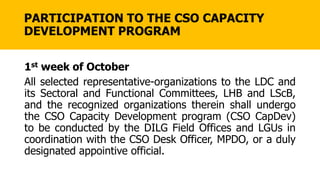
PARTICIPATION TO THE CSO CAPACITY
DEVELOPMENT PROGRAM
1st week of October
All selected representative-organizations to the LDC and
its Sectoral and Functional Committees, LHB and LScB,
and the recognized organizations therein shall undergo
the CSO Capacity Development program (CSO CapDev)
to be conducted by the DILG Field Offices and LGUs in
coordination with the CSO Desk Officer, MPDO, or a duly
designated appointive official.
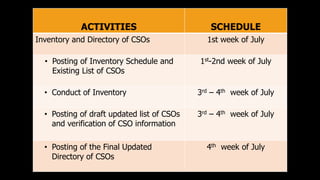
ACTIVITIES SCHEDULE
Inventory and Directory of CSOs 1st week of July
• Posting of Inventory Schedule and
Existing List of CSOs
1st-2nd week of July
• Conduct of Inventory 3rd – 4th week of July
• Posting of draft updated list of CSOs
and verification of CSO information
3rd – 4th week of July
• Posting of the Final Updated
Directory of CSOs
4th week of July
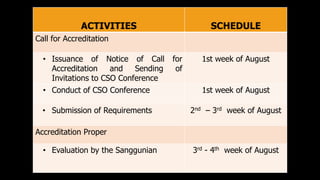
ACTIVITIES SCHEDULE
Call for Accreditation
• Issuance of Notice of Call for
Accreditation and Sending of
Invitations to CSO Conference
1st week of August
• Conduct of CSO Conference 1st week of August
• Submission of Requirements 2nd – 3rd week of August
Accreditation Proper
• Evaluation by the Sanggunian 3rd - 4th week of August
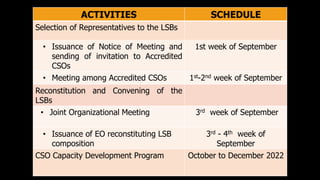
ACTIVITIES SCHEDULE
Selection of Representatives to the LSBs
• Issuance of Notice of Meeting and
sending of invitation to Accredited
CSOs
1st week of September
• Meeting among Accredited CSOs 1st-2nd week of September
Reconstitution and Convening of the
LSBs
• Joint Organizational Meeting 3rd week of September
• Issuance of EO reconstituting LSB
composition
3rd - 4th week of
September
CSO Capacity Development Program October to December 2022
REPLACEMENT OF A REPRESENTATIVE-
ORGANIZATION
Should a vacancy arise in the office of the representative-
organization, the selected CSO shall designate a replacement
from their organization for the unexpired term.
A CSO representative who has incurred three (3) cumulative
absences to the meetings of the LSB shall submit a
justification detailing the cause of their absences. Should
such justification be deemed insufficient or unsatisfactory
and/or the CSO representative exceeds three (3) cumulative
absences, the representative –organization shall be replaced
by another accredited organization.
REVOCATION OF ACCREDITATION
The sanggunian may revoke the accreditation or recognition
of an organization due to, but not limited to, any of the
following grounds:
 Violation by the CSO, during the validity period of the
Certificate of Accreditation, of any existing accounting and
auditing laws, rules and regulations;
 Conduct of activities without adherence to local laws,
including compliance with the minimum public health
standards in the locality;
 Unauthorized use of the name and/or of the local
government or any NGA and other unscrupulous activities;
and
 Engaging primarily in, or using the organization
primarily for, partisan political activities.
ROLES AND RESPONSIBILITIES
Provincial Governor, City and Municipal Mayors
Ensure that the accreditation process of CSOs, and selection of
representatives to the LSBs are duly executed within the prescribed
timeline;
Engage the support of the DILG, NGAs and CSO Networks or the Local
People’s Council in conducting the inventory and preparing the Directory of
CSOs;
Assign the CSO Desk Officer, MPDO or a duly designated LGU appointive
official the responsibility of submitting and updating reports online to the
DILG on the CSO Conference, CSO CapDev, CSO Accreditation, and
membership in the LSBs;
Concerned with the concerned DILG MLGOO for technical assistance and
staff support, if any, in relation to the conduct of the CSO Conference and
CSO CapDev, and the accreditation and selection processes;
ROLES AND RESPONSIBILITIES
Provincial Governor, City and Municipal Mayors
Preside the joint organizational meeting with the LSBs and ensure the
attendance and participation of non-accredited civil society stakeholders;
Issue and Executive Order reconstituting the composition of the LSBs;
Provide funding and other logistical support for the conduct of the CSO
Conference, the CSO CapDev, and the accreditation and selection
processes; and
Perform other responsibilities and relevant functions as may be required
in the implementation of the memorandum circular.
ROLES AND RESPONSIBILITIES
Sangguniang Panlalawigan/Panlungsod/Bayan
Cause the widest dissemination of this Memorandum Circular and the call
for Accreditation of CSOs;
Accept all applications for accreditations free of charge and ensure that
all forms and other documentary templates are readily available in the CSO
Desk or the Office of the Secretary to the Sanggunian and during the CSO
CSO Conference;
Evaluate all applications for accreditation within the prescribed timeline
and according to the criteria specified in the memorandum;
Perform other responsibilities and relevant functions as may be required
in the implementation of the memorandum circular.
ROLES AND RESPONSIBILITIES
CSO Desk Officers, MPDO or duly designated LGU
appointive official
Take the lead in the conduct of the inventory and updating the Directory
of CSOs;
Ensure that all CSOs in the locality are covered by the inventory;
Coordinate with the sanggunian during the accreditation process and
selection of representatives to the LSBs;
Facilitate, in coordination with the concerned DILG Field Office, the CSO
Conference and the orientation/meeting among accredited CSOs after the
accreditation process;
Keep copies of all accreditation documents submitted by the CSOs;
Prepare and submit documentation on the CSO Conference, the
orientation/ meeting among accredited CSOs, the joint organizational
meeting with the LSBs, and the CSO CapDev to the C/MLGOO;
ROLES AND RESPONSIBILITIES
CSO Desk Officers, MPDO or duly designated LGU
appointive official
Submit and update reports online to the DILG on the CSO
Conference, CSO CapDev, CSO Accreditation, and membership in
the LSBs
Provide staff support and/or technical assistance, if necessary,
on the conduct of the CSO CapDev;
Address queries, issues, and concerns from CSOs on the
accreditation and selection processes expeditiously;
Mobilize and ensure participation of accredited CSOs n the
LSBs; and
Perform other responsibilities and relevant functions as may be
required in the implementation of the memorandum circular.
ROLES AND RESPONSIBILITIES
Recognized CSOs
Actively participate in the planning, implementation, monitoring and evaluation
of the programs, projects and activities in their respective local governments,
through participation in the sectoral and functional committees of the LDC;
Guarantee the autonomy of their organization by not allowing it to be influenced
or used for purposes of partisan politics;
Provide the LSBs in which they are a member of or invited to participate in with
data and information essential to the formulation of plans, programs, and
activities;
Conduct, in coordination with the sanggunian, public hearings on vital issues
affecting their sector;
Actively participate in the CSO CapDev program; and
Member-organizations to the Sectoral or Functional committees of the LDC shall
be guided by the IRR of the Local Government Code in performing their functions.
ROLES AND RESPONSIBILITIES
Accredited CSOs
Selected representative-organizations to the LSBs shall be
guided by the following in performing their functions as a
member of the respective LSB:
LDC- Section 109 of the Local Government Code
LHB – Section 102(b) of the Local Government Code
LScB – Section 99 of the Local Government Code
LPOC – EO No. 309, as amended s. 1988; and
Perform other responsibilities and relevant functions as
may be required in the implementation of the memorandum
circular.
ROLES AND RESPONSIBILITIES
Accredited CSOs
Actively participate in the planning, implementation, monitoring
and evaluation of the programs, projects and activities in their
respective local governments,;
Guarantee the autonomy of their organization by not allowing it
to be influenced or used for purposes of partisan politics;
Perform sectoral and community consultations, or other such
activities, that merit their representational duties in the special
bodies;
Actively participate in the CSO CapDev program;
CSO guidelines.pptx
CSO guidelines.pptx

CSO guidelines.pptx

  • 1.
    GUIDELINES IN THE ACCREDITATIONOF CIVIL SOCIETY ORGANIZATIONS AND SELECTION OF REPRESENTATIVES TO THE LOCAL SPECIAL BODIES Municipal Planning and Development Office
  • 2.
    BASIS DILG MEMORANDUM CIRCULARNO. 2022-083: Guidelines on the Accreditation of Civil Society Organizations and Selection of Representatives to the Local Special Bodies BASIS COVERAGE All provinces, cities and municipalities, and all civil society organizations intending to apply for accreditation to seek representation in the LSBs.
  • 3.
    The directory shallcontain the following information for each CSO: Name of the Organization Contact information Organization’s objectives or purposes Services offered Community or communities served or currently being served Project development and implementation track record Name and mobile number of the officer-in-charge or a responsible official of the organization National, regional, provincial, city and municipal affiliations, if any Registration and/or accreditation information INVENTORY AND DIRECTORY OF CIVIL SOCIETY ORGANIZATIONS The final updated Directory shall serve as the source document for the issuance of Notice of Call for Accreditation.
  • 4.
    CALL FOR ACCREDITATION •Within the 1st week of August, the Sanggunian, in coordination with the CSO Desk Officer, shall issue a Notice of Call for Accreditation and send an invitation to all the CSOs listed in the final updated Directory of CSOs, through the conduct of a CSO Conference that shall be conducted by the local government unit. • Concurrent with the call for accreditation, the LGU through the CSO Desk Officer, shall hold as CSO Conference to orient participants in the accreditation guidelines and raise their awareness on the importance of civil society participation in the local governance processes, and to encourage CSOs to apply for accreditation with their local sanggunian.
  • 5.
    Relevance of participatorygovernance Guidelines on LGU accreditation of CSOs and reconstitution of LSBs, including discussion on accomplishing the forms and requirements Avenues of CSO participation as provided for in RA 7160 and other relevant policies and issuances Encouraging the formation and/or expansion of a local CSO Network and/or local People’s Council if not already established. THE CSO CONFERENCE SHALL COVER FOUR MAJOR TOPICS
  • 6.
    Within the 2ndweek of August, but not later than the last working day of the 3rd week, every organization seeking for accreditation, or renewal, shall submit one (1) copy of each of the following requirements: Letter of Application Duly accomplished Application Form for Accreditation Duly approved Board Resolution signifying intention for accreditation for the purpose of representation in a local special body Certificate of Registration or existing valid Certificate of Accreditation from any NGA List of current Officers For CSOs that have been in operation for at least one (1) year, Minutes of the Annual Meetings of the immediately preceding year as certified by the organization’s board secretary or Certification from the board secretary certifying the annual meeting’s conduct including the date, location, attendees, and agenda For CSOs that have been in operation for at least one (1) year, Financial Statement, signed by the executive officers of the organization, also of the immediately preceding year, and indicating therein other information such as revenue, expenses and the sources of funds
  • 7.
    ACCREDITATION PROPER The Sanggunian,through a resolution, shall evaluate all applications for accreditation starting on the 3rd week but not later than the last working day of August, on the basis of the following criteria: Registration with SEC, CDA, DOLE, or DHSUD, or accreditation with any NGA that is empowered by law or policy to accredit such organizations; Organization purposes and objectives which include community organization and development, institution- building, local enterprise development, livelihood development, capacity building, and similar development objectives and considerations;
  • 8.
    Sanggunian shall accreditCSOs which comply with all the administrative requirements and satisfy all the criteria enumerated. Community-based and sectoral-based with project development and implementation track record in the province, city or municipality of at least one (1) year; Reliability as evidenced by the preparation of annual reports and conduct of annual meetings duly certified by the board secretary of the organization;
  • 9.
    THE SANGGUNIAN SHALLISSUE NOT LATER THAN THE LAST WORKING DAY OF AUGUST THE FOLLOWING: A Certificate of Accreditation to every qualified CSO and shall be valid until June 30, 2025, subject to revocation, based on the grounds stated on the DILG Memorandum Circular. Notice to every organization, which applied and satisfied in the set criteria but failed to submit all the requirements encouraging them to complete the lacking requirements. Notice of Non-Qualification to CSOs that were not able to satisfy the requirements and set criteria, informing them of the reason/s for said non-qualification, and encouraging them to participate in other avenues for civil society participation in local governance. A Certificate of Recognition issued to a CSO that meet and pass all the requirements except the Certificate of Registration from any NGA. A Certificate of Recognition shall be valid until June 30, 2025, subject to revocation, based on the grounds stated on the DILG Memorandum Circular.
  • 10.
    1st week ofSeptember After the accreditation, the DILG Provincial Director, CLGOO and MLGOO, as the case may be, in coordination with the CSO Desk Officer, MPDO or a duly designated LGU appointive official, shall issue a notice to all accredited CSOs for a meeting on the selection of representatives to the LSBs. 2nd week of September Conduct an orientation on the functions of the Local Special Bodies and responsibilities of the CSO that will be selected during the same meeting. SELECTION OF REPRESENTATIVES TO THE LSBs
  • 11.
    The executive officers,or the duly authorized representatives of the selected CSOs shall designate their principal and alternate representatives to the LSBs. The Local People’s Council shall have the sole prerogative to identify their principal and alternate representatives to the LSBs from among their member-organizations. No organization or representative shall be a member of more than one (1) local special body within a province, city or municipality. The selected representative of an organization must not be an employee of the provincial, city or municipal government to avoid conflicts of interest. The term of office of a selected representative shall be coterminous with that of the local chief executive.
  • 12.
    SELECTION OF REPRESENTATIVESTO THE LOCAL DEVELOPMENT COUNCIL Must have representatives from the women’s sector, or as may be practicable, at least (40%) of the fully organized council shall be composed of women as prescribed by RA 9710 or the Magna Carta of Women of 2009; Other existing laws enacted and passed subsequent to the passage of RA 7160 that further define the composition of the LDC and other special bodies, such as but not limited to, RA 8371 or the Indigenous Peoples Rights Act of 1997 and RA No. 8371 or the Agriculture and Fisheries Modernization Act. Representatives of NGOs operating in the barangay, municipality, city or province, as the case maybe, shall constitute not less than ¼ of the members of the fully organized council.
  • 13.
    The representative-organization shouldbe involved in health services or composed of individuals that have competencies that are related to or may contribute to the functions of the LHB. All provinces, cities and municipalities are also encouraged to increase the membership of representative-organizations to one-half (1/2) of the fully organized LHB to further expand citizen participation. Such representative-organizations shall represent sectors, such as, but not limited to: ICCPs/IPs, agriculture, transport, housing, education, environment, faith-based organizations, senior citizens, PWDs, women, LGBTQIA+ and the youth. Increased representation from the private sector such as private hospital chiefs, is also encouraged to contribute to the integration of the province-wide and city-wide health system pursuant to Section 19 of RA11223 or the Universal Health Care Act. SELECTION OF REPRESENTATIVES TO THE LOCAL HEALTH BOARD
  • 14.
    All provinces, citiesand municipalities are also encouraged to invite, as non-voting members, representatives from the private sector such as the business community, private academic institutions, civic organizations, people’s organizations, and civil society to share their expertise and resources.
  • 15.
    The LScB shallhave representative-organizations from parents- teachers associations, and teacher’s organizations and organization of non-academic personnel of public schools in the locality, and other organizations involved in the education service. All provinces, cities and municipalities are also encouraged to increase the membership of representative-organizations to one- half (1/2) of the fully organized LScB to further expand citizen participation. Such representative-organizations shall represent sectors, such as, but not limited to: ICCPs/IPs, senior citizens, PWDs, parents of children with disabilities, principals, high school representatives, Alternative Learning System (ALS), and Early Childhood Care and Development (ECCD). SELECTION OF REPRESENTATIVES TO THE LOCAL SCHOOL BOARD
  • 16.
    All provinces, citiesand municipalities are also encouraged to invite, as non-voting members, representatives from the private sector such as the business community, private academic institutions, School Governing Councils, civic organizations, people’s organizations, and civil society to share their expertise and resources.
  • 17.
    SELECTION OF THETHREE ORGANIZATIONS FOR THE LOCAL PEACE AND ORDER COUNCIL The representative-organizations shall be chosen in adherence to Article 63(e) of the Implementing Rules and Regulations of RA 7160, Section 1 of EO No. 30-9 S1987, as amended by Section 1(b) and (d) of EO 773 S2009 and other relevant administrative issuances from the National Peace and Order Council such as, but not limited to, the issuance of security clearances, and shall come from CSOs.
  • 18.
    RECONSTITUTION AND CONVENINGOF THE LSBs Within 3rd week of September The Provincial Governors and City/Municipal Mayor shall call for a joint organizational meeting with the LDC, LHB, LScB and LPOC. The Provincial Governors and City/Municipal Mayor shall also send an invitation to recognized CSOs, member organizations of the Local People’s Council and other stakeholders who did not gain accreditation as members of the LSBs to explore potential avenues for their participation in the sectoral or functional committees of the LDC and other such committees and ad hoc bodies that shall be formed for the various LSBs.
  • 19.
    The purposes ofthe joint organizational meeting shall include the discussion of the functions of the LSBs, initial exploration of partnerships in local governance and development, and in the case of LDC, the creation of an executive committee, sectoral and functional committees, secretariat, technical working group, and consideration of the selection of a CSO representative as vice chairperson. Accreditation is not a requirement for membership in the sectoral or functional committees.
  • 20.
    PARTICIPATION TO THECSO CAPACITY DEVELOPMENT PROGRAM 1st week of October All selected representative-organizations to the LDC and its Sectoral and Functional Committees, LHB and LScB, and the recognized organizations therein shall undergo the CSO Capacity Development program (CSO CapDev) to be conducted by the DILG Field Offices and LGUs in coordination with the CSO Desk Officer, MPDO, or a duly designated appointive official.
  • 21.
    ACTIVITIES SCHEDULE Inventory andDirectory of CSOs 1st week of July • Posting of Inventory Schedule and Existing List of CSOs 1st-2nd week of July • Conduct of Inventory 3rd – 4th week of July • Posting of draft updated list of CSOs and verification of CSO information 3rd – 4th week of July • Posting of the Final Updated Directory of CSOs 4th week of July
  • 22.
    ACTIVITIES SCHEDULE Call forAccreditation • Issuance of Notice of Call for Accreditation and Sending of Invitations to CSO Conference 1st week of August • Conduct of CSO Conference 1st week of August • Submission of Requirements 2nd – 3rd week of August Accreditation Proper • Evaluation by the Sanggunian 3rd - 4th week of August
  • 23.
    ACTIVITIES SCHEDULE Selection ofRepresentatives to the LSBs • Issuance of Notice of Meeting and sending of invitation to Accredited CSOs 1st week of September • Meeting among Accredited CSOs 1st-2nd week of September Reconstitution and Convening of the LSBs • Joint Organizational Meeting 3rd week of September • Issuance of EO reconstituting LSB composition 3rd - 4th week of September CSO Capacity Development Program October to December 2022
  • 24.
    REPLACEMENT OF AREPRESENTATIVE- ORGANIZATION Should a vacancy arise in the office of the representative- organization, the selected CSO shall designate a replacement from their organization for the unexpired term. A CSO representative who has incurred three (3) cumulative absences to the meetings of the LSB shall submit a justification detailing the cause of their absences. Should such justification be deemed insufficient or unsatisfactory and/or the CSO representative exceeds three (3) cumulative absences, the representative –organization shall be replaced by another accredited organization.
  • 25.
    REVOCATION OF ACCREDITATION Thesanggunian may revoke the accreditation or recognition of an organization due to, but not limited to, any of the following grounds:  Violation by the CSO, during the validity period of the Certificate of Accreditation, of any existing accounting and auditing laws, rules and regulations;  Conduct of activities without adherence to local laws, including compliance with the minimum public health standards in the locality;  Unauthorized use of the name and/or of the local government or any NGA and other unscrupulous activities; and  Engaging primarily in, or using the organization primarily for, partisan political activities.
  • 26.
    ROLES AND RESPONSIBILITIES ProvincialGovernor, City and Municipal Mayors Ensure that the accreditation process of CSOs, and selection of representatives to the LSBs are duly executed within the prescribed timeline; Engage the support of the DILG, NGAs and CSO Networks or the Local People’s Council in conducting the inventory and preparing the Directory of CSOs; Assign the CSO Desk Officer, MPDO or a duly designated LGU appointive official the responsibility of submitting and updating reports online to the DILG on the CSO Conference, CSO CapDev, CSO Accreditation, and membership in the LSBs; Concerned with the concerned DILG MLGOO for technical assistance and staff support, if any, in relation to the conduct of the CSO Conference and CSO CapDev, and the accreditation and selection processes;
  • 27.
    ROLES AND RESPONSIBILITIES ProvincialGovernor, City and Municipal Mayors Preside the joint organizational meeting with the LSBs and ensure the attendance and participation of non-accredited civil society stakeholders; Issue and Executive Order reconstituting the composition of the LSBs; Provide funding and other logistical support for the conduct of the CSO Conference, the CSO CapDev, and the accreditation and selection processes; and Perform other responsibilities and relevant functions as may be required in the implementation of the memorandum circular.
  • 28.
    ROLES AND RESPONSIBILITIES SangguniangPanlalawigan/Panlungsod/Bayan Cause the widest dissemination of this Memorandum Circular and the call for Accreditation of CSOs; Accept all applications for accreditations free of charge and ensure that all forms and other documentary templates are readily available in the CSO Desk or the Office of the Secretary to the Sanggunian and during the CSO CSO Conference; Evaluate all applications for accreditation within the prescribed timeline and according to the criteria specified in the memorandum; Perform other responsibilities and relevant functions as may be required in the implementation of the memorandum circular.
  • 29.
    ROLES AND RESPONSIBILITIES CSODesk Officers, MPDO or duly designated LGU appointive official Take the lead in the conduct of the inventory and updating the Directory of CSOs; Ensure that all CSOs in the locality are covered by the inventory; Coordinate with the sanggunian during the accreditation process and selection of representatives to the LSBs; Facilitate, in coordination with the concerned DILG Field Office, the CSO Conference and the orientation/meeting among accredited CSOs after the accreditation process; Keep copies of all accreditation documents submitted by the CSOs; Prepare and submit documentation on the CSO Conference, the orientation/ meeting among accredited CSOs, the joint organizational meeting with the LSBs, and the CSO CapDev to the C/MLGOO;
  • 30.
    ROLES AND RESPONSIBILITIES CSODesk Officers, MPDO or duly designated LGU appointive official Submit and update reports online to the DILG on the CSO Conference, CSO CapDev, CSO Accreditation, and membership in the LSBs Provide staff support and/or technical assistance, if necessary, on the conduct of the CSO CapDev; Address queries, issues, and concerns from CSOs on the accreditation and selection processes expeditiously; Mobilize and ensure participation of accredited CSOs n the LSBs; and Perform other responsibilities and relevant functions as may be required in the implementation of the memorandum circular.
  • 31.
    ROLES AND RESPONSIBILITIES RecognizedCSOs Actively participate in the planning, implementation, monitoring and evaluation of the programs, projects and activities in their respective local governments, through participation in the sectoral and functional committees of the LDC; Guarantee the autonomy of their organization by not allowing it to be influenced or used for purposes of partisan politics; Provide the LSBs in which they are a member of or invited to participate in with data and information essential to the formulation of plans, programs, and activities; Conduct, in coordination with the sanggunian, public hearings on vital issues affecting their sector; Actively participate in the CSO CapDev program; and Member-organizations to the Sectoral or Functional committees of the LDC shall be guided by the IRR of the Local Government Code in performing their functions.
  • 32.
    ROLES AND RESPONSIBILITIES AccreditedCSOs Selected representative-organizations to the LSBs shall be guided by the following in performing their functions as a member of the respective LSB: LDC- Section 109 of the Local Government Code LHB – Section 102(b) of the Local Government Code LScB – Section 99 of the Local Government Code LPOC – EO No. 309, as amended s. 1988; and Perform other responsibilities and relevant functions as may be required in the implementation of the memorandum circular.
  • 33.
    ROLES AND RESPONSIBILITIES AccreditedCSOs Actively participate in the planning, implementation, monitoring and evaluation of the programs, projects and activities in their respective local governments,; Guarantee the autonomy of their organization by not allowing it to be influenced or used for purposes of partisan politics; Perform sectoral and community consultations, or other such activities, that merit their representational duties in the special bodies; Actively participate in the CSO CapDev program;