LOCAL ANESTHESIA
Local Anesthesia
Drugs that are used to produce reversible loss of
sensation in a circumscribed area(restricted) of the
body
Caused by depression of excitation in nerve endings
or an inhibition of the conduction process in
peripheral nerves and in every type of nerve fibres i.e.
Sensory,motor or autonomic
No Structural damage to the neurons
Desirable Properties Of Local Anesthesia
Should not be irritating
Should not cause any permanent alteration of
nerve structure
Its systemic toxicity should be low
Time of onset of anesthesia should be short
Should have high potency so that low
concentration should be used
Should be free from producing allergic reactions
Should be stable in solution and relatively undergo
biotransformation in the body
MECHANISM OF ACTION
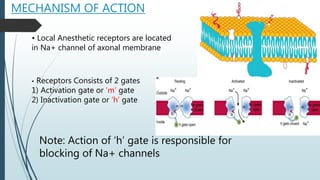
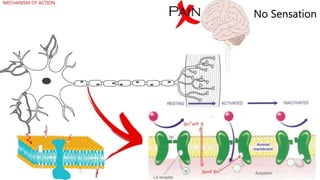
• Local Anesthetic receptors are located
in Na+ channel of axonal membrane
• Receptors Consists of 2 gates
1) Activation gate or ‘m’ gate
2) Inactivation gate or ‘h’ gate
Note: Action of ‘h’ gate is responsible for
blocking of Na+ channels
MECHANISM OF ACTION
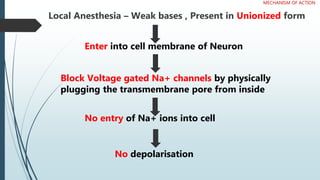
Local Anesthesia – Weak bases , Present in Unionized form
Enter into cell membrane of Neuron
Block Voltage gated Na+ channels by physically
plugging the transmembrane pore from inside
No entry of Na+ ions into cell
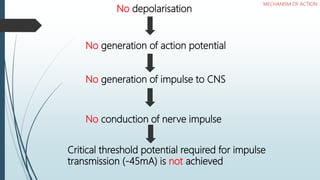
No depolarisation
No depolarisation
No generation of action potential
No generation of impulse to CNS
No conduction of nerve impulse
Critical threshold potential required for impulse
transmission (-45mA) is not achieved
MECHANISM OF ACTION
No Sensation
MECHANISM OF ACTION
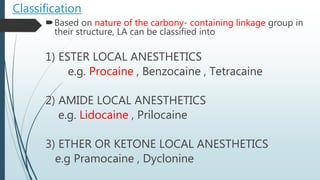
Classification
Based on nature of the carbony- containing linkage group in
their structure, LA can be classified into
1) ESTER LOCAL ANESTHETICS
e.g. Procaine , Benzocaine , Tetracaine
2) AMIDE LOCAL ANESTHETICS
e.g. Lidocaine , Prilocaine
3) ETHER OR KETONE LOCAL ANESTHETICS
e.g Pramocaine , Dyclonine
1) ESTER LOCAL ANESTHETICS
Procaine
• first synthetic local anesthetic introduced in 1905
• is an ester of diethylaminoethanol and paraamino benzoic
acid(PABA)
Pharmacological Effects
a) Local Action :
• Rapidly effective when injected locally
• When injected around mixed nerve , causes
anesthesia of skin and paralysis of voluntary muscle
supplied by the nerve
• Reduces the release of acetylcholine from motor nerve endings
• Local effects : Loss of pain, tempertature and touch,
vasodilation, and loss of motor power
b) Systemic actions
• CNS : Normal dose : rapidly inactivated in the plasma
and has little apparent CNS effects
High dose : CNS stimulation like restless , tremors
and convulsions
• Cardiovascular system :
Normal doses : No significant
effect on heart
High doses : Myocardial depressant activity and can
decrease automaticity, excitability, contractility, conductivity, and
increase refractory period
Pharmacokinetics :
Not effective due to its poor penetration through GI
mucosa and high first pass effect
 parenterally injection → has delayed onset of action ( 5-10
min) and short duration of action ( 25-30 min )
[ causes vasodilation → results in rapid absorption and
biotransformation ]
 after absorption → rapidly hydrolysed by plasma
cholinesterase and by esterase in liver → inactive
metabolites PABA and diethylaminoethanol → excreted by
the kidneys into the urine.
Metabolism : Hydrolysis by plasma esterases to PABA
Route of elimination : With normal kidney function, the
drug is excreted rapidly by tubular excretion.
Half life : 7.7 minutes
Side effects :
Low local and systemic toxicity
High doses may produce restlessness, tremors, and
convulsions followed by CNS depression
Cardiovascular toxicity includes hypotension,
bradycardia, arrthymias, and possible cardiac arrest
Contraindications & Precautions
Should not be used in patients suffering from
cardiac disease or those hypersensitive to it
Vasoconstrictor shouldnot be added to procaine
when used for nerve block of extremities ( e.g. tail,
toes, ears, penis, e.t.c )
Drug interaction :
Procaine should not be used with sulphonamides as it
decreases antimicrobial activity of sulphonamides by enhancing
availability of PABA
Clinical Uses :
 Used mainly for nerve block anesthesia
Doses :
 Dogs and cats : 2-5 ml of 2 % solution
 Large animals : 5-10 ml of 4% solution
LIDOCAINE :
 Is an aminoethlyamide and is the prototypical members of
amide group of local anesthetics
Pharmacological effects :
 Most properties similar to procaine but produces more prompt,
more intense, long lasting, and more extensive anesthesia
 Rapid onset of action ( blocks conduction within 3 minutes )
 Duration of action : 45 min ( without epinephrine )
: 90 min ( with epinephrine )
Pharmacokinetics :
 Not effective orally as it has high 1st pass effect
 After absorption, is dealkylated in the liver by mixed function
oxidases ( MFOs ) → monoethylglycine and glycine xylidide
which retain local anesthetic activity
 These active metabolites biotransformed further before
excretion in urine
 Elimination half life : 90-120 min
Side Effects :
 Same effects as procaine
 Unlike procaine, early central effects are Drowsiness, dizziness,
and tinnitus
 Overdosage causes muscle twitching, convulsions, cardiac
arrthymias, fall in blood pressure, coma & respiratory
depression and arrest
Contraindications and precautions :
 Contraindicated in patients with known hypersensitivity to
amide type local anesthetic
 Most widely used local anesthetic for infiltration, regional,
nerve block, epidural and also topical anesthesia
Clinical Uses
 Use of epinephrine is contraindicated with lidocaine, if it is
used in treatment of ventricular arrthymias
 For epidural injection (2 % soln) :
Dogs and Cats : 0.2 ml/kg
Sheep : 3-4 ml
Cattle : 5-6 ml
Doses
Pramocaine :
Ether or ketone local anesthetic
Used primarily on skin or mucous membrane as a
topical anesthetic
HCL salt form of pramocaine is water soluble and
hence more easily absorbed into skin
Used to relieve pain or itching caused by conditions
such as sunburn or minor burns, insect bites, poison,
minor cuts and scratches.
Thank you

Local anesthesia

  • 1.
  • 2.
    Local Anesthesia Drugs thatare used to produce reversible loss of sensation in a circumscribed area(restricted) of the body Caused by depression of excitation in nerve endings or an inhibition of the conduction process in peripheral nerves and in every type of nerve fibres i.e. Sensory,motor or autonomic No Structural damage to the neurons
  • 3.
    Desirable Properties OfLocal Anesthesia Should not be irritating Should not cause any permanent alteration of nerve structure Its systemic toxicity should be low Time of onset of anesthesia should be short Should have high potency so that low concentration should be used Should be free from producing allergic reactions Should be stable in solution and relatively undergo biotransformation in the body
  • 4.
    MECHANISM OF ACTION •Local Anesthetic receptors are located in Na+ channel of axonal membrane • Receptors Consists of 2 gates 1) Activation gate or ‘m’ gate 2) Inactivation gate or ‘h’ gate Note: Action of ‘h’ gate is responsible for blocking of Na+ channels
  • 5.
    MECHANISM OF ACTION LocalAnesthesia – Weak bases , Present in Unionized form Enter into cell membrane of Neuron Block Voltage gated Na+ channels by physically plugging the transmembrane pore from inside No entry of Na+ ions into cell No depolarisation
  • 6.
    No depolarisation No generationof action potential No generation of impulse to CNS No conduction of nerve impulse Critical threshold potential required for impulse transmission (-45mA) is not achieved MECHANISM OF ACTION
  • 7.
  • 8.
    Classification Based on natureof the carbony- containing linkage group in their structure, LA can be classified into 1) ESTER LOCAL ANESTHETICS e.g. Procaine , Benzocaine , Tetracaine 2) AMIDE LOCAL ANESTHETICS e.g. Lidocaine , Prilocaine 3) ETHER OR KETONE LOCAL ANESTHETICS e.g Pramocaine , Dyclonine
  • 9.
    1) ESTER LOCALANESTHETICS Procaine • first synthetic local anesthetic introduced in 1905 • is an ester of diethylaminoethanol and paraamino benzoic acid(PABA) Pharmacological Effects a) Local Action : • Rapidly effective when injected locally • When injected around mixed nerve , causes anesthesia of skin and paralysis of voluntary muscle supplied by the nerve • Reduces the release of acetylcholine from motor nerve endings
  • 10.
    • Local effects: Loss of pain, tempertature and touch, vasodilation, and loss of motor power b) Systemic actions • CNS : Normal dose : rapidly inactivated in the plasma and has little apparent CNS effects High dose : CNS stimulation like restless , tremors and convulsions • Cardiovascular system : Normal doses : No significant effect on heart High doses : Myocardial depressant activity and can decrease automaticity, excitability, contractility, conductivity, and increase refractory period
  • 11.
    Pharmacokinetics : Not effectivedue to its poor penetration through GI mucosa and high first pass effect  parenterally injection → has delayed onset of action ( 5-10 min) and short duration of action ( 25-30 min ) [ causes vasodilation → results in rapid absorption and biotransformation ]  after absorption → rapidly hydrolysed by plasma cholinesterase and by esterase in liver → inactive metabolites PABA and diethylaminoethanol → excreted by the kidneys into the urine. Metabolism : Hydrolysis by plasma esterases to PABA Route of elimination : With normal kidney function, the drug is excreted rapidly by tubular excretion. Half life : 7.7 minutes
  • 12.
    Side effects : Lowlocal and systemic toxicity High doses may produce restlessness, tremors, and convulsions followed by CNS depression Cardiovascular toxicity includes hypotension, bradycardia, arrthymias, and possible cardiac arrest Contraindications & Precautions Should not be used in patients suffering from cardiac disease or those hypersensitive to it Vasoconstrictor shouldnot be added to procaine when used for nerve block of extremities ( e.g. tail, toes, ears, penis, e.t.c )
  • 13.
    Drug interaction : Procaineshould not be used with sulphonamides as it decreases antimicrobial activity of sulphonamides by enhancing availability of PABA Clinical Uses :  Used mainly for nerve block anesthesia Doses :  Dogs and cats : 2-5 ml of 2 % solution  Large animals : 5-10 ml of 4% solution
  • 14.
    LIDOCAINE :  Isan aminoethlyamide and is the prototypical members of amide group of local anesthetics Pharmacological effects :  Most properties similar to procaine but produces more prompt, more intense, long lasting, and more extensive anesthesia  Rapid onset of action ( blocks conduction within 3 minutes )  Duration of action : 45 min ( without epinephrine ) : 90 min ( with epinephrine ) Pharmacokinetics :  Not effective orally as it has high 1st pass effect  After absorption, is dealkylated in the liver by mixed function oxidases ( MFOs ) → monoethylglycine and glycine xylidide which retain local anesthetic activity
  • 15.
     These activemetabolites biotransformed further before excretion in urine  Elimination half life : 90-120 min Side Effects :  Same effects as procaine  Unlike procaine, early central effects are Drowsiness, dizziness, and tinnitus  Overdosage causes muscle twitching, convulsions, cardiac arrthymias, fall in blood pressure, coma & respiratory depression and arrest Contraindications and precautions :  Contraindicated in patients with known hypersensitivity to amide type local anesthetic
  • 16.
     Most widelyused local anesthetic for infiltration, regional, nerve block, epidural and also topical anesthesia Clinical Uses  Use of epinephrine is contraindicated with lidocaine, if it is used in treatment of ventricular arrthymias  For epidural injection (2 % soln) : Dogs and Cats : 0.2 ml/kg Sheep : 3-4 ml Cattle : 5-6 ml Doses
  • 17.
    Pramocaine : Ether orketone local anesthetic Used primarily on skin or mucous membrane as a topical anesthetic HCL salt form of pramocaine is water soluble and hence more easily absorbed into skin Used to relieve pain or itching caused by conditions such as sunburn or minor burns, insect bites, poison, minor cuts and scratches.
  • 18.