11/11/2024 1
The CONCEPT OF LOADING
AND MAINTENANCE DOSE
DR KAWALYA STEVEN
Victoria university kampala
11/11/2024 2
INTRODUCTION
• Most drugs for chronic condition are prescribed in a dosage regimen
is based on the administration of a fixed constant dose(D) at fixed
regular dosing intervals(T) for long period of time.
• The D & T recommended by the manufacturer is based on the
effective therapeutic concentration of drug in the plasma needed to
treat the chronic condition.
11/11/2024 3
• The T is based on elimination rate constant of the drug.
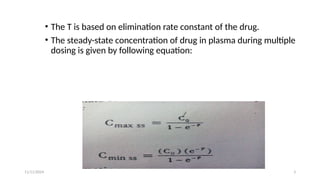
• The steady-state concentration of drug in plasma during multiple
dosing is given by following equation:
11/11/2024 4
• The concentration of drug in plasma at steady-state depends on
the following 3 factors:
a) C0, concentration of drug in plasma.
b) Ke, elimination rate constant.
c) T, the dosing interval.
11/11/2024 5
DEFINITION & CONCEPT
• Loading dose: A dose of medication, often larger than subsequent
doses, administered for the purpose of establishing a therapeutic level
of the medication.
• Primary purpose of using loading dose in therapeutic treatment is to
attain steady-state concentration of the drug as quickly as possible,
usually right from the start of the dosage regimen for the treatment.
11/11/2024 6
• This approach may also reduce the time of onset of drug action,
i.e; the time its takes to achieve the minimum effective
concentration.
• The purpose of administering the loading dose is to reduce the
time needed for the drug to accumulate to the steady-state level
in the plasma.
• The size of loading dose will depend on the T of the maintenance
dose.
11/11/2024 7
INTRAVENOUS ADMINISTRATION
• A drug when administered intravenously as a single rapid bolus dose,
confers the characteristics of one-compartment model on the body.
• The main purpose of loading dose(D*) is to provide a steady-state
concentration in plasma during multiple dosing.
11/11/2024 8
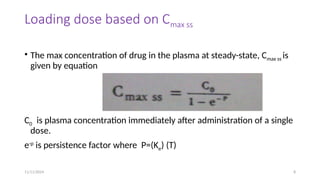
Loading dose based on Cmax ss
• The max concentration of drug in the plasma at steady-state, Cmax ss is
given by equation
C0 is plasma concentration immediately after administration of a single
dose.
e-p
is persistence factor where P=(Ke) (T)
11/11/2024 9
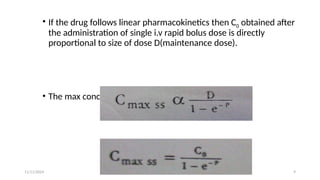
• If the drug follows linear pharmacokinetics then C0 obtained after
the administration of single i.v rapid bolus dose is directly
proportional to size of dose D(maintenance dose).
• The max concentration at steady-state is
11/11/2024 10
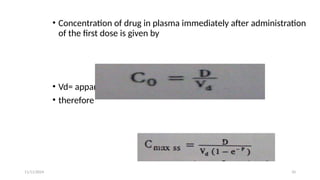
• Concentration of drug in plasma immediately after administration
of the first dose is given by
• Vd= apparent volume of distribution
• therefore
11/11/2024 11
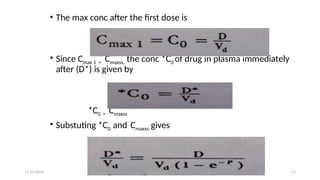
• The max conc after the first dose is
• Since Cmax 1 = Cmaxss, the conc *C0 of drug in plasma immediately
after (D*) is given by
*C0 = Cmaxss
• Substuting *C0 and Cmaxss gives
11/11/2024 12
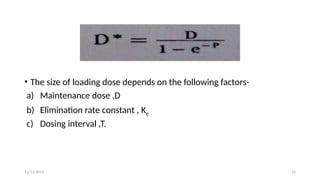
• The size of loading dose depends on the following factors-
a) Maintenance dose ,D
b) Elimination rate constant , Ke
c) Dosing interval ,T.
11/11/2024 13
Loading dose based on Cmin ss
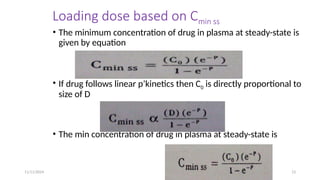
• The minimum concentration of drug in plasma at steady-state is
given by equation
• If drug follows linear p’kinetics then C0 is directly proportional to
size of D
• The min concentration of drug in plasma at steady-state is
11/11/2024 14
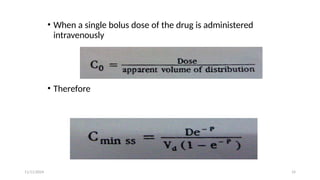
• When a single bolus dose of the drug is administered
intravenously
• Therefore
11/11/2024 15
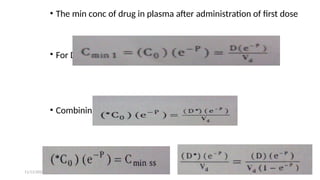
• The min conc of drug in plasma after administration of first dose
• For D* Cmin 1 = (*C0 ) (e-p
),which should be equal to Cmin ss
• Combining eq
11/11/2024 16
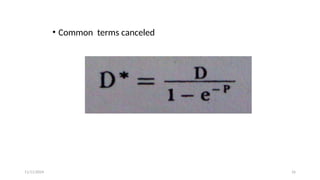
• Common terms canceled
11/11/2024 17
Factors affecting size of dose
• If all doses and all T are kept constant, then the size of D depends on
size of D*, T & Ke
Effect of dosing interval:
• If the size of D is kept constant & biological halflife of the drug dose
not change during the course of therapy, the size of D* depends
entirely upon the T of a given drug.
11/11/2024 18
EXTRAVASCULAR ADMINISTRATION
• For the determination of D* during e.v, administration, the simplest
case is a drug which, when administered, confers upon the body the
characteristics of one-compartment model, & does not exhibit lag-
time.
• The size of D* needed to attain steady-sate conc of drug in plasma
depends on:
11/11/2024 19
a. Maximum concentration of drug in plasma at steady state.
OR
b. Minimum concentration of drug in plasma at steady state.
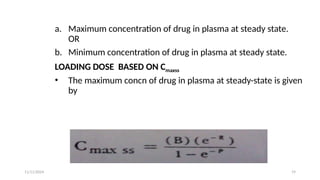
LOADING DOSE BASED ON Cmaxss
• The maximum concn of drug in plasma at steady-state is given
by
11/11/2024 20
• Where B is the back extrapolated y-intercept of the elimination
phase after administration of a single dose.
• R=(Ke) (tmax)
11/11/2024 21
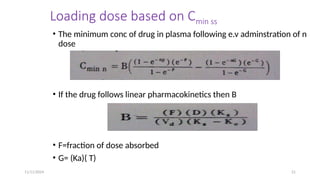
Loading dose based on Cmin ss
• The minimum conc of drug in plasma following e.v adminstration of n
dose
• If the drug follows linear pharmacokinetics then B
• F=fraction of dose absorbed
• G= (Ka)( T)
11/11/2024 22
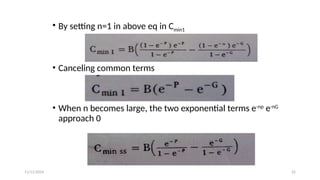
• By setting n=1 in above eq in Cmin1
• Canceling common terms
• When n becomes large, the two exponential terms e-np
e-nG
approach 0
11/11/2024 23
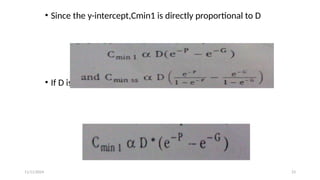
• Since the y-intercept,Cmin1 is directly proportional to D
• If D is administered at the first dose
11/11/2024 24
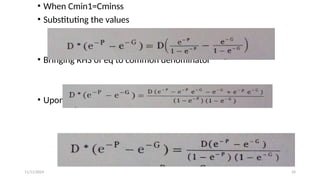
• When Cmin1=Cminss
• Substituting the values
• Bringing RHS of eq to common denominator
• Upon simplification
11/11/2024 25
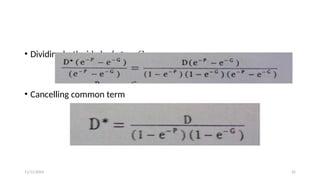
• Dividing both side by (e-p
– e-G
)
• Cancelling common term
11/11/2024 26
Maintenance Dose
• After the loading dose is given the another dose is given to maintain
the steady- state drug conc. / plateau. Such dose is known as
maintenance dose.
• i.e. maintain the response of drug by replacing drug lost during
dosing interval
11/11/2024 27
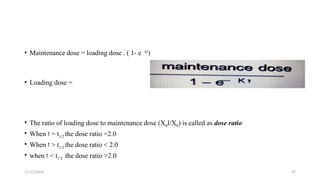
• Maintenance dose = loading dose . ( 1- e k‫ז‬
)
• Loading dose =
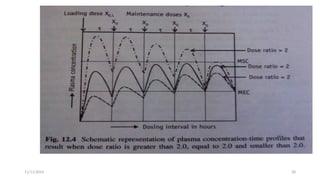
• The ratio of loading dose to maintenance dose (X0l/X0) is called as dose ratio
• When ‫ז‬ = t1/2 the dose ratio =2.0
• When ‫ז‬ > t1/2 the dose ratio < 2.0
• when ‫ז‬ < t1/2 the dose ratio >2.0
11/11/2024 28
11/11/2024 29
Maintenance of drug within the therapeutic
range
The ease or difficulty in maintaining drug concentration within the
therapeutic window depends on-
• The Therapeutic index of drug
• The Half- life of drug
• Convenience of dosing
11/11/2024 30
THANK YOU

loading dose and maintainance dose.power point(pptx)

  • 1.
    11/11/2024 1 The CONCEPTOF LOADING AND MAINTENANCE DOSE DR KAWALYA STEVEN Victoria university kampala
  • 2.
    11/11/2024 2 INTRODUCTION • Mostdrugs for chronic condition are prescribed in a dosage regimen is based on the administration of a fixed constant dose(D) at fixed regular dosing intervals(T) for long period of time. • The D & T recommended by the manufacturer is based on the effective therapeutic concentration of drug in the plasma needed to treat the chronic condition.
  • 3.
    11/11/2024 3 • TheT is based on elimination rate constant of the drug. • The steady-state concentration of drug in plasma during multiple dosing is given by following equation:
  • 4.
    11/11/2024 4 • Theconcentration of drug in plasma at steady-state depends on the following 3 factors: a) C0, concentration of drug in plasma. b) Ke, elimination rate constant. c) T, the dosing interval.
  • 5.
    11/11/2024 5 DEFINITION &CONCEPT • Loading dose: A dose of medication, often larger than subsequent doses, administered for the purpose of establishing a therapeutic level of the medication. • Primary purpose of using loading dose in therapeutic treatment is to attain steady-state concentration of the drug as quickly as possible, usually right from the start of the dosage regimen for the treatment.
  • 6.
    11/11/2024 6 • Thisapproach may also reduce the time of onset of drug action, i.e; the time its takes to achieve the minimum effective concentration. • The purpose of administering the loading dose is to reduce the time needed for the drug to accumulate to the steady-state level in the plasma. • The size of loading dose will depend on the T of the maintenance dose.
  • 7.
    11/11/2024 7 INTRAVENOUS ADMINISTRATION •A drug when administered intravenously as a single rapid bolus dose, confers the characteristics of one-compartment model on the body. • The main purpose of loading dose(D*) is to provide a steady-state concentration in plasma during multiple dosing.
  • 8.
    11/11/2024 8 Loading dosebased on Cmax ss • The max concentration of drug in the plasma at steady-state, Cmax ss is given by equation C0 is plasma concentration immediately after administration of a single dose. e-p is persistence factor where P=(Ke) (T)
  • 9.
    11/11/2024 9 • Ifthe drug follows linear pharmacokinetics then C0 obtained after the administration of single i.v rapid bolus dose is directly proportional to size of dose D(maintenance dose). • The max concentration at steady-state is
  • 10.
    11/11/2024 10 • Concentrationof drug in plasma immediately after administration of the first dose is given by • Vd= apparent volume of distribution • therefore
  • 11.
    11/11/2024 11 • Themax conc after the first dose is • Since Cmax 1 = Cmaxss, the conc *C0 of drug in plasma immediately after (D*) is given by *C0 = Cmaxss • Substuting *C0 and Cmaxss gives
  • 12.
    11/11/2024 12 • Thesize of loading dose depends on the following factors- a) Maintenance dose ,D b) Elimination rate constant , Ke c) Dosing interval ,T.
  • 13.
    11/11/2024 13 Loading dosebased on Cmin ss • The minimum concentration of drug in plasma at steady-state is given by equation • If drug follows linear p’kinetics then C0 is directly proportional to size of D • The min concentration of drug in plasma at steady-state is
  • 14.
    11/11/2024 14 • Whena single bolus dose of the drug is administered intravenously • Therefore
  • 15.
    11/11/2024 15 • Themin conc of drug in plasma after administration of first dose • For D* Cmin 1 = (*C0 ) (e-p ),which should be equal to Cmin ss • Combining eq
  • 16.
  • 17.
    11/11/2024 17 Factors affectingsize of dose • If all doses and all T are kept constant, then the size of D depends on size of D*, T & Ke Effect of dosing interval: • If the size of D is kept constant & biological halflife of the drug dose not change during the course of therapy, the size of D* depends entirely upon the T of a given drug.
  • 18.
    11/11/2024 18 EXTRAVASCULAR ADMINISTRATION •For the determination of D* during e.v, administration, the simplest case is a drug which, when administered, confers upon the body the characteristics of one-compartment model, & does not exhibit lag- time. • The size of D* needed to attain steady-sate conc of drug in plasma depends on:
  • 19.
    11/11/2024 19 a. Maximumconcentration of drug in plasma at steady state. OR b. Minimum concentration of drug in plasma at steady state. LOADING DOSE BASED ON Cmaxss • The maximum concn of drug in plasma at steady-state is given by
  • 20.
    11/11/2024 20 • WhereB is the back extrapolated y-intercept of the elimination phase after administration of a single dose. • R=(Ke) (tmax)
  • 21.
    11/11/2024 21 Loading dosebased on Cmin ss • The minimum conc of drug in plasma following e.v adminstration of n dose • If the drug follows linear pharmacokinetics then B • F=fraction of dose absorbed • G= (Ka)( T)
  • 22.
    11/11/2024 22 • Bysetting n=1 in above eq in Cmin1 • Canceling common terms • When n becomes large, the two exponential terms e-np e-nG approach 0
  • 23.
    11/11/2024 23 • Sincethe y-intercept,Cmin1 is directly proportional to D • If D is administered at the first dose
  • 24.
    11/11/2024 24 • WhenCmin1=Cminss • Substituting the values • Bringing RHS of eq to common denominator • Upon simplification
  • 25.
    11/11/2024 25 • Dividingboth side by (e-p – e-G ) • Cancelling common term
  • 26.
    11/11/2024 26 Maintenance Dose •After the loading dose is given the another dose is given to maintain the steady- state drug conc. / plateau. Such dose is known as maintenance dose. • i.e. maintain the response of drug by replacing drug lost during dosing interval
  • 27.
    11/11/2024 27 • Maintenancedose = loading dose . ( 1- e k‫ז‬ ) • Loading dose = • The ratio of loading dose to maintenance dose (X0l/X0) is called as dose ratio • When ‫ז‬ = t1/2 the dose ratio =2.0 • When ‫ז‬ > t1/2 the dose ratio < 2.0 • when ‫ז‬ < t1/2 the dose ratio >2.0
  • 28.
  • 29.
    11/11/2024 29 Maintenance ofdrug within the therapeutic range The ease or difficulty in maintaining drug concentration within the therapeutic window depends on- • The Therapeutic index of drug • The Half- life of drug • Convenience of dosing
  • 30.