30 September 2014 1
UNDER THE GUIDENCE OF
Dr.SATYABRATA BHANJA
M. Pharm, Ph.D.
Department of Pharmaceutics
Mallareddy College Of Pharmacy
PRESENTED BY :
K.V.SIVA PRASAD
M.Pharm(Pharmaceutics).
256213886018
Mallareddy College of pharmacy
PHARMACOKINETICS OF MULTIPLE
DOSING
CONTENTS
• Dosage regimen
• Objectives of dose regimen
• Therapeutic drug monitoring
• Multiple dosage regimen
• Multiple dosing with respect to I.V.
• Multiple dosing with respect to Oral route.
• Concept of loading dose, maintenance dose.
• Drug accumulation
 References
2
Dosage regimen
 It is defined as the manner in which a drug is taken.
For certain analgesics, hypnotics, anti-emetics etc. a
single dose may provide an effective treatment. But the
duration of most illness is longer than the therapeutic
effect produced by a single dose. In such cases drugs
are required to be taken on a repetitive basis over a
period of time.
3
Objective of dosage regimen
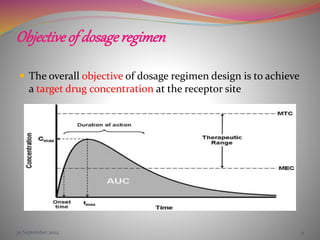
 The overall objective of dosage regimen design is to achieve
a target drug concentration at the receptor site
30 September 2014 4
30 September 2014 5
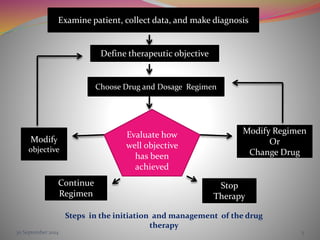
Examine patient, collect data, and make diagnosis
Define therapeutic objective
Choose Drug and Dosage Regimen
Evaluate how
well objective
has been
achieved
Modify Regimen
Or
Change Drug
Modify
objective
Stop
Therapy
Continue
Regimen
Steps in the initiation and management of the drug
therapy
TherapeuticDrugMonitoring
 The success of Drug therapy is highly dependent on
Choice of Drug and Drug Product
Design of the Dosage Regimen
 While the choice of Drug and Drug product is based on
Patient's characteristics
Pharmacokinetic of Drug
 Every patient have different Drug absorption, distribution, and
elimination as well as different pathophysiological condition, so
for the improvement in the clinical effectiveness of the drug
THERAPEUTIC DRUG MONITORING are done.
30 September 2014 6
 It specializes in the measurement
of medication levels in blood. Its main focus is on
drugs with a narrow therapeutic range, i.e. drugs
that can easily be under- or overdosed.
 Therapeutic drug monitoring is important as
Insufficient levels of drug in the plasma will lead
to under treatment or resistance, and excessive
levels can lead to toxicity and tissue damage.
7
Indications for TDM
include:
 There is narrow therapeutic window.
 There are potential patient compliance problems.
 The drug dose cannot be optimized by clinical
observation alone.
 Knowledge of the drug level influences
management.
8
Sampling and drug analysis
 Usually, plasma or serum is used for drug assays.
 Drug assay methods should have adequate sensitivity,
be specific for the drug (or metabolite) to be measured
and have appropriate accuracy and precision.
 Automated immunoassay methods, High performance
liquid chromatography (HPLC) and Gas liquid
chromatography (GLC) (e.g. amiodarone, perhexiline)
can be used.
9
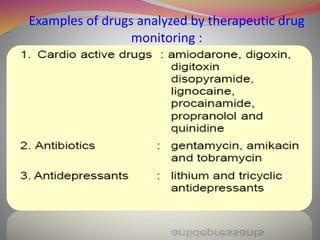
Examples of drugs analyzed by therapeutic drug
monitoring :
10
BBDNITM , Lucknow
11
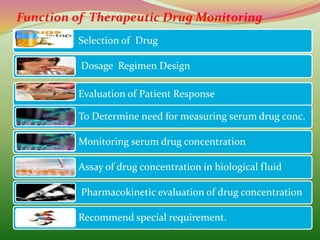
Function of Therapeutic Drug Monitoring
Selection of Drug
Dosage Regimen Design
Evaluation of Patient Response
To Determine need for measuring serum drug conc.
Monitoring serum drug concentration
Assay of drug concentration in biological fluid
Pharmacokinetic evaluation of drug concentration
Recommend special requirement.
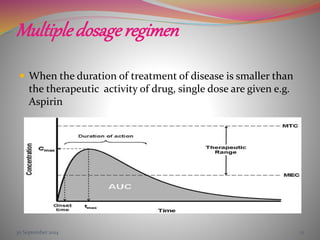
Multipledosageregimen
 When the duration of treatment of disease is smaller than
the therapeutic activity of drug, single dose are given e.g.
Aspirin
30 September 2014 12
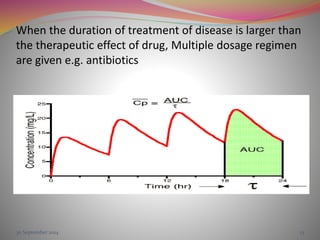
When the duration of treatment of disease is larger than
the therapeutic effect of drug, Multiple dosage regimen
are given e.g. antibiotics
30 September 2014 13
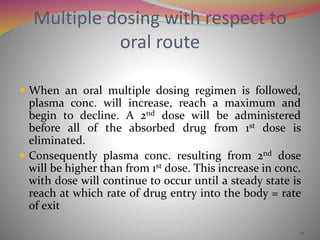
Multiple dosing with respect to
oral route
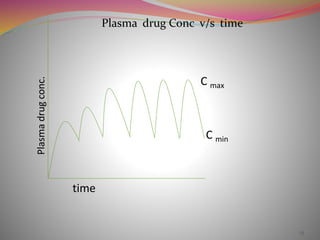
 When an oral multiple dosing regimen is followed,
plasma conc. will increase, reach a maximum and
begin to decline. A 2nd dose will be administered
before all of the absorbed drug from 1st dose is
eliminated.
 Consequently plasma conc. resulting from 2nd dose
will be higher than from 1st dose. This increase in conc.
with dose will continue to occur until a steady state is
reach at which rate of drug entry into the body = rate
of exit
14
Plasma drug Conc v/s time
1515
Plasma
drug
conc.
time
C max
C min
Multiple dosing with respect to I.V.
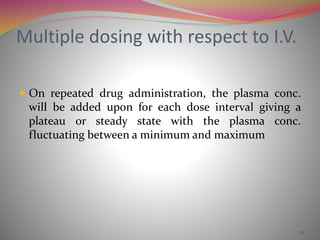
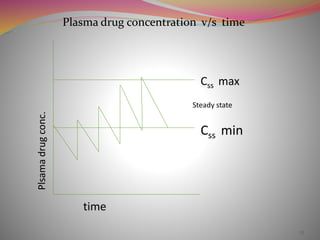
 On repeated drug administration, the plasma conc.
will be added upon for each dose interval giving a
plateau or steady state with the plasma conc.
fluctuating between a minimum and maximum
16
Plasma drug concentration v/s time
1717
Css max
Css min
Steady state
time
Plsama
drug
conc.
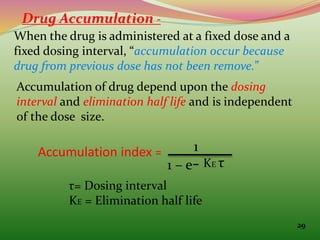
Drug Accumulation -
When the drug is administered at a fixed dose and a
fixed dosing interval, “accumulation occur because
drug from previous dose has not been remove.”
Accumulation of drug depend upon the dosing
interval and elimination half life and is independent
of the dose size.
Accumulation index = 1
1 – e- KE τ
τ= Dosing interval
KE = Elimination half life
29
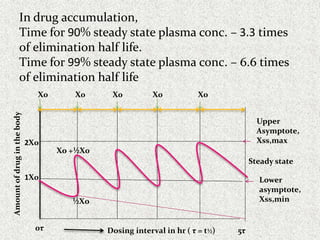
In drug accumulation,
Time for 90% steady state plasma conc. – 3.3 times
of elimination half life.
Time for 99% steady state plasma conc. – 6.6 times
of elimination half life
0τ 5τ
1X0
2X0
Dosing interval in hr ( τ = t½)
Amount
of
drug
in
the
body
X0 X0
X0
X0
X0
Steady state
Upper
Asymptote,
Xss,max
Lower
asymptote,
Xss,min
½Xo
Xo +½X0
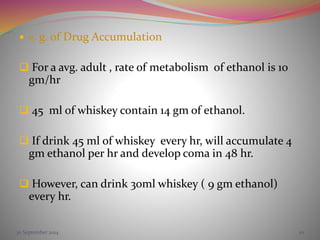
 e. g. of Drug Accumulation
 For a avg. adult , rate of metabolism of ethanol is 10
gm/hr
 45 ml of whiskey contain 14 gm of ethanol.
 If drink 45 ml of whiskey every hr, will accumulate 4
gm ethanol per hr and develop coma in 48 hr.
 However, can drink 30ml whiskey ( 9 gm ethanol)
every hr.
30 September 2014 20
21
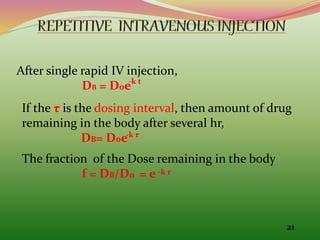
After single rapid IV injection,
DB = D0e-k t
If the τ is the dosing interval, then amount of drug
remaining in the body after several hr,
DB= D0e-k τ
The fraction of the Dose remaining in the body
f = DB/D0 = e -k τ
22
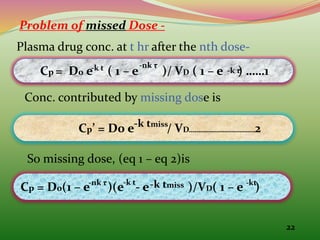
Problem of missed Dose -
Plasma drug conc. at t hr after the nth dose-
Cp = D0 e ( 1 – e )/ VD ( 1 – e ) ……1
-k t -nk τ
Conc. contributed by missing dose is
Cp’ = D0 e / VD……………………………2
-k tmiss
So missing dose, (eq 1 – eq 2)is
Cp = D0(1 – e )(e - e )/VD( 1 – e )
-nk τ -k t -k tmiss
-k τ
-kt
23
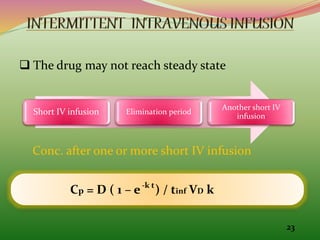
 The drug may not reach steady state
Short IV infusion Elimination period
Another short IV
infusion
Conc. after one or more short IV infusion
Cp = D ( 1 – e ) / tinf VD k
-k t
24
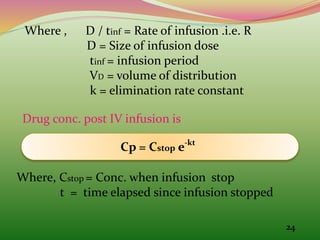
Where , D / tinf = Rate of infusion .i.e. R
D = Size of infusion dose
tinf = infusion period
VD = volume of distribution
k = elimination rate constant
Drug conc. post IV infusion is
Cp = Cstop e-kt
Where, Cstop = Conc. when infusion stop
t = time elapsed since infusion stopped
25
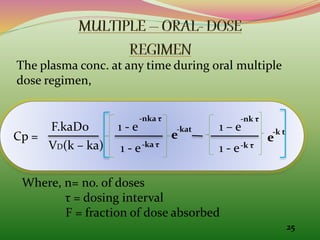
The plasma conc. at any time during oral multiple
dose regimen,
Cp =
F.kaDo
VD(k – ka)
1 - e
1 - e
-nka τ
-ka τ
e
-kat 1 – e
1 - e
-nk τ
-k τ
e
-k t
Where, n= no. of doses
τ = dosing interval
F = fraction of dose absorbed
26
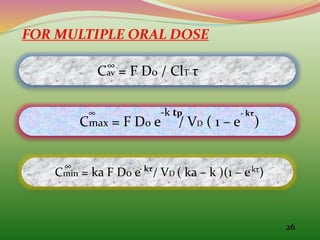
Cav = F D0 / ClT τ
FOR MULTIPLE ORAL DOSE
∞
Cmax = F Do e / VD ( 1 – e )
∞ -k tp - kτ
Cmin = ka F D0 e / VD ( ka – k )(1 – e )
- kτ -kτ
∞
27
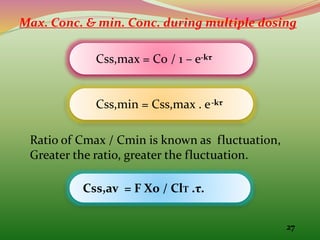
Max. Conc. & min. Conc. during multiple dosing
Css,max = C0 / 1 – e
Css,min = Css,max . e
-kτ
-kτ
Ratio of Cmax / Cmin is known as fluctuation,
Greater the ratio, greater the fluctuation.
Css,av = F X0 / ClT .τ.
28
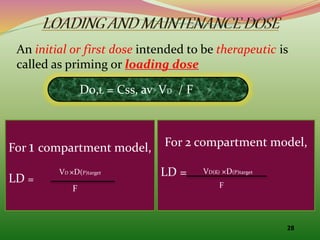
An initial or first dose intended to be therapeutic is
called as priming or loading dose
D0,L = Css, av VD / F
For 1 compartment model,
LD =
For 2 compartment model,
LD =
VD ×D(P)target
F
VD(ß) ×D(P)target
F
29
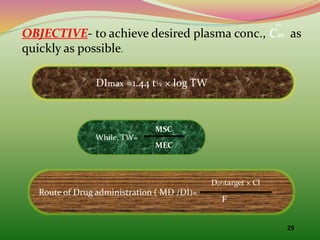
∞
OBJECTIVE- to achieve desired plasma conc., Cav , as
quickly as possible.
DImax =1.44 t½ × log TW
Route of Drug administration ( MD /DI)=
D(P)target × Cl
F
While, TW=
MSC
MEC
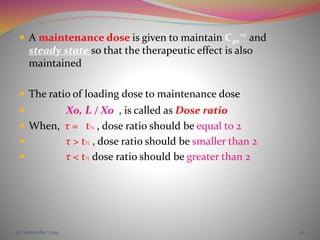
 A maintenance dose is given to maintain Cav
∞ and
steady state so that the therapeutic effect is also
maintained
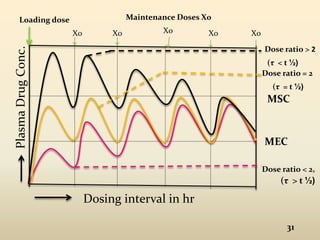
 The ratio of loading dose to maintenance dose
 X0, L / X0 , is called as Dose ratio
 When, τ = t½ , dose ratio should be equal to 2
 τ > t½ , dose ratio should be smaller than 2
 τ < t½ dose ratio should be greater than 2
30 September 2014 30
31
Dosing interval in hr
Plasma
Drug
Conc.
MEC
MSC
Dose ratio > 2
Dose ratio = 2
Dose ratio < 2,
Loading dose
X0 X0 Xo Xo X0
Maintenance Doses X0
(τ > t ½)
(τ < t ½)
(τ = t ½)
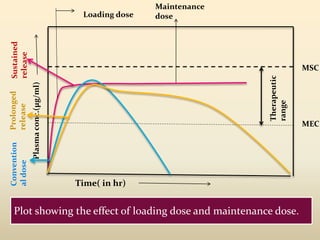
Time( in hr)
Plasma
conc.(µg/ml)
MEC
MSC
Therapeutic
range
Plot showing the effect of loading dose and maintenance dose.
Loading dose
Maintenance
dose
Convention
al
dose
Prolonged
release
Sustained
release
REFERENCES
Shargel Leon, Andrew Yu B.C., “Applied
biopharmaceutics and pharmacokinetics” , 5th edition,
published by Mc Graw Hill ,page no. 185 .207,613-625.
 Gibaldi M., “Biopharmaceutics And Clinical
Pharmacokinetics” 4th edition, Pulished by Pharma Med
Press,Page no.345.
Notari Robert E., “Biopharmaceutics & clinical
pharmacokinetics.”, Fourth Edition, published by
Marcell Dekker, page no.351-397.
30 September 2014 BBDNITM , Lucknow 33
MULTIPLE DOSAGE REGIMEN-REPETITIVE PROFILES.pdf

MULTIPLE DOSAGE REGIMEN-REPETITIVE PROFILES.pdf

  • 1.
    30 September 20141 UNDER THE GUIDENCE OF Dr.SATYABRATA BHANJA M. Pharm, Ph.D. Department of Pharmaceutics Mallareddy College Of Pharmacy PRESENTED BY : K.V.SIVA PRASAD M.Pharm(Pharmaceutics). 256213886018 Mallareddy College of pharmacy PHARMACOKINETICS OF MULTIPLE DOSING
  • 2.
    CONTENTS • Dosage regimen •Objectives of dose regimen • Therapeutic drug monitoring • Multiple dosage regimen • Multiple dosing with respect to I.V. • Multiple dosing with respect to Oral route. • Concept of loading dose, maintenance dose. • Drug accumulation  References 2
  • 3.
    Dosage regimen  Itis defined as the manner in which a drug is taken. For certain analgesics, hypnotics, anti-emetics etc. a single dose may provide an effective treatment. But the duration of most illness is longer than the therapeutic effect produced by a single dose. In such cases drugs are required to be taken on a repetitive basis over a period of time. 3
  • 4.
    Objective of dosageregimen  The overall objective of dosage regimen design is to achieve a target drug concentration at the receptor site 30 September 2014 4
  • 5.
    30 September 20145 Examine patient, collect data, and make diagnosis Define therapeutic objective Choose Drug and Dosage Regimen Evaluate how well objective has been achieved Modify Regimen Or Change Drug Modify objective Stop Therapy Continue Regimen Steps in the initiation and management of the drug therapy
  • 6.
    TherapeuticDrugMonitoring  The successof Drug therapy is highly dependent on Choice of Drug and Drug Product Design of the Dosage Regimen  While the choice of Drug and Drug product is based on Patient's characteristics Pharmacokinetic of Drug  Every patient have different Drug absorption, distribution, and elimination as well as different pathophysiological condition, so for the improvement in the clinical effectiveness of the drug THERAPEUTIC DRUG MONITORING are done. 30 September 2014 6
  • 7.
     It specializesin the measurement of medication levels in blood. Its main focus is on drugs with a narrow therapeutic range, i.e. drugs that can easily be under- or overdosed.  Therapeutic drug monitoring is important as Insufficient levels of drug in the plasma will lead to under treatment or resistance, and excessive levels can lead to toxicity and tissue damage. 7
  • 8.
    Indications for TDM include: There is narrow therapeutic window.  There are potential patient compliance problems.  The drug dose cannot be optimized by clinical observation alone.  Knowledge of the drug level influences management. 8
  • 9.
    Sampling and druganalysis  Usually, plasma or serum is used for drug assays.  Drug assay methods should have adequate sensitivity, be specific for the drug (or metabolite) to be measured and have appropriate accuracy and precision.  Automated immunoassay methods, High performance liquid chromatography (HPLC) and Gas liquid chromatography (GLC) (e.g. amiodarone, perhexiline) can be used. 9
  • 10.
    Examples of drugsanalyzed by therapeutic drug monitoring : 10
  • 11.
    BBDNITM , Lucknow 11 Functionof Therapeutic Drug Monitoring Selection of Drug Dosage Regimen Design Evaluation of Patient Response To Determine need for measuring serum drug conc. Monitoring serum drug concentration Assay of drug concentration in biological fluid Pharmacokinetic evaluation of drug concentration Recommend special requirement.
  • 12.
    Multipledosageregimen  When theduration of treatment of disease is smaller than the therapeutic activity of drug, single dose are given e.g. Aspirin 30 September 2014 12
  • 13.
    When the durationof treatment of disease is larger than the therapeutic effect of drug, Multiple dosage regimen are given e.g. antibiotics 30 September 2014 13
  • 14.
    Multiple dosing withrespect to oral route  When an oral multiple dosing regimen is followed, plasma conc. will increase, reach a maximum and begin to decline. A 2nd dose will be administered before all of the absorbed drug from 1st dose is eliminated.  Consequently plasma conc. resulting from 2nd dose will be higher than from 1st dose. This increase in conc. with dose will continue to occur until a steady state is reach at which rate of drug entry into the body = rate of exit 14
  • 15.
    Plasma drug Concv/s time 1515 Plasma drug conc. time C max C min
  • 16.
    Multiple dosing withrespect to I.V.  On repeated drug administration, the plasma conc. will be added upon for each dose interval giving a plateau or steady state with the plasma conc. fluctuating between a minimum and maximum 16
  • 17.
    Plasma drug concentrationv/s time 1717 Css max Css min Steady state time Plsama drug conc.
  • 18.
    Drug Accumulation - Whenthe drug is administered at a fixed dose and a fixed dosing interval, “accumulation occur because drug from previous dose has not been remove.” Accumulation of drug depend upon the dosing interval and elimination half life and is independent of the dose size. Accumulation index = 1 1 – e- KE τ τ= Dosing interval KE = Elimination half life 29
  • 19.
    In drug accumulation, Timefor 90% steady state plasma conc. – 3.3 times of elimination half life. Time for 99% steady state plasma conc. – 6.6 times of elimination half life 0τ 5τ 1X0 2X0 Dosing interval in hr ( τ = t½) Amount of drug in the body X0 X0 X0 X0 X0 Steady state Upper Asymptote, Xss,max Lower asymptote, Xss,min ½Xo Xo +½X0
  • 20.
     e. g.of Drug Accumulation  For a avg. adult , rate of metabolism of ethanol is 10 gm/hr  45 ml of whiskey contain 14 gm of ethanol.  If drink 45 ml of whiskey every hr, will accumulate 4 gm ethanol per hr and develop coma in 48 hr.  However, can drink 30ml whiskey ( 9 gm ethanol) every hr. 30 September 2014 20
  • 21.
    21 After single rapidIV injection, DB = D0e-k t If the τ is the dosing interval, then amount of drug remaining in the body after several hr, DB= D0e-k τ The fraction of the Dose remaining in the body f = DB/D0 = e -k τ
  • 22.
    22 Problem of missedDose - Plasma drug conc. at t hr after the nth dose- Cp = D0 e ( 1 – e )/ VD ( 1 – e ) ……1 -k t -nk τ Conc. contributed by missing dose is Cp’ = D0 e / VD……………………………2 -k tmiss So missing dose, (eq 1 – eq 2)is Cp = D0(1 – e )(e - e )/VD( 1 – e ) -nk τ -k t -k tmiss -k τ -kt
  • 23.
    23  The drugmay not reach steady state Short IV infusion Elimination period Another short IV infusion Conc. after one or more short IV infusion Cp = D ( 1 – e ) / tinf VD k -k t
  • 24.
    24 Where , D/ tinf = Rate of infusion .i.e. R D = Size of infusion dose tinf = infusion period VD = volume of distribution k = elimination rate constant Drug conc. post IV infusion is Cp = Cstop e-kt Where, Cstop = Conc. when infusion stop t = time elapsed since infusion stopped
  • 25.
    25 The plasma conc.at any time during oral multiple dose regimen, Cp = F.kaDo VD(k – ka) 1 - e 1 - e -nka τ -ka τ e -kat 1 – e 1 - e -nk τ -k τ e -k t Where, n= no. of doses τ = dosing interval F = fraction of dose absorbed
  • 26.
    26 Cav = FD0 / ClT τ FOR MULTIPLE ORAL DOSE ∞ Cmax = F Do e / VD ( 1 – e ) ∞ -k tp - kτ Cmin = ka F D0 e / VD ( ka – k )(1 – e ) - kτ -kτ ∞
  • 27.
    27 Max. Conc. &min. Conc. during multiple dosing Css,max = C0 / 1 – e Css,min = Css,max . e -kτ -kτ Ratio of Cmax / Cmin is known as fluctuation, Greater the ratio, greater the fluctuation. Css,av = F X0 / ClT .τ.
  • 28.
    28 An initial orfirst dose intended to be therapeutic is called as priming or loading dose D0,L = Css, av VD / F For 1 compartment model, LD = For 2 compartment model, LD = VD ×D(P)target F VD(ß) ×D(P)target F
  • 29.
    29 ∞ OBJECTIVE- to achievedesired plasma conc., Cav , as quickly as possible. DImax =1.44 t½ × log TW Route of Drug administration ( MD /DI)= D(P)target × Cl F While, TW= MSC MEC
  • 30.
     A maintenancedose is given to maintain Cav ∞ and steady state so that the therapeutic effect is also maintained  The ratio of loading dose to maintenance dose  X0, L / X0 , is called as Dose ratio  When, τ = t½ , dose ratio should be equal to 2  τ > t½ , dose ratio should be smaller than 2  τ < t½ dose ratio should be greater than 2 30 September 2014 30
  • 31.
    31 Dosing interval inhr Plasma Drug Conc. MEC MSC Dose ratio > 2 Dose ratio = 2 Dose ratio < 2, Loading dose X0 X0 Xo Xo X0 Maintenance Doses X0 (τ > t ½) (τ < t ½) (τ = t ½)
  • 32.
    Time( in hr) Plasma conc.(µg/ml) MEC MSC Therapeutic range Plotshowing the effect of loading dose and maintenance dose. Loading dose Maintenance dose Convention al dose Prolonged release Sustained release
  • 33.
    REFERENCES Shargel Leon, AndrewYu B.C., “Applied biopharmaceutics and pharmacokinetics” , 5th edition, published by Mc Graw Hill ,page no. 185 .207,613-625.  Gibaldi M., “Biopharmaceutics And Clinical Pharmacokinetics” 4th edition, Pulished by Pharma Med Press,Page no.345. Notari Robert E., “Biopharmaceutics & clinical pharmacokinetics.”, Fourth Edition, published by Marcell Dekker, page no.351-397. 30 September 2014 BBDNITM , Lucknow 33