Roles of the Library Media SpecialistMichelle de Freitas6 April 2011By PresenterMedia.com
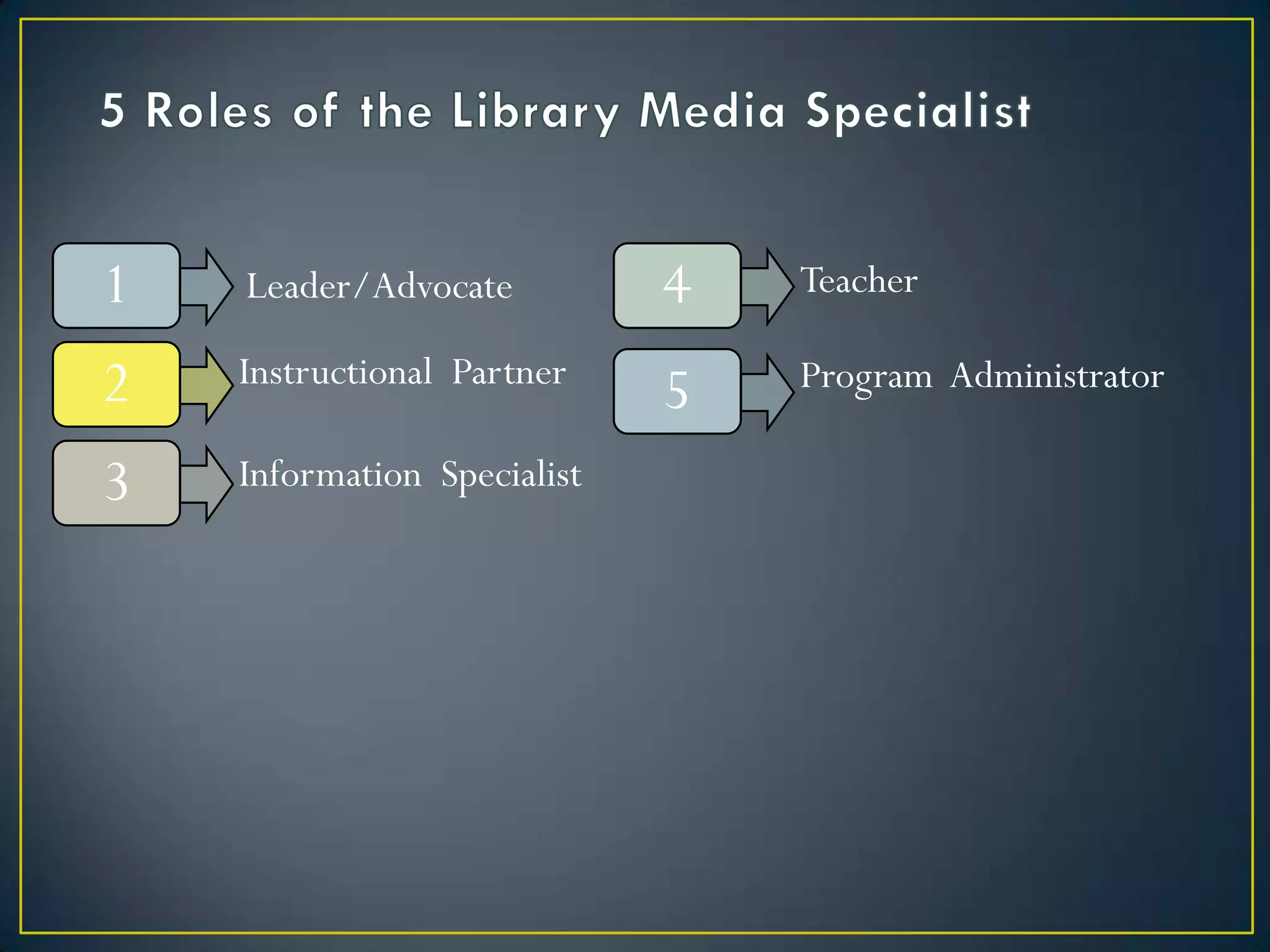
5 Roles of the Library Media SpecialistTeacherLeader/Advocate12345InstructionalPartnerProgramAdministratorInformationSpecialist
Leader/AdvocateResponsibilities:Leads development of 21st Century    skillsSeeks out new learning opportunitiesJoins global communities and professionalorganizations and reads professional/trade publications and electronic resourcesTeaches these skills and concepts to facultyListens to and respects the ideas of others Peers, teachers, and studentsAdvocates on behalf of the program and patronsEstablishes a relationship with the greater community to broaden learning resources and support student learningPromotes the program to the entire communityMember of the ALA and AASL since 2010(AASL, 2009)
Leader/AdvocateCourse Work:EDMD 7000:  Instructional Design and DevelopmentCollaborative WorkEDMD 7010:  Instructional and Information TechnologiesCollaborative WorkDeveloped WorkshopEDMD 7100:  Selection and Use of Media for YouthProfessional Material Selection
Leader/AdvocateCourse Work:EDMD 7130:  Administration of Media and Technology ServicesCollaboration with practicing librarianProfessional DevelopmentERMA 7200:  Basic Research MethodsConducted Literature Searches
Instructional PartnerResponsibilities:Collaborates with the community to develop 	policies, practices, and curricula to promote 	learningBuilds a relationship with stakeholders to utilize guest speakersCollaborates with teachers to help students develop:Critical thinking, information literacy, technology and social skillsCollaborates with classroom teachers to:Develop learning objectives and goalsImplement assessment strategies before, during, and after instruction (AASL, 2009)
Instructional PartnerCourse Work:EDMD 7000:  Instructional Design and DevelopmentCreated Curricular UnitEDMD 7100:  Instructional and Information TechnologiesNeeds Assessment/Collection DevelopmentEDMD 7120:  Information Sources, Services and InstructionCollection DevelopmentCollaborative Lesson
Instructional PartnerCourse Work:EDMD 7130: Administration of Media Technology ServicesPrecis AssignmentsEPSY 7400:  Educational Psychology and Educational ImplicationsPhysical and Mental Development
Information SpecialistsResponsibilities:The LMS effectively uses technology to:Supplement school resources (e.g., databases)Connect with the global learning community Forums, listservs, and blogsProvide 24-7 communication with students and teachers as well as access to library services (e.g., library website and OPAC)Creates engaging learning tasks that support the use of technologyUnderstands copyright and fair use guidelinesTeaches students and teachers about the ethical use of technologyPosts appropriate copyright warnings by scanners and copy machines(AASL, 2009)
Information SpecialistCourse Work:EDMD 7010:  Instructional and Informational TechnologiesEvaluated Hardware and Software Developed Acceptable Use PolicyStudied Copyright LawsEDMD 7100:  Selection and Use of Media for YouthEvaluated Resources/Collection DevelopmentCreated Webliography
Information SpecialistCourse Work:EDMD 7120:  Information Sources, Services and InstructionInformation Searching Strategies9 Points of EvaluationEDMD 7130:  Administration of Media and Technology ServicesPrecis AssignmentsEDMD 7210:  Integration of Technology into the CurriculumEngaging Learning Tasks
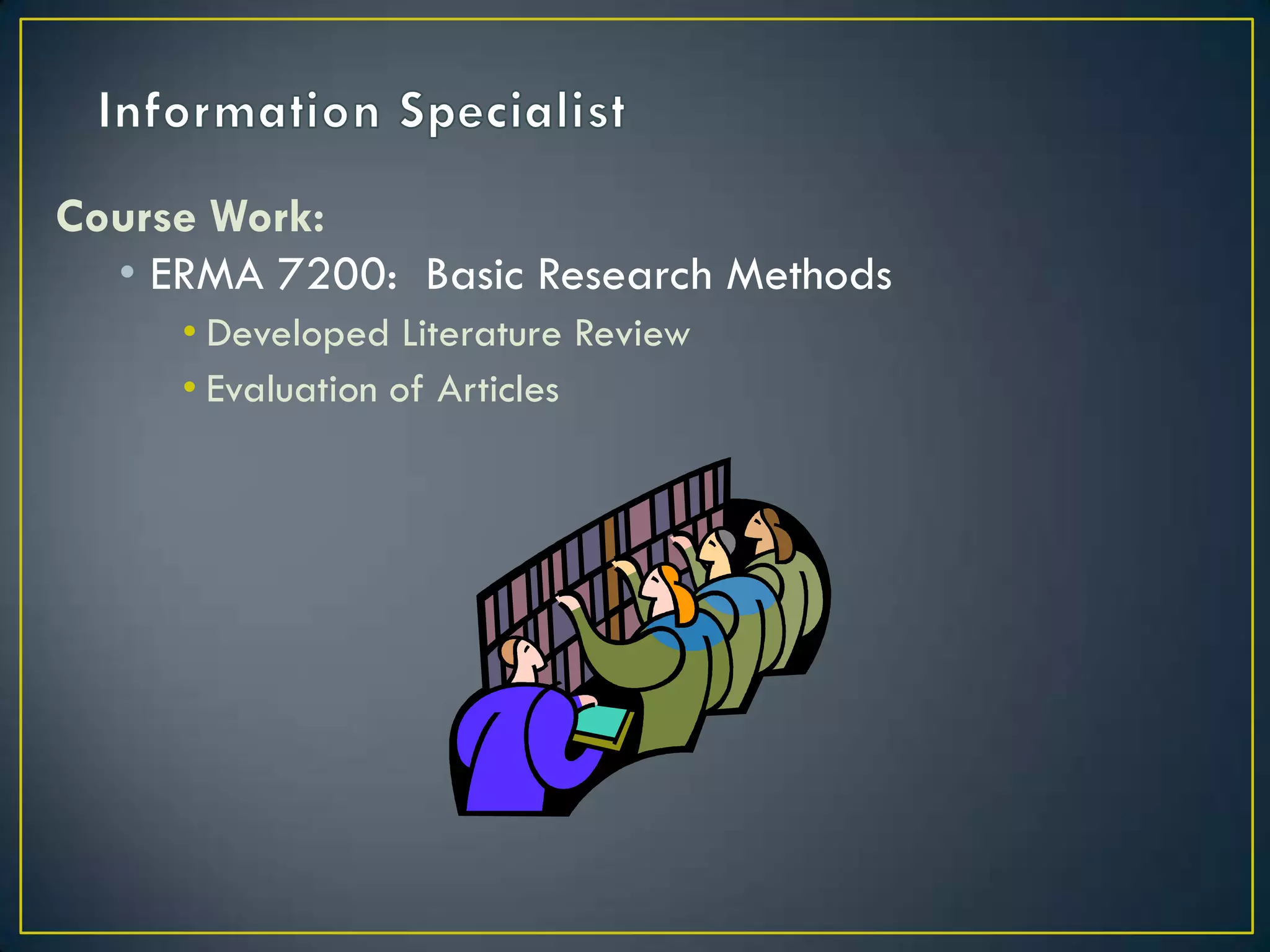
Information SpecialistCourse Work:ERMA 7200:  Basic Research MethodsDeveloped Literature ReviewEvaluation of Articles
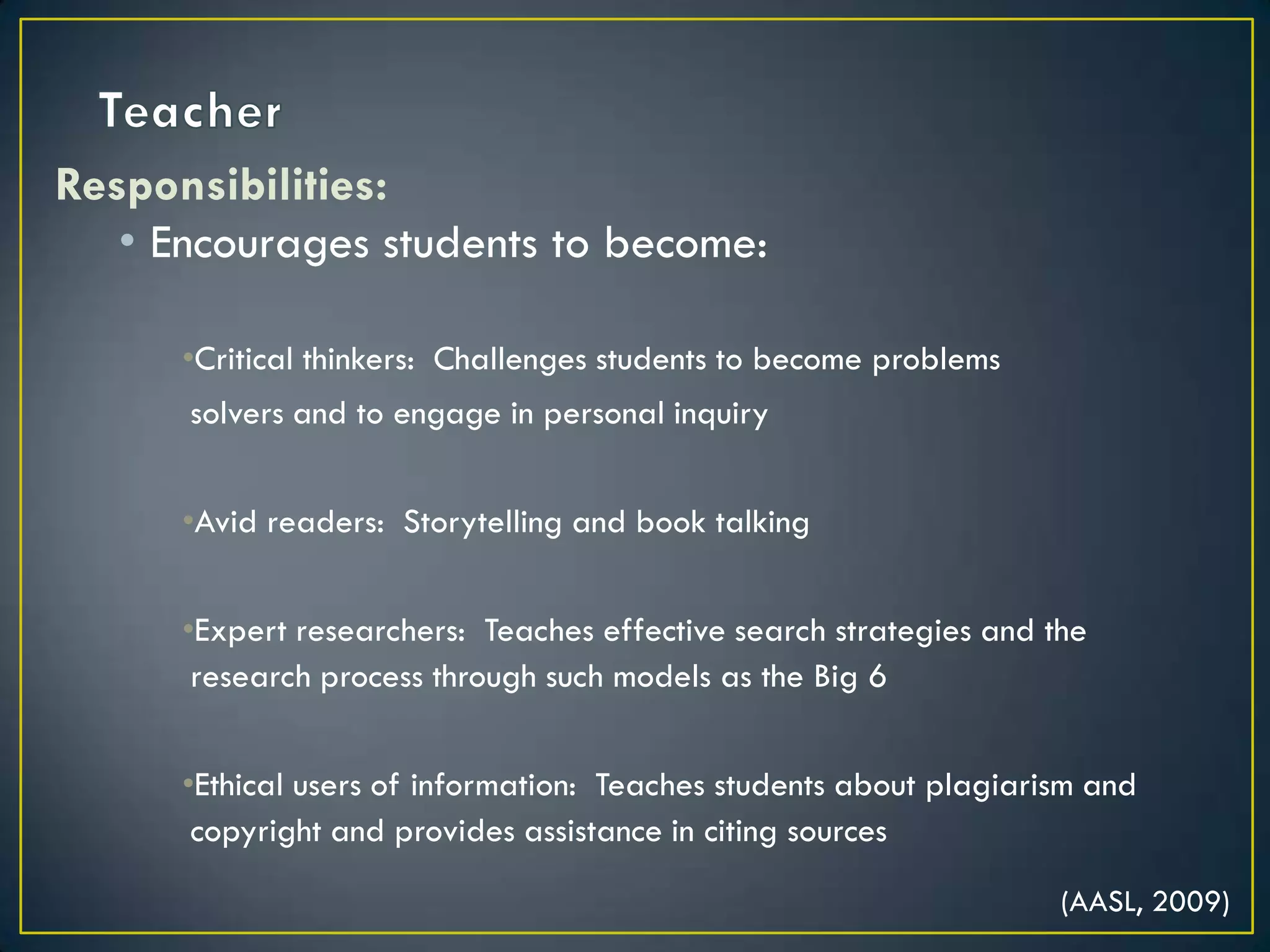
TeacherResponsibilities:Encourages students to become:Critical thinkers:  Challenges students to become problems solvers and to engage in personal inquiryAvid readers:  Storytelling and book talkingExpert researchers:  Teaches effective search strategies and the research process through such models as the Big 6 Ethical users of information:  Teaches students about plagiarism and copyright and provides assistance in citing sources (AASL, 2009)
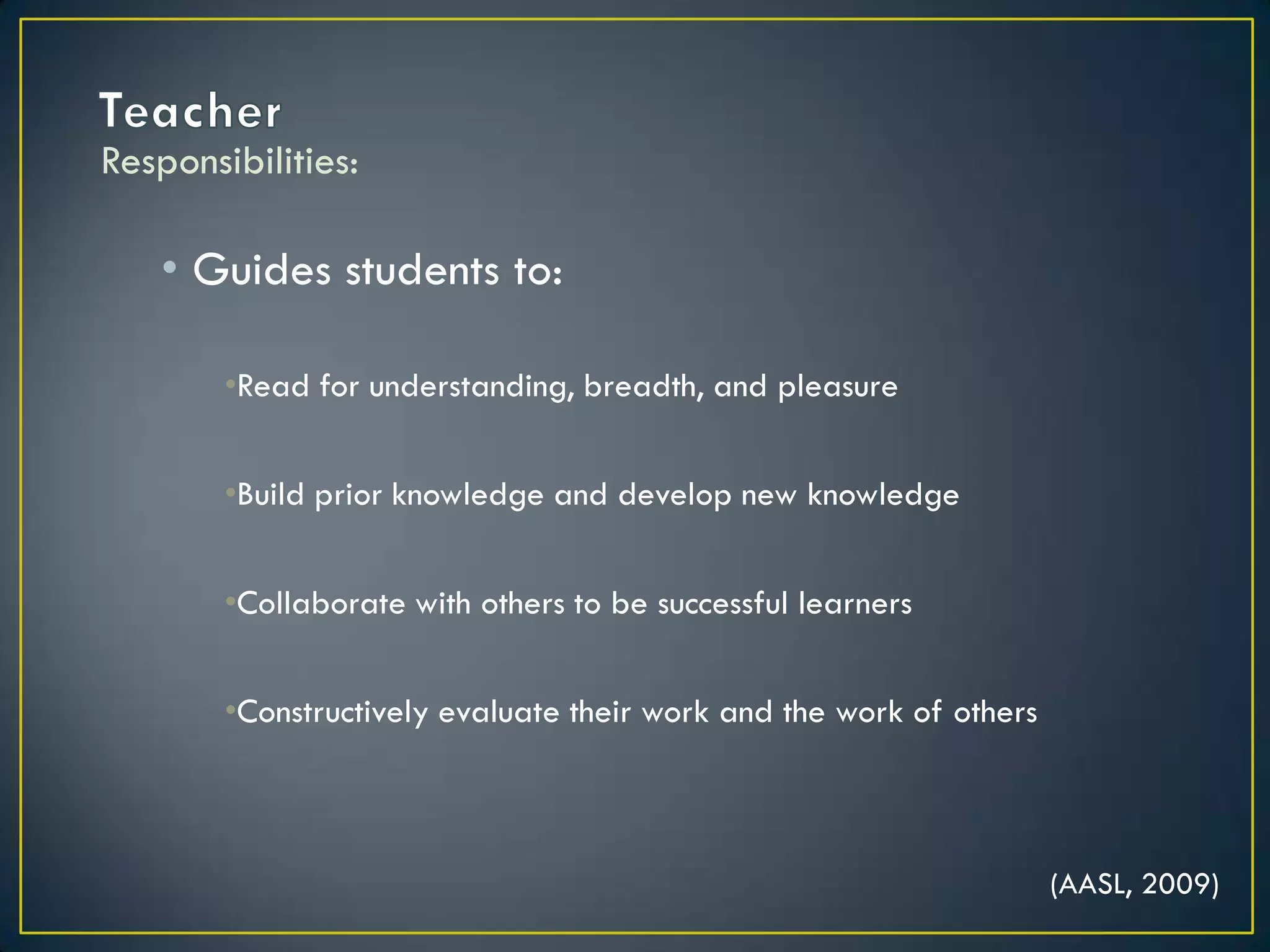
TeacherGuides students to:Read for understanding, breadth, and pleasureBuild prior knowledge and develop new knowledgeCollaborate with others to be successful learnersConstructively evaluate their work and the work of othersResponsibilities:(AASL, 2009)
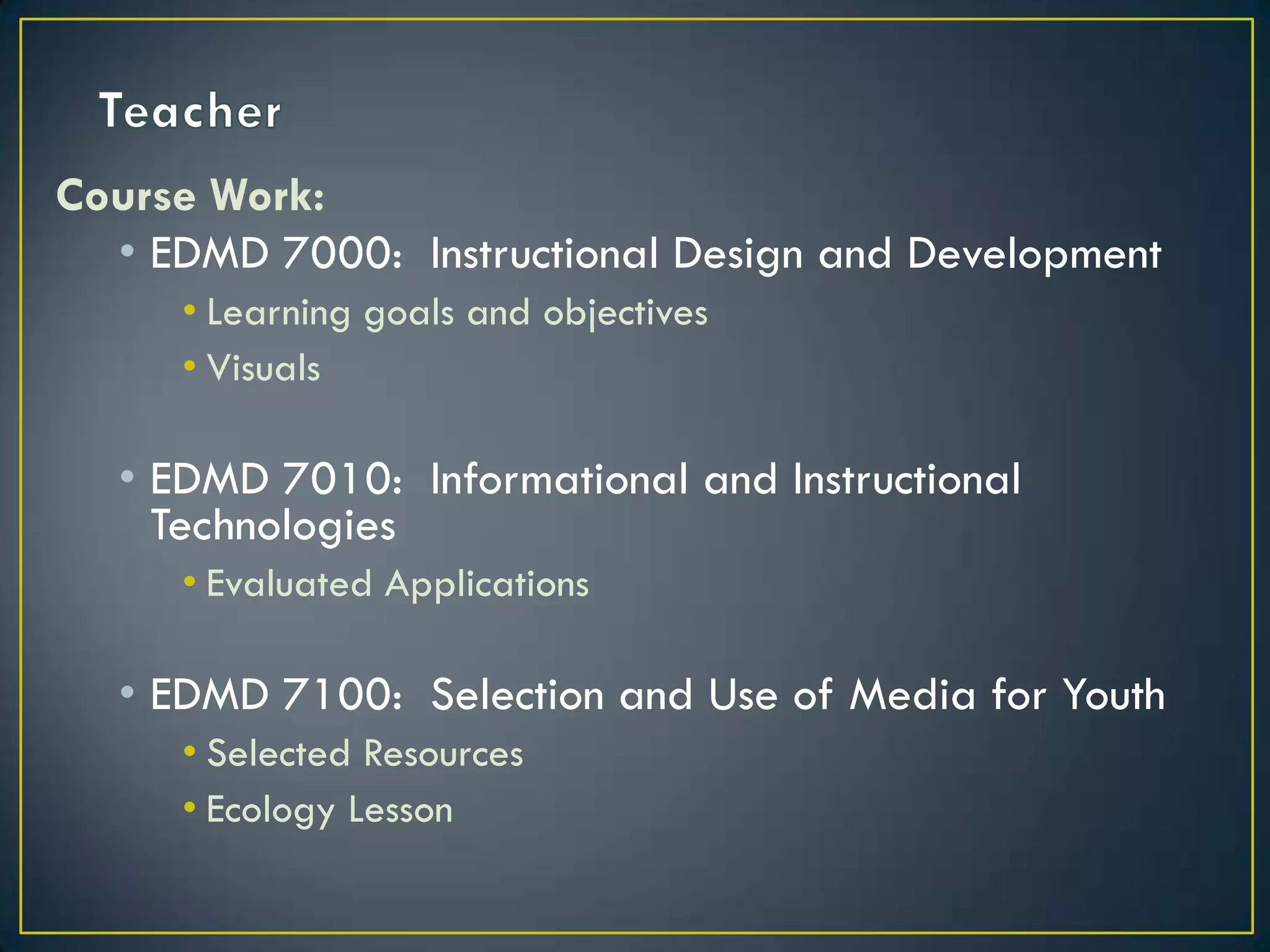
TeacherCourse Work:EDMD 7000:  Instructional Design and DevelopmentLearning goals and objectivesVisualsEDMD 7010:  Informational and Instructional TechnologiesEvaluated ApplicationsEDMD 7100:  Selection and Use of Media for YouthSelected ResourcesEcology Lesson
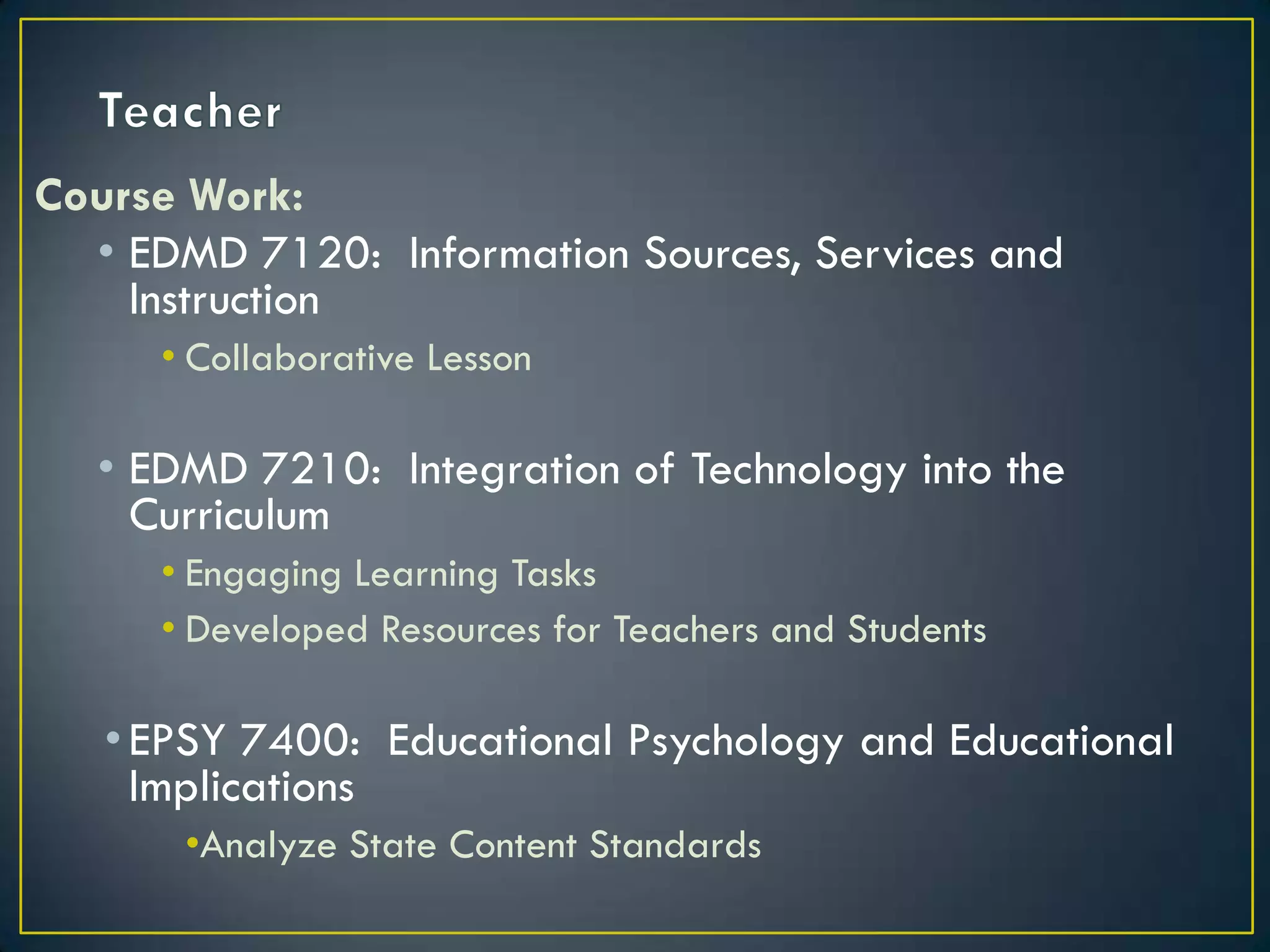
TeacherCourse Work:EDMD 7120:  Information Sources, Services and InstructionCollaborative LessonEDMD 7210:  Integration of Technology into the CurriculumEngaging Learning TasksDeveloped Resources for Teachers and StudentsEPSY 7400:  Educational Psychology and Educational   ImplicationsAnalyze State Content Standards
Program AdministratorResponsibilities:Provides the community with access to information that supports:Patrons needs and interestsDiverging points of viewA multicultural societyThe collection should not only represent all members of the immediate community, but those who are not a part of it as well Works in collaboration to develop:Library mission and goals, strategic plan, and policiesCollaborates with teachers, administrators, community members, and other library media specialists(AASL, 2009)
Program AdministratorResponsibilities:Effectively manages:Library staff and volunteersBudget (follows district/school procedures)Physical and virtual placesChooses appropriate furnishings and colors for school/library population, mission, and goalsFollows safety guidelines Establishes partnerships to:Increase library resources by utilizing guest speakers from the community and local and global organizationsPartners with other libraries to engage in inter-library loans(AASL, 2009)
Program AdministratorCourse Work:EDMD 7010:  Instructional and Information TechnologiesAcceptable Use PolicyGrant ProposalEDMD 7100:  Selection and Use of Media for YouthCollection Development PoliciesCollaboration with LMSCollection Development
Program AdministratorCourse Work:EDMD 7110:  Bibliographic Design, Organization and ControlAdhered to Cataloging RulesCollection OrganizationEDMD 7120:  Information Sources, Services and   InstructionCollection DevelopmentEPSY 7400:  Educational Psychology and Educational  ImplicationsStudent Development
Program AdministratorCourse Work:EDMD 7130:  Administration of Media and Technology ServicesCollaborating with LMSCase StudiesEDMD 7210:  Integration of Technology into the  CurriculumAnalyzed use of Technology
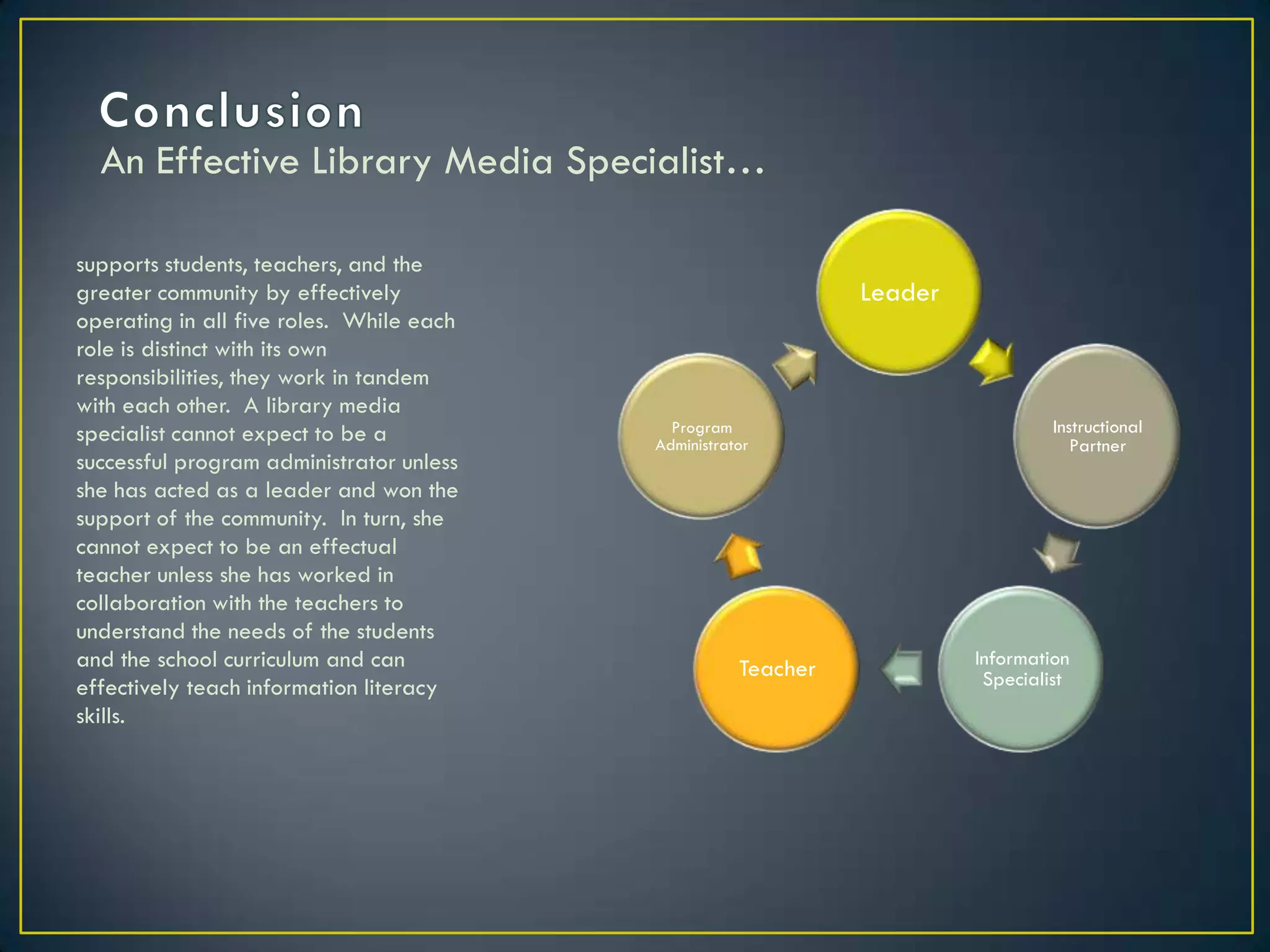
supports students, teachers, and the greater community by effectively operating in all five roles.  While each role is distinct with its own responsibilities, they work in tandem with each other.  A library media specialist cannot expect to be a successful program administrator unless she has acted as a leader and won the support of the community.  In turn, she cannot expect to be an effectual teacher unless she has worked in collaboration with the teachers to understand the needs of the students and the school curriculum and can effectively teach information literacy skills.ConclusionAn Effective Library Media Specialist…
American Association of School Librarians.  (2009).  Empowering Learners:  	Guidelines for School Library Programs.  Chicago, IL:  American Association of School Librarians.References

LMS Roles

  • 1.
    Roles of theLibrary Media SpecialistMichelle de Freitas6 April 2011By PresenterMedia.com
  • 2.
    5 Roles ofthe Library Media SpecialistTeacherLeader/Advocate12345InstructionalPartnerProgramAdministratorInformationSpecialist
  • 3.
    Leader/AdvocateResponsibilities:Leads development of21st Century skillsSeeks out new learning opportunitiesJoins global communities and professionalorganizations and reads professional/trade publications and electronic resourcesTeaches these skills and concepts to facultyListens to and respects the ideas of others Peers, teachers, and studentsAdvocates on behalf of the program and patronsEstablishes a relationship with the greater community to broaden learning resources and support student learningPromotes the program to the entire communityMember of the ALA and AASL since 2010(AASL, 2009)
  • 4.
    Leader/AdvocateCourse Work:EDMD 7000: Instructional Design and DevelopmentCollaborative WorkEDMD 7010: Instructional and Information TechnologiesCollaborative WorkDeveloped WorkshopEDMD 7100: Selection and Use of Media for YouthProfessional Material Selection
  • 5.
    Leader/AdvocateCourse Work:EDMD 7130: Administration of Media and Technology ServicesCollaboration with practicing librarianProfessional DevelopmentERMA 7200: Basic Research MethodsConducted Literature Searches
  • 6.
    Instructional PartnerResponsibilities:Collaborates withthe community to develop policies, practices, and curricula to promote learningBuilds a relationship with stakeholders to utilize guest speakersCollaborates with teachers to help students develop:Critical thinking, information literacy, technology and social skillsCollaborates with classroom teachers to:Develop learning objectives and goalsImplement assessment strategies before, during, and after instruction (AASL, 2009)
  • 7.
    Instructional PartnerCourse Work:EDMD7000: Instructional Design and DevelopmentCreated Curricular UnitEDMD 7100: Instructional and Information TechnologiesNeeds Assessment/Collection DevelopmentEDMD 7120: Information Sources, Services and InstructionCollection DevelopmentCollaborative Lesson
  • 8.
    Instructional PartnerCourse Work:EDMD7130: Administration of Media Technology ServicesPrecis AssignmentsEPSY 7400: Educational Psychology and Educational ImplicationsPhysical and Mental Development
  • 9.
    Information SpecialistsResponsibilities:The LMSeffectively uses technology to:Supplement school resources (e.g., databases)Connect with the global learning community Forums, listservs, and blogsProvide 24-7 communication with students and teachers as well as access to library services (e.g., library website and OPAC)Creates engaging learning tasks that support the use of technologyUnderstands copyright and fair use guidelinesTeaches students and teachers about the ethical use of technologyPosts appropriate copyright warnings by scanners and copy machines(AASL, 2009)
  • 10.
    Information SpecialistCourse Work:EDMD7010: Instructional and Informational TechnologiesEvaluated Hardware and Software Developed Acceptable Use PolicyStudied Copyright LawsEDMD 7100: Selection and Use of Media for YouthEvaluated Resources/Collection DevelopmentCreated Webliography
  • 11.
    Information SpecialistCourse Work:EDMD7120: Information Sources, Services and InstructionInformation Searching Strategies9 Points of EvaluationEDMD 7130: Administration of Media and Technology ServicesPrecis AssignmentsEDMD 7210: Integration of Technology into the CurriculumEngaging Learning Tasks
  • 12.
    Information SpecialistCourse Work:ERMA7200: Basic Research MethodsDeveloped Literature ReviewEvaluation of Articles
  • 13.
    TeacherResponsibilities:Encourages students tobecome:Critical thinkers: Challenges students to become problems solvers and to engage in personal inquiryAvid readers: Storytelling and book talkingExpert researchers: Teaches effective search strategies and the research process through such models as the Big 6 Ethical users of information: Teaches students about plagiarism and copyright and provides assistance in citing sources (AASL, 2009)
  • 14.
    TeacherGuides students to:Readfor understanding, breadth, and pleasureBuild prior knowledge and develop new knowledgeCollaborate with others to be successful learnersConstructively evaluate their work and the work of othersResponsibilities:(AASL, 2009)
  • 15.
    TeacherCourse Work:EDMD 7000: Instructional Design and DevelopmentLearning goals and objectivesVisualsEDMD 7010: Informational and Instructional TechnologiesEvaluated ApplicationsEDMD 7100: Selection and Use of Media for YouthSelected ResourcesEcology Lesson
  • 16.
    TeacherCourse Work:EDMD 7120: Information Sources, Services and InstructionCollaborative LessonEDMD 7210: Integration of Technology into the CurriculumEngaging Learning TasksDeveloped Resources for Teachers and StudentsEPSY 7400: Educational Psychology and Educational ImplicationsAnalyze State Content Standards
  • 17.
    Program AdministratorResponsibilities:Provides thecommunity with access to information that supports:Patrons needs and interestsDiverging points of viewA multicultural societyThe collection should not only represent all members of the immediate community, but those who are not a part of it as well Works in collaboration to develop:Library mission and goals, strategic plan, and policiesCollaborates with teachers, administrators, community members, and other library media specialists(AASL, 2009)
  • 18.
    Program AdministratorResponsibilities:Effectively manages:Librarystaff and volunteersBudget (follows district/school procedures)Physical and virtual placesChooses appropriate furnishings and colors for school/library population, mission, and goalsFollows safety guidelines Establishes partnerships to:Increase library resources by utilizing guest speakers from the community and local and global organizationsPartners with other libraries to engage in inter-library loans(AASL, 2009)
  • 19.
    Program AdministratorCourse Work:EDMD7010: Instructional and Information TechnologiesAcceptable Use PolicyGrant ProposalEDMD 7100: Selection and Use of Media for YouthCollection Development PoliciesCollaboration with LMSCollection Development
  • 20.
    Program AdministratorCourse Work:EDMD7110: Bibliographic Design, Organization and ControlAdhered to Cataloging RulesCollection OrganizationEDMD 7120: Information Sources, Services and InstructionCollection DevelopmentEPSY 7400: Educational Psychology and Educational ImplicationsStudent Development
  • 21.
    Program AdministratorCourse Work:EDMD7130: Administration of Media and Technology ServicesCollaborating with LMSCase StudiesEDMD 7210: Integration of Technology into the CurriculumAnalyzed use of Technology
  • 22.
    supports students, teachers,and the greater community by effectively operating in all five roles. While each role is distinct with its own responsibilities, they work in tandem with each other. A library media specialist cannot expect to be a successful program administrator unless she has acted as a leader and won the support of the community. In turn, she cannot expect to be an effectual teacher unless she has worked in collaboration with the teachers to understand the needs of the students and the school curriculum and can effectively teach information literacy skills.ConclusionAn Effective Library Media Specialist…
  • 23.
    American Association ofSchool Librarians. (2009). Empowering Learners: Guidelines for School Library Programs. Chicago, IL: American Association of School Librarians.References