CONNECTIVES TO COMPARE AND CONTRAST
   List as many as you can:
AS ENGLISH LANGUAGE AND
LITERATURE

L.O: To understand the
structure and assessment
objectives for LL1.
To begin applying
terminology to prose texts
THE EXAM

LL1 – Exam preparation (2 ½ hour written paper 80 marks)

Critical reading of literary and non-literary texts
Section A: Poetry pre-1900 plus an unseen text
You will answer one of two questions.

Section B: Prose
Read two prose texts: Choose one from two questions
SECTION A: POETRY PRE-1900 PLUS AN
UNSEEN TEXT

   In this section you will be asked to compare one
    of the poems from the Anthology with an unseen
    text.

   The unseen text can be from any genre. You
    should apply the same terminology and skills of
    analysis as you use to analyse poetry.
WHAT YOU ARE ASSESSED ON
  AO1 (16/40)         AO2 (8/40)          AO3 (16/40)
Select and apply    Demonstrate         Use integrated
relevant concepts   detailed critical   approaches to
and approaches      understanding in    explore
from integrated     analysing the       relationships
linguistic and      ways in which       between texts,
literary study,     structure, form     analysing and
using appropriate   and language        evaluating the
terminology and     shape meanings in   significance of
accurate,           a range of spoken   contextual
coherent written    and written         factors in their
expression.         texts.              production and
                                        reception.
PRACTICE TEXT
   Text A: The poem New Prince, New Pomp

   Text B: An article on the birth of a new prince in
    Japan by the BBC. Japan’s new prince seen in
    public.
ANALYSIS
   Look back at your notes from this poem.

 Use the analysis table and the cone to try and
  pick out features from the article.
 Think about any similarities between the two
  texts.
Overview                                                                    Style
 CONTENT; CONTEXT; AUDIENCE;
                                                                             Your own written and spoken
 ATTITUDES; PURPOSE; TEXT
 TYPE;
                                                                             expression has an impact on how
                                                                             your ideas are perceived by others.
 TONE; THEMES
                                                                             Always use an appropriate style
When we analyse texts we are primarily                                       and register for the context in
exploring meaning.                                                           which you are writing or speaking.
Without keeping the focus on meaning,
                                                                             Punctuation and vocabulary need to
you will be feeding the examiner a dry
                                                                             be used accurately.
cone of frameworks. But without the                        MEANING
cone, you are likely to end up with                                      Form and structure/Discourse
meaning melting and running through                                      Genre, narrative stance (first person, third person,
your fingers. Yuk!                                                       second person address), narrative voice, dialogue,
Remember: you can get ice creams                                         verse type e.g. sonnet (Petrarchan/Shakespearean),
with different scoops of flavour:                                        ballad, lyric, free verse, epistolary form, prose/verse
always try to explore different ways of                                  Order of content; development of ideas/argument,
reading a text.                                                          chronology, juxtaposition of content, chapters,
                                                      FORM & STRUCTURE
                                                                         flashback, stanza structure (couplet; quatrain, sestet,
Sentence level/Grammar
                                                                         octave, enjambment, caesura, volta) rhyme scheme,
Sentence types
Syntax (word order)                                                      metre, scansion, enjambment, turn-taking, pausing,
(especially: parallelism, foregrounding; end focus;   SENTENCE LEVEL     non-fluency, overlapping, latching
nonstandard features) Mood (Declarative,
Interrogative,                                                           Phonology
Imperative)                                                              Accent/Pronunciation e.g. elision,
Tense, Standard/Non-standard features/Dialect          WORD LEVEL        phonemes //, plosives, fricatives, sibilants,
Ellipsis                                                                 IPA, Received Pronunciation, regional
                                                                         accents. .Prosodic features (loudness, stress, pitch,
Word level/Lexis                                      Phonology &        intonation, etc.)
Modifiers, Register Word classes (e.g. pronouns,      Typography         Sound alliteration, assonance, rhyme
verbs, abstract nouns)
                                                                         (couplets, masculine, half-rhyme, eye
Lexical sets Connotations
                                                                         rhyme), rhythm, iambic and trochaic feet,
Standard/Non-standard
                                                                         sound effects, onomatopoeia, )
features/Dialect/Idioms/Archaisms
                                                                         Typography –Font, Punctuation
Literary and Rhetorical techniques including:
                                                                         Orthography Graphemes <>
metaphor, simile, allusion, imagery, symbolism,
                                                                         Pictorial elements, Use of colour
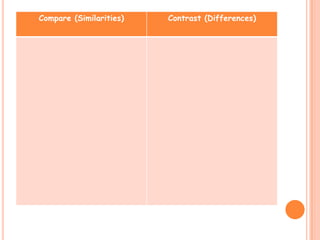
Compare (Similarities)   Contrast (Differences)

Ll1 exam prep

  • 1.
    CONNECTIVES TO COMPAREAND CONTRAST  List as many as you can:
  • 2.
    AS ENGLISH LANGUAGEAND LITERATURE L.O: To understand the structure and assessment objectives for LL1. To begin applying terminology to prose texts
  • 3.
    THE EXAM LL1 –Exam preparation (2 ½ hour written paper 80 marks) Critical reading of literary and non-literary texts Section A: Poetry pre-1900 plus an unseen text You will answer one of two questions. Section B: Prose Read two prose texts: Choose one from two questions
  • 4.
    SECTION A: POETRYPRE-1900 PLUS AN UNSEEN TEXT  In this section you will be asked to compare one of the poems from the Anthology with an unseen text.  The unseen text can be from any genre. You should apply the same terminology and skills of analysis as you use to analyse poetry.
  • 6.
    WHAT YOU AREASSESSED ON AO1 (16/40) AO2 (8/40) AO3 (16/40) Select and apply Demonstrate Use integrated relevant concepts detailed critical approaches to and approaches understanding in explore from integrated analysing the relationships linguistic and ways in which between texts, literary study, structure, form analysing and using appropriate and language evaluating the terminology and shape meanings in significance of accurate, a range of spoken contextual coherent written and written factors in their expression. texts. production and reception.
  • 7.
    PRACTICE TEXT  Text A: The poem New Prince, New Pomp  Text B: An article on the birth of a new prince in Japan by the BBC. Japan’s new prince seen in public.
  • 8.
    ANALYSIS  Look back at your notes from this poem.  Use the analysis table and the cone to try and pick out features from the article.  Think about any similarities between the two texts.
  • 9.
    Overview Style CONTENT; CONTEXT; AUDIENCE; Your own written and spoken ATTITUDES; PURPOSE; TEXT TYPE; expression has an impact on how your ideas are perceived by others. TONE; THEMES Always use an appropriate style When we analyse texts we are primarily and register for the context in exploring meaning. which you are writing or speaking. Without keeping the focus on meaning, Punctuation and vocabulary need to you will be feeding the examiner a dry be used accurately. cone of frameworks. But without the MEANING cone, you are likely to end up with Form and structure/Discourse meaning melting and running through Genre, narrative stance (first person, third person, your fingers. Yuk! second person address), narrative voice, dialogue, Remember: you can get ice creams verse type e.g. sonnet (Petrarchan/Shakespearean), with different scoops of flavour: ballad, lyric, free verse, epistolary form, prose/verse always try to explore different ways of Order of content; development of ideas/argument, reading a text. chronology, juxtaposition of content, chapters, FORM & STRUCTURE flashback, stanza structure (couplet; quatrain, sestet, Sentence level/Grammar octave, enjambment, caesura, volta) rhyme scheme, Sentence types Syntax (word order) metre, scansion, enjambment, turn-taking, pausing, (especially: parallelism, foregrounding; end focus; SENTENCE LEVEL non-fluency, overlapping, latching nonstandard features) Mood (Declarative, Interrogative, Phonology Imperative) Accent/Pronunciation e.g. elision, Tense, Standard/Non-standard features/Dialect WORD LEVEL phonemes //, plosives, fricatives, sibilants, Ellipsis IPA, Received Pronunciation, regional accents. .Prosodic features (loudness, stress, pitch, Word level/Lexis Phonology & intonation, etc.) Modifiers, Register Word classes (e.g. pronouns, Typography Sound alliteration, assonance, rhyme verbs, abstract nouns) (couplets, masculine, half-rhyme, eye Lexical sets Connotations rhyme), rhythm, iambic and trochaic feet, Standard/Non-standard sound effects, onomatopoeia, ) features/Dialect/Idioms/Archaisms Typography –Font, Punctuation Literary and Rhetorical techniques including: Orthography Graphemes <> metaphor, simile, allusion, imagery, symbolism, Pictorial elements, Use of colour
  • 10.
    Compare (Similarities) Contrast (Differences)