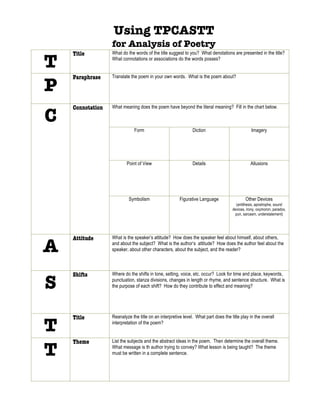
Using TPCASTT
                  for Analysis of Poetry

T
    Title         What do the words of the title suggest to you? What denotations are presented in the title?
                  What connotations or associations do the words posses?


P
    Paraphrase    Translate the poem in your own words. What is the poem about?


C
    Connotation   What meaning does the poem have beyond the literal meaning? Fill in the chart below.


                              Form                            Diction                           Imagery


                          Point of View                       Details                          Allusions


                           Symbolism                   Figurative Language                  Other Devices
                                                                                      (antithesis, apostrophe, sound
                                                                                    devices, irony, oxymoron, paradox,
                                                                                     pun, sarcasm, understatement)


A
    Attitude      What is the speaker’s attitude? How does the speaker feel about himself, about others,
                  and about the subject? What is the author’s attitude? How does the author feel about the
                  speaker, about other characters, about the subject, and the reader?


S
    Shifts        Where do the shifts in tone, setting, voice, etc. occur? Look for time and place, keywords,
                  punctuation, stanza divisions, changes in length or rhyme, and sentence structure. What is
                  the purpose of each shift? How do they contribute to effect and meaning?


T
    Title         Reanalyze the title on an interpretive level. What part does the title play in the overall
                  interpretation of the poem?


T
    Theme         List the subjects and the abstract ideas in the poem. Then determine the overall theme.
                  What message is th author trying to convey? What lesson is being taught? The theme
                  must be written in a complete sentence.
D.U.C.A.T.S. The “6 gold pieces” of writer’s voice
Diction refers to a writer’s (or speaker’s) word choice with the following considerations:
    •   denotation / connotation
    •   degree of difficulty or complexity of a word
    •   monosyllabic / polysyllabic
    •   abstract / conceret
    •   euphonius / cacophonous
    •   colloquial / formal / informal / technical
    •   tone of a word (the emotional charge a word carries)
    •   the above will often create a subtext for the text

Unity refers to the idea that all of the ideas in a written piece are relevant and appropriate to the focus.
Some considerations:
   • each claim (assertion, topic sentence) supports the thesis
   • each piece of evidence is important and relevant to the focus of the paragraph or the piece of writing as
      a whole
   • occasionally, a writer may choose to purposely violate the element of unity for a specific effect (some
      humorists / satirists will sometimes consciously do this)
   • it is important to consider what has been omitted from a piece and examine the writer’s intent in doing so

Coherence refers to the organization and logic of a piece of writing; some considerations include:
    •   precision and clarity in a thesis and supportive arguments
    •   the arguments ordered in the most effective way for the writer’s intent
    •   the sentences and paragraphs “flow smoothly” for the reader; there should not be any abrupt leaps or
        gaps in the presentation of the ideas or story (unless the writer makes a conscious choice for a specific
        and appropriate effect)

Audience refers to the writer’s awareness of who will be reading his or her piece of writing; some
considerations are:
   • Who are the targeted readers?
   • How well informed are they on the subject? What does the writer want the reader to learn as a result of
       this piece?
   • What first impression is created for the reader and how does the author’s voice shape this first
       impression?
   • How interested and attentive are they likely to be? Will they resist any of the ideas?
   • What is the relationship between the writer and the reader? Employee to supervisor? Citizen to citizen?
       Expert to novice? Scholar to scholar? Student to teacher? Student to student?
   • How much time will the reader be willing to spend reading?
   • How sophisticated are the readers in regard to vocabulary and syntax?

Tone refers to a writer’s ability to create an attitude toward the subject matter of a piece of writing. Whst
does that attutude suggest about the author? Te subject? What effect is produced by the writing and how is that
effect produced? The tools a writer uses to create tone:
    • Diction, Figurative language, Characterization, Plot, Theme, Structure

Syntax refers to the arrangement--the ordering, grouping, and placement--of words within a phrase,
clause, or sentence. Some considerations:
    • Type of sentence
    • Length of sentence
    • Subtle shifts or abrupt changes in sentence length or patterns
    • Punctuation use
    • Use of repetition
    • Language patterns / rhythm / cadence
    • How all of the above factors contribute to narrative pace
    • The use of active and/or passive voice
S.O.A.P.S.Tone – Analyzing point of view
Speaker: Is there someone identified as the speaker? Can you make some assumptions
      about this person? What class does the author come from? What political bias can be
      inferred? What gender?

Occasion: What may have prompted the author to write this piece? What event led to its
      publication or development?

Audience: Does the speaker identify an audience? What assumptions can you make
      about the audience? Is it a mixed in terms of: race, politics, gender, social class,
      religion, etc.? Who was the document created for? Does the speaker use language
      that is specific for a unique audience? Does the speaker evoke: Nation? Liberty? God?
      History? Hell? Does the speaker allude to any particular time in history such as:
      Ancient Times? Industrial Revolution? World Wars? Vietnam?

Purpose: What is the speaker’s purpose? In what ways does the author convey this
      message? What seems to be the emotional state of the speaker? How is the speaker
      trying to spark a reaction in the audience? What words or phrases show the speaker’s
      tone? How is this document supposed to make you feel?

Subject: What is the subject of the piece? How do you know this? How has the subject
      been selected and presented by the author?


Tone: What is the author’s attitude toward the subject? How is the writer’s attitude
      revealed? The tools a writer uses to create are diction, figurative language,
      characterization, plot, theme, structure
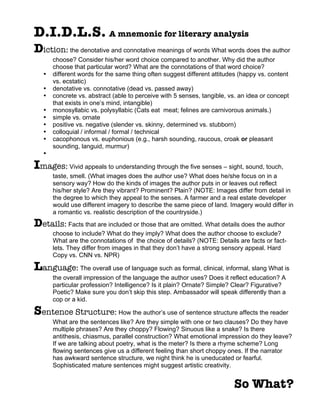
D.I.D.L.S. A mnemonic for literary analysis
Diction: the denotative and connotative meanings of words What words does the author
       choose? Consider his/her word choice compared to another. Why did the author
       choose that particular word? What are the connotations of that word choice?
   •   different words for the same thing often suggest different attitudes (happy vs. content
       vs. ecstatic)
   •   denotative vs. connotative (dead vs. passed away)
   •   concrete vs. abstract (able to perceive with 5 senses, tangible, vs. an idea or concept
       that exists in one’s mind, intangible)
   •   monosyllabic vs. polysyllabic (Cats eat meat; felines are carnivorous animals.)
   •   simple vs. ornate
   •   positive vs. negative (slender vs. skinny, determined vs. stubborn)
   •   colloquial / informal / formal / technical
   •   cacophonous vs. euphonious (e.g., harsh sounding, raucous, croak or pleasant
       sounding, languid, murmur)
   •

Images: Vivid appeals to understanding through the five senses – sight, sound, touch,
       taste, smell. (What images does the author use? What does he/she focus on in a
       sensory way? How do the kinds of images the author puts in or leaves out reflect
       his/her style? Are they vibrant? Prominent? Plain? (NOTE: Images differ from detail in
       the degree to which they appeal to the senses. A farmer and a real estate developer
       would use different imagery to describe the same piece of land. Imagery would differ in
       a romantic vs. realistic description of the countryside.)
Details: Facts that are included or those that are omitted. What details does the author
       choose to include? What do they imply? What does the author choose to exclude?
       What are the connotations of the choice of details? (NOTE: Details are facts or fact-
       lets. They differ from images in that they don’t have a strong sensory appeal. Hard
       Copy vs. CNN vs. NPR)

Language: The overall use of language such as formal, clinical, informal, slang What is
       the overall impression of the language the author uses? Does it reflect education? A
       particular profession? Intelligence? Is it plain? Ornate? Simple? Clear? Figurative?
       Poetic? Make sure you don’t skip this step. Ambassador will speak differently than a
       cop or a kid.

Sentence Structure: How the author’s use of sentence structure affects the reader
       What are the sentences like? Are they simple with one or two clauses? Do they have
       multiple phrases? Are they choppy? Flowing? Sinuous like a snake? Is there
       antithesis, chiasmus, parallel construction? What emotional impression do they leave?
       If we are talking about poetry, what is the meter? Is there a rhyme scheme? Long
       flowing sentences give us a different feeling than short choppy ones. If the narrator
       has awkward sentence structure, we night think he is uneducated or fearful.
       Sophisticated mature sentences might suggest artistic creativity.


                                                                         So What?
S.O.L.L.I.D.D.                           Analyzing rhetorical elements & author’s style
Syntax: Sentence structure
Organization: The structure of sections within a passage and as a whole.Movement in the
         passage between tones, ideas, defining literary/rhetorical strategies
Literary Devices: Metaphor, simile, personification, irony (situational, verbal and dramatic),
         hyperbole, allusion, alliteration, etc.
Levels of Discourse: Cultural levels of language act, with attendant traits (does the
         narrator’s voice represent a particular social, political, or cultural viewpoint or perspective?)
Imagery: Deliberate vivid appeal to the audience’s understanding through the five senses (visual,
         auditory, tactile, olfactory, gustatory)
Diction: Word choice and its denotative and connotative significance
Detail: Descriptive items selected for inclusion. Concrete aspects of the poem or passage. What is
         included; what is omitted
Ingredients
 Poem:                                                   Drama:
     •    Title                                              •   Title
     •    Speaker/Persona/Voice                              •   Speaker
     •    Structure (prosody.verse, stanza,                  •   Structure (plot elements, flashback,
          poetic form)                                           foreshadowing)
     •    Theme (direct/implied)                             •   Theme (direct/implied)
     •    Figures of Speech                                  •   Character (direct/indirect; flat/round;
     •    Symbolism                                              static/dynamic; foil; stereotype)
                                                             •   Setting (staging, props, costumes)
 Fiction/Novel:                                              •   Figures of Speech
     •    Title                                              •   Symbolism
     •    Speaker
     •    Structure (plot elements, flashback,           Essay:
          foreshadowing; fictional form)                     •   Title
     •    Theme (direct/implied)                             •   Speaker
     •    Character (direct/indirect; flat/round;            •   Structure (thesis, introduction,
          static/dynamic; foil; stereotype)                      evidence, conclusion; enumeration,
     •    Setting (integral)                                     chronological, compare/contrast.
     •    Point of View (first/third;                            cause/effect)
          limited/omniscient; major/minor;                   •   Purpose (inform, educate, persuade)
          reliable/näive; stream-of-                         •   Theme (direct/implied)
          consciousness                                      •   Figures of Speech
     •    Figures of Speech                                  •   Rhetorical Devices
     •    Symbolism                                          •   Symbolism
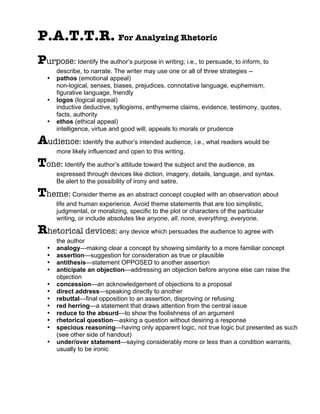
P.A.T.T.R. For Analyzing Rhetoric
Purpose: Identify the author’s purpose in writing; i.e., to persuade, to inform, to
       describe, to narrate. The writer may use one or all of three strategies --
   •   pathos (emotional appeal)
       non-logical, senses, biases, prejudices, connotative language, euphemism,
       figurative language, friendly
   •   logos (logical appeal)
       inductive deductive, syllogisms, enthymeme claims, evidence, testimony, quotes,
       facts, authority
   •   ethos (ethical appeal)
       intelligence, virtue and good will; appeals to morals or prudence

Audience: Identify the author’s intended audience, i.e., what readers would be
       more likely influenced and open to this writing.

Tone: Identify the author’s attitude toward the subject and the audience, as
       expressed through devices like diction, imagery, details, language, and syntax.
       Be alert to the possibility of irony and satire.

Theme: Consider theme as an abstract concept coupled with an observation about
       life and human experience. Avoid theme statements that are too simplistic,
       judgmental, or moralizing, specific to the plot or characters of the particular
       writing, or include absolutes like anyone, all, none, everything, everyone.

Rhetorical devices: any device which persuades the audience to agree with
       the author
   •   analogy—making clear a concept by showing similarity to a more familiar concept
   •   assertion—suggestion for consideration as true or plausible
   •   antithesis—statement OPPOSED to another assertion
   •   anticipate an objection—addressing an objection before anyone else can raise the
       objection
   •   concession—an acknowledgement of objections to a proposal
   •   direct address—speaking directly to another
   •   rebuttal—final opposition to an assertion, disproving or refusing
   •   red herring—a statement that draws attention from the central issue
   •   reduce to the absurd—to show the foolishness of an argument
   •   rhetorical question—asking a question without desiring a response
   •   specious reasoning—having only apparent logic, not true logic but presented as such
       (see other side of handout)
   •   under/over statement—saying considerably more or less than a condition warrants,
       usually to be ironic
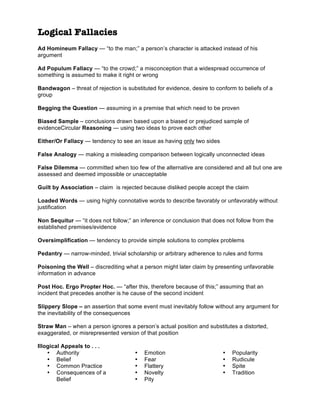
Logical Fallacies
Ad Homineum Fallacy — “to the man;” a person’s character is attacked instead of his
argument

Ad Populum Fallacy — “to the crowd;” a misconception that a widespread occurrence of
something is assumed to make it right or wrong

Bandwagon – threat of rejection is substituted for evidence, desire to conform to beliefs of a
group

Begging the Question — assuming in a premise that which need to be proven

Biased Sample – conclusions drawn based upon a biased or prejudiced sample of
evidenceCircular Reasoning — using two ideas to prove each other

Either/Or Fallacy — tendency to see an issue as having only two sides

False Analogy — making a misleading comparison between logically unconnected ideas

False Dilemma — committed when too few of the alternative are considered and all but one are
assessed and deemed impossible or unacceptable

Guilt by Association – claim is rejected because disliked people accept the claim

Loaded Words — using highly connotative words to describe favorably or unfavorably without
justification

Non Sequitur — “it does not follow;” an inference or conclusion that does not follow from the
established premises/evidence

Oversimplification — tendency to provide simple solutions to complex problems

Pedantry — narrow-minded, trivial scholarship or arbitrary adherence to rules and forms

Poisoning the Well – discrediting what a person might later claim by presenting unfavorable
information in advance

Post Hoc. Ergo Propter Hoc. — “after this, therefore because of this;” assuming that an
incident that precedes another is he cause of the second incident

Slippery Slope – an assertion that some event must inevitably follow without any argument for
the inevitability of the consequences

Straw Man – when a person ignores a person’s actual position and substitutes a distorted,
exaggerated, or misrepresented version of that position

Illogical Appeals to . . .
    • Authority                       •   Emotion                         •   Popularity
    • Belief                          •   Fear                            •   Rudicule
    • Common Practice                 •   Flattery                        •   Spite
    • Consequences of a               •   Novelty                         •   Tradition
        Belief                        •   Pity
Acronyms

Acronyms

  • 1.
    Using TPCASTT for Analysis of Poetry T Title What do the words of the title suggest to you? What denotations are presented in the title? What connotations or associations do the words posses? P Paraphrase Translate the poem in your own words. What is the poem about? C Connotation What meaning does the poem have beyond the literal meaning? Fill in the chart below. Form Diction Imagery Point of View Details Allusions Symbolism Figurative Language Other Devices (antithesis, apostrophe, sound devices, irony, oxymoron, paradox, pun, sarcasm, understatement) A Attitude What is the speaker’s attitude? How does the speaker feel about himself, about others, and about the subject? What is the author’s attitude? How does the author feel about the speaker, about other characters, about the subject, and the reader? S Shifts Where do the shifts in tone, setting, voice, etc. occur? Look for time and place, keywords, punctuation, stanza divisions, changes in length or rhyme, and sentence structure. What is the purpose of each shift? How do they contribute to effect and meaning? T Title Reanalyze the title on an interpretive level. What part does the title play in the overall interpretation of the poem? T Theme List the subjects and the abstract ideas in the poem. Then determine the overall theme. What message is th author trying to convey? What lesson is being taught? The theme must be written in a complete sentence.
  • 2.
    D.U.C.A.T.S. The “6gold pieces” of writer’s voice Diction refers to a writer’s (or speaker’s) word choice with the following considerations: • denotation / connotation • degree of difficulty or complexity of a word • monosyllabic / polysyllabic • abstract / conceret • euphonius / cacophonous • colloquial / formal / informal / technical • tone of a word (the emotional charge a word carries) • the above will often create a subtext for the text Unity refers to the idea that all of the ideas in a written piece are relevant and appropriate to the focus. Some considerations: • each claim (assertion, topic sentence) supports the thesis • each piece of evidence is important and relevant to the focus of the paragraph or the piece of writing as a whole • occasionally, a writer may choose to purposely violate the element of unity for a specific effect (some humorists / satirists will sometimes consciously do this) • it is important to consider what has been omitted from a piece and examine the writer’s intent in doing so Coherence refers to the organization and logic of a piece of writing; some considerations include: • precision and clarity in a thesis and supportive arguments • the arguments ordered in the most effective way for the writer’s intent • the sentences and paragraphs “flow smoothly” for the reader; there should not be any abrupt leaps or gaps in the presentation of the ideas or story (unless the writer makes a conscious choice for a specific and appropriate effect) Audience refers to the writer’s awareness of who will be reading his or her piece of writing; some considerations are: • Who are the targeted readers? • How well informed are they on the subject? What does the writer want the reader to learn as a result of this piece? • What first impression is created for the reader and how does the author’s voice shape this first impression? • How interested and attentive are they likely to be? Will they resist any of the ideas? • What is the relationship between the writer and the reader? Employee to supervisor? Citizen to citizen? Expert to novice? Scholar to scholar? Student to teacher? Student to student? • How much time will the reader be willing to spend reading? • How sophisticated are the readers in regard to vocabulary and syntax? Tone refers to a writer’s ability to create an attitude toward the subject matter of a piece of writing. Whst does that attutude suggest about the author? Te subject? What effect is produced by the writing and how is that effect produced? The tools a writer uses to create tone: • Diction, Figurative language, Characterization, Plot, Theme, Structure Syntax refers to the arrangement--the ordering, grouping, and placement--of words within a phrase, clause, or sentence. Some considerations: • Type of sentence • Length of sentence • Subtle shifts or abrupt changes in sentence length or patterns • Punctuation use • Use of repetition • Language patterns / rhythm / cadence • How all of the above factors contribute to narrative pace • The use of active and/or passive voice
  • 3.
    S.O.A.P.S.Tone – Analyzingpoint of view Speaker: Is there someone identified as the speaker? Can you make some assumptions about this person? What class does the author come from? What political bias can be inferred? What gender? Occasion: What may have prompted the author to write this piece? What event led to its publication or development? Audience: Does the speaker identify an audience? What assumptions can you make about the audience? Is it a mixed in terms of: race, politics, gender, social class, religion, etc.? Who was the document created for? Does the speaker use language that is specific for a unique audience? Does the speaker evoke: Nation? Liberty? God? History? Hell? Does the speaker allude to any particular time in history such as: Ancient Times? Industrial Revolution? World Wars? Vietnam? Purpose: What is the speaker’s purpose? In what ways does the author convey this message? What seems to be the emotional state of the speaker? How is the speaker trying to spark a reaction in the audience? What words or phrases show the speaker’s tone? How is this document supposed to make you feel? Subject: What is the subject of the piece? How do you know this? How has the subject been selected and presented by the author? Tone: What is the author’s attitude toward the subject? How is the writer’s attitude revealed? The tools a writer uses to create are diction, figurative language, characterization, plot, theme, structure
  • 4.
    D.I.D.L.S. A mnemonicfor literary analysis Diction: the denotative and connotative meanings of words What words does the author choose? Consider his/her word choice compared to another. Why did the author choose that particular word? What are the connotations of that word choice? • different words for the same thing often suggest different attitudes (happy vs. content vs. ecstatic) • denotative vs. connotative (dead vs. passed away) • concrete vs. abstract (able to perceive with 5 senses, tangible, vs. an idea or concept that exists in one’s mind, intangible) • monosyllabic vs. polysyllabic (Cats eat meat; felines are carnivorous animals.) • simple vs. ornate • positive vs. negative (slender vs. skinny, determined vs. stubborn) • colloquial / informal / formal / technical • cacophonous vs. euphonious (e.g., harsh sounding, raucous, croak or pleasant sounding, languid, murmur) • Images: Vivid appeals to understanding through the five senses – sight, sound, touch, taste, smell. (What images does the author use? What does he/she focus on in a sensory way? How do the kinds of images the author puts in or leaves out reflect his/her style? Are they vibrant? Prominent? Plain? (NOTE: Images differ from detail in the degree to which they appeal to the senses. A farmer and a real estate developer would use different imagery to describe the same piece of land. Imagery would differ in a romantic vs. realistic description of the countryside.) Details: Facts that are included or those that are omitted. What details does the author choose to include? What do they imply? What does the author choose to exclude? What are the connotations of the choice of details? (NOTE: Details are facts or fact- lets. They differ from images in that they don’t have a strong sensory appeal. Hard Copy vs. CNN vs. NPR) Language: The overall use of language such as formal, clinical, informal, slang What is the overall impression of the language the author uses? Does it reflect education? A particular profession? Intelligence? Is it plain? Ornate? Simple? Clear? Figurative? Poetic? Make sure you don’t skip this step. Ambassador will speak differently than a cop or a kid. Sentence Structure: How the author’s use of sentence structure affects the reader What are the sentences like? Are they simple with one or two clauses? Do they have multiple phrases? Are they choppy? Flowing? Sinuous like a snake? Is there antithesis, chiasmus, parallel construction? What emotional impression do they leave? If we are talking about poetry, what is the meter? Is there a rhyme scheme? Long flowing sentences give us a different feeling than short choppy ones. If the narrator has awkward sentence structure, we night think he is uneducated or fearful. Sophisticated mature sentences might suggest artistic creativity. So What?
  • 5.
    S.O.L.L.I.D.D. Analyzing rhetorical elements & author’s style Syntax: Sentence structure Organization: The structure of sections within a passage and as a whole.Movement in the passage between tones, ideas, defining literary/rhetorical strategies Literary Devices: Metaphor, simile, personification, irony (situational, verbal and dramatic), hyperbole, allusion, alliteration, etc. Levels of Discourse: Cultural levels of language act, with attendant traits (does the narrator’s voice represent a particular social, political, or cultural viewpoint or perspective?) Imagery: Deliberate vivid appeal to the audience’s understanding through the five senses (visual, auditory, tactile, olfactory, gustatory) Diction: Word choice and its denotative and connotative significance Detail: Descriptive items selected for inclusion. Concrete aspects of the poem or passage. What is included; what is omitted Ingredients Poem: Drama: • Title • Title • Speaker/Persona/Voice • Speaker • Structure (prosody.verse, stanza, • Structure (plot elements, flashback, poetic form) foreshadowing) • Theme (direct/implied) • Theme (direct/implied) • Figures of Speech • Character (direct/indirect; flat/round; • Symbolism static/dynamic; foil; stereotype) • Setting (staging, props, costumes) Fiction/Novel: • Figures of Speech • Title • Symbolism • Speaker • Structure (plot elements, flashback, Essay: foreshadowing; fictional form) • Title • Theme (direct/implied) • Speaker • Character (direct/indirect; flat/round; • Structure (thesis, introduction, static/dynamic; foil; stereotype) evidence, conclusion; enumeration, • Setting (integral) chronological, compare/contrast. • Point of View (first/third; cause/effect) limited/omniscient; major/minor; • Purpose (inform, educate, persuade) reliable/näive; stream-of- • Theme (direct/implied) consciousness • Figures of Speech • Figures of Speech • Rhetorical Devices • Symbolism • Symbolism
  • 6.
    P.A.T.T.R. For AnalyzingRhetoric Purpose: Identify the author’s purpose in writing; i.e., to persuade, to inform, to describe, to narrate. The writer may use one or all of three strategies -- • pathos (emotional appeal) non-logical, senses, biases, prejudices, connotative language, euphemism, figurative language, friendly • logos (logical appeal) inductive deductive, syllogisms, enthymeme claims, evidence, testimony, quotes, facts, authority • ethos (ethical appeal) intelligence, virtue and good will; appeals to morals or prudence Audience: Identify the author’s intended audience, i.e., what readers would be more likely influenced and open to this writing. Tone: Identify the author’s attitude toward the subject and the audience, as expressed through devices like diction, imagery, details, language, and syntax. Be alert to the possibility of irony and satire. Theme: Consider theme as an abstract concept coupled with an observation about life and human experience. Avoid theme statements that are too simplistic, judgmental, or moralizing, specific to the plot or characters of the particular writing, or include absolutes like anyone, all, none, everything, everyone. Rhetorical devices: any device which persuades the audience to agree with the author • analogy—making clear a concept by showing similarity to a more familiar concept • assertion—suggestion for consideration as true or plausible • antithesis—statement OPPOSED to another assertion • anticipate an objection—addressing an objection before anyone else can raise the objection • concession—an acknowledgement of objections to a proposal • direct address—speaking directly to another • rebuttal—final opposition to an assertion, disproving or refusing • red herring—a statement that draws attention from the central issue • reduce to the absurd—to show the foolishness of an argument • rhetorical question—asking a question without desiring a response • specious reasoning—having only apparent logic, not true logic but presented as such (see other side of handout) • under/over statement—saying considerably more or less than a condition warrants, usually to be ironic
  • 7.
    Logical Fallacies Ad HomineumFallacy — “to the man;” a person’s character is attacked instead of his argument Ad Populum Fallacy — “to the crowd;” a misconception that a widespread occurrence of something is assumed to make it right or wrong Bandwagon – threat of rejection is substituted for evidence, desire to conform to beliefs of a group Begging the Question — assuming in a premise that which need to be proven Biased Sample – conclusions drawn based upon a biased or prejudiced sample of evidenceCircular Reasoning — using two ideas to prove each other Either/Or Fallacy — tendency to see an issue as having only two sides False Analogy — making a misleading comparison between logically unconnected ideas False Dilemma — committed when too few of the alternative are considered and all but one are assessed and deemed impossible or unacceptable Guilt by Association – claim is rejected because disliked people accept the claim Loaded Words — using highly connotative words to describe favorably or unfavorably without justification Non Sequitur — “it does not follow;” an inference or conclusion that does not follow from the established premises/evidence Oversimplification — tendency to provide simple solutions to complex problems Pedantry — narrow-minded, trivial scholarship or arbitrary adherence to rules and forms Poisoning the Well – discrediting what a person might later claim by presenting unfavorable information in advance Post Hoc. Ergo Propter Hoc. — “after this, therefore because of this;” assuming that an incident that precedes another is he cause of the second incident Slippery Slope – an assertion that some event must inevitably follow without any argument for the inevitability of the consequences Straw Man – when a person ignores a person’s actual position and substitutes a distorted, exaggerated, or misrepresented version of that position Illogical Appeals to . . . • Authority • Emotion • Popularity • Belief • Fear • Rudicule • Common Practice • Flattery • Spite • Consequences of a • Novelty • Tradition Belief • Pity