LIVER FUNCTION TEST
INTRODUCTION
• Liver function tests are blood test that measure different substances
produced by Liver.
• These measurements gives the physician important information about
the overall health of liver and its functioning.
• A liver panel will often measure several substances in one blood
sample, which includes various enzymes, proteins and byproducts.
COMMON LIVER TESTS
• Liver enzymes test. It include alkaline phosphatase (ALP), alanine transaminase (ALT),
aspartate aminotransferase (AST) and gamma-glutamyl transferase (GGT).These are
elevated when there’s liver injury.
• Total protein test. A total protein test measures levels of protein in the blood, liver makes
protein, and low protein levels may indicate that liver isn’t functioning optimally.
• Bilirubin test. Bilirubin is a waste product that liver deposits in bile.
• LDH test. . Lactate dehydrogenase (LDH) is an enzyme found in almost all body’s tissues,
including liver.
• Prothrombin time test.This test measures how long it takes for a sample of blood to clot,
a process that involves proteins that is produced by liver.
• When these tests are all part of a routine blood panel it is called a
COMPREHENSIVE METABOLIC PANEL.
INDICATION
• If patient has liver inflammation (hepatitis).
• Whether the inflammation is alcohol-related or non-alcoholic
(metabolic).
• Whether person has a problem in liver itself or in the bile ducts.
• If liver function is impaired, and if so, how much.
• If bile flow is impaired, and if so, how much.
• Whether medications are affecting liver, and if so, how much.
PROCEDURE
• Patient can have the test at a hospital or a specialized testing facility.
• The healthcare technician will locate the vein in the arm that they’ll use
to draw blood from and then clean the site.
• They will the wrap the arm with a compression band to make veins stick
out. And insert a small needle into the vein and draw blood into a vial.
• The blood sample is send to a lab for analysis.
• As long as the patient doesn’t feeling lightheaded from the blood
drawn, they can go home and resume medications and have something
to eat and drink.
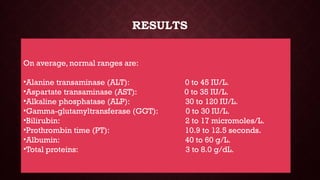
RESULTS
On average, normal ranges are:
•Alanine transaminase (ALT): 0 to 45 IU/L.
•Aspartate transaminase (AST): 0 to 35 IU/L.
•Alkaline phosphatase (ALP): 30 to 120 IU/L.
•Gamma-glutamyltransferase (GGT): 0 to 30 IU/L.
•Bilirubin: 2 to 17 micromoles/L.
•Prothrombin time (PT): 10.9 to 12.5 seconds.
•Albumin: 40 to 60 g/L.
•Total proteins: 3 to 8.0 g/dL.
THANK YOU

LIVER FUNCTION TEST for nursing students.

  • 1.
  • 2.
    INTRODUCTION • Liver functiontests are blood test that measure different substances produced by Liver. • These measurements gives the physician important information about the overall health of liver and its functioning. • A liver panel will often measure several substances in one blood sample, which includes various enzymes, proteins and byproducts.
  • 3.
    COMMON LIVER TESTS •Liver enzymes test. It include alkaline phosphatase (ALP), alanine transaminase (ALT), aspartate aminotransferase (AST) and gamma-glutamyl transferase (GGT).These are elevated when there’s liver injury. • Total protein test. A total protein test measures levels of protein in the blood, liver makes protein, and low protein levels may indicate that liver isn’t functioning optimally. • Bilirubin test. Bilirubin is a waste product that liver deposits in bile. • LDH test. . Lactate dehydrogenase (LDH) is an enzyme found in almost all body’s tissues, including liver. • Prothrombin time test.This test measures how long it takes for a sample of blood to clot, a process that involves proteins that is produced by liver. • When these tests are all part of a routine blood panel it is called a COMPREHENSIVE METABOLIC PANEL.
  • 4.
    INDICATION • If patienthas liver inflammation (hepatitis). • Whether the inflammation is alcohol-related or non-alcoholic (metabolic). • Whether person has a problem in liver itself or in the bile ducts. • If liver function is impaired, and if so, how much. • If bile flow is impaired, and if so, how much. • Whether medications are affecting liver, and if so, how much.
  • 5.
    PROCEDURE • Patient canhave the test at a hospital or a specialized testing facility. • The healthcare technician will locate the vein in the arm that they’ll use to draw blood from and then clean the site. • They will the wrap the arm with a compression band to make veins stick out. And insert a small needle into the vein and draw blood into a vial. • The blood sample is send to a lab for analysis. • As long as the patient doesn’t feeling lightheaded from the blood drawn, they can go home and resume medications and have something to eat and drink.
  • 6.
    RESULTS On average, normalranges are: •Alanine transaminase (ALT): 0 to 45 IU/L. •Aspartate transaminase (AST): 0 to 35 IU/L. •Alkaline phosphatase (ALP): 30 to 120 IU/L. •Gamma-glutamyltransferase (GGT): 0 to 30 IU/L. •Bilirubin: 2 to 17 micromoles/L. •Prothrombin time (PT): 10.9 to 12.5 seconds. •Albumin: 40 to 60 g/L. •Total proteins: 3 to 8.0 g/dL.
  • 7.