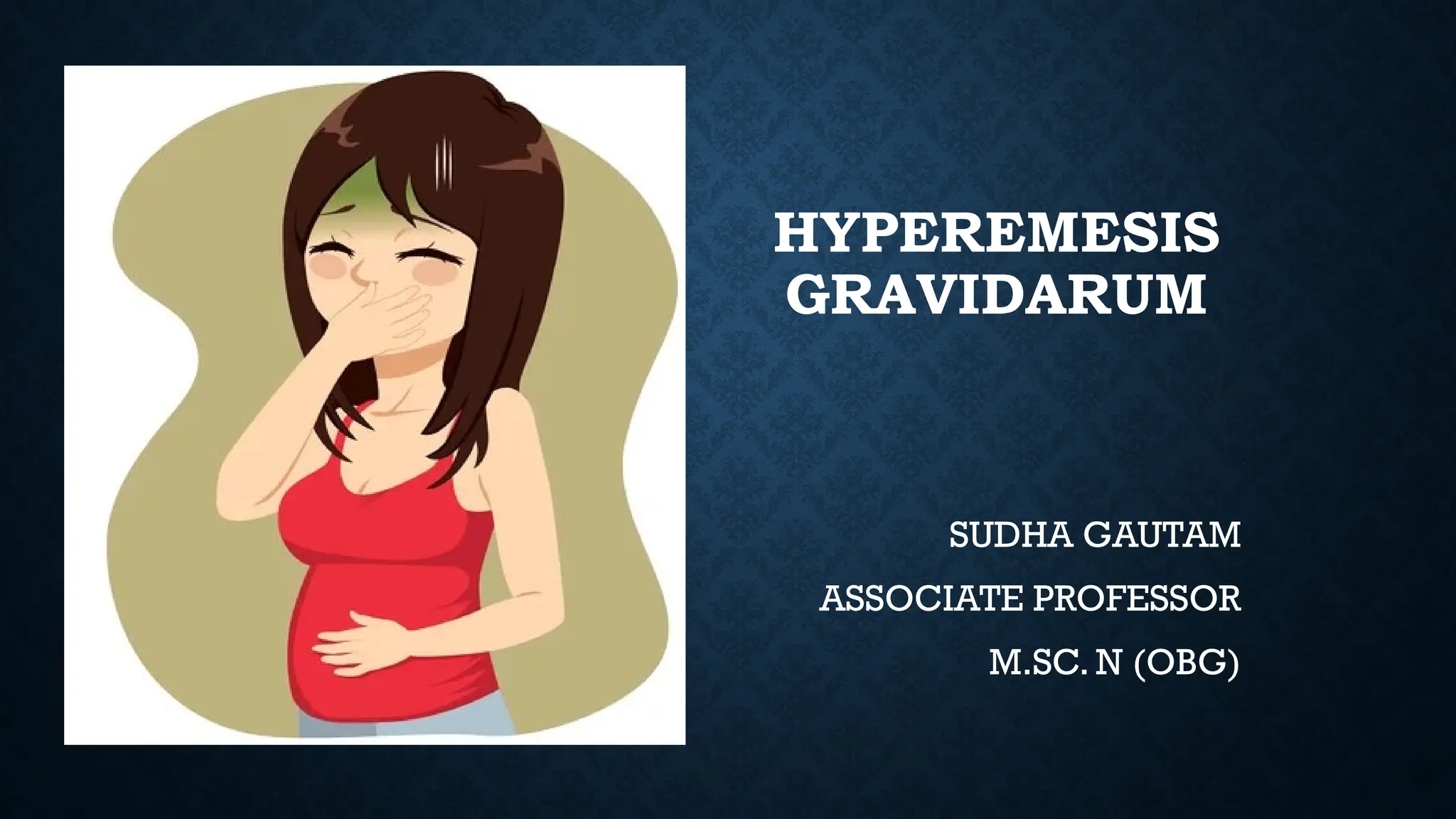
HYPEREMESIS
GRAVIDARUM
SUDHA GAUTAM
ASSOCIATE PROFESSOR
M.SC. N (OBG)
DEFINITION
• Hyperemesis gravidarum or Pernicious Vomiting is extreme, persistent nausea and
vomiting during pregnancy which can lead to dehydration, weight loss, electrolyte
imbalances and may have adverse fetal consequences.
• It is a severe type of vomiting of pregnancy which has got deleterious effect on the
health of the patient and / or incapacitates her day to day activities.
- D. C. Dutta
HYPER – INCREASED/ EXCESSIVE
EMESIS – VOMIT
GRAVIDARUM - PREGNANCY
• .
MORNING SICKNESS
• Morning sickness is mild nausea and vomiting that occurs in
early pregnancy and affects most women to some extent.
• Begins early in pregnancy , mostly between 4th
and 7th
week
and subsides by 12 to 14 weeks.
• Irrespective of the name it can occur during any time of the
day and night.
ETIOLOGY
• Abnormal upsurge in the pregnancy hormones – HCG
• Rise in Estrogen and Progesterone leading to nausea and digestive
issues.
• Family history
• Can reoccur in subsequent pregnancy if once she has suffered with the
problem.
• Hydatidiform mole / Molar pregnancy
• Multiple pregnancy
• More common in unplanned pregnancy
ETIOLOGY (CONTINUED)
• Early primigravida (age <17 years)
• Elderly primigravida (age >35 years)
• Psychological factors like marital problems or unmarried
mother or teenage pregnancy
SUGGESTED THEORIES FOR HG
A. HORMONAL THEORY:
 High levels of HCG – Molar pregnancy, multiple pregnancy
 Increased levels of Estrogen
 High progesterone which leads to relaxation of cardiac sphincter
 Other hormones:Thyroxine, Prolactin, Leptin, Adeno- cortisol
hormones.
THEORIES ( CONTINUED)
B. PSYCHOGENIC THEORY :
 Nausea gets aggravated once neurogenic elements are triggered.
C. DIETARY DEFICIENCY:
 When a woman stays a night without food, the low carbohydrate
reserve in her body and its increasing demand over time by her
body and the fetus can lead to HG.
 Deficiency of Vitamin B1, B6 and Protein may be the effect rather
than the cause.
THEORIES ( CONTINUED)
D. Allergic or Immunological Basis
E. Decrease gastric motility can lead to increased nausea.
CLINICAL COURSE
• EARLY – Vomiting through out the day
Daily activities are disturbed
No evidence of dehydration and starvation
 LATE – Evidenced by dehydration and starvation
Weight loss
SYMPTOMS
• Excess vomiting and retching day and night
• Epigastric pain
• Constipation
• Ptyalism
• Fatigue
• Anorexia
• Dehydration & Ketoacidosis
SYMPTOMS ( CONTINUED)
• Dry coated tongue
• Sunken eyes
• Acetone smell in breath
• Tachycardia
• Postural hypertension
LAB INVESTIGATION
• URINANALYSIS – For analysis of ketones and specific gravity ( a sign of
starvation, ketones may be harmful for fetal development and high
specific gravity occurs with volume depletion).
• SERUM ELECTROLYTES AND KETONES – To evaluate low potassium
or sodium or chloride (to identify hyperchloremic metabolic alkalosis
or acidosis and evaluate renal function and volume status).
• LIVER ENZYMES AND BILIRUBIN – Elevated liver enzymes as a sign
of underlying liver condition such as hepatitis, liver injury.
• AMYLASE/ LIPASE ESTIMATION, TSH AND FREE THYROXINE
may suggest overt hyperthyroidism which is often associated with HG.
• OTHERS : Opthalmic examination for retinal detachment and ECG
DIAGNOSIS
• Pregnancy should be confirmed first.
• Differential Diagnosis should be done to find the associated
causes of vomiting like Gynecological or Medical Or
Surgical Causes.
• USG – Pregnancy, Multiple Pregnancy, Hydatidiform mole
COMPLICATIONS
• NEUROLOGICAL - Wernicke’s encephalopathy d/t thiamine def.
Peripheral Neuritis
Psychosis
Retinal Hemorrhage
Convulsion
Coma
• OTHER’S - Stress ulcer in stomach
Oesophageal Tear
Jaundice d/t Liver Damage
PREVENTION
• Although there are no known ways to completely prevent
hyperemesis gravidarum, the following measures might help
keep morning sickness from becoming severe:
• Eating small, frequent meals.
• Eating bland foods.
• Waiting until nausea has improved before taking iron
supplements
MANAGEMENT
• PRINCIPLES: To control vomiting
To correct fluid and electrolyte imbalance
To correct Metabolic disturbance
To prevent serious complication of severe
vomiting
HOSPITALIZATION
• Admit the patient
• Administer IV Fluids and electrolytes to correct the imbalances.
• Send for relevant investigations
• Maintain intake- output chart
• Monitor urine output ( catheterize the patient)
• Monitor the vitals.
• Periodical urine test should be done to check for presence and
concentration of ketone bodies.
FLUIDS
• Oral feeding is withheld for at least 24 hours after the cessation of vomiting
• During this period, fluid given through IV drip method
• The amount of fluid to be infused in 24 hours is calculated as: total amount
of fluid approx. 3litres, of which half is 5% is dextrose and half is Ringer’s
solution.
• Extra amount of 5% dextrose equal to the amount of vomitus and urine in
24 hours, is to be added.
• These measures help to correct dehydration, electrolyte imbalance and
keto-acidosis.
DRUGS
• Antiemetics such as:
 Vitamin B6 + Doxylamine
 Promethazine
 Prochlorperazine
 Chlorpromazine
 Triflupromazine
 Meclozine HCl
 Metoclopramide
 D2 Antagonist
 Given parenterally H1 Antihistaminics
DRUGS (CONTINUED)
• Vitamin supplements like Vitamin B1,Vitamin B6,Vitamin C
and Vitamin B12 may be given
• Hydrocortisone in cases of hypotension or intractable (hard
to heal) vomiting.
• Oral Prednisolone is also useful is severe cases.
NURSING CARE
• Sympathetic but firm handling of patient
• Daily monitoring of the patient
• Look for signs of improvement in the patient: subsidence of
vomiting, feeling hungry, better look, disappearance of
acetone from breath and urine, normal pulse and blood
pressure, normal urine output.
DIET
• Before IV fluids are omitted, food is given orally
• Small and frequent dry meals without fat
• Biscuit, bread and toast
• Ginger is helpful
• Gradually full diet is restored
REFERENCES
1. Williams Obstetrics, 24th Edition
2. DC Dutta’s Textbook of Obstetrics, 7th Edition
THANK YOU

Hyperemesis gravidarum.pptx for Nursing Students

  • 1.
  • 2.
    DEFINITION • Hyperemesis gravidarumor Pernicious Vomiting is extreme, persistent nausea and vomiting during pregnancy which can lead to dehydration, weight loss, electrolyte imbalances and may have adverse fetal consequences. • It is a severe type of vomiting of pregnancy which has got deleterious effect on the health of the patient and / or incapacitates her day to day activities. - D. C. Dutta HYPER – INCREASED/ EXCESSIVE EMESIS – VOMIT GRAVIDARUM - PREGNANCY • .
  • 3.
    MORNING SICKNESS • Morningsickness is mild nausea and vomiting that occurs in early pregnancy and affects most women to some extent. • Begins early in pregnancy , mostly between 4th and 7th week and subsides by 12 to 14 weeks. • Irrespective of the name it can occur during any time of the day and night.
  • 4.
    ETIOLOGY • Abnormal upsurgein the pregnancy hormones – HCG • Rise in Estrogen and Progesterone leading to nausea and digestive issues. • Family history • Can reoccur in subsequent pregnancy if once she has suffered with the problem. • Hydatidiform mole / Molar pregnancy • Multiple pregnancy • More common in unplanned pregnancy
  • 5.
    ETIOLOGY (CONTINUED) • Earlyprimigravida (age <17 years) • Elderly primigravida (age >35 years) • Psychological factors like marital problems or unmarried mother or teenage pregnancy
  • 6.
    SUGGESTED THEORIES FORHG A. HORMONAL THEORY:  High levels of HCG – Molar pregnancy, multiple pregnancy  Increased levels of Estrogen  High progesterone which leads to relaxation of cardiac sphincter  Other hormones:Thyroxine, Prolactin, Leptin, Adeno- cortisol hormones.
  • 7.
    THEORIES ( CONTINUED) B.PSYCHOGENIC THEORY :  Nausea gets aggravated once neurogenic elements are triggered. C. DIETARY DEFICIENCY:  When a woman stays a night without food, the low carbohydrate reserve in her body and its increasing demand over time by her body and the fetus can lead to HG.  Deficiency of Vitamin B1, B6 and Protein may be the effect rather than the cause.
  • 8.
    THEORIES ( CONTINUED) D.Allergic or Immunological Basis E. Decrease gastric motility can lead to increased nausea.
  • 9.
    CLINICAL COURSE • EARLY– Vomiting through out the day Daily activities are disturbed No evidence of dehydration and starvation  LATE – Evidenced by dehydration and starvation Weight loss
  • 10.
    SYMPTOMS • Excess vomitingand retching day and night • Epigastric pain • Constipation • Ptyalism • Fatigue • Anorexia • Dehydration & Ketoacidosis
  • 11.
    SYMPTOMS ( CONTINUED) •Dry coated tongue • Sunken eyes • Acetone smell in breath • Tachycardia • Postural hypertension
  • 12.
    LAB INVESTIGATION • URINANALYSIS– For analysis of ketones and specific gravity ( a sign of starvation, ketones may be harmful for fetal development and high specific gravity occurs with volume depletion). • SERUM ELECTROLYTES AND KETONES – To evaluate low potassium or sodium or chloride (to identify hyperchloremic metabolic alkalosis or acidosis and evaluate renal function and volume status). • LIVER ENZYMES AND BILIRUBIN – Elevated liver enzymes as a sign of underlying liver condition such as hepatitis, liver injury. • AMYLASE/ LIPASE ESTIMATION, TSH AND FREE THYROXINE may suggest overt hyperthyroidism which is often associated with HG. • OTHERS : Opthalmic examination for retinal detachment and ECG
  • 13.
    DIAGNOSIS • Pregnancy shouldbe confirmed first. • Differential Diagnosis should be done to find the associated causes of vomiting like Gynecological or Medical Or Surgical Causes. • USG – Pregnancy, Multiple Pregnancy, Hydatidiform mole
  • 14.
    COMPLICATIONS • NEUROLOGICAL -Wernicke’s encephalopathy d/t thiamine def. Peripheral Neuritis Psychosis Retinal Hemorrhage Convulsion Coma • OTHER’S - Stress ulcer in stomach Oesophageal Tear Jaundice d/t Liver Damage
  • 15.
    PREVENTION • Although thereare no known ways to completely prevent hyperemesis gravidarum, the following measures might help keep morning sickness from becoming severe: • Eating small, frequent meals. • Eating bland foods. • Waiting until nausea has improved before taking iron supplements
  • 16.
    MANAGEMENT • PRINCIPLES: Tocontrol vomiting To correct fluid and electrolyte imbalance To correct Metabolic disturbance To prevent serious complication of severe vomiting
  • 17.
    HOSPITALIZATION • Admit thepatient • Administer IV Fluids and electrolytes to correct the imbalances. • Send for relevant investigations • Maintain intake- output chart • Monitor urine output ( catheterize the patient) • Monitor the vitals. • Periodical urine test should be done to check for presence and concentration of ketone bodies.
  • 18.
    FLUIDS • Oral feedingis withheld for at least 24 hours after the cessation of vomiting • During this period, fluid given through IV drip method • The amount of fluid to be infused in 24 hours is calculated as: total amount of fluid approx. 3litres, of which half is 5% is dextrose and half is Ringer’s solution. • Extra amount of 5% dextrose equal to the amount of vomitus and urine in 24 hours, is to be added. • These measures help to correct dehydration, electrolyte imbalance and keto-acidosis.
  • 19.
    DRUGS • Antiemetics suchas:  Vitamin B6 + Doxylamine  Promethazine  Prochlorperazine  Chlorpromazine  Triflupromazine  Meclozine HCl  Metoclopramide  D2 Antagonist  Given parenterally H1 Antihistaminics
  • 20.
    DRUGS (CONTINUED) • Vitaminsupplements like Vitamin B1,Vitamin B6,Vitamin C and Vitamin B12 may be given • Hydrocortisone in cases of hypotension or intractable (hard to heal) vomiting. • Oral Prednisolone is also useful is severe cases.
  • 21.
    NURSING CARE • Sympatheticbut firm handling of patient • Daily monitoring of the patient • Look for signs of improvement in the patient: subsidence of vomiting, feeling hungry, better look, disappearance of acetone from breath and urine, normal pulse and blood pressure, normal urine output.
  • 22.
    DIET • Before IVfluids are omitted, food is given orally • Small and frequent dry meals without fat • Biscuit, bread and toast • Ginger is helpful • Gradually full diet is restored
  • 23.
    REFERENCES 1. Williams Obstetrics,24th Edition 2. DC Dutta’s Textbook of Obstetrics, 7th Edition
  • 24.