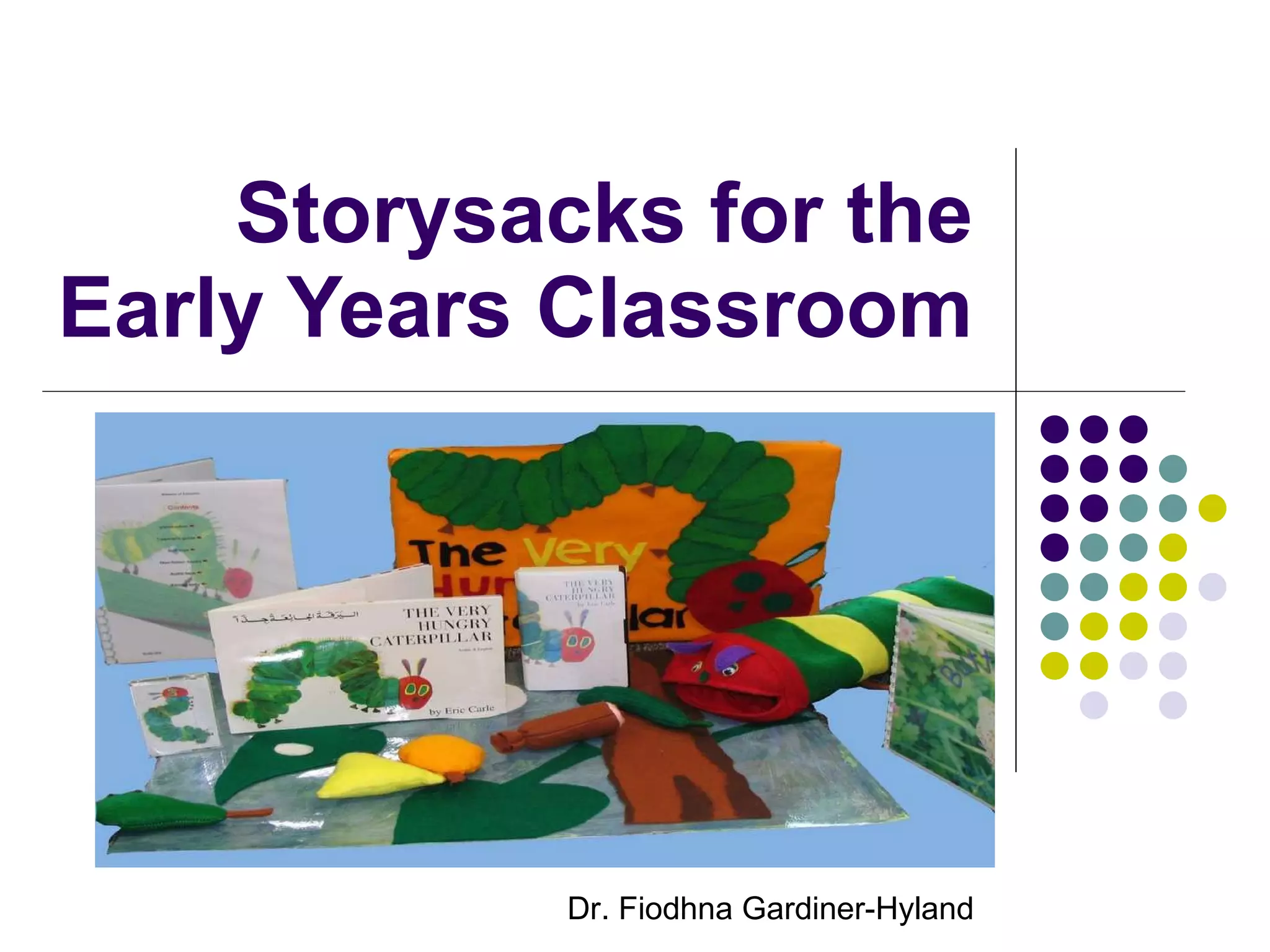
Storysacks for the Early Years Classroom Dr. Fiodhna Gardiner-Hyland
WALT? Benefits of using storysacks with young children Identifying pre-, while- and post- shared reading activities for a chosen storysack
1. Literacy Rich Environment Children should experience times and places to simply enjoy literature. This develops a positive attitude to literacy (Neuman et al, 2000). Discuss the above in pairs.
What makes a literacy-rich environment? Reading corner Story time Literacy Centre – reading and writing area Dramatic play area –  containing literacy related props, lists, notes, menus Listening Centre – accompanying book, tape and headphones Games Special events, e.g. book week, character parade Home-school links, e.g. storysacks project In pairs, discuss other ideas you may have.
What is a Storysack? Bag + Book + Toys + Activities =Storysack
What goes into a Storysack? Storybook Soft toys of the main characters (or masks, puppets, wooden/plastic characters, finger puppets) Props and scenery  A non-fiction book  An audio tape  A language game based on the book A “prompt card” with ideas for activities
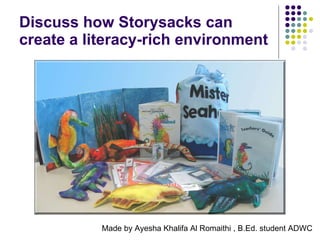
Discuss how Storysacks can create a literacy-rich environment Made by Ayesha Khalifa Al Romaithi , B.Ed. student ADWC
Story sacks… Motivate and excite children about reading Are visually attractive and tactile Encourage active participation in reading Create a safe environment for young learners Provide fun and enjoyment Stimulate language development Develop home-school links
Using a storysack to read aloud Children can  sit back and hear the flow and rhythm and magic of good literature  without having to struggle with the text themselves” (Combs,1996, p.144). Through read-alouds, EFL children are provided a “ model  of what oral reading sounds like”.
Tips for using storysacks…  Discuss exciting incidents, funny characters. Dramatize the story where possible, using song, mine, puppets or props.  Personalize the story by adding children’s names Read and re-read stories that interest the children. Make the reading session short. Show your own enjoyment!
Something to try: Make your own story sack! Start with a bag Pick a story Fill your story sack with supporting materials, such as puppets, soft toys of the main characters and a game to stimulate reading/language skills.
Create a library of storysacks Include children’s favourite stories Involve children in making storysacks Make non-fiction storysacks or curiosity kits Engage in paired reading with older children Use storysacks to involve parents in reading at home
Audience Activity Using Hyland’s (2005, p.24) ‘Sample activities for using storysacks in a Shared Reading lesson’, choose pre-, while- and post-reading activities to match your core storybook for next week.
References Combs (1996), in Soderman, A.K., Gregory, K.M. and O’ Neill, L.T. (1999) Scaffolding emergent literacy: a child-centred approach for preschool through grade 5, Allyn & Bacon publications.  Griffiths, N. (2001) Once upon a time…  Literacy Today  No.26, p.9 Hyland, F.(2005) Using storysacks during shared reading in the EFL classroom, in Classroom Connections, pp.23-25, HCT Press. Neuman S., Copples C. & Bredekamp S. (2000) Learning to Read and Write, National Assoc. for the Education of Young Children.  www.storysack.com   www.literacytrust.org.uk/socialinclusion/earlyyears/storysackspractice.html

Storysacks For The Early Years Classroom

  • 1.
    Storysacks for theEarly Years Classroom Dr. Fiodhna Gardiner-Hyland
  • 2.
    WALT? Benefits ofusing storysacks with young children Identifying pre-, while- and post- shared reading activities for a chosen storysack
  • 3.
    1. Literacy RichEnvironment Children should experience times and places to simply enjoy literature. This develops a positive attitude to literacy (Neuman et al, 2000). Discuss the above in pairs.
  • 4.
    What makes aliteracy-rich environment? Reading corner Story time Literacy Centre – reading and writing area Dramatic play area – containing literacy related props, lists, notes, menus Listening Centre – accompanying book, tape and headphones Games Special events, e.g. book week, character parade Home-school links, e.g. storysacks project In pairs, discuss other ideas you may have.
  • 5.
    What is aStorysack? Bag + Book + Toys + Activities =Storysack
  • 6.
    What goes intoa Storysack? Storybook Soft toys of the main characters (or masks, puppets, wooden/plastic characters, finger puppets) Props and scenery A non-fiction book An audio tape A language game based on the book A “prompt card” with ideas for activities
  • 7.
    Discuss how Storysackscan create a literacy-rich environment Made by Ayesha Khalifa Al Romaithi , B.Ed. student ADWC
  • 8.
    Story sacks… Motivateand excite children about reading Are visually attractive and tactile Encourage active participation in reading Create a safe environment for young learners Provide fun and enjoyment Stimulate language development Develop home-school links
  • 9.
    Using a storysackto read aloud Children can sit back and hear the flow and rhythm and magic of good literature without having to struggle with the text themselves” (Combs,1996, p.144). Through read-alouds, EFL children are provided a “ model of what oral reading sounds like”.
  • 10.
    Tips for usingstorysacks… Discuss exciting incidents, funny characters. Dramatize the story where possible, using song, mine, puppets or props. Personalize the story by adding children’s names Read and re-read stories that interest the children. Make the reading session short. Show your own enjoyment!
  • 11.
    Something to try:Make your own story sack! Start with a bag Pick a story Fill your story sack with supporting materials, such as puppets, soft toys of the main characters and a game to stimulate reading/language skills.
  • 12.
    Create a libraryof storysacks Include children’s favourite stories Involve children in making storysacks Make non-fiction storysacks or curiosity kits Engage in paired reading with older children Use storysacks to involve parents in reading at home
  • 13.
    Audience Activity UsingHyland’s (2005, p.24) ‘Sample activities for using storysacks in a Shared Reading lesson’, choose pre-, while- and post-reading activities to match your core storybook for next week.
  • 14.
    References Combs (1996),in Soderman, A.K., Gregory, K.M. and O’ Neill, L.T. (1999) Scaffolding emergent literacy: a child-centred approach for preschool through grade 5, Allyn & Bacon publications. Griffiths, N. (2001) Once upon a time… Literacy Today No.26, p.9 Hyland, F.(2005) Using storysacks during shared reading in the EFL classroom, in Classroom Connections, pp.23-25, HCT Press. Neuman S., Copples C. & Bredekamp S. (2000) Learning to Read and Write, National Assoc. for the Education of Young Children. www.storysack.com www.literacytrust.org.uk/socialinclusion/earlyyears/storysackspractice.html