DAU KALYAN SINGH COLLEGE OF AGRICULTURE
AND RESEARCH STATION, BHATAPARA
Course Title : Communication skills and Personality
Development
Course code : AEXT 5321
TOPIC : Listening and Note taking
Guided By :
Dr. Rajesh Kumar Sahu
Submitted By :
Anchal Gupta
B.Sc. Agri.
3rd
Year 2nd
Sem
Listening
Meaning
Listening is giving attention at a sound.
Definition
The process of receiving, constructing meaning from and responding to or non verbal
messages, to hear something with thoughtful attention.
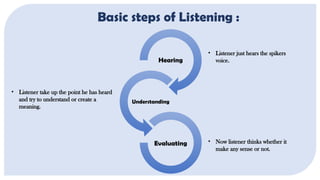
Basic steps of Listening :
Hearing
Understanding
Evaluating
• Listener just hears the spikers
voice.
• Listener take up the point he has heard
and try to understand or create a
meaning.
• Now listener thinks whether it
make any sense or not.
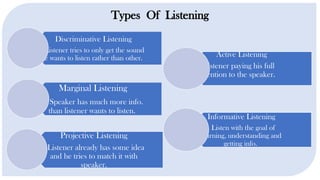
Discriminative Listening
. Listener tries to only get the sound
he wants to listen rather than other.
Marginal Listening
. Speaker has much more info.
than listener wants to listen.
Projective Listening
. Listener already has some idea
and he tries to match it with
speaker.
Types Of Listening
Active Listening
. Listener paying his full
attention to the speaker.
Informative Listening
. Listen with the goal of
learning, understanding and
getting info.
Notes taking
Meaning
The process of recording information from different sources and platforms n non-verbal form.
Taking notes involves active listening, as well as connecting and relating information to Idea you already know.
It also involves seeking answers to questions that arise from the material.
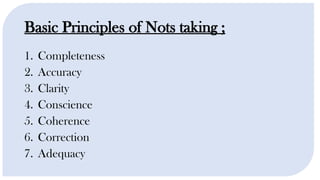
Basic Principles of Nots taking ;
1. Completeness
2. Accuracy
3. Clarity
4. Conscience
5. Coherence
6. Correction
7. Adequacy
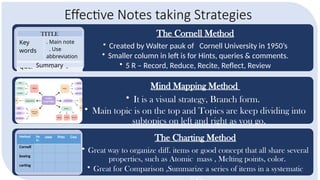
Effective Notes taking Strategies
The Cornell Method
• Created by Walter pauk of Cornell University in 1950’s
• Smaller column in left is for Hints, queries & comments.
• 5 R – Record, Reduce, Recite, Reflect, Review
Mind Mapping Method
• It is a visual strategy, Branch form.
• Main topic is on the top and Topics are keep dividing into
subtopics on left and right as you go.
The Charting Method
• Great way to organize diff. items or good concept that all share several
properties, such as Atomic mass , Melting points, color.
• Great for Comparison ,Summarize a series of items in a systematic
way.
Key
words
. Main note
. Use
abbreviation
Que. Key thoughts
Summary
TITLE
Method De
sc.
uses Pros Cou
Cornell
boxing
carting
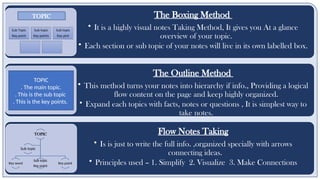
The Boxing Method
• It is a highly visual notes Taking Method, It gives you At a glance
overview of your topic.
• Each section or sub topic of your notes will live in its own labelled box.
The Outline Method
• This method turns your notes into hierarchy if info., Providing a logical
flow content on the page and keep highly organized.
• Expand each topics with facts, notes or questions , It is simplest way to
take notes.
Flow Notes Taking
• Is is just to write the full info. ,organized specially with arrows
connecting ideas.
• Principles used – 1. Simplify 2. Visualize 3. Make Connections
TOPIC
TOPIC
Key word
Sub topic
Key point
Key point
Sub topic
TOPIC
. The main topic.
. This is the sub topic
. This is the key points.
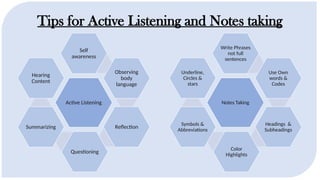
Tips for Active Listening and Notes taking
Active Listening
Self
awareness
Observing
body
language
Reflection
Questioning
Summarizing
Hearing
Content
Notes Taking
Write Phrases
not full
sentences
Use Own
words &
Codes
Headings &
Subheadings
Color
Highlights
Symbols &
Abbreviations
Underline,
Circles &
stars
Thankyou !

Listening And Note taking ..........pptx

  • 1.
    DAU KALYAN SINGHCOLLEGE OF AGRICULTURE AND RESEARCH STATION, BHATAPARA Course Title : Communication skills and Personality Development Course code : AEXT 5321 TOPIC : Listening and Note taking Guided By : Dr. Rajesh Kumar Sahu Submitted By : Anchal Gupta B.Sc. Agri. 3rd Year 2nd Sem
  • 2.
    Listening Meaning Listening is givingattention at a sound. Definition The process of receiving, constructing meaning from and responding to or non verbal messages, to hear something with thoughtful attention.
  • 3.
    Basic steps ofListening : Hearing Understanding Evaluating • Listener just hears the spikers voice. • Listener take up the point he has heard and try to understand or create a meaning. • Now listener thinks whether it make any sense or not.
  • 4.
    Discriminative Listening . Listenertries to only get the sound he wants to listen rather than other. Marginal Listening . Speaker has much more info. than listener wants to listen. Projective Listening . Listener already has some idea and he tries to match it with speaker. Types Of Listening Active Listening . Listener paying his full attention to the speaker. Informative Listening . Listen with the goal of learning, understanding and getting info.
  • 5.
    Notes taking Meaning The processof recording information from different sources and platforms n non-verbal form. Taking notes involves active listening, as well as connecting and relating information to Idea you already know. It also involves seeking answers to questions that arise from the material.
  • 6.
    Basic Principles ofNots taking ; 1. Completeness 2. Accuracy 3. Clarity 4. Conscience 5. Coherence 6. Correction 7. Adequacy
  • 7.
    Effective Notes takingStrategies The Cornell Method • Created by Walter pauk of Cornell University in 1950’s • Smaller column in left is for Hints, queries & comments. • 5 R – Record, Reduce, Recite, Reflect, Review Mind Mapping Method • It is a visual strategy, Branch form. • Main topic is on the top and Topics are keep dividing into subtopics on left and right as you go. The Charting Method • Great way to organize diff. items or good concept that all share several properties, such as Atomic mass , Melting points, color. • Great for Comparison ,Summarize a series of items in a systematic way. Key words . Main note . Use abbreviation Que. Key thoughts Summary TITLE Method De sc. uses Pros Cou Cornell boxing carting
  • 8.
    The Boxing Method •It is a highly visual notes Taking Method, It gives you At a glance overview of your topic. • Each section or sub topic of your notes will live in its own labelled box. The Outline Method • This method turns your notes into hierarchy if info., Providing a logical flow content on the page and keep highly organized. • Expand each topics with facts, notes or questions , It is simplest way to take notes. Flow Notes Taking • Is is just to write the full info. ,organized specially with arrows connecting ideas. • Principles used – 1. Simplify 2. Visualize 3. Make Connections TOPIC TOPIC Key word Sub topic Key point Key point Sub topic TOPIC . The main topic. . This is the sub topic . This is the key points.
  • 9.
    Tips for ActiveListening and Notes taking Active Listening Self awareness Observing body language Reflection Questioning Summarizing Hearing Content Notes Taking Write Phrases not full sentences Use Own words & Codes Headings & Subheadings Color Highlights Symbols & Abbreviations Underline, Circles & stars
  • 10.