Week 2
Week 2 day 1 objectives: Study
past simple and present perfect,
learn presentation skills, practice
listening skills.
• favorite /‘feɪvrɪt/
• mountain /‘maʊntɪn/
• climate /ˈklaɪmɪt/
• live /lɪv/
• patient /ˈpeɪʃənt/
• communicate /kəˈmjuːnɪˌkeɪt/
• punctual /ˈpʌŋktjʊəl/
• organization /ɔːɡənaɪˈzeɪʃən/
• tourism /ˈtʊərɪzəm/
• should /ʃʊd/
• construction /kənˈstrʌkʃən/
• future /ˈfjuːtʃər/
• study /ˈstʌdɪ/
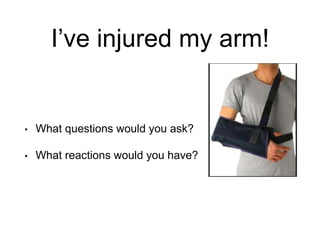
I’ve injured my arm!
• What questions would you ask?
• What reactions would you have?
Mingle! Find someone
who…
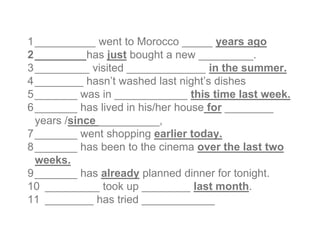
1__________ went to Morocco _____ years ago
2________ has just bought a new _________.
3_________ visited _____________ in the summer.
4________ hasn’t washed last night’s dishes
5_______ was in ____________ this time last week.
6_______ has lived in his/her house for ________
years /since __________,
7_______ went shopping earlier today.
8_______ has been to the cinema over the last two
weeks.
9_______ has already planned dinner for tonight.
10 _________ took up ________ last month.
11 ________ has tried ____________
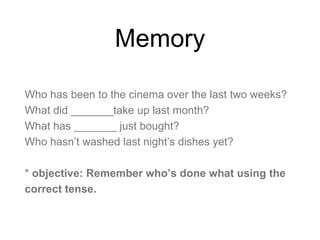
Memory
Who has been to the cinema over the last two weeks?
What did _______take up last month?
What has _______ just bought?
Who hasn’t washed last night’s dishes yet?
* objective: Remember who’s done what using the
correct tense.
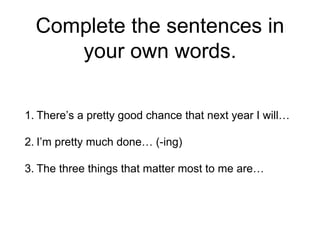
Complete the sentences in
your own words.
1. There’s a pretty good chance that next year I will…
2. I’m pretty much done… (-ing)
3. The three things that matter most to me are…
Socializing
In small groups discuss this
question
If you’re listening to spoken English, what do you find
most difficult?
• the speaker’s accent
• the speed at which he/she is speaking
• the words he/she uses
Look at the strategies for dealing with
accents. Rank them in order of the ones you
prefer (1=best strategy, 6=worst strategy)
• Ask the speaker to talk more slowly
• Ask the speaker to repeat wha he/she said
• Check that you understand by saying things like “Are you
saying…?”
• Interrupt and ask questions to slow the speaker down.
• Listen to English radio on the internet
• Watch English-language films.
Are there any other strategies you would use?
If you were meeting a group of business
people for the first time in a social setting,
e.g. in the bar of a hotel or restaurant at a
conference, what subjects would you
discuss in the first half hour?
Listen and complete
exercise D
Which person was easier
to understand? Why?
Listen again and answer
questions for ex E
Role play
Week 2 day 2 objectives: Review
present perfect and past simple,
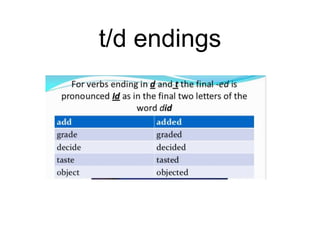
practice pronunciation of “ed” endings,
look at presentation strategies
Introductions!
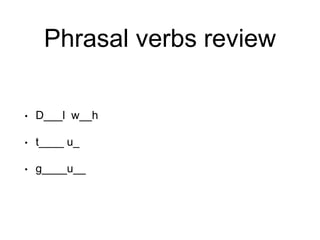
Phrasal verbs review
• D___l w__h
• t____ u_
• g____u__
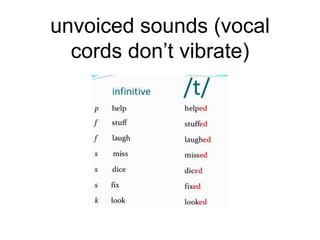
unvoiced sounds (vocal
cords don’t vibrate)
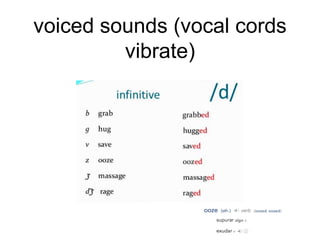
voiced sounds (vocal cords
vibrate)
t/d endings
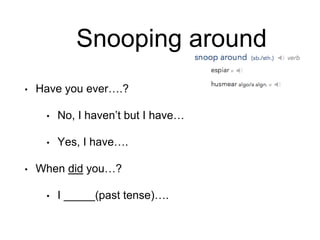
Snooping around
• Have you ever….?
• No, I haven’t but I have…
• Yes, I have….
• When did you…?
• I _____(past tense)….
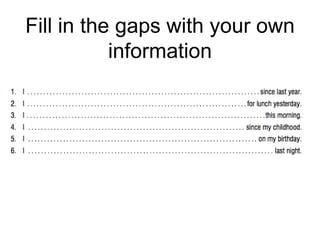
Fill in the gaps with your own
information
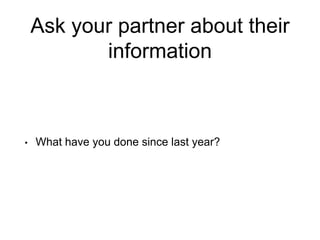
Ask your partner about their
information
• What have you done since last year?
Critical Thinking
On Friday we watched a presentation. Read the
conclusion of Mark’s presentation. How did he get
his message across?
“Don’t wait until you make your first million to make a
difference in somebody life. If you have something to give, give it
now”
A. with different examples
B. with visuals/ pictures
C. with a simple story
Presentation Skills
• What kind of person do you think an audience likes
to see giving a presentation: a confident person, a
knowledgeable person, a funny person, or a sincere
person?
• Which characteristic is the most interesting to you?
• What tips would you give to someone doing a
presentation?
Presentation Tips
1. Write your talk yourself. Use words and expressions that
you would normally use so that your words show your
personality
2. Speak from the heart. Talk about things you know about
and believe in.
3. Don’t worry if you are nervous. An audience sometimes
warms more to someone who is nervous than full of
confidence. They want you to succeed.
4. Relax your body. Try to move and gesture as you normally
do.
Presentation (in pairs)
• You are going to give a two minute mini-
presentation. Make some notes to present what you
do for a living and/or what you are studying. Explain
some surprising things about your job or studies-
what people may not know about it- and/or the
aspects of your job you like or dislike.
Work in pairs. Give your
presentation. Use the advice from
the Presentation tips box and be
yourself.
• Write down 5 words or phrases you have learned in
the past 3 days.
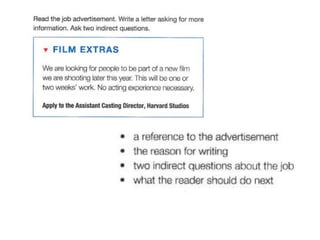
Week 2 day 3 objectives: Look at some typical
quick responses, Study indirect questions for
formal writing
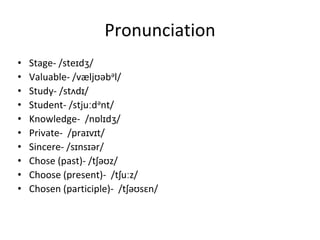
Pronunciation
• Stage- /steɪdʒ/
• Valuable- /væljʊəbəl/
• Study- /stʌdɪ/
• Student- /stjuːdənt/
• Knowledge- /nɒlɪdʒ/
• Private- /praɪvɪt/
• Sincere- /sɪnsɪər/
• Chose (past)- /tʃəʊz/
• Choose (present)- /tʃuːz/
• Chosen (participle)- /tʃəʊsɛn/
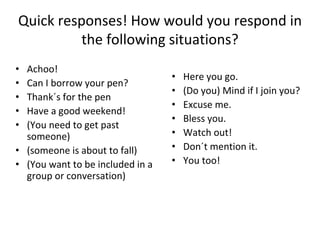
Quick responses! How would you respond in
the following situations?
• Achoo!
• Can I borrow your pen?
• Thank´s for the pen
• Have a good weekend!
• (You need to get past
someone)
• (someone is about to fall)
• (You want to be included in a
group or conversation)
• Here you go.
• (Do you) Mind if I join you?
• Excuse me.
• Bless you.
• Watch out!
• Don´t mention it.
• You too!
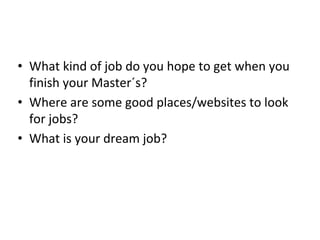
• What kind of job do you hope to get when you
finish your Master´s?
• Where are some good places/websites to look
for jobs?
• What is your dream job?
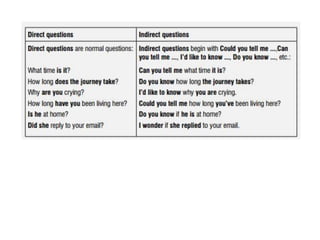
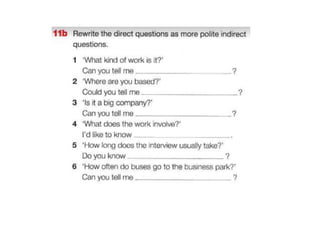
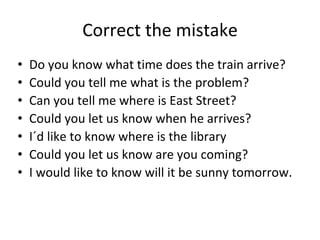
Correct the mistake
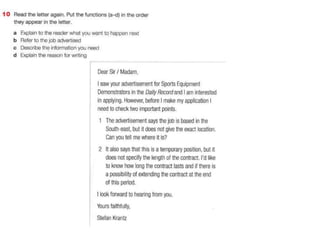
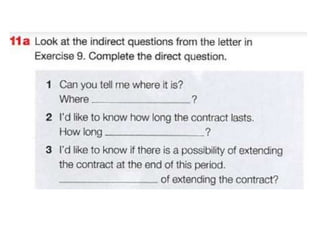
• Do you know what time does the train arrive?
• Could you tell me what is the problem?
• Can you tell me where is East Street?
• Could you let us know when he arrives?
• I´d like to know where is the library
• Could you let us know are you coming?
• I would like to know will it be sunny tomorrow.
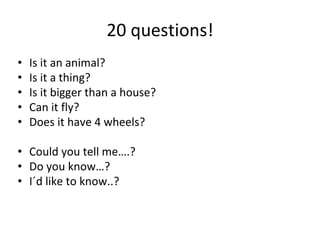
20 questions!
• Is it an animal?
• Is it a thing?
• Is it bigger than a house?
• Can it fly?
• Does it have 4 wheels?
• Could you tell me….?
• Do you know…?
• I´d like to know..?
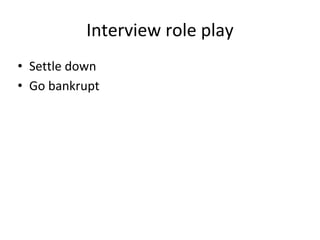
• Settle down
• Go bankrupt
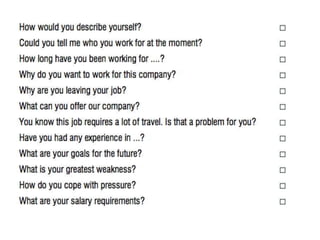
Interview role play
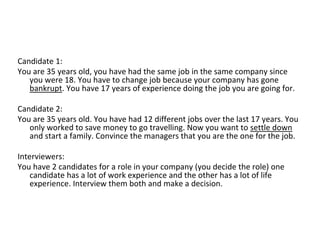
Candidate 1:
You are 35 years old, you have had the same job in the same company since
you were 18. You have to change job because your company has gone
bankrupt. You have 17 years of experience doing the job you are going for.
Candidate 2:
You are 35 years old. You have had 12 different jobs over the last 17 years. You
only worked to save money to go travelling. Now you want to settle down
and start a family. Convince the managers that you are the one for the job.
Interviewers:
You have 2 candidates for a role in your company (you decide the role) one
candidate has a lot of work experience and the other has a lot of life
experience. Interview them both and make a decision.
Day 4 Objectives: Review grammar
and practice reading
comprehension and job interview
skills.
Watch the video. What does the
interviewer do to make the people
being interviewed uncomfortable?
Work in pairs. Look at the list of work skills.
What do you think each one means?
Discuss with your partner
A. Interpersonal skills
B. Working independently
C. Bilingualism
D. Critical thinking
E. Teamwork
F. Organizational skills
G. Management skills
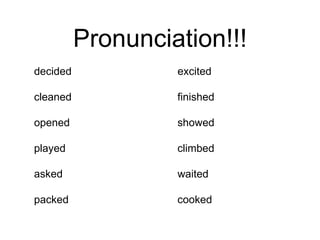
Pronunciation!!!
decided
cleaned
opened
played
asked
packed
excited
finished
showed
climbed
waited
cooked
Week 2 day 5 objectives: Practice listening
comprehension and presentation skills
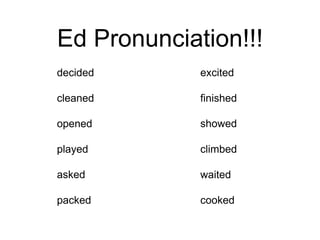
Ed Pronunciation!!!
decided
cleaned
opened
played
asked
packed
excited
finished
showed
climbed
waited
cooked
Watch the video. What happens in the video?
What are your impressions of this guy?
https://www.youtube.com/watch?v=GA8z7f7a2Pk
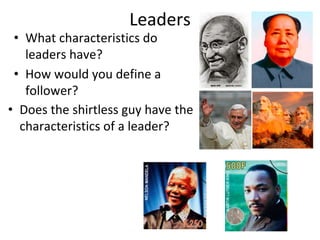
Leaders
• What characteristics do
leaders have?
• How would you define a
follower?
• Does the shirtless guy have the
characteristics of a leader?
• Do you agree or disagree with
this statement? Can you think
of an example?
“A leader needs the guts to stand
out and be ridiculed.”
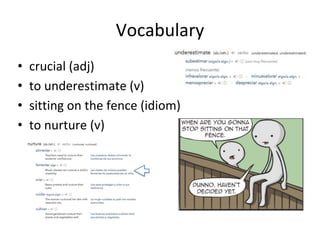
Vocabulary
• crucial (adj)
• to underestimate (v)
• sitting on the fence (idiom)
• to nurture (v)
Vocabulary
• When you learn a new language it is crucial to…
• When you are starting a new job you should
never underestimate…
• Sitting on the fence can be a good idea
sometimes. For example…
• A good boss nurtures…
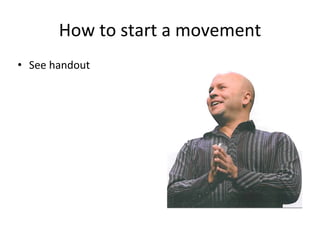
How to start a movement
• See handout
Watch the beginning and ending of this talk. How
did Derek Sivers begin and end his talk?
Ladies and gentlemen, at TED we talk a lot about
leadership and how to make a movement. So let's
watch a movement happen, start to finish, in under
three minutes and dissect some lessons from it.
If you really care about starting a movement, have the courage to fo
2:45
Thanks.
Work in pairs. Think of a group that you belong to (a
club, an interest group, a master’s program) and
how you can convince people that it is a good group
to join. Prepare the opening and closing lines of
your presentation.
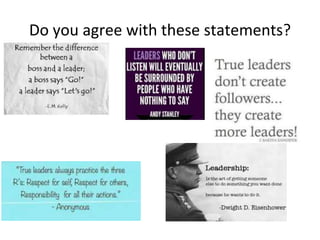
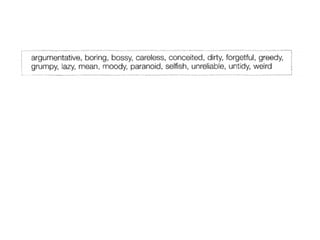
Do you agree with these statements?
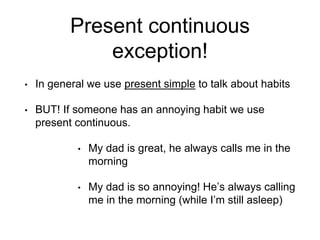
Present continuous
exception!
• In general we use present simple to talk about habits
• BUT! If someone has an annoying habit we use
present continuous.
• My dad is great, he always calls me in the
morning
• My dad is so annoying! He’s always calling
me in the morning (while I’m still asleep)
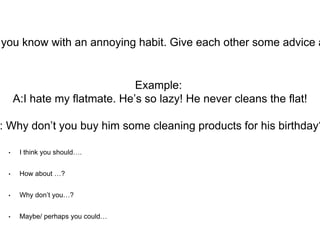
• I think you should….
• How about …?
• Why don’t you…?
• Maybe/ perhaps you could…
you know with an annoying habit. Give each other some advice a
Example:
A:I hate my flatmate. He’s so lazy! He never cleans the flat!
: Why don’t you buy him some cleaning products for his birthday?

Cesif week 2

  • 1.
  • 2.
    Week 2 day1 objectives: Study past simple and present perfect, learn presentation skills, practice listening skills.
  • 3.
    • favorite /‘feɪvrɪt/ •mountain /‘maʊntɪn/ • climate /ˈklaɪmɪt/ • live /lɪv/ • patient /ˈpeɪʃənt/ • communicate /kəˈmjuːnɪˌkeɪt/ • punctual /ˈpʌŋktjʊəl/ • organization /ɔːɡənaɪˈzeɪʃən/ • tourism /ˈtʊərɪzəm/ • should /ʃʊd/ • construction /kənˈstrʌkʃən/ • future /ˈfjuːtʃər/ • study /ˈstʌdɪ/
  • 4.
    I’ve injured myarm! • What questions would you ask? • What reactions would you have?
  • 5.
  • 6.
    1__________ went toMorocco _____ years ago 2________ has just bought a new _________. 3_________ visited _____________ in the summer. 4________ hasn’t washed last night’s dishes 5_______ was in ____________ this time last week. 6_______ has lived in his/her house for ________ years /since __________, 7_______ went shopping earlier today. 8_______ has been to the cinema over the last two weeks. 9_______ has already planned dinner for tonight. 10 _________ took up ________ last month. 11 ________ has tried ____________
  • 7.
    Memory Who has beento the cinema over the last two weeks? What did _______take up last month? What has _______ just bought? Who hasn’t washed last night’s dishes yet? * objective: Remember who’s done what using the correct tense.
  • 8.
    Complete the sentencesin your own words. 1. There’s a pretty good chance that next year I will… 2. I’m pretty much done… (-ing) 3. The three things that matter most to me are…
  • 9.
  • 10.
    In small groupsdiscuss this question If you’re listening to spoken English, what do you find most difficult? • the speaker’s accent • the speed at which he/she is speaking • the words he/she uses
  • 11.
    Look at thestrategies for dealing with accents. Rank them in order of the ones you prefer (1=best strategy, 6=worst strategy) • Ask the speaker to talk more slowly • Ask the speaker to repeat wha he/she said • Check that you understand by saying things like “Are you saying…?” • Interrupt and ask questions to slow the speaker down. • Listen to English radio on the internet • Watch English-language films. Are there any other strategies you would use?
  • 12.
    If you weremeeting a group of business people for the first time in a social setting, e.g. in the bar of a hotel or restaurant at a conference, what subjects would you discuss in the first half hour?
  • 13.
  • 14.
    Which person waseasier to understand? Why?
  • 15.
    Listen again andanswer questions for ex E
  • 16.
  • 17.
    Week 2 day2 objectives: Review present perfect and past simple, practice pronunciation of “ed” endings, look at presentation strategies
  • 18.
  • 19.
    Phrasal verbs review •D___l w__h • t____ u_ • g____u__
  • 20.
  • 21.
    voiced sounds (vocalcords vibrate)
  • 22.
  • 23.
    Snooping around • Haveyou ever….? • No, I haven’t but I have… • Yes, I have…. • When did you…? • I _____(past tense)….
  • 24.
    Fill in thegaps with your own information
  • 25.
    Ask your partnerabout their information • What have you done since last year?
  • 26.
    Critical Thinking On Fridaywe watched a presentation. Read the conclusion of Mark’s presentation. How did he get his message across? “Don’t wait until you make your first million to make a difference in somebody life. If you have something to give, give it now” A. with different examples B. with visuals/ pictures C. with a simple story
  • 27.
    Presentation Skills • Whatkind of person do you think an audience likes to see giving a presentation: a confident person, a knowledgeable person, a funny person, or a sincere person? • Which characteristic is the most interesting to you? • What tips would you give to someone doing a presentation?
  • 28.
    Presentation Tips 1. Writeyour talk yourself. Use words and expressions that you would normally use so that your words show your personality 2. Speak from the heart. Talk about things you know about and believe in. 3. Don’t worry if you are nervous. An audience sometimes warms more to someone who is nervous than full of confidence. They want you to succeed. 4. Relax your body. Try to move and gesture as you normally do.
  • 29.
    Presentation (in pairs) •You are going to give a two minute mini- presentation. Make some notes to present what you do for a living and/or what you are studying. Explain some surprising things about your job or studies- what people may not know about it- and/or the aspects of your job you like or dislike.
  • 30.
    Work in pairs.Give your presentation. Use the advice from the Presentation tips box and be yourself.
  • 31.
    • Write down5 words or phrases you have learned in the past 3 days.
  • 32.
    Week 2 day3 objectives: Look at some typical quick responses, Study indirect questions for formal writing
  • 33.
    Pronunciation • Stage- /steɪdʒ/ •Valuable- /væljʊəbəl/ • Study- /stʌdɪ/ • Student- /stjuːdənt/ • Knowledge- /nɒlɪdʒ/ • Private- /praɪvɪt/ • Sincere- /sɪnsɪər/ • Chose (past)- /tʃəʊz/ • Choose (present)- /tʃuːz/ • Chosen (participle)- /tʃəʊsɛn/
  • 34.
    Quick responses! Howwould you respond in the following situations? • Achoo! • Can I borrow your pen? • Thank´s for the pen • Have a good weekend! • (You need to get past someone) • (someone is about to fall) • (You want to be included in a group or conversation) • Here you go. • (Do you) Mind if I join you? • Excuse me. • Bless you. • Watch out! • Don´t mention it. • You too!
  • 35.
    • What kindof job do you hope to get when you finish your Master´s? • Where are some good places/websites to look for jobs? • What is your dream job?
  • 42.
    Correct the mistake •Do you know what time does the train arrive? • Could you tell me what is the problem? • Can you tell me where is East Street? • Could you let us know when he arrives? • I´d like to know where is the library • Could you let us know are you coming? • I would like to know will it be sunny tomorrow.
  • 43.
    20 questions! • Isit an animal? • Is it a thing? • Is it bigger than a house? • Can it fly? • Does it have 4 wheels? • Could you tell me….? • Do you know…? • I´d like to know..?
  • 45.
    • Settle down •Go bankrupt Interview role play
  • 46.
    Candidate 1: You are35 years old, you have had the same job in the same company since you were 18. You have to change job because your company has gone bankrupt. You have 17 years of experience doing the job you are going for. Candidate 2: You are 35 years old. You have had 12 different jobs over the last 17 years. You only worked to save money to go travelling. Now you want to settle down and start a family. Convince the managers that you are the one for the job. Interviewers: You have 2 candidates for a role in your company (you decide the role) one candidate has a lot of work experience and the other has a lot of life experience. Interview them both and make a decision.
  • 47.
    Day 4 Objectives:Review grammar and practice reading comprehension and job interview skills.
  • 48.
    Watch the video.What does the interviewer do to make the people being interviewed uncomfortable?
  • 49.
    Work in pairs.Look at the list of work skills. What do you think each one means? Discuss with your partner A. Interpersonal skills B. Working independently C. Bilingualism D. Critical thinking E. Teamwork F. Organizational skills G. Management skills
  • 50.
  • 51.
    Week 2 day5 objectives: Practice listening comprehension and presentation skills
  • 52.
  • 53.
    Watch the video.What happens in the video? What are your impressions of this guy? https://www.youtube.com/watch?v=GA8z7f7a2Pk
  • 54.
    Leaders • What characteristicsdo leaders have? • How would you define a follower? • Does the shirtless guy have the characteristics of a leader?
  • 55.
    • Do youagree or disagree with this statement? Can you think of an example? “A leader needs the guts to stand out and be ridiculed.”
  • 56.
    Vocabulary • crucial (adj) •to underestimate (v) • sitting on the fence (idiom) • to nurture (v)
  • 57.
    Vocabulary • When youlearn a new language it is crucial to… • When you are starting a new job you should never underestimate… • Sitting on the fence can be a good idea sometimes. For example… • A good boss nurtures…
  • 58.
    How to starta movement • See handout
  • 59.
    Watch the beginningand ending of this talk. How did Derek Sivers begin and end his talk? Ladies and gentlemen, at TED we talk a lot about leadership and how to make a movement. So let's watch a movement happen, start to finish, in under three minutes and dissect some lessons from it. If you really care about starting a movement, have the courage to fo 2:45 Thanks.
  • 60.
    Work in pairs.Think of a group that you belong to (a club, an interest group, a master’s program) and how you can convince people that it is a good group to join. Prepare the opening and closing lines of your presentation.
  • 61.
    Do you agreewith these statements?
  • 63.
    Present continuous exception! • Ingeneral we use present simple to talk about habits • BUT! If someone has an annoying habit we use present continuous. • My dad is great, he always calls me in the morning • My dad is so annoying! He’s always calling me in the morning (while I’m still asleep)
  • 64.
    • I thinkyou should…. • How about …? • Why don’t you…? • Maybe/ perhaps you could… you know with an annoying habit. Give each other some advice a Example: A:I hate my flatmate. He’s so lazy! He never cleans the flat! : Why don’t you buy him some cleaning products for his birthday?