

Presented by
Lee Chye Ewe, DTM
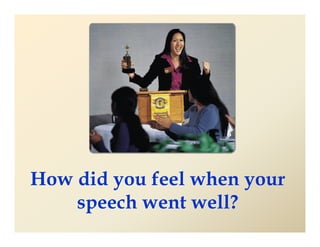
How did you feel when your
    speech went well?
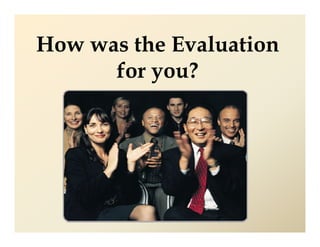
How was the Evaluation
      for you?
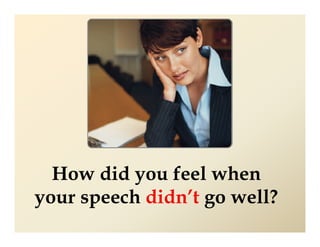
How did you feel when
your speech didn’t go well?
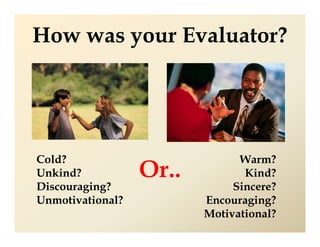
How was your Evaluator?


                  Or..
Cold?                          Warm?
Unkind?                         Kind?
Discouraging?                 Sincere?
Unmotivational?          Encouraging?
                         Motivational?
Have you ever consider how
your evaluation will help or
 will not help the speaker?
TERRIBLE
MISTAKE!


 I didn’t motivate her.
Let’s do it right…
Providing immediate feedback
 Supportive commentary
 Helpful suggestions
 Positive reinforcement
Offering methods for improvement
 Hard to judge ourselves
 Evaluators offer new perspective
 Recognize and solve difficulties
Building and maintaining self-esteem
 Build on strengths
 Correct flaws
 Spills over into personal and
 professional lives
When the
evaluator talks…


                         …and the
                   speaker listens!
Most common method used in Toastmasters
 Evaluator talks
 Speaker listens
Efficient
 Moves smoothly
 Avoids conversational digressions
Speaker can focus on evaluation
Makes assumptions
 Evaluator is experienced
 Speaker values the evaluator’s input
Show that you are interested

Before the speech, talk with the speaker
about:
 Manual objectives
 Evaluation guidelines
 Any additional concerns
Personalize your language
 Encourage don’t indict
 “I believe” or “I suggest”, not “You didn’t” or
 “You failed to”
 Use examples – “What I saw” or “What I heard”
Evaluate the speech - not the person
 Forget sticks and stones, word CAN hurt
 Leave out your values or opinions

Your goal is simple
 Help the speaker communicate their ideas in a
 more effective manner
Promote self-esteem
 Listen
 Take notes
 Encourage and inspire
 Be honest and sincere
Avoiding Whitewash
 Do not over-praise or only-praise
 Tends to demoralize club
 Purpose is to give and receive insight
 Empty compliments and platitudes
 benefit no one
Review the Effective Speech Evaluation
manual.
Talk with the speaker before the
presentation
Review the goals and evaluation criteria
of the speech.
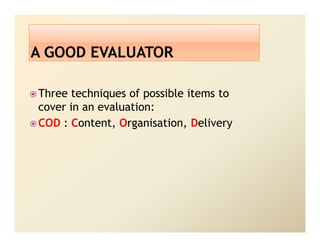
Three techniques of possible items to
cover in an evaluation:
COD : Content, Organisation, Delivery
Three techniques of possible items to
cover in an evaluation:
COD : Content, Organisation, Delivery
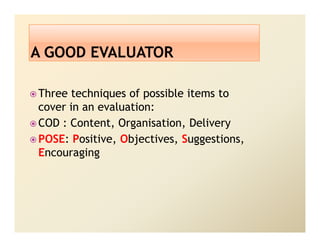
POSE: Positive, Objectives, Suggestions,
Encouraging
Three techniques of possible items to
cover in an evaluation:
COD : Content, Organisation, Delivery
POSE: Positive, Objectives, Suggestions,
Encouraging
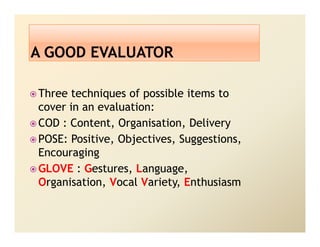
GLOVE : Gestures, Language,
Organisation, Vocal Variety, Enthusiasm
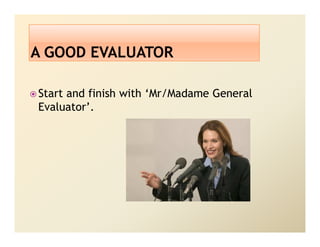
Start and finish with ‘Mr/Madame General
Evaluator’.
Evaluations are important learning tools

When assigned to evaluate
 We polish our own skills
 We assist others meet their goals

Be positive, be constructive,
be informative
The speaker is more advance than I am?

I am suppose to tell him what is right and
what is wrong?

Present evaluation in sandwich manner, good
+ bad + good?
As long as you are an audience, you are
qualify.

You are only providing feedback
 You are not judging

Sandwich is for presenting evaluation, not an
approach in looking for good and bad about
the speech
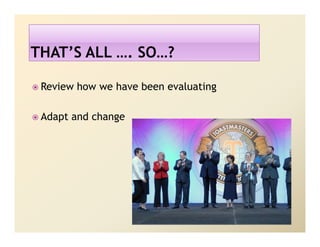
Review how we have been evaluating

Adapt and change
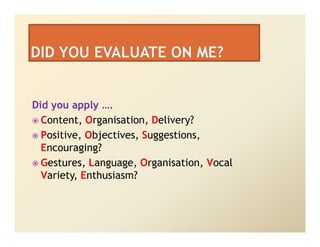
Did you apply ….
  Content, Organisation, Delivery?
  Positive, Objectives, Suggestions,
  Encouraging?
  Gestures, Language, Organisation, Vocal
  Variety, Enthusiasm?

Evaluate to motivate

  • 2.
  • 3.
    How did youfeel when your speech went well?
  • 4.
    How was theEvaluation for you?
  • 5.
    How did youfeel when your speech didn’t go well?
  • 6.
    How was yourEvaluator? Or.. Cold? Warm? Unkind? Kind? Discouraging? Sincere? Unmotivational? Encouraging? Motivational?
  • 7.
    Have you everconsider how your evaluation will help or will not help the speaker?
  • 8.
  • 9.
    Let’s do itright…
  • 10.
    Providing immediate feedback Supportive commentary Helpful suggestions Positive reinforcement
  • 11.
    Offering methods forimprovement Hard to judge ourselves Evaluators offer new perspective Recognize and solve difficulties
  • 12.
    Building and maintainingself-esteem Build on strengths Correct flaws Spills over into personal and professional lives
  • 13.
    When the evaluator talks… …and the speaker listens!
  • 14.
    Most common methodused in Toastmasters Evaluator talks Speaker listens Efficient Moves smoothly Avoids conversational digressions
  • 15.
    Speaker can focuson evaluation Makes assumptions Evaluator is experienced Speaker values the evaluator’s input
  • 16.
    Show that youare interested Before the speech, talk with the speaker about: Manual objectives Evaluation guidelines Any additional concerns
  • 17.
    Personalize your language Encourage don’t indict “I believe” or “I suggest”, not “You didn’t” or “You failed to” Use examples – “What I saw” or “What I heard”
  • 18.
    Evaluate the speech- not the person Forget sticks and stones, word CAN hurt Leave out your values or opinions Your goal is simple Help the speaker communicate their ideas in a more effective manner
  • 19.
    Promote self-esteem Listen Take notes Encourage and inspire Be honest and sincere
  • 20.
    Avoiding Whitewash Donot over-praise or only-praise Tends to demoralize club Purpose is to give and receive insight Empty compliments and platitudes benefit no one
  • 21.
    Review the EffectiveSpeech Evaluation manual. Talk with the speaker before the presentation Review the goals and evaluation criteria of the speech.
  • 22.
    Three techniques ofpossible items to cover in an evaluation: COD : Content, Organisation, Delivery
  • 23.
    Three techniques ofpossible items to cover in an evaluation: COD : Content, Organisation, Delivery POSE: Positive, Objectives, Suggestions, Encouraging
  • 24.
    Three techniques ofpossible items to cover in an evaluation: COD : Content, Organisation, Delivery POSE: Positive, Objectives, Suggestions, Encouraging GLOVE : Gestures, Language, Organisation, Vocal Variety, Enthusiasm
  • 25.
    Start and finishwith ‘Mr/Madame General Evaluator’.
  • 26.
    Evaluations are importantlearning tools When assigned to evaluate We polish our own skills We assist others meet their goals Be positive, be constructive, be informative
  • 27.
    The speaker ismore advance than I am? I am suppose to tell him what is right and what is wrong? Present evaluation in sandwich manner, good + bad + good?
  • 28.
    As long asyou are an audience, you are qualify. You are only providing feedback You are not judging Sandwich is for presenting evaluation, not an approach in looking for good and bad about the speech
  • 29.
    Review how wehave been evaluating Adapt and change
  • 30.
    Did you apply…. Content, Organisation, Delivery? Positive, Objectives, Suggestions, Encouraging? Gestures, Language, Organisation, Vocal Variety, Enthusiasm?