Extraction & Destruction ofExtraction & Destruction of
Organics in Wastewater byOrganics in Wastewater by
OzoneOzone--Loaded SolventLoaded Solvent
Dr David WardDr David Ward
University of Bradford, UKUniversity of Bradford, UK
OverviewOverview
General ConceptGeneral Concept
Selecting an Appropriate SolventSelecting an Appropriate Solvent
VolasilVolasilTMTM245 Characteristics245 Characteristics
Preliminary Tests: Organics in WaterPreliminary Tests: Organics in Water
ConclusionsConclusions
General ConceptGeneral ConceptGeneral ConceptGeneral Concept
Water Treatment byWater Treatment by
Conventional LiquidConventional Liquid--Gas/OzoneGas/Ozone
Wastewater contacted with ozone gas.Wastewater contacted with ozone gas.
Ozone dissolved in directly into wastewater.Ozone dissolved in directly into wastewater.
However……However……
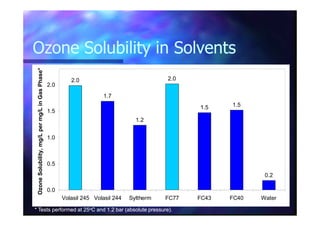
Ozone solubility in water poor (~0.2 mg/L per mg/L).Ozone solubility in water poor (~0.2 mg/L per mg/L).
Ozone generated at low gas concentration (<10%).Ozone generated at low gas concentration (<10%).
As a consequence…….As a consequence…….
Low aqueous ozone concentrations achieved.Low aqueous ozone concentrations achieved.
Reaction rates may be less than optimal.Reaction rates may be less than optimal.
Water Treatment byWater Treatment by
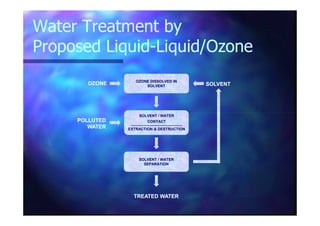
Proposed LiquidProposed Liquid--Liquid/OzoneLiquid/Ozone
OZONE DISSOLVED IN
SOLVENT
OZONEOZONE SOLVENTSOLVENT
POLLUTEDPOLLUTED
WATERWATER
SOLVENT / WATER
CONTACT
EXTRACTION & DESTRUCTION
SOLVENT / WATER
SEPARATION
TREATED WATERTREATED WATER
Previous InvestigationsPrevious Investigations
Stich & Bhattacharyya, 1987;Stich & Bhattacharyya, 1987;
Chang & Chen, 1994;Chang & Chen, 1994;
BhattacharyyaBhattacharyya et al., 1994;et al., 1994;
Guha et al., 1995;Guha et al., 1995;Guha et al., 1995;Guha et al., 1995;
Freshour et al., 1996Freshour et al., 1996..
Studied destruction of organics in waterStudied destruction of organics in water
using ozoneusing ozone--loadedloaded fluorocarbonfluorocarbon solvents.solvents.
But are more suitable solvents available?But are more suitable solvents available?
Selecting anSelecting an
Appropriate SolventAppropriate SolventAppropriate SolventAppropriate Solvent
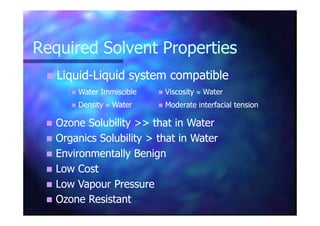
Required Solvent PropertiesRequired Solvent Properties
LiquidLiquid--Liquid system compatibleLiquid system compatible
Water ImmiscibleWater Immiscible ViscosityViscosity ≈≈ WaterWater
DensityDensity ≠≠ WaterWater Moderate interfacial tensionModerate interfacial tension
Ozone Solubility >> that in WaterOzone Solubility >> that in Water
Organics Solubility > that in WaterOrganics Solubility > that in Water
Environmentally BenignEnvironmentally Benign
Low CostLow Cost
Low Vapour PressureLow Vapour Pressure
Ozone ResistantOzone Resistant
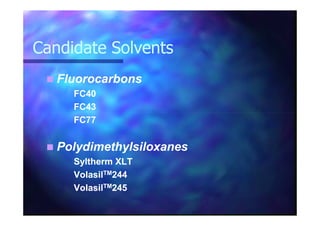
Candidate SolventsCandidate Solvents
FluorocarbonsFluorocarbons
FC40FC40
FC43FC43
FC77FC77
PolydimethylsiloxanesPolydimethylsiloxanes
Syltherm XLTSyltherm XLT
VolasilVolasilTMTM244244
VolasilVolasilTMTM245245
Ozone Solubility TestsOzone Solubility Tests
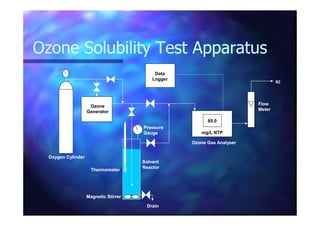
Ozone Solubility Test ApparatusOzone Solubility Test Apparatus
KIKI
FlowFlow
MeterMeter
Ozone
Generator
Data
Logger
Ozone Gas AnalyserOzone Gas Analyser
Generator
Oxygen CylinderOxygen Cylinder
SolventSolvent
ReactorReactor
Magnetic StirrerMagnetic Stirrer
ThermometerThermometer
DrainDrain
85.0
mg/L NTP
PressurePressure
GaugeGauge
Ozone Solubility in SolventsOzone Solubility in Solvents
SolventSolvent
Ozone SolubilityOzone Solubility
(mg/L per mg/L in Gas Phase)(mg/L per mg/L in Gas Phase)**
2.0
1.7
2.0
1.5 1.5
1.5
2.0
OzoneSolubility,mg/Lpermg/LinGasPhase*
WaterWater 0.20.2
PolydimethylsiloxanesPolydimethylsiloxanes
Volasil 245Volasil 245 2.02.0
Volasil 244Volasil 244 1.71.7
Syltherm XLTSyltherm XLT 1.21.2
FluorocarbonsFluorocarbons
FC40FC40 1.71.7
FC43FC43 1.51.5
FC77FC77 2.02.0
* Tests performed at 25* Tests performed at 25ooC and 1.2 bar (absolute pressure).C and 1.2 bar (absolute pressure).
1.2
0.2
0.0
0.5
1.0
1.5
Volasil 245 Volasil 244 Syltherm FC77 FC43 FC40 Water
OzoneSolubility,mg/Lpermg/LinGasPhase*
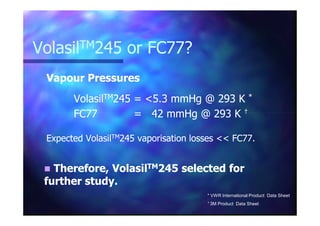
VolasilVolasilTMTM245 or FC77?245 or FC77?
Vapour PressuresVapour Pressures
VolasilVolasilTMTM245 = <5.3 mmHg @ 293 K245 = <5.3 mmHg @ 293 K **
FC77 = 42 mmHg @ 293 KFC77 = 42 mmHg @ 293 K ††FC77 = 42 mmHg @ 293 KFC77 = 42 mmHg @ 293 K ††
Expected VolasilExpected VolasilTMTM245 vaporisation losses << FC77.245 vaporisation losses << FC77.
* VWR International Product Data Sheet
†† 3M Product Data Sheet
Therefore, VolasilTherefore, VolasilTMTM245 selected for245 selected for
further study.further study.
VolasilVolasilTMTM245245
CharacteristicsCharacteristics
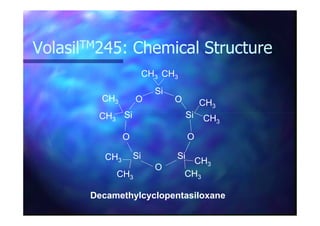
VolasilVolasilTMTM245: Chemical Structure245: Chemical Structure
Si
Si Si
O O CH3
CH
CH3
CH3 CH3
Si
Si Si
Si
O
O O
CH3
CH3
CH3
CH3
CH3
CH3
Decamethylcyclopentasiloxane
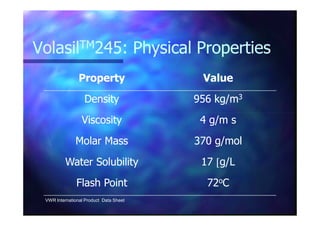
VolasilVolasilTMTM245: Physical Properties245: Physical Properties
PropertyProperty ValueValue
DensityDensity 956 kg/m956 kg/m33
ViscosityViscosity 4 g/m s4 g/m sViscosityViscosity 4 g/m s4 g/m s
Molar MassMolar Mass 370 g/mol370 g/mol
Water SolubilityWater Solubility 1717 [[g/Lg/L
Flash PointFlash Point 7272ooCC
VWR International Product Data Sheet
VolasilVolasilTMTM245: Environment245: Environment
Low ToxicityLow Toxicity
(LD(LD5050 oral rats = 2 g/kg)oral rats = 2 g/kg)(LD(LD5050 oral rats = 2 g/kg)oral rats = 2 g/kg)
Degrades in environment to harmlessDegrades in environment to harmless
products.products.
(carbon dioxide, water and silicic acid)(carbon dioxide, water and silicic acid)
VWR International Product Data Sheet
VolasilVolasilTMTM245:245:
Resistance to Oxidation by OzoneResistance to Oxidation by Ozone
100 hour Exposure100 hour Exposure
•• 70 mg/L O70 mg/L O33 gas bubbled through 100 mL solvent at rate ofgas bubbled through 100 mL solvent at rate of
100 mL/min.100 mL/min.
Effects of ExposureEffects of ExposureEffects of ExposureEffects of Exposure
•• Ozone solubility unchanged.Ozone solubility unchanged.
•• Small amount solvent loss (3 % volume).Small amount solvent loss (3 % volume).
•• Small amount precipitate (< 10 mg/L or <0.001 % wt).Small amount precipitate (< 10 mg/L or <0.001 % wt).
Therefore, solvent considered sufficientlyTherefore, solvent considered sufficiently
resistant to ozone attack to merit further study.resistant to ozone attack to merit further study.
VolasilVolasilTMTM245: Henry’s Law245: Henry’s Law
Dissolved ODissolved O33 found to obey Henry’s Lawfound to obey Henry’s Law
(10(10 –– 90 mg/L gas phase).90 mg/L gas phase).(10(10 –– 90 mg/L gas phase).90 mg/L gas phase).
[O[O33 in Solvent]in Solvent] ∝∝ [O[O33 in Gas]in Gas]
H =H = 34 bar/mole34 bar/mole--fractionfraction @ 298 K@ 298 K
VolasilVolasilTMTM245: Ozone Stability245: Ozone Stability
Ozone decay monitored by examining declineOzone decay monitored by examining decline
in UV absorption at 254 nm.in UV absorption at 254 nm.
Concentration declines exponentially.Concentration declines exponentially.
TT½½ ≈≈≈≈≈≈≈≈ 25 minutes25 minutes
Similar to that experienced in water.Similar to that experienced in water.
VolasilVolasilTMTM245: Interfacial Tension245: Interfacial Tension
Water/VolasilWater/VolasilTMTM245 interfacial tension245 interfacial tension
determined asdetermined as 24 mN/m24 mN/m at 25at 25ooC.C.
MidMid--range (similar to that of toluene).range (similar to that of toluene).
Therefore, solvent deemed potentially suitableTherefore, solvent deemed potentially suitable
for application in a waterfor application in a water--solvent system.solvent system.
Preliminary Tests:Preliminary Tests:
Organics in WaterOrganics in WaterOrganics in WaterOrganics in Water
Aims of Preliminary TestsAims of Preliminary Tests
Determine effectiveness ofDetermine effectiveness of VolasilVolasilTMTM245245
LL--L/OL/O33 contactcontact with respect to elimination ofwith respect to elimination of
organics from aqueous solution.organics from aqueous solution.organics from aqueous solution.organics from aqueous solution.
Compare effectiveness of VolasilCompare effectiveness of VolasilTMTM245245 LL--L/OL/O33
contactcontact with that of conventional Lwith that of conventional L--G/OG/O33
contact.contact.
Organic ContaminantsOrganic Contaminants
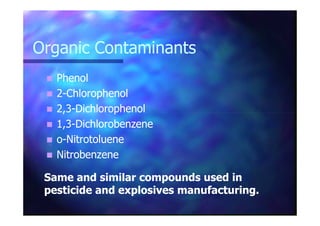
PhenolPhenol
22--ChlorophenolChlorophenol
2,32,3--DichlorophenolDichlorophenol2,32,3--DichlorophenolDichlorophenol
1,31,3--DichlorobenzeneDichlorobenzene
oo--NitrotolueneNitrotoluene
NitrobenzeneNitrobenzene
Same and similar compounds used inSame and similar compounds used in
pesticide and explosives manufacturing.pesticide and explosives manufacturing.
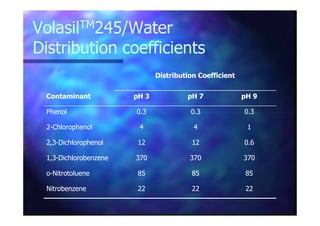
VolasilVolasilTMTM245245/Water/Water
Distribution coefficientsDistribution coefficients
Distribution CoefficientDistribution Coefficient
ContaminantContaminant pH 3pH 3 pH 7pH 7 pH 9pH 9
PhenolPhenol 0.30.3 0.30.3 0.30.3PhenolPhenol 0.30.3 0.30.3 0.30.3
22--ChlorophenolChlorophenol 44 44 11
2,32,3--DichlorophenolDichlorophenol 1212 1212 0.60.6
1,31,3--DichlorobenzeneDichlorobenzene 370370 370370 370370
oo--NitrotolueneNitrotoluene 8585 8585 8585
NitrobenzeneNitrobenzene 2222 2222 2222
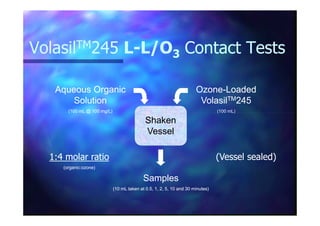
VolasilVolasilTMTM245245 LL--L/OL/O33 Contact TestsContact Tests
Aqueous OrganicAqueous Organic
SolutionSolution
(100 mL @ 100 mg/L)(100 mL @ 100 mg/L)
OzoneOzone--LoadedLoaded
VolasilVolasilTMTM245245
(100 mL)
ShakenShaken
VesselVessel
(100 mL @ 100 mg/L)(100 mL @ 100 mg/L) (100 mL)
SamplesSamples
(10 mL taken at 0.5, 1, 2, 5, 10 and 30 minutes)(10 mL taken at 0.5, 1, 2, 5, 10 and 30 minutes)
1:4 molar ratio1:4 molar ratio
(organic:ozone)(organic:ozone)
(Vessel sealed)(Vessel sealed)
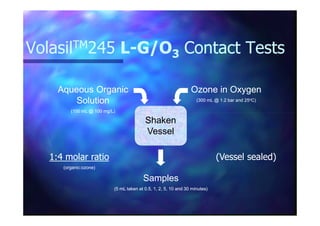
VolasilVolasilTMTM245245 LL--G/OG/O33 Contact TestsContact Tests
Aqueous OrganicAqueous Organic
SolutionSolution
(100 mL @ 100 mg/L)(100 mL @ 100 mg/L)
Ozone in OxygenOzone in Oxygen
(300 mL @ 1.2 bar and 25(300 mL @ 1.2 bar and 25ooC)C)
ShakenShaken
VesselVessel
(100 mL @ 100 mg/L)(100 mL @ 100 mg/L)
SamplesSamples
(5 mL taken at 0.5, 1, 2, 5, 10 and 30 minutes)(5 mL taken at 0.5, 1, 2, 5, 10 and 30 minutes)
1:4 molar ratio1:4 molar ratio
(organic:ozone)(organic:ozone)
(Vessel sealed)(Vessel sealed)
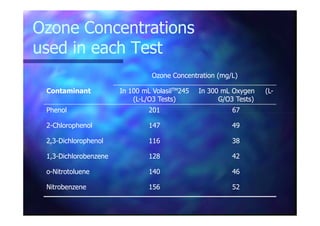
Ozone ConcentrationsOzone Concentrations
used in each Testused in each Test
Ozone Concentration (mg/L)Ozone Concentration (mg/L)
ContaminantContaminant In 100 mL VolasilIn 100 mL VolasilTMTM245245
(L(L--L/O3 Tests)L/O3 Tests)
In 300 mL Oxygen (LIn 300 mL Oxygen (L--
G/O3 Tests)G/O3 Tests)
PhenolPhenol 201201 6767PhenolPhenol 201201 6767
22--ChlorophenolChlorophenol 147147 4949
2,32,3--DichlorophenolDichlorophenol 116116 3838
1,31,3--DichlorobenzeneDichlorobenzene 128128 4242
oo--NitrotolueneNitrotoluene 140140 4646
NitrobenzeneNitrobenzene 156156 5252
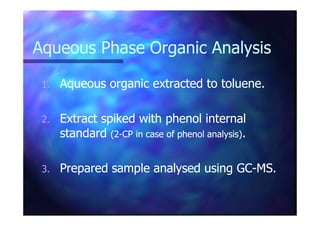
Aqueous Phase Organic AnalysisAqueous Phase Organic Analysis
1.1. Aqueous organic extracted to toluene.Aqueous organic extracted to toluene.
Extract spiked with phenol internalExtract spiked with phenol internal2.2. Extract spiked with phenol internalExtract spiked with phenol internal
standardstandard (2(2--CP in case of phenol analysis)CP in case of phenol analysis)..
3.3. Prepared sample analysed using GCPrepared sample analysed using GC--MS.MS.
ResultsResultsResultsResults
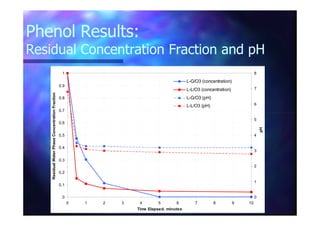
Phenol Results:Phenol Results:
Residual Concentration Fraction and pHResidual Concentration Fraction and pH
0.7
0.8
0.9
1
ResidualWaterPhaseConcentrationFraction
6
7
8
L-G/O3 (concentration)
L-L/O3 (concentration)
L-G/O3 (pH)
L-L/O3 (pH)
0
0.1
0.2
0.3
0.4
0.5
0.6
0 1 2 3 4 5 6 7 8 9 10
Time Elapsed, minutes
ResidualWaterPhaseConcentrationFraction
0
1
2
3
4
5
pH
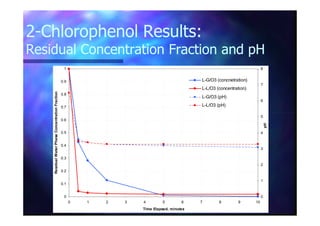
22--Chlorophenol Results:Chlorophenol Results:
Residual Concentration Fraction and pHResidual Concentration Fraction and pH
0.7
0.8
0.9
1
ResidualWaterPhaseConcentrationFraction
6
7
8
L-G/O3 (concnetration)
L-L/O3 (concentration)
L-G/O3 (pH)
L-L/O3 (pH)
0
0.1
0.2
0.3
0.4
0.5
0.6
0 1 2 3 4 5 6 7 8 9 10
Time Elapsed, minutes
ResidualWaterPhaseConcentrationFraction
0
1
2
3
4
5
pH
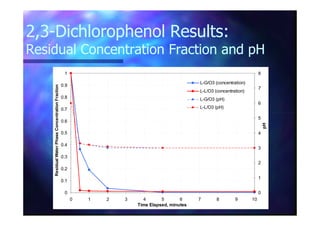
2,32,3--Dichlorophenol Results:Dichlorophenol Results:
Residual Concentration Fraction and pHResidual Concentration Fraction and pH
0.7
0.8
0.9
1
ResidualWaterPhaseConcentrationFraction
6
7
8
L-G/O3 (concentration)
L-L/O3 (concentration)
L-G/O3 (pH)
L-L/O3 (pH)
0
0.1
0.2
0.3
0.4
0.5
0.6
0 1 2 3 4 5 6 7 8 9 10
Time Elapsed, minutes
ResidualWaterPhaseConcentrationFraction
0
1
2
3
4
5
pH
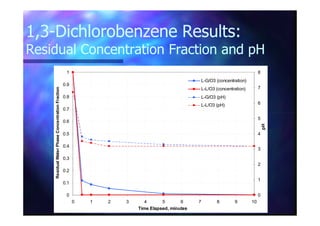
1,31,3--Dichlorobenzene Results:Dichlorobenzene Results:
Residual Concentration Fraction and pHResidual Concentration Fraction and pH
0.7
0.8
0.9
1
ResidualWaterPhaseConcentrationFraction
6
7
8
L-G/O3 (concentration)
L-L/O3 (concentration)
L-G/O3 (pH)
L-L/O3 (pH)
0
0.1
0.2
0.3
0.4
0.5
0.6
0 1 2 3 4 5 6 7 8 9 10
Time Elapsed, minutes
ResidualWaterPhaseConcentrationFraction
0
1
2
3
4
5
pH
DiscussionDiscussion
Phenol and chlorinated organicsPhenol and chlorinated organics
Aqueous decontamination by LAqueous decontamination by L--L/OL/O33 is faster.is faster.
However, LHowever, L--G/OG/O33 contact already rapid (~2 minutes).contact already rapid (~2 minutes).However, LHowever, L--G/OG/O33 contact already rapid (~2 minutes).contact already rapid (~2 minutes).
Extent of decontamination can be limited by interfacial massExtent of decontamination can be limited by interfacial mass
transfer resistance.transfer resistance.
Destruction and/or Extraction?Destruction and/or Extraction?
Fall in pH suggests the occurrence of destruction.Fall in pH suggests the occurrence of destruction.
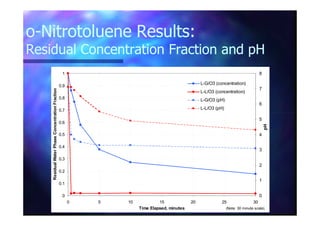
oo--Nitrotoluene Results:Nitrotoluene Results:
Residual Concentration Fraction and pHResidual Concentration Fraction and pH
0.7
0.8
0.9
1
ResidualWaterPhaseConcentrationFraction
6
7
8
L-G/O3 (concentration)
L-L/O3 (concentration)
L-G/O3 (pH)
L-L/O3 (pH)
0
0.1
0.2
0.3
0.4
0.5
0.6
0 5 10 15 20 25 30
Time Elapsed, minutes
ResidualWaterPhaseConcentrationFraction
0
1
2
3
4
5
pH
(Note: 30 minute scale)
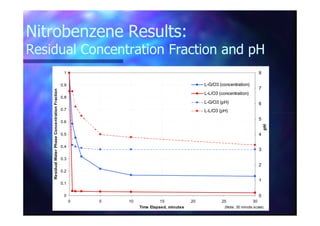
Nitrobenzene Results:Nitrobenzene Results:
Residual Concentration Fraction and pHResidual Concentration Fraction and pH
0.7
0.8
0.9
1
ResidualWaterPhaseConcentrationFraction
6
7
8
L-G/O3 (concentration)
L-L/O3 (concentration)
L-G/O3 (pH)
L-L/O3 (pH)
0
0.1
0.2
0.3
0.4
0.5
0.6
0 5 10 15 20 25 30
Time Elapsed, minutes
ResidualWaterPhaseConcentrationFraction
0
1
2
3
4
5
pH
L-L/O3 (pH)
(Note: 30 minute scale)
DiscussionDiscussion
NitroaromaticsNitroaromatics
LL--L/OL/O33 contact shown to yield faster and morecontact shown to yield faster and more
extensive aqueous decontamination.extensive aqueous decontamination.
Destruction and/or Extraction?Destruction and/or Extraction?Destruction and/or Extraction?Destruction and/or Extraction?
pH behaviour suggests LpH behaviour suggests L--L/OL/O33 contact to yield less rapid andcontact to yield less rapid and
less extensive destruction.less extensive destruction.
Are reaction pathways altered?Are reaction pathways altered?
Role ofRole of ••OH radical (OH radical (Bin et al., 2001)Bin et al., 2001)??
ConclusionsConclusionsConclusionsConclusions
ConclusionsConclusions
VolasilVolasilTMTM245245 so far proved an appropriateso far proved an appropriate
solvent for use in proposed process.solvent for use in proposed process.
Advantages ofAdvantages of VolasilVolasilTMTM245245 are:are:
ability to dissolveability to dissolve ten timesten times more ozone than does water,more ozone than does water,
ability to dissolve wide variety of organics,ability to dissolve wide variety of organics,
resistance to ozone attack,resistance to ozone attack,
low water solubility (17low water solubility (17 µµg/Lg/L),),
low vapour pressure (<5.3 mm Hg), andlow vapour pressure (<5.3 mm Hg), and
low toxicitylow toxicity
ConclusionsConclusions
Aqueous decontamination by LAqueous decontamination by L--L/OL/O33 shown to be moreshown to be more
rapid than Lrapid than L--G/OG/O33..
Decline in pH suggests destruction as well asDecline in pH suggests destruction as well as
extraction.extraction.extraction.extraction.
However…….However…….
Increased aqueous decontamination rate may notIncreased aqueous decontamination rate may not
justify process where Ljustify process where L--G/OG/O33 contact already fast.contact already fast.
Interfacial resistances may result in less extensiveInterfacial resistances may result in less extensive
aqueous decontamination.aqueous decontamination.
ConclusionsConclusions
LL--L/OL/O33 contactcontact maymay bebe mostmost effectiveeffective
wherewhere contaminantscontaminants possesspossess::
i.i. highhigh solvent/watersolvent/water distributiondistribution coefficientcoefficient
andand are,are,
ii.ii. susceptiblesusceptible toto directdirect reactionsreactions withwith
molecularmolecular ozoneozone..
ConclusionsConclusions
InIn suchsuch cases,cases, mostmost efficientefficient meansmeans ofof
treatmenttreatment maymay bebe asas followsfollows::
i.i. ConcentrateConcentrate contaminantscontaminants inin relativelyrelatively
smallsmall volumevolume ofof VolasilVolasilTMTM245245 byby extractionextraction
andand then,then,
ii.ii. RegenerateRegenerate VolasilVolasilTMTM245245 byby ozoneozone--loadingloading..
Further InvestigationFurther InvestigationFurther InvestigationFurther Investigation
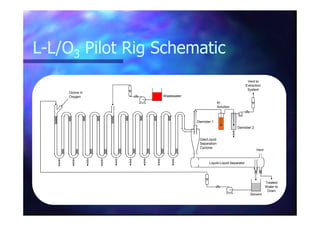
LL--L/OL/O33 Pilot Rig SchematicPilot Rig Schematic
Ozone in
Oxygen Wastewater
KI
Solution
Vent to
Extraction
System
Solvent
Treated
Water to
Drain
Vent
Gas/Liquid
Separation
Cyclone
Demister 1
Demister 2
Liquid-Liquid Separator
AcknowledgementsAcknowledgements
Many thanksMany thanks
for your attention.for your attention.
Any questions?Any questions?

LiquidLiquidOzone

  • 1.
    Extraction & DestructionofExtraction & Destruction of Organics in Wastewater byOrganics in Wastewater by OzoneOzone--Loaded SolventLoaded Solvent Dr David WardDr David Ward University of Bradford, UKUniversity of Bradford, UK
  • 2.
    OverviewOverview General ConceptGeneral Concept Selectingan Appropriate SolventSelecting an Appropriate Solvent VolasilVolasilTMTM245 Characteristics245 Characteristics Preliminary Tests: Organics in WaterPreliminary Tests: Organics in Water ConclusionsConclusions
  • 3.
  • 4.
    Water Treatment byWaterTreatment by Conventional LiquidConventional Liquid--Gas/OzoneGas/Ozone Wastewater contacted with ozone gas.Wastewater contacted with ozone gas. Ozone dissolved in directly into wastewater.Ozone dissolved in directly into wastewater. However……However…… Ozone solubility in water poor (~0.2 mg/L per mg/L).Ozone solubility in water poor (~0.2 mg/L per mg/L). Ozone generated at low gas concentration (<10%).Ozone generated at low gas concentration (<10%). As a consequence…….As a consequence……. Low aqueous ozone concentrations achieved.Low aqueous ozone concentrations achieved. Reaction rates may be less than optimal.Reaction rates may be less than optimal.
  • 5.
    Water Treatment byWaterTreatment by Proposed LiquidProposed Liquid--Liquid/OzoneLiquid/Ozone OZONE DISSOLVED IN SOLVENT OZONEOZONE SOLVENTSOLVENT POLLUTEDPOLLUTED WATERWATER SOLVENT / WATER CONTACT EXTRACTION & DESTRUCTION SOLVENT / WATER SEPARATION TREATED WATERTREATED WATER
  • 6.
    Previous InvestigationsPrevious Investigations Stich& Bhattacharyya, 1987;Stich & Bhattacharyya, 1987; Chang & Chen, 1994;Chang & Chen, 1994; BhattacharyyaBhattacharyya et al., 1994;et al., 1994; Guha et al., 1995;Guha et al., 1995;Guha et al., 1995;Guha et al., 1995; Freshour et al., 1996Freshour et al., 1996.. Studied destruction of organics in waterStudied destruction of organics in water using ozoneusing ozone--loadedloaded fluorocarbonfluorocarbon solvents.solvents. But are more suitable solvents available?But are more suitable solvents available?
  • 7.
    Selecting anSelecting an AppropriateSolventAppropriate SolventAppropriate SolventAppropriate Solvent
  • 8.
    Required Solvent PropertiesRequiredSolvent Properties LiquidLiquid--Liquid system compatibleLiquid system compatible Water ImmiscibleWater Immiscible ViscosityViscosity ≈≈ WaterWater DensityDensity ≠≠ WaterWater Moderate interfacial tensionModerate interfacial tension Ozone Solubility >> that in WaterOzone Solubility >> that in Water Organics Solubility > that in WaterOrganics Solubility > that in Water Environmentally BenignEnvironmentally Benign Low CostLow Cost Low Vapour PressureLow Vapour Pressure Ozone ResistantOzone Resistant
  • 9.
  • 10.
  • 11.
    Ozone Solubility TestApparatusOzone Solubility Test Apparatus KIKI FlowFlow MeterMeter Ozone Generator Data Logger Ozone Gas AnalyserOzone Gas Analyser Generator Oxygen CylinderOxygen Cylinder SolventSolvent ReactorReactor Magnetic StirrerMagnetic Stirrer ThermometerThermometer DrainDrain 85.0 mg/L NTP PressurePressure GaugeGauge
  • 12.
    Ozone Solubility inSolventsOzone Solubility in Solvents SolventSolvent Ozone SolubilityOzone Solubility (mg/L per mg/L in Gas Phase)(mg/L per mg/L in Gas Phase)** 2.0 1.7 2.0 1.5 1.5 1.5 2.0 OzoneSolubility,mg/Lpermg/LinGasPhase* WaterWater 0.20.2 PolydimethylsiloxanesPolydimethylsiloxanes Volasil 245Volasil 245 2.02.0 Volasil 244Volasil 244 1.71.7 Syltherm XLTSyltherm XLT 1.21.2 FluorocarbonsFluorocarbons FC40FC40 1.71.7 FC43FC43 1.51.5 FC77FC77 2.02.0 * Tests performed at 25* Tests performed at 25ooC and 1.2 bar (absolute pressure).C and 1.2 bar (absolute pressure). 1.2 0.2 0.0 0.5 1.0 1.5 Volasil 245 Volasil 244 Syltherm FC77 FC43 FC40 Water OzoneSolubility,mg/Lpermg/LinGasPhase*
  • 13.
    VolasilVolasilTMTM245 or FC77?245or FC77? Vapour PressuresVapour Pressures VolasilVolasilTMTM245 = <5.3 mmHg @ 293 K245 = <5.3 mmHg @ 293 K ** FC77 = 42 mmHg @ 293 KFC77 = 42 mmHg @ 293 K ††FC77 = 42 mmHg @ 293 KFC77 = 42 mmHg @ 293 K †† Expected VolasilExpected VolasilTMTM245 vaporisation losses << FC77.245 vaporisation losses << FC77. * VWR International Product Data Sheet †† 3M Product Data Sheet Therefore, VolasilTherefore, VolasilTMTM245 selected for245 selected for further study.further study.
  • 14.
  • 15.
    VolasilVolasilTMTM245: Chemical Structure245:Chemical Structure Si Si Si O O CH3 CH CH3 CH3 CH3 Si Si Si Si O O O CH3 CH3 CH3 CH3 CH3 CH3 Decamethylcyclopentasiloxane
  • 16.
    VolasilVolasilTMTM245: Physical Properties245:Physical Properties PropertyProperty ValueValue DensityDensity 956 kg/m956 kg/m33 ViscosityViscosity 4 g/m s4 g/m sViscosityViscosity 4 g/m s4 g/m s Molar MassMolar Mass 370 g/mol370 g/mol Water SolubilityWater Solubility 1717 [[g/Lg/L Flash PointFlash Point 7272ooCC VWR International Product Data Sheet
  • 17.
    VolasilVolasilTMTM245: Environment245: Environment LowToxicityLow Toxicity (LD(LD5050 oral rats = 2 g/kg)oral rats = 2 g/kg)(LD(LD5050 oral rats = 2 g/kg)oral rats = 2 g/kg) Degrades in environment to harmlessDegrades in environment to harmless products.products. (carbon dioxide, water and silicic acid)(carbon dioxide, water and silicic acid) VWR International Product Data Sheet
  • 18.
    VolasilVolasilTMTM245:245: Resistance to Oxidationby OzoneResistance to Oxidation by Ozone 100 hour Exposure100 hour Exposure •• 70 mg/L O70 mg/L O33 gas bubbled through 100 mL solvent at rate ofgas bubbled through 100 mL solvent at rate of 100 mL/min.100 mL/min. Effects of ExposureEffects of ExposureEffects of ExposureEffects of Exposure •• Ozone solubility unchanged.Ozone solubility unchanged. •• Small amount solvent loss (3 % volume).Small amount solvent loss (3 % volume). •• Small amount precipitate (< 10 mg/L or <0.001 % wt).Small amount precipitate (< 10 mg/L or <0.001 % wt). Therefore, solvent considered sufficientlyTherefore, solvent considered sufficiently resistant to ozone attack to merit further study.resistant to ozone attack to merit further study.
  • 19.
    VolasilVolasilTMTM245: Henry’s Law245:Henry’s Law Dissolved ODissolved O33 found to obey Henry’s Lawfound to obey Henry’s Law (10(10 –– 90 mg/L gas phase).90 mg/L gas phase).(10(10 –– 90 mg/L gas phase).90 mg/L gas phase). [O[O33 in Solvent]in Solvent] ∝∝ [O[O33 in Gas]in Gas] H =H = 34 bar/mole34 bar/mole--fractionfraction @ 298 K@ 298 K
  • 20.
    VolasilVolasilTMTM245: Ozone Stability245:Ozone Stability Ozone decay monitored by examining declineOzone decay monitored by examining decline in UV absorption at 254 nm.in UV absorption at 254 nm. Concentration declines exponentially.Concentration declines exponentially. TT½½ ≈≈≈≈≈≈≈≈ 25 minutes25 minutes Similar to that experienced in water.Similar to that experienced in water.
  • 21.
    VolasilVolasilTMTM245: Interfacial Tension245:Interfacial Tension Water/VolasilWater/VolasilTMTM245 interfacial tension245 interfacial tension determined asdetermined as 24 mN/m24 mN/m at 25at 25ooC.C. MidMid--range (similar to that of toluene).range (similar to that of toluene). Therefore, solvent deemed potentially suitableTherefore, solvent deemed potentially suitable for application in a waterfor application in a water--solvent system.solvent system.
  • 22.
    Preliminary Tests:Preliminary Tests: Organicsin WaterOrganics in WaterOrganics in WaterOrganics in Water
  • 23.
    Aims of PreliminaryTestsAims of Preliminary Tests Determine effectiveness ofDetermine effectiveness of VolasilVolasilTMTM245245 LL--L/OL/O33 contactcontact with respect to elimination ofwith respect to elimination of organics from aqueous solution.organics from aqueous solution.organics from aqueous solution.organics from aqueous solution. Compare effectiveness of VolasilCompare effectiveness of VolasilTMTM245245 LL--L/OL/O33 contactcontact with that of conventional Lwith that of conventional L--G/OG/O33 contact.contact.
  • 24.
  • 25.
    VolasilVolasilTMTM245245/Water/Water Distribution coefficientsDistribution coefficients DistributionCoefficientDistribution Coefficient ContaminantContaminant pH 3pH 3 pH 7pH 7 pH 9pH 9 PhenolPhenol 0.30.3 0.30.3 0.30.3PhenolPhenol 0.30.3 0.30.3 0.30.3 22--ChlorophenolChlorophenol 44 44 11 2,32,3--DichlorophenolDichlorophenol 1212 1212 0.60.6 1,31,3--DichlorobenzeneDichlorobenzene 370370 370370 370370 oo--NitrotolueneNitrotoluene 8585 8585 8585 NitrobenzeneNitrobenzene 2222 2222 2222
  • 26.
    VolasilVolasilTMTM245245 LL--L/OL/O33 ContactTestsContact Tests Aqueous OrganicAqueous Organic SolutionSolution (100 mL @ 100 mg/L)(100 mL @ 100 mg/L) OzoneOzone--LoadedLoaded VolasilVolasilTMTM245245 (100 mL) ShakenShaken VesselVessel (100 mL @ 100 mg/L)(100 mL @ 100 mg/L) (100 mL) SamplesSamples (10 mL taken at 0.5, 1, 2, 5, 10 and 30 minutes)(10 mL taken at 0.5, 1, 2, 5, 10 and 30 minutes) 1:4 molar ratio1:4 molar ratio (organic:ozone)(organic:ozone) (Vessel sealed)(Vessel sealed)
  • 27.
    VolasilVolasilTMTM245245 LL--G/OG/O33 ContactTestsContact Tests Aqueous OrganicAqueous Organic SolutionSolution (100 mL @ 100 mg/L)(100 mL @ 100 mg/L) Ozone in OxygenOzone in Oxygen (300 mL @ 1.2 bar and 25(300 mL @ 1.2 bar and 25ooC)C) ShakenShaken VesselVessel (100 mL @ 100 mg/L)(100 mL @ 100 mg/L) SamplesSamples (5 mL taken at 0.5, 1, 2, 5, 10 and 30 minutes)(5 mL taken at 0.5, 1, 2, 5, 10 and 30 minutes) 1:4 molar ratio1:4 molar ratio (organic:ozone)(organic:ozone) (Vessel sealed)(Vessel sealed)
  • 28.
    Ozone ConcentrationsOzone Concentrations usedin each Testused in each Test Ozone Concentration (mg/L)Ozone Concentration (mg/L) ContaminantContaminant In 100 mL VolasilIn 100 mL VolasilTMTM245245 (L(L--L/O3 Tests)L/O3 Tests) In 300 mL Oxygen (LIn 300 mL Oxygen (L-- G/O3 Tests)G/O3 Tests) PhenolPhenol 201201 6767PhenolPhenol 201201 6767 22--ChlorophenolChlorophenol 147147 4949 2,32,3--DichlorophenolDichlorophenol 116116 3838 1,31,3--DichlorobenzeneDichlorobenzene 128128 4242 oo--NitrotolueneNitrotoluene 140140 4646 NitrobenzeneNitrobenzene 156156 5252
  • 29.
    Aqueous Phase OrganicAnalysisAqueous Phase Organic Analysis 1.1. Aqueous organic extracted to toluene.Aqueous organic extracted to toluene. Extract spiked with phenol internalExtract spiked with phenol internal2.2. Extract spiked with phenol internalExtract spiked with phenol internal standardstandard (2(2--CP in case of phenol analysis)CP in case of phenol analysis).. 3.3. Prepared sample analysed using GCPrepared sample analysed using GC--MS.MS.
  • 30.
  • 31.
    Phenol Results:Phenol Results: ResidualConcentration Fraction and pHResidual Concentration Fraction and pH 0.7 0.8 0.9 1 ResidualWaterPhaseConcentrationFraction 6 7 8 L-G/O3 (concentration) L-L/O3 (concentration) L-G/O3 (pH) L-L/O3 (pH) 0 0.1 0.2 0.3 0.4 0.5 0.6 0 1 2 3 4 5 6 7 8 9 10 Time Elapsed, minutes ResidualWaterPhaseConcentrationFraction 0 1 2 3 4 5 pH
  • 32.
    22--Chlorophenol Results:Chlorophenol Results: ResidualConcentration Fraction and pHResidual Concentration Fraction and pH 0.7 0.8 0.9 1 ResidualWaterPhaseConcentrationFraction 6 7 8 L-G/O3 (concnetration) L-L/O3 (concentration) L-G/O3 (pH) L-L/O3 (pH) 0 0.1 0.2 0.3 0.4 0.5 0.6 0 1 2 3 4 5 6 7 8 9 10 Time Elapsed, minutes ResidualWaterPhaseConcentrationFraction 0 1 2 3 4 5 pH
  • 33.
    2,32,3--Dichlorophenol Results:Dichlorophenol Results: ResidualConcentration Fraction and pHResidual Concentration Fraction and pH 0.7 0.8 0.9 1 ResidualWaterPhaseConcentrationFraction 6 7 8 L-G/O3 (concentration) L-L/O3 (concentration) L-G/O3 (pH) L-L/O3 (pH) 0 0.1 0.2 0.3 0.4 0.5 0.6 0 1 2 3 4 5 6 7 8 9 10 Time Elapsed, minutes ResidualWaterPhaseConcentrationFraction 0 1 2 3 4 5 pH
  • 34.
    1,31,3--Dichlorobenzene Results:Dichlorobenzene Results: ResidualConcentration Fraction and pHResidual Concentration Fraction and pH 0.7 0.8 0.9 1 ResidualWaterPhaseConcentrationFraction 6 7 8 L-G/O3 (concentration) L-L/O3 (concentration) L-G/O3 (pH) L-L/O3 (pH) 0 0.1 0.2 0.3 0.4 0.5 0.6 0 1 2 3 4 5 6 7 8 9 10 Time Elapsed, minutes ResidualWaterPhaseConcentrationFraction 0 1 2 3 4 5 pH
  • 35.
    DiscussionDiscussion Phenol and chlorinatedorganicsPhenol and chlorinated organics Aqueous decontamination by LAqueous decontamination by L--L/OL/O33 is faster.is faster. However, LHowever, L--G/OG/O33 contact already rapid (~2 minutes).contact already rapid (~2 minutes).However, LHowever, L--G/OG/O33 contact already rapid (~2 minutes).contact already rapid (~2 minutes). Extent of decontamination can be limited by interfacial massExtent of decontamination can be limited by interfacial mass transfer resistance.transfer resistance. Destruction and/or Extraction?Destruction and/or Extraction? Fall in pH suggests the occurrence of destruction.Fall in pH suggests the occurrence of destruction.
  • 36.
    oo--Nitrotoluene Results:Nitrotoluene Results: ResidualConcentration Fraction and pHResidual Concentration Fraction and pH 0.7 0.8 0.9 1 ResidualWaterPhaseConcentrationFraction 6 7 8 L-G/O3 (concentration) L-L/O3 (concentration) L-G/O3 (pH) L-L/O3 (pH) 0 0.1 0.2 0.3 0.4 0.5 0.6 0 5 10 15 20 25 30 Time Elapsed, minutes ResidualWaterPhaseConcentrationFraction 0 1 2 3 4 5 pH (Note: 30 minute scale)
  • 37.
    Nitrobenzene Results:Nitrobenzene Results: ResidualConcentration Fraction and pHResidual Concentration Fraction and pH 0.7 0.8 0.9 1 ResidualWaterPhaseConcentrationFraction 6 7 8 L-G/O3 (concentration) L-L/O3 (concentration) L-G/O3 (pH) L-L/O3 (pH) 0 0.1 0.2 0.3 0.4 0.5 0.6 0 5 10 15 20 25 30 Time Elapsed, minutes ResidualWaterPhaseConcentrationFraction 0 1 2 3 4 5 pH L-L/O3 (pH) (Note: 30 minute scale)
  • 38.
    DiscussionDiscussion NitroaromaticsNitroaromatics LL--L/OL/O33 contact shownto yield faster and morecontact shown to yield faster and more extensive aqueous decontamination.extensive aqueous decontamination. Destruction and/or Extraction?Destruction and/or Extraction?Destruction and/or Extraction?Destruction and/or Extraction? pH behaviour suggests LpH behaviour suggests L--L/OL/O33 contact to yield less rapid andcontact to yield less rapid and less extensive destruction.less extensive destruction. Are reaction pathways altered?Are reaction pathways altered? Role ofRole of ••OH radical (OH radical (Bin et al., 2001)Bin et al., 2001)??
  • 39.
  • 40.
    ConclusionsConclusions VolasilVolasilTMTM245245 so farproved an appropriateso far proved an appropriate solvent for use in proposed process.solvent for use in proposed process. Advantages ofAdvantages of VolasilVolasilTMTM245245 are:are: ability to dissolveability to dissolve ten timesten times more ozone than does water,more ozone than does water, ability to dissolve wide variety of organics,ability to dissolve wide variety of organics, resistance to ozone attack,resistance to ozone attack, low water solubility (17low water solubility (17 µµg/Lg/L),), low vapour pressure (<5.3 mm Hg), andlow vapour pressure (<5.3 mm Hg), and low toxicitylow toxicity
  • 41.
    ConclusionsConclusions Aqueous decontamination byLAqueous decontamination by L--L/OL/O33 shown to be moreshown to be more rapid than Lrapid than L--G/OG/O33.. Decline in pH suggests destruction as well asDecline in pH suggests destruction as well as extraction.extraction.extraction.extraction. However…….However……. Increased aqueous decontamination rate may notIncreased aqueous decontamination rate may not justify process where Ljustify process where L--G/OG/O33 contact already fast.contact already fast. Interfacial resistances may result in less extensiveInterfacial resistances may result in less extensive aqueous decontamination.aqueous decontamination.
  • 42.
    ConclusionsConclusions LL--L/OL/O33 contactcontact maymaybebe mostmost effectiveeffective wherewhere contaminantscontaminants possesspossess:: i.i. highhigh solvent/watersolvent/water distributiondistribution coefficientcoefficient andand are,are, ii.ii. susceptiblesusceptible toto directdirect reactionsreactions withwith molecularmolecular ozoneozone..
  • 43.
    ConclusionsConclusions InIn suchsuch cases,cases,mostmost efficientefficient meansmeans ofof treatmenttreatment maymay bebe asas followsfollows:: i.i. ConcentrateConcentrate contaminantscontaminants inin relativelyrelatively smallsmall volumevolume ofof VolasilVolasilTMTM245245 byby extractionextraction andand then,then, ii.ii. RegenerateRegenerate VolasilVolasilTMTM245245 byby ozoneozone--loadingloading..
  • 44.
    Further InvestigationFurther InvestigationFurtherInvestigationFurther Investigation
  • 45.
    LL--L/OL/O33 Pilot RigSchematicPilot Rig Schematic Ozone in Oxygen Wastewater KI Solution Vent to Extraction System Solvent Treated Water to Drain Vent Gas/Liquid Separation Cyclone Demister 1 Demister 2 Liquid-Liquid Separator
  • 46.
  • 47.
    Many thanksMany thanks foryour attention.for your attention. Any questions?Any questions?