EFFLUENT TREATMENT
EFFLUENT TREATMENT
PRESENTED
PRESENTED
BY
BY
GEETHA. M.S.
GEETHA. M.S.
DEFINITION
DEFINITION
OBJECTIVES
OBJECTIVES
DISPOSAL OF EFFLUENTS
IMPORTANCE OF EFFLUENT TESTING
EFFLUENT TREATMENT METHODS
DEFINITION:
DEFINITION:
Effluent treatment is a process where
industrial discharged waste water is
recycled and make it usable one.
OBJECTIVES:
OBJECTIVES:
 To prevent the adverse effects of industrial wastes.
To prevent the adverse effects of industrial wastes.
 The valuable material to be recovered from effluent as
The valuable material to be recovered from effluent as
animal food and fertilizer.
 Prediction of size and factory effluent testing plant.
Prediction of size and factory effluent testing plant.
 To know the amount of water used sewage waste and
To know the amount of water used sewage waste and
charge.
charge.
 To prevent the waste to mix up with natural water.
To prevent the waste to mix up with natural water.
 Toxic effluents need special treatment to prevent toxic
Toxic effluents need special treatment to prevent toxic
effect on human.
effect on human.
 Acids or alkalies leading to neutralization.
Acids or alkalies leading to neutralization.
Disposal of effluents
Disposal of effluents:
:
 The effluent is discharged to river and seain an
The effluent is discharged to river and seain an
untreated state.
untreated state.
 Discharged to the ground, a lagoon, a unwed
Discharged to the ground, a lagoon, a unwed
well.
well.
 Discharged as in 1or 2, the remainder is treated
Discharged as in 1or 2, the remainder is treated
at the sewage work.
at the sewage work.
 All the effluent is sent to the sewage works for
All the effluent is sent to the sewage works for
treatment and discharge.
 Effluent is treated at the factory before
Effluent is treated at the factory before
discharge.
discharge.
IMPORTANCE OF EFFLUENT TESTING
Effluent testing is done to find out the following;
o Colour- pigments, metals ions, nonmetals.
Colour- pigments, metals ions, nonmetals.
o pH- acidity/alkalinity
pH- acidity/alkalinity
o Turbidity- suspended solids, dissolved solids,
Turbidity- suspended solids, dissolved solids,
settleable solids.
settleable solids.
o Odour- volatile materials, dissolved gases, phenolic
Odour- volatile materials, dissolved gases, phenolic
compounds.
compounds.
o Oily substances and greases.
Oily substances and greases.
o Dissolved Oxygen (DO)
Dissolved Oxygen (DO)
o Biological Oxygen Demand (BOD)
Biological Oxygen Demand (BOD)
o Chemical Oxygen Demand (COD)
Chemical Oxygen Demand (COD)
 METALS:
METALS:
1.
1. HEXAVALENT CHROMIUM:
HEXAVALENT CHROMIUM:
DETERMINATION:
DETERMINATION:
 Hexavalent chromium is treated with
Hexavalent chromium is treated with
ammonium pyrrolidine dithiocarbamate in
buffer solution (potassium hydrogen phthalate
and sodium hydroxide solution).
 Chromium is determined by atomic absorption
Chromium is determined by atomic absorption
spectrophotometry.
spectrophotometry.
2.
2. ARSENIC:
ARSENIC:
DETERMINATION:
DETERMINATION:
 Arsenic ions are converted to gaseous
Arsenic ions are converted to gaseous
arsenic hydride, arsine by nascent hydrogen
in acidic solution.
in acidic solution.
 Arsenic hydride reacts with silver diethyl
Arsenic hydride reacts with silver diethyl
dithiocarbamate solution in pyridine forming
red compound.
red compound.
 Colour is measured at 560nm.
Colour is measured at 560nm.
3.
3. MERCURY:
MERCURY:
DETERMINATION:
DETERMINATION:
 Using atomic absorption photometry.
Using atomic absorption photometry.
 Waste water is treated with nitric acid and
Waste water is treated with nitric acid and
potassium dichromate solution.
 Air is expelled using nitrogen/organ gas.
Air is expelled using nitrogen/organ gas.
 Sample is treated with tin (ll) chloride.
Sample is treated with tin (ll) chloride.
 Resulting mercury vapour is carried through
Resulting mercury vapour is carried through
carrier gas and determined for metal content.
4.
4. LEAD:
LEAD:
DETERMINATION:
DETERMINATION:
 In neutral to alkaline solution, lead (ll)ions
In neutral to alkaline solution, lead (ll)ions
react with dithizone to form di-dithizonate.
 Dithizone was treated with hydrochloric acid
Dithizone was treated with hydrochloric acid
immediately for removing excess dithizone.
 Dithizonate is soluble in organic solvents
Dithizonate is soluble in organic solvents
(chloroform, carbon tetrachloride)
 Carmine red coloured organic phase is
Carmine red coloured organic phase is
measured at 620nm.
measured at 620nm.
 NON METALS:
NON METALS:
1.
1. CYANIDE:
CYANIDE:
DETERMINATION
DETERMINATION:
:
 Cyanides are chlorinated and subseqently
Cyanides are chlorinated and subseqently
complexed with pyridine pyroxolene to form
coloured stable solution.
 Colour is estimated by colorimetrically.
Colour is estimated by colorimetrically.
2.
2. SULPHIDES:
SULPHIDES:
DETERMINATION:
DETERMINATION:
 Determined by iodometric titration.
Determined by iodometric titration.
 Sulphides are precipitated as cadmium
Sulphides are precipitated as cadmium
sulphide.
sulphide.
 It is treated with an acid.
It is treated with an acid.
 Hydrogen sulphide is evolved and allowed to
Hydrogen sulphide is evolved and allowed to
absorb into a measured volume of standard
iodine solution.
iodine solution.
3.
3. PHOSPHATES:
PHOSPHATES:
Determination:
Determination:
 Organic phosphorus compounds are converted to
Organic phosphorus compounds are converted to
hydrogen phosphate by sulphuric acid and
hydrogen peroxide at 160
hydrogen peroxide at 1600
0
C-180
C-1800
0
C.
C.
 The phosphate is converted into ammonium
The phosphate is converted into ammonium
molybdophosphate by using ammonium molybdate.
 The ammonium molybdophosphate is extracted
The ammonium molybdophosphate is extracted
with a benzene/isobutyl alcohol mixture.
 The organic phase is treated with acid tin chloride
The organic phase is treated with acid tin chloride
solution for reduction reaction.
 The intense blue coloured phosphorous
The intense blue coloured phosphorous
molybdenum is measured at 625nm.
 pH:
pH:
 Waste water sample is tested for acidity/alkalinity
Waste water sample is tested for acidity/alkalinity
using a litmus paper.
 pH can be measured electrochemically using Ph
pH can be measured electrochemically using Ph
meter.
meter.
 ACIDITY:
ACIDITY:
 Acidity is calculated by titrating the samples with
Acidity is calculated by titrating the samples with
strong base.
strong base.
 Acidity can be neutralized by adding alkalies such as
Acidity can be neutralized by adding alkalies such as
lime and hydroxides.
 ALKALINITY:
ALKALINITY:
 It is due to presence of alkaline
It is due to presence of alkaline
substances (carbonates, hydroxides)
 Reduced by adding acids.
Reduced by adding acids.
 Sulphuric acid (35%) is used.
Sulphuric acid (35%) is used.
 TURBIDITY:
TURBIDITY:
 Caused by suspended colloidal and coarse
Caused by suspended colloidal and coarse
particles.
particles.
 Measured by using nepheloturbidimeter.
Measured by using nepheloturbidimeter.
 SUSPENDED SOLIDS
SUSPENDED SOLIDS:
:
 Determined by filtering the waste water sample through a
Determined by filtering the waste water sample through a
previously tared sintered crucible or Gooch crucible.
 Sample is dried at 103
Sample is dried at 1030
0
C to 105
C to 1050
0
C to constant weight.
 Difference in weight of tared and final weight gives the
Difference in weight of tared and final weight gives the
suspended solids.
suspended solids.
 SETTELEABLE SOLIDS:
SETTELEABLE SOLIDS:
 Determined by allowing 1 liter of the sample to settle for about
Determined by allowing 1 liter of the sample to settle for about
1 hour at 20
1 hour at 200
0
C in Imhoff cone, which is a tapered conical tube.
 The volume of the settleable matter in the cone, which is
The volume of the settleable matter in the cone, which is
recorded as ml/l.
recorded as ml/l.
TOTAL DISSOLVED SOLIDS:
TOTAL DISSOLVED SOLIDS:
 The total solids content of a sample is
The total solids content of a sample is
determined by evaporating a known
volume of the waste water sample.
 Dry the residue for 24 hours at 103
Dry the residue for 24 hours at 1030
0
C to
C to
105
1050
0
C followed by weighing.
 This gives the total solid content of the
This gives the total solid content of the
sample which includes dissolved as well as
suspended solids.
suspended solids.
 PHENOLIC COMPOUNDS:
PHENOLIC COMPOUNDS:
DETERMINATION:
DETERMINATION:
 Phenolic compounds are isolated by steam
Phenolic compounds are isolated by steam
distillation.
distillation.
 The distillate is acidified to a pH of less
The distillate is acidified to a pH of less
than 4.0
than 4.0
 Then copper sulphate solution is added.
Then copper sulphate solution is added.
 To this amino antipyrine solution is added.
To this amino antipyrine solution is added.
 The reaction mixture is extracted with
The reaction mixture is extracted with
chloroform.
chloroform.
 The colour of the chloroform layer is
The colour of the chloroform layer is
measured at 460nm.
measured at 460nm.
 DISSOLVED OXYGEN (DO):
DISSOLVED OXYGEN (DO):
PRINCIPLE:
PRINCIPLE:
 Determined iodometrically by the modified Winkler’s
Determined iodometrically by the modified Winkler’s
method.
method.
 When manganous sulphate is added to the water
When manganous sulphate is added to the water
sample containing alkaline potassium iodide thereby
manganese hydroxide is formed.
 This is oxidised to basic manganic oxide by the
This is oxidised to basic manganic oxide by the
dissolved oxygen present in the water sample.
 When sulphuric acid is added, the basic manganic
When sulphuric acid is added, the basic manganic
oxide liberates iodine which is equivalent to the
dissolved oxygen originally present in the water
sample.
sample.
 Liberated iodine is titrated with standard hypo solution
Liberated iodine is titrated with standard hypo solution
(thiosulphate solution) using starch as indicator.
 BIOLOGICAL OXYGEN DEMAND:
BIOLOGICAL OXYGEN DEMAND:
Biological oxygen demand represents the quantity of
oxygen required by bacteria and other microorganisms
during the biochemical degradation and transformation
of organic matter present in the waste water under
aerobic conditions.
aerobic conditions.
PRINCIPLE:
PRINCIPLE:
 BOD test essentially consists of measurement of
BOD test essentially consists of measurement of
dissolved oxygen content of the sample before and
after incubation at 20
after incubation at 200
0
c for 5 days.
c for 5 days.
 The BOD is usually expressed as mg/l (5 days at
The BOD is usually expressed as mg/l (5 days at
20
200
0
c)
c)
 Normal water contains BOD less than or equal
Normal water contains BOD less than or equal
10mg/l of dissolved oxygen.
 Excess BOD makes water toxic.
Excess BOD makes water toxic.
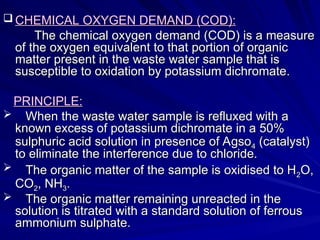
 CHEMICAL OXYGEN DEMAND (COD):
CHEMICAL OXYGEN DEMAND (COD):
The chemical oxygen demand (COD) is a measure
of the oxygen equivalent to that portion of organic
matter present in the waste water sample that is
susceptible to oxidation by potassium dichromate.
PRINCIPLE:
PRINCIPLE:
 When the waste water sample is refluxed with a
When the waste water sample is refluxed with a
known excess of potassium dichromate in a 50%
sulphuric acid solution in presence of Agso
sulphuric acid solution in presence of Agso4
4 (catalyst)
(catalyst)
to eliminate the interference due to chloride.
 The organic matter of the sample is oxidised to H
The organic matter of the sample is oxidised to H2
2O,
O,
CO
CO2
2, NH
, NH3
3.
.
 The organic matter remaining unreacted in the
The organic matter remaining unreacted in the
solution is titrated with a standard solution of ferrous
ammonium sulphate.
ammonium sulphate.
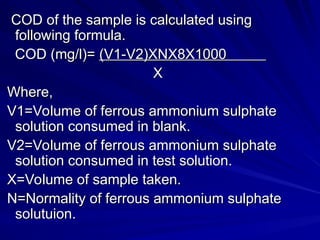
COD of the sample is calculated using
following formula.
following formula.
COD (mg/l)=
COD (mg/l)= (V1-V2)XNX8X1000
(V1-V2)XNX8X1000
X
X
Where,
Where,
V1=Volume of ferrous ammonium sulphate
solution consumed in blank.
V2=Volume of ferrous ammonium sulphate
solution consumed in test solution.
X=Volume of sample taken.
N=Normality of ferrous ammonium sulphate
solutuion.
solutuion.
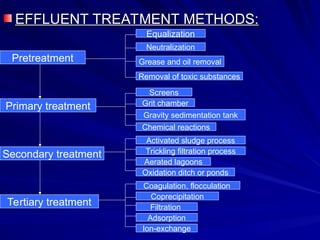
EFFLUENT TREATMENT METHODS:
Pretreatment
Equalization
Neutralization
Grease and oil removal
Removal of toxic substances
Screens
Grit chamber
Gravity sedimentation tank
Chemical reactions
Primary treatment
Activated sludge process
Trickling filtration process
Aerated lagoons
Oxidation ditch or ponds
Coagulation, flocculation
Coprecipitation
Filtration
Adsorption
Ion-exchange
Secondary treatment
Tertiary treatment
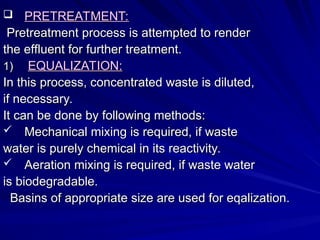
 PRETREATMENT:
PRETREATMENT:
Pretreatment process is attempted to render
the effluent for further treatment.
1)
1) EQUALIZATION:
EQUALIZATION:
In this process, concentrated waste is diluted,
if necessary.
if necessary.
It can be done by following methods:
 Mechanical mixing is required, if waste
Mechanical mixing is required, if waste
water is purely chemical in its reactivity.
 Aeration mixing is required, if waste water
Aeration mixing is required, if waste water
is biodegradable.
is biodegradable.
Basins of appropriate size are used for eqalization.
2)
2) NEUTRALIZATION:
NEUTRALIZATION:
 Prior to the treatment, acidic or basic waste
Prior to the treatment, acidic or basic waste
water must be neutralized.
 If the industry produces acidic as well as
If the industry produces acidic as well as
basic wastes, these waste water can be
mixed together into a proper ratio to obtain
neutral pH levels.
neutral pH levels.
 Equalization basins can be used for
Equalization basins can be used for
neutralization.
neutralization.
3)
3) REMOVAL OF GREASES AND OILS:
REMOVAL OF GREASES AND OILS:
 These tend to form an insoluble layer on the
These tend to form an insoluble layer on the
water surface.
water surface.
 These can be removed using grease traps,
These can be removed using grease traps,
gravity methods, skimming methods.
4)
4) REMOVAL OF TOXIC SUBSTANCES:
REMOVAL OF TOXIC SUBSTANCES:
 Pretreatment is essential to reduce the
Pretreatment is essential to reduce the
concentration of heavy metals to below its
toxic levels.
toxic levels.
 If heavy metals cannot be reused, they
If heavy metals cannot be reused, they
must be concentrated and removed as
insoluble materials.
 Organic molecules can be destroyed by
Organic molecules can be destroyed by
oxidation systems or incineration (burning
in air)
in air)
 PRIMARY TREATMENT:
PRIMARY TREATMENT:
It involves the removal of large floating
or suspended particles (fibres, glass pieces,
wooden pieces, hard materials) first by
physical and then by chemical treatments.
1)
1) SCREENS:
SCREENS:
 Large particles are removed mechanically by
Large particles are removed mechanically by
passing waste water through fixed or movable
screens.
screens.
 Different types of screens are used, such as,
Different types of screens are used, such as,
Bar screen, Hand raked or mechanically racked
screen.
screen.
2)
2) GRIT CHAMBERS:
GRIT CHAMBERS:
Grit (small particles, stones) chambers are
used for the removal of heavy and inert
particles by centrifugal action and friction
against tank walls.
against tank walls.
 Grit should be removed so as to protect
Grit should be removed so as to protect
against any damage of pumps and other
equipments by abrasion and also to avoid
settling in pipe bends and channels.
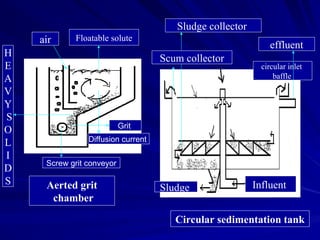
 Floatable solids are removed in the aerated grit
Floatable solids are removed in the aerated grit
chamber.
chamber.
3)
3) GRAVITY SEDIMENTATION TANK:
GRAVITY SEDIMENTATION TANK:
 The suspended particles can be removed
The suspended particles can be removed
effectively and economically by sedimentation.
 Useful for the treatment of waste containing
Useful for the treatment of waste containing
high percentage of settleable solids.
Aerted grit
chamber
grit
air Floatable solute
H
E
A
V
Y
S
O
L
I
D
S
Circular sedimentation tank
Influent
Sludge
Sludge collector
Scum collector
circular inlet
baffle
effluent
Screw grit conveyor
Grit
Diffusion current
4)
4) CHEMICAL REACTIONS:
CHEMICAL REACTIONS:
Coagulation, flocculation, precipitation:
 These processes involve agglomeration of tiny
These processes involve agglomeration of tiny
particles into large particles, so that
sedimentation will be rapid.
 Light weight and colloidal solids are removed by
Light weight and colloidal solids are removed by
chemical means followed by gravity sedimentation.
 Flocculating agents (coagulating) are, ferric
Flocculating agents (coagulating) are, ferric
chloride, aluminium sulphate, ferrous sulphite, lime.
 Coagulation aids, such as activated silica, a
Coagulation aids, such as activated silica, a
acrylic and methacrylic polymers are added to
promote the formation of large and quick settling
floc.
floc.
 SECONDARY TREATMENT:
SECONDARY TREATMENT:
It is a biological process in which bacteria
and other microorganisms utilize the components
present in the waste water as nutrients for their
growth.
growth.
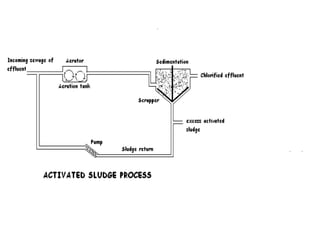
1)
1) ACTIVATED SLUDGE PROCESS:
ACTIVATED SLUDGE PROCESS:
 In this process the microbial floc is suspended in
In this process the microbial floc is suspended in
an open tank and aerated about 6 to 24 hours.
 Molecular oxygen (air) is continuously supplied by
Molecular oxygen (air) is continuously supplied by
mechanical means into the tank.
 When industrial waste is aerated, biological
When industrial waste is aerated, biological
degradation of waste into CO
degradation of waste into CO2
2 and H2
and H2O
O
takesplace.
takesplace.
 Bacterial flora grows and remains suspended in
Bacterial flora grows and remains suspended in
the form of a floc, which is called as ‘
the form of a floc, which is called as ‘activated
activated
sludge
sludge’.
’.
2)
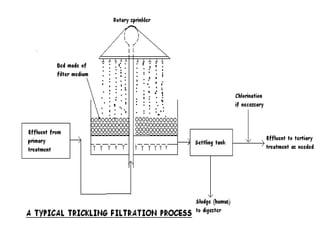
2) TRICKLING FILTRATION
TRICKLING FILTRATION:
:
 In this process microorganisms are attached to a
In this process microorganisms are attached to a
fixed bed rather than floating and remain
suspended.
suspended.
 The bacterial mass forms a gelatinous film.
The bacterial mass forms a gelatinous film.
 Using rotary sprinklers, effluent is sprayed and
Using rotary sprinklers, effluent is sprayed and
distributed evenly over the surface (i.e.trickling).
 Trickling filter is provided with slots at bottom for
Trickling filter is provided with slots at bottom for
the air inlet.
the air inlet.
 On the surface aerobic metabolism occurs.
On the surface aerobic metabolism occurs.
 At the bottom of the layer anaerobic metabolism
At the bottom of the layer anaerobic metabolism
occurs due to lack of oxygen.
 Secondary settling basin is installed.
Secondary settling basin is installed.
3)
3) AERATED LAGOONS
AERATED LAGOONS:
:
 These permit the conversion of organic
These permit the conversion of organic
components in the waste water by microbes
without stabilization.
 Mixing is achieved as a result of gas production
Mixing is achieved as a result of gas production
from bacterial metabolism and wind action.
 Discharge is allowed into solid separation
Discharge is allowed into solid separation
ponds.
ponds.
 After about 3 to 6 days, flocculated sludge is
After about 3 to 6 days, flocculated sludge is
formed and oxidation of organic matter starts.
 It removes about 80% of BOD.
It removes about 80% of BOD.
4)
4) OXIDATION DITCH OR POND
OXIDATION DITCH OR POND:
:
 These are relatively less shallow than
These are relatively less shallow than
aerated lagoons.
aerated lagoons.
 Solids in waste settle at the bottom and
Solids in waste settle at the bottom and
form thin layer, which acts as anaerobic
layer.
layer.
 Anaerobic bacteria convert organic matter
Anaerobic bacteria convert organic matter
to methane, carbon dioxide, ammonia.
 Final discharge should be separately
Final discharge should be separately
 Disinfected to avoid pollution due to
Disinfected to avoid pollution due to
microorganisms.
microorganisms.
 TERTIARY TREAMENT
TERTIARY TREAMENT:
:
1.
1. COAGULATION
COAGULATION
2.
2. COPRECIPITATION
COPRECIPITATION
3.
3. ADSORPTION
ADSORPTION
4.
4. ION EXCHANGE
ION EXCHANGE
5.
5. FILTRATION
FILTRATION
1.
1. Coagulation
Coagulation:
: The reaction that takes place
The reaction that takes place
upon the addition of coagulant is called
coagulation.
coagulation.
Ex: Metal salts organic polymers.
2.
2. Co precipitation
Co precipitation: It is a process in which ions
: It is a process in which ions
in solution phase are allowed to precipitate
with the carrier molecule either by adsorption
method or inclusion method.
3.
3. Adsorption
Adsorption: Treatment of effluent with
: Treatment of effluent with
activated carbon is called adsorption.
This is particularly useful for removal of
pesticides and carbamates.
Advanced industrial pharmacy. importanceppt

Advanced industrial pharmacy. importanceppt

  • 1.
  • 2.
    DEFINITION DEFINITION OBJECTIVES OBJECTIVES DISPOSAL OF EFFLUENTS DISPOSALOF EFFLUENTS IMPORTANCE OF EFFLUENT TESTING IMPORTANCE OF EFFLUENT TESTING EFFLUENT TREATMENT METHODS EFFLUENT TREATMENT METHODS
  • 3.
    DEFINITION: DEFINITION: Effluent treatment isa process where Effluent treatment is a process where industrial discharged waste water is industrial discharged waste water is recycled and make it usable one. recycled and make it usable one.
  • 4.
    OBJECTIVES: OBJECTIVES:  To preventthe adverse effects of industrial wastes. To prevent the adverse effects of industrial wastes.  The valuable material to be recovered from effluent as The valuable material to be recovered from effluent as animal food and fertilizer. animal food and fertilizer.  Prediction of size and factory effluent testing plant. Prediction of size and factory effluent testing plant.  To know the amount of water used sewage waste and To know the amount of water used sewage waste and charge. charge.  To prevent the waste to mix up with natural water. To prevent the waste to mix up with natural water.  Toxic effluents need special treatment to prevent toxic Toxic effluents need special treatment to prevent toxic effect on human. effect on human.  Acids or alkalies leading to neutralization. Acids or alkalies leading to neutralization.
  • 5.
    Disposal of effluents Disposalof effluents: :  The effluent is discharged to river and seain an The effluent is discharged to river and seain an untreated state. untreated state.  Discharged to the ground, a lagoon, a unwed Discharged to the ground, a lagoon, a unwed well. well.  Discharged as in 1or 2, the remainder is treated Discharged as in 1or 2, the remainder is treated at the sewage work. at the sewage work.  All the effluent is sent to the sewage works for All the effluent is sent to the sewage works for treatment and discharge. treatment and discharge.  Effluent is treated at the factory before Effluent is treated at the factory before discharge. discharge.
  • 6.
    IMPORTANCE OF EFFLUENTTESTING IMPORTANCE OF EFFLUENT TESTING Effluent testing is done to find out the following; Effluent testing is done to find out the following; o Colour- pigments, metals ions, nonmetals. Colour- pigments, metals ions, nonmetals. o pH- acidity/alkalinity pH- acidity/alkalinity o Turbidity- suspended solids, dissolved solids, Turbidity- suspended solids, dissolved solids, settleable solids. settleable solids. o Odour- volatile materials, dissolved gases, phenolic Odour- volatile materials, dissolved gases, phenolic compounds. compounds. o Oily substances and greases. Oily substances and greases. o Dissolved Oxygen (DO) Dissolved Oxygen (DO) o Biological Oxygen Demand (BOD) Biological Oxygen Demand (BOD) o Chemical Oxygen Demand (COD) Chemical Oxygen Demand (COD)
  • 7.
     METALS: METALS: 1. 1. HEXAVALENTCHROMIUM: HEXAVALENT CHROMIUM: DETERMINATION: DETERMINATION:  Hexavalent chromium is treated with Hexavalent chromium is treated with ammonium pyrrolidine dithiocarbamate in ammonium pyrrolidine dithiocarbamate in buffer solution (potassium hydrogen phthalate buffer solution (potassium hydrogen phthalate and sodium hydroxide solution). and sodium hydroxide solution).  Chromium is determined by atomic absorption Chromium is determined by atomic absorption spectrophotometry. spectrophotometry.
  • 8.
    2. 2. ARSENIC: ARSENIC: DETERMINATION: DETERMINATION:  Arsenicions are converted to gaseous Arsenic ions are converted to gaseous arsenic hydride, arsine by nascent hydrogen arsenic hydride, arsine by nascent hydrogen in acidic solution. in acidic solution.  Arsenic hydride reacts with silver diethyl Arsenic hydride reacts with silver diethyl dithiocarbamate solution in pyridine forming dithiocarbamate solution in pyridine forming red compound. red compound.  Colour is measured at 560nm. Colour is measured at 560nm.
  • 9.
    3. 3. MERCURY: MERCURY: DETERMINATION: DETERMINATION:  Usingatomic absorption photometry. Using atomic absorption photometry.  Waste water is treated with nitric acid and Waste water is treated with nitric acid and potassium dichromate solution. potassium dichromate solution.  Air is expelled using nitrogen/organ gas. Air is expelled using nitrogen/organ gas.  Sample is treated with tin (ll) chloride. Sample is treated with tin (ll) chloride.  Resulting mercury vapour is carried through Resulting mercury vapour is carried through carrier gas and determined for metal content. carrier gas and determined for metal content.
  • 10.
    4. 4. LEAD: LEAD: DETERMINATION: DETERMINATION:  Inneutral to alkaline solution, lead (ll)ions In neutral to alkaline solution, lead (ll)ions react with dithizone to form di-dithizonate. react with dithizone to form di-dithizonate.  Dithizone was treated with hydrochloric acid Dithizone was treated with hydrochloric acid immediately for removing excess dithizone. immediately for removing excess dithizone.  Dithizonate is soluble in organic solvents Dithizonate is soluble in organic solvents (chloroform, carbon tetrachloride) (chloroform, carbon tetrachloride)  Carmine red coloured organic phase is Carmine red coloured organic phase is measured at 620nm. measured at 620nm.
  • 11.
     NON METALS: NONMETALS: 1. 1. CYANIDE: CYANIDE: DETERMINATION DETERMINATION: :  Cyanides are chlorinated and subseqently Cyanides are chlorinated and subseqently complexed with pyridine pyroxolene to form complexed with pyridine pyroxolene to form coloured stable solution. coloured stable solution.  Colour is estimated by colorimetrically. Colour is estimated by colorimetrically.
  • 12.
    2. 2. SULPHIDES: SULPHIDES: DETERMINATION: DETERMINATION:  Determinedby iodometric titration. Determined by iodometric titration.  Sulphides are precipitated as cadmium Sulphides are precipitated as cadmium sulphide. sulphide.  It is treated with an acid. It is treated with an acid.  Hydrogen sulphide is evolved and allowed to Hydrogen sulphide is evolved and allowed to absorb into a measured volume of standard absorb into a measured volume of standard iodine solution. iodine solution.
  • 13.
    3. 3. PHOSPHATES: PHOSPHATES: Determination: Determination:  Organicphosphorus compounds are converted to Organic phosphorus compounds are converted to hydrogen phosphate by sulphuric acid and hydrogen phosphate by sulphuric acid and hydrogen peroxide at 160 hydrogen peroxide at 1600 0 C-180 C-1800 0 C. C.  The phosphate is converted into ammonium The phosphate is converted into ammonium molybdophosphate by using ammonium molybdate. molybdophosphate by using ammonium molybdate.  The ammonium molybdophosphate is extracted The ammonium molybdophosphate is extracted with a benzene/isobutyl alcohol mixture. with a benzene/isobutyl alcohol mixture.  The organic phase is treated with acid tin chloride The organic phase is treated with acid tin chloride solution for reduction reaction. solution for reduction reaction.  The intense blue coloured phosphorous The intense blue coloured phosphorous molybdenum is measured at 625nm. molybdenum is measured at 625nm.
  • 14.
     pH: pH:  Wastewater sample is tested for acidity/alkalinity Waste water sample is tested for acidity/alkalinity using a litmus paper. using a litmus paper.  pH can be measured electrochemically using Ph pH can be measured electrochemically using Ph meter. meter.  ACIDITY: ACIDITY:  Acidity is calculated by titrating the samples with Acidity is calculated by titrating the samples with strong base. strong base.  Acidity can be neutralized by adding alkalies such as Acidity can be neutralized by adding alkalies such as lime and hydroxides. lime and hydroxides.
  • 15.
     ALKALINITY: ALKALINITY:  Itis due to presence of alkaline It is due to presence of alkaline substances (carbonates, hydroxides) substances (carbonates, hydroxides)  Reduced by adding acids. Reduced by adding acids.  Sulphuric acid (35%) is used. Sulphuric acid (35%) is used.  TURBIDITY: TURBIDITY:  Caused by suspended colloidal and coarse Caused by suspended colloidal and coarse particles. particles.  Measured by using nepheloturbidimeter. Measured by using nepheloturbidimeter.
  • 16.
     SUSPENDED SOLIDS SUSPENDEDSOLIDS: :  Determined by filtering the waste water sample through a Determined by filtering the waste water sample through a previously tared sintered crucible or Gooch crucible. previously tared sintered crucible or Gooch crucible.  Sample is dried at 103 Sample is dried at 1030 0 C to 105 C to 1050 0 C to constant weight. C to constant weight.  Difference in weight of tared and final weight gives the Difference in weight of tared and final weight gives the suspended solids. suspended solids.  SETTELEABLE SOLIDS: SETTELEABLE SOLIDS:  Determined by allowing 1 liter of the sample to settle for about Determined by allowing 1 liter of the sample to settle for about 1 hour at 20 1 hour at 200 0 C in Imhoff cone, which is a tapered conical tube. C in Imhoff cone, which is a tapered conical tube.  The volume of the settleable matter in the cone, which is The volume of the settleable matter in the cone, which is recorded as ml/l. recorded as ml/l.
  • 17.
    TOTAL DISSOLVED SOLIDS: TOTALDISSOLVED SOLIDS:  The total solids content of a sample is The total solids content of a sample is determined by evaporating a known determined by evaporating a known volume of the waste water sample. volume of the waste water sample.  Dry the residue for 24 hours at 103 Dry the residue for 24 hours at 1030 0 C to C to 105 1050 0 C followed by weighing. C followed by weighing.  This gives the total solid content of the This gives the total solid content of the sample which includes dissolved as well as sample which includes dissolved as well as suspended solids. suspended solids.
  • 18.
     PHENOLIC COMPOUNDS: PHENOLICCOMPOUNDS: DETERMINATION: DETERMINATION:  Phenolic compounds are isolated by steam Phenolic compounds are isolated by steam distillation. distillation.  The distillate is acidified to a pH of less The distillate is acidified to a pH of less than 4.0 than 4.0  Then copper sulphate solution is added. Then copper sulphate solution is added.  To this amino antipyrine solution is added. To this amino antipyrine solution is added.  The reaction mixture is extracted with The reaction mixture is extracted with chloroform. chloroform.  The colour of the chloroform layer is The colour of the chloroform layer is measured at 460nm. measured at 460nm.
  • 19.
     DISSOLVED OXYGEN(DO): DISSOLVED OXYGEN (DO): PRINCIPLE: PRINCIPLE:  Determined iodometrically by the modified Winkler’s Determined iodometrically by the modified Winkler’s method. method.  When manganous sulphate is added to the water When manganous sulphate is added to the water sample containing alkaline potassium iodide thereby sample containing alkaline potassium iodide thereby manganese hydroxide is formed. manganese hydroxide is formed.  This is oxidised to basic manganic oxide by the This is oxidised to basic manganic oxide by the dissolved oxygen present in the water sample. dissolved oxygen present in the water sample.  When sulphuric acid is added, the basic manganic When sulphuric acid is added, the basic manganic oxide liberates iodine which is equivalent to the oxide liberates iodine which is equivalent to the dissolved oxygen originally present in the water dissolved oxygen originally present in the water sample. sample.  Liberated iodine is titrated with standard hypo solution Liberated iodine is titrated with standard hypo solution (thiosulphate solution) using starch as indicator. (thiosulphate solution) using starch as indicator.
  • 20.
     BIOLOGICAL OXYGENDEMAND: BIOLOGICAL OXYGEN DEMAND: Biological oxygen demand represents the quantity of Biological oxygen demand represents the quantity of oxygen required by bacteria and other microorganisms oxygen required by bacteria and other microorganisms during the biochemical degradation and transformation during the biochemical degradation and transformation of organic matter present in the waste water under of organic matter present in the waste water under aerobic conditions. aerobic conditions. PRINCIPLE: PRINCIPLE:  BOD test essentially consists of measurement of BOD test essentially consists of measurement of dissolved oxygen content of the sample before and dissolved oxygen content of the sample before and after incubation at 20 after incubation at 200 0 c for 5 days. c for 5 days.  The BOD is usually expressed as mg/l (5 days at The BOD is usually expressed as mg/l (5 days at 20 200 0 c) c)  Normal water contains BOD less than or equal Normal water contains BOD less than or equal 10mg/l of dissolved oxygen. 10mg/l of dissolved oxygen.  Excess BOD makes water toxic. Excess BOD makes water toxic.
  • 21.
     CHEMICAL OXYGENDEMAND (COD): CHEMICAL OXYGEN DEMAND (COD): The chemical oxygen demand (COD) is a measure The chemical oxygen demand (COD) is a measure of the oxygen equivalent to that portion of organic of the oxygen equivalent to that portion of organic matter present in the waste water sample that is matter present in the waste water sample that is susceptible to oxidation by potassium dichromate. susceptible to oxidation by potassium dichromate. PRINCIPLE: PRINCIPLE:  When the waste water sample is refluxed with a When the waste water sample is refluxed with a known excess of potassium dichromate in a 50% known excess of potassium dichromate in a 50% sulphuric acid solution in presence of Agso sulphuric acid solution in presence of Agso4 4 (catalyst) (catalyst) to eliminate the interference due to chloride. to eliminate the interference due to chloride.  The organic matter of the sample is oxidised to H The organic matter of the sample is oxidised to H2 2O, O, CO CO2 2, NH , NH3 3. .  The organic matter remaining unreacted in the The organic matter remaining unreacted in the solution is titrated with a standard solution of ferrous solution is titrated with a standard solution of ferrous ammonium sulphate. ammonium sulphate.
  • 22.
    COD of thesample is calculated using COD of the sample is calculated using following formula. following formula. COD (mg/l)= COD (mg/l)= (V1-V2)XNX8X1000 (V1-V2)XNX8X1000 X X Where, Where, V1=Volume of ferrous ammonium sulphate V1=Volume of ferrous ammonium sulphate solution consumed in blank. solution consumed in blank. V2=Volume of ferrous ammonium sulphate V2=Volume of ferrous ammonium sulphate solution consumed in test solution. solution consumed in test solution. X=Volume of sample taken. X=Volume of sample taken. N=Normality of ferrous ammonium sulphate N=Normality of ferrous ammonium sulphate solutuion. solutuion.
  • 23.
    EFFLUENT TREATMENT METHODS: EFFLUENTTREATMENT METHODS: Pretreatment Equalization Neutralization Grease and oil removal Removal of toxic substances Screens Grit chamber Gravity sedimentation tank Chemical reactions Primary treatment Activated sludge process Trickling filtration process Aerated lagoons Oxidation ditch or ponds Coagulation, flocculation Coprecipitation Filtration Adsorption Ion-exchange Secondary treatment Tertiary treatment
  • 24.
     PRETREATMENT: PRETREATMENT: Pretreatment processis attempted to render Pretreatment process is attempted to render the effluent for further treatment. the effluent for further treatment. 1) 1) EQUALIZATION: EQUALIZATION: In this process, concentrated waste is diluted, In this process, concentrated waste is diluted, if necessary. if necessary. It can be done by following methods: It can be done by following methods:  Mechanical mixing is required, if waste Mechanical mixing is required, if waste water is purely chemical in its reactivity. water is purely chemical in its reactivity.  Aeration mixing is required, if waste water Aeration mixing is required, if waste water is biodegradable. is biodegradable. Basins of appropriate size are used for eqalization. Basins of appropriate size are used for eqalization.
  • 25.
    2) 2) NEUTRALIZATION: NEUTRALIZATION:  Priorto the treatment, acidic or basic waste Prior to the treatment, acidic or basic waste water must be neutralized. water must be neutralized.  If the industry produces acidic as well as If the industry produces acidic as well as basic wastes, these waste water can be basic wastes, these waste water can be mixed together into a proper ratio to obtain mixed together into a proper ratio to obtain neutral pH levels. neutral pH levels.  Equalization basins can be used for Equalization basins can be used for neutralization. neutralization. 3) 3) REMOVAL OF GREASES AND OILS: REMOVAL OF GREASES AND OILS:  These tend to form an insoluble layer on the These tend to form an insoluble layer on the water surface. water surface.  These can be removed using grease traps, These can be removed using grease traps, gravity methods, skimming methods. gravity methods, skimming methods.
  • 26.
    4) 4) REMOVAL OFTOXIC SUBSTANCES: REMOVAL OF TOXIC SUBSTANCES:  Pretreatment is essential to reduce the Pretreatment is essential to reduce the concentration of heavy metals to below its concentration of heavy metals to below its toxic levels. toxic levels.  If heavy metals cannot be reused, they If heavy metals cannot be reused, they must be concentrated and removed as must be concentrated and removed as insoluble materials. insoluble materials.  Organic molecules can be destroyed by Organic molecules can be destroyed by oxidation systems or incineration (burning oxidation systems or incineration (burning in air) in air)
  • 27.
     PRIMARY TREATMENT: PRIMARYTREATMENT: It involves the removal of large floating It involves the removal of large floating or suspended particles (fibres, glass pieces, or suspended particles (fibres, glass pieces, wooden pieces, hard materials) first by wooden pieces, hard materials) first by physical and then by chemical treatments. physical and then by chemical treatments. 1) 1) SCREENS: SCREENS:  Large particles are removed mechanically by Large particles are removed mechanically by passing waste water through fixed or movable passing waste water through fixed or movable screens. screens.  Different types of screens are used, such as, Different types of screens are used, such as, Bar screen, Hand raked or mechanically racked Bar screen, Hand raked or mechanically racked screen. screen.
  • 28.
    2) 2) GRIT CHAMBERS: GRITCHAMBERS: Grit (small particles, stones) chambers are Grit (small particles, stones) chambers are used for the removal of heavy and inert used for the removal of heavy and inert particles by centrifugal action and friction particles by centrifugal action and friction against tank walls. against tank walls.  Grit should be removed so as to protect Grit should be removed so as to protect against any damage of pumps and other against any damage of pumps and other equipments by abrasion and also to avoid equipments by abrasion and also to avoid settling in pipe bends and channels. settling in pipe bends and channels.  Floatable solids are removed in the aerated grit Floatable solids are removed in the aerated grit chamber. chamber.
  • 29.
    3) 3) GRAVITY SEDIMENTATIONTANK: GRAVITY SEDIMENTATION TANK:  The suspended particles can be removed The suspended particles can be removed effectively and economically by sedimentation. effectively and economically by sedimentation.  Useful for the treatment of waste containing Useful for the treatment of waste containing high percentage of settleable solids. high percentage of settleable solids.
  • 30.
    Aerted grit chamber grit air Floatablesolute H E A V Y S O L I D S Circular sedimentation tank Influent Sludge Sludge collector Scum collector circular inlet baffle effluent Screw grit conveyor Grit Diffusion current
  • 31.
    4) 4) CHEMICAL REACTIONS: CHEMICALREACTIONS: Coagulation, flocculation, precipitation: Coagulation, flocculation, precipitation:  These processes involve agglomeration of tiny These processes involve agglomeration of tiny particles into large particles, so that particles into large particles, so that sedimentation will be rapid. sedimentation will be rapid.  Light weight and colloidal solids are removed by Light weight and colloidal solids are removed by chemical means followed by gravity sedimentation. chemical means followed by gravity sedimentation.  Flocculating agents (coagulating) are, ferric Flocculating agents (coagulating) are, ferric chloride, aluminium sulphate, ferrous sulphite, lime. chloride, aluminium sulphate, ferrous sulphite, lime.  Coagulation aids, such as activated silica, a Coagulation aids, such as activated silica, a acrylic and methacrylic polymers are added to acrylic and methacrylic polymers are added to promote the formation of large and quick settling promote the formation of large and quick settling floc. floc.
  • 32.
     SECONDARY TREATMENT: SECONDARYTREATMENT: It is a biological process in which bacteria It is a biological process in which bacteria and other microorganisms utilize the components and other microorganisms utilize the components present in the waste water as nutrients for their present in the waste water as nutrients for their growth. growth. 1) 1) ACTIVATED SLUDGE PROCESS: ACTIVATED SLUDGE PROCESS:  In this process the microbial floc is suspended in In this process the microbial floc is suspended in an open tank and aerated about 6 to 24 hours. an open tank and aerated about 6 to 24 hours.  Molecular oxygen (air) is continuously supplied by Molecular oxygen (air) is continuously supplied by mechanical means into the tank. mechanical means into the tank.  When industrial waste is aerated, biological When industrial waste is aerated, biological degradation of waste into CO degradation of waste into CO2 2 and H2 and H2O O takesplace. takesplace.  Bacterial flora grows and remains suspended in Bacterial flora grows and remains suspended in the form of a floc, which is called as ‘ the form of a floc, which is called as ‘activated activated sludge sludge’. ’.
  • 34.
    2) 2) TRICKLING FILTRATION TRICKLINGFILTRATION: :  In this process microorganisms are attached to a In this process microorganisms are attached to a fixed bed rather than floating and remain fixed bed rather than floating and remain suspended. suspended.  The bacterial mass forms a gelatinous film. The bacterial mass forms a gelatinous film.  Using rotary sprinklers, effluent is sprayed and Using rotary sprinklers, effluent is sprayed and distributed evenly over the surface (i.e.trickling). distributed evenly over the surface (i.e.trickling).  Trickling filter is provided with slots at bottom for Trickling filter is provided with slots at bottom for the air inlet. the air inlet.  On the surface aerobic metabolism occurs. On the surface aerobic metabolism occurs.  At the bottom of the layer anaerobic metabolism At the bottom of the layer anaerobic metabolism occurs due to lack of oxygen. occurs due to lack of oxygen.  Secondary settling basin is installed. Secondary settling basin is installed.
  • 36.
    3) 3) AERATED LAGOONS AERATEDLAGOONS: :  These permit the conversion of organic These permit the conversion of organic components in the waste water by microbes components in the waste water by microbes without stabilization. without stabilization.  Mixing is achieved as a result of gas production Mixing is achieved as a result of gas production from bacterial metabolism and wind action. from bacterial metabolism and wind action.  Discharge is allowed into solid separation Discharge is allowed into solid separation ponds. ponds.  After about 3 to 6 days, flocculated sludge is After about 3 to 6 days, flocculated sludge is formed and oxidation of organic matter starts. formed and oxidation of organic matter starts.  It removes about 80% of BOD. It removes about 80% of BOD.
  • 37.
    4) 4) OXIDATION DITCHOR POND OXIDATION DITCH OR POND: :  These are relatively less shallow than These are relatively less shallow than aerated lagoons. aerated lagoons.  Solids in waste settle at the bottom and Solids in waste settle at the bottom and form thin layer, which acts as anaerobic form thin layer, which acts as anaerobic layer. layer.  Anaerobic bacteria convert organic matter Anaerobic bacteria convert organic matter to methane, carbon dioxide, ammonia. to methane, carbon dioxide, ammonia.  Final discharge should be separately Final discharge should be separately  Disinfected to avoid pollution due to Disinfected to avoid pollution due to microorganisms. microorganisms.
  • 38.
     TERTIARY TREAMENT TERTIARYTREAMENT: : 1. 1. COAGULATION COAGULATION 2. 2. COPRECIPITATION COPRECIPITATION 3. 3. ADSORPTION ADSORPTION 4. 4. ION EXCHANGE ION EXCHANGE 5. 5. FILTRATION FILTRATION
  • 39.
    1. 1. Coagulation Coagulation: : Thereaction that takes place The reaction that takes place upon the addition of coagulant is called upon the addition of coagulant is called coagulation. coagulation. Ex: Metal salts organic polymers. Ex: Metal salts organic polymers. 2. 2. Co precipitation Co precipitation: It is a process in which ions : It is a process in which ions in solution phase are allowed to precipitate in solution phase are allowed to precipitate with the carrier molecule either by adsorption with the carrier molecule either by adsorption method or inclusion method. method or inclusion method. 3. 3. Adsorption Adsorption: Treatment of effluent with : Treatment of effluent with activated carbon is called adsorption. activated carbon is called adsorption. This is particularly useful for removal of This is particularly useful for removal of pesticides and carbamates. pesticides and carbamates.