Lipids
Presentor: GARCIA, Mary
Lipids
WHAT IS
LIPIDS?
01
❖ Make food oily
❖ Keeps our body warm
❖ prevent the watery component of the cell
from leaking out.
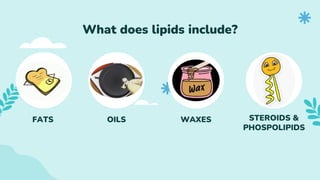
What does lipids include?
FATS OILS WAXES STEROIDS &
PHOSPOLIPIDS
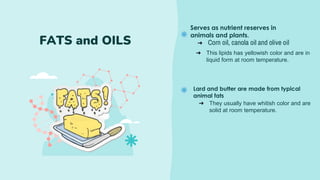
FATS and OILS
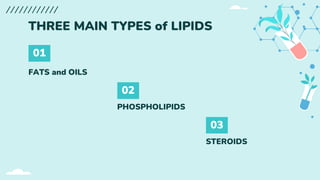
THREE MAIN TYPES of LIPIDS
01
02
03
PHOSPHOLIPIDS
STEROIDS
Serves as nutrient reserves in
animals and plants.
FATS and OILS ➔ Corn oil, canola oil and olive oil
➔ This lipids has yellowish color and are in
liquid form at room temperature.
Lard and butter are made from typical
animal fats
➔ They usually have whitish color and are
solid at room temperature.
GLYCEROL
TWO BASIC UNITS of FATS and OILS
01
02
FATTY ACIDS
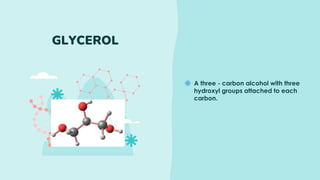
A three - carbon alcohol with three
hydroxyl groups attached to each
carbon.
GLYCEROL
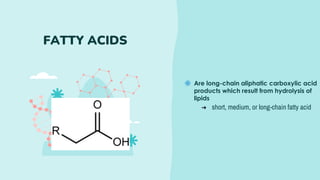
Are long-chain aliphatic carboxylic acid
products which result from hydrolysis of
lipids
FATTY ACIDS
➔ short, medium, or long-chain fatty acid
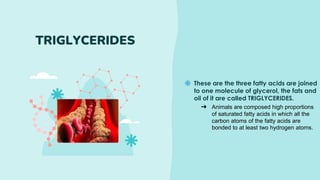
These are the three fatty acids are joined
to one molecule of glycerol, the fats and
oil of it are called TRIGLYCERIDES.
TRIGLYCERIDES
➔ Animals are composed high proportions
of saturated fatty acids in which all the
carbon atoms of the fatty acids are
bonded to at least two hydrogen atoms.
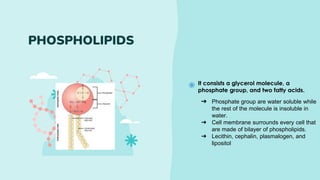
It consists a glycerol molecule, a
phosphate group, and two fatty acids.
PHOSPHOLIPIDS
➔ Phosphate group are water soluble while
the rest of the molecule is insoluble in
water.
➔ Cell membrane surrounds every cell that
are made of bilayer of phospholipids.
➔ Lecithin, cephalin, plasmalogen, and
lipositol
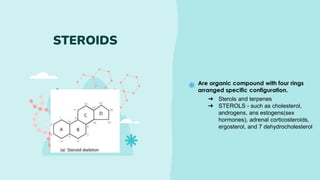
Are organic compound with four rings
arranged specific configuration.
STEROIDS
➔ Sterols and terpenes
➔ STEROLS - such as cholesterol,
androgens, ans estogens(sex
hormones), adrenal corticosteroids,
ergosterol, and 7 dehydrocholesterol

LIPIDS REPORT.pptx

  • 1.
  • 2.
  • 3.
  • 4.
    ❖ Make foodoily ❖ Keeps our body warm ❖ prevent the watery component of the cell from leaking out.
  • 5.
    What does lipidsinclude? FATS OILS WAXES STEROIDS & PHOSPOLIPIDS
  • 6.
    FATS and OILS THREEMAIN TYPES of LIPIDS 01 02 03 PHOSPHOLIPIDS STEROIDS
  • 7.
    Serves as nutrientreserves in animals and plants. FATS and OILS ➔ Corn oil, canola oil and olive oil ➔ This lipids has yellowish color and are in liquid form at room temperature. Lard and butter are made from typical animal fats ➔ They usually have whitish color and are solid at room temperature.
  • 8.
    GLYCEROL TWO BASIC UNITSof FATS and OILS 01 02 FATTY ACIDS
  • 9.
    A three -carbon alcohol with three hydroxyl groups attached to each carbon. GLYCEROL
  • 10.
    Are long-chain aliphaticcarboxylic acid products which result from hydrolysis of lipids FATTY ACIDS ➔ short, medium, or long-chain fatty acid
  • 11.
    These are thethree fatty acids are joined to one molecule of glycerol, the fats and oil of it are called TRIGLYCERIDES. TRIGLYCERIDES ➔ Animals are composed high proportions of saturated fatty acids in which all the carbon atoms of the fatty acids are bonded to at least two hydrogen atoms.
  • 12.
    It consists aglycerol molecule, a phosphate group, and two fatty acids. PHOSPHOLIPIDS ➔ Phosphate group are water soluble while the rest of the molecule is insoluble in water. ➔ Cell membrane surrounds every cell that are made of bilayer of phospholipids. ➔ Lecithin, cephalin, plasmalogen, and lipositol
  • 13.
    Are organic compoundwith four rings arranged specific configuration. STEROIDS ➔ Sterols and terpenes ➔ STEROLS - such as cholesterol, androgens, ans estogens(sex hormones), adrenal corticosteroids, ergosterol, and 7 dehydrocholesterol